J. Software Engineering & Applications, 2010, 3, 580-587
doi:10.4236/jsea.2010.36067 Published Online June 2010 (http://www.SciRP.org/journal/jsea)
The Exploratory Analysis on Knowledge Creation
Effective Factors in Software Requirement
Development
Jiangping Wan1,2, Ruoting Wang1
1School of Business Administration, South China University of Technology, Guangzhou, China; 2Institute of Emerging Industrialization Development, South China University of Technology, Guangzhou, China.
Email: [email protected], [email protected]
Received March 16th, 2010; revised April 9th, 2010; accepted April 11th, 2010.
ABSTRACT
The knowledge creation effective factors were found in both necessary elements for stimulus of knowledge creation and the key influencing factors of software project success. The research was carried with the specific successful practices of Microsoft Corporation and William Johnson’s analysis of R & D project knowledge creation. The knowledge creation effective factors in requirement development project are clarified through deeply interviewing the software enterprises in Guangdong province as well as other corporate information departments. The effective factors are divided with R & D project knowledge creation model in the view of organizational, team, personal and technical four levels through literature research and interview in enterprises, and the empirical study was done with questionnaire and exploratory analysis.
Keywords: Software Requirement, Knowledge Creation, Project, Organization, Empirical Study
1. Introduction
The smooth development of software requirements needs an efficient organization to support [1], this paper dis-cusses the knowledge creation factors in software re-quirements development process in the meta-level of the software process with the instance of Microsoft corpora-tion [2-4]. Software requirement development as a knowledge creation process, Nonaka etc. have attributed the knowledge effect factors to four reasons: intention, autonomy, creative chaos, requisite variety. On this basis, Krogh etc. emphasized the importance of friendly re-lationship to build efficient “Ba” [5]. J. P. Wan etc. ana-lyzed from knowledge management view, some of them proposed a number of effective factors: experience in the domain, knowledge gaps, user participation, administra-tive support, personal capability, comprehensive training, methodology and related technology and so on [6,7].
This paper is organized as follows: first knowledge creation effective factors are illustrated and the effective factors in the requirement development process are
con-cluded. With deeply interviewing the software enterprises in Guangdong province as well as other corporate infor-mation departments, the knowledge creation effective factors in requirement development project are clarified, finally the empirical study is done with questionnaire survey and exploratory analysis.
2. Knowledge Creation Effective Factors
Nonaka attributed knowledge creation effective factors to intention, self-management, creative chaos, redundancy and requisite variety [8], and re-emphasizes the friendly environment in the organization [5].2.1 Intention
Nonaka indicated that the organization intention is the most important criterion in judging the authenticity of intent. If there is no organization intention, the organiza-tion will not be able to judge the value of perceived in-formation and creative knowledge, at the same time, the organization intention must be affected by the organiza-tional value. William Johnson considers that it should give one intention for each project at last, and it is obviously that if there is no intention, the next research will not continue [9]. Software requirements development process This research was supported by Key Project of Guangdong Province
is a knowledge creation process in nature [7]. For example, the first is to establish a shared vision to enhance the team’s sense of identity, belonging in the Microsoft cor-poration’s successful rules [3].
2.2 Self-Management
It is that the members or the teams take actions volun-tarily to improve the organization creativity. Autonomy team refers to taking the team as operation mainstay vo-luntarily. For example, William Johnson discovers that personal autonomy is very important for knowledge cre-ation with interviews [9]. It allows large teams to work like small teams by dividing work into pieces, proceeding in parallel but synchronizing continuously, stabilizing in increments, and continuously finding and fixing problems in Microsoft Corporation [10].
2.3 Creative Chaos
Nonaka etc. illustrate that turbulence and creative chaos accelerate the interaction between the organization and environment. Members will start to question the validity of the basic attitudes. It will be opportunity to amend the fundamental thinking and insight. It is obviously that turbulence and creative chaos contribute to organizational knowledge creation [5]. William Johnson discovered that only in a few projects, turbulence and creative chaos possess function which promotes knowledge creation, just same as Nonaka’s description with R & D’s research projects. In most projects, it is often closely linked with the problem’s occurrence. There is no data illustrated that the creative chaos and knowledge creation have a strong correlation [9].
2.4 Redundancy
Redundancy usually refers to the repetition and share for group members and the unnecessary information. It is a kind of redundancy to adopt different technologies to solve the same problem during requirement development process. For example, it is an effective knowledge crea-tion process to build a number of schemes and choose the optimal with review.
2.5 Requisite Variety
William Johnson concluded that all projects regard the requisite variety as a positive factor in the project knowl-edge creation on the R & D project study [9]. Microsoft Corporation emphasized the small teams, which should be diversification and even in a role. There are usually many different working ways and its members should have dif-ferent job skills or experience levels in a project team [5]. 2.6 Friendly Relationship
Krogh etc. considered that the friendly relationship can remove the distrust, fear and dissatisfaction in the
know-ledge creation process, and allow team members to ex-plore new markets, new customers, new products and new manufacturing technologies in the unknown territory with enough reassurance [5].
3. The Effective Factors in the Requirement
Development Process
The goal of software development is to exploit the high quality software which meets the customers’ real requi- rements timely within the budget. The success of the pro- ject depends on good requirement management [11]. This paper discusses the effect factors of requirement devel-opment process in perspective of knowledge creation. 3.1 Domain Experiences
Cohen and Levinthal argued that if the organization had more relevant knowledge or experiences, and its absorp-tive capacity is better, it is a function of its past experi-ences accumulation [12]. Y. H. Ke etc. analyzed the im-portance of domain experience for system development, and discovered that the system development experience and deeply understanding of domain knowledge have a positive effect on knowledge transfer [13]. Pete Sawyer and Gerald Kotonya considered that one of the key re-sources in software requirement acquisition is the domain knowledge. Requirements engineers need to acquire ef-fective knowledge on application domain. It can help them to know the tacit knowledge what stakeholders can not clearly illustrate and learn about the necessary balance between the conflict requirements [14]. For example, Microsoft’s team model advocates on the basis of deeply understanding the client’s business requirements and familiarly mastering related technologies to develop the project and decision-making. Therefore, the project team members should have the professional and deeply tech-nology and business skills in themselves domains [15]. 3.2 Knowledge Gap
It refers that the developer is lacking of business operation knowledge, knowledge of technology, and understanding of user business and software technology [16]. S. Alshawi etc. argued that it is important to have the business and technical knowledge for any enterprise [17].
3.3 User Participation
involve-The Exploratory Analysis on Knowledge Creation Effective Factors in Software Requirement Development 582
ment is listed in the top ten reasons of software project failure [23,24].
3.4 Administrative Support
For example, the Microsoft product development process explicitly specifies that when the projects passing the review and approval by higher managers, and the com-pany will make sure the development progress is going smoothly, and appropriate human and resources for de-velopment will deploy through human resource depart-ment and finance departdepart-ment [3,4].
3.5 Personal Capability
System analyst is a typical compound talent, and his knowledge structure not only strides the social sciences and natural sciences, but also is the perfect combination of theory and practice. For example, Microsoft asked the staff who participates the software development project have good professionalism and excellent job skills. Staff qualities include: personal quality, passion for product, concerning customer feedback, having cooperation spirit and so on [25].
3.6 Comprehensive Training
For example, Microsoft pays much attention to the de-veloper’s re-improved process, including learning and training and so on. The training ways are various, such as professional skills training, many kinds of seminars, training of product plan and development and so on. It also pursues to learn from the past and current research projects and products in system way [4].
3.7 Methodology
Today, many software organizations implement the best industry practices as the software development method-ology, such as the SW-CMM (Capability Maturity Model For Software) has been promoted the Software Engi-neering Institute (SEI) of Carnegie Mellon University in United States since 1987 and so on [15,24].
3.8 Related Technology
Eriksson and Dickson argued that people share the exist-ing knowledge and the new knowledge are created in same time, and the IT infrastructure is one of the factors impacting knowledge creation and share, including sup-porting information circulation, integrating tools for group problem-solving, such as Intranet, Extranet, video conferencing etc. [26].
4. Interview in Enterprises
We interview some experienced requirement developers, project managers, technical directors and other staffs of the software enterprises in Guangzhou P. R. China for the effect factors of software requirement development. The
results are summary as follows. 4.1 Positive Factors
Requirement developer generally plays by the veteran in a team with abundant project experience. These skills in-clude: 1) domain knowledge; 2) communication skill; 3) analysis & arranging capability, comprehensive capability; 4) mastering a certain tool, specially the requirement analysis tools.
It has great importance on the methods and techniques of requirement development process in the software en-terprise. First, it carries out the project generally according to the project management standards. Second, it uses prescriptive specification to develop requirement, e.g. the standard template, the standard development tool and so on. Finally, it will use variously interview methods, re-cording methods and tools in the requirement develop-ment process.
4.2 Uncertain Factors
Enterprises always hold uncertain attitude about auton-omy. They considered that in the project management, whether the team processes autonomy is related to the project property. Employee must complete their work following the requirement specification and the standard format and submit the required report. However, they can complete independently in really operation.
4.3 Negative Factors
Software companies generally oppose chaotic environ-ment, in particularly they do not like working in a tense environment. The creative chaos environment is not es-tablished, and tense working environment usually causes staffs turnoff.
5. The Classification on the Effective Factors
of Knowledge Creation in Software
Requirement Development
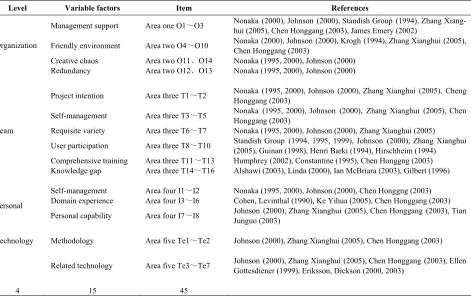
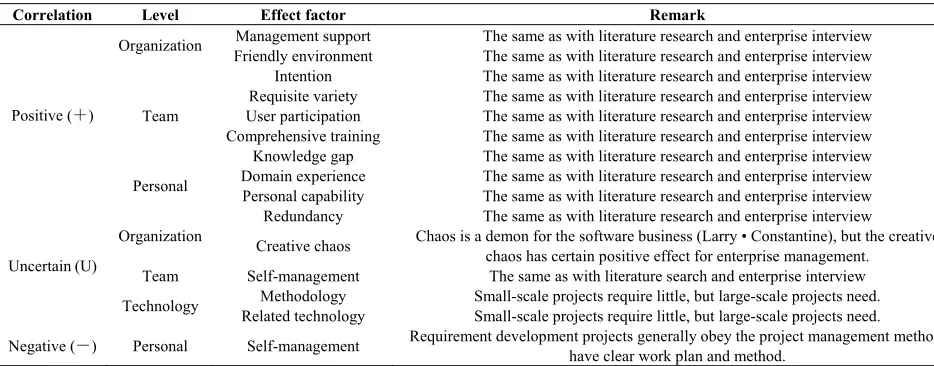
The knowledge creative factors in software requirement development are classified into three areas through the literature research and enterprise interviews (Table 1). 10 of which factors are positive, 3 are unable to determine clearly, there are two negative factors.
6. Questionnaire Design and Collection
The quantitative sample survey is taken to test the hy-potheses of knowledge creation effective factors in soft-ware requirement development.The questionnaire includes the following six areas: basic information, organizational characteristic, personal chara- cteristic, technical characteristic, knowledge creation and requirement development characteristic relationship.
system development team, the number of system requi- rement development team and testee related role in order to have a more clear understanding of the sample. The second area is about organizational characteristic scale, including 4 variables and 14 items. The third area is about the team characteristic scales, including 6 variables and 16
[image:4.595.56.533.180.394.2]items. The fourth area is about the personal characteristic scale, including 3 variables and 8 items. The fifth area is about the technical characteristic scales, including 2 variables and 7 items (Table 2). The sixth area is about the knowledge creation and requirement development rela-tionship characteristic scale, including 4 items.
Table 1. Classification on the effective factors
Relativity Level Effect factor Remark
Management support Organization Friendly environment
Project intention Requisite variety User participation Team
Comprehensive training
Domain experience Personal
Personal capability
Methodology Positive
Technology Related technology
Organization Redundancy Team Self-management Uncertain
Personal Self-management
Organization Creative chaos Negative Team Knowledge gap
Literature research and enterprise interviews on the effective factors’
classification is basically same.
Table 2. Questionnaire detailed corresponding table
Level Variable factors Item References
Management support Area one O1 O3 ~ Nonaka (2000), Johnson (2000), Standish Group (1994), Zhang Xiang-hui (2005), Chen Honggang (2003), James Emery (2002)
Friendly environment Area two O4 O10 ~ Nonaka (2000), Johnson (2000), Krogh (1994), Zhang Xianghui (2005), Chen Honggang (2003)
Creative chaos Area two O11 O14 、 Nonaka (1995, 2000), Johnson (2000) Organization
Redundancy Area two O12 O13 、 Nonaka (1995, 2000), Johnson (2000)
Project intention Area three T1 T2 ~ Nonaka (1995, 2000), Johnson (2000), Zhang Xianghui (2005), Cheng Honggang (2003)
Self-management Area three T3 T5 ~ Nonaka (1995, 2000), Johnson (2000), Zhang Xianghui (2005), Chen Honggang (2003)
Requisite variety Area three T6 T7 ~ Nonaka (1995, 2000), Johnson (2000), Zhang Xianghui (2005)
User participation Area three T8 T10 ~ Standish Group (1994, 1995, 1999), Johnson (2000), Zhang Xianghui (2005), Guinan (1998), Henri Barki (1994), Hirschheim (1994)
Comprehensive training Area three T11~T13 Humphrey (2002), Constantine (1995), Chen Honggng (2003) Team
Knowledge gap Area three T14 T16 ~ Alshawi (2003), Linda (2000), Ian McBriara (2003), Gilbert (1996)
Self-management Area four I1 I2 ~ Nonaka (1995, 2000), Johnson (2000), Chen Honggng (2003) Domain experience Area four I3 I6 ~ Cohen, Levinthal (1990), Ke Yihua (2005), Chen Honggang (2003) Personal
Personal capability Area four I7 I8 ~ Johnson (2000), Zhang Xianghui (2005), Chen Honggang (2003), Tian Junguo (2003)
Technology Methodology Area five Te1 Te2 ~ Johnson (2000), Zhang Xianghui (2005), Chen Honggang (2003)
Related technology Area five Te3 Te7 ~ Johnson (2000), Zhang Xianghui (2005), Chen Honggang (2003), Ellen Gottesdiener (1999), Eriksson, Dickson (2000, 2003)
[image:4.595.67.538.418.716.2]The Exploratory Analysis on Knowledge Creation Effective Factors in Software Requirement Development 584
7. The Exploratory Analysis of Requirement
Development Effective Factors
7.1 Reclaiming Questionnaire
Questionnaire has surveyed during December 2006 to January 2007 in Guangdong region, including Guangzhou Ferryman Management Consulting Co., Ltd., Guangdong Visionsky Information Technology Co., Ltd., Guangzhou KeenFox Engineering Co., Ltd., Computer and Tech-nologies Solution (Shenzhen) Co., Ltd., nearly 20 enter-prises, issued totally 50 e-mails, and totally recovered 26s, all are valid.
7.2 Characteristic of Sample
The highest proportion is the software industry, the num- ber is 17, accounting for 65.4%; the rest of the industry includes financial industry, service industry and other industries accounted for 11.5%, 11.5% and 11.8% corre-spondingly.
The products which belong to interviewee’s team are generally provided to the external clients to use (sample number 10, accounting for 38.5%), internal requirement (sample number 8, accounting for 30.8%) and the com-bination of the two (sample number 8, accounting for 30.8 %). The products which belong to the interviewee’s team, mainly MIS (sample number 17, accounting for 26.6%) and DSS (sample number 13, accounting for 20.3%), others such as ERP, EC, KM, special products, common products as well as other, accounting for 9.4%, 9.4%, 6.3%, 10.9%, 1.6% and 15.6% correspondingly.
The 51 persons and above (sample number 16) is do- minated, in the software development team where the interviewee is accounting for 38.5%; 1 to 10, 11 to 20, 21 to 50 are accounted for 26.9%, 23.1 % and 11.5% corspondingly. The 4 to 5 persons is dominated in the re-quirement development team, accounting for 42.3%, while, 11 persons and above, 6 to 10, and less than 3, are accounting for 26.9%, 19.2% and 11.5% correspondingly. The main interviewees are team project management, the sample number is 12, accounting for 36.2%; developer, requirement person, designer, tester and others are ac-counting for 26.9%, 7.7%, 3.8% and 7.7% correspond-ingly. Software industry is dominated in theinterviewee’s enterprises, the main products is MIS and DSS. Inter-viewee’s software development team usually are large, the number of requirement team is 4 to 5 persons. Mainly interviewees are project managers in order to make the data more persuasive.
7.3 Analysis on Reliability and Validity
The Cronbach’s α value is used to determine internal con- sistency because this paper is exploratory research and items are limited. The reliability of every variable is more than 0.350 after deleting items I3 and Te7, and reliability
can be basically acceptable (Table 3). 7.4 Statistical Analysis
7.4.1 Descriptive Statistics
The descriptive statistics is illustrated in the Table 4 ac-cording to the variables in Table 2. The summary is in the following.
1) The average score of knowledge transformation & requirement development is 4.4712 and indicates that there is close relationship between knowledge transfor-mation and requirement development, it is same as with literature research and enterprise interview.
2) Personal capability, comprehensive training, friendly environment, project intent, customer participation, do-main experience and requisite variety and etc., score more than 4 and have a higher acceptance.
3) Redundancy, creative chaos, team self-management, individual self-management, methodology and technol-ogy, score lower than 3.5, are basically same as the ex-pected results.
7.4.2 One-Sample T Test
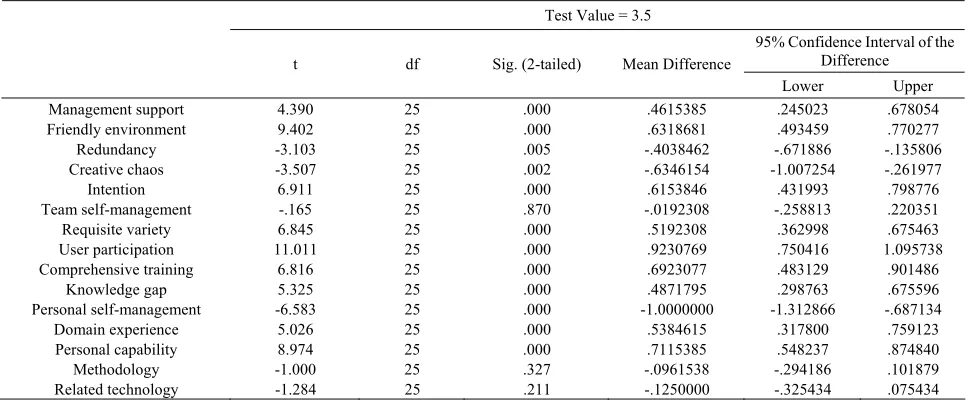
It judges one-sample T test which the test value is 3.5, confidence interval is 95%. If the significant coefficient is less than 0.05, and the upper and lower bounds are greater than 0, indicating its value to more than 3.5 large (have passed the examination); if a significant factor greater than 0.05, or the upper and lower bounds are less than 0, then its value is smaller than 3.5. It is illustrated in Table 5 that the items are passed the test except redundancy, creative chaos, the team self-management, individual self- management, methodology and technology.
Redundancy, creative chaos, team self-management, individual self-management, methodology and technolo- gy do not pass the test where the test value is 3.5. The reverse scoring one-sample T test results is illustrated in the Table 6 where the test value is 3. Only the individual autonomy is significant, it specified that the individual autonomy plays a negative effect on knowledge creation of requirement development. The other variables do not pass the test, they are unclear type. In addition, the knowledge transfer and requirement development still passing the test where test value 4, it illustrates in Table 7 that the relationship between the requirement develop-ment and knowledge transfer is recognized highly.
8. Conclusions
Table 3. Reliability of variables
Variably Item number Cronbach’s α value Remove item Reference value Management Support 3 0.710
Friendly environment 7 0.771
Redundancy 2 0.447
Creative chaos 2 0.683
Intention 2 0.410
Team self-management 3 0.532 Requisite variety 2 0.555 User participation 3 0.502 Comprehensive training 3 0.824 Knowledge gap 3 0.379 Personal self-management 2 0.703
Domain experience 2 0.552 I3 Personal capability 3 0.409
Methodology 2 0.627
Technology 4 0.469 Te7
Knowledge transfer& requirements development 4 0.914
[image:6.595.57.540.300.488.2]0.350
Table 4. Descriptive statistics
N Minimum Maximum Mean Std. Deviation
Management support 26 3.0000 5.0000 3.961538 .5360508 Friendly environment 26 3.4286 4.8571 4.131868 .3426739
Redundancy 26 2.0000 4.0000 3.096154 .6636148 Creative chaos 26 1.0000 5.0000 2.865385 .9225800
Intention 26 3.0000 5.0000 4.115385 .4540417 Team self-management 26 2.0000 4.3333 3.480769 .5931590
Requisite variety 26 3.5000 5.0000 4.019231 .3868015 User participation 26 3.6667 5.0000 4.423077 .4274752 Comprehensive training 26 3.3333 5.0000 4.192308 .5178852 Knowledge gap 26 3.0000 4.6667 3.987179 .4664835 Personal Self-management 26 1.0000 4.0000 2.500000 .7745967 Experience in the field 26 2.5000 5.0000 4.038462 .5463163
Personal capability 26 3.5000 5.0000 4.211538 .4043038
Methodology 26 2.5000 4.0000 3.403846 .4902903 Related technology 26 1.7500 4.0000 3.375000 .4962358
Knowledge transfer & requirements development 26 3.7500 5.0000 4.471154 .4707809
( )
Valid N listwise 26
Table 5. Variable one-sample T test
Test Value = 3.5
95% Confidence Interval of the Difference t df Sig. (2-tailed) Mean Difference
Lower Upper Management support 4.390 25 .000 .4615385 .245023 .678054 Friendly environment 9.402 25 .000 .6318681 .493459 .770277
Redundancy -3.103 25 .005 -.4038462 -.671886 -.135806 Creative chaos -3.507 25 .002 -.6346154 -1.007254 -.261977
Intention 6.911 25 .000 .6153846 .431993 .798776 Team self-management -.165 25 .870 -.0192308 -.258813 .220351
Requisite variety 6.845 25 .000 .5192308 .362998 .675463 User participation 11.011 25 .000 .9230769 .750416 1.095738 Comprehensive training 6.816 25 .000 .6923077 .483129 .901486
Knowledge gap 5.325 25 .000 .4871795 .298763 .675596 Personal self-management -6.583 25 .000 -1.0000000 -1.312866 -.687134 Domain experience 5.026 25 .000 .5384615 .317800 .759123
[image:6.595.56.545.514.715.2]The Exploratory Analysis on Knowledge Creation Effective Factors in Software Requirement Development 586
Table 6. Not pass the variable reverse scoring one-sample T test where the test value is 3.5
Test Value = 3.5
95% Confidence Interval of the Difference t df Sig. (2-tailed) Mean Difference
Lower Upper )
Redundancy (reverse –.739 25 .467 –.0961538 –.364194 .171886
Creative chaos (reverse .744 ) 25 .464 .1346154 –.238023 .507254 Team Self-management reverse ( ) –4.133 25 .000 –.4807692 –.720351 –.241187 Personal Self-management reverse ( ) 3.291 25 .003 .5000000 .187134 .812866
(
[image:7.595.58.539.239.300.2]Methodology reverse ) –4.200 25 .000 –.4038462 –.601879 –.205814 Related technology reverse ( ) –3.853 25 .001 –.3750000 –.575434 –.174566
Table 7. Knowledge transfer and requirement development one-sample T test
Test Value = 3.5
95% Confidence Interval of the Difference t df Sig. (2-tailed) Mean Difference
Lower Upper Knowledge transfer and requirement development 5.103 25 .000 .4711538 .281001 .661306
Table 8. The summarized relationship between variables
Correlation Level Effect factor Remark
Management support The same as with literature research and enterprise interview Organization
Friendly environment The same as with literature research and enterprise interview Intention The same as with literature research and enterprise interview Requisite variety The same as with literature research and enterprise interview User participation The same as with literature research and enterprise interview Comprehensive training The same as with literature research and enterprise interview Team
Knowledge gap The same as with literature research and enterprise interview Domain experience The same as with literature research and enterprise interview Positive (+)
Personal
Personal capability The same as with literature research and enterprise interview Redundancy The same as with literature research and enterprise interview
Organization Creative chaos Chaos is a demon for the software business (Larry • Constantine), but the creative chaos has certain positive effect for enterprise management.
Team Self-management The same as with literature search and enterprise interview Methodology Small-scale projects require little, but large-scale projects need. Uncertain (U)
Technology
Related technology Small-scale projects require little, but large-scale projects need.
-
Negative ( ) Personal Self-management Requirement development projects generally obey the project management method, have clear work plan and method.
knowledge gap and it is positive. Considering the litera-ture research and interview in the enterprise, individual independency is determined negative because it illustrates significance in reverse scoring. The others, including redundancy, creative chaos, team self-management, methodology and technology, are unclear. It concludes that the technology and the methodology are support factors of project development and would be very useful for large scale projects. On the contrary, redundancy, creative chaos and team self-management should be avoided as far as possible in the project, because it is inconsistence with the goals of requirement development.
9. Acknowledgements
Thanks for helpful discussion with Mr. Huang Deyi, Mr.Li Jiangzhang, Mr. Chen Zhening, Mr. Wang Shuwen, Mr. Liu Bing, Brenda Huang, and Ms. Zhang Hui etc.
REFERENCES
[1] X. M. Li, L. Y. Sun and Y. L. Wang, “Research on Software Requirement Management Based on Knowledge Management,” Management of Research and Deve- lopment, Vol. 17, No. 2, February 2005, pp. 28-32, 39. [2] Swebok, “Guide to Software the Software Engineering
Body of Knowledge,” 2004. http://www.swebok.org [3] X. H. Zhang, “Software Development Process and Mana-
gement,” Tsinghua University Press, Beijing, 2005. [4] M. A. Cusumano and R. W. Selby, “The Secrets of Micro-
soft,” Free Press, New York, 1995.
[5] G. von Krogh, K. Ichijo and I. Nonaka, “Enabling Knowledge Creation: How to Unlock the Mystery of Tacit Knowledge and Release the Power of Innovation,” Oxford University Press, New York and Oxford, 2000.
[image:7.595.58.525.325.508.2]Process Improvement,” Journal of Software Engineering and Applications, Vol. 3, No. 2, February 2010, pp. 134- 140.
[7] J. P. Wan, H. Zhang, D. Wan and D. Y. Huang, “Research on Knowledge Creation in Software Requirement Deve- lopment,” Journal of Software Engineering and Applica- tions, Vol. 3, No. 5, May 2010, pp. 487-494.
[8] I. Nonaka and H. Takeuchi, “The Knowledge Creating Company,” Oxford University Press, New York, 1995. [9] W. Johnson, “Technological Innovation and Knowledge
Creation: A Study of Enabling Condition and Processes of Knowledge Creation in Collaborative R & D Project,” Ph.D. Dissertation, York University, Toronto, 2000. [10] H. G. Chen, et al., “The Science and Art of Software De-
velopment,” Electronic Industry Press, Beijing, 2002. [11] Y. S. Zhang, “The Way of System Analyzer,” Electronic
Industry Press, Beijing, 2006.
[12] W. M. Cohen and D. Levinthal, “Absorptive Capacity: A New Perspective on Learning and Innovation,” Adminis- trative Science Quarterly, Vol. 35, No. 1, 1990, pp. 128- 152.
[13] Y. H. Ke, “Research on Imparting Knowledge Transfer across Team: Based Information Systems,” Master Thesis, Information Management of Institute, National Sun Yat-sen University, Taiwan, 2005.
[14] P. Sawyer and G. Kotonya, “Swebok: Software Require- ments Engineering Knowledge Area Description Version 0.5,” IEEE and ACM Project on Software Engineering Body of Knowledge, San Francisco, July 1999.
[15] J. P. Wan, “Research on Software Product Support Struc- ture,” Journal of Software Engineering and Applications, Vol. 2, No. 3, October 2009, pp.174-194.
[16] B. Jayatilaka, “The Role of Developer and User Know- ledge Domains and Learning in Systems Development,” AMCIS2000, 2000, pp.1323-1329.
[17] S. Alshawi and W. Al-Karaghouli, “Managing Know- ledge in Business Requirements Identification,” Logis- tics Information Management, Vol. 16, No. 5, 2003, pp. 341-349.
[18] H. Barki and J. Hartwick, “User Participation, Conflict and Conflict Resolution,” Information Systems Research,Vol. 5, No. 2,December 1994, pp. 422-440.
[19] P. J. Guinan, J. G. Cooprider and S. Faraj, “Enabling Software Development Team Performance during Requi- rement Definition: A Behavioral vs. Technical Approach,” Information Systems Research, July 1998, pp. 101-125. [20] R. Hirschheim and H. K. Heinz, “Realizing Emancipatory
Principles in Information Systems Development: The Case for ETHICS,” Management Information Systems Quar- terly, Vol. 18, No. 1, March 1994, pp. 83-109.
[21] Standish Group, “Chaos 1994,” The Standish Group International, Massachusetts, 1994.
[22] Standish Group, “Chaos,” Standish Group Report, 1995. [23] Standish Group, “Chaos: A Recipe to Success,” Standish
Group Report, 1999.
[24] W. S. Humphrey, “Managing the Software Process,” Reading, Addison-Wesley, Massachusetts, 1989, pp. 19- 24.
[25] L. L. Constantine, “Beyond Chaos: The Expert Edge in Managing Software Development,” Addison-Wesley, Boston, 2001.