Cite as
Bird V, Le Boutillier C, Leamy M, Williams J, Bradstreet S, Slade M (2014) Evaluating the feasibility of complex interventions in mental health services: standardised measure and reporting guidelines, British Journal of Psychiatry, 204, 316-321.
Evaluating the feasibility of complex interventions in mental health services:
standardised measure and reporting guidelines
Victoria J. Bird1, Clair Le Boutillier1, Mary Leamy1, Julie Williams1, Simon Bradstreet2, Mike Slade1.
1King’s College London, Institute of Psychiatry, Health Service and Population Research Department, (Box 029) De Crespigny park, London, SE5 8AF,
2Scottish Recovery Network, Suite 320-321, Baltic Chambers, 50 Wellington Street, Glasgow, G2 6HJ, Simon Bradstreet, Network Director
Corresponding author
Abstract
Background: Feasibility of implementation is insufficiently considered in clinical guideline
development, leading to human and financial resource wastage.
Aims: To develop a) an empirically-based standardised measure of the feasibility of complex
interventions for use within mental health services and b) reporting guidelines to facilitate feasibility assessment.
Method: A focussed narrative review of studies assessing implementation blocks and
enablers was conducted with thematic analysis and vote counting used to determine candidate items for the measure. Twenty purposively sampled studies (15 trial reports, 5 protocols) were included in the psychometric evaluation, spanning different interventions types. Cohen’s Kappa was calculated for inter-rater reliability and test-retest reliability.
Results: 95 influences on implementation were identified from 299 reviewed references. The
final measure - Structured Assessment of Feasibility (SAFE) - comprises 16 items rated on a Likert scale. SAFE demonstrated excellent inter-rater (kappa 0.84, 95% CI 0.79 - 0.89) and test re-test reliability (kappa 0.89, 95% CI 0.85 - 0.93). Cost information and training time were the two influences least likely to be reported in intervention papers. SAFE Reporting Guidelines include 16 items organised into 3 categories (Intervention, Resource
consequences, Evaluation).
Conclusion: SAFE is a novel approach to evaluating interventions, and supplements efficacy
Introduction
Routine implementation of new technologies and innovation within standard practice is a pertinent issue within healthcare, and one which crosses both geographical and disciplinary boundaries(1, 2). The Cooksey report identified cultural, financial and institutional barriers to the implementation of health research, with recommendations suggesting translational research should be viewed as a key area for future investment.(3) Within England and Wales policy and treatment decisions are guided by the National Institute for Health and Clinical Excellence Guideline programme. Guidelines are typically based on evidence reviews with a focus on efficacy and cost-effectiveness. Likewise, international approaches to quality assurance and evaluation have also aimed to use best available evidence to improve patient care by assisting policy makers and clinicians with the decision making process.(4) However, implementation of interventions within routine practice often remains low.(5) For example, an audit of four adult community mental health teams within one London Trust highlighted that only a minority of eligible patients received the interventions recommended in the Schizophrenia Guideline Update.(6) Recommending interventions which cannot readily be implemented wastes resources.
intervention to be assessed. This study aims (i) to produce an evidence-based measure of the feasibility of implementing a complex intervention in mental health services within the NHS, and (ii) to develop reporting guidelines identifying information to report which allows feasibility to be assessed.
Method
Study design
A focussed narrative review was used to inform the development of a measure. This was followed by psychometric evaluation and modification of the measure through piloting.
Literature search
Four data sources were used to identify potential studies for inclusion in the focussed narrative review:
1) Google Scholar, NHS evidence and PubMed were searched using the terms “implementation” AND (“barriers” OR “facilitators”) AND “mental health”
2) Table of contents for the journal Implementation Science from January 1999 until December 2010
3) Hand searching the references of retrieved papers for additional citations 4) Recommendations from an implementation science expert.
Eligibility criteria
within the UK or (for review studies) a proportion of the included studies were conducted within the UK to ensure applicability to the NHS context; and e) the study focused on the implementation of a manualised intervention or guideline at the individual staff, team or service level.
Data extraction and tabulation
For each included paper the following data were extracted and recorded in an online database: study methodology, target population, study location, details of the intervention or guideline being implemented and the main implementation barriers and facilitators identified. To assess the quality of the included studies the RATs checklist(10) was used for qualitative papers, the Effective Public Health Practice Project tool(11) used for quantitative research and the NICE systematic review checklist(12) for review studies. For qualitative studies, poor quality was defined as two or more red flags (as indicated on the RATS checklist). Quantitative studies or systematic reviews receiving a negative quality rating on their respective tools were defined as poor quality, as for both a negative rating indicates significant evidence of bias within the study. Poor quality studies were excluded.
Development of SAFE
required or whether the intervention was manualised for example. Each influence was then operationalised as a single question e.g. the implementation barrier lack of time was operationalised as: Is the intervention time consuming? Each item was rated as Yes, Partial, No or Unable to rate. Anchor points for each item were developed based on the consensus opinion of three NHS clinicians and two researchers. The draft measure was then piloted and modified by three members of the research team (one clinician and two researchers) to ensure the rating categories were comprehensively defined and the measure easy to use.
Psychometric evaluation
Within the psychometric evaluation of SAFE, 19 purposively selected papers (reporting on 20 interventions) were rated using the measure (references available on request). The interventions were described in trial reports (n=15) and study protocols (n=5), and spanned pharmacotherapy (n=2), psychosocial (n=12) and service based interventions (n=6). To investigate test-retest reliability each paper was re-rated one week later. To investigate inter-rater reliability, each paper was double rated by at least one of three other researchers. Reliability was measured using weighted Cohen’s Kappa. Confidence intervals were calculated using Wilson efficient-score method, corrected for continuity with a coefficient >0.75 representing excellent reliability.(13) Cohen’s Kappa was calculated for overall agreement between raters and to rate agreement by category (Yes vs. Partial vs. No vs. Unable to rate).
Results
Development of the measure
reviewed the international literature, including UK based papers. Additionally, 43 papers were excluded. The most common reason for exclusion was that results of the paper were not applicable to the NHS context (Online Data Supplement 1).
Ninety-five implementation influences (i.e. barriers and facilitators) were identified from the 11 included papers. Thirty-nine of these 95 influences related to the characteristics of the intervention so were retained and included in the vote counting (Table 1).
Insert Table 1 here
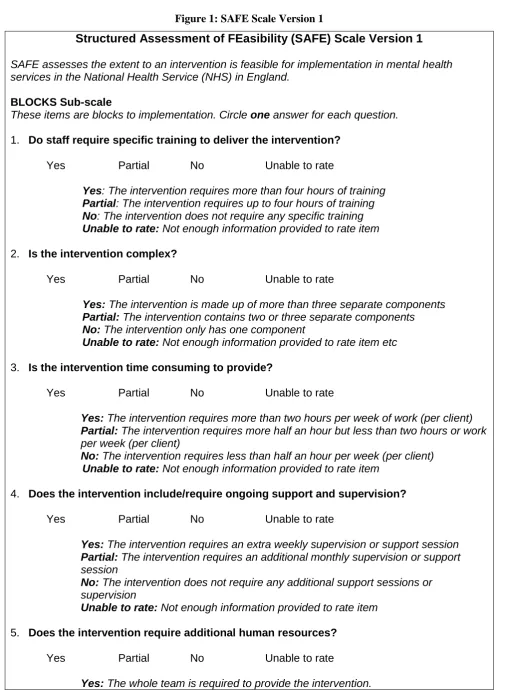
The most common implementation themes were staff skills required to carry out the intervention, applicability of the intervention to the population of interest, and concordance with staff values. From the 39 influences, 17 (shown in bold in Table 1) were identified in at least three papers and were used as candidate items for the measure. Items were then selected through a process of consensus and consultation within the research team, by merging items (e.g. additional skills or knowledge required was merged with the need for additional training), separating items (e.g. cost implications of the intervention was split into cost effectiveness and the cost of setting up the intervention), and deleting one item (concerning the match with staff values, as this could not be rated based on intervention papers alone). This process produced a 16-item draft measure, comprising eight barriers and eight facilitators of implementation. The measure was piloted and modifications made to the descriptions of each category, including defining the Unable to rate category, and adding more detail to items 3 and 14. This resulted in the final measure (Fig 1).
Insert Fig 1 here
papers within a systematic review, since items within the scale may have unequal weight. Instead it is recommended that reviewers attend to the individual items of the scale when conducting sensitivity and sub-group analyses. This same approach was therefore adopted for scoring SAFE, whereby the reviewer rates individual items, without providing an overall summary score, as barriers and facilitators differ in their importance depending on the context.
Psychometric properties
Inter-rater reliability (Kappa = 0.84, 95% CI 0.79 – 0.89) and test-retest reliability (Kappa = 0.89, 95% CI 0.85 – 0.93) were both excellent. Across all responses, inter-rater agreement was 89% (95% CI 0.85 – 0.92) and test re-test agreement was 92.5% (95% CI 0.89 – 0.95).
Insert Table 2 here
The “partial” category produced the lowest percentage agreement across different raters and
time points (Table 2). Our impression is that the lower consistency was due to unclear descriptions given in the papers, rather than due to raters switching to other responses. For example, it was often hard to determine whether an intervention had two or three components or whether the training involved X or Y amount of time. Table 3 provides the frequencies for each response category per item as suggests the items varied in the proportion of each category response. The overall level of agreement per item (irrespective of response category e.g. “yes”, “no”) was consistently very high ranging from 80-100%. Agreement between
raters and across time points was 95-100% for over half of the items.
Insert Table 3 here
The percentage of papers reporting enough information to allow for a rating varied for each item (Table 3).
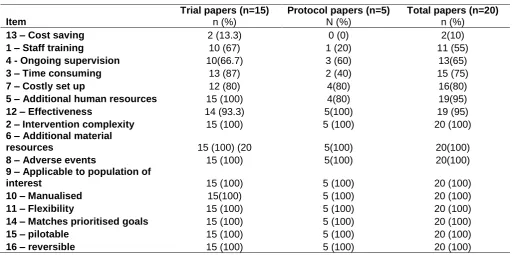
Insert Table 4 here
As detailed in Table 4, 90% of papers did not provide enough information for Cost saving to be rated, followed by Staff training (45%) and Ongoing supervision (35%). In contrast, the complexity of the intervention, the applicability of the population, and additional human and material resources were rateable for all papers (e.g.100%).
Reporting guidelines
Each item from the developed measure was modified and re-organised to produce reporting guidelines (Fig 2).
Insert Fig 2 here
Discussion
will be useful for three groups. First, for reviewers and policy makers when assessing the evidence base for an intervention. Second, researchers developing an intervention could make use of the scale to ensure they consider factors related to the implementation of that intervention. Finally, the reporting guidelines are intended to be used by authors reporting an intervention.
Strengths and limitations
Although we have demonstrated that SAFE is a useable and reliable measure, our study has a number of limitations. Firstly the candidate item selection process was not systematic. Instead we conducted a selective but focused review of the implementation science literature. It is possible that a wider systematic review would have identified additional implementation barriers and facilitators in relation to characteristics of the intervention. Further to this, the review was restricted to mental health services within the NHS. Although this may limit the tools applicability to other healthcare settings, a number of systematic reviews have identified similar implementation barriers and facilitators in other settings (such as the US) and for other long-term health conditions. (17) Furthermore, a number of included reviews assessed the implementation literature on a broader scale. Specifically, for a review to be included in the thematic analysis, it needed to present data that was applicable, but not restricted, to the UK.
properties evaluated in this study were selected to reflect these features. Future work could look at evaluating the use of SAFE within an evidence review procedure such as a Health Technology Appraisal (HTA) or guideline development process.
Finally, the methods used to develop the reporting guidelines were limited in their scope. Moher and colleagues suggests a method for developing reporting guidelines which includes a review of the literature followed by a Delphi exercise and face-to-face consensus meeting.(26) As the reporting guidelines in this study focus specifically on allowing the rating of SAFE within evidence appraisal and decision-making processes, a more pragmatic approach to the development process was undertaken, in that each item in SAFE was constructed as an item in the reporting guidance. Future work could look at expanding these reporting guidelines to include other areas outside of mental health services and implementation features in addition to the characteristics of the intervention.
Despite these limitations, one strength of the study was that the psychometric evaluation indicated that SAFE is useable and reliable. The ease of use of SAFE suggests it could be easily appended to current evidence review processes across a range of different contexts. The associated reporting guidelines also have the potential to positively impact on the quality of interventions reported in peer-reviewed journals, thus providing systematic reviewers and policy makers with the information needed to evaluate likely implementation.
Comparison with the literature
important influences on the sustainability of the innovation being assessed in the individual studies. Furthermore, features such as resources, working culture and training and education requirements also had an impact and match items included in the SAFE scale.
Relevance for practice and policy
To support implementation in clinical practice, an understanding of the factors that facilitate or hinder successful evidence utilisation is required. At present, health care improvements have often been targeted at factors related to individual health care practitioners, such as their knowledge, routine and attitudes.(27, 31) However, successful implementation is influenced by components occurring at multiple ecological levels of the healthcare system, such as the individual, social, organisation, economic and political context and patient beliefs and behaviour.(7, 32-34) Implementation is a complex social process linked with the context in which it takes place.
The SAFE scale specifically focuses on one factor indentified as important to successful implementation, namely the characteristics of the intervention. Within this complex process of implementation, rating feasibility based on the characteristics of that intervention offers one circumscribed and useable source of information for both reviewers and policy makers when making decisions about evidence recommendations. Guideline development processes make use of systematic reviews of best available evidence as part of the decision making process, alongside other rating systems such as GRADE (Grading of Recommendations Assessment, Development and Evaluation), which makes statements about the overall quality of the evidence. Recently, there have been further suggestions that the GRADE process should incorporate other features of the evidence and intervention including resource allocation.(35) It is at this stage in the evidence review process that SAFE could be used to help clinicians and guideline panellists with the decision making process.
behavioural therapy for psychosis has been low, with estimates suggesting that less than 30% of eligible patients receive these interventions.(38) These findings are not restricted to schizophrenia - Rhodes and colleagues(39) found that although the majority of clinicians were aware of and using NICE clinical guidance for depression, only 20% felt confident in their use of the guidelines. Many clinicians stated that resource implications, lack of time and availability of training had a negative impact on their routine utilisation within clinical practice. Using SAFE within the evidence review process could help to highlight areas of interventions which make their implementation more difficult. This would allow for the strategic targeting of resources and the tailoring of implementation strategies at an early stage in the dissemination process to overcome these issues and hence maximise routine implementation. As well as the clinical gains, the cost savings arising from higher levels of implementation are potentially significant. For example, Vos and colleagues(40) indicated that if recommended treatments which are currently underutilised, such as CBT for depression and anxiety and family interventions for schizophrenia were implemented then significant cost savings would be made, in addition to improvements in the health status of individuals.
Future research
Given that the interest in implementation science and the increasing evidence to suggest low implementation of evidence within clinical practice, it is imperative that future work continues to assess not only the barriers to implementation but how these can be overcome. The results presented here represent a pilot study and small psychometric evaluation of a new measure and reporting guideline. Larger scale work is needed to assess the utility of SAFE within systematic reviews such as those used within the guideline development process. Additionally work could focus on adapting and modifying SAFE to be applicable to other areas of healthcare and other non-UK settings. In particular, implementation influences may differ across settings, and degree of commonality is unknown – future research using the same methodology with different clinical populations and service settings will be needed to establish whether the same influences, and hence SAFE apply.
Implications
Declaration of interest
VB, CL, ML and JW are funded by a National Institute for Health Research (NIHR) Program Grant for Applied Research. MS received a research grant from National Institute for Health Research (NIHR) Program Grant for Applied Research (Grant RP-PG-0707-10040). VB does consultancy for the National Collaborating Centre for Mental Health, no other relationships or activities that could appear to have influenced the submitted work are reported.
Author contributions
All authors made a substantial contribution to the conception and design of the study, data collection and interpretation. All authors were involved in drafting and revising the article and gave their final approval for the version to be published.
Ethical approval
Ethical approval was obtained from the South East London Research Ethics Committee 4 (formally known as Joint South London & Maudsley and the Institute of Psychiatry NHS Research Ethics Committee) approval 10/H0807/4.
Source of funding
The study is independent research commissioned through a National Institute for Health Research (NIHR) Program Grant for Applied Research (Grant RP-PG-0707-10040) and in relation to the NIHR Specialist Mental Health Biomedical Research Centre at the Institute of Psychiatry, King’s College London, and the South London and Maudsley National Health
1.
Tansella M, Thornicroft G. Implementation science: understanding the
translation of evidence into practice. The British journal of psychiatry : the journal of
mental science. 2009;195:283 - 5.
2.
McGorry P. Prevention, innovation and implementation science in mental health:
the next wave of reform.
Br J Psychiatry Suppl
. 2013;54:s3-4.
3.
Cooksey D.
A review of UK health research funding
: HM Treasury2006.
4.
Grol R. Has guideline development gone astray? Yes. BMJ (Clinical research
ed). 2010;340:c306.
5.
Colom F. Keeping therapies simple: psychoeducation in the prevention of
relapse in affective disorders. The British journal of psychiatry : the journal of mental
science. 2011;198(5):338-40.
6.
NCCMH.
Core interventions in the treatment and mangament of Schizophrenia
in adults in primary and secondary care (updated edition) CG 82
. Leicester: British
Psychological Society; 2009.
7.
Damschroder LJ, Aron DC, Keith RE, Kirsh SR, Alexander JA, Lowery JC.
Fostering implementation of health services research findings into practice: a
consolidated framework for advancing implementation science.
Implem Sci
. 2009;4.
8.
Chaudoir SR, Dugan AG, Barr CH. Measuring factors affecting implementation
of health innovations: A systematic review of structural, organizational, provider,
patient, and innovation level measures.
Implem Sci
. 2013;8:22.
9.
Hopewell S, Ravaud P, Baron G, Boutron I. Effect of editors’ implementation of
CONSORT guidelines on the reporting of abstracts in high impact medical journals:
interrupted time series analysis. BMJ (Clinical research ed). 2012;344.
10.
Clark J.
How to peer review a qualitative manuscript.
In: Godlee F, Jefferson T,
editors. Peer review in health sciences. London: BMJ Books; 2003. p. 219–35.
11.
EPHPP. Quality Assessment Tool for Quantitative Studies. EPHPP, .
EPHPP2009 [cited 2011]; Available from: (http://www.ephpp.ca/tools.html).
12.
NICE.
NICE guidelines Manual
. UK: National Institute of Health and Clinical
Excellence; 2009.
13.
Fleiss JL.
Statistical methods for rates and proportions.
2nd ed. New York: John
Wiley; 1981
15.
Brooker C, Curran J. The national continuous quality improvement tool for
mental health education: Results of targeted and supported implementation in England.
J
Interprof Care
. 2006;20(3):276 - 89.
16.
Brooker C, Saul C, Robinson J, King J, Dudley M. Is training in psychosocial
social interventions worthwhile? Report of a psychosocial intervention trainee follow-up
staudy.
Int J Nurs Stud
. 2003;40:731 - 47.
17.
Cabana MD, Rand CS, Powe NR, et al. Why don't physicians follow practice
guidelines? A framework for improvement.
JAMA
. 1999;282(15):1458 - 65.
18.
Carroll C, Patterson M, Wood S, Booth A, Rick J, Balain S. A conceptual
framework for implementation fidelity.
Implem Sci
. 2007;2.
19.
Gravel K, Legare F, Graham ID. Barriers and facilitators to implementing shared
decision-making in clinical practice: a systematic review of health professionals'
perceptions.
Implem Sci
. 2006;1.
20.
Michie S, Johnston M, Abraham C, Lawton R, Parker D, Walker A. Making
psychological theory useful for implementing evidence based practice: a consensus
approach.
Qual Saf Health Care
2005;14:26 - 33.
21.
Michie S, Pilling S, Garety P, Whitty P, Eccles MP, Johnston M, et al.
Difficulties implementing a mental health guideline: an exploratory investigation using
psychological theory.
Implem Sci
. 2007;2.
22.
Smith G, Velleman R. Maintaining a family work for psychosis service by
recognising and addressing barriers to implementation.
J Ment Health
. 2002;11(5):471 -
79.
23.
Williams CHJ. Cognitive behaviour therapy with assertive outreach teams:
barriers to implementaton a qualitative peer audit.
J Psychiatr Ment Health Nurs
.
2008;15:850 - 6.
24.
Higgins JT, Green S.
Cochrane Handbook for Systematic Reviews of
Interventions
1ed. UK: Wiley; 2008.
25.
CRD.
Systematic Reviews: CRD's Guidance for Undertaking Reviews in
Healthcare
. UK: Centre for Reviews & Dissemination; 2009.
26.
Moher D, Schulz KF, Simera I, Altman DG. Guidance for developers of health
research reporting guidelines. PLoS medicine. 2010;7:e1000217.
27.
Grimshaw JM, Thomas RE, MacLennan G, Fraser C, Ramsay CR, Vale L, et al.
Effectiveness and efficiency of guideline dissemination and implementation strategies
:
Health Technology Assessment2004.
29.
Improvement NIfIa. The spread and adoption tool. NHS Institute for Innovation
and
Improvement;
2012
[cited
2012
03/12/2012];
Available
from:
http://www.institute.nhs.uk/index.php?option=com_spread_and_adoption.
30.
Slaghuis SS, Strating MM, Bal RA, Nieboer AP. A framework and a
measurement instrument for sustainability of work practices in long-term care. BMC
health services research. 2011;11:314.
31.
Lawrence V, Fossey J, Ballard C, Moniz-Cook E, Murray J. Improving quality
of life for people with dementia in care homes: making psychosocial interventions work.
The British journal of psychiatry : the journal of mental science. 2012;201:344-51.
32.
Grol R, Wensing M, Eccles M.
Improving patient care: The implementation of
change in clinical practice
: Elsevier Ltd; 2005.
33.
Grol RPTM, Bosch MC, Hulscher MEJL, Eccles MP, Wensing M. Planning and
studying improvement in patient care: The use of theoretical perspectives.
The Milbank
Quarterly
. 2007;85:93 - 138.
34.
Sanders D, Haines A. Implementation research is needed to achieve international
health goals. PLoS medicine. 2006;3:e186.
35.
Guyatt GH, Oxman AD, Kunz R, Jaeschke R, Helfand M, Liberati A, et al.
Incorporating considerations of resources use into grading recommendations. BMJ
(Clinical research ed). 2008;336:1170-3.
36.
Gagliardi AR. Translating knowledge to practice: optimizing the use of
guidelines. Epidemiology and psychiatric sciences. 2012 Sep;21:231-6.
37.
Jolley S, Onwumere J, Kuipers E, Craig T, Moriarty A, Garety P. Increasing
access to psychological therapies for people with psychosis: predictors of successful
training. Behaviour research and therapy. 2012;50:457-62.
38.
Prytys M, Garety PA, Jolley S, Onwumere J, Craig T. Implementing the NICE
guideline for schizophrenia recommendations for psychological therapies: a qualitative
analysis of the attitudes of CMHT staff. Clinical psychology & psychotherapy.
2011;18:48-59.
39.
Rhodes L, Genders R, Owen R, O'Hanlon K, Brown JS. Investigating barriers to
implementation of the NICE Guidelines for Depression: a staff survey with Community
Mental Health Teams.
J Psychiatr Ment Health Nurs
. 2010;17:147-51.
Table 1: Vote counting of the identified influences on implementation (number of influences = 39)
IMPLEMENTATION INFLUENCE Identified in N
papers (%)
Staff skills to deliver the intervention 9 (82)
Applicability of the intervention (to Service users) 8 (73)
Match with staff values, attitudes – does it clash with preferred treatment approach and culture of the team, staff preference?
8 (73)
Staff knowledge to deliver the intervention 7 (64)
Time constraints 7 (64)
Ongoing support and supervision 5 (45)
Outcome expectancy (efficacy) – Do staff think the intervention will work? Etc. 5 (45)
Cost-benefit of intervention (financial) 5 (45)
Cost-benefit (efficacy, risk etc.) – perception of advantage, risks, regret for doing or not doing the intervention
5 (45) Match with the organisational culture – does it link with values, attitudes of the
organisation, is it supported etc.
4 (36) Match with current practice - Is the intervention breaking routines and habits? Are
there contradictory practices or guidelines. Conflict with usual routines and roles
4 (36)
Lack of resources 4 (36)
Flexibility / modifiability – can the intervention be adapted to fit the local context and situation
4 (36) Guideline / intervention availability including availability of a manual or guide 3 (27) Confidence in the intervention – lack of confidence in the developer, approach,
evidence-based, credibility of the intervention and source.
3 (27) Lack of reimbursement or incentives to do the intervention 3 (27) Complexity of the intervention – is the intervention simple or complex 3 (27) Reversibility and trialability - are the changes permanent or can they be trialled 3 (27) Service user involvement including in the design of the intervention 2 (18) Outcome expectancy (observability) – time needed before the results become apparent, are the
results observable
2 (18) Role match – does the intervention challenge the social roles and professional identity of staff. 2 (18)
Intervention is too rigid, cook book and biased 2 (18)
The intervention challenges staff autonomy 2 (18)
Quality of design of the intervention 2 (18)
Degree to which the action done by the team, organisation or individual is disruptive or radical 2 (18)
Stressful nature of the intervention 2 (18)
Time needed to keep up to date with the intervention 1 (9)
Is the source of the intervention internal or external to the organisation 1 (9) Forgetting the intervention (content) – forgetting the content of the intervention 1 (9) Forgetting the intervention (action) – forgetting to do the intervention 1 (9) Divisibility – being able to separate out components of the intervention to implement at
different times
1 (9) Centrality – does the intervention effect a central or peripheral activity 1 (9)
Duration of change and how long will it take 1 (9)
How much attention does the intervention require 1 (9)
Will staff observe others doing the intervention 1 (9)
Lack of trained supervisors 1 (9)
Lack of opportunities for co-working 1 (9)
Adaption of the intervention for sensory impaired groups 1 (9)
Table 2: Percentage agreement for each response category
Response category Agreement
% (95% CI) INTER-RATER
Yes 84.5 (78.0 – 89.5)
Partial 57.8 (45.5 – 69.2)
No 87.0 (76.2 – 93.5)
Unable to rate 89.4 (76.1 – 96.0) TEST RE-TEST
Yes 90.7 (84.9 – 94.6)
Partial 72.9 (60.7 – 82.5)
No 89.1 (78.2 – 95.1)
Table 3: Number (and percentage) of papers with each response category by SAFE item
SAFE Item
Response Q1 Q2 Q3 Q4 Q5 Q6 Q7 Q8 Q9 Q10 Q11 Q12 Q13 Q14 Q15 Q16
Yes 6 (30) 16 (80) 6 (30) 2 (10) 4 (20) 5 (25) 7 (35) 1 (5) 20 (100)
Table 4: Items able to be rated in the included papers (n=20)
Item
Trial papers (n=15) n (%)
Protocol papers (n=5) N (%)
Total papers (n=20) n (%)
13 – Cost saving 2 (13.3) 0 (0) 2(10)
1 – Staff training 10 (67) 1 (20) 11 (55)
4 - Ongoing supervision 10(66.7) 3 (60) 13(65)
3 – Time consuming 13 (87) 2 (40) 15 (75)
7 – Costly set up 12 (80) 4(80) 16(80)
5 – Additional human resources 15 (100) 4(80) 19(95)
12 – Effectiveness 14 (93.3) 5(100) 19 (95)
2 – Intervention complexity 15 (100) 5 (100) 20 (100)
6 – Additional material
resources 15 (100) (20 5(100) 20(100)
8 – Adverse events 15 (100) 5(100) 20(100)
9 – Applicable to population of
interest 15 (100) 5 (100) 20 (100)
10 – Manualised 15(100) 5 (100) 20 (100)
11 – Flexibility 15 (100) 5 (100) 20 (100)
14 – Matches prioritised goals 15 (100) 5 (100) 20 (100)
15 – pilotable 15 (100) 5 (100) 20 (100)
Figure 1: SAFE Scale Version 1
Structured Assessment of FEasibility (SAFE) Scale Version 1
SAFE assesses the extent to an intervention is feasible for implementation in mental health services in the National Health Service (NHS) in England.
BLOCKS Sub-scale
These items are blocks to implementation. Circle one answer for each question.
1. Do staff require specific training to deliver the intervention?
Yes Partial No Unable to rate
Yes: The intervention requires more than four hours of training Partial: The intervention requires up to four hours of training No: The intervention does not require any specific training Unable to rate: Not enough information provided to rate item
2. Is the intervention complex?
Yes Partial No Unable to rate
Yes: The intervention is made up of more than three separate components Partial: The intervention contains two or three separate components No: The intervention only has one component
Unable to rate: Not enough information provided to rate item etc
3. Is the intervention time consuming to provide?
Yes Partial No Unable to rate
Yes: The intervention requires more than two hours per week of work (per client) Partial: The intervention requires more half an hour but less than two hours or work
per week (per client)
No: The intervention requires less than half an hour per week (per client) Unable to rate: Not enough information provided to rate item
4. Does the intervention include/require ongoing support and supervision?
Yes Partial No Unable to rate
Yes: The intervention requires an extra weekly supervision or support session Partial: The intervention requires an additional monthly supervision or support
session
No: The intervention does not require any additional support sessions or
supervision
Unable to rate: Not enough information provided to rate item
5. Does the intervention require additional human resources?
Yes Partial No Unable to rate
Partial: More than one member of staff are involved in providing the intervention No: The intervention can be provided by one member of staff
Unable to rate: Not enough information provided to rate item
6. Does the intervention require additional material resources?
Yes Partial No Unable to rate
Yes: Sizeable resources or special equipment which staff would not usually have
access to e.g. a dedicated room, instruments, art materials.
Partial: The intervention requires additional but readily available resources e.g.
computers
No: The intervention does not require any additional resources that staff would not
usually have access to.
Unable to rate: Not enough information provided to rate item
7. Is the intervention costly to set up?
Yes Partial No Unable to rate
Yes: The intervention is likely to be too costly to provide without extra funding Partial: The intervention is likely to require other costs to be de-prioritised No: The intervention cost is low
Unable to rate: Not enough information provided to rate item
8. Are there known adverse events associated with the intervention?
Yes Partial No Unable to rate
Yes: There are known serious adverse events associated with the intervention Partial: There are known adverse events associated with the intervention
No: There are no known serious or adverse events associated with the intervention Unable to rate: Not enough information provided to rate item
ENABLERS Sub-scale
These items are enablers of implementation. Circle one answer for each question.
9. Is the intervention applicable to the population of interest (e.g. adults using community mental health teams)
Yes Partial No Unable to rate
Yes: The intervention has been designed for the population of interest
Partial: The intervention has been designed for a general mental health population
or can be adapted to be applicable to the population of interest
No: The intervention is not applicable to the population of interest Unable to rate: Not enough information provided to rate item
10. Is the intervention manualised?
Yes Partial No Unable to rate
Yes: All aspects of the intervention are manualised
No: The intervention is not manualised
Unable to rate: Not enough information provided to rate item
11. Is the intervention flexible (i.e. can be tailored to the context and situation)?
Yes Partial No Unable to rate
Yes: The intervention is flexible and can be tailored to the context and situation Partial: Elements of the intervention can be tailored to the context and situation No: the intervention cannot be tailored to the specific context
Unable to rate: Not enough information provided to rate item
12. Is the intervention likely to be effective (i.e. evidence based and expected to produce positive outcomes)?
Yes Partial No Unable to rate
Yes: There is an established evidence base regarding the effectiveness of the
intervention (e.g. clinical trials)
Partial: There is some evidence for the effectiveness of the intervention (e.g. case
studies but no clinical trials)
No: There is no evidence base for the intervention
Unable to rate: Not enough information provided to rate item
13. Is the intervention cost saving?
Yes Partial No Unable to rate
Yes: The intervention has been demonstrated to save costs
Partial: The intervention has been demonstrated to be cost neutral and/or cost
effective
No: The intervention is not cost saving or cost effective Unable to rate: Not enough information provided to rate item
14. Do the intended goals of the intervention match the prioritised goals of the NHS?
Yes Partial No Unable to rate
Yes: The primary aims of the intervention match values NHS outcomes e.g.
improving mental health and wellbeing, supporting clinical and personal recovery, promoting good physical health, improving service satisfaction, reducing stigma and discrimination [Taken from No Health Without Mental Health, 2011, Department of Health]
Partial: The secondary aims of the intervention match the current valued outcomes No: The primary and secondary aims of the intervention do not match the current
valued outcomes of the NHS
Unable to rate: Not enough information provided to rate item
15. Can the intervention be piloted?
Yes Partial No Unable to rate
Yes: The intervention can be piloted by a few members of staff AND with only a few
service users.
service users
No: The intervention cannot be piloted
Unable to rate: Not enough information provided to rate item
16. Is the intervention reversible?
Yes Partial No Unable to rate
Yes: It is possible to stop the intervention without harmful, or unwanted, effects Partial: It is possible to stop the intervention, but there are likely to be some
harmful, or unwanted, effects
No: It is not possible to stop the intervention without serious adverse effects Unable to rate: Not enough information provided to rate item
© Section for Recovery, Institute of Psychiatry, 2012.
Figure 2 – SAFE Reporting Guidelines for characterising implementation influences
These reporting guidelines identify the characteristics of a mental health intervention to report in order to allow influences on implementation within the NHS to be evaluated.
Intervention
Item 1: Details of the intervention components
Descriptor: The complexity of the intervention should be specified, this includes recording and listing how many separate components make up the intervention. Item 2: Intervention Manual
Descriptor: Is the intervention manualised? The report should contain details of any intervention manuals developed or used.
Item 3: Flexibility
Descriptor: Can the intervention be tailored to different contexts and environments? Item 4: Ability to Pilot the intervention
Descriptor: Can the intervention be piloted with a few individuals or within one or two teams?
Item 5: Reversibility
Descriptor: Are the effects of the intervention permanent or can the intervention be stopped at any point within any harmful effects. If there are likely to be adverse effects associated with discontinuing the intervention, these should be reported.
Item 6: Population
Descriptor: The intended population of the intervention should be described. For example is the intervention aimed at people with a particular diagnosis or using a particular service? The ability to adapt the intervention for use within other populations should also be reported.
Resource consequences
Item 7: Staff training
Descriptor: Do staff require any specific training to deliver the intervention? If yes, details of the training should be reported. This includes the name of any specific training, the length of training e.g. does it last two half days, three hours etc. and any details about booster training sessions.
Item 8: Support and supervision
Item 9: Time costs
Descriptor: How much time does the intervention require per client per week? Item 10: Human resources
Descriptor: what human resources are required to deliver the intervention? Item 11: Material resources
Descriptor: what material resources are required to deliver the intervention? Item 12: Set-up costs
Descriptor: Where possible the cost implications of the intervention should be reported. Any estimated costs associated with setting up the intervention should be reported. Evaluation
Item 13: Efficacy
Descriptor: This relates to the existing evidence base for the intervention or any
theoretical evidence base. For instance is there supporting evidence that the intervention is efficacy of the intervention? Has the effectiveness of the intervention been established in previous clinical trials?
Item 14: Outcomes
Descriptor: what are the intended outcomes of the intervention? What are the primary outcomes? What are the secondary outcomes?
Item 15: Cost saving
Descriptor: Any information relating to the costs of the intervention should be reported, including the potential costs saved. Is there evidence of cost saving? Has the cost effectiveness of the intervention been assessed or estimated?
Item 16: Adverse events