Linear Overhead Optimally-resilient Robust MPC Using Preprocessing
Ashish Choudhury1, Emmanuela Orsini2, Arpita Patra3, and Nigel. P. Smart2 1 International Institute of Information Technology Bangalore, India.
2 Dept. Computer Science, University of Bristol, Bristol, United Kingdom.
[email protected],[email protected] 3
Department of Computer Science and Automation, Indian Institute of Science, India. [email protected]
Abstract. We present a new technique for robust secret reconstruction withO(n)communication complexity. By applying this technique, we achieveO(n)communication complexity per multiplication for a wide class of robust practical Multi-Party Computation (MPC) protocols. In particular our technique applies to robust threshold com-putationally secure protocols in the case oft < n/2in the pre-processing model. Previously in the pre-processing model,O(n)communication complexity per multiplication was only known in the case of computationally secure non-robust protocols in the dishonest majority setting (i.e. witht < n) and in the case of perfectly-secure robust protocols witht < n/3. A similar protocol was sketched by Damg˚ard and Nielsen, but no details were given to enable an estimate of the communication complexity. Surprisingly our robust reconstruction protocol applies for both the synchronous and asynchronous settings.
1
Introduction
Secure MPC is a fundamental problem in secure distributed computing [33,27,8,14]. An MPC protocol allows a set of
nmutually distrusting parties with private inputs to securely compute a joint function of their inputs, even iftout of thenparties are corrupted. Determining the communication complexity of MPC in terms ofn, is a task which is both interesting from a theoretical and a practical standpoint. It is a folklore belief that the complexity should be essentially O(n)per multiplication in the computation. However, “most”robustsecret-sharing based MPC protocols which are practical have complexityO(n2).
To understand the problem notice that apart from the protocols for entering parties inputs and determining parties outputs, the main communication task in secret-sharing based MPC protocols is the evaluation of the multiplication gates (we assume a standard arithmetic circuit representation of the function to be computed for purely expository reasons, in practice other representations may be better). If we consider the classic information-theoretic passively secure sub-protocol for multiplication gates whent < n/2(locally multiply the shares, reshare and then recombine) we requireO(n2)messages per multiplication gate [8,26]. This is because each party needs to send the shares representing its local multiplication to every other party, thus requiringO(n2)messages, and henceO(n2)bits if we only look at complexity depending onn.
Even if we look at such protocols in the pre-processing model, where the so-called “Beaver multiplication triples” are produced in an offline phase [4], and we are primarily concerned about the communication complexity of the online phase, a similar situation occurs. In such protocols, see for example [19], the standard multiplication sub-protocol is for each party to broadcast a masking of their shares of the gate input values to every other party. This again hasO(n2) communication complexity.
In the SPDZ protocol [22], for the case of non-robust4 maliciously secure MPC (with abort) in the dishonest majority setting (i.e. witht < n), an online communication complexity ofO(n)was achieved. This is attained by replacing the broadcast communication of the previous method with the following trick. For each multiplication gate one party is designated as the “reconstructor”. The broadcast round is then replaced by each party sending their masked values to the reconstructor, who then reconstructs the value and then sends it to each party. This requires exactly2·n
4
messages being sent, and is henceO(n). However, this protocol is only relevant in the dishonest majority setting as any dishonest behaviour of any party is subsequently detected via the SPDZ MAC-checking procedure, in which case the protocol aborts. Our goal is to achieve such a result for robust protocols in thepre-processing model.
Related Work: Witht < n/3, information-theoretically secure an online protocols withO(n)communication per multiplication are presented in [21]. There the basic idea is a new method of reconstructing a batch ofΘ(n) secret-shared values withO(n2)communication complexity, thus providing a linear overhead. However, the method is tailor-made only fort < n/3(as it is based on the error-correcting capability of the Reed-Solomon (RS) codes) and will not work witht < n/2. Hence witht < n/2 in the computational setting, a new technique to obtainO(n)online complexityis needed. In [21] a similar protocol in the pre-processing model is also sketched, which uses the designatred reconstructor idea (similar to the idea used in SPDZ, discussed above). The protocol is only sketched, and appears to requireO(t)rounds to identify the faulty shares; as opposed to our method which requires no additional rounds.
In [28], a computationally-secure MPC protocol witht < n/2and communication complexityO(n)per multi-plication is presented. The protocol is not designed in the pre-processing model, but rather in the player-elimination framework, where the circuit is divided into segments and each segment is evaluated “optimistically”, assuming no fault will occur. At the end of the segment evaluation, a detection protocol is executed to identify whether the segment is evaluated correctly and if any inconsistency is detected, then a localization protocol is executed. The fault-localization process identifies a pair of parties, with at least one of them being corrupted. The pair is then neglected for the rest of the protocol execution and the procedure is repeated. There are several drawbacks of this protocol. The protocol cannot be adapted to the pre-processing model; so the benefits provided by the pre-processing based MPC protocols (namely efficiently generating circuit-independent raw materials for several instances of the computation in parallel) cannot be obtained. The protocol also makes expensive use of zero-knowledge (ZK) machinery throughout the protocol and it does not seem to be adaptable to the asynchronous setting withO(n)communication complexity. Our techniques on the other hand are focused on efficient protocols in the pre-processing model. For example we use ZK tools only in the offline phase, and our online methods are easily applicable to the asynchronous communication setting5, which models real-world networks like the Internet more appropriately than the synchronous communication
setting.
In [9], an information-theoretically secure MPC protocol in the pre-processing model with t < n/2andO(n) communication complexity per multiplication is presented. Both the offline and online phase of [9] are designed in the dispute control framework [5], which is a generalisation of the player-elimination technique and so like other pa-pers in the same framework it is not known if the protocol can be made to work in the more practical asynchronous communication setting. Moreover since their online phase protocol is in the dispute control framework, it requires O(n2+D)rounds of interaction in the online phase, whereDis the multiplicative depth of the circuit. This is un-like other MPC protocols in the pre-processing model whose online phase requires onlyO(D)rounds of interaction [21,6,10,22]. Our technique for the online phase protocol does not deploy any player-elimination/dispute-control tech-niques and so requires fewer rounds than [9]. And our online phase can be executed even in the asynchronous setting witht < n/2andO(n)communication complexity. Imagine a scenario involving a large number of parties, partici-pating from various parts of the globe. Clearly (an asynchronous) online protocol with less number of communication rounds is desirable here and so our online phase protocol will fit the bill appropriately. In the non-preprocessing model, information-theoretically secure MPC protocols with “near linear” amortized communication complexity but non-optimal resilienceare presented in [3,20,25]. Namely the overall communication complexity of these protocols are O(polylog(n, C)·C), whereCis the circuit size. While the protocol of [20] is perfectly-secure and can tolerate upto
t <(1/3−)·ncorruptions where0< <1/3, the protocols in [3,25] are statistical with resiliencet <(1/2−)·n
where0< <1/2. The central idea in these protocols is to take advantage of the non-optimal resilience by deploying packed secret-sharing, where “several” values are secret shared simultaneously via a single sharing instance. None of the protocols are known to work in asynchronous settings and all of them heavily rely on the fact that there are more honest parties than just1/2(making them non-optimal in terms of resilience).
5
Finally we note that an asynchronous MPC protocol witht < n/3andO(n)communication complexity in the pre-processing model is presented in [17]. However the online phase protocol of [17] is based on theO(n)reconstruction method of [6,21] witht < n/3and hence cannot be adapted to thet < n/2setting.
Our Contribution: We present a computationally-secure method to obtainO(n)communication complexity for the online phase of robust MPC protocols witht < n/2. We are focused on protocols which could be practically relevant, so we are interested in suitable modifications of protocols such as VIFF [19], BDOZ [10] and SPDZ [22]. Our main contribution is a trick to robustly reconstruct a secret with an amortized communication complexity ofO(n)messages. Assuming our arithmetic circuit is suitably wide, this implies anO(n)online phase when combined with the standard method for evaluating multiplication gates based on pre-processed Beaver triples.
To produce this sub-protocol we utilize the error-correcting capability of the underlying secret-sharing scheme when error positions are already known. To detect the error positions we apply the the pair-wise BDOZ MACs from [10]. The overall sub-protocol is highly efficient and can be utilized in practical MPC protocols. Interestingly our reconstruction protocol also works in the asynchronous setting. Thus we obtain a practical optimization in both syn-chronous and asynsyn-chronous setting.
Before proceeding we pause to examine the communication complexity of the offline phase of protocols such as SPDZ. It is obvious that in the case of a computationally secure offline phase one can easily adapt the somewhat homomorphic encryption (SHE) based offline phase of SPDZ to the case of Shamir secret sharing whent < n/2. In addition one can adapt it to generate SPDZ or BDOZ style MACs. And this is what we exactly do to implement our offline phase in the synchronous setting. In [22] the offline communication complexity is given asO(n2/s)in terms of the number of messages sent, wheresis the “packing” parameter of the SHE scheme. As shown in the full version of [23], assuming a cyclotomic polynomial is selected which splits completely modulo the plaintext modulus
p, the packing parameter grows very slowly in terms of the number of parties (for all practical purposes it does not increase at all). In addition sincesis in the many thousands, for all practical purposes the communication complexity of the offline phase isO(n) in terms of the number of messages. However, each message isO(s)and so the bit communication complexity is stillO(n2).
As our online phase also works in the asynchronous setting, we explore how the offline phase, and the interaction between the offline and online phases can be done asynchronously. For this we follow the VIFF framework [19], which implements the offline phase asynchronously witht < n/3via the pseudo-random secret sharing, assuming a single synchronization point between the offline and online phases. Following the same approach, we show how the interaction between our offline and online phase can be handled asynchronously witht < n/2. However we require an additional technicality fort < n/2to deal with the issue of agreement among the parties at the end of asynchronous offline phase. Specifically, we either require “few” synchronous rounds or a non-equivocation mechanism at the end of offline phase to ensure agreement among the parties. We stress that once this is done then the online phase protocol can be executed in a completely asynchronous fashion witht < n/2.
2
Preliminaries
We assume a set of partiesP = {P1, . . . , Pn}, connected by pair-wise authentic channels, and a centralized static,
active PPT adversaryAwho can corrupt anyt < n/2parties. For simplicity we assumen= 2t+ 1, so thatt=Θ(n). The functionality that the parties wish to compute is represented by an arithmetic circuit over a finite fieldF, where
|F|> n. We denote byµandκthe statistical and cryptographic security parameter respectively. A negligible function inκ(µ) will be denoted bynegl(κ)(negl(µ)), whilenegl(κ, µ)denotes a function which is negligible in bothκand
µ. We use both information-theoretic and public-key cryptographic primitives in our protocols. The security of the information theoretic primitives are parameterised withµ, while that of cryptographic primitives are parametrised withκ. We assumeF=GF(p), wherepis a prime withp≈2µ, to ensure that the statistical security of our protocol
holds with all butnegl(µ)probability. Each element ofFcan be represented byµbits. For vectorsA= (a1, . . . , am)
andB = (b1, . . . , bm),A⊗B denotes the valueP m
i=1aibi. Theith element in a vectorAis denoted asA[i]and
2.1 Communication Settings
In this paper we consider two communication settings. The first setting is the popular and simple, but less practical, synchronous channel setting, where the channels are synchronous and there is a strict upper bound on the message delays. All the parties in this setting are assumed to be synchronized via a global clock. Any protocol in this setting operates as a sequence of rounds, where in every round: A party first performs some computation, then they send messages to the others parties over the pair-wise channels and broadcast any message which need to be broadcast; this stage is followed by receiving both the messages sent to the party by the other parties over the pair-wise channels and the messages broadcast by the other parties. Since the system is synchronous, any (honest) party need not have to wait endlessly for any message in any round. Thus the standard behaviour is to assume that if a party does not receive a value which it is supposed to receive or instead it receives a “syntactically incorrect” value, then the party simply substitutes a default value (instead of waiting endlessly) and proceeds further to the next round.
The other communication setting is the more involved, but more practical, asynchronous setting; here the channels are asynchronous and messages can be arbitrarily (but finitely) delayed. The only guarantee here is that the messages sent by the honest parties will eventually reach their destinations. The order of the message delivery is decided by ascheduler. To model the worst case scenario, we assume that the scheduler is under the control of the adversary. The scheduler can only schedule the messages exchanged between the honest parties, without having access to the “contents” of these messages. As in [7,12], we consider a protocol execution in this setting as a sequence ofatomic steps, where a single party isactivein each step. A party is activated when it receives a message. On receiving a message, it performs an internal computation and then possibly sends messages on its outgoing channels. The order of the atomic steps are controlled by the scheduler. At the beginning of the computation, each party will be in a special start state. A party is said toterminate/completethe computation if it reaches a halt state, after which it does not perform any further computation. A protocol execution is said to be complete if all the honest parties terminate the computation.
It is easy to see that the asynchronous setting models real-world networks like the Internet (where there can be arbitrary message delays) more appropriately than the synchronous setting. Unfortunately, designing protocol in the asynchronous setting is complicated and this stems from the fact that we cannot distinguish between a corrupted sender (who does not send any messages) and a slow but honest sender (whose messages are arbitrarily delayed). Due to this the following unavoidable but inherent phenomenon is always present in any asynchronous protocol: at any stage of the protocol, no (honest) party can afford to receive communication fromallthenparties, as this may turn out to require an endless wait. So as soon as the party hears fromn−tparties, it has to proceed to the next stage; but in this process, communication fromtpotentially honest parties may get ignored.
2.2 Primitives
Linearly-homomorphic Encryption Scheme (HE). We assume an IND-CPA secure linearly-homomorphic public-key encryption scheme set-up for everyPi ∈ P with message space F; a possible instantiation could be the BGV
scheme [11]. Under this set-up, Pi will own a secret decryption keydk(i) and the corresponding encryption key
pk(i) will be publicly known. Given pk(i), a plaintext x and a randomness r, anyone can compute a ciphertext
HE.c(x) def= HE.Encpk(i)(x, r)of xfor Pi, using the encryption algorithmHE.Enc, where the size ofHE.c(x)is
O(κ)bits. Given a ciphertextHE.c(x) =HE.Encpk(i)(x, ?)and the decryption keydk(i),Pican recover the plaintext x = HE.Decdk(i)(cx)using the decryption algorithmHE.Dec. The encryption scheme is assumed to be linearly
homomorphic: given two ciphertextsHE.c(x) =HE.Encpk(i)(x, ?)andHE.c(y) =HE.Encpk(i)(y, ?), there exists an
operation, say⊕, such thatHE.c(x)⊕HE.c(y) =HE.Encpk(i)(x+y, ?). Moreover, given a ciphertextHE.c(x) = HE.Encpk(i)(x, ?)and a public constantc, there exists some operation, say, such thatcHE.c(x) =HE.Encpk(i)(c·
x, ?).
Information-theoretic MACs: We will use information-theoretically secure MAC, similar to the one used in [10]. Here a random pairK= (α, β)∈F2is selected as the MAC key and the MAC tag on a valuea∈F, under the key
Kis defined asMACK(a)
def
= α·a+β. The MACs will be used as follows: a partyPi will hold some valueaand
aalong withMACK(a);Pj verifies ifais consistent with the MAC tag with respect to its keyK. Acorruptedparty Pion holding the MAC tag on a message gets one point on the straight-liney = αx+β and it leaves one degree
of freedom on the polynomial. Therefore even a computationally unboundedPi cannot recoverKcompletely. So a
corruptedPicannot reveal an incorrect valuea0 6=ato an honestPjwithout getting caught, except with probability
1
|F|≈2
−µ=negl(µ), which is the probability of guessing a second point on the straight-line. We call two MAC keys K= (α, β)andK0= (α0, β0)consistentifα=α0. Given two consistent MAC keysK= (α, β)andK0 = (α, β0)and a public constantc, we define the following operations on MAC keys:
K+K0 def= (α, β+β0), K+cdef= (α, β+αc) and c·Kdef= (α, c·β).
Given two consistent MAC keysK,K0and a valuec, the followinglinearityproperties hold for the MAC: – Addition:
MACK(a) +MACK0(b) =MACK+K0(a+b).
– Addition/Subtraction by a Constant:
MACK−c(a+c) =MACK(a) and MACK+c(a−c) =MACK(a).
– Multiplication by a constant:
c·MACK(a) =MACc·K(c·a).
2.3 The Various Sharings
We define following two types of secret sharing.
Definition 1 ([·]-sharing).We say a values∈Fis[·]-shared amongPif there exists a polynomialp(·)of degree at
mosttwithp(0) =sand every (honest) partyPi ∈ P holds a sharesi def
= p(i)ofs. We denote by[s]the vector of shares ofscorresponding to the (honest) parties inP. That is,[s] ={si}
n i=1.
Definition 2 (h·i-sharing).We say that a values ∈ Fish·i-shared amongP ifsis[·]-shared amongP and every (honest) partyPiholds a MAC tag on its sharesifor a keyKjiheld by everyPj. That is, the following holds for every
pair of (honest) partiesPi, Pj ∈ P: partyPiholds MAC tagMACKji(si)for a MAC keyKjiheld byPj. We denote
byhsithe vector of such shares, MAC keys and MAC tags ofscorresponding to the (honest) parties inP. That is, hsi=
si,{MACKji(si),Kij} n j=1
n
i=1.
While most of our computations are done over values that areh·i-shared, our efficient public reconstruction protocol forh·i-shared values will additionally require a tweaked version ofh·i-sharing, where there exists some designated party, sayPj; and the parties hold the shares and the MAC tags in an encrypted form under the public keypk(j)of an
HE scheme, wherePj knows the corresponding secret keydk(j). We stress that the shares and MAC tags will not be
available in clear. More formally:
Definition 3 (hh·iij-sharing).Lets∈ Fand[s] = {si} n
i=1be the vector of shares corresponding to an[·]-sharing ofs. We say thatsishh·iij-shared amongP with respect to a designated partyPj, if every (honest) partyPi holds
an encrypted shareHE.c(si)and encrypted MAC tagHE.c(MACKji(si))under the public keypk
(j)
, such thatPj
holds the MAC keysKjiand the secret keydk(j). We denote byhhsiij the vector of encrypted shares and encrypted
MAC tags corresponding to the (honest) parties in P, along with the MAC keys and the secret key of Pj. That is,
hhsiij =
n
{HE.c(si),HE.c(MACKji(si))} n
Private Reconstruction ofh·iandhh·ii-shared Value Towards a Designated Party. Note that withn= 2t+ 1, a [·]-shared value cannot be robustly reconstructed towards a designated party just by sending the shares, as we cannot do error-correction. However, we can robustly reconstruct ah·i-sharing towards a designated party, sayPj, by asking
the parties to send their shares, along with MAC tags toPj, who then identifies the correct shares with high probability
and reconstructs the secret. A similar idea can be used to reconstruct anhhsiij-sharing towardsPj. Now the parties
send encrypted shares and MAC tags toPj, who decrypts them before doing the verification. We call the resultant
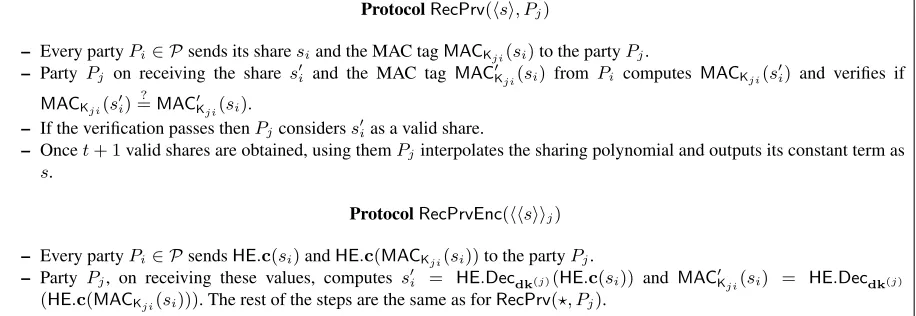
protocolsRecPrv(hsi, Pj)andRecPrvEnc(hhsiij)respectively, which are presented in Fig. 1. We stress that whilehsi
can be reconstructed towardsanyPj,hhsiij can be reconstructed only towardsPj, asPj alone holds the secret key
dk(j)that is required to decrypt the shares and the MAC tags.
ProtocolRecPrv(hsi, Pj)
– Every partyPi∈ Psends its sharesiand the MAC tagMACKji(si)to the partyPj.
– Party Pj on receiving the share s0i and the MAC tag MAC0Kji(si) from Pi computes MACKji(s 0
i) and verifies if
MACKji(s 0 i)
?
=MAC0Kji(si).
– If the verification passes thenPjconsiderss0ias a valid share.
– Oncet+ 1valid shares are obtained, using themPjinterpolates the sharing polynomial and outputs its constant term as s.
ProtocolRecPrvEnc(hhsiij)
– Every partyPi∈ PsendsHE.c(si)andHE.c(MACKji(si))to the partyPj.
– Party Pj, on receiving these values, computes s0i = HE.Decdk(j)(HE.c(si)) and MAC0Kji(si) = HE.Decdk(j) (HE.c(MACKji(si))). The rest of the steps are the same as forRecPrv(?, Pj).
Fig. 1.Protocols for Reconstructing ah·i-sharing andhh·ii-sharing Towards a Designated Party
It is easy to see that ifPj is honest, thenPj correctly reconstructs the shared value in protocolRecPrvas well as in RecPrvEnc, except with probability at most |t
F| ≈negl(µ). While protocolRecPrvhas communication complexity
O(µ·n)bits, protocolRecPrvEnchas communication complexityO(κ·n)bits. Also note that both the protocols will work in the asynchronous setting. We argue this forRecPrv(the same argument will work forRecPrvEnc). The party
Pjwill eventually receive the shares ofsfrom at leastn−t=t+ 1honest parties, with correct MACs. Theset+ 1
shares are enough for the robust reconstruction ofs. So we state the following lemma forRecPrv. Similar statements hold for protocolRecPrvEnc. Thus we have the following Lemmas.
Lemma 1. Letsbeh·i-shared among the partiesP. LetPjbe a specific party. ProtocolRecPrvachieves the following
in the synchronous communication setting:
– Correctness: Except with probabilitynegl(µ), an honestPjreconstructss.
– Communication Complexity: The communication complexity isO(µ·n)bits.
Lemma 2. Letsbeh·i-shared among the partiesP. LetPjbe a specific party. ProtocolRecPrvachieves the following
in the asynchronous communication setting:
– Correctness & Communication Complexity: Same as in Lemma 1.
– Termination: If every honest party participates inRecPrv, then an honestPjwill eventually terminate.
Linearity of Various Sharings. All of the previously defined secret sharings are linear, which for ease of exposition we shall now overview. We first define what is meant by key consistent sharings.
Definition 4 (Key-consistenth·iandhh·iij Sharings).Twoh·i-sharingshaiandhbiare said to be key-consistent if
every (honest)Piholds consistent MAC keys for everyPjacross both the sharings.
Sharingshhaiij andhhbiij with respect to a designatedPj are called key-consistent ifPj holds consistent MAC
Linearity of[·]-sharings: Given[a] ={ai} n
i=1and[b] ={bi} n
i=1and a public constantc, we have: – Addition: To compute[a+b], every partyPineeds to locally computeai+bi,
[a] + [b] = [a+b] ={ai+bi}ni=1.
– Addition by a Public Constant: To compute[c+a], every partyPineeds to locally computec+ai, c+ [a] = [c+a] ={c+ai}
n i=1.
– Multiplication by a Public Constant: To compute[c·a], every partyPineeds to locally computec·ai, c·[a] = [c·a] ={c·ai}
n i=1. Linearity ofh·i-sharing: Givenhai=
ai,{MACKji(ai),Kij} n j=1
n
i=1, andhbi = n
bi,{MACK0
ji(bi),K
0 ij}nj=1
on
i=1 that are key-consistent and a publicly-known constantc, we have:
– Addition: To computeha+bi, every partyPineeds to locally computeai+bi,{MACKji(ai) +MACK0ji(bi)} n j=1 and{Kij+K0ij}
n j=1,
hai+hbi=ha+bi=nai+bi,{MACKji+K0ji(ai+bi),Kij+K
0 ij} n j=1 on i=1 .
– Addition by a Public Constant: To computehc+ai, every partyPineeds to locally computec+ai, In addition
recall thatMACKji−c(ai+c) =MACKji(ai). Hence we assignMACKji(ai)toMACKji−c(ai+c)and compute
{Kij−c}nj=1.
c+hai=hc+ai=
c+ai,{MACKji−c(ai+c),Kij−c} n j=1
n
i=1.
– Multiplication by a Public Constant: To computehc·ai, every partyPi needs to locally computec·ai,{c· MAC·Kji(ai)}
n
j=1and{c·Kij}nj=1,
c· hai=hc·ai=
c·ai,{MACc·Kji(c·ai), c·Kij} n j=1
n i=1. Linearity ofhh·iij-sharings: Givenhhaiij=
{HE.c(ai),HE.c(MACKji(ai)),} n
i=1, {Kji}ni=1,dk (j)o
andhhbiij=
n
{HE.c(bi),HE.c(MACKji(bi))} n
i=1,{K0ji} n i=1,dk
(j)o
that are key-consistent we can add the sharings via the oper-ation
hhaiij+hhbiij=hha+biij
=n{HE.c(ai+bi),HE.c(MACKji+K0ji(ai+bi))} n i=1, {Kji+K0ji}ni=1,dk
(j)o
So to compute hha +biij, every party Pi ∈ P needs to locally compute the values HE.c(ai)⊕HE.c(bi) and HE.c(MACKji(ai))⊕HE.c(MACK0ji(bi)), while partyPj needs to compute{Kji+K
0 ji}ni=1.
Generatinghh·iij-sharing fromh·i-sharing. In our efficient protocol for public reconstruction ofh·i-shared values,
we come across the situation where there exists: a valuerknown only to a designated partyPj, a publicly known
encryptionHE.c(r)ofr, under the public keypk(j), and ah·i-sharinghai=
ai,{MACKji(ai),Kij} n j=1
n
i=1. Given the above, the parties need to compute ahh·iijsharing:
hhr·aiij=
n
{HE.c(r·ai),HE.c(MACr·Kji(r·ai))} n
i=1,{r·Kji}ni=1,dk (j)o
ofr·a. Computing the above needs only local computation by the parties. Specifically, each partyPi ∈ P locally
computes the valuesHE.c(r·ai) =aiHE.c(r)and
HE.c(MACr·Kji(r·ai)) =HE.c(r·MACKji(ai)) =MACKji(ai)HE.c(r),
3
Public Reconstruction of
h·i
-sharings with a Linear Overhead
We present a new protocol to publicly reconstructn(t+ 1)κ µ =Θ(
n2κ
µ )h·i-shared values with communication
com-plexityO(κ·n3)bits. So the amortized communication overhead for public reconstruction of oneh·i-shared value is linear inni.e.O(µ·n)bits. For a better understanding of the ideas used in the protocol, we first present a protocol
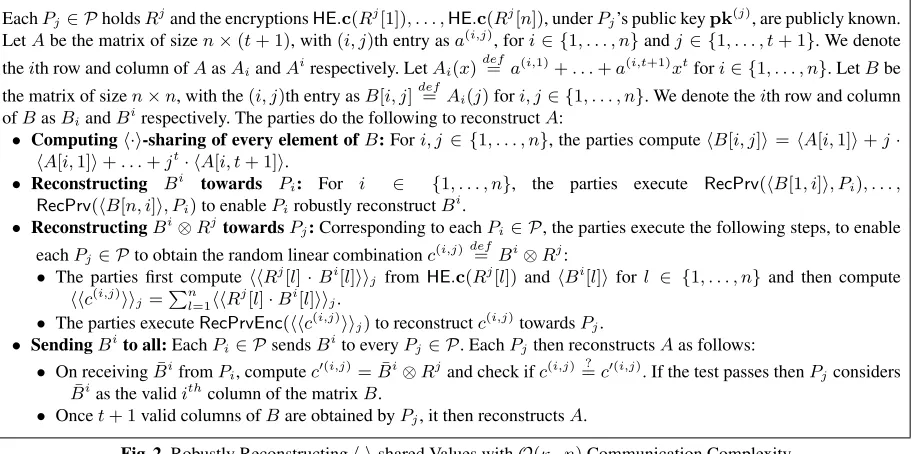
RecPubSimpleto publicly reconstructn(t+ 1)h·i-shared values with communication complexityO(κ·n3)bits. We will then extend this protocol forn(t+ 1)κµsecrets while retaining the same communication complexity; the resulting protocol is calledRecPub.
Let{ha(i,j)i}n,t+1
i=1,j=1 be theh·i-sharings, which need to be publicly reconstructed. The naive way of achieving the task is to runΘ(n3)instances ofRecPrv, whereΘ(n2)instances are run to reconstruct all the values to a single party. This method has communication complexityO(κ·n4)bits and thus has a quadratic overhead. Our approach outperforms the naive method, and works for both synchronous as well as asynchronous setting; for simplicity we first explain the protocol assuming a synchronous setting.
LetAbe ann×(t+ 1)matrix, with(i, j)th element asa(i,j). LetA
i(x)be a polynomial of degreetdefined over
the values in theith row ofA; i.e. Ai(x) def
= A[i,1] +A[i,2]x+. . . , A[i, t+ 1]xt. LetBdenote ann×nmatrix and B[i, j]def= Ai(j), fori, j ∈ {1, . . . , n}. ClearlyAcan be recovered given anyt+ 1columns ofB. We explain below
how to reconstruct at leastt+ 1columns ofB to all the parties with communication complexityO(κ·n3)bits. In what follows, we denoteith row and column ofAasAiandAirespectively, with a similar notation used for the rows
and columns ofB.
SinceBi is linearly dependent onAi, givenh·i-sharing ofAi, it requires only local computation to generate
h·i-sharings of the elements inBi. Specifically,hB[i, j]i =hA[i,1]i+hA[i,2]i ·j+. . .+hA[i, t+ 1]i ·jt. Then we
reconstruct the elements ofAto all the parties in two steps. FirstBiis reconstructed towardsP
iusingninstances of RecPrvwith an overall costO(µ·n3)bits. Next each partyP
isendsBito all the parties, requiringO(µ·n3)bits of
communication. If everyPibehaves honestly then every party would possessBat the end of the second step. However
a corruptedPimay not send the correctBi. So what we need is a mechanism that allows an honest party to detect if
a corrupted partyPihas sent an incorrectBi. Detecting is enough, since every (honest) party is guaranteed to receive
correctly theBicolumns fromt+ 1honest parties. Recall thatt+ 1correct columns ofBare enough to reconstruct A.
AfterPireconstructsBi, and before it sends the same to partyPj, we allowPjto obtain a random linear
combi-nation of the elements inBi(via interaction) in a way that the linear combiners are known to no one other thanP j.
Later, whenPisendsBitoPj, partyPjcan verify if theBireceived fromPiis correct or not by comparing the linear
combination of the elements of the receivedBi with the linear combination that it obtained before. It is crucial to
pick the linear combiners randomly and keep them secret, otherwisePican cheat with an incorrectBiwithout being
detected by an honestPj. In our method, the random combiners for an honestPj are never leaked to anyone and this
allowsPj to reuse them in a latter instance of the public reconstruction protocol. Specifically, we assume the
follow-ingone time setupforRecPubSimple(which can be done beforehand in the offline phase of the main MPC protocol). Every partyPj holds a secret keydk(j)for the linearly-homomorphic encryption schemeHEand the corresponding
public keypk(j)is publicly available. In addition,Pjholds a vectorRjofnrandom combiners and the encryptions HE.c(Rj[1]), . . . ,HE.c(Rj[n])of the values inRjunderP
j’s public keypk(j)are available publicly. The above setup
can be created once and for all, and can be reused across multiple instances ofRecPubSimple.
Given the above random combiners in an encrypted form, party Pj can obtain the linear combinationc(i,j) def
= Pn
l=1B
i[l]Rj[l]of the elements ofBias follows. First note that the parties holdh·i-sharing of the elements ofBi. If
the linear combiners were publicly known, then the parties could computehc(i,j)i=Pn
l=1R
j[l]hBi[l]iand reconstruct c(i,j)to partyP
jusingRecPrv. However since we donotwant to disclose the combiners, the above task is performed
in an encrypted form, which is doable since the combiners are encrypted under the linearly-homomorphic PKE. Specif-ically, given encryptionsHE.c(Rj[l])underpk(j)
and sharingshBi[l]i, the parties first generatehhRj[l]·Bi[l]ii j for
everyPj(recall that it requires only local computation). Next the parties linearly combine the sharingshhRj[l]·Bi[l]iij
forl= 1, . . . , nto obtainhhc(i,j)ii
j, which is then reconstructed towards partyPjusing an instance ofRecPrvEnc. In
ProtocolRecPubSimple({ha(i,j)i}n,t+1
i=1,j=1)
EachPj∈ PholdsRjand the encryptionsHE.c(Rj[1]), . . . ,HE.c(Rj[n]), underPj’s public keypk(j), are publicly known.
LetAbe the matrix of sizen×(t+ 1), with(i, j)th entry asa(i,j), fori∈ {1, . . . , n}andj∈ {1, . . . , t+ 1}. We denote theith row and column ofAasAiandAirespectively. LetAi(x)
def
= a(i,1)+. . .+a(i,t+1)xtfori∈ {1, . . . , n}. LetBbe the matrix of sizen×n, with the(i, j)th entry asB[i, j]def= Ai(j)fori, j∈ {1, . . . , n}. We denote theith row and column
ofBasBiandBirespectively. The parties do the following to reconstructA:
• Computingh·i-sharing of every element ofB:Fori, j∈ {1, . . . , n}, the parties computehB[i, j]i=hA[i,1]i+j· hA[i,1]i+. . .+jt· hA[i, t+ 1]i.
• Reconstructing Bi towards Pi: For i ∈ {1, . . . , n}, the parties execute RecPrv(hB[1, i]i, Pi), . . . ,
RecPrv(hB[n, i]i, Pi)to enablePirobustly reconstructBi.
• ReconstructingBi⊗RjtowardsP
j:Corresponding to eachPi∈ P, the parties execute the following steps, to enable
eachPj∈ Pto obtain the random linear combinationc(i,j) def
= Bi⊗Rj:
• The parties first computehhRj[l]·Bi[l]iij from HE.c(Rj[l])and hBi[l]i forl ∈ {1, . . . , n}and then compute
hhc(i,j)iij=Pnl=1hhR
j
[l]·Bi[l]iij.
• The parties executeRecPrvEnc(hhc(i,j)iij)to reconstructc(i,j)towardsPj.
• SendingBi
to all:EachPi∈ PsendsBito everyPj∈ P. EachPjthen reconstructsAas follows:
• On receivingB¯ifromPi, computec0(i,j)= ¯Bi⊗Rjand check ifc(i,j) ?=c0(i,j). If the test passes thenPjconsiders
¯
Bias the validithcolumn of the matrixB.
• Oncet+ 1valid columns ofBare obtained byPj, it then reconstructsA.
Fig. 2.Robustly Reconstructingh·i-shared Values withO(κ·n)Communication Complexity
The correctness and communication complexity of the protocol are stated in Lemma 3, which follows in a straight forward fashion from the protocol description and the detailed protocol overview. The security of the protocol will be proven, in Appendix A, in conjunction with the online phase of our MPC protocol.
Lemma 3. Let{ha(i,j)i}in,t=1+1,j=1be a set ofn(t+ 1)shared values which need to be publicly reconstructed by the parties. Then given a setup(pk(1),dk(1)), . . . ,(pk(n),dk(n))for the linearly-homomorphic encryption schemeHE
for thenparties and encryptionsHE.c(Rj[1]), . . . ,HE.c(Rj[n])ofnrandom values inRjon the behalf of each party Pj∈ P, with onlyPjknowing the random values, protocolRecPubSimpleachieves the following in the synchronous
communication setting:
– Correctness: Except with probabilitynegl(κ, µ), every honest party reconstructs{a(i,j)}n,ti=1+1,j=1. – Communication Complexity: The communication complexity isO(κ·n3)bits.
FromO(κ·n)toO(µ·n)Amortized cost of Reconstruction. We note that the amortized complexity of recon-structing one secret viaRecPubSimpleisO(κ·n), whereκis the cryptographic security parameter. To improve the amortized cost toO(µ·n), we make the following observation on the communication inRecPubSimple. There is a scope to amortize part of the communication to reconstruct more thann(t+ 1)secrets. This leads to a trick that brings down the amortized communication complexity per secret toO(µ·n)bits. We call our new protocolRecPub. which starts with κµbatches of secrets where each batch consists ofn(t+ 1)secrets. For each batch,RecPubexecutes exactly the same steps as done inRecPubSimpleexcept for the step involving the reconstruction ofBi⊗Rj.RecPubkeeps
the communication cost of this step unperturbed by taking a random linear combination of κµ Bi columns together.
ThereforeRecPubstill needs private reconstruction ofn2hh·iij-shared values and a communication ofO(κ·n3)bits
for this step. For the rest of the steps, the communication complexity ofRecPubwill be κµ times the communication complexity of the same steps inRecPubSimple. SinceRecPubSimplerequiresO(µ·n3)bits of communication for the rest of the steps, the communication complexity ofRecPubwill turn out to beO(κ·n3)bits of communication overall. Since the number reconstructed secrets aren(t+ 1)κ
µ,RecPuboffers an amortized cost ofO(µ·n)bits per
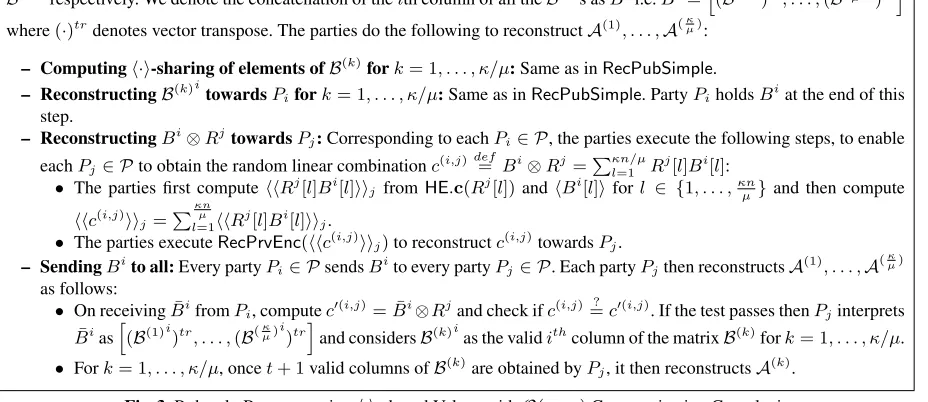
secret. The formal specification of protocolRecPubis in Fig. 3.
ProtocolRecPub({ha(i,j,k)i}in,t=1+1,j=1,κ/µ,k=1)
EachPj∈ PholdsRj= (Rj[1], . . . , Rj[κn/µ])and the encryptionsHE.c(Rj[1]), . . . ,HE.c(Rj[κn/µ]), underPj’s public
keypk(j), are publicly known. For akthat varies over1, . . . , κ/µ, the set of secrets{a(i,j,k)}n,t+1
i=1,j=1is denoted as thekth batch of secrets. LetA(k)
be the matrix of sizen×(t+ 1)consisting of thekth batch i.e., the(i, j)th entry ofA(k)
isa(i,j,k), fori∈ {1, . . . , n}andj∈ {1, . . . , t+ 1}. We denote theith row and column ofA(k)
asA(ik)andA
(k)i
respectively. We
defineA(ik)(x) def
= A(k)
[i,1] +A(k)
[i,2]·x+. . .+A(k)
[i, t+ 1]·xtfori∈ {1, . . . , n}. LetB(k)
be the matrix of sizen×n, with the(i, j)th entry asB(k)
[i, j]def= A(ik)(j)fori, j∈ {1, . . . , n}. We denote theith row and column ofB
(k)
asB(ik)and
B(k)i
respectively. We denote the concatenation of theith column of all theB(k) s asBi
i.e.Bi=h(B(1)i)tr, . . . ,(B(κµ)i )tri
where(·)trdenotes vector transpose. The parties do the following to reconstructA(1), . . . ,A(κµ) :
– Computingh·i-sharing of elements ofB(k)
fork= 1, . . . , κ/µ:Same as inRecPubSimple. – ReconstructingB(k)itowardsP
ifork= 1, . . . , κ/µ:Same as inRecPubSimple. PartyPiholdsBiat the end of this
step.
– ReconstructingBi⊗RjtowardsPj:Corresponding to eachPi∈ P, the parties execute the following steps, to enable
eachPj∈ Pto obtain the random linear combinationc(i,j) def
= Bi⊗Rj=Pκn/µ l=1 R
j
[l]Bi[l]: • The parties first computehhRj[l]Bi[l]ii
jfromHE.c(Rj[l])and hBi[l]iforl ∈ {1, . . . ,κnµ}and then compute
hhc(i,j)iij=P
κn µ
l=1hhR
j
[l]Bi[l]iij.
• The parties executeRecPrvEnc(hhc(i,j)iij)to reconstructc(i,j)towardsPj.
– SendingBito all:
Every partyPi∈ PsendsBito every partyPj∈ P. Each partyPjthen reconstructsA(1), . . . ,A(
κ µ)
as follows:
• On receivingB¯ifromP
i, computec0(i,j)= ¯Bi⊗Rjand check ifc(i,j) ?=c0(i,j). If the test passes thenPjinterprets
¯
Biash(B(1)i
)tr, . . . ,(B(κµ)i)tr
i
and considersB(k)i
as the validithcolumn of the matrixB(k)
fork= 1, . . . , κ/µ.
• Fork= 1, . . . , κ/µ, oncet+ 1valid columns ofB(k)
are obtained byPj, it then reconstructsA(k).
Fig. 3.Robustly Reconstructingh·i-shared Values withO(µ·n)Communication Complexity
a vector ofκn/µrandom values and the encryptionsHE.c(Rj[1]), . . . ,HE.c(Rj[κn/µ])done underP
j’s public key
pk(j)are available publicly. We thus have the following Lemma.
Lemma 4. Let{ha(i,j,k)i}n,t+1,κ/µ
i=1,j=1,k=1be a set ofn(t+ 1)
κ
µshared values which need to be publicly reconstructed by
the parties. Then given a setup(pk(1),dk(1)), . . . ,(pk(n),dk(n))for the linearly-homomorphic encryption scheme
HEfor thenparties and encryptionsHE.c(Rj[1]), . . . ,HE.c(Rj[κn/µ])ofκn/µrandom values inRjon the behalf
of each party Pj ∈ P, with onlyPj knowing the random values, protocolRecPub achieves the following in the
synchronous communication setting:
– Correctness: Except with probabilitynegl(κ, µ), every honest party reconstructs{a(i,j,k)}n,t+1,κ/µ i=1,j=1,k=1. – Communication Complexity: The communication complexity isO(κ·n3)bits.
ProtocolRecPubSimpleandRecPubin the Asynchronous Setting: Consider the protocolRecPubSimple, and note that the steps involving interaction among the parties are during the instances of RecPrv andRecPrvEnc. All the remaining steps involve only local computation by the parties. As the instances ofRecPrvandRecPrvEnceventually terminate for each honest party, it follows thatRecPubSimple eventually terminates for each honest party in the asynchronous setting. Similar arguments hold forRecPub, so we get the following lemma.
Lemma 5. ProtocolRecPubachieves the following in the asynchronous communication setting:
4
Linear Overhead Online Phase Protocol
Letf : Fn → Fbe a publicly known function overF, represented as an arithmetic circuitC overF, consisting of
M multiplication gates. Then using our efficient reconstruction protocolRecPubenables one to securely realize the standard ideal functionalityFf(see Fig. 4 for an explicit functionality) for the MPC evaluation of the circuitC, in the
FPREP-hybrid model, with communication complexityO(µ·(n·M +n2))bits, thus providing a linear overhead per multiplication gate. More specifically, assume that the parties have access to an ideal pre-processing and input pro-cessing functionalityFPREP, which creates the followingone-timesetup:(i)EveryPjholds a secret keydk(j)for the
linearly-homomorphic encryption schemeHEand the corresponding public keypk(j)is available publicly. In addition, eachPj holdsnrandom combinersR(j)= (r(j,1), . . . , r(j,n))and the encryptionsHE.c(r(j,1)), . . . ,HE.c(r(j,n))of
these values underPj’s public key are publicly available.(ii)EachPiholdsαij, theα-component of all its keys for
partyPj(recall that for key-consistent sharings everyPihas to use the sameα-component for all its keys
correspond-ing toPj). The above setup can be reused across multiple instances ofΠONLINEand can be created once and for all. In addition to the one-time setup, the functionality also creates at leastM randomh·i-shared multiplications triples (these are not reusable and have to be created afresh for every execution of ΠONLINE) andh·i-shared inputs of the parties. FunctionalityFPREPis presented in Fig. 5. InFPREP, the ideal adversary specifies all the data that the corrupted
parties would like to hold as part of the various sharings generated by the functionality. Namely it specifies the shares, MAC keys and MAC tags. The functionality then completes the sharings while keeping them consistent with the data specified by the adversary.
FunctionalityFf
Ff interacts with the partiesP1, . . . , Pnand the adversary S and is parametrized by ann-input functionf : Fn → F
represented as an arithmetic circuitC.
– Upon receiving(i, x(i))from every partyPi ∈ Pwherex(i) ∈F, the functionality computesy=C(x(1), . . . , x(n)),
sendsyto all the parties and the adversarySand halts. HereCdenotes the arithmetic circuit overFrepresentingf.
Fig. 4.The Ideal Functionality for Computing a Given Function
UsingFPREPwe design a protocolΠONLINE(see Fig. 6) which realizesFf in the synchronous setting and provides
universal composability(UC) security [13,10,22,16]. The protocol is based on the standard Beaver’s idea of securely evaluating the circuit in a shared fashion using pre-processed shared random multiplication triples [4] and shared inputs. Namely, the parties evaluate the circuitC in ah·i-shared fashion by maintaining the following invariant for each gate in the circuit. Given ah·i-sharing of the inputs of the gate, the parties generate anh·i-sharing of the output of the gate. Maintaining the invariant for linear gates requires only local computation, thanks to the linearity property of theh·i-sharing. For multiplication gates, the parties deploy a shared multiplication triple received fromFPREPand evaluate the multiplication gate by using Beaver’s trick. Specifically, lethpi,hqibe the sharing corresponding to the inputs of a multiplication gate and let(hai,hbi,hci)be the shared random multiplication triple obtained fromFPREP,
which is associated with this multiplication gate. To compute anh·i-sharing of the gate output p·q, we note that
p·q= (p−a+a)·(q−b+b) =d·e+d·b+e·a+c, whereddef= p−aandedef= q−b. So ifdandeare publicly known thenhp·qi =d·e+d· hbi+e· hai+hciholds. To makedandepublic, the parties first locally compute hdi=hpi − haiandhei=hqi − hbiand publicly reconstruct these sharings. Note that even thoughdandeare made public, the privacy of the gate inputspandqis preserved, asaandbare random and private. Finally once the parties have the sharinghyifor the circuit output, it is publicly reconstructed to enable every party obtain the function output. To achieve the linear overhead inΠONLINE, we require that the circuit is “wide” in the sense that at every level
FunctionalityFPREP
The functionality interacts with the parties inPand the adversarySas follows. LetC ⊂ Pbe the set of corrupted parties. – Setup Generation:On inputSetupfrom the parties inP, the functionality does the following:
• It createsnpublic key, secret key pairs{pk(i),dk(i)}n
i=1of the linearly-homomorphic encryption schemeHE, • For eachPi, it selects κnµ random valuesRi = (r(i,1), . . . , r(i,
κn
µ)), computesHE.c(r(i,1)), . . . ,HE.c(r(i,κnµ))
underpk(i), • To partyPiit sends
dk(i),(r(i,1), . . . , r(i,κnµ)),{pk(j)}n
j=1,{HE.c(r (j,1)
), . . . ,HE.c(r(j,κnµ ))}n
j=1
.
• On the behalf of each honestPi ∈ P \ C, it selectsnrandom values{αij}nj=1, where thejth value is designated to be used in the MAC key for partyPj. On the behalf of each corrupted partyPi ∈ C, it receives fromS theαij
values thatPiwants to use in the MAC keys corresponding to the honest partyPj. On receiving, the functionality
stores these values.
– Triple Sharings: On inputTriplesfrom all the parties inP, the functionality generatesh·i-sharing ofχrandom multipli-cation triples in parallel. To generate one such sharing(hai,hbi,hci), it does the following:
• It randomly selectsa, band computesc=ab. It then runs ‘Singleh·i-sharing Generation’ (see below) fora,bandc. – Input Sharings: On input(x(i), i,Input)from partyP
iand(i,Input)from the remaining parties, the functionality runs
‘Singleh·i-sharing Generation’ (given below) forx(i).
Singleh·i-sharing Generation: The functionality does the following to generatehsi-sharing for a given values:
– On receiving the shares{si}Pi∈CfromSon the behalf of the corrupted parties, it selects a polynomialS(·)of degree at
mostt, such thatS(0) =sandS(i) =sifor eachPi∈ C. ForPi6∈ P \ C, it computessi=S(i).
– On receiving{βij}Pi∈C, Pj6∈CfromS, the second components of the MAC key thatPi ∈ C will have for an honest
partyPj, it setsKij = (αij, βij)whereαijwas specified bySin ‘Setup generation’ stage. It computes the MAC tag
MACKij(sj)ofsjfor every honestPjcorresponding to the key of every corruptedPi.
– On receiving MAC tags{MACij}Pi∈C, Pj6∈Cthat the corrupted parties would like to have on their sharessicorresponding
to the MAC key of honestPj, it fixes the key ofPjcorresponding toPiasKji= (αji, βji)whereβji=MACij−αji·si
andαjiwas selected by the functionality in ‘Setup generation’ stage.
– For every pair of honest parties(Pj, Pk), it chooses the key ofPjasKjk = (αjk, βjk)whereαjkis taken from ‘setup
generation phase’ andβjkis chosen randomly. It then computes the corresponding MAC tag ofPkasMACKjk(sk).
– It sendssj,{MACKkj,Kjk}
n
k=1 to honest partyPj(no need to send anything to corrupted parties asShas the data of
the corrupted parties already).
Fig. 5.Ideal Functionality for Setup Generation, Offline Pre-processing and Input Processing
in arithmetic circuit format, and practical systems use algorithms to maximise the level of such parallelism in their execution, see e.g. [32].
The properties of ΠONLINE are stated in Theorem 1, which is proved in Appendix A. In the protocol,2M h·i-shared values are publicly reconstructed viaRecPubwhile evaluating the multiplication gates. Assuming that theM
multiplication gates can be divided into blocks ofn(t+ 1)κµ independent multiplication gates, evaluating the same will costO(κn3· µM
n(t+1)κ) =O(µ·n·M)bits. The only steps inΠONLINEwhich require interaction among the parties are during the instances of the reconstruction protocols, which eventually terminate for the honest parties. Hence we get Theorem 2 for the asynchronous setting.
Theorem 1. ProtocolΠONLINEUC-securely realizes the functionalityFfin theFPREP-hybrid model in the synchronous
setting. The protocol has communication complexityO(µ·(n·M+n2))bits.
Theorem 2. Protocol ΠONLINE UC-securely realizes the functionality Ff in the FPREP-hybrid model in the
ProtocolΠONLINE
Every party Pi ∈ P interact with FPREP with input Setup, Triples and (x
(i)
, i,Input) and receives dk(i), {pk(j)}n
j=1, R
i
= (r(i,1), . . . , r(i,κnµ)), {HE.c(r(j,1)), . . . ,HE.c(r(j,κnµ))}n
j=1, its information for multiplication triples {(ha(l)i,hb(l)i,hc(l)i)}M
l=1 and its information for inputs {hx(j)i}nj=1. The honest parties associate the sharing (ha(l)i,hb(l)i,hc(l)i)
with thelth
multiplication gate forl∈ {1, . . . , M}and evaluate each gate in the circuit as follows: – Linear Gates: using the linearity property ofh·i-sharing, the parties apply the linear function associated with the gate on
the correspondingh·i-shared gate inputs to obtain anh·i-sharing of the gate output. – Multiplication Gates:M multiplication gates as grouped as a batch ofn·(t+ 1)· κ
µ. We explain the evaluation for
one batch. Let the inputs to theith batch be{(hp(l)i,hq(l)i)}n·(t+1)·
κ µ
l=1 and let{(ha (l)i
,hb(l)i,hc(l)i)}n·(t+1)·
κ µ
l=1 be the corresponding associated multiplication triples. To computehp(l)·q(l)i, the parties do the following:
• Locally computehd(l)i=hp(l)i − ha(l)i=hp(l)−a(l)iandhe(l)i=hq(l)i − hb(l)it=hq(l)−b(l)i.
• Publicly reconstruct the values{d(l)}n·(t+1)·κµ
l=1 and{e
(l)}n·(t+1)·κµ
l=1 using two instances ofRecPub. • On reconstructingd(l), e(l), the parties sethp(l)·ql)i=d(l)·e(l)+d(l)· hb(l)i+e(l)· ha(l)i+hc(l)i.
– Output Gate: Lethyibe the sharing of the output gate. The parties executeRecPrv(hyi, Pi)for everyPi∈ P, robustly
reconstructyand terminate.
Fig. 6.RealizingFfwith a Linear Overhead inFPREP-hybrid Model for the Synchronous Setting
5
The Various Secure Realizations of
F
PREPSecurely RealizingFPREPin the Synchronous Setting. In Appendix B, we present a protocolΠPREPwhich realizes FPREPin the synchronous setting and achieves UC security. The protocol is a straight forward adaptation of the offline phase protocol of [10,22] to deal with Shamir sharing, instead of additive sharing.
Securely RealizingFPREPwith Abort in the Partial Synchronous Setting. Any secure realization ofFPREPhas to ensure that all the honest parties have anagreementon the final outcome, which is impossible in the asynchronous setting witht < n/2[29,30]. Another difficulty in realizingFPREP in an asynchronous setting is that it is possible to ensure input provision from onlyn−tparties to avoid endless wait. Forn = 2t+ 1this implies that there may be only one honest input provider. This may not be acceptable for most practical applications of MPC. To get rid of the latter difficulty, [19] introduced the following variant of the traditional asynchronous communication setting, which we refer aspartial asynchronous setting:
• The protocols in the partial asynchronous setting have onesynchronizationpoint. Specifically, there exists a certain well defined time-out and the assumption is that all the messages sent by the honest parties before the deadline will reach to their destinations within this deadline.
• Any protocol executed in the partial asynchronous setting need not always terminate and provide output to all the honest parties. Thus the adversary may cause the protocol to fail. However it is required that the protocol up to the synchronization point does not release any new information to the adversary.
In Appendix C we examine how to makeΠPREPwork in the partial asynchronous setting. We present two solutions; the first which allows some synchronous rounds after the synchronization point, and one which uses a non-equivocation mechanism (which can be implemented using a trusted hardware module).
Acknowledgements
References
1. G. Asharov, A. Jain, A. L´opez-Alt, E. Tromer, V. Vaikuntanathan, and D. Wichs. Multiparty Computation with Low Commu-nication, Computation and Interaction via Threshold FHE. In D. Pointcheval and T. Johansson, editors,EUROCRYPT, volume 7237 ofLecture Notes in Computer Science, pages 483–501. Springer, 2012.
2. M. Backes, F. Bendun, A. Choudhury, and A. Kate. Asynchronous MPC with a Strict Honest Majority Using Non-equivocation. In M. M. Halld´orsson and S. Dolev, editors,PODC, pages 10–19. ACM, 2014.
3. J. Baron, K. E. Defrawy, J. Lampkins, and R. Ostrovsky. How to Withstand Mobile Virus Attacks, Revisited. In M. M. Halld´orsson and S. Dolev, editors,PODC, pages 293–302. ACM, 2014.
4. D. Beaver. Efficient Multiparty Protocols Using Circuit Randomization. In J. Feigenbaum, editor,CRYPTO, volume 576 of
Lecture Notes in Computer Science, pages 420–432. Springer Verlag, 1991.
5. Z. Beerliov´a-Trub´ıniov´a and M. Hirt. Efficient Multi-party Computation with Dispute Control. In S. Halevi and T. Rabin, editors,TCC, volume 3876 ofLecture Notes in Computer Science, pages 305–328. Springer, 2006.
6. Z. Beerliov´a-Trub´ıniov´a and M. Hirt. Perfectly-Secure MPC with Linear Communication Complexity. In R. Canetti, editor,
TCC, volume 4948 ofLecture Notes in Computer Science, pages 213–230. Springer Verlag, 2008.
7. M. Ben-Or, R. Canetti, and O. Goldreich. Asynchronous Secure Computation. In S. R. Kosaraju, D. S. Johnson, and A. Ag-garwal, editors,STOC, pages 52–61. ACM, 1993.
8. M. Ben-Or, S. Goldwasser, and A. Wigderson. Completeness Theorems for Non-Cryptographic Fault-Tolerant Distributed Computation (Extended Abstract). In J. Simon, editor,STOC, pages 1–10. ACM, 1988.
9. E. Ben-Sasson, S. Fehr, and R. Ostrovsky. Near-Linear Unconditionally-Secure Multiparty Computation with a Dishonest Minority. In R. Safavi-Naini and R. Canetti, editors,CRYPTO, volume 7417 ofLecture Notes in Computer Science, pages 663–680. Springer, 2012.
10. R. Bendlin, I. Damg˚ard, C. Orlandi, and S. Zakarias. Semi-homomorphic Encryption and Multiparty Computation. In K. G. Paterson, editor,EUROCRYPT, volume 6632 ofLecture Notes in Computer Science, pages 169–188. Springer, 2011. 11. Zvika Brakerski, Craig Gentry, and Vinod Vaikuntanathan. (leveled) fully homomorphic encryption without bootstrapping.
TOCT, 6(3):13:1–13:36, 2014.
12. R. Canetti.Studies in Secure Multiparty Computation and Applications. PhD thesis, Weizmann Institute, Israel, 1995. 13. R. Canetti. Security and Composition of Multiparty Cryptographic Protocols.J. Cryptology, 13(1):143–202, 2000.
14. D. Chaum, C. Cr´epeau, and I. Damg˚ard. Multiparty Unconditionally Secure Protocols (Extended Abstract). InSTOC, pages 11–19. ACM, 1988.
15. A. Choudhury, M. Hirt, and A. Patra. Asynchronous Multiparty Computation with Linear Communication Complexity. In Y. Afek, editor,DISC, volume 8205 ofLecture Notes in Computer Science, pages 388–402. Springer, 2013.
16. A. Choudhury, J. Loftus, E. Orsini, A. Patra, and N. P. Smart. Between a Rock and a Hard Place: Interpolating between MPC and FHE. In K. Sako and P. Sarkar, editors,ASIACRYPT, volume 8270, pages 221–240. Springer, 2013.
17. A. Choudhury and A. Patra. Optimally Resilient Asynchronous MPC with Linear Communication Complexity. In S. K. Das, D. Krishnaswamy, S. Karkar, A. Korman, M. Kumar, M. Portmann, and S. Sastry, editors,ICDCN, pages 5:1–5:10. ACM, 2015.
18. A. Clement, F. Junqueira, A. Kate, and R. Rodrigues. On the (Limited) Power of Non-equivocation. In D. Kowalski and A. Panconesi, editors,PODC, pages 301–308. ACM, 2012.
19. I. Damg˚ard, M. Geisler, M. Krøigaard, and J. B. Nielsen. Asynchronous Multiparty Computation: Theory and Implementation. In S. Jarecki and G. Tsudik, editors,PKC, pages 160–179, 2009.
20. I. Damg˚ard, Y. Ishai, and M. Krøigaard. Perfectly Secure Multiparty Computation and the Computational Overhead of Cryp-tography. In H. Gilbert, editor,EUROCRYPT, volume 6110 ofLecture Notes in Computer Science, pages 445–465. Springer, 2010.
21. I. Damg˚ard and J. B. Nielsen. Scalable and Unconditionally Secure Multiparty Computation. In A. Menezes, editor,CRYPTO, volume 4622 ofLecture Notes in Computer Science, pages 572–590. Springer Verlag, 2007.
22. I. Damg˚ard, V. Pastro, N. P. Smart, and S. Zakarias. Multiparty Computation from Somewhat Homomorphic Encryption. In R. Safavi-Naini and R. Canetti, editors,CRYPTO, volume 7417 ofLecture Notes in Computer Science, pages 643–662. Springer, 2012.
23. Ivan Damg˚ard, Marcel Keller, Enrique Larraia, Valerio Pastro, Peter Scholl, and Nigel P. Smart. Practical covertly secure MPC for dishonest majority - or: Breaking the SPDZ limits. In Jason Crampton, Sushil Jajodia, and Keith Mayes, editors,Computer Security - ESORICS 2013, volume 8134 ofLecture Notes in Computer Science, pages 1–18. Springer, 2013.
24. M. Fitzi and M. Hirt. Optimally Efficient Multi-valued Byzantine Agreement. In E. Ruppert and D. Malkhi, editors,PODC, pages 163–168. ACM Press, 2006.
26. R. Gennaro, M. O. Rabin, and T. Rabin. Simplified VSS and Fact-Track Multiparty Computations with Applications to Threshold Cryptography. In B. A. Coan and Y. Afek, editors,podc, pages 101–111. ACM, 1998.
27. O. Goldreich, S. Micali, and A. Wigderson. How to Play any Mental Game or A Completeness Theorem for Protocols with Honest Majority. InSTOC, pages 218–229. ACM, 1987.
28. M. Hirt and J. B. Nielsen. Robust Multiparty Computation with Linear Communication Complexity. In C. Dwork, editor,
CRYPTO, volume 4117 ofLecture Notes in Computer Science, pages 463–482. Springer, 2006.
29. M. Hirt, J. B. Nielsen, and B. Przydatek. Cryptographic Asynchronous Multi-party Computation with Optimal Resilience (Extended Abstract). InEUROCRYPT, LNCS 3494, pages 322–340. Springer Verlag, 2005.
30. M. Hirt, J. B. Nielsen, and B. Przydatek. Asynchronous Multi-Party Computation with Quadratic Communication. InICALP, LNCS 5126, pages 473–485. Springer Verlag, 2008.
31. J. Katz and C. Y. Koo. On Expected Constant-Round Protocols for Byzantine Agreement. In C. Dwork, editor,CRYPTO, volume 4117 ofLecture Notes in Computer Science, pages 445–462. Springer, 2006.
32. Marcel Keller, Peter Scholl, and Nigel P. Smart. An architecture for practical actively secure MPC with dishonest majority. In Ahmad-Reza Sadeghi, Virgil D. Gligor, and Moti Yung, editors,ACM CCS’13, pages 549–560. ACM, 2013.
33. A. C. Yao. Protocols for Secure Computations (Extended Abstract). InFOCS, pages 160–164. IEEE Computer Society, 1982.
A
Proof of Theorem 1
We refer to [10,13,16,22] for the definition of UC-security. LetAbe a real-world adversary corruptingtparties during the execution ofΠONLINE and letC ⊂ P denote the set of corrupted parties. We present a simulatorSf forA, who
interacts withFf and simulates each received message ofAin the protocolΠONLINEfrom the honest parties and from the functionalityFPREP, stage by stage. Note that the simulator will also simulate the steps of the subprotocolRecPub executed inside the protocolΠONLINE. We present the high level idea of the simulator first, for formal details see Figures
7 and 8.
The idea ofSfis straight forward. The simulator plays the role ofFPREPand honestly simulates the call toFPREP.
Specifically, on receivingSetupfrom the corrupted parties, it createsnpublic key, secret key pairs{pk(i),dk(i)}n i=1of the linearly-homomorphic encryption schemeHE, selects κnµ random valuesRj= (r(j,1), . . . , r(j,κnµ))and computes
their encryptionsHE.c(r(j,1)), . . . ,HE.c(r(j,κn
µ))underpk(j)and sends
dk(i),(r(i,1), . . . , r(i,κnµ )),{pk(j)}n
j=1,{HE.c(r
(j,1)), . . . ,HE.c(r(j,κn µ ))}n
j=1
to every corrupted partyPi. Next, it createsh·i-sharings ofχrandom multiplication triples, taking inputs fromAthe
shares, the MAC keys and the MAC tags of the corrupted parties in each of these sharings just as inFPREP. Next the simulator learns a corrupted partyPi’s inputx(i)fromPi’s input message(x(i), i,Input)that it sends toFPREP. The simulator sets the inputx(i) of each honestP
i as zero. With these inputs, Sf perfectly emulatesFPREP. That is, it
createsh·i-sharings of the inputs of each party, whereAselects the shares, the MAC keys and the MAC tags of the corrupted parties in each of these sharings just as inFPREP.
Then, the simulator simulates the shared circuit evaluation using the above inputs of the parties , updating the sharings after each gate evaluation. The sharings that need to be opened during the evaluation of multiplication gates are known to the simulator and hence it can easily simulate the messages of the honest parties, corresponding to the protocol steps ofRecPub. On receiving the communication from the corrupted parties (on behalf of the honest parties), it checks if the corrupted parties have sent incorrect information that pass the MAC test or the random combination test whichever is applicable according toRecPubprotocol steps (for the latter, recall that an honestPj is supposed
to test ifc0(i,j) = ¯Bi⊗Rj =? c(i,j)for everyP
i). Note that it can do so since it knows all the information that the
corrupted parties hold and latter reveal to the honest parties as a part of the sharings that are opened inRecPub. If it notes that a corrupted party sent wrong information that passes the above tests, then it halts the simulation and aborts. Otherwise, it goes on to simulate the opening of the output sharing as follows:
– The simulator first learns the function outputy by sending the inputs of the corrupted parties toFf. Since the
– The simulator ensures that the shares of the honest parties in the sharinghyihave MAC tags consistent with the MAC keys of the corrupted parties in the sharinghyei. Again the simulator can do this, as it knows the MAC keys of the corrupted parties.
– Having done so, the simulator can now easily send the fake shares ofyand MAC tags on the behalf of the honest parties, which will be consistent with respect to the MAC keys of the parties underAcorresponding to the honest parties. Using these shares, Areconstructsy, which is the same as in the real protocol. If the corrupted parties sends wrong shares that passes the MAC test, the simulator halts the simulation and aborts.
The differences between the simulated and hybrid views are: (i) First, in simulated view the inputs for the honest parties arenotreal inputs (0is used instead) whereas the real inputs of the honest parties are used in the hybrid view. During the simulation of the output opening, the shares (and the MAC tags) of the honest parties corresponding to the output sharing are changed to cook up a sharing corresponding to the actual function outputy. This enables the simulator to make sure that the adversary outputs the realy. The adversary/environment cannot make out whether the real inputs or fake (0) inputs are used for the honest parties since the inputs of the honest parties as well as the intermediate values of the circuit computation remainh·i-shared. The public openings during the computation are masked values and therefore they do not leak any information too. So even if the environment has unbounded computing power, it cannot tell apart the views. (ii) Second, in the simulated view, the adversary/environment cannot cheat the simulator who is acting on the behalf of the honest parties, by guessing the MAC keys or by guessing the random combiners. corresponding to the honest parties. The reason is that the simulator knows in advanceh·iijfor every corruptedPi∈ C
and honestPj 6∈ Cfor each of the sharing involved in the computation. That is, it knows in advance the information
that corruptedPiis supposed to send to an honestPjeither for MAC test or for linear combiner test. If the adversary
sends wrong information for the above verifications and still passes the tests, then the simulator halts. Whereas in the hybrid world, the honest parties will carry on the computation as the tests pass and may end up outputting wrong output. However the probability with which the simulated world and the hybrid would will differ in this regard is the same as the probability with which the adversary can pass the MAC test or the random combiner test corresponding to the MAC keys and the random combiners of the honest parties. For the MAC test, the probability is same as the probability of forging a MAC tag and is negligible. For the random combiner test, the probability is the same as the chances of the adversary in guessing the random combiners from their encrypted form. So the security here can be reduced to the security of the underlying HE scheme. In other words, if the HE is semantically secure, then the probability of guessing the random linear combiners of an honest party is negligible. This implies that the simulated and the hybrid views are indistinguishable from the view point of the environment. This completes our proof.
SimulatorSf – Part 1
LetHEbe a linearly-homomorphic encryption scheme. The simulator plays the role of the honest parties and simulates each step of the protocolΠONLINE as follows. The communication of the environmentZ with the adversaryAis handled
as follows: Every input value received by the simulator fromZ is written onA’s input tape. Likewise, every output value written byAon its output tape is copied to the simulator’s output tape (to be read by the environmentZ). The simulator does the following. In the simulation below, we use the following notation: for ah·i-sharing: (i) the information that corre-sponds to a partyPiis denoted byh·iiand (ii) the share and (MAC tag, MAC key) ofPicorresponding toPjis denoted ash·iij.
Simulating the call toFPREP:Sf honestly emulatesFPREP setting the function inputs of the honest parties to be0. At
the end, it knows the following for the triple sharings {(ha(l)i),hb(l)i),hc(l)i)}χ
l=1, input sharings {hx (i)i}
Pi∈C of the
corrupted parties and the inputs sharings{hxg(i)i}P
i∈P\Ccorresponding to honest (we denote the input of an honest partyPi
withxg(i)since it is not the real input ofPi): (i)h·ijfor every honestPjand (ii)h·iijfor every corruptedPi∈ Cand honest
partyPj. It also knows the combinersRi=r(i,1), . . . , r
(i,κn
µ)and the encrypted combinersHE.c(r(i,1)), . . . ,HE.c(r(i,κnµ))
for eachPi∈ P, along with the public-key secret-key pairs{(pk(i),dk(i))}ni=1.