Print Publication Date: Jul 2015 Subject: Philosophy, Philosophy of Mind
Online Publication Date: Jun 2014 DOI: 10.1093/oxfordhb/9780199600472.013.041
Perception and Demonstratives
Imogen Dickie
The Oxford Handbook of Philosophy of Perception
Edited by Mohan Matthen
Abstract and Keywords
A ‘perceptual demonstrative’ thought is a thought of the kind standardly made available by a perceptual link with an object, and standardly expressed using ‘this’ or that’. This chapter is an introduction to a range of questions about how perception of objects en
ables us to form perceptual demonstrative thoughts about them.
Keywords:perceptual demonstratives,acquaintance,reference
THIS chapter is about the relationship between perception and perceptual demonstrative
thought. A ‘perceptual demonstrative thought’ is a thought standardly made available by
a perceptual link with an object in the external world, and standardly expressed using the
demonstratives ‘this’ or ‘that’. For example, the thought you express when you say ‘That is rolling’, looking at an orange rolling along the table in front of you in an ordinary situa
tion, is a central case of perceptual demonstrative thought. The class of perceptual demonstrative thoughts includes this kind of central case and other thoughts relevantly
similar to it. (What counts as a ‘relevant’ similarity will emerge as we go on.)
The definition of ‘perceptual demonstrative thought’ supposes that, in central cases, your
perceptual link with an external-world object does enable you to think about it. (This sets
aside various extreme views from the history of discussion of the relationship between
perception and thought. For example it sets aside ‘idealist’ views, according to which per
ception enables us to think only about mind-dependent entities.1And it sets aside ‘in
scrutability’ views, according to which there is no fact of the matter as to which object a
thought is about, or whether it is about an object at all.2) But to insist that, in this kind of
case, a perceptual link doesenable thought about an external-world object is to say noth
ing about howit does. This question—the question ofhow a perceptual link with an object
enables perceptual demonstrative thought about it—is the fundamental question that an
To keep to handbook-entry scale, I shall restrict the discussion to the question as it arises for visual perception: How does a visual perceptual link with an object enable perceptual
demonstrative thought about it? (The philosophical literature on perceptual demonstra
tive (p. 834) thought has developed around vision.3 There are hard questions about how
closely perceptual demonstrative thought in other modalities parallels the visual case.)
The chapter has three sections. Section 1 elucidates the fundamental question by sketch
ing some of the traditional and contemporary puzzles that accompany it. Section 2 lays
out the contrast between ‘acquaintance theoretic’ and ‘description theoretic’ responses to the fundamental question and the associated puzzles. Section 3 is about how a traditional view of the nature of perception has skewed the acquaintance vs. description discussion.
Section 4 shows how recent advances in our understanding of perception—advances away
from the traditional view—shift the ground on which the debate about perception and
demonstratives must take place.
1
Some Puzzles about Perceptual Demonstra
tive Thought
Recall the example of perceptual demonstrative thought with which we began. You are
looking at an orange rolling along a table in front of you in a situation devoid of perceptu al or cognitive perversity—no mirrors, distorting lenses, or unusual lighting; no worries about whether you are a brain in a vat—and thinking the thought you would express by saying ‘That is rolling’. We are supposing that in this case your perceptual link with the
orange does enable you to think about it. The fundamental question for an account of the
relation between perception and demonstratives is the question of how your perceptual
link is doing its aboutness-fixing and thought-enabling work. But many philosophers have thought it best to approach the fundamental question against the background of a range
of puzzles or subsidiary questions which bring out the kinds of commitment that an an
swer to the central question might carry. This section sketches seven of these puzzles.
First puzzle—directness
4The first puzzle concerns how direct in space, time, and causal pathway a perceptual link
must be if it is to enable perceptual demonstrative thought. Let us say that a ‘perceptual link’ with an object is a perceptual information feed whose deliverances are sensitive to the object’s properties. Then all of the following count as cases where subjectShas a per
ceptual link with object o:
(1) a central case situation of the kind we started with (S is looking at o as o rolls
along a table a couple of feet away).
(2) S is looking at o in a mirror. (p. 835)
(3) S is looking at o’s shadow.
(5) S is looking at a now long-dead person on film; the film shows the person still in her prime
(6) S is looking at a bright, reddish, star which in fact ceased to exist 500 years ago,
but is still visible to S because it was 1,000 light years away.
(7) S is looking at some o* many of whose properties depend causally on o’s (for ex
ample, o’s footprint in the sand).
(8) S is looking at some o* only a few of whose properties depend causally on o’s (for
example, S might be looking at o’s car, inexpertly parked byo, and now festooned
with parking tickets, and thinking ‘He’ll be sorry’).
Let us say that in (1)—the central case situation—S’s perceptual link withois ‘maximally direct’: it is as direct in space, time, and causal pathway as our perceptual links get. Then (2)–(8) describe various kinds and degrees of progression away from maximal directness. Most participants in the debate about perception and demonstratives agree that the per ceptual links at (7) and (8) cannot sustain perceptual demonstrative thought. These per
ceptual links are too indirect to put S in a position to think about o in the same way as the
perceptual link at (1) does (they enable S to think about o, but only under the descrip
tions ‘the maker of this footprint’ or ‘the driver of that car’). But (2)–(6) describe a contin uum of situations in which S’s perceptual link witho is less and less direct. Where along
this continuum does a perceptual link with an object become too indirect to enable per
ceptual demonstrative thought about it?
Second puzzle—comprehensiveness
5The second puzzle is about how much of a thing a perceptual link must put you in contact with to enable perceptual demonstrative thought about it. On the face of things, it seems
that a central-case perceptual link does not put you in touch with an entire ordinary ob ject. Ordinary objects extend in three dimensions. But your eyes pick up only light reflect
ed by the surfaces of the object that face you. So (it seems) there are reasonable grounds for saying that there are parts of the object (its interior; its back surfaces) with which
your perceptual link is not putting you in contact.6 But it is also plausible that the thought
you express when you say ‘That is rolling’ in the central case we have described is about
the whole orange, not just the part of it that faces you. So it seems that in central-case
perceptual demonstrative thought, perceptual contact with part of a thing enables per
ceptual demonstrative thought about all of it. And in that case we should be able to say
how much of a thing a perceptual link must put you in contact with—how much of the thing the perceptual link must comprehend—if it is to sustain perceptual demonstrative
thought. Can S have a perceptual demonstrative thought about a whole fence-post on the
basis of a (p. 836) perceptual link that comprehends only the part of the post that sticks up
Note that this is another continuum puzzle. There is a continuum running from the cen
tral case to something like the peninsula/continent case. We should be able to say how far
along this continuum the class of perceptual links that can sustain perceptual demonstra
tive thought extends.
Third puzzle—classification
The third puzzle concerns the relation between perceptual demonstrative reference and
sortal classification. In intuitive terms, ‘sortal’ classification is classification of objects ac cording to the kinds of objects they are. For example, ‘X is an animal’, ‘X is a tree’, and ‘X is an item of furniture’ are all statements of sortal classification because ‘animal’, ‘tree’, and ‘item of furniture’ are all kinds in some intuitive sense of ‘kind’. ‘X is red’ is not a
statement of sortal classification because it does not carry genuine kind information: to
tell you that X is red is not yet to tell you anything about how X might have come into ex
istence; how it might change over time; or the kind of event that would destroy it. (There
are very hard questions about how the intuitive notion of ‘sortal’ classification is to be
made precise.7)
The puzzle about perceptual demonstrative thought and sortal classification arises be cause there are apparently strong grounds for both the (‘sortalist’) claim that a perceptu
al link enables perceptual demonstrative thought only if it enables sortal classification
and the competing (‘anti-sortalist’) claim that a perceptual link can enable perceptual
demonstrative thought about an object without even in principle putting the subject in a position to know what kind of thing it is.
One argument for sortalism comes from the old contention that any scene perception might present can be divided up into objects in different ways, and it is only by supplying
a sortal concept that you can isolate one of the objects in a scene as the thing you are go
ing to go on and think about. For example, looking at a stand of trees you might think
each of ‘Here is a copse’, ‘Here are five trees’, or ‘Here are thousands of leaves, dozens of
branches, and five trunks’. According to the sortalist, your perceptual feed alone cannot
do the job of determining whether you are thinking about the copse, the trees, or the
leaves and branches. Rather, you must supply a sortal concept (‘copse’, ‘tree’, ‘branch’) to
determine which of the things in the perceived scene is the object of your perceptual
demonstrative thought.8
The main grounds for anti-sortalism come from apparent counterexamples to sortalism: cases where a perceptual link seems to enable perceptual demonstrative thought without
enabling sortal classification. Here are some examples of this kind.9
CASE 1—You stumble upon a thing of a kind you have not come across before. You have no idea where it might fit in your system of sortal classification—whether it is ani
mal, (p. 837) vegetable, or mineral; whether it is an artefact or something that came to
CASE 2—You think (looking ato and noting o’s tallness-for-a-man) ‘That is a tall man’.
In fact, o is a waxwork. But surely (it seems) your perceptual link is securing o as the
object your thought is about.
CASE 3—You can see a thing moving around in the distance. It is too far away for you
to tell what kind of thing it is. But surely (it seems) you can think about it. (You and
your friend might be having a dispute about whether it is a bird, a plane, or Super
man.)
The standard sortalist response to cases like these10is to say that perceptual demonstra
tive thought does not require a right sortal classification of the object the thought is
about. A perceptual link that enables perceptual demonstrative thought need only enable
the subject to make an approximately right classification. Or, alternatively, it need only
supply the subject with the in principle capacity to home in on a right classification. But
anyone making this move faces difficult questions. How is the notion of ‘approximating to’ or ‘homing in on’ a right sortal classification to be made precise? Does the move work
against all of the examples the anti-sortalist might raise? Does the weakened sortalist view respect the arguments that motivate sortalism in the first place?
A right account of how perception enables perceptual demonstrative thought should en
able us to settle the sortalist/ anti-sortalist dispute.
Fourth puzzle—category
11The fourth puzzle concerns the category of particular about which perceptual demonstra
tive thought is possible. In the central-case example we started with, the perceptual demonstrative thought is about an ordinary material thing. But does the class of things about which we can have this kind of thought include non-ordinary physical things like ripples, clouds, and shadows? Does it include mereological gryphons built from parts of
distinct material objects (so that a suitable perceptual link could enable me to have ‘that’ thoughts about the mereological sum of my dog’s left ear and a tree in the middle dis tance)? What about places, times, and events—can a perceptual feed enable a subject to think about these particulars in the same way as it enables us to think about ordinary ma
terial things in central cases?
Fifth puzzle—focus
12The fifth puzzle is (roughly) the puzzle of whether there can be perceptual demonstrative
thought on the basis of merely peripheral vision (strictly speaking this is a puzzle (p. 838)
about unattended peripheral vision).13 There is significant intuitive appeal to the claim
that peripheral vision cannot sustain perceptual demonstrative thought. For (it seems), a
perceptual link that can sustain perceptual demonstrative thought about o must at least
present oas distinct from the objects around it. And objects with which we have peripher
of gross macroscopic property instantiation: ‘There is something pale coloured over there’; ‘There is something with sharp edges’; ‘There is something moving’. And you will be better than chance at putting gross macroscopic properties together (‘The sharp-edged thing is moving’; ‘The pale thing is curved’). But, if you are relying on peripheral
vision alone, you will also make many mistakes about which properties go together as
properties of the same object.14 And any fine detail you add to your account will have to
come from either guesswork or prior knowledge.)
However, we need a more-than-just-intuitive story about whyperipheral vision cannot sus
tain perceptual demonstrative thought. And the case of peripheral vision also raises yet another continuum problem. On the face of things, there are degrees of perceptual focus
and peripherality.15What degree of centrality to perceptual focus does perceptual demon
strative thought require?
Sixth puzzle—awareness
16The sixth puzzle is about the relation between perceptual demonstrative thought and con
scious awareness.
It is a widespread (though comparatively recent) observation that the perceptual system can generate a quite rich information feed even though the subject has no awareness of the object from which the information is derived. For example, subjects with a specific type of brain damage can give, on the basis of visual contact alone, very reliable forced-choice answers to questions about the properties of objects they are not aware of seeing.
(These are ‘blindsight’ patients. Blindsight is commonly explained as involving informa
tion delivery without consciousness.17) There are also non-pathological cases of this kind.
These are cases of ‘subliminal’ information delivery, where perceptual contact with a thing is too brief to yield awareness, but the fact that the subject has received informa
tion from the brief perceptual contact shows up in other aspects of his or her behaviour.
(For example, subliminal (p. 839) exposure to a word or to a familiar face has measureable
impact how the subject behaves next.)18
But the possibility of perceptual information delivery without perceptual awareness rais
es immediate questions that a right account of how perception enables perceptual demonstrative thought should enable us to answer. In central cases, the perceptual link that enables perceptual demonstrative thought delivers both information and awareness.
But is the ‘awareness’ part playing a necessary aboutness-securing role, or could there be
cases (for us, or for subjects like us, or perhaps for subjects radically different from us)
where perceptual demonstrative thought is enabled by a perceptual link that delivers in
Seventh puzzle—emptiness
The seventh puzzle concerns what to say about cases which seem, at first sight, to involve perceptual demonstrative aboutness failure. Here are two cases of this kind:
CASE 4—Your experience is indistinguishable by you from the experience you would
have if you were looking at an orange rolling along the table in front of you. You form
the belief you would express by saying ‘That is an orange’. In fact you are hallucinating —there is no orange there for you to experience.
CASE 5—It seems to you that you are looking at a rectangular thing in the middle dis tance. You form the belief you would express by saying ‘That is rectangular’. In fact,
your experience as of a rectangular thing in the middle distance is caused by a freak combination of a speck on your glasses and a tree on the horizon.
In each of these cases, you have an experience indistinguishable by you from the experi ence you would have in a case where a perceptual link with an object does sustain per
ceptual demonstrative thought. In each case you form a thought you would express using
‘that’, and which is indistinguishable by you from a perceptual demonstrative thought.
And in each case it seems plausible that there is nothing your thought is about. But does it follow that there can be perceptual demonstrative thoughts about nothing? What are
the implications of a decision on this issue for the question of how perceptual demonstra
tive aboutness-fixing works?
2
Descriptivist Theories vs. Acquaintance Theo
ries
Accounts of how perception enables perceptual demonstrative thought divide into de
scriptivist theories and acquaintance theories. This section introduces the two types of view, and consolidates the contrast between them by saying a little about the responses
to the puzzles from section 1 that each generates. (p. 840)
Descriptivist theories
According to a ‘descriptivist theory’ of perceptual demonstrative thought, a perceptual
link with o enables perceptual demonstrative thought about o by putting the subject in a
position to grasp a descriptive condition that osatisfies. (In general, a ‘descriptivist theo
ry’ of thoughts of a kind is a theory according to which being in a position to have a
thought of the kind about o involves grasping, or being in a position to come to grasp, a
descriptive condition that o satisfies. Descriptivism about perceptual demonstrative
thought is a special case of this kind of view. A descriptivist about perceptual demonstra tives might be motivated either by ‘global descriptivism’—the view that all aboutness-fix ing is descriptive—or by specific arguments for descriptivism in the perceptual demon
Different descriptivist views are generated by different accounts of the aboutness-fixing description. For example, philosophers have upheld each of the following (this is not an exhaustive list).
Traditional descriptivism about perceptual demonstrative thought—In a central case, S’s
perceptual link enables perceptual demonstrative thought about an object by providing S with a specification of macroscopic observable properties. The specification will be of
form ‘the thing of shape F , colour F , position F , degree of motion F , size F …’ (with
the list completed by specifications of other kinds of property, and no kind of property
havingto appear on the list). ‘That’-beliefs formed on the basis of the perceptual link are
about o iff o is the unique object that has all (or most of the most important) properties in
the specification.19
Sortal descriptivism about perceptual demonstrative thought—In a central case, S’s per
ceptual link with o enables perceptual demonstrative thought about oby putting S in a po
sition to grasp a descriptive condition of form ‘the thing of sort σ at position p’ whicho
satisfies.20
Reflexive descriptivism about perceptual demonstrative thought—In a central case, S’s
perceptual link with o enables perceptual demonstrative thought about o by providing S
with grasp of a descriptive condition which osatisfies, where this condition mentions ei
ther the perceptual link or the experience it delivers, for example, the condition might be
‘the object at the end of this perceptual link’ or ‘the object causing this experience’.21
One way to bring out the important similarities and differences between these descrip
tivist views is in terms of the responses they generate to the puzzles from section 1.
Let us start with the emptiness puzzle. According to all three descriptivist views, thinking
a perceptual demonstrative thought involves (actual or potential) grasp of an
aboutness-fixing description, and the thought is about o iff ois the description’s satisfier. But it takes
some squirming to formulate a descriptive condition grasp of which entails the (p. 841) ex
istence of an object that satisfies it. So the most obvious forms of descriptivism about per ceptual demonstrative thought (including the three I have sketched) all entail that a per
ceptual feed might enable grasp of an aboutness-fixing description with no satisfier. For descriptivist views that have this consequence, there is at least an intuitive sense in
which a perceptual demonstrative thought may be ‘available’ even though there is noth
ing it is about. (There are still hard questions about whether the thoughts a subject forms in cases like Case 4 and Case 5 are false (the alternative is to say that they have no truth
values) but addressing these questions requires engagement with issues about the rela
tionship between aboutness-fixing and truth-conditions that I cannot discuss here.22)
I shall give a brief indication of how the other puzzles come out under each descriptivist view in turn.
A traditional descriptivist’s response to the puzzles aboutdirectness and comprehensive
ness will be to say that a perceptual link is direct and comprehensive enough to sustain
perceptual demonstrative reference as long as it provides the subject with a (sufficiently
rich) range of observable macroscopic property information that the object matches. Tra
ditional descriptivism also generates a solution to the puzzle about category: there can be
perceptual demonstrative thought about any particular for which a perceptual link can
deliver grasp of the traditional descriptivist’s favoured model of aboutness-fixing descrip tion. So if perceptual links with times, places, and mereological gryphons (‘things’ that are the mereological sums of parts of distinct objects) can deliver grasp of this kind of de scription, there can be perceptual demonstrative thought about them. Similarly, a tradi tional descriptivist’s response to the puzzle aboutfocuswill be to say that peripheral vi
sion does not sustain perceptual demonstrative thought because a peripheral perceptual
link with odoes not enable the subject to formulate a sufficiently rich descriptive condi
tion.
With respect to the puzzle about classification, traditional descriptivism is an anti-sortal
ist view—a traditional descriptivist maintains that aboutness for a perceptual demonstra tive thought can be determined just by a suitably wide match between the subject’s be liefs and the object’s properties, with no one property of the object’shaving to feature in the list of its properties that the subject gets right..
Finally, with respect to the awarenesspuzzle, a traditional descriptivist’s view will depend
on whether he or she thinks a perceptual link can provide grasp of a suitably rich descrip
tion without also delivering awareness.
In contrast, a sortal descriptivist will say that a perceptual link with o is direct and com
prehensive enough to sustain perceptual demonstrative thought about oiff it puts the sub
ject in a position to locate o and discover its kind. So, for example, the sortal descriptivist
has a reason to say that there can be demonstrative reference to things seen in mirrors but not to things seen on television: a mirror-mediated perceptual link with a thing does, while a television-mediated link does not put you in a position (without any information
not transmitted through the link) to discover the object’s location.23 And for the case of
comprehension, a sortal descriptivist will say that a perceptual link that might involve im
mediate contact with only the facing surface of a three-dimensional object puts you in a
position to refer to the whole object because it is the whole object that your sortal con
cept classifies. (p. 842)
The sortal descriptivist’s responses to the puzzles offocus and awareness will depend on his or her view of whether an unfocused (non-attentional) perceptual link, on the one hand, and a perceptual link that delivers information without awareness, on the other,
can enable sortal classification. On the face of things, it is implausible that a merely pe
ripheral perceptual link with an object can deliver precise or detailed enough information
to enable sortal classification. So the sortal descriptivist has grounds to deny that an un
focused perceptual link with an object can put a subject in a postion to have perceptual demonstrative thoughts about it. The question of whether a perceptual link that does not
ing that the answer to this question will determine the sortal descriptivists’s response to
the awareness puzzle.
Finally, there can be no surprises about the sortal descriptivist’s response to the puzzle
about classification: perceptual demonstrative thought, on this view, doesrest on the ca
pacity for sortal classification.
(What exactly a sortal descriptivist will say about the category puzzle depends on how his
or her sortalism is motivated. This is too complicated an issue to dabble in here.)
For a reflexive descriptivist, the solutions to the puzzles will depend on the nature of the
proposed reflexive descriptive condition. For example, if the descriptive condition is ‘the object this perceptual link is focused on’, perceptual demonstrative thought on the basis
of peripheral vision will be ruled out automatically because a peripheral perceptual link is
not focused. In contrast, if the favoured descriptive condition is ‘the cause of this experi ence’, there seems to be no barrier to perceptual demonstrative thought on the basis of a
merely peripheral perceptual link. Again, a reflexive descriptivist favouring the first kind of descriptive condition will say that an indirect perceptual link can sustain perceptual demonstrative thought iff it is focused (so that the burden in saying whether there can be
perceptual demonstrative thought about an object seen in a mirror is shifted to the ques
tion of whether the perceptual link in this case is focused on the object or its reflection).
In contrast, for a reflexive descriptivist favouring the second kind of descriptive condi
tion, the burden will shift to the question of whether the object or its reflection is the cause of the experience. For the kinds of reflexive descriptivism I have mentioned so far,
grasp of the descriptive condition requires that the perceptual link be delivering aware ness. But a reflexive descriptivist might step back from this result by formulating a differ ent aboutness-fixing description, for example, ‘the object that is causing me to hold these beliefs and respond in these ways’.
Acquaintance-theoretic views
The notion of ‘acquaintance’ has both a negative and a positive characterization in the
philosophical tradition:
Negative characterization of ‘acquaintance’—S is ‘acquainted’ witho iff S is in a
position to think about o in virtue of a perceptual link with o, and independently of
actual or potential grasp of any descriptive condition that o satisfies.
Positive characterization of ‘acquaintance’—S is ‘acquainted’ withoiff S is in a po
sition to think about o because S has a perceptual link with o that enables S to
have thoughts that are directly about o.
(p. 843)
One of the problems in developing an acquaintance-theoretic view is to explain how the
An explanation that collapses the positive characterization into the negative characteriza tion is to say that S is thinking ‘directly’ abouto iff S has a thought about owhose about ness is not secured by S’s actual or potential grasp of an aboutness-fixing description that
o satisfies.25
Another possibility is to explain acquaintance-theoretic ‘directness’ in terms of the claim
that acquaintance-based thoughts are formed in immediate response to perception. An
acquaintance theorist making this move will say that your ‘That is rolling’ thought is
formed in cognitively unmediated response to your perceptual information feed (it is
formed by taking what this feed delivers at face value), and that the aboutness-fixing sto
ry about this kind of thought is a story about why a thought formed in this way should
count as ‘about’ the thing at the end of the perceptual link that gives rise to it.26
A third possible move is to try to explain the relevant notion of directness in terms of the
acquaintance theorist’s characteristic response to theemptinesspuzzle. If (as the ac
quaintance theorist maintains) a central-case perceptual link does its thought-enabling
work by establishing a direct ‘aboutness’ relation between the subject and the thing at
the end of the perceptual link, if there is no thing at the end of the perceptual link there will be no thought enabling and (therefore) no thought. Philosophers trying to elucidate
the acquaintance-theoretic ‘directness’ in this way have said that thoughts made avail able by acquaintance with objects are ‘object-dependent’ thoughts—thoughts which (in an
intuitive sense of ‘available’) are not available if there are no objects they are about.27
(One interesting question for philosophers working on acquaintance-theoretic views is
that of the extent to which these three accounts of ‘directness’ coincide.)
In the absence of more detail about what an acquaintance-theoretic view might look like,
we are not in a position to see how acquaintance theorists will respond to the other puz
zles from section 1. I shall say more about this in section 4.
Note that an acquaintance theorist should allow that a perceptual link with o that puts S
in a position to think about omight also enable S to grasp a range of descriptive condi
tions that osatisfies, for example, ‘the object I am now thinking about’; ‘the object that is
(p. 844)
3 The Traditional View of What Cognitively
Unaided Perception Delivers, and how it Skews
the Traditional Debate about Perception and
Demonstratives
Let us return to our example of a central-case perceptual demonstrative thought. You are
looking at an orange as it rolls along the table in front of you in a situation devoid of cog
nitive or perceptual funny-business. You form the belief you would express by saying
‘That is rolling’. The fundamental question for accounts of how perception enables per
ceptual demonstrative thought is the question of how your perceptual link with the object secures its status as the thing your belief is about.
Any answer to this question will need three components:
First component—an account of how belief formation on the basis of a perceptual link
works.
Second component—a general account of what it takes for a belief to be ‘about’ a par
ticular thing.
Third component—an explanation of how, given thefirst component, a central case of
belief formation on the basis of a perceptual link with o meets the requirements for the
belief to be about o entailed by the second component.
The second and third components here are irredeemably philosophical. But at least part
of what is required of the first component is an empirical story: a story about the causal
pathway by which our perceptual systems deliver perceptual experiences to which our cognitive systems respond by forming beliefs. So an account of how perception enables perceptual demonstrative thought must incorporate an empirical element.
The mainstream traditional debate about perception and demonstratives got its empirical
element from a less than reputable source. Philosophers participating in this debate28
took it that the path to formation of central-case perceptual demonstrative beliefs in volves introspectively discernible stages: perception makes its contribution; then cogni
tion goes to work on what perception delivers; the boundary between what is given in
perception and what must be worked out by cognition is a boundary that can be dis
cerned by each of us from within. And these philosophers claimed that what is delivered
by the first (perception-only) stage of this process, though phenomenally rich, is struc turally poor. The suggestion was that cognitively unaided perception delivers a succes sion of qualitative seemings. These seemings have spatial structure in that they fill the vi
sual field: each point in the visual field has a colour; same-coloured adjacent points result in the appearance of a patchwork of coloured shapes. And the succession of qualitative seemings has temporal structure: coloured patchworks succeed one another. But this is
all the structure (p. 845) that cognitively unaided perceptual experience has. On this tradi
tional view, the kind of account that would come to mind most readily if you were asked
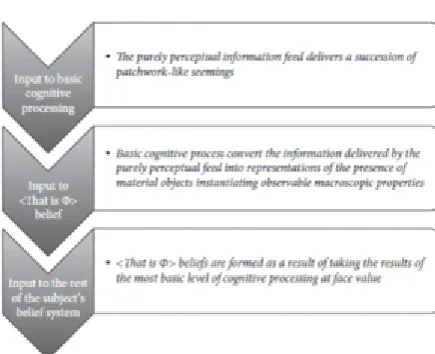
Fig. 43.1 The traditional view.
light’) does not capture what perception delivers. It captures the output of cognitive pro
cessing brought to bear on the raw, comparatively unstructured, perceptual feed.
This traditional view has had an impact on the debate about perceptual demonstratives that is too various and pervasive to survey here. But I think it is fair to say that its most important result has been the skewing of the debate about the viability of theoretic views. For the traditional view makes it very hard to see how an acquaintance-theoretic view could be made to work. To see why, consider the following three claims
(A)Cognitively unaided perception delivers an information feed that is too unstruc tured to sustain the claim that our perceptual experiences ‘represent’ or are ‘of’ or
dinary three-dimensional objects and their macroscopic observable properties. (Con
sequence of the traditional view)
(B) We form perceptual demonstrative thoughts by taking what perception delivers
at face value. (Acquaintance-theoretic commitment)
(C)Central case perceptual demonstrative thoughts are about ordinary three- dimen
sional material objects. (Consequence of the definition of ‘perceptual demonstrative
thought’)
(A), (B), and (C) are inconsistent. But (C) is a consequence of the definition of ‘perceptual demonstrative thought’. So if (A) is assumed, (B) will have to go.
The inconsistency between (A), (B), and (C) brings out why the traditional view presents a
barrier to acquaintance-theoretic views that explain ‘directness’ in terms of direct uptake of what is delivered by perception. Other ways of explaining acquaintance-theoretic ‘di rectness’ will bring the tension between the traditional view and acquaintance theories to
the surface in other ways.
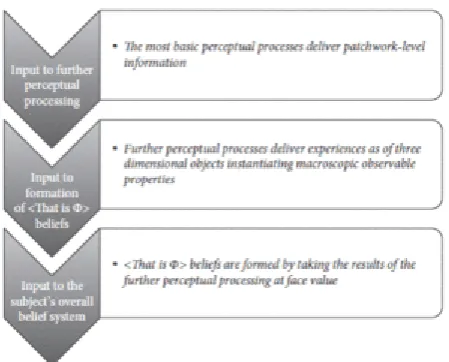
Fig. 43.2 The post-traditional view.
The traditional view took as empirical fact something that its proponents found plausible in their own cases, and expected each of us to find plausible in ours. But claims about matters of empirical fact are subject to empirical falsification. And one of the morals philosophers have been forced to draw from the growing flood of experimental findings
about perception is that the traditional view is false. In particular, findings about
object-directed attention29 and the ways that the perceptual system binds features together as belonging to the same object establish that the perceptual system does not deliver a patchwork which must then be parsed into particular things by thought-level processes.
And findings about perceptual constancy30 establish that the property information the
perceptual (p. 846) system delivers is not mere two-dimensional patchwork-level informa
tion. Rather, the step to representation of observable macroscopic properties (properties
like three-dimensional shape; size; colour; and motion or rest) is made by perceptual pro
cessing that is already complete before cognition comes to the table.31
The two charts (Figures 43.1 and 43.2) summarize the difference this step beyond the tra
ditional view makes from the point of view of an account of the causal pathway from per
ceptual contact with an object to formation of perceptual demonstrative beliefs.
I do not think it is an exaggeration to say that the step to the post-traditional view opens up the possibility of a revolution in the debate about how perception enables perceptual
demonstrative thought.32 Though the impact of this step redounds through the full range
of questions considered in this chapter, it is most obvious with respect to the point about skewing of the description-theoretic vs. acquaintance-theoretic debate from the end of section 3. For with the traditional view gone, (A) in the inconsistent triad laid out above is
gone too, and with (A) gone, the acquaintance theorist can look anew for a view that up
holds both (B) and (C).
I suggest that the first step in the new debate lies with an empirical claim about the path way to <That is Φ> belief described by the post-traditional view. To motivate this claim,
suppose you are looking at a strange object whose shape properties and
reflectance-of-light properties (p. 847) are radically anomalous. This object starts out round, then, in the
space of a few seconds, compresses into an ellipse, then into a skinnier ellipse, then into
a flat rectangle, before expanding through shades of ellipticality back into a circle. Mean
while, the object absorbs and reflects light in a non-standard way. The overall result is that the shape and orientation cues picked up by your visual system are the same as
those it picks up when you look at a constantly shaped disc rotating on an axis that pass
es through its centre parallel to its surface (a coin rotating on a vertical spit). In this case,
the ‘further perceptual processing’ mentioned in the middle box of Figure 43.2 makes the same calculations as it does in a case where you actually are seeing a rotating disc. (That
is why you end up with an experience indistinguishable by you from a ‘rotating disc’ expe rience.) But, given the category of object you are looking at, the <That is Φ> beliefs you form based on these property calculations will not tend to get the object’s properties
right.
This conclusion generalizes. The visual system uses a series of algorithms to calculate the
perceptual property information that serves as input for formation of <That is Φ> belief.
These algorithms result in reliable belief formation only given perceptual encounters with objects that behave the way ordinary objects behave in ordinary circumstances.
So the post-traditional view generates an empirical claim about the relation between
<That is Φ> beliefs and the object at the end of the perceptual link that gives rise to
them:
An empirical claim about the formation of perceptual demonstrative beliefs—The
pathway by which perceptual demonstrative beliefs are formed produces beliefs that tend to match the properties of the object at the other end of the perceptual link iff it is an ordinary material object.
I suggest that perceptual links with ordinary objects enable us to have perceptual demon
strative thoughts about them because they deliver beliefs that are reliable in this (p. 848)
sense: beliefs that tend to match what the object at the end of the perceptual link is like.
And I suggest that, in a post-traditional framework, the fundamental question about per ception and demonstratives—the question of how perceptual contact with objects enables perceptual demonstrative thoughts about them—becomes the question of how to build an account of perceptual demonstrative aboutness-fixing around this central claim about re
liability.
ing works: this is the second component identified at the start of section 3.) Here are two widely accepted elements of this more general discussion:
A claim connecting truth and justification—In general, justification homes in on
truth, so that if you have sufficient justification to make it rational for you to form a belief, you will be unlucky if the belief is not true and not merely lucky if it is.
A claim connecting what a belief is about with what it would take for it to be true
— A body of beliefs is about an object iff their truth or falsity depends on what the
object is like.
The first claim coordinates aboutness and truth. The second coordinates truth and justifi
cation. Putting the two coordinating claims together we get an argument for a third claim
coordinating aboutness and justification (aboutness and truth + truth and justification→
aboutness and justification):
A claim connecting aboutness and justification—A body of beliefs is about an ob ject iff justification for holding them homes in on getting the object’s properties
right.
(For example, this claim says that the beliefs you would express using the proper name
‘Barack Obama’ are about Obama iff, in general, if it is rational for you to hold the belief
you would express by saying Barack Obama is Φ , it will not just be a matter of luck
whether Obama is Φ—given your justification for the belief, you will be unlucky if Obama
is not Φ and not merely lucky if he is.33 I suppress both the details of how the third claim
follows from the first two, and any discussion of how the intuitive notions of ‘homing in on truth’ and being ‘lucky’ or ‘unlucky’ in the relevant sense are to be made precise.34)
The claim connecting aboutness and justification can be restated as a claim about the
kind of relation that suffices to fix aboutness. For the special case of perceptual demon
strative aboutness-fixing, the account can be summarized like this:
A claim about perceptual demonstrative aboutness-fixing—A perceptual link witho
enables perceptual demonstrative thought about o by securing the result that
<That is Φ> beliefs justified on the basis of this link will tend to geto’s properties
right.
(p. 849)
Now let us place the empirical claim and the claim about perceptual demonstrative about
ness-fixing side by side:
The empirical claim The claim about perceptual
demonstrative aboutness—fixing
As long as the object at the other end of a perceptual link
is an ordinary object, the or
dinary route to formation of
<That is Φ> beliefs will tend
to deliver beliefs that match
the object’s properties.
A perceptual link with an object en
ables perceptual demonstrative
thought about it by securing the re sult that <That is Φ> beliefs justi
fied on the basis of the link tend to match what the object is like.
The left-hand claim here is a ‘descriptive’ or ‘is’ claim (it describes a result that a causal process usually generates). The right-hand claim is a ‘normative’ or ‘ought’ claim (it de
scribes a result that will tend to be generated if subjects form only beliefs that conform to a specific normative condition (beliefs that the subject ought to form given justification on
the basis of perception)). To get from the first (‘is’) claim to the second (‘ought’) claim, we need a reason to say that the ordinary route to formation of <That is Φ> beliefs is justifi cation conferring. So, given the left-hand claim, the problem in explaining how a percep
tual link with an object enables a perceptual demonstrative thought about it reduces to the problem of explaining why perceptual demonstrative beliefs formed by ordinary means are justified: different views of how perceptual demonstrative beliefs are justified
will coordinate with different views of how perceptual demonstrative aboutness is se
cured.
The question of how perception justifies perception-based beliefs has its own entries else
where in this volume.35 So, rather than embarking on a discussion of this topic here, I
shall close by saying a little about the more immediate consequences of the post-tradi
tional approach I have suggested for the puzzles from section 1. I should stress that the following remarks are not intended as comprehensive solutions to the puzzles. They are
intended as a first indication of what a solution to each puzzle will look like in the frame
work I have proposed.
Let us consider the categorypuzzle first. This is the puzzle of whether there can be per
ceptual demonstrative thought about particulars other than ordinary material objects, for example, events, times, places, shadows, ripples, or mereological gryphons. According to
the post-traditional approach, the mechanism of perceptual demonstrative aboutness-fix ing is keyed to ordinary objects. For it is if, but only if, the object at the end of the percep tual link is an ordinary object that the ordinary route to formation of <That is Φ> beliefs will tend to produce beliefs that match the object’s properties. So it is if, but only if, the
object at the end of the perceptual link is an ordinary object that it will be the object the
beliefs formed by these means are about. If you are having an experience indistinguish
able by you from an experience of looking at an ordinary thing when (unbeknownst to
you) the ‘visual object’36 you are looking at is a shadow or a ripple or a (p. 850) mereologi
saying <That is Φ> you are not having a perceptual demonstrative belief about the visual
object from which your perceptual information is derived; you are having a belief about nothing. (Note that the point is not that a perceptual link cannot put you in a position to think about a particular that is not an ordinary object. It is just that the mechanism of aboutness-fixing in this kind of case is not the mechanism of perceptual demonstrative aboutness fixing. Note also that the post-traditional approach generates a way to refine
our grasp of the boundaries of the category of ordinary objects: an ‘ordinary object’ (given this approach) is just a potential object of perceptual demonstrative
thought; an object whose properties the ordinary mechanisms for formation of perceptual demonstrative belief will tend to get right.)
Now consider the directnesspuzzle. This is the puzzle of how causally serpentine a per
ceptual link with an object may be while still sustaining perceptual demonstrative refer ence to it. For example, one standard case discussed by philosophers interested in per ception and demonstratives is the case of an object seen in a mirror: is a <That is Φ>
thought formed on the basis of this kind of perceptual feed about the reflected object or its reflection or neither? The approach I have recommended generates an answer to this
question, and a general rubric for addressing similar ones. Your <That is Φ> thought is about the object, not the reflection, because it is the object’s properties, not the
reflection’s, that you will tend to get right if you form beliefs by taking what the perceptu
al feed delivers at face value. If your are watching an orange roll in a mirror, you will form <That is spherical>; <That is rolling>; <That is solid>; and <That is about to fall>
beliefs. Given the way they are formed, these beliefs will almost all match what the or ange, not the reflection, is like. (Your beliefs about the direction in which the thing is lo
cated and its orientation will tend to match the reflection, but these are exceptions to the rule). And this pattern holds in general: a perceptual link with an object is direct enough
to sustain perceptual demonstrative reference to it iff <That is Φ> beliefs formed by di
rect uptake from what the link delivers will tend to produce beliefs that match the
object’s properties.
The comprehensiveness puzzle is the puzzle of how much of an object you have to be in perceptual contact with if you are to form perceptual demonstrative thoughts about it.
The approach I have suggested explains why perceptual contact with an ordinary object’s facing surfaces enables perceptual demonstrative reference to all of it: the path to forma tion of <That is Φ> beliefs produces beliefs that tend to match what the whole object, not
its facing surface, is like. And, again, this rubric generalizes to other comprehensiveness
puzzle cases: perceptual contact with a part of X will sustain perceptual demonstrative
thought about all of X wherever this same pattern (<That is Φ> beliefs formed by uptake of what the perceptual link delivers tend to match X’s properties) holds.
The classification puzzle concerns whether the capacity for perceptual demonstrative thought depends on the capacity for sortal classification. The post-traditional approach
generates an (at least initial) ‘No’ answer to this question. According to this approach, a
perceptual link with an ordinary object enables perceptual demonstrative thought about
tends to get the object’s properties right. But on the face of things this route to formation of <That is Φ> beliefs does not involve sortal classification. So, on the face of things, per
ceptual demonstrative aboutness-fixing does not involve sortal classification either.
(p. 851)
The focus puzzle is the puzzle of whether (and if not why not) we can have perceptual
demonstrative thoughts about objects in peripheral vision. Recall that one of the difficul
ties involved in addressing this puzzle is that there are degrees of peripherality, so we
seem to have to ask how much focus perceptual demonstrative aboutness-fixing requires.
But according to the post-traditional approach, a perceptual link that secures perceptual demonstrative aboutness does so in virtue of the fact that beliefs formed on the basis of the link will reliably match what the object at the end of the link is like. And the reliability of a perceptual link depends on the degree to which it is focused. So we have a principle
to use in addressing the focuspuzzle. A perceptual link will enable perceptual demonstra
tive thought iff it is sufficiently focused on an object to put the information it delivers above an appropriate reliability threshold. Peripheral vision cannot sustain perceptual demonstrative thought because merely peripheral perceptual feeds do not generate
<That is Φ> beliefs that reliably match what the perceived objects are like.
Finally, consider the awareness puzzle: what role (if any) does perceptual awareness play
in enabling perceptual demonstrative thought. The post-traditional view does not gener ate an immediate response to this puzzle. But it does tell us where to look for one. Per
ceptual awareness plays an essential role in perceptual demonstrative aboutness-fixing iff
it plays an essential role in the justification of <That is Φ> beliefs formed by ordinary
means.
References
Ayers, M. (1974). ‘Individuals without sortals’.Canadian Journal of Philosophy, 4(1), 113–
48.
Ayers, M. (1997). ‘Is “physical object” a sortal concept? A reply to Xu’.Mind and Lan
guage, 12(3–4), 393–405.
Campbell, J. (2002). Reference and Consciousness. Oxford: Oxford University Press.
Campbell, J. (2006). ‘Does visual reference depend on sortal classification?’Philosophical Studies, 127(2), 221–37.
Campbell, J. (2011). ‘Visual attention and the epistemic role of consciousness’. In Mole,
Smithies, and Wu, (eds), Attention: Philosophical and Psychological Essays(pp. 323–41).
Oxford: Oxford University Press.
Crane, T. (2011). ‘The problem of perception’. In Edwards N. Zalta (ed.),The Stanford En
Dehaene, S., Changeux, J.-P., Naccachel, L., Sackur, J., and Sergent, C. (2006). ‘Conscious, preconscious, and subliminal processing: a testable taxonomy’.Trends in Cognitive
Science, 10, 204–11.
Dennett, D. (1978). ‘Where am I?’ In Dennett,Brainstorms: Philosophical Essays on Mind and Psychology. Cambridge, MA: MIT Press.
Dickie, I. (2010). ‘We are acquainted with ordinary things’. In Robin Jeshion (ed.),New Essays on Singular Thought(pp. 213–45). Oxford: Oxford Unversity Press.
Dickie, I. (2011a). ‘Visual attention fixes demonstrative reference by eliminating referen tial luck’. In C. Mole, D. Smithies, and W. Wu (eds),Attention: Philosophical and psycho
logical essays(pp. 293–322). Oxford: Oxford University Press.
Dickie, I. (2011b). ‘The sortal dependence of demonstrative reference’.European Journal of Philosophy.
Dummett, M. (1973). Frege: Philosophy of language. London: Duckworth. (p. 852)
Dummett, M. (1978). ‘Truth’. In Michael Dummett,Truth and Other Enigmas. London: Duckworth.
Evans, G. (1985). ‘Understanding demonstratives’. In Gareth Evans (ed.),Collected Pa
pers(pp. 291–321). Oxford: Oxford University Press.
Evans, G. (1982). The Varieties of Reference. Oxford: Oxford University Press.
Frege, G. (1884/1953). The Foundations of Arithmetic, trans. J. L. Austin. Oxford: Black
well.
Grandy, R. E. (2008). ‘Sortals’. In Edward N. Zalta (ed.),The Stanford Encyclopedia of Philosophy (Fall 2008 edn).
Kaplan, D. (1968–9). ‘Quantifying in’.Synthese, 19, 178–214.
McDowell, J. (1984). ‘De re senses’.Philosophical Quarterly, 34, 283–94.
Matthen, M. (2005). Seeing, Doing, and Knowing. Oxford: Oxford University Press.
Moore, G. E. (1918). ‘Some judgements of perception’.Proceedings of the Aristotelian So
ciety, New Series, 19, 1–29.
Moore, G. E. (1962). Commonplace Book 1919–1953. London: Allen and Unwin.
Palmer, S. E. (1999). Vision Science—Photons to Phenomenology. Cambridge, MA: MIT
Press.
Quine, W. v. O. (1960). Word and Object. Cambridge, MA: MIT Press.
Quine, W. v. O. (1969). ‘Speaking of objects’. In W. v. O. Quine,Ontological Relativity and Other Essays(pp. 1–25). New York: Columbia University Press
Recanati, F. (2012). Mental Files. Oxford: Oxford University Press.
Russell, B. (1912). The Problems of Philosophy. Oxford: Oxford University Press.
Searle, J. (1980). ‘Minds, brains, and programs’.Behavioral and Brain Sciences, 3, 417–
57.
Searle, J.(1983). Intentionality. Cambridge: Cambridge University Press.
Siegel, S. (2010). The Contents of Visual Experience. Oxford: Oxford University Press.
Smithies, D. (2011). ‘What is the role of consciousness in demonstrative thought?’Journal of Philosophy, 108, 5–34.
Strawson, P. F. (1950). ‘On referring’.Mind, 59, 320–44.
Wiggins, D. (1997). ‘Sortal concepts: A reply to Fei Xu’.Mind and Language, 12, 413–21.
Wiggins, D. (2001). Sameness and Substance Renewed. Cambridge: Cambridge Universi
ty Press.
Xu, F. (1997). ‘From Lot’s wife to a pillar of salt: Evidence that physical object is a sortal concept’.Mind and Language, 12, 365–392.
Notes:
(1) See relevant entries in this volume—Simmons, Chapter 4, on early modern philosophy,
and Snowdon, Chapter 6, on sense-data.
(2) Views of this kind are an extension of Quine’s thesis of the inscrutability of reference.
The canonical source for Quine’s original arguments for this thesis is Quine, 1960: ch 2.
Quine gives a more accessible introduction in Quine, 1969. For a discussion of the in
scrutability challenge as it arises for the case of perceptual demonstrative thought, see
Campbell, 2002: 216–34.
(3) There are exceptions. See in particular Evans, 1982: ch. 6 (pp. 143–91). For discussion
of perception in non-visual modalities, see chapters 15–18 in Part III of this volume. For
discussion of multisensory perception, see Bayne and Spence, Chapter 32, this volume.
(4) For discussions of this puzzle, see Evans, 1982: 144, 149–50; Campbell, 2002: 111.
(5) The contemporary discussion of this puzzle starts with Moore, 1918 and 1962: 177.
(6) There is a debate about whether this claim should be accepted. See Crane, 2011 for an introduction and references.
(7) Grandy, 2008 provides an informative introduction and references. The contemporary
debate on this question traces to Frege, 1953: §53 (pp. 65–7). There is a related debate
about whether sortal properties can be presented in perception. For a ‘yes’ answer, see
Siegel, 2011.
(8) For sortalist views, see Frege, 1953: esp. 28, 59, 62, 66; Quine, 1953; Wiggins, 2001;
Evans, 1982: esp. 105–12, 178–9; Dummett, 1973: 73–80, 179–80. There are important
differences in motivation between these varieties of sortalism.
(9) For examples like this in the anti-sortalist literature, see Ayers, 1974, 1997; Campbell,
2006.
(10) See Wiggins, 2001: 7, 55–61; Evans, 1982: 178–9. For a discussion of the viability of
the standard move, see Dickie, 2011b: §4. An alternative move is to say that the reference requires being right about sortal classification, but that the only referentially relevant
sortal is something very general like ‘physical object’. See Xu, 1997 for a psychologist making this proposal; Wiggins, 1997 and Ayers, 1997 for sortalist and anti-sortalist replies.
(11) For discussion of this puzzle, see Dickie, 2011a: 315–8.
(12) The most thorough discussion of this puzzle to date is in Campbell, 2002.
(13) For an introduction to discussion of perceptual attention see Campbell, Chapter 31,
this volume.
(14) For an introduction to empirical results about the relationship between perceptual at tention and reliable ‘binding’ of features as belonging to the same thing, see Palmer, 1999: 556–563.
(15) More accurately, there are ‘degrees of perceptual attention’. See Campbell, Chapter 31, this volume, on attention.
(16) This puzzle was brought into the debate on perception and demonstratives by Camp
bell (2002). For subsequent discussions, see Campbell, 2011; Dickie, 2011a; Smithies, 2011. The puzzle is connected with general issues about the relationship between con
scious awareness and intentionality of the kind most famously raised by Searle (1980).
(17) See Prinz, Chapter 19, this volume.
(18) See Dehaene et al., 2006.
(19) For an approximation to this kind of view, see Russell, 1912: ch. 2, pp. 46–59.
Kaplan’s 1969notion of a ‘vivid’ name combines traditional descriptivism with a causal
(20) Dummett is a sortal descriptivist about perceptual demonstratives. See for example
his 1973: 233. Evans’s view in his 1982, ch. 6, is that a perceptual link with an object en ables perceptual demonstrative reference to it iff the link gives the subject the ‘practical and in principle’ capacity to locate an object and discover its kind. Evans denies that this is a descriptivist view. But it is a form of ‘sortal descriptivism’ in the sense defined here.
(21) Compare Searle, 1983: 225–7.
(22) For two important first moves in this debate, see Strawson, 1950 and Dummett, 1978.
(23) Evans argues like this at 1982: 147–50. See also Dennett, 1978.
(24) For an introduction to the history of attempts to answer this question, see Recanati,
2012: 3–14.
(25) See, for example, Russell, 1912: 46; Matthen, 2005: ch. 13.
(26) This kind of view forms one strand in Evans’s account of the ‘directness’ of perceptu
al demonstrative aboutnesss-fixing. See for example Evans, 1982: 146 (but remember
that Evans’s view also incorporates a descriptivist element – see n. 20). The proposals in
Campbell, 2002 and Dickie, 2010, 2011a also involve this kind of view of the ‘directness’
of perceptual demonstrative thought.
(27) For infuential discussions of this idea, see Evans, 1982: esp. 10–33; Evans, 1985; Mc
Dowell, 1984.
(28) See Simmons, Chapter 4, this volume, on early modern views of perception and
Casati, Chapter 20, this volume, on object perception. For a recent account of the transi
tion away from the traditional view see Matthen, 2005: ch. 1.
(29) See Campbell, Chapter 31, this volume, on attention.
(30) See Cohen, Chapter 33, this volume.
(31) For a recent book-length discussion of which properties are represented in percep
tion, see Siegel, 2010.
(32) Many others working on these and related issues are of the same mind. Evans’s talk of ‘perceptual information channels’ (1982: ch. 6) is already a step in this direction. See
also Campbell, 2002; Matthen, 2005.
(33) I am using ‘Φ’ as a schematic variable ranging over conceptual representations of properties when it occurs inside pointy brackets and the associated predicates when it oc curs in corner quotes. ‘Φ’ ranges over properties, and is braced with ‘Φ’: That is Φ
expresses the thought <That is Φ>, and both are true if the referent of ‘that’ isΦ.
(34) I provide some of the relevant details in Dickie, 2011a.
35
(36) This is a psychologists’ term used to describe whatever is treated as an object by the
visual system.
Imogen Dickie