Accepted Manuscript
Finding parallel functional pearls: Automatic parallel recursion scheme detection in Haskell functionsviaanti-unification
Adam D. Barwell, Christopher Brown, Kevin Hammond
PII: S0167-739X(17)31520-0
DOI: http://dx.doi.org/10.1016/j.future.2017.07.024
Reference: FUTURE 3554
To appear in: Future Generation Computer Systems
Received date : 16 December 2016 Revised date : 27 June 2017 Accepted date : 10 July 2017
Please cite this article as: A.D. Barwell, C. Brown, K. Hammond, Finding parallel functional pearls: Automatic parallel recursion scheme detection in Haskell functionsviaanti-unification, Future Generation Computer Systems(2017), http://dx.doi.org/10.1016/j.future.2017.07.024
Finding Parallel Functional Pearls:
Automatic Parallel Recursion Scheme Detection in
Haskell Functions
via
Anti-Unification
Adam D. Barwell, Christopher Brown, and Kevin Hammond
School of Computer Science, University of St Andrews, St Andrews, United Kingdom
{adb23,cmb21,kh8}@st-andrews.ac.uk
Abstract
This paper describes a new technique for identifying potentially parallelisable code structures in functional programs. Higher-order functions enable simple and easily understood abstractions that can be used to implement a variety of commonrecursion schemes, such asmapsandfoldsover traversable data struc-tures. Many of these recursion schemes have natural parallel implementations in the form ofalgorithmic skeletons. This paper presents a technique that detects instances of potentially parallelisable recursion schemes in Haskell 98 functions. Unusually, we exploit anti-unification to expose these recursion schemes from source-level definitions whose structures match a recursion scheme, but which are not necessarily written directly in terms ofmaps,folds, etc. This allows us to automatically introduce parallelism, without requiring the programmer to structure their code a priori in terms of specific higher-order functions. We have implemented our approach in the Haskell refactoring tool, HaRe, and demonstrated its use on a range of common benchmarking examples. Using our technique, we show that recursion schemes can be easily detected, that parallel implementations can be easily introduced, and that we can achieve real parallel speedups (up to 23.79×the sequential performance on 28 physical cores, or 32.93×the sequential performance with hyper-threading enabled).
1. Introduction
predict parallel runtimes and speedups. There is a close, and long-observed, correspondence between structured approaches and functional programming. In particular, algorithmic skeletons can be seen as parallel implementations of higher-order functions (e.g. [3, 4]). There are further advantages to structured parallel approaches when writing parallel software forheterogeneous [5] orhigh performanceparallel systems [6], which may involve massive numbers of proces-sors, of possibly different types. Given a set of skeletons for the desired target architecture(s), the programmer need only be concerned with which skeletons to call, where they should be called, and what parameters should be given to them so that they give the best performance on the given architecture. Unfortunately, determining precisely where to introduce skeletons can be a non-trivial exercise, requiring significant programmer effort [2, 7, 8]. It follows that if instances of higher-order functions can be discovered automatically, and if cost information can be used to direct the choices of skeletons, parameters, etc., then parallel functional programs can be produced quickly, easily and efficiently. Such pat-terns occur frequently in real applications. For example, the spectral part of the NoFib suite of Haskell benchmarks [9] comprises a total of 48 programs. Manual inspection shows that at least 19 (39.6%) of these have one or more functions that could be rewritten in terms of mapor fold patterns. This gives a potentially large corpus of easily parallelisable programs.
1.1. Novel Contributions
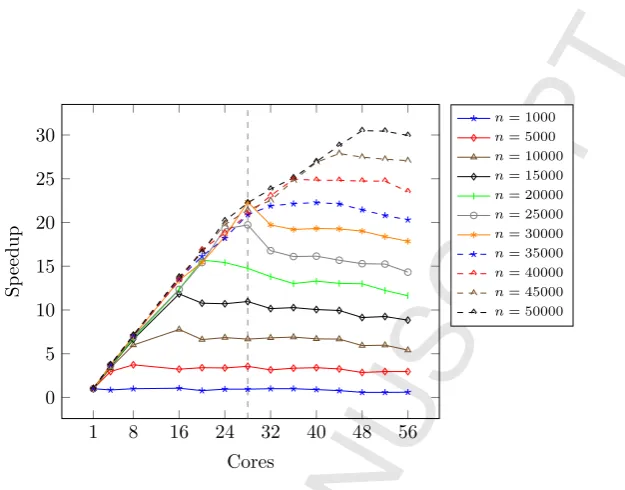
1 8 16 24 32 40 48 56 0
5 10 15 20 25 30
Cores
Sp
eedup
[image:4.595.154.467.106.351.2]n= 1000 n= 5000 n= 10000 n= 15000 n= 20000 n= 25000 n= 30000 n= 35000 n= 40000 n= 45000 n= 50000
Figure 1: sumeuler, speedups oncorryvreckan, a 28-core hyper-threaded Intel Xeon server, dashed line shows extent of physical cores.
1.2. Illustrative Example
We illustrate our approach using an example from theNoFib suite, sumeuler, that calculates Euler’s totient function for a list of integers and sums the results. 1 sumeuler :: [Int] -> Int
2 sumeuler xs = sum (map euler xs)
Here,euleris Euler’s totient function, andsumsums the values in its argument, a list of integers. sumeuler can be easily parallelised using, e.g., the Haskell Strategies library:
1 sumeuler :: [[Int]] -> Int 2 sumeuler xs =
3 sum (map (sum . map euler) xs `using` parList rdeepseq)
to rewritesumeulerto use a directfold (orreduce) operation. This applies an operation, gbetween each pair of elements in an input list, returningq, when the end of the input list is reached. So, for example,foldr (+) 0 [1,2,3]is expanded tofoldr (+) 0 ((:) 1 ((:) 2 ((:) 3 [])), where(:) is the binary list constructor function of typea -> [a] -> [a]and[]is the empty list. This is reduced to(+) 1 ((+) 2 ((+) 3 0)), the result of which is6, the sum of the elements in the input list.
1 sumeuler [Int] -> Int
2 sumeuler xs = foldr ((+) . euler) 0 xs 3 where foldr g q [] = q
4 foldr g q (w:ws) = g w (foldr g q ws)
This new definition ofsumeulercan then be parallelised in an alternative way to the parallel map above, using e.g. a parallel implementation of foldr. Taking advantage of parallelism in sumeuleris therefore both simple and potentially automatic [14]. Moreover, alternative parallelisation approaches are possible. However, ifsumeulerwas defined without using either an explicitmaporfoldr, e.g. as shown below using direct recursion, then parallelisation would be less straightforward, and lower, or no, speedups might result.
1 sumeuler :: [Int] -> Int 2 sumeuler [] = 0
3 sumeuler (x:xs) = ((+) . euler) x (sumeuler xs)
Since this version of sumeulerisimplicitly an instance of foldr, it is best to first restructure the definition so that itexplicitlycallsfoldrbefore attempting parallelisation. In order to rewrite the inlined sumeuleras an explicit foldr, however, we need to derive concrete arguments tofoldrthat will yield a func-tionally equivalent definition. These arguments can be derived by inspecting the inlined definition of sumeuler, as shown in Fig. 2. Toautomatically derive the arguments tofoldr, we inspect the definitions of sumeulerandfoldr us-inganti-unification, which aims to find theleast general generalisation between two terms. In Plotkin and Reynolds’ original work [10, 15], anti-unification was defined for totally ordered terms, where terms consisted of variables, literals, and function application. More recent approaches to anti-unification have ap-plied the technique to programming languages such as Haskell [16, 17], primarily for clone detection and elimination [18]. In these approaches, anti-unification compares two terms (expressions) to find their shared structure, producing an anti-unifier term (representing the shared structure), plus two sets of substitu-tions that enable the original term to be reconstructed from the anti-unifier. For example, anti-unifying the[]clause of sumeulerwithfoldrcompares the unequal0andzexpressions, producing the anti-unifier,h:
1 h g z [] = z
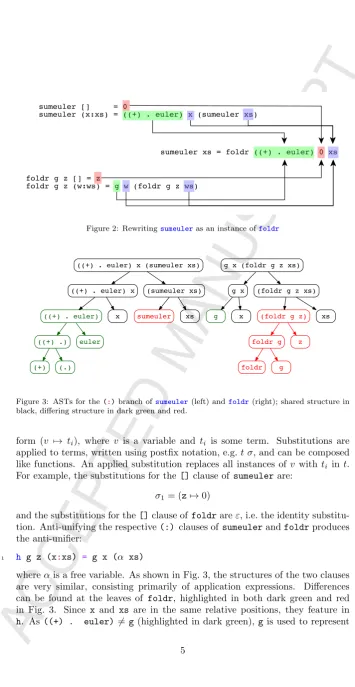
Figure 2: Rewritingsumeuleras an instance offoldr
((+) . euler) x (sumeuler xs)
((+) . euler) x (sumeuler xs)
((+) . euler) x sumeuler xs
((+) .) euler
(+) (.)
g x (foldr g z xs)
g x (foldr g z xs)
g x (foldr g z) xs
foldr g z
foldr g
Figure 3: ASTs for the(:)branch ofsumeuler(left) andfoldr(right); shared structure in black, differing structure in dark green and red.
form (v 7→ ti), where v is a variable and ti is some term. Substitutions are
applied to terms, written using postfix notation, e.g.t σ, and can be composed like functions. An applied substitution replaces all instances ofv with ti int.
For example, the substitutions for the[]clause of sumeulerare: σ1= (z7→0)
and the substitutions for the[]clause of foldrareε, i.e. the identity substitu-tion. Anti-unifying the respective(:) clauses ofsumeulerandfoldrproduces the anti-unifier:
1 h g z (x:xs) = g x (α xs)
[image:6.595.139.473.106.477.2]the function applied to two arguments in h. Finally, since the recursive call prefixessumeuler6=(foldr g z)(highlighted in red), the variableαis used in their place inh. This produces the substitutions: (g7→((+) . euler)) and (α7→sumeuler) forsumeuler, and: (α7→(foldr g z)) forfoldr. Since it is possible to reconstruct the original terms by applying the relevant substitutions to an anti-unifier, when given the anti-unifierh:
1 h g z [] = z
2 h g z (x:xs) = g x (a xs)
we can, in principle, rewritesumeulerandfoldrin terms of husing substitu-tions as arguments:
1 sumeuler xs = h ((+) . euler) 0 xs 2
3 foldr g z xs = h g z xs
Furthermore, becausefoldrisequivalent toh, we conclude thatsumeulermust be an instance offoldr. As bothsumeulerandfoldrcan be rewritten in terms of h, it must be the case that sumeuler can be rewritten in terms of foldr. The substitutions forsumeulerinferred as part of anti-unification are valid as arguments tofoldr, allowingsumeulerto be rewritten:
1 sumeuler xs = foldr ((+) . euler) 0 xs
Parallelism can now be introduced using a parallel implementationfoldr, either manually or using e.g. a refactoring/rewriting tool (e.g. [19, 8]). Alternatively, the foldr operation can be split into its map and foldr (sum) components, perhaps by using the laws of hylomorphisms as in [4], producing:
1 sumeuler xs = foldr (+) 0 (map euler xs)
which is equivalent to our original definition of sumeuler: 1 sumeuler xs = sum (map euler xs)
This can then be parallelised using the parallel map that we originally showed.
2. Algorithmic Skeletons and Structured Parallelism
gives a flexible approach, where parallelism is exposed to the programmer only through the choice of skeleton and perhaps through some specific behavioural parameters (e.g., the number of parallel processes to be created, or how elements of a parallel list are to be grouped to reduce communication costs). Details of communication, task creation, task or data migration, scheduling, etc. are em-bedded within the skeleton implementation, which may be tailored to a specific parallel architecture or class of architectures [5].
Common skeletons include: farm,reduce,feedback, andpipeline [1]. Afarm applies some function, (f :: a -> b), to each element in a stream of inputs in parallel, where the number of processes created may be controlled by some parameter. The farm skeleton corresponds to the sequential map operation. The reduce skeleton takes an associative function, (f :: a -> a -> a), and repeatedly applies it to a collection of two or more elements in parallel until one element, i.e. the result, remains. This corresponds to afold when the fold fix-point function is associative. The feedback skeleton enables looping operations for skeletons, taking some skeleton, s, to which inputs are applied repeatedly until some function, (f :: a -> Bool), is satisfied. This corresponds to an iterate, where the result is the nth element of the produced list. Finally, the
pipeline skeleton enables the composition of two or more skeletons, where par-allelism arises from executing multiple pipeline stages in parallel. This corre-sponds to function composition(.). Many implementations of these skeletons exist, e.g. [1, 7, 8, 12, 11, 19, 21, 22, 23], with some for multiple architectures such as GPUs, e.g. [5, 13, 24]. The choice of implementation is beyond the scope of this paper. In principle, however, this correspondence allows skeletons to be introduced over their sequential equivalents, introducing parallelism for free [4]. This paper takes full advantage of these correspondences. Our anti-unification technique therefore focuses on finding instances of recursion scheme implementations such asmap,foldr, anditerN.
1 iterate :: (a -> a) -> a -> [a] 2 iterate f x = x : iterate f (f x)
3 -- iterate ((+) 1) 1 = [1, 1+1, 1+2, 1+3,...]
4
5 iterN :: Int -> (a -> a) -> a -> a 6 iterN n f x = iterate f x !! n
7 -- iterN 1 ((+) 1) 1 = 2
8
9 map :: (a -> b) -> [a] -> [b] 10 map f [] = []
11 map f (x:xs) = f x : map f xs
12 -- map ((+) 1) [1,2,3,..] = [1+1,1+2,1+3,..]
13
14 foldr :: (a -> a -> a) -> a -> [a] -> a 15 foldr f z [] = z
16 foldr f z (x:xs) = f x (foldr f z xs)
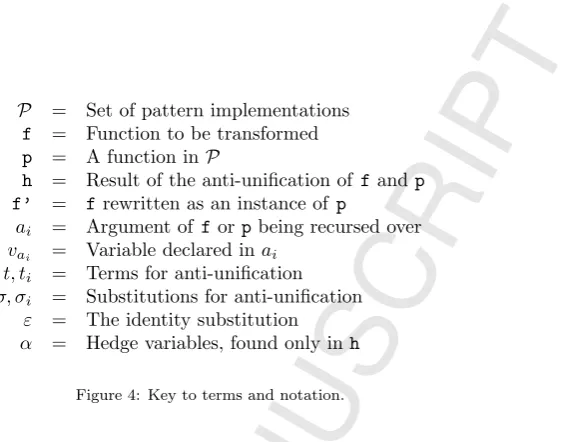
P = Set of pattern implementations f = Function to be transformed p = A function inP
h = Result of the anti-unification of fand p f’ = frewritten as an instance of p
ai = Argument of forpbeing recursed over
vai = Variable declared inai t, ti = Terms for anti-unification
σ, σi = Substitutions for anti-unification
[image:9.595.192.475.109.330.2]ε = The identity substitution α = Hedge variables, found only inh
Figure 4: Key to terms and notation.
These higher-order functions can be automatically introduced for suitable Haskell 98 data types, using e.g. the Haskell type class Functor for map pattern in-stances. We assume they are supplied in a library such as the Haskell standard Prelude. Here,iterate creates ann-element list where the first item is calcu-lated by applying the functionfto the second argument,x; the second item is computed by applyingfto the previous result and so on. The example on Line 3 shows how iterate can be used to generate an infinite list of incrementing integers. For convenience, we also define iterN, which takes the nth element
from the result ofiterate. Line 7 illustrates this. mapapplies a given function (((+) 1), which defines the function that adds 1 to its argument) to a list of elements. Line 12 shows how map can be used to apply the function((+) 1)to a list of integers, [1,2,3,..], to produce a list of integers where each element is incremented by one. As discussed above, foldr reduces a list by replacing (:) with a binary right associative function. The result reduces the elements of the list by applying the binary function,f, pair-wise to the elements of the list. Line 17 shows how foldr can be used to sum a list. For the rest of this paper, we refer to these higher-order functions aspatterns, and we denote these patterns collectively byP (see Figure 4).
3. Detecting and Refactoring Pattern Instances for Haskell
This section gives an overview of our technique. Fig. 4 provides a key to our notation. Some functionfthat matches a pattern,p, in the set of patterns,P, is rewritten to a new function,f’, that usespand that is functionally equivalent tof. Our approach determines whetherfis an instance ofp, and if so, derives the arguments that are needed to make fand pfunctionally equivalent. This is achieved in two main stages: i) anti-unifying f and p to derive argument candidates; and ii) using the result of the anti-unification to determine if fis an instance of p, and if so, validating the argument candidates. Our approach compares two functions, and given a finite set ofP, can be applied repeatedly to discover a set of potential rewrites. When multiple rewrites are valid, we take the first, although other selection methods are also valid. We give our assumptions in Sec. 3.1; we define a specialised anti-unification algorithm in Sec. 3.2; and define the properties to check whetherfcan be rewritten as a call top. We give definitions for all our concepts, and provide a proof of soundness for our anti-unification algorithm.
3.1. Preliminaries and Assumptions
We illustrate our approach using the Programatica AST representation of the Haskell 98 standard [26]. Programatica is used as a basis for the Haskell refac-torer, HaRe, which we extend to implement our approach. Our prototype imple-mentation is available at https://adb23.host.cs.st-andrews.ac.uk/hare. html. Programatica represents a Haskell AST using a collection of 20 Haskell data types, comprising a total of 110 constructors [16]. These types are parame-terised by the location of the syntactic elements they represent, and in the case of variables and constructors, where they are declared. For example, the expression 42 is represented in Programatica by(Exp (HsLit loc (HsInt 42))). Here, HsLit indicates that 42 is an expression;HsInt indicates that it is an integer; andlocrepresents its location in the source code. We refer to the representation of Haskell expressions in Programatica as terms; i.e. given some expressione and some termt, we say thattis the Programatica representation ofe(denoted JeK=t). In the above example, J42K= (Exp (HsLit loc (HsInt 42))); i.e. (Exp (HsLit loc (HsInt 42)))is thetermthat represents theexpression42. There is a one-to-one mapping between expressions and terms. In the Progra-matica tool set, terms are values of theHsExpItype. We make the distinction between expressions and terms since terms can be easily generalised over using their constructors, as we do in Sec. 3.2.
string). For example,(Exp (HsLit loc (HsInt 42))) is instead recorded as (Lit 42). Where variables and constructors are both represented as identifiers, we will instead record these using VarandCon, respectively. For example, the term of the variable expressionxis(Var x), and the term of theconsoperator expression,(:), is(Con (:)). While our approach works for all terms, here we only need to explicitly refer to: Var(representing variables),Lit(representing literals), and App (representing application expressions). All other terms fall under the generic constructorC, and lists of terms (e.g.[t1, . . . , tn]) that used
as arguments to C to represent lists and tuples. Other common expressions found in functional languages, such as lambdas, fall under the general case since they are both unlikely to appear in recursion scheme implementations, and are otherwise safe to anti-unify due to the assumptions below.
Assumptions. In order to determine whether f is an instance of p, we will assume:
1. that variables are unique infandp;
2. that no variables are free inp, and that all variables in pare declared as arguments top;
3. thatfand precurse on the same type (denotedτ);
4. thatfand ponly pattern match on the argument that is being traversed (denotedai, whereai is theithargument tofand/orp);
5. that for every clause that matches a constructor of τ in p, there is a corresponding clause that matches the same constructor in f, and vice versa; and
6. that no parameter toai(denotedvai) occurs as part of any binding in an as-pattern,let-expression, orwhere-block.
Clauses in p are always anti-unified with like clauses in f, according to the constructor ofτ matched for that clause, C. ai then acts as ‘common ground’
betweenfandp; i.e. both functions declare the parameters of the constructor in aias arguments. This enables a check to ensure that the inferred substitutions
are sensible (Def. 14). It is therefore useful to know whichvai infcorrespond to which vai in p. Despite this, since variables in f and p are assumed to be unique, it follows that no variable term infwill ever be syntactically equal to any variable term inp. We instead considervaiwith the same position infand pto be equivalent.
Definition 1 (Shared Argument Equivalence). Given the argument of type τ
that is pattern matched in bothfand p,ai, where in f,ai= (D v1 . . . vn), and
in p, ai= (D w1 . . . wn), we say that eachviis equivalent to each wi (denoted
vi≡wi); i.e. ∀i∈[1, n], vi ≡wi. Given two arbitraryvai in fand p, v
f ai and vapi, we denote their equivalence byv
f ai≡v
Insumeulerandfoldrfrom Sec. 1.2, for example,xandxsarevaiinsumeuler, and wand wsare similarly vai in foldr. Here, bothx≡wand xs≡ wshold, sincex and ware the first arguments to their respective cons operations, and xsandws are the second arguments.
Traditional anti-unification algorithms use syntactic equality to relate two terms, t1 and t2, their anti-unifier, t, and the substitutions σ1 and σ2. To
take advantage of argument equivalence we must use a weaker form of syntactic equality. First, we define the binary relation ∼ over terms, a form of alpha equivalence.
Definition 2 (Alpha Equivalent Terms). Given two variables, vf
ai and v
p ai,
we say that the term representations of vf
ai and v
p
ai are equivalent (denoted
Jvf aiK∼Jv
p
aiK) when:
vf ai≡v
p ai
Varvf
ai∼Varv
p ai
We then replace syntactic equality with a weaker form of equivalence using Def. 2.
Definition 3 (Syntactic Equivalence). We define syntactic equivalence to be a binary relation over two terms, t1 and t2, denoted t1 ∼= t2, where ∼= is the
reflexive structural closure of∼.
For example, (Lit 42)∼= (Lit 42) holds;t1∼=t2holds for allt1= (C t11 . . . tn)
and t2 = (C t21 . . . t2n) when∀i ∈ [1, n], t1i ∼= t2i; and finally, (Var vafi)∼= (Varvpai) holdsonly whenv
f ai ≡v
p
aiis true. We note that for all other variables, v, w, (Varv)∼= (Varw)does not hold.
Whereτ is a product type, e.g. as inzipWith, we permit pattern matching on all arguments that represent the data structure(s) being traversed. All other arguments must be declared as simple variables. For example, given:
1 f1 a b c [] [] = [] 2
3 f2 0 (b',b'') c [] = []
f1is permitted, butf2is not.
As-patterns, let-expressions, and where-blocks all enable occurrences of somevaito be aliased, orobfuscated, and thereby potentially obstruct argument derivation. Since our analysis inspects the syntax offandp, such patterns and expressions can obfuscate the exact structure of f; i.e. lift potentially important information out of the main body of fandp. For example, given the definition, 1 f3 [] = []
2 f3 (x:xs) = g1 x : f3 xs where g1 = g2 xs
the fact that xs is passed to g2 is obfuscated by the where-block, and could lead to an incorrect rewriting of f3as, e.g., amap.
and zipWith1 are valid as implementations of the general zipWith recursion scheme:
1 zipWith g [] [] = []
2 zipWith g (x:xs) (y:ys) = g x y : zipWith xs ys 3
4 zipWith1 g1 g2 g3 [] [] = []
5 zipWith1 g1 g2 g3 (x:xs) [] = g1 x : zipWith1 xs [] 6 zipWith1 g1 g2 g3 [] (y:ys) = g2 y : zipWith1 [] ys 7 zipWith1 g1 g2 g3 (x:xs) (y:ys) = g3 x y : zipWith1 xs ys
This permits more implementations of a given scheme, and so increases the likelihood of discovering an instance of a scheme inf.
Finally, and since our approach effectively requires thatfhas a similar syn-tactic structure topas a result of the anti-unification, we permit any valid and finite normalisation procedure that rewrites some arbitraryf0tof, such thatf0
is functionally equivalent to f. Normalisation can be used, e.g., to ensure that any of the above assumptions are met. For example, consider assumption 6: as-patterns and definitions inlet-expressions and where-blocks can be inlined (orunfolded in the transformational sense). For example, thewhere-block def-inition of g1inf3can be unfolded to produce:
1 f3 [] = []
2 f3 (x:xs) = g2 xs x : f3 xs
Alternatively, normalisation procedures can be used toreshape[2] functions into a form to allow, or simplify, the discovery of recursion schemes. For example, the definition,
1 f4 xs0 = case xs0 of
2 [] -> 0
3 (x:xs) -> x + f xs
can be rewritten to lift the case-split into a pattern match, allowing the function to be anti-unified against afoldr:
1 f4 [] = 0
2 f4 (x:xs) = x + f xs 3
4 foldr g z [] = z
5 foldr g z (x:xs) = g x (foldr g z xs)
More ambitious normalisation procedures may split a function, e.g.f5:
1 f5 [] z = g2 z
2 f5 (x:xs) z = f5 xs (g1 x z)
1 f5 xs z = g2 (f5' xs z) 2
3 f5' [] z = z
4 f5' (x:xs) z = f5' xs (g1 x z)
Splitting of functions in this way is allowed provided that any such splitting is finite andreduces the size of the split function. For example, somef0cannot be split into the composition of f0’and f0’’, wheref0’orf0’’is functionally equivalent to the identity operation. In line with the intention forfto be anti-unified against a set of recursion schemes, we donot require the normalisation procedure to be confluent.
3.2. Argument Derivation via Anti-Unification
In order to derive arguments to expressfas an instance ofp, we must anti-unify fand p. We define anti-unification for two levels: i) at the term level for two arbitrary terms; and ii)at the function level where we anti-unify fand p. At the term level, the anti-unification of two terms, t1 and t2, (denotedt1 , t2)
we obtain the triple (t×σ1×σ2), wheretis the anti-unifier with respect to the
substitutionsσ1 andσ2. At the function level, the anti-unification of fand p
produces a list of triples that represents the results of anti-unification for each pair of clauses infandp.
We define asubstitutionto be a function that takes a variable,x, and returns a term, t2. When applied to a term, t1, a substitution returnst1 but with all
occurrences ofx replaced byt2.
Definition 4 (Substitution). Given two terms,t1,t2, and a variable name, x,
that occurs in t1, substituting x fort2 int1replaces all occurrences of (Varx)
in t1 with t2. This substitution is denoted (x 7→ t2); and the application of
substitutions to terms is denoted t1(x 7→t2), where (x 7→t2)is applied to t1.
We useσ to refer to substitutions; e.g.σ= (x7→t2).
Here, we update the classical definition of substitution [15] to account for the Programatica representation. Substitutions are denoted as substituting a vari-ablename for some term. When applied to a term, a substitution replaces all variable terms that are parameterised by the given variable name with another term. For example, the result of the substitutionσapplied the termt,t σ, is:
t=Var g
σ= (g7→(App(App(Var .) (Var +)) (Var euler))) t σ= (App(App(Var .) (Var +)) (Var euler))
Definition 5 (Identity Substitution). The identity substitution, denoted ε, is defined such that for all terms t, t=t ε.
Substitutions can be composed using an n-ary relation such that composition forms a rose tree of substitutions.
Definition 6 (Substitution Composition). For all terms t0, . . . , tn, and for all
substitutionsσ1, . . . , σn, wheret0= (C t1 . . . tn), there exists some substitution
σ0 = Lσ1, . . . , σnM such that t0σ0 = (C (t1σ1) . . . (tnσn)). Similarly, where
t0 = [t1, . . . , tn], there exists some substitution σ0 = Lσ1, . . . , σnM such that
t0σ0=[(t1σ1), . . . ,(tnσn)].
For the functionf, defined
f v11 . . . v1n=e1
.. .
f v21 . . . v2n=en
and for the substitutionsσ1, . . . , σn, there exists some substitution
σ0=Lσ1, . . . , σnM
such thatJfKσ0 is defined:
f v11 . . . v1n=e01
.. .
f v21 . . . v2n=e0n
where
∀i∈[1, n],Jei0K=JeiKσi
Composed substitutions are ordered, such that when applied to some term t0,
the first composed substitution is applied to the first direct subterm to t0, the
second composed substitution is applied to the second direct subterm, and so on. Each composed substitution is only applied to its corresponding direct subterm in t0, and does not interfere with any other subterm oft0. For example, the
expression(g x x)is represented by the termt0,
t0=App(App(Var g) (Var x)) (Var x)
and given the substitution,σ0,
σ0=L L(g7→Var euler), εM,(x7→Var p)M
when we applyσ0tot0, the resulting term is:
t0σ0=App(App(Var euler) (Var x)) (Var p)
1 sum [] = []
2 sum (x:xs) = x + (sum xs)
and the substitutionσf =Lσ1, σ2M, applyingσf tosum, appliesσ1 to the term
representation of[], i.e. the right-hand side of the first equation, andσ2to the
term representation of(x + (sum xs)), i.e. the right-hand side of the second equation.
Anti-unification computes the anti-unifier of two terms. In the literature, all hedge variables arefresh. Conversely, and since we aim to rewritefin terms of p, we can use the variables declared inpas hedge variables. This allows us to easily derive expressions that can be passed to pin f. We refer to the set of hedge variables frompby Vp. All hedge variables not inVp are fresh hedge
variables, which we denote byα.
Another difference to traditional anti-unification algorithms can be found the concept ofunobstructive recursive prefixes. As we are anti-unifying two different recursive functions, by definition they will diverge in at least one respect: their recursive calls. We extend this notion to recursive prefixes, where a recursive prefix is a variable expression comprising the name of the function, i.e.forp, or an application expression that appliesforpto one or more expressions. For example, given the definition of foldr,
1 foldr g z [] = z
2 foldr g z (x:xs) = g x (foldr g z xs)
the recursive call(foldr g z xs), has four recursive prefixes: i) (foldr g z xs); ii) (foldr g z); iii) (foldr g); and iv) foldr. It is useful to further extend the notion of recursive prefixes with the concept of unobstructiveness. We define an unobstructive recursive prefix to be a recursive prefix for which the values of its arguments do not change. In the above example, all recursive prefixes, with the exception of (foldr g z xs), areunobstructive.
Definition 7 (Unobstructive Recursive Prefix). Given a recursive functionf,
f v1 . . . vn=e
for all recursive calls in e,
f e1 . . . en
we say that a recursive prefix is either:
1. the direct subexpressionf e1 . . . em, where1≤m≤n; or
2. the expression f itself.
We say that a recursive prefix isunobstructivewhen∀i∈[1, m], ei=vi. An
ex-pression,e0 is denoted as being an unobstructive recursive prefix by membership of the set of unobstructive recursive prefixes forf; i.e.e0∈ R
f.
Definition 8 (The Identity Operation). We define id to be the lambda expres-sion (\ x -> x) such that for all terms,t, (App(Varid)(t))∼=t.
Our anti-unification algorithm calculates the anti-unifiertand substitutionsσ1
andσ2for the termst1and t2, such thatt1∼=t σ1and t2∼=t σ2hold, denoted:
t1,t2=t×σ1×σ2
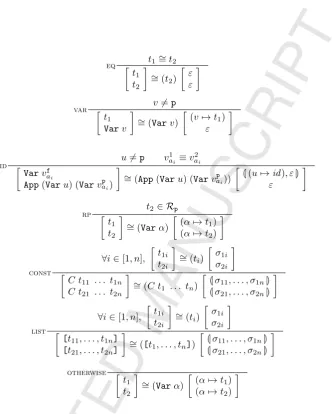
Our rules in Fig 5 define how to infert,σ1, andσ2 fromt1andt2. Rules have
the form,
p
t1
t2
∼ = (t)
σ1
σ2
wherepdenotes any additional assumptions necessary fort1∼=t σ1andt2∼=t σ2
to hold. We use matrix notation as shorthand for the two equations; i.e.
t1
t2
∼ = (t)
σ1
σ2
=t1∼=t σ1∧t2∼=t σ2
Whent1 and t2 are the same, i.e.t1∼=t2,eq holds. For all other cases when
t2 is a variable term, and is not (Var p), t2 is used as the hedge variable in t
(var). When t2is an application term applying some function uto avai, and t2is a variable term that is equivalent to thevaiint2, then the application term is used int, anduis substituted forid inσ1 (id). Whent2 is an unobstructive
recursive prefix of p, rp holds. const states that when t1 and t2 are terms
with the same constructor,C, thentis a term with constructorCand its direct subterms are the anti-unifiers of each of the respective direct subterms int1and
t2. list is similar toconst, but satisfies when thet1andt2are lists of terms,
wheret1 andt2are the same length. In all other cases,otherwiseholds. For
example, the terms,t1and t2,
t1=App(Var e) (Lit 42)
t2=App(Var g) (Lit 108)
both apply some function to some literal, and have the anti-unifier and substi-tutions:
t= (App(Var g) (Varα))
σ1=L(g7→(Var e)),(α7→(Lit 42))M
σ2=Lε,(α7→(Lit 108))M
Here,σ1andσ2are compositions reflecting the two arguments toApp(const).
Since the first argument in botht1andt2are variable terms, but with different
names, t2 is chosen as the anti-unifier with the substitution for σ1 replacing
g with e, and the identity substitution for σ2 (var). Conversely, the second
argument differs int1and t2, and since(Lit 108)is not an identifier, a fresh
eq t1∼=t2
t1
t2
∼ = (t2)
ε ε
var v6=p
t1
Varv
∼ = (Varv)
(v7→t1)
ε
id u6=p v
1 ai ≡v
2 ai
Varvf ai
App(Varu) (Varvapi)
∼
= (App(Varu) (Varvapi))
L(u7→id), εM
ε
rp t2∈ Rp
t1
t2
∼
= (Varα)
(α7→t1)
(α7→t2)
const
∀i∈[1, n],
t1i
t2i
∼ = (ti)
σ1i
σ2i
C t11 . . . t1n
C t21 . . . t2n
∼
= (C t1 . . . tn)
Lσ11, . . . , σ1nM
Lσ21, . . . , σ2nM
list
∀i∈[1, n],
t1i
t2i
∼ = (ti)
σ1i
σ2i
[t11, . . . , t1n]
[t21, . . . , t2n]
∼
= ([t1, . . . , tn])
Lσ11, . . . , σ1nM
Lσ21, . . . , σ2nM otherwise t1 t2 ∼
= (Varα)
(α7→t1)
(α7→t2)
[image:18.595.139.473.103.518.2]
Figure 5: Inference rules to calculate the anti-unifiertfor the termst1andt2.
As we are interested in finding instances of a pattern in a function, it is con-venient to relax theleast general property found in traditional anti-unification algorithms. Specifically, thercrule in Fig. 5 can result in an anti-unifier that is not the least general generalisation of two terms. To illustrate this, consider the example of elemanti-unified against afoldr, where
1 elem a [] = False 2 elem a (x:xs) =
3 (\y ys -> if a == y then True else ys) x (elem a xs) 4
5 foldr g z [] = z
Here, the anti-unification of the recursive calls in thecons-clauses produces the term:
App(Varα) (Var xs)
since(foldr g z)is an unobstructive recursive prefix. In this case, thercrule applies instead of const. constwould otherwise apply since both (foldr g z)and(elem a)are application expressions, and would produce a less general generalisation than the result of applying the rc rule. Intuitively, the least general generalisation is the term t that shares the closest structure tot1 and
t2, and requires the least number of substitutions inσ1 and σ2. In the above
example, the least general generalisation for the recursive call is: App(App(Varα) (Var z)) (Var xs)
The ‘shortcuts’ produced by application of thercrule areuseful. Unobstructive recursive prefixes are uninteresting, aside from their relative location, since they produce no validargument candidatesinσf(Sec. 3.3). Moreover, without therc
rule, extra work would be necessary to derive and/or choose between argument candidates.
Theorem 1 (Soundness of Anti-Unification Algorithm). Given the terms t1
andt2, we can findt, σ1, andσ2, such thatt1∼=t σ1 andt2∼=t σ2 hold.
We give the proof for the above soundness property in Appendix A.
Having defined anti-unification for terms, we can now define it forfandp. Given the functionsfand p,
fv11 . . . v1m=ef1 pw11 . . . w1l=ep1
..
. ...
fvn1 . . . vnm=efn pwn1 . . . wnl=epn
where vij and wij are arguments to f and p, respectively, and we define the
anti-unification of fandp, denotedh, to be the list: h=hJef
1K,Je p
1K, . . . ,JefnK,JepnK i
where each element, ∀i ∈[1, n], eh
i, in h corresponds to the anti-unification of
the ith clauses in f and p; and elements are the triple (t
i×σ1i×σ2i). The
substitutions for each element inhcan be composed, and we refer to the com-position of substitutions forfasσf, and the composition of substitutions forp
asσp; i.e.
σf=Lσ11, . . . , σ1nM
σp=Lσ21, . . . , σ2nM
1 f x = x + 42 2 g y = y + 108
when anti-unified, produce:
h= [(App(App(Var +) (Var y)) (Var z))
×L Lε,(y7→(Var x))M,(z7→(Id 42))M×L Lε, εM,(z7→(Id 108))M] Here,hcan be represented as:
1 h y z = y + z 2
3 f x = h x 42 4
5 g y = h y 102
where,his the anti-unifier, and the substitutions are represented using standard function application. To simplify our presentation, in examples we confusehfor its equivalent function definition.
3.3. Deriving Pattern Arguments
Given the anti-unifier hof fand p, with substitutions σf and σp respectively,
we next derive the arguments to pthat are needed to rewritefas an instance ofp. Our anti-unification algorithm is designed such thatσ1providescandidate
arguments. These candidates are considered valid when they adhere to three properties:
1. thatpand hare equivalent (Def. 10);
2. that there does not exist a (sub-)substitution inσforσpwhere avaioccurs as either a hedge variable or as a term (Def. 12); and
3. that all substitutions inσf substituting for the same hedge variable that
is derived frompmust substitute for the same term (Def. 14).
Equivalence of Pattern and Anti-Unifier. Recall that we aim to rewrite f in terms of p. As stated in Sec. 3.2, the syntactic equivalence properties of the produced anti-unifier allowfto be rewritten as a call to the function represen-tation ofh. Furthermore, by equational reasoning [27], ifpandhareequivalent, thenfcan be rewritten to replace the call tohwith a call top; i.e.fis an instance ofp. Since anti-unification willalwaysproduce an anti-unifier and substitutions between any two arbitrary terms, the production of an anti-unifier cannot be used as a test of equivalence. We instead define an equivalence relation between p, h, σf, and σp. In order to do this, we first define equivalence between two
Definition 9 (Equivalence of Terms with Substitutions). Given the terms, t,
t1,t2, and the substitutions σ1 and σ2, such that
t1
t2
∼ = (t)
σ1
σ2
we say that t2and t are equivalent with respect toσ1, σ2, andt1, (denoted
t2≡t1t×σ1×σ2) when:
eq t2∼=t
t2≡t1t×ε×ε
hedge v6=p v∈ Vp
(Varv)≡t1(Varv)×(v7→t1)×ε
fresh t1∈ Rf t2∈ Rp α6∈ Vp
t2≡t1(Varα)×(α7→t1)×(α7→t2)
const ∀i∈[1, n], t2i≡t1ti×σ1i×σ2i
(C t21 . . . t2n)≡t1 (C t1 . . . tn)×Lσ11, . . . , σ1nM×Lσ21, . . . , σ2nM
list ∀i∈[1, n], t2i≡t1ti×σ1i×σ2i
[t21, . . . , t2n]≡t1 [t1, . . . , tn]×Lσ11, . . . , σ1nM×Lσ21, . . . , σ2nM
Here,eqstates that whent2and tare the same, and whenσ1and σ2are both
ε, thent2 and t are equivalent with respect toσ1 and σ2. When t2 and tare
both variable terms,t2 and t are equivalent when the variables have the same
name and when the the variable is a hedge variable derived fromp (hedge). Similarly, when t2 and t are both fresh hedge variables, α, then both terms
substituted for α must be unobstructive recursive prefixes in their respective functions (fresh). Finally, const and list state that terms consisting only of subterms are equivalent when all respective subterms are equivalent. The definition of equivalence forpandhthen follows naturally.
Definition 10(Equivalence of Pattern and Anti-Unifier). Given two functions
fand p, and the result of their anti-unification,h, containing the substitutions
σf and σp, we say thatpand hare equivalent when for all clauses in p, e p i, and
elements in h, eh
i = (ti×σ1i×σ2i), JepiK≡t1i e
h i.
Absence of Shared Arguments in Substitutions. As stated in Sec. 3.1, the vari-ables,vai, that are declared inai are shared betweenfand p. As such, if fis an instance of p, vai must be used infin an equivalent way to their use inp; i.e. their relative locations in the structure of f andp must be the same. For example, insumeulerandfoldr,
1 sumeuler [] = 0
2 sumeuler (x:xs) = ((+) . euler) x (sumeuler xs) 3
4 foldr g z [] = z
the heads of the matched lists,xinsumeulerand winfoldr, are both passed as the first argument to some function,g; and the tails of the matched lists,xs and wsrespectively, are passed as the last argument to the recursive calls inf and p. While the equivalence of pattern and anti-unifier (Def. 10) ensures the structural equivalence of pand h, it does not inspect hedge variables derived from p. Our anti-unification rules in Fig. 5 means that no vai will occur as either a hedge variable or as a subterm in eitherσf or σp when all equivalent
vai have the same relative positions in fandp. Conversely, the occurrence of somevaiinσf orσp indicates that not all equivalentvai have the same relative positions infandp.
Definition 11 (Variable Occurrence in Terms). For all variablesv, and for all terms, t, we say that v occurs int (denotedv t) whent= (Varv) or when there exists a subterm,ti, in tsuch thatti= (Varv).
Definition 12(Shared Argument Absence). Given the functionsfand p, and their anti-unification h, containing the substitutions σf and σp, we say that no
vai occurs in σf or σp (denotedvai 6∈Lσf, σpM) when, for allvai:
v6∼=vai (Varvai)6t vai 6∈(v7→t)
∀i∈[1, n], vai6∈σi vai 6∈Lσ1, . . . , σnM
Substitution Uniqueness. Substitution composition (Def. 6) ensures that the same hedge variable can be used to substitute for different terms without the problem of substitution interference. For example, consider somefthat is anti-unified againstscanl:
1 f a [] = [a]
2 f a (x:xs) = (+) a x : f ((-) a x) xs 3
4 scanl g z [] = [z]
5 scanl g z (x:xs) = g z x : scanl g (g z x) xs
Here, the result of the anti-unification of the twocons-clauses will include sub-stitutions wheregis substituted for both(+)and(-)inσf. Inscanl, however,
gis the same in both instances. We therefore also require that all substitutions that substitute for the same hedge variable inσf are substituted for the same
term.
Definition 13 (Substitution Flattening). For all substitutions, σ, we say the flattening ofσ (denotedbσc) is the list of substitutions, where:
b(v7→t)c= [(v7→t)] bLσ1, . . . , σnMc=bσ1c+· · ·+bσnc
Here,+ appends two lists, and[a] denotes the singleton list.
Definition 14 (Substitution Uniqueness). Given the functions f and p, and their anti-unification h. Given that σf is the composition of substitutions in h
for the clauses of f. We say that substitutions are unique in σf when for all
hedge variables,v∈ Vp, and for all pairs of substitutions in bσfc, (v7→t1)and
(v7→t2), t1=t2 holds.
Sufficiency of Validity Properties. Given f, p, h, σf and σp, the above three
properties are sufficient to determine whether the candidate arguments in σf
are valid. Equivalence ofpandh(Def. 10) ensures that for all clauses inpand h, the terms for that clause,t2andt, are syntactically equivalent (Def. 3). Hedge
variable terms have additional information in their respective substitutions,σ1
and σ2. There are two cases: fresh hedge variables, α, and hedge variables
derived fromp,v. Forα, Def. 10 requires that both terms,t1andt2, substituted
forαare unobstructive recursive prefixes (Def. 7). No other terms are allowed. For v, two cases are possible: v = vai and otherwise. All equivalent vai in f and p must have the same relative locations to ensure that ai is traversed
in the same way, and that no free variables occur in any argument candidate expression. The rules in Fig. 5 mean that the identity substitution is derived for all equivalentvai in the same relative position infandp. For the case when a vai is not anti-unified with its equivalent, Shared Argument Absence (Def. 12) requires that novai occurs in any substitution and so will fail in this case. For all otherv, Def. 10 requires thatvwill be in scope, due to the assumption that all variables that occur inpare in scope and are declared as parameters of p. Any updates to the value ofvmust be reflected inp, e.g. such as infoldland scanl. Finally, and since each argument may be instantiated only once for each call to p, Substitution Uniqueness (Def. 14) ensures that for all substitutions that substitute for the same hedge variable, the substituted terms are the same. 3.4. Deriving Arguments from Substitutions
Given that f, p, and their anti-unification, h, adhere to Def. 10 (Equivalence of Pattern and Anti-Unifier), Def. 12 (Shared Argument Absence), and Def. 14 (Substitution Uniqueness), the arguments for pcan be directly obtained from σf. Forsumeuler, givenσ1 for the[]clause:
σ1= (z7→(Lit0))
andσ1for the(:) clause:
σ1=L L(g7→(App(App(Var .) (Var +)) (Var euler))), εM,
L(α7→(Var sumeuler)), εM M
((+) . euler)is passed asg;0is passed asz; andai(i.e.(x:xs)) is passed as
itself due to Shared Argument Absence and Argument Equivalence properties. Substitutions with fresh hedge variables are discarded. We can now refactorf in terms of pusing the derived arguments above, to give:
Which, as before, can be rewritten to give our original definition: 1 sumeuler xs = foldr (+) 0 (map euler xs)
¡/¿Maximum Segment Sum. Wheresumeuler is a simplefoldr, consider the less obvious example of maximum segment sum, as defined by Kannan [7]: 1 mss xs0 = mss2 0 0 xs0
2
3 mss2 y z [] = z
4 mss2 y z (x:xs) = mss2 (max y (x+z)) (max x (x+z)) xs
Here, mss2 traverses over the listxs0. Since mss2does not return a list, we instead consider a fold pattern. Two possibilities are available: a foldr or a foldl. The standard Prelude definitions of these functions take only one initial/accumulator argument, and neither will produce a rewritten mss2. To solve this,yandzinmss2may be tupled as part of a normalisation process: 1 mss2 y z xs0 = fst (mss2' (y,z) xs0)
2
3 mss2' w [] = w 4 mss2' w (x:xs) =
5 mss2' ((\(y1,z1) x -> (max y1 (x1+z1), max x1 (x1+z1))) w x) xs
When anti-unified against foldrand foldl, mss2’ will produce the following anti-unifiers:
1 hr g z [] = z
2 hr g z (x:xs) = g x α 3
4 hl g z [] = z
5 hl g z (x:xs) = α (g z x) xs
wherehris the result of anti-unifyingmss2’andfoldr, andhlis the result of anti-unifying mss2’and foldl. Forhr,zis substituted forw, gis substituted formss2’,xis substituted for
1 (\(y1,z1) x1 -> (max y1 (x1+z1), max x1 (x1+z1))) w x)
and α is substituted forxs in mss2’ and (foldr g z xs)in foldr. hr will not pass the validation properties, since: i) x and xs (i.e. vai) both occur in substitutions; and ii) hr is not equivalent to foldr, in part because α is substituted for(foldr g z xs)which is not an unobstructive recursive prefix. Conversely, an instance of foldlcan be found, andfrewritten:
1 mss2' w xs0 = foldl (\(y,z) x -> (max y (x+z), max x (x+z))) w xs0
1 foldl g1 g2 y z [] = y
2 foldl g1 g2 y z (x:xs) = foldl g1 g2 (g1 y z x) (g2 y z x) xs
When anti-unified againstmss2’in the form: 1 mss2' y z [] = y
2 mss2' y z (x:xs) =
3 mss2' ((\y1 z1 x1 -> max y1 (x1+z1)) y z x) 4 ((\y1 z1 x1 -> max x1 (x1+z1)) y z x)
5 xs
the following anti-unifier is produced, andmss2’is rewritten: 1 h g1 g2 y z [] = y
2 h g1 g2 y z (x:xs) =
3 α (g1 y z x) (g2 y z x) xs 4
5 mss2' y z xs0 =
6 foldl (\y1 z1 x1 -> max y1 (x1+z1)) 7 (\y1 z1 x1 -> max x1 (x1+z1))
8 xs0
where α is substituted for mss2’ and (foldl g1 g2) in mss2’ and foldl, respectively. This example demonstrates the increased importance of normal-isation as functions become more complicated; a limitation we will explore in future work.
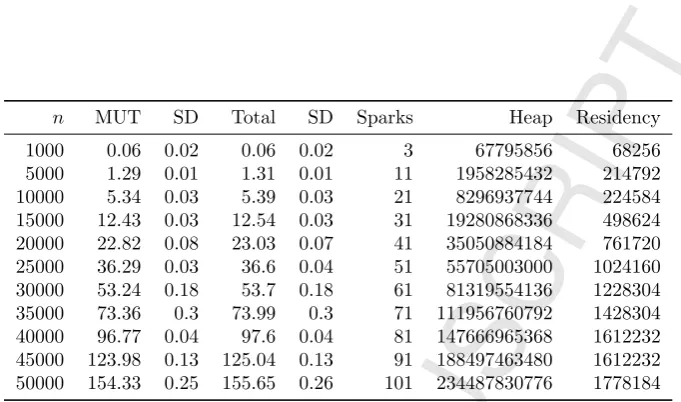
n MUT SD Total SD Sparks Heap Residency 1000 0.06 0.02 0.06 0.02 3 67795856 68256 5000 1.29 0.01 1.31 0.01 11 1958285432 214792 10000 5.34 0.03 5.39 0.03 21 8296937744 224584 15000 12.43 0.03 12.54 0.03 31 19280868336 498624 20000 22.82 0.08 23.03 0.07 41 35050884184 761720 25000 36.29 0.03 36.6 0.04 51 55705003000 1024160 30000 53.24 0.18 53.7 0.18 61 81319554136 1228304 35000 73.36 0.3 73.99 0.3 71 111956760792 1428304 40000 96.77 0.04 97.6 0.04 81 147666965368 1612232 45000 123.98 0.13 125.04 0.13 91 188497463480 1612232 50000 154.33 0.25 155.65 0.26 101 234487830776 1778184 Figure 6: Sequential mutator (MUT) and total (Total) times in seconds (with standard devia-tions), total number of sparks for parallel version, and heap allocation and residency in bytes forsumeuleroncorryvreckan.
4. Examples
1 8 16 24 32 40 48 56 0
5 10 15 20 25 30
Cores
Sp
eedup
n= 1000
n= 5000
n= 10000
n= 15000
n= 20000
n= 25000
n= 30000
n= 35000
n= 40000
n= 45000
[image:27.595.151.467.105.350.2]n= 50000
Figure 7: Speedups forsumeuleroncorryvreckan using reported mutator (MUT, reduplicated from Sec. 1.2) times. Dashed line indicates 28 physical cores, with a total of 56 hyper-threaded cores.
real-time for the program as a whole, and also includes the additional system runtime overheads of initialisation, finalisation and garbage collection time. 4.1. Sumeuler
As described in Sec. 1.2,sumeulercalculates Euler’s totient function for a list of integers and sums the results. In the NoFib suite,sumeulerconsists of three Haskell files: ListAux(41 lines),SumEulerPrimes(36 lines), andSumEuler(290 lines). Collectively, these introduce 31 functions, 12 of which have explicitmaps orfolds as part of their definitions. Our prototype implementation rediscovers all the implicitmapsand folds. One interesting case isprimesIn:
1 primesIn :: [Int] -> Int -> [Int] 2 primesIn ps@(p:rest) n
3 | p > n = []
4 | n `mod` p == 0 = p:primesIn ps (n `div` p) 5 | otherwise = primesIn rest n
primesInis afoldr over aninfinite list when the standard Prelude definition of foldrdoes not define behaviour for the empty list.
We executedsumeulerfor n= 1000,5000 and between 10000 and 50000 at intervals of 5000, with a chunk size of 500. Fig. 6 gives average sequential times (with standard deviations), the number of sparks, heap allocation, and residency for alln. All sparks are converted for alln. Fig. 7 and Fig. 8 give speedups for
1 8 16 24 32 40 48 56 0
5 10 15 20 25 30
Cores
Sp
eedup
n= 1000
n= 5000
n= 10000
n= 15000
n= 20000
n= 25000
n= 30000
n= 35000
n= 40000
n= 45000
[image:28.595.151.467.105.350.2]n= 50000
Figure 8: Speedups forsumeuleroncorryvreckan using reported total (Total) times. Dashed line indicates 28 physical cores, with a total of 56 hyper-threaded cores.
n MUT SD Total SD Sparks Heap Residency
11 0.1 0.03 0.1 0.03 101 95722624 64088
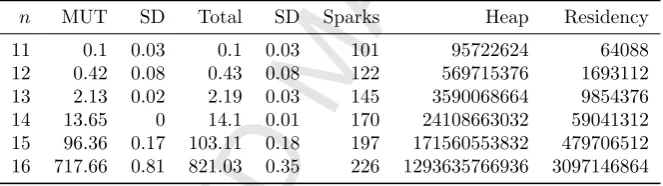
12 0.42 0.08 0.43 0.08 122 569715376 1693112 13 2.13 0.02 2.19 0.03 145 3590068664 9854376 14 13.65 0 14.1 0.01 170 24108663032 59041312 15 96.36 0.17 103.11 0.18 197 171560553832 479706512 16 717.66 0.81 821.03 0.35 226 1293635766936 3097146864 Figure 9: Sequential mutator (MUT) and total (Total) times in seconds (with standard devia-tions), total number of sparks for parallel version, and heap allocation and residency in bytes, forqueensoncorryvreckan.
the number of cores. Total time speedups are more likely to reduce as further cores are added for a givenn, since garbage collection timeincreases with more cores. The irregularity of the tasks insumeuleris also likely to have contributed to this result. For this example, all of the potential parallelism (Haskellsparks) was converted into actual parallelism (Haskell ultra-lightweight threads). In general, however, the sophisticated evaluate-and-die mechanism will throttle excess parallelism, giving a better load-balance, and avoiding system overload when massive amounts of parallelism are present.
4.2. N-Queens
[image:28.595.132.464.383.476.2]1 8 16 24 32 40 48 56 0
2 4 6 8 10 12 14 16 18 20 22 24
Cores
Sp
eedup
[image:29.595.157.470.105.352.2]n= 11 n= 12 n= 13 n= 14 n= 15 n= 16
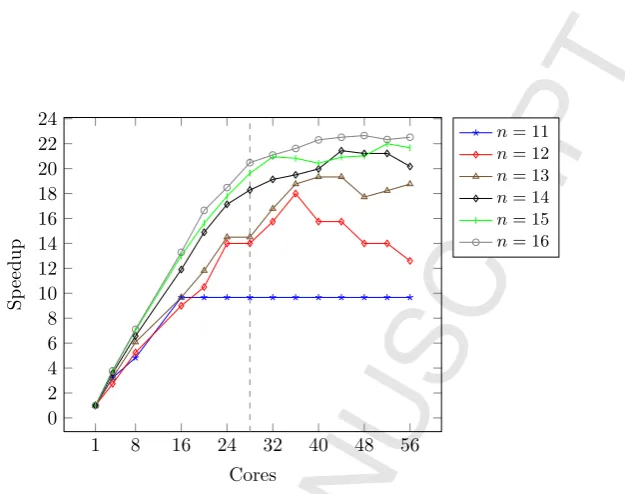
Figure 10: Speedups forqueensoncorryvreckanusing reported mutator (MUT) time. Dashed line indicates 28 physical cores, with a total of 56 hyper-threaded cores.
functions. Two of these 6 functions have explicit maps and folds (including list comprehensions), and an explicit call toiterate. One other function,safe, 1 safe :: Int -> Int -> [Int] -> Bool
2 safe x d [] = True
3 safe x d (q:l) = x /= q && x /= q+d && x /= q-d && safe x (d+1) l
is animplicit foldrover lists:
1 safe :: Int -> Int -> [Int] -> Bool 2 safe x d qs = fst $ foldr f (True,d) qs 3 where
4 f q (l,d) = (x /= q && x /= q+d && x /= q-d && l, d+1)
Since dis updated between recursive calls, our prototype implementation will not currently detect this foldr1. By rewriting safe as a composition of an unfoldand an (implicit) foldr, our prototype can detect thefoldr over the tree generated by theunfold. safemay alternatively be considered an instance of azygomorphism[28], it may therefore be worth investigating this pattern as part of our future work. Another function, pargen, enumerates the different possible locations of the queens on the board.
1This is because in the original definition of safe, d is updated between recursive calls
1 8 16 24 32 40 48 56 0
2 4 6 8 10 12 14 16 18 20 22 24
Cores
[image:30.595.166.475.106.352.2]n= 11 n= 12 n= 13 n= 14 n= 15 n= 16
Figure 11: Speedups forqueensoncorryvreckan using reported total (Total) time. Dashed line indicates 28 physical cores, with a total of 56 hyper-threaded cores.
1 pargen strat n b
2 n >= t = iterate gen [b] !! (nq - n) 3 otherwise =
4 concat (map (pargen strat (n+1)) (gen [b]) `using` strat)
This is defined as a sub-function of the top-level queens function. Here, nq denotes the number of queens that are to be searched for, andtis a threshold for controlling parallelism. Thestrat parameter is an evaluation strategy: either evalListorparList depending on whether sequential or parallel operation is chosen. n is used as a measure for determining whether the threshold, t, is reached;baccumulates results; andgengenerates an individual result. We can unfold bothiterate andmap expressions as implicititerNand mapfunctions that are called bypargen:
1 pargen n b
2 n >= t = pgI ([b],(nq-n))
3 otherwise = concat $ pgM (gen [b])
4 where
5 pgI (rs,0) = rs
6 pgI (rs,i) = pgI ((gen rs),i-1) 7
8 pgM [] = []
9 pgM (r:rs) = pargen' (n+1) r : pgM rs
1 8 16 24 32 40 48 56 0
20 40 60 80 100 120 140 160
Cores
Time
(s)
n= 11
n= 12
n= 13
n= 14
n= 15
[image:31.595.182.476.108.314.2]n= 16
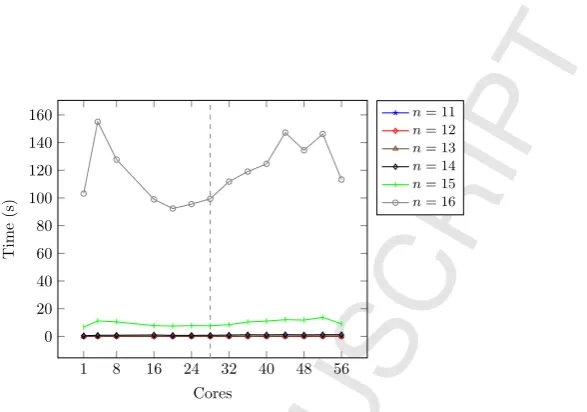
Figure 12: Garbage collection times for queensoncorryvreckan. Dashed line indicates 28 physical cores, with a total of 56 hyper-threaded cores.
gives mutator and total times (with standard deviations) for sequential runs, and number of sparks, heap allocation size, and residency for eachn. An average of 30% of sparks were converted on 4 cores, 65% on 8 cores, and 85% for all other cores. Fig. 10 and 11 shows speedups forqueensin terms of mutator and total time. We achieve maximum speedups of 22.65 forn= 16 on 48 hyper-threaded cores and 10.00 for n = 12 on 36 hyper-threaded cores. When n = 11, the mutator time plateaus quickly and sharply, possibly due to lack of work. When n= 12, speedups reduce as the number of cores is increased, probably because there is insufficient work to offset increased overheads. Otherwise, mutator times plateau above 28 cores, probably because hyper-threading is not effective in this example. Unlike our other examples, total time speedups reveal an overall halving of performance gains as a consequence of increased garbage collection time. Fig. 12 shows that whenn= 15 andn= 16, garbage collection times are heavily increased. This is probably due to repeated generation of lists.
4.3. N-Body
nbodycalculates the movement of bodies in m-dimensional space according to the physical forces between them. The classical representation of this problem is between celestial bodies, modelling the effects of gravity on their trajectories. In the NoFib suite, nbody consists of two Haskell files: Future (16 lines) and nbody(135 lines) which collectively define 8 functions. Two of these 8 functions have an explicit map or fold, and one,loop, is animplicititerN. Our prototype discovers the maps and folds in both functions where they are explicitly used, from their inlined definitions. Theloopsub-function of computeis defined as: 1 loop i ax ay az
2 i == end = (# ax,ay,az #)
3 otherwise = loop (i+1) (ax+px) (ay+py) (az+pz)
n MUT SD Total SD Sparks Heap Residency 10000 2.06 0.06 2.07 0.06 40 6310152 1197488 25000 11.61 0.1 11.63 0.11 40 15670360 5216880 50000 46.93 0.13 46.98 0.13 40 31270520 12311984 75000 104.9 0.35 104.96 0.34 40 46870848 12547600 100000 187.47 0.1 187.57 0.11 40 62471232 25082544 250000 1164.34 0.68 1164.52 0.65 40 156226496 40215360 Figure 13: Sequential mutator (MUT) and total (Total) times in seconds (with standard devia-tions), total number of sparks for parallel version, and heap allocation and residency in bytes, fornbodyoncorryvreckan.
1 8 16 24 32 40 48 56
0 5 10 15 20 25
Cores
Sp
eedup
n= 10000
n= 25000
n= 50000
n= 75000
n= 100000
n= 250000
Figure 14: Speedups fornbodyoncorryvreckan using reported mutator (MUT) time. Dashed line indicates 28 physical cores, with a total of 56 hyper-threaded cores.
5 ( x,y,z ) = vector
6 ( x',y',z' ) = vecList Array.! i 7
8 (# dx,dy,dz #) = (# x'-x, y'-y, z'-z #)
9 eps = 0.005
10 distanceSq = dx^2 + dy^2 + dz^2 + eps 11 factor = 1/sqrt(distanceSq ^ 3) 12 (# px,py,pz #) =
13 (# factor * dx, factor * dy, factor *dz #)
1 8 16 24 32 40 48 56 0
5 10 15 20 25
Cores Total
n= 10000
n= 25000
n= 50000
n= 75000
n= 100000
[image:33.595.155.471.104.369.2]n= 250000
Figure 15: Speedups fornbodyoncorryvreckan using reported total (Total) time. Dashed line indicates 28 physical cores, with a total of 56 hyper-threaded cores.
endinverted such thatidecreases to 0, our prototype discovers theiterN. 1 loop ((ax,ay,az),i) = iterN g ((ax,ay,az),i)
2 where
3 g (ax,ay,az) = let ... in ((ax+px),(ay+py),(az+pz))
We have elided the local definitions for clarity. We executed nbody for n = {10000,250000}and between 0 and 100000 at intervals of 25000. Fig. 13 gives the corresponding mutator and total times (with standard deviations), and the number of sparks (potential parallelism), heap allocation size, and residency for each n. An average of 97.5% of sparks were converted on 4 cores, and 100% of sparks were converted on all other numbers of cores. Fig. 14 and 15 give speedups fornbodyusing mutator and total time, achieving maximum speedups of 27.08 forn= 250000 on 52 hyper-threaded cores and 26.82 forn= 250000 on 52 hyper-threaded cores, respectively. There is little difference between mutator and total reported speedups fornbody, showing that garbage collection is not significant for this example. The example also demonstrates good scalability for both varyingnand number of cores. The growth in speedup does diminish after 28 cores, and the use of hyper-threading is again the most likely cause. 4.4. Matrix Multiplication
n MUT SD Total SD Sparks Heap Residency 1000 13.15 1.59 13.37 1.58 18 317362136 44416 1500 56.09 5.12 56.33 5.14 27.5 713751520 44416 2000 131.72 14.07 131.96 14.07 38 1268624520 44416 2500 226.58 7.49 226.83 7.51 49.5 1835831694 44416 3000 402.13 2.71 402.36 2.69 62 1801405160 44416 3500 633.18 9.43 633.44 9.43 67 2451609160 44416 4000 946.42 12.1 946.67 12.08 80.5 3201845928 44416 4500 1344.39 16.09 1344.59 16.08 85.5 4052049928 44416 5000 1823.05 0.96 1823.31 0.96 100 5002253928 44416 Figure 16: Sequential mutator (MUT) and total (Total) times in seconds (with standard devia-tions), total number of sparks for parallel version, and heap allocation and residency in bytes, formatmultoncorryvreckan.
are used extensively in this example). All the instances of explicit maps and folds are discovered by our prototype from their inlined definitions. Three func-tions,shiftRightand bothaddProddefinitions, are implicit folds.shiftRight is defined as:
1 shiftRight c [] = []
2 shiftRight c (xs:xss) = (xs2++xs1):shiftRight (c-1) xss 3 where (xs1,xs2) = splitAt c xs
and is an implicitfoldr:
1 shiftRight c xs = fst $ foldr f ([],c) xs 2 where
3 g xs (xss,c) = let (xs1,xs2) = splitAt c xs
4 in ((xs2++xs1):xss, c-1)
As withsafefromqueens(Sec. 4.2), our prototype cannot discover thefoldr inshiftRight becausecis updated in the recursive call. The second implicit fold,addProd, is defined as:
1 addProd :: Vector -> Vector -> Int -> Int
2 addProd (v:vs) (w:ws) acc = addProd vs ws (acc + v*w) 3 addProd [] [] n = n
1 8 16 24 32 40 48 56 0
5 10 15 20 25 30 35
Cores
Sp
eedup
[image:35.595.156.468.104.349.2]n= 1500 n= 2000 n= 2500 n= 3000 n= 3500 n= 4000 n= 4500 n= 5000
Figure 17: Speedups formatmultoncorryvreckan using the row-wise parallelisation option and reported mutator (MUT) time. Dashed line indicates 28 physical cores, with a total of 56 hyper-threaded cores.
1 replicate n [1..n]
Fig. 16 reports sequential times (with standard deviations), and the number of sparks, heap allocation size, and residency for eachn. The average number of sparks converted varies withn, instead of the number of cores seen in previous examples. Converted sparks fluctuate between 100% and not less than 93% (seen on 4 cores), and fluctuations grow smaller with largern. Figs. 17, 19, 18, and 20 give speedups formatmultusing mutator and total time for both parallel modes. Row-wise parallelisation achieves maximum speedups of 28.26 forn= 2500 on 56 hyper-threaded cores for both mutator and total values. Block-wise parallelisation achieves maximum speedups of 32.93 forn= 1500 on 52 hyper-threaded cores for both mutator and total values. As withnbody, there is little difference between mutator and total reported speedups formatmult, and mode 2 proves generally only slightly better than mode 1. The example demonstrates good scalability for both varyingnand number of cores. Once again, speedup growth slows after 28 cores due to hyper-threading.
5. Related Work
detec-1 8 16 24 32 40 48 56 5
10 15 20 25 30 35
Cores
Sp
eedup
[image:36.595.156.467.104.348.2]n= 1500 n= 2000 n= 2500 n= 3000 n= 3500 n= 4000 n= 4500 n= 5000
Figure 18: Speedups formatmultoncorryvreckan using the block-wise parallelisation option and reported mutator (MUT) time. Dashed line indicates 28 physical cores, with a total of 56 hyper-threaded cores.
tion [33, 18]. Whilst our technique can be considered a form of clone detec-tion, traditional anti-unification approaches to clone detection have focussed on comparing functions within the same program. Instead, we compare functions against potentially arbitrary higher-order functions that can either be from the same program, the Haskell Prelude, or a library.
1 8 16 24 32 40 48 56 0
5 10 15 20 25 30 35
Cores
Sp
eedup
[image:37.595.156.467.104.348.2]n= 1500 n= 2000 n= 2500 n= 3000 n= 3500 n= 4000 n= 4500 n= 5000
Figure 19: Speedups formatmultoncorryvreckan using the row-wise parallelisation option and reported total (Total) time. Dashed line indicates 28 physical cores, with a total of 56 hyper-threaded cores.
1 8 16 24 32 40 48 56 5
10 15 20 25 30 35
Cores
Sp
eedup
[image:38.595.156.467.104.348.2]n= 1500 n= 2000 n= 2500 n= 3000 n= 3500 n= 4000 n= 4500 n= 5000
Figure 20: Speedups formatmultoncorryvreckan using the block-wise parallelisation option and reported total (Total) time. Dashed line indicates 28 physical cores, with a total of 56 hyper-threaded cores.
6. Conclusions and Future Work
al-ready exist in e.g. thehackagerepository. We also intend to apply our approach to more varied patterns, e.g.unfolds [47], which have been shown to be useful components of parallel programs [4].
7. Acknowledgements
This work has been partially supported by the EU H2020 grant “RePhrase: Refactoring Parallel Heterogeneous Resource-Aware Applications – a Software Engineering Approach” (ICT-644235), by COST Action IC1202 (TACLe), sup-ported by COST (European Cooperation in Science and Technology), by EP-SRC grant “Discovery: Pattern Discovery and Program Shaping for Manycore Systems” (EP/P020631/1), and by Scottish Enterprise PS7305CA44.
References
[1] H. Gonz´alez-V´elez, M. Leyton, A Survey of Algorithmic Skeleton Frame-works: High-level Structured Parallel Programming Enablers, Vol. 40, John Wiley & Sons, Inc., New York, NY, USA, 2010, pp. 1135–1160.
[2] A. Barwell, C. Brown, K. Hammond, W. Turek, A. Byrski, Using “Program Shaping” to Parallelise an Evolutionary Multi-Agent System in Erlang, J. Computing and Informatics (to appear).
[3] M. Cole, Algorithmic Skeletons: Structured Management of Parallel Com-putation, MIT Press, Cambridge, MA, USA, 1991.
[4] D. Castro, S. Sarkar, K. Hammond, Farms, Pipes, Streams and Refor-estation: Reasoning about Structured Parallel Processes using Types and Hylomorphisms, in: Proc. ICFP ’16, 2016, pp. 4–17.
[5] V. Janjic, C. Brown, K. Hammond, Lapedo: Hybrid Skeletons for Program-ming Heterogeneous Multicore Machines in Erlang, Parallel Computing: On the Road to Exascale 27 (2016) 185.
[6] M. Coppola, M. Vanneschi, High-performance data mining with skeleton-based structured parallel programming, Parallel Computing 28 (5) (2002) 793–813.
[7] V. Kannan, G. Hamilton, Program Transformation to Identify Parallel Skeletons, in: Int. Conf. on Parallel, Distributed, and Network-Based Pro-cessing (PDP’16), IEEE, 2016, pp. 486–494.
[9] W. Partain, The nofib benchmark suite of haskell programs, in: J. Launch-bury, P. Sansom (Eds.), Functional Programming, Glasgow 1992: Pro-ceedings of the 1992 Glasgow Workshop on Functional Programming, Ayr, Scotland, 6–8 July 1992, Springer London, London, 1993, pp. 195–202. [10] G. D. Plotkin, A Note on Inductive generalization, Machine Intelligence 5
(1970) 153–163.
[11] S. Breitinger, R. Loogen, Y. O. Mallen, R. Pena, The Eden Coordination Model for Distributed Memory Systems, in: Proceedings of the 1997 Work-shop on High-Level Programming Models and Supportive Environments (HIPS ’97), HIPS ’97, 1997, pp. 120–.
[12] S. Marlow, R. Newton, S. Peyton Jones, A Monad for Deterministic Par-allelism, in: Proceedings of the 4th ACM Symposium on Haskell, Haskell ’11, 2011, pp. 71–82.
[13] M. M. Chakravarty, G. Keller, S. Lee, T. L. McDonell, V. Grover, Accel-erating Haskell Array Codes with Multicore GPUs, in: Proceedings of the Sixth Workshop on Declarative Aspects of Multicore Programming, DAMP ’11, 2011, pp. 3–14.
[14] N. Scaife, S. Horiguchi, G. Michaelson, P. Bristow, A Parallel SML Com-piler Based on Algorithmic Skeletons, Journal of Functional Programming 15 (4) (2005) 615–650.
[15] J. C. Reynolds, Transformational Systems and the Algebraic Structure of Atomic Formulas, Machine intelligence 5 (1) (1970) 135–151.
[16] C. Brown, Tool Support for Refactoring Haskell Programs.
[17] P. E. Bulychev, E. V. Kostylev, V. A. Zakharov, Anti-unification Algo-rithms and Their Applications in Program Analysis, in: Proceedings of the 7th International Andrei Ershov Memorial Conference on Perspectives of Systems Informatics, PSI’09, 2010, pp. 413–423.
[18] P. Bulychev, M. Minea, An Evaluation of Duplicate Code Detection Using Anti-Unification, in: Proc. 3rd International Workshop on Software Clones, 2009.
[19] C. Brown, H.-W. Loidl, K. Hammond, ParaForming: Forming Parallel Haskell Programs Using Novel Refactoring Techniques, in: Proceedings of the 12th International Conference on Trends in Functional Programming, TFP’11, 2012, pp. 82–97.
[21] E. Horowitz, A. Zorat, Divide-and-Conquer for Parallel Processing, IEEE Transactions on Computers C-32 (6) (1983) 582–585.
[22] V. Janjic, C. Brown, K. MacKenzie, K. Hammond, M. Danelutto, M. Ald-inucci, J. D. Garcia, RPL: A Domain-Specific Language for Designing and Implementing Parallel C++ Applications, in: Proc. PDP ’16: Intl. Conf. on Parallel, Distrib. and Network-Based Proc., 2016, pp. 288–295.
[23] S. Marlow, P. Maier, H.-W. Loidl, M. K. Aswad, P. Trinder, Seq No More: Better Strategies for Parallel Haskell, in: Proceedings of the Third ACM Haskell Symposium on Haskell, Haskell ’10, 2010, pp. 91–102.
[24] L. Bergstrom, J. Reppy, Nested Data-parallelism on the Gpu, in: Proceed-ings of the 17th ACM SIGPLAN International Conference on Functional Programming, ICFP ’12, 2012, pp. 247–258.
[25] C. Brown, M. Danelutto, K. Hammond, P. Kilpatrick, A. Elliott, Cost-Directed Refactoring for Parallel Erlang Programs, International Journal of Parallel Programming (2013) 1–19.
[26] Programatica: Integrating programming, properties and validation. URLhttp://programatica.cs.pdx.edu
[27] D. A. Plaisted, Handbook of Logic in Artificial Intelligence and Logic Pro-gramming (Vol. 1), 1993, Ch. Equational Reasoning and Term Rewriting Systems, pp. 274–364.
[28] R. Hinze, N. Wu, J. Gibbons, Unifying Structured Recursion Schemes, SIGPLAN Not. 48 (9) (2013) 209–220.
[29] T. Kutsia, J. Levy, M. Villaret, Anti-unification for unranked terms and hedges, Journal of Automated Reasoning 52 (2) (2014) 155–190.
[30] H. Gust, K.-U. K¨uhnberger, U. Schmid, Metaphors and anti-unification, in: Proc. Twenty-First Workshop on Language Technology: Algebraic Meth-ods in Language Processing, Verona, Italy, 2003, pp. 111–123.
[31] J. W. Lloyd, An Algorithm of Generalization in Positive Supercompilation, in: Logic Programming: The 1995 International Symposium, MIT Press, 1995, pp. 465–479.
[32] C. Oancea, C. So, S. M. Watt, Generalisation in Maple 277–328.
[33] C. Brown, S. Thompson, Clone Detection and Elimination for Haskell, in: Proceedings of the 2010 ACM SIGPLAN Workshop on Partial Evaluation and Program Manipulation, PEPM ’10, 2010, pp. 111–120.