rsos.royalsocietypublishing.org
Research
Cite this article:Lambert ML, Schiestl M,
Schwing R, Taylor AH, Gajdon GK, Slocombe KE, Seed AM. 2017 Function and flexibility of object exploration in kea and New Caledonian crows.R. Soc. open sci.4: 170652.
http://dx.doi.org/10.1098/rsos.170652
Received: 14 June 2017 Accepted: 31 August 2017
Subject Category:
Biology (whole organism)
Subject Areas:
behaviour/cognition/ecology
Keywords:
cognition, tool use, object play, corvid, parrot, object properties
Author for correspondence:
Katie E. Slocombe
e-mail:[email protected]
†These authors contributed equally to this
study.
Electronic supplementary material is available online at https://dx.doi.org/10.6084/m9. figshare.c.3879730.
Function and flexibility of
object exploration in kea
and New Caledonian crows
Megan L. Lambert
1,2
, Martina Schiestl
3,4
, Raoul
Schwing
5
, Alex H. Taylor
6
, Gyula K. Gajdon
5
,
Katie E. Slocombe
1,
†
and Amanda M. Seed
7,
†
1Department of Psychology, University of York, York, UK
2Department of Cognitive Science, Lund University, Lund, Sweden
3Haidlhof Research Station, University of Vienna and University of Veterinary
Medicine, Vienna, Austria
4Department of Linguistic and Cultural Evolution, Max Planck Institute for the Science
of Human History, Jena, Germany
5Comparative Cognition Unit, Messerli Research Institute, University of Veterinary
Medicine Vienna, Medical University of Vienna, University of Vienna, Vienna, Austria 6Department of Psychology, University of Auckland, Auckland, New Zealand
7School of Psychology and Neuroscience, University of St Andrews, St Andrews, UK
MLL,0000-0003-3618-7260; RS,0000-0003-4663-8432;
AHT,0000-0003-3492-7667; KES,0000-0002-7310-1887
A range of non-human animals frequently manipulate and explore objects in their environment, which may enable them to learn about physical properties and potentially form more abstract concepts of properties such as weight and rigidity. Whether animals can apply the information learned during their exploration to solve novel problems, however, and whether they actually change their exploratory behaviour to seek functional information about objects have not been fully explored. We allowed kea (Nestor notabilis) and New Caledonian crows (Corvus moneduloides) to explore sets of novel objects both before and after encountering a task in which some of the objects could function as tools. Following this, subjects were given test trials in which they could choose among the objects they had explored to solve a tool-use task. Several individuals from both species performed above chance on these test trials, and only did so after exploring the objects, compared with a control experiment with no prior exploration phase. These results suggest that selection of functional tools may be guided by information acquired during exploration. Neither kea nor crows changed the duration or quality of their exploration after learning that the objects had a functional relevance, suggesting that birds do not adjust their behaviour to explicitly seek this information.
2
rsos
.ro
yalsociet
ypublishing
.or
g
R.
Soc
.open
sc
i.
4
:1
70652
...
1. Introduction
Unrewarded object exploration is widespread among non-human animals, and is thought to confer important benefits by allowing individuals to develop motor skills for foraging and engage in novel behaviour patterns that may lead to innovative foraging strategies [1–3]. Additionally, it might provide increased opportunities to learn about the affordances of objects and potentially develop more abstract concepts about ‘invisible’ physical properties such as weight and rigidity, which could provide a route to flexible problem solving and tool use [4]. The exploratory play of young humans is thought to scaffold such learning, whereby infants construct knowledge about an object’s functionality through repeated interaction [5–7]. Consequently, unrewarded object exploration may serve as an important phylogenetic or ontogenetic precursor to tool use. Despite its potential importance in this domain, however, little is known as to whether any animals gain information about object properties through exploration, and whether any non-human animals can use exploration strategically to gain such information.
Some of the most pronounced object exploration is found among relatively large-brained birds and primates, with tool-using species generally exhibiting higher rates of object exploration than non-tool-using species [8–11]. For example, early comparative studies of 74 primate species found that tool-non-tool-using
Cebus[10] and great ape species [9,10] showed a broader repertoire of manipulations than non-tool-using primate species, or spent more time manipulating detached objects during development than closely related species which did not habitually use tools (chimpanzees vs. bonobos [12]). Among birds, some species of corvid and parrot, which readily explore and play with objects, demonstrate sophisticated problem-solving abilities in captivity as well as spontaneous and habitual tool use either in the wild (New Caledonian crows [13], see [14,15] for problem-solving experiments) or captivity (e.g. Goffin cockatoos [11,16]; greater vasa parrots [17]). Recent comparative studies within parrots and corvids have additionally shown that species proficient in tool use, either in the wild or in experimental contexts, showed high frequencies of combined object manipulation compared with non-tool-using species, either during ontogeny or in adulthood [18,19].
Despite this evidence, the nature of the link between object exploration and problem solving (including tool use) is relatively unexplored. What (if any) information is being gained from exploration of an object that may later translate to its functional use? Do animals change the way they explore objects in order to gain information about them? There is some evidence to suggest that tool-using primates such as chimpanzees and capuchin monkeys can learn about potential tools through exploration. For example, an early study found that chimpanzees were only able to solve a task involving a stick tool after they gained experience manipulating sticks in their home enclosure, suggesting that subjects learned something about the functionality of the sticks through exploration [20]. Additionally, great apes and capuchins perform significantly better at selecting functional (rigid) stick tools from a set of objects either after having manipulated the objects themselves or after watching an experimenter demonstrate the properties of the objects ([21,22], but see [23,24]). In a related study, non-tool-using marmosets also learned to select functional tools after gaining experience with similar tasks [25].
A related question involves whether exploration is used intentionally to seek information. Individuals might incidentally gain information about the objects’ hidden structural properties as they are manipulated, but do they alter the quality or duration of their exploration to learn about these properties once they have been confronted with a task? This type of behaviour is evident in young children who increase their exploration in order to learn about causally ambiguous stimuli [26]. Similarly, when choosing among stone tools for nut-cracking, wild capuchin monkeys resort to techniques such as tapping or moving stones that do not possess reliable visual cues about weight as a functional property (e.g. when choosing between identical stones, or when larger stones are lighter than smaller stones [27]). By contrast, chimpanzees did not change their exploratory behaviour in order to seek explanations about why familiar objects suddenly functioned differently in the absence of visual cues (e.g. counterweighted blocks which no longer stood upright [28]).
The current literature, therefore, provides some evidence that primates such as chimpanzees and capuchin monkeys can learn about objects through exploration [21,22], and even change their exploratory behaviour to gain information about potential tools, though the degree to which this involves abstract representations of object properties such as weight and rigidity remains a matter for debate [29,30]). Our study aimed to determine whether (i) information about object properties is gained through exploration and can be applied in a problem-solving context; and (ii) if knowledge about the potential use of an object as a tool changes exploratory behaviour.
3
rsos
.ro
yalsociet
ypublishing
.or
g
R.
Soc
.open
sc
i.
4
:1
70652
...
and captive settings [15,32], with a series of experiments to investigate the function and flexibility of exploration in learning about structural object properties. The behavioural differences between these two species allowed us to test the potential role of exploration for a habitually tool-using species (i.e. whether tool-using birds are more likely to attend to object properties during manipulation or directly seek information), as well as how the kea’s pronounced exploration into adulthood might function (i.e. what information they glean from their exploration and how flexible this behaviour might be). As both kea and New Caledonian crows excel at solving physical problems, examining their exploratory behaviour provides insight into how they actually acquire information to solve these tasks, as well as what object features they attend to.
In Experiment 1, we gave subjects the opportunity to explore sets of similar novel objects that varied in their underlying structure (i.e. identically sized blocks of different weights and identically sized rope pieces with different rigidity). These objects also varied visually in terms of colour and pattern, so each object was unique and one of these visual features varied systematically with the structural properties (e.g. all heavy blocks were striped). We investigated whether they gained information from their object exploration which could later be used to solve a task. They were trained to solve the task with different objects (a heavy ball that collapsed a platform, and a rigid stick that could be used to extract a reward from a pipe). Following this, subjects received forced-choice trials in which objects from the explore phase were presented to see if subjects could select the functional tool based on their previous experience with them. By presenting the objects in two phases, half before and half after the task was first introduced, we also aimed to investigate whether subjects changed the duration or quality of their exploration to gain information about the objects’ properties once they had had the chance to learn that half of the objects would function as tools. In Experiment 2, we presented subjects with a new set of blocks, this time with colour as the visual feature corresponding with structure (rather than pattern), to determine whether poor performance with the blocks in Experiment 1 resulted from difficulties in discriminating between heavy and light objects, or in associating weight with pattern. Finally, each subject’s performance in Experiments 1 and 2 was compared with test trials featuring a new set of objects that subjects did not have the opportunity to explore or interact with prior to testing (Experiment 3).
It was expected that birds which spent longer exploring objects or engaged in more functional behaviours (potentially able to reveal the hidden structural properties of the object; e.g. picking up a block to reveal weight versus touching the surface of a block with the beak) would perform better in the tool-use trials. If subjects’ exploration was driven by information seeking, they were expected to increase the amount of time they spent exploring similar (but visually novel) objects and/or to qualitatively alter their exploratory behaviour after learning that the properties of the objects had a functional relevance. Finally, if exploration generally provided information about the underlying structure of the objects, it was predicted that subjects would perform significantly better in Experiments 1 or 2, in which they were allowed to explore the objects prior to using them as tools, than in Experiment 3 when they were not allowed to explore.
2. General methods
2.1. Subjects
2.1.1. Kea
4
rsos
.ro
yalsociet
ypublishing
.or
g
R.
Soc
.open
sc
i.
4
:1
70652
...
2.1.2. Crows
Subjects were six wild-caught New Caledonian crows (three juvenile males; one adult male and two adult females) housed in captivity for approximately five weeks prior to the start of testing. Age was determined from mouth coloration and sex was determined from body size [35]. Prior to testing, all birds had been trained to drop stones into a Perspex box, causing a platform to fall and release a reward. During testing the birds concurrently participated in a hand tracking study [36], but otherwise had no experience with artificial tasks that required them to attend to structural object properties, although we note that subjects likely had experience using stick tools in the wild. Consequently, rigidity may be a particularly salient structural property for the crow subjects.
2.2. Testing compartments
2.2.1. Kea
For the kea, all object exploration trials (Phases 1 and 3) took place in the waiting compartment, while test trials (Phase 4) took place in the neighbouring testing compartment. The waiting and testing compartments were attached to the main aviary and featured opaque sliding doors so that subjects were in visual but not auditory isolation from conspecifics. The experimenter was visible throughout exploration and test trials, and during test trials was present in the same compartment as the subject but remained motionless with gaze fixed on the apparatus until the subject made a choice, at which point the experimenter removed the remaining object. The experimenter stood next to the entrance to the testing compartment, so that subjects walked into the compartment and immediately had their backs facing the experimenter as they selected an object.
2.2.2. Crows
Both exploration and test trials took place in a designated testing aviary attached to each group’s main aviary, such that each group had its own distinct testing compartment. The experimenter was never visible and remained on the outside of the testing compartment filming all interactions during object exploration trials. Throughout test trials, the experimenter only entered to re-bait the apparatus and begin a new trial.
3. Experiment 1: learning about weight and rigidity through exploration
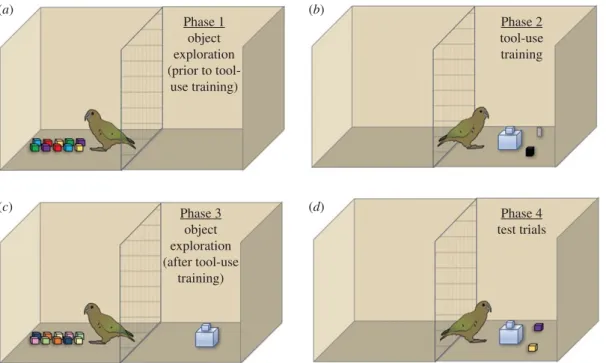
Experiment 1 was aimed at determining whether exploration provided birds with information about the structural properties of objects that would enable them to subsequently choose a functional tool in a tool-use task, and whether subjects changed the quality or duration of their exploration to learn about these properties after they had experience that some of the objects could function as tools. All test phases are outlined in figure 1 for clarity and are described in further detail under Procedure.3.1. Set-up and apparatus
5
rsos
.ro
yalsociet
ypublishing
.or
g
R.
Soc
.open
sc
i.
4
:1
70652
...
Phase 1 object exploration (prior to
tool-use training)
Phase 3 object exploration (after tool-use
training)
Phase 2 tool-use training
Phase 4 test trials
(a) (b)
(c) (d)
Figure 1.Overview of Experiment 1 testing phases, using the block set as an example.
3.1.1. Blocks/weight
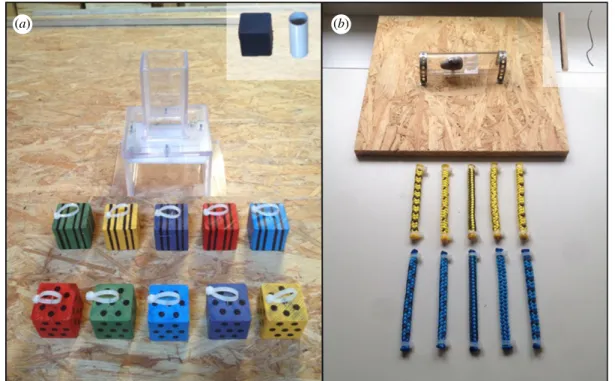
The ‘weight’ object set for the kea consisted of 20 wooden blocks (4×4×4 cm), half of which were light (45 g) while the other half were heavy (125 g). All heavy blocks featured a striped pattern and all light blocks featured dots (figure 2a). Ten different colours were used within the set, with each colour featured on both a heavy and light block, thus making colour an irrelevant feature. Owing to size restrictions, the crows were presented with an analogous set of objects consisting of small clay balls (2 cm diameter), with the heavy balls weighing 44 g and the light balls weighing 0.04 g.
For the test trials (Phase 4, described below), the birds had to drop the blocks or balls into an opening in the top of a Perspex box (figure 2a) [37]. If the birds selected a heavy block, the weight of the block would cause a platform within the box to collapse, consequently releasing a reward (1/8 of a peanut for the kea, a similarly sized piece of meat for the crows) from an opening in the bottom of the box. In order to prevent mistrials, the platform was held in place by an electromagnet that was operated remotely by the experimenter, so that when subjects inserted the correct object, the experimenter pressed a button on a remote that was hidden behind a clipboard held by the experimenter throughout the session, causing the platform to collapse.
3.1.2. Ropes/rigidity
The ‘rigidity’ object set consisted of 20 pieces of rope (13 cm long, 0.75 cm diameter), half of which had a piece of gardening wire inserted in the middle, thus allowing the rope to function as a stick tool, and the other half of which were flexible and non-functional (figure 2b). Note that wire added a minimal amount of weight (2 g) to the rigid rope. The relevant observable property for the ropes was colour, so that all of the functional ropes were yellow, for example, while the other half were blue. Pattern was an irrelevant feature, with one functional and non-functional object marked with identical patterns so that the object set featured 10 different patterns in total.
6
rsos
.ro
yalsociet
ypublishing
.or
g
R.
Soc
.open
sc
i.
4
:1
70652
...
(a) (b)
Figure 2.Example object sets and apparatuses used with the kea. (a) Block set: individuals must select a heavy block (weight corresponds
with pattern) to insert into the opening of the box to collapse the platform inside. (b) Rope set: subjects must choose a rigid rope (rigidity corresponds with colour) to push out the weighted box in the middle of the tube. Training objects for each set are shown in the insets of each image.
3.2. Procedure
3.2.1. Phase 1. Object exploration (prior to training)
This stage served as a baseline measure of how subjects interacted with the objects prior to learning that the objects could be used as tools. Ten of the twenty objects (five functional, five non-functional) were presented in the compartment, either on the ground (kea;figure 1a) or a table (crows). Subjects were given 10 min to explore the objects, during which time the experimenter filmed all interactions. If subjects did not interact with the objects during their first session they then received habituation trials (see the electronic supplementary material for detailed procedure) before continuing with exploration sessions. Subjects moved on to Phase 2 after they explored at least three exemplars of a functional and non-functional object (six total), or after a maximum of four sessions, to avoid the objects becoming irrelevant.
3.2.2. Phase 2. Tool-use training
3.2.2.1. Weight
7
rsos
.ro
yalsociet
ypublishing
.or
g
R.
Soc
.open
sc
i.
4
:1
70652
...
3.2.2.2. Rigidity
Subjects were required to choose between a functional, wooden stick tool (13 cm long, 1 cm diameter) over a non-functional piece of string (22 cm long, 0.5 cm wide) to retrieve a reward from a clear, Perspex tube (kea) or artificial crevice (crows). This task proved difficult for some kea (AN, LI), who were unable to retrieve the reward after several sessions with the stick tool inserted in the tube. These subjects were instead trained using the Perspex box apparatus from the block set, but with a new Perspex tube (height: 5 cm, diameter: 5 cm) on the top as the opening. Subjects were required to insert one end of the stick tool into the tube so that it made contact with the platform, and then apply enough force on the distal end of the stick to collapse the platform. These subjects were subsequently tested in Phase 4 using the same box apparatus. Subjects completed tool-use training after choosing the rigid stick tool on five consecutive trials.
3.2.3. Phase 3. Object exploration (after training)
This stage allowed us to measure any differences in exploration patterns after subjects had encountered a task in which objects similar to those they explored could be used as tools. After reaching training criterion, birds were presented with the remaining 10 objects (half functional, half non-functional), and were again given 10 min for exploration upon first contacting an object. Different objects from those presented in Phase 1 were used (e.g. new colours or patterns) to reduce the likelihood that subjects would lose interest in the objects. In this stage, the apparatus used during training was baited and presented in full view, but not accessible, while the subjects explored the objects to increase the likelihood that they would associate the objects with the problem-solving task (figure 1c). In order to standardize comparisons between the two phases, the number of sessions subjects were given in this phase matched the number of sessions they were given in the first phase, such that if subjects had two exploration sessions in Phase 1, they were given two exploration sessions in Phase 3.
3.2.4. Phase 4. Test trials
To test whether birds had gained information about the properties of the objects they explored relevant to their functionality as tools, subjects were presented with one test session of 10 consecutive trials in which they could choose between a non-functional and a functional object from the set of objects they had previously encountered. Subjects were allowed one choice per trial, and a success was measured when subjects chose and used the functional tool. The set-up was identical to that used in the final stage of Phase 2, where the objects were presented equidistant from either side of the apparatus, with the side of the functional object pseudorandomized and counterbalanced across trials (figure 1d). A choice was counted as the first object that the subject touched, so subjects could not use manipulation during this phase to inform their choice.
3.2.5. Behavioural data
All exploration sessions (Phases 1 and 3) were coded in THE OBSERVERXT. As subjects met criteria for interacting with the objects at different times and, therefore, had different amounts of total object exploration time, the resulting behavioural data were then converted into several proportional measures for subsequent analysis (i.e. the duration of exploration behaviours divided by the total exploration time; see electronic supplementary material for full ethogram). Our three primary variables of interest were (i) general exploratory behaviour or all behaviours directed at the objects, (ii) functional behaviours which could potentially provide information about the underlying structure of the objects (e.g. picking up a block) and (iii) exploration directed toward the different object types (i.e. exploration of functional versus non-functional objects).
3.2.6. Analyses
8
rsos
.ro
yalsociet
ypublishing
.or
g
R.
Soc
.open
sc
i.
4
:1
70652
...
3.2.6.1. Do birds learn from their exploration?
To determine whether, as a group, subjects performed above chance on test trials following exploration, a one-sample Wilcoxon’s signed-rank test was used. To determine whether performance on the test trials was predicted by individuals’ duration or quality of exploration across all exploration sessions (Phases 1 and 3 grouped), and whether this differed between species, a binomial GLMM (GLMM1) with a logit-link function was run with the number of correct trials as the numerator and the total number of trials (n=10 for each subject) as the denominator. Fixed factors entered into the model were (i) total proportion of trial time spent exploring the objects (pre- and post-exploration grouped), (ii) total proportion of exploration time spent engaging in functional behaviours (pre- and post-exploration grouped) and (iii) species. Each individual had one data point per set entered into the model, resulting in 25 data points. Subject and object set were entered as random factors to control for repeated sampling.
We then ran a separate binomial GLMM (GLMM2) with a logit-link function to examine, on a trial-by-trial basis, whether subjects performed better on trial-by-trials that included objects they had previously chosen to explore with functional behaviours, and whether this covaried with species. Trial outcome (correct versus incorrect) was entered as the binary target variable into the model. Fixed factors entered into the model were (i) experience with the objects (no functional behaviour directed towards either object, functional behaviour directed towards the functional object, functional behaviour directed towards the non-functional object or functional behaviour directed towards both objects), (ii) species and (iii) the interaction between species and prior experience (n=250; 10 data points per individual per set). Subject and object set were entered as random factors to control for repeated sampling.
3.2.6.2. Do birds alter their exploration to gain information about objects?
To determine whether individuals changed their behaviour depending on condition (pre- or post-tool-use training) and whether this differed depending on species, three separate GLMMs (3–5) were run, each featuring condition (pre- or post-tool-use training) and species as fixed factors, and individual and object set as random factors. The target variables for each GLMM were (i) the proportion of trial time spent exploring all objects (GLMM3), (ii) the proportion of time spent exploring functional objects (GLMM4) and (iii) the proportion of trial time engaged in functional behaviours (see electronic supplementary material, table S2 for examples; GLMM5). Each individual had two data points per object set entered into each model (one for pre and one for post), resulting in 50 data points in total. All proportional data were transformed for normality using the arcsine square root transformation [41, p. 248], and all GLMMs were run using a normal probability distribution and identity link function. We note that the arcsine transformation may not be a preferred method of data transformation [42], and we therefore ran additional pairwise comparisons corroborating the results of GLMMs 3–5 which are detailed in the electronic supplementary material.
3.3. Results
3.3.1. Performance on test trials and relationship to exploration
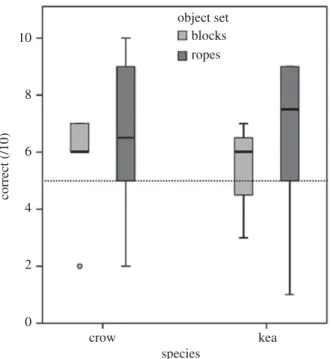
Each subject’s performance for all experiments is detailed in the electronic supplementary material, table S4. Overall, four out of the 12 individuals that completed all four testing phases for the rope set (kea: one adult male and one sub-adult male; crows: two sub-adult males) performed above chance in the test trials set (9 or more of 10 trials correct, binomial test with chance probability of 0.5:p=0.021), and no subjects (0/13) performed above chance for the block set. As a group, there was a trend for subjects’ average test performance for both sets to be above chance (figure 3), but not significantly so (one-sample Wilcoxon’s test:p=0.074). A generalized linear mixed model (table 1, GLMM1) revealed that there were no significant between-species differences in performance on the test trials, and that performance on the test trials was not predicted by the total proportion of time that subjects spent exploring objects (Phases 1 and 3 combined), or the proportion of exploration time engaged in functional behaviours (Phases 1 and 3 combined).
9
rsos
.ro
yalsociet
ypublishing
.or
g
R.
Soc
.open
sc
i.
4
:1
70652
...
10
object set blocks ropes 8
6
correct (/10)
4
2
0
crow kea
species
Figure 3.Boxplots illustrating the proportion of correct trials scored on either the block or rope set. Minimum and maximum values,
median and 25th and 75th percentiles are shown. Dotted line denotes chance performance at 50%.
3.3.2. Species differences in exploration
Each species’ exploratory behaviour is summarized intable 2. There was a significant difference between species in the amount of time spent exploring the objects, with kea spending a significantly greater proportion of time interacting with the objects, engaging in functional behaviours and interacting with the functional objects relative to the non-functional objects than the crows (table 1, GLMMs 3–5).
3.3.3. Pre- versus post-exploration
Each individual’s exploratory behaviour for Phases 1 and 3 is summarized in the electronic supplementary material, table S3. There was no significant difference in the proportion of time that subjects spent exploring, engaging in functional behaviours or exploring functional objects before or after encountering the tool-use task;table 1, GLMMs 3–5), and these were also not predicted by an interaction between phase (pre- or post-tool-use training) and species (table 1).
4. Experiment 2: block set–colour versus pattern as a relevant feature
The results from Experiment 1 showed that four individuals performed significantly above chance in selecting functional objects to solve the task on the rope set, but not on the block set. This difference in performance could be linked to the materials themselves by reflecting a better understanding of rigidity, which unlike weight is visible following manipulation. Alternatively, it could be linked to the salience of the objects’ visual features (e.g. colour relative to pattern). Colour, in particular, has been shown to be a highly salient stimulus in non-tool-using contexts, both in natural and in experimental settings [43–45]. If colour was a more salient feature associated with function, subjects were expected to perform better on this set of test trials relative to the block set in Experiment 1.4.1. Procedure
10
rsos
.ro
yalsociet
ypublishing
.or
g
R.
Soc
.open
sc
i.
4
:1
70652
...
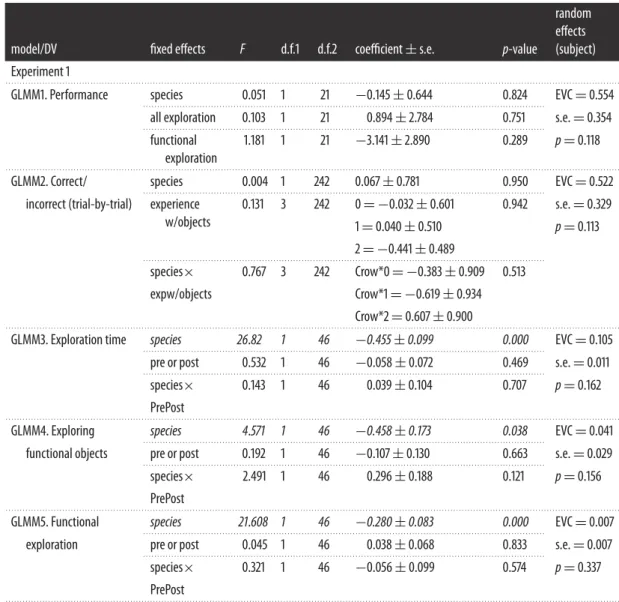
Table 1.Results from Experiments 1–3. Full models are reported. Table includes dependent variable (DV), fixed effects,Fstatistic (F),
degrees of freedom (d.f.) and coefficients±standard error (s.e.). Random effects column includes the estimated variance component (EVC) for the random effect of subject, including standard error and significance. Significant effects (p<0.05) are in italics. Note that ‘object set’ was included as a random factor but did not contribute to the model due to its small number of levels (i.e. removing it from the model had no influence on the results).
model/DV fixed effects F d.f.1 d.f.2 coefficient±s.e. p-value
random effects (subject)
Experiment 1
. . . .
GLMM1. Performance species 0.051 1 21 −0.145±0.644 0.824 EVC=0.554
. . . .
all exploration 0.103 1 21 0.894±2.784 0.751 s.e.=0.354
. . . .
functional exploration
1.181 1 21 −3.141±2.890 0.289 p=0.118
. . . .
GLMM2. Correct/ species 0.004 1 242 0.067±0.781 0.950 EVC=0.522
. . . .
incorrect (trial-by-trial) experience w/objects
0.131 3 242 0= −0.032±0.601 0.942 s.e.=0.329
1=0.040±0.510 p=0.113
2= −0.441±0.489
. . . .
species× 0.767 3 242 Crow*0= −0.383±0.909 0.513
expw/objects Crow*1= −0.619±0.934
Crow*2=0.607±0.900
. . . .
GLMM3. Exploration time species 26.82 1 46 −0.455±0.099 0.000 EVC=0.105
. . . .
pre or post 0.532 1 46 −0.058±0.072 0.469 s.e.=0.011
. . . .
species× 0.143 1 46 0.039±0.104 0.707 p=0.162
PrePost
. . . .
GLMM4. Exploring species 4.571 1 46 −0.458±0.173 0.038 EVC=0.041
. . . .
functional objects pre or post 0.192 1 46 −0.107±0.130 0.663 s.e.=0.029
. . . .
species× 2.491 1 46 0.296±0.188 0.121 p=0.156
PrePost
. . . .
GLMM5. Functional species 21.608 1 46 −0.280±0.083 0.000 EVC=0.007
. . . .
exploration pre or post 0.045 1 46 0.038±0.068 0.833 s.e.=0.007
. . . .
species× 0.321 1 46 −0.056±0.099 0.574 p=0.337
PrePost
. . . . Experiment 2
. . . .
GLMM6. Comparing species 1.741 1 18 −1.207±0.531 0.204 EVC=0.308
. . . .
performance Exps 1 & 2 experiment 0.193 1 18 −0.750±0.393 0.666 s.e.=0.253
. . . .
species× 4.845 1 18 1.251±0.568 0.041 p=0.224
experiment
. . . .
GLMM7. Performance species 0.096 1 7 −0.453±1.460 0.766 EVC=2.232
. . . .
and exploration exploration 1.424 1 7 3.421±2.867 0.272 s.e.=1.649
. . . .
functional exploration
1.347 1 7 1.924±1.658 0.284 p=0.176
. . . . Experiment 3
. . . .
GLMM8. Exploration species 0.090 1 18 0.031±0.646 0.768 EVC=0.594
. . . .
versus no exploration condition 12.209 1 18 −1.180±0.410 0.003 s.e.=0.415
. . . .
species× 0.203 1 18 0.270±0.598 0.658 p=0.153
condition
11
rsos
.ro
yalsociet
ypublishing
.or
g
R.
Soc
.open
sc
i.
4
:1
70652
...
Table 2.Summary of exploratory behaviour. Mean percentage of trial time (±s.e.) in each exploration phase that each species spent
interacting with the objects (all exploration) or performing functional behaviours towards the objects (functional exploration), as well as mean percentage of exploration time spent interacting with functional objects.
exploration phase
behaviour category pre post average of pre and post
kea (n=8)
. . . .
all exploration 29±8% 26±5% 27±6%
. . . .
functional exploration 15±3% 18±5% 16±4%
. . . .
functional objects 53±6% 43±5% 48±4%
. . . . crow (n=6)
. . . .
all exploration 4±2% 3±2% 3±2%
. . . .
functional exploration 3±2% 2±1% 3±2%
. . . .
functional objects 20±8% 32±15% 26±10%
. . . .
up to four sessions in which they were required to interact with three exemplars of each object type (functional and non-functional) before completing 10 test trials.
4.2. Analyses
To compare subjects’ performance on test trials between Experiments 1 and 2, we ran a binomial GLMM with a logit-link function, featuring the proportion of correct trials as the target variable, and condition (colour versus pattern as the relevant feature) and species as binary fixed factors, as well as the interaction between species and condition. Subject identity was entered as a random factor. Each individual had one data point per object set entered into the model, resulting in 22 data points total in the model (n=11 individuals).
We ran an additional binomial GLMM with a logit-link function to again determine whether, similar to Experiment 1, performance on the test trials was predicted by individuals’ duration or quality of exploration, and whether this differed between species. The proportion of correct trials was entered as the target variable, and fixed factors entered into the model were (i) total proportion of trial time spent exploring the objects, (ii) total proportion of exploration time spent engaging in functional behaviours and (iii) species. Each individual had one data point entered into the model, resulting in 11 data points.
4.3. Results
While no subjects performed above chance for the weight set in Experiment 1, when the relevant feature was pattern, three kea (PA, PI and RO) and one crow (AZ) performed above chance when the relevant feature was switched to colour. Two of these individuals (PA and AZ) had also performed above chance for the rope set. Nonetheless, at a group level, performance was not significantly better when colour rather than pattern was the relevant feature on the blocks (table 1, GLMM6). There was no significant effect of species, however the interaction between species and condition was significant, with kea performing better than the crows when the relevant feature on the blocks was colour rather than pattern.
There was no significant difference between the species’ performance on the test trials (table 1, GLMM7), and, similar to the results of Experiment 1, test performance was not predicted by the total proportion of time that subjects spent exploring, or the proportion of exploration time engaged in functional behaviours.
5. Experiment 3: no exploration control
5.1. Procedure
12
rsos
.ro
yalsociet
ypublishing
.or
g
R.
Soc
.open
sc
i.
4
:1
70652
...
Table 3.Individual scores for test trials after subjects were allowed to explore the objects (Experiment 2 for kea and Experiment 1 ropes
for crow) or not (no exploration column). Italic denotes above chance performance.
proportion of correct trials
species subject exploration no exploration
kea PA 1.00 0.80
. . . .
PI 0.90 0.20
. . . .
FR 0.60 0.10
. . . .
LI 0.40 0.50
. . . .
RO 0.90 0.80
. . . .
JN 0.50 0.40
. . . .
crow BL 0.50 0.50
. . . .
AZ 0.90 0.40
. . . .
JO 0.70 0.90
. . . .
AT 1.00 0.40
. . . .
EM 0.60 0.50
. . . .
mean 0.73 0.50
. . . .
s.d. 0.21 0.24
. . . .
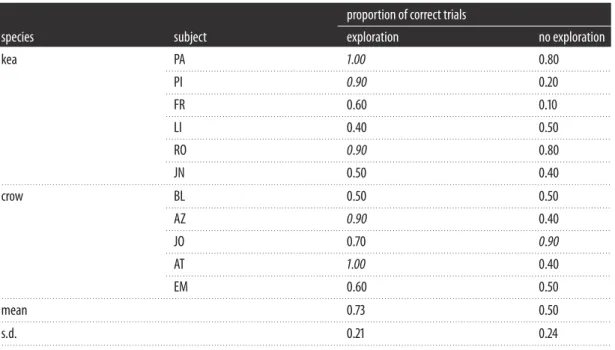
whether these individuals are succeeding due to information gained during exploration it is important to test an alternative explanation, which is that subjects may be able to rapidly learn the reward contingencies in the test trials. To measure how well subjects would perform on test trials without any prior exploration of the objects, subjects were presented with a novel object set with novel relevant (colour) and irrelevant (pattern) features and were presented with 10 test trials in which they could choose between an unfamiliar functional and non-functional object to solve the task. We matched the control set to the exploration set on which the greatest number of individuals within each species performed significantly above chance. For the kea, this was the block set from Experiment 2 (3/6 individuals significantly above chance; colour-relevant feature) and for the crows, this was the rope set from Experiment 1 (2/6 individuals above chance; colour-relevant feature).
If exploration facilitated learning about the objects’ functionality and thus enabled subjects to perform well on test trials in Experiments 1 and 2, it is expected that subjects that performed significantly above chance on test trials following exploration would perform worse in this experiment. By contrast, if subjects performed above chance in this condition as well as previous test trials, this would suggest that either (i) subjects may have generalized the rule that they learned during their exploration and applied it to these trials (e.g. colour correlates with functionality) or (ii) are able to rapidly associate success with the visual properties of the objects. Overall, it was predicted that if exploration enabled learning about object structure, performance of the group should be better on test trials following exploration than no exploration.
5.2. Analysis
To compare subjects’ performance on test trials following exploration or no-exploration, a GLMM with a binomial probability distribution and a logit-link function was run featuring the proportion of correct trials as the target variable, condition (exploration versus no exploration), species and the interaction between condition and species as binary fixed factors, and subject as a random factor. Each individual had one data point per object set entered into the model, resulting in 22 data points total in the model (n=11 individuals).
5.3. Results
5.3.1. Do birds perform better after exploration versus no exploration?
13
rsos
.ro
yalsociet
ypublishing
.or
g
R.
Soc
.open
sc
i.
4
:1
70652
...
10
8
6
correct (/10)
4
2
0
no explore explore condition
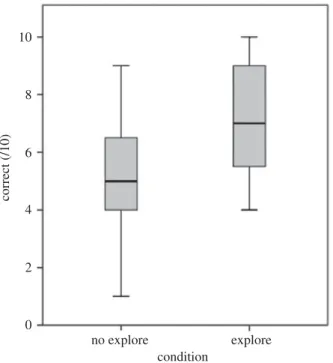
Figure 4.Boxplots illustrating the kea and crows’ performance in the no-exploration and exploration conditions. Minimum and
maximum values, median and 25th and 75th percentiles are shown.
in Experiments 1 and 2 did so for this experiment. Performance on test trials was significantly predicted by condition, with subjects showing higher performance in conditions in which they could explore the objects beforehand compared to the no-exploration control condition (table 1, GLMM8). There was no significant between-species difference in scores for either condition or interaction between species and condition (figure 4).
6. General discussion
Overall, six birds performed significantly above chance on test trials in Experiments 1 and 2 when they could explore the objects beforehand (two for the rope set in Experiment 1, two for Experiment 2 and two for both). Importantly, in Experiment 3 all of these individuals performed at chance levels when similar visual cues were available but they had no opportunity to explore the objects. Five of these individuals encountered a no-exploration task that was directly comparable to the one in which they performed significantly above chance with exploration, providing support for the idea that exploration facilitated learning about the structural properties of the objects that informed test performance. One individual (FR) was significantly above chance for the rope set, but not above chance levels for the control block set. Although colour remained the functional feature in both of these object sets, the structural properties of the two object sets were different, so his data, although suggestive, cannot be interpreted in a comparable way to the other five birds.
14
rsos
.ro
yalsociet
ypublishing
.or
g
R.
Soc
.open
sc
i.
4
:1
70652
...
ecological relevance, may serve as a more salient feature than pattern for forming associations between structure and visual features. It is important to note, however, that these results are not consistent at an individual level; for example, not all subjects that performed above chance with the rope set performed above chance with the block set, and vice versa, even when colour was the relevant feature in both cases. This is perhaps unsurprising given that the tool-use tasks were different for the two types of objects and required subjects to attend to different structural properties. It may be that some subjects excelled at attending to particular structural properties over others.
We were interested in initial performance on the task as a result of exploration rather than learning over trials, and therefore limited our number of trials to ten. With just 10 trials the performances that we predict (i.e. chance, or 5/10 on no exploration trials and above chance or minimum 9/10 on exploration trials) would not yield a significant difference at an individual level. While additional trials would have allowed for this, they would also have increased the chances of individuals learning during testing, potentially masking the effect of interest: prior exploration. At present, our findings are constrained by our limited sample size and therefore warrant follow-up with a larger number of individuals, and should be replicated over multiple object sets focusing on the same properties to further test the repeatability of individual performance and to rule out the possibility that individuals succeed merely by chance.
Although exploration may play a role in the ability to choose correctly between a functional and non-functional tool, it remains unclear what aspects of exploration drive this learning. In Experiment 1, performance in the problem-solving task was not predicted by the quality or quantity of experience that individuals had with the objects. These results are comparable to those of Manriqueet al. [21,22], which show that capuchins and great apes are more likely to choose functional tools to solve a task if they had previous experience with those objects, and that this performance was not predicted by the quality of information provided, in terms of exploring the objects themselves or watching demonstrations by an experimenter. This lack of relationship may not be particularly diagnostic, however, as one could in principle get all the necessary information from a couple of manipulations, and conversely glean nothing from playing with all of the objects. If individuals meet a certain threshold level of exploration (that happens not to differ from their baseline as revealed in Phase 1) then we would not predict a correlation between exploration and success. An experiment in which a certain type or quantity of manipulation is required to reveal the hidden information, and unlikely to be performed during baseline, would be needed for this measure to be more revealing.
Both kea and New Caledonian crows did not appear to change their exploratory tactics after encountering the tool-using task, suggesting that their exploration was not driven by an attempt to gain information about the objects. Specifically, there was no difference in the amount of time that subjects spent exploring the objects, the proportion of functional behaviours directed toward the objects or the type of objects (functional or non-functional) explored after encountering the tool-use task. This was the case despite the baited apparatus being in full view, and even after subjects had completed their first object sets and had learned that the objects they were presented with could later be used as tools during the test trials. These results are consistent with those of Povinelli & Dunphy-Lelii [28], which suggest that chimpanzees do not engage in exploration in order to gain information about objects, but rather that exploration is driven by visual novelty. However, as above, it is possible that the birds’ motivation to explore did differ between phases, but that we were not able to see evidence for this in the exploratory behaviour. Alternatively, the exploratory behaviour of these birds in the first phase may have already provided the necessary information about structure.
15
rsos
.ro
yalsociet
ypublishing
.or
g
R.
Soc
.open
sc
i.
4
:1
70652
...In terms of ultimate function, these results support the hypothesis that unrewarded object exploration provides information about object properties or affordances which can then be used to solve problems, but do not speak to other potentially overlapping functions of exploration such as honing manual skills or generating novel behavioural sequences [1]. Given its apparent costliness it is likely that exploration confers myriad benefits [46]. Further research explicitly addressing each of these benefits and their relative importance is needed to gain a richer view about how different animals learn about and interact with their environments in the absence of reinforcement (see [47] for a discussion).
In summary, this study suggests that kea and New Caledonian crow subjects may apply information generated from their exploration of novel objects to select functional tools in a later problem-solving task; however, we have no evidence that that they engage in strategic exploration to gain information about the functional properties of objects with respect to a problem-solving task. Although further data are needed to test other alternative (but not mutually exclusive) hypotheses, these data tentatively support the hypothesis that a key function of exploration in these birds is to provide opportunities to learn about object properties.
Ethics. This study was conducted under approval from the University of Auckland ethics committee (reference: R602) and the Department of Biology ethics committee, University of York. We thank the Province Sud for permission to work in New Caledonia.
Data accessibility. Our data are deposited at:http://dx.doi.org/10.5061/dryad.dq04j[48].
Authors’ contributions. A.M.S., K.E.S. and M.L.L. designed the study with input from A.H.T., R.S. and G.K.G. M.S. collected data from the kea for Experiment 3 and trained the New Caledonian crows in stone dropping, and M.L.L. collected all other data and ran the analyses. All authors contributed to the writing of the manuscript and approved the final version for publication.
Competing interests. The authors declare no competing interests.
Funding. Data collection with the New Caledonian crows was funded by an International Seedcorn Award from the University of York to M.L.L. This study was supported by a Rutherford Discovery Fellowship (A.H.T.).
Acknowledgements. We thank Nicole Lahiff for reliability coding, András Péter for technical assistance and two anonymous reviewers for useful comments on an earlier version of this manuscript.
References
1. Power T. 2000Play and exploration in children and animals. Mahwah, NJ: Lawrence Erlbaum Associates, Inc.
2. Bateson P, Martin P. 2013Play, playfulness, creativity and innovation. Cambridge, UK: Cambridge University Press.
3. Auersperg AM. 2015 Exploration technique and technical innovations in corvids and parrots. In Animal creativity and innovation(eds AB Kaufman, JC Kaufman), pp. 45–63. New York, NY: Academic Press.
4. Call J. 2012 Three ingredients for becoming a creative tool user. InTool use in animals: cognition and ecology(eds CM Sanz, J Call, C Boesch), p. 326. Cambridge, UK: Cambridge University Press.
5. Piaget J. 1952The origins of intelligence in children. New York, NY: Norton.
6. Gibson EJ. 1988 Exploratory behavior in the development of perceiving, acting, and the acquiring of knowledge.Annu. Rev. Psychol.39, 1–42. (doi:10.1146/annurev.ps.39.020188. 000245)
7. Greif ML, Needham A. 2011 The development of tool use in early life. InTool use and causal cognition (eds T McCormack, C Hoerl, S Butterfill), pp. 51–67. Oxford, UK: Oxford University Press.
8. Glickman SE, Sroges RW. 1966 Curiosity in zoo animals.Behaviour26, 151–187. (doi:10.1163/ 156853966X00074)
9. Parker CE. 1974 Behavioral diversity in ten species of nonhuman primates.J. Comp. Physiol. Psychol.87, 930–937. (doi:10.1037/h0037228)
10. Torigoe T. 1985 Comparison of object manipulation among 74 species of non-human primates.Primates
26, 182–194. (doi:10.1007/BF02382017) 11. Auersperg AMI, van Horik JO, Bugnyar T, Kacelnik A,
Emery NJ, von Bayern AMP. 2015 Combinatory actions during object play in psittaciformes (Diopsittaca nobilis,Pionites melanocephala, Cacatua goffini) and corvids (Corvus corax, C. monedula,C. moneduloides).J. Comp. Psychol.
129, 62–71. (doi:10.1037/a0038314)
12. Koops K, Furuichi T, Hashimoto C. 2015 Chimpanzees and bonobos differ in intrinsic motivation for tool use.Sci. Rep.5, 11356. (doi:10.1038/srep11356) 13. Hunt GR. 1996 Manufacture and use of hook-tools
by New Caledonian crows.Nature379, 249–251. (doi:10.1038/379249a0)
14. Taylor AH, Hunt GR, Holzhaider JC, Gray RD. 2007 Spontaneous metatool use by New Caledonian crows.Curr. Biol.17, 1504–1507. (doi:10.1016/j.cub. 2007.07.057)
15. Taylor AH, Elliffe D, Hunt GR, Gray RD. 2010 Complex cognition and behavioural innovation in New Caledonian crows.Proc. R. Soc. B277, 2637–2643. (doi:10.1098/rspb.2010.0285)
16. Auersperg AMI, Szabo B, von Bayern AMP, Kacelnik A. 2012 Spontaneous innovation in tool manufacture and use in a Goffin’s cockatoo.Curr. Biol.22, R903–R904. (doi:10.1016/j.cub.2012. 09.002)
17. Lambert ML, Seed AM, Slocombe KE. 2015 A novel form of spontaneous tool use displayed by several captive greater vasa parrots (Coracopsis vasa).Biol. Lett.11, 20150861. (doi:10.1098/rsbl.2015.0861)
18. Kenward B, Schloegl C, Rutz C, Weir AAS, Bugnyar T, Kacelnik A. 2011 On the evolutionary and ontogenetic origins of tool-oriented behaviour in New Caledonian crows (Corvus moneduloides).Biol. J. Linn. Soc.102, 870–877. (doi:10.1111/j.1095-8312. 2011.01613.x)
19. Auersperg AMI, Oswald N, Domanegg M, Gajdon GK, Bugnyar T. 2014 Unrewarded object combinations in captive parrots.Anim. Behav. Cogn.
1, 470–488. (doi:10.12966/abc.11.05.2014) 20. Birch HG. 1945 The relation of previous experience
to insightful problem-solving.J. Comp. Psychol.38, 367–383. (doi:10.1037/h0056104)
21. Manrique HM, Gross AN-M, Call J. 2010 Great apes select tools on the basis of their rigidity.J. Exp. Psychol. Anim. Behav. Process.36, 409–422. (doi:10.1037/a0019296)
22. Manrique H, Sabbatini G, Call J, Visalberghi E. 2011 Tool choice on the basis of rigidity in capuchin monkeys.Anim. Cogn.14, 775–786. (doi:10.1007/ s10071-011-0410-9)
23. Povinelli D. 2000Folk physics for apes: the chimpanzee’s theory of how the world works. New York, NY: Oxford University Press. 24. Povinelli D, Ballew NG. 2012World without weight:
perspectives on an alien mind. Oxford, UK: Oxford University Press.
25. Spaulding B, Hauser MD. 2005 What experience is required for acquiring tool competence? Experiments with two callitrichids.Anim. Behav.70, 517–526. (doi:10.1016/j.anbehav.2004.11.024) 26. Schulz LE, Bonawitz EB. 2007 Serious fun:
16
rsos
.ro
yalsociet
ypublishing
.or
g
R.
Soc
.open
sc
i.
4
:1
70652
...
evidence is confounded.Dev. Psychol.43, 1045–1050. (doi:10.1037/0012-1649.43.4.1045) 27. Visalberghi E, Addessi E, Truppa V, Spagnoletti N,
Ottoni E, Izar P, Fragaszy D. 2009 Selection of effective stone tools by wild bearded capuchin monkeys.Curr. Biol.19, 213–217. (doi:10.1016/ j.cub.2008.11.064)
28. Povinelli DJ, Dunphy-Lelii S. 2001 Do chimpanzees seek explanations? Preliminary comparative investigations.Can. J. Exp. Psychol.55, 185–193. (doi:10.1037/h0087365)
29. Povinelli D, Penn D. 2011 Through a floppy tool darkly. InTool use and causal cognition(eds T McCormack, C Hoerl, SA Buterfill), pp. 69–97. Oxford, UK: Oxford University Press.
30. Seed AM, Hanus D, Call J. 2011 Causal knowledge in corvids, primates and children: more than meets the eye? InTool use and causal cognition (eds T McCormack, C Hoerl, SA Butterfill), pp. 89–110. Oxford, UK: Oxford University Press. 31. Auersperg AMI, Huber L, Gajdon GK. 2011 Navigating
a tool end in a specific direction: stick-tool use in kea (Nestor notabilis).Biol. Lett.7, 825–828. (doi:10.1098/rsbl.2011.0388)
32. Weir AAS, Chappell J, Kacelnik A. 2002 Shaping of hooks in New Caledonian crows.Science297, 981. (doi:10.1126/science.1073433)
33. Auersperg AMI, Gajdon GK, Huber L. 2010 Kea, Nestor notabilis, produce dynamic relationships between objects in a second-order tool use task.
Anim. Behav.80, 783–789. (doi:10.1016/j.anbehav. 2010.08.007)
34. Diamond J, Bond AB. 1991 Social-behaviour and the ontogeny of foraging in the kea (Nestor notabilis). Ethology88, 128–144. (doi:10.1111/j.1439-0310. 1991.tb00268.x)
35. Kenward B, Rutz C, Weir AAS, Chappell J, Kacelnik A. 2004 Morphology and sexual dimorphism of the New Caledonian CrowCorvus moneduloides, with notes on its behaviour and ecology.Ibis146, 652–660. (doi:10.1111/j.1474-919x.2004. 00299.x)
36. Jelbert SA, Taylor AH, Gray RD. 2016 Does absolute brain size really predict self-control? Hand-tracking training improves performance on the A-not-B task. Biol. Lett.12, 20150871. (doi:10.1098/rsbl.2015. 0871)
37. Bird CD, Emery NJ. 2009 Insightful problem solving and creative tool modification by captive nontool-using rooks.Proc. Natl Acad. Sci. USA106, 10 370–10 375. (doi:10.1073/pnas.0901008106) 38. Mundry R, Fischer J. 1998 Use of statistical programs
for nonparametric tests of small samples often leads to incorrectpvalues: examples fromAnimal Behaviour.Anim. Behav.56, 256–259. (doi:10.1006/anbe.1998.0756)
39. Whittingham MJ, Stephens PA, Bradbury RB, Freckleton RP. 2006 Why do we still use stepwise modelling in ecology and behaviour?J. Anim. Ecol.
75, 1182–1189. (doi:10.1111/j.1365-2656.2006.01141.x)
40. Burnam KP, Anderson DR. 2014Model selection and multimodel inference. New York, NY: Springer. 41. Crawley MJ. 2011Statistics: an introduction using R.
Chichester, UK: John Wiley & Sons Inc. 42. Warton DI, Hui FKC. 2011 The arcsine is asinine: the
analysis of proportions in ecology.Ecology92, 3–10. (doi:10.1890/10-0340.1)
43. Guilford T. 1990 The evolution of aposematism. In Insect defenses: adaptive mechanism and strategies of prey and predators(eds DL Evans, JO Schmidt), pp. 43–60. Albany, NY: State University of New York Press.
44. Moller AP, Erritzoe J. 2010 Why birds eat colourful grit: colour preferences revealed by the colour of gizzard stones.J. Evol. Biol.23, 509–517. (doi:10.1111/j.1420-9101.2009.01918.x) 45. Kazemi B, Gamberale-Stille G, Tullberg BS, Leimar
O. 2014 Stimulus salience as an explanation for imperfect mimicry.Curr. Biol.24, 965–969. (doi:10.1016/j.cub.2014.02.061)
46. Bateson P, Martin P. 2013Play, playfulness, creativity and innovation. Cambridge, UK: University Press. 47. Renner MJ. 1990 Neglected aspects of exploratory
and investigatory behavior.Psychobiology18, 16–22. (doi:10.3758/BF03327209) 48. Lambert ML, Schiestl M, Schwing R, Taylor AH,