A More Precise Computation of Along Wind Dynamic
Response Analysis for Tall Buildings Built in Urban Areas
Shu-Xun Chen
Guangxi University, Nanning, Guangxi, China E-mail: [email protected]
Received November 12, 2009; revised January 25, 2010; accepted February 4, 2010
Abstract
Modern tall buildings are generally built in urban areas, where value of the terrain roughness length is much greater than that of the general terrain areas, therefore wind-induced vibrations become more pronounced. The present formulas of numerical analysis of wind-induced response become less accurate. A more accurate expression of along-wind load spectrum matrix is proposed. On the basis of the expression, structural analy-sis formula of along-wind displacement and acceleration response are developed and programmed. The ra-tionality of these formulas are illustrated in examples.
Keywords:Tall Building, Wind Load Spectrum, Wind-Induced Vibration, Response Analysis, Structural Analysis
1. Introduction
In modern cities, buildings get taller and more slender. The effects of wind-induced motions become more pro-nounced. Accurate prediction of structural response to wind-induced random vibrations displacement and vibra-tion acceleravibra-tion at the design stage is a basis for struc-tural safety design and serviceability design of modern tall buildings. The wind-induced response consists of along-wind response, across-wind response and torsion response [1,2]. The paper focuses on along-wind re-sponse analysis firstly.
Several quasi-static methods in wind codes in various countries and approximate methods based on wind tunnel studies are used to predict the wind-induced response. As a building gets taller, the wind-induced random vibra-tions becomes more violent, these methods become less reliable. So the wind-induced response of modern tall buildings should be assessed accurately by using the the-ory of random vibration. Using the numerical analysis methods of random vibration response of tall buildings, people calculate structural response according to wind load spectra. According to present literatures [2-5] whose representative is literature [3], considering that the values of terrain roughness lengths are generally very small, and the turbulence densities are also very small, square items of the turbulence component are neglected in expression The project supported by Dr Chun-Man Chan of HKUST.
formula of the wind load in along-wind direction. But, for the modern tall buildings built in urban areas, the values of terrain roughness lengths are much more than ones for general buildings in general open areas. So that these items should not be neglected for tall buildings, as they are the same order values with some items that are not neglected. Otherwise, calculation results of the tur-bulence response of the tall buildings will have a large relative error.
To overcome the above-mentioned error, a more ac-curate expression of wind load spectrum matrixes is proposed in this paper. This expression is especially ap-plicable to tall and other important buildings. Even an approximate form of the accurate expression is more precise than the present expression [3]. On the basis of this expression of wind load spectrum, structural analysis formulas of wind-induced displacement response and acceleration response in along-wind direction are devel-oped and programmed. The expression forms of wind load spectrum and the analysis formulas proposed in this paper are especially suitable for using the models of the structural finite element analysis of tall buildings and their results of vibration modal analysis. These analysis results of wind-induced response can be directly used in member stress analysis, structural deformation analysis and structural serviceability analysis of tall buildings.
S. X. CHEN 291
2. Expression of Wind Load Spectrum Matrix
2.1. Wind-Induced Load Vector
Wind around tall building flows in a complex and ran-dom way, so the wind is a ranran-dom process. Wind loads acting on windward walls are mainly caused by the steady flow and the turbulence flow. The wind speed at node iof the windward walls can be expressed as:
Vi(t) = V0 i + Vr i (t) (1)
where V0 i is the mean wind speed at node i, V0 i can be
obtained with the following formulas:
V0 i = V0 (hi /h0) (2)
here V0 is standard wind speed at a reference height h0 ,
e.g. 10 m , = 0.12 ~ 0.30 , hi is height of node i. Vr i (t)
in Equation (1) is the fluctuate wind speed at height hi,
its power spectrum density S r i ( ) can be determined by
fomulas of the present representative literature [3]. Because along-wind drag force is directly proportional to the square of relative wind speed, wind load acting vertically on node i of windward walls of a tall building can be expressed as:
Pui = c i a i ( /2) [ Vi(t) - U i' ] 2
=c i a i ( /2) [Vi(t)2- 2 Vi(t) U i' + U i' 2 ] (3)
in which
ci --- ci is the drag coefficient describing the ratio of the
wind load per unit area at i node and the velocity pres-sure ( /2)[ Vi(t) -U i' ] 2.
a i --- area distributed at i node;
--- air density
U i' --- along-wind displacement speed of node i .
In Equation (3), since wind speed Vi(t) is much
greater than the structural displacement speed U i', the
high order small value U i' 2 can be undoubtedly
ne-glected, then we can get
Pui ( t ) = c i a i ( /2) [Vi(t)2- 2 Vi(t) U i' ] (4)
Let
C a i = ci ai ( /2)2 Vi(t) ci ai V0 i (5)
Adding C a i to the structural damping coefficient Cs i ,
a total damping coefficient C i is obtained:
C i = C s i + C a i (6)
It is taken as the i-th diagonal element of damping matrix C of the structural dynamic equation of the tall building shown in Equation (7):
K U + C U’ + M U” = P (t) (7) Then the along-wind load vector of the tall building can be expressed as:
Pu (t) = {c i a i ( /2)Vi(t)2}
( i = 1, 2, …, N ) (8)
where N is the total number of structural freedom de-grees. In Equation (8), if i does not correspond to the along-wind load of the nodes of the windward walls, then ci is taken as zero.
Place Equation (1) into Equation (8) : Pu (t) = { c i a i ( /2) [V0 i + Vr i (t)] 2 }
= { c i a i ( /2) [V0 i 2 + 2 V0 i Vr i (t) + Vr i 2(t)] }
(i = 1, 2,…, N) (9) In the present literature, e.g. in page 76 of the present representative literature [3], Vr i 2(t) is neglected, then
( )
u t
P = { c i a i ( /2) [V0 i 2 + 2 V0 i Vr i (t)] }
( i = 1, 2, …, N ) (10) The author consider that Vr I 2(t) should not be
ne-glected for tall buildings in urban areas. The author’s reason is as follows:
In Equation (1), Vr i (t) is the turbulent flow speed at i
node. It is a random process with a zero mean value. Its variance is determined by the following equations:
r i2 (h i) = E [ V r i2(t) ] = Vo i2 I r i 2 (11)
where I r iis the turbulence density at i node, it can be
obtained from the following equation [3]:
I r i = r i(h i) / Vo i= 1 / ln (h i/r0 ) (12)
where hi is the height of i node, r0 is the roughness
length of building terrain, r0 = 10 - 5 ~ 10 meter is
deter-mined by the terrain type. Because most of the modern tall buildings are usually built in urban areas, roughness length r0 of urban area is about 1-10meter [3], which is a
very great value. Vr i 2(t) is not much less than V0 i 2, for
instance, when r0 = 3 m and h i = 22 m, then I r i = r i(h i) /
Vo i = 0.5. In Equation (11), r i2 (h i)= E [ V r i2(t) ] =
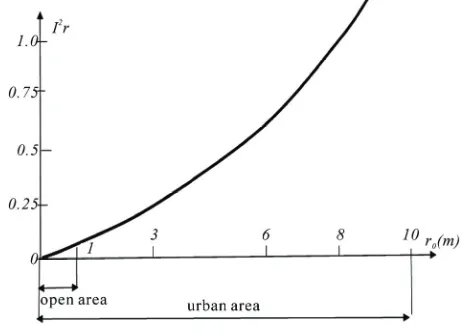
Vo i2 I r i 2= 0.25 Vo i2. When h i = 22 m, the relationship
curve of I r i 2 and r0 is showm in Figure 1:
It is shown in the The relationship curve in Figure 1 that I r i2of tall buildings in urban area of is much more
[image:2.595.306.537.538.705.2]
than one of general buildings in open area. Considering Equation (11), Vr i 2(t) of Equation (9) can not be
ne-glected, and Equation (10) with Vr i 2(t) neglected can
only be applied to buildings built in general open terrain. For modern tall buildings in urban areas, Equation (10) will cause a large relative error.
2.2. Wind Load Correlation Matrix
Correlation matrix of the wind load vector shown as Equation (9) is
R P u ( ) = E [ Pu (t)PuT (t + ) ] (13)
Its element of row i, column j is: R Pu i j () = c i c j a i a j ( /2) 2E { [V0 i+ Vr i (t)] 2 [V0 j + Vr j (t + )] 2 } = c i c j a i a j ( /2) 2E [ Vo i2 Vo j2 + 2 Vo i2 Vo jVr j(t + ) + 2 Vo i Vo j2 Vr i(t) + Vo i2 Vr j 2(t + ) + Vo j2 Vr i2(t) + 4 Vo i Vo j Vr i(t) Vr j(t + ) + 2Vo i Vr i(t) Vr j2 (t + ) + 2Vo j Vr i2 (t) Vr j(t + ) + Vr i2(t) Vr j2 (t + )] (14)
Because Vr i(t) and Vr j(t + ) are stationary ergodic normal distributive random processes[2,5,6], then E [ Vr i(t)] = E [ Vr j(t + )] = 0 (15)
E [ Vr i2(t)] = r i 2 (16)
E [ Vr j2 (t + )] = r j 2 (17)
E[ Vr i(t) Vr j(t + )] = R r i j() (18)
E [ Vr i2 (t) Vr j(t + )] = E [ Vr i(t) Vr j2 (t + )] = 0 (19)
E [ Vr i2 (t) Vr j2 (t + ) ] = r i2 r j2 + 2 R r i j2( ) (20)
Then Equation (14) can be: R Pu i j ( ) = c i c j a i a j ( /2) 2[ Vo i2Vo j2 + Vo i2 r j2+ Vo j2 r i2+ r i2 r j2 + 4 Vo i Vo j R r i j () + 2 R r i j2() ] (21)
Considering Equation (12), the element of row i, col-umn j of the correlation matrix of the wind load can be obtained: R Pu i j ( ) = c i c j a i a j ( /2) 2[ Vo i2Vo j2 (1+ I r i 2+ I r j 2 + I r i2I r j2) + 4 Vo i Vo j R r i j ( ) + 2R r i j 2( ) ] (22)
In the present literature [3], Vr i 2(t) of wind load is ne-glected as Equation (10), then the correlation matrix shown in Equation (13) is ( ) [ u( ) ( uT ) ] u = E RP P t P t + (23)
The element of of row i, column j of the correlation matrix of the wind load is ( ) P u i j R = c i c j a i a j ( /2) 2[ Vo i2Vo j2 + 4 Vo i Vo j R r i j ( )] (24)
Comparing Equation (24) and Equation (22), their relative error is a quite large for modern tall buildings built in urban areas. 2.3. Wind Load Spectrum Matrix From Equation (22), a spectrum matrix of the wind load vector can be obtained: S P u ( ) = [1 / (2 )]
R P u ( ) e
j d (25)Its element of row i, column j is: S P u i j ( ) = [1 / (2 )]
R Pu i j ( ) e
j d (26) Placing Equation (22) into Equation (26), the result is: S P u i j ( ) = c i c j a i a j ( /2) 2 [ Vo i2Vo j2 ( 1+ I r i2+ I r j 2+ I r i2I r j2 ) ( ) + 4 Vo i Vo j S r i j ( ) + 2 S r i j ( ) S r i j ( )] (27) in which the symbol expresses Duhamel integral, () is the - function: () = [1/(2)]
e
j d (28)and S r i j ( ) = [1/(2 )]
R r i j ( ) e
j d (29)S r i j ( ) is a cross-spectrum of turbulent wind velocity, which can be obtained from literature [2,12]. A good approximate expression of Equation (27) is S P u i j ( ) = c i c j a i a j ( /2) 2 [ Vo i2Vo j2( 1+ I r i2 + I r j 2 ) ( ) + 4 Vo i Vo j S r i j ( )] (30)
In the comparison example in this paper, relative error of Equation (30) and Equation (27) will be discussed. If Vr i 2(t) of Equation (9) is neglected as Equation (10), then the element of row i, column j of the wind load spectrum matrix is:
( )
P u i jS
= c i c j a i a j ( /2) 2 [ Vo i2Vo j2 ( ) + 4 Vo i Vo j S r i j ( )] (31)Comparing with Equation (31), the approximate ex-pression Equation (30) has more items (I r I 2+I r j 2),
S. X. CHEN 293
E [ Uu2 ( t )] = R u (0) = S u ( ) d (36)
Its N diagonal elements are mean square values of the
displac d
They are marked as a vector u . It includes the
follow-in
i-th m egree. It is obtained from the following eq
in which S P u m n ( w Equa (2
In Equati n (37
static translation response. Its i-th element is the square egree. It
( /2) 2 V
o m2Vo n2 / u 4 (39)
In 7), u2i ector
of the dynam ndom b Its i-th elem
vi
{[ V 2V
o n2( I r m2 +I r n2+I 2I r n2)] / u4
+ ( ) 2 V S )
2 S ( ] d (40) in which S r m n ( ) is shown as Equation (29).
For c ce o ion,
tion (27 as i
dom vi
{ [ Vo m2Vo n2( I r m2 + I r n2 )] / 4
+ H ( ) 2 4 V V ( ) d } (41)
to 4 Vo iVo j S r i j ( ), and should not be neglected. Their
necessity is shown in the following formulas of wind-induced response analysis.
3. Wind-Induced Response Analysis
Wind-induced structural responses in along-wind direc-tion include a static part, i.e. an along-wind transladirec-tion, and a dynamic part, i.e. an along-wind random vibration. The along-wind translation is mainly caused by the steady flow. The along-wind vibration is caused by the turbulent flow. The along-wind random vibration in-cludes a quasi-steady background turbulence response to low frequency component and a narrow-band resonant response.
3.1. Displacement Response Analysis
According to the analysis method of random vibration response, the calculation formula of spectrum matrix of the displacement response vector can be expressed as:
S u ( ) = Hu ( ) S P u( ) Hu *( ) (32)
in which the spectrum matrix of wind-induced load SPu() is shown as Equation (25), Hu*() is the
conju-gate matrixes of frequency response matrix Hu ( ), and
Hu () = u Hu () u T (33)
In which u and Hu( ) are the natural vibration shape
and the frequency response function of the lower along-wind vibration model respectively. The relationship between the vibration shape and mass matrix is uT M u
= Mu* = 1. Hu ( ) can be obtained from the following
formula:
Hu ( ) = 1 / [( u 2- 2) + j 2 u u ] (34)
in which uand u are the natural frequency and
damp-ing of the lowest along-wind vibration model.
The element of row i, column j of the displacement spectrum matrix shown in Equation (32) is:
S u i j ( )= i u j u m u n uHu ()2 SP u m n ( )
(35)
m N
1 n N
1
In which i u is the i-th element of vibration shape u
of the along-wind vibration mode. SP u m n () is shown as
Equation (27). Hu () is the absolute value of the
frequency response functions of the along-wind vibration mode shown in Equation (34).
According to the response analysis theory of random vibration, the across mean square value matrix of the displacement response is:
ement response of the N no e freedom degrees.
2
g two parts:
u 2= u 2 + u2 (37)
its i-th element is the mean square value of displacement response of the freedo d
uation:
u i2=
Su i i ( ) d = i u 2
N
N m u n um1
) d
n1
Hu ( ) 2 SP u m n ( (38)
) is sho n as tion 7).
o ), u2isthe square value vector of the
value of the static translation of the i-th freedom d is
u i 2= i u 2
N
N m u n u c m cn am anm1 n1
Equation (3 s the mean square value v
ic ra vi ration displacement response. ent is the mean square value of the random bration displacement of the i-th freedom degree. It is
u i 2= i u 2
m N
1 n N
1
m u n u c m cn am an ( /2) 2
o m r m
Hu [4 o m Vo n r m n(
+ r m n( ) S r m n ) }
onvenien f computat SP u m n ( ) of
Equa-) can be taken ts approximate form shown in Equation (30). So the mean square value of the ran
bration displacement of the i-th freedom degree of the tall building u i 2becomes:
u i 2= i u 2
m N
1 n N
1
m u n u c m cn am an ( /2) 2
u
Considering:
Hu () 2S r m n ( ) d Hu (0) 2
S )2S
rm n / u +S ( )[/(2 3)] (42)
w 1/ ( u rmn
is cross correlation. By convention of the present repre-sen
r
of the i-th freedom degree. It is sh l
Vo m2 Vo n2( Ir m2+Ir n2 ) / u4
+ i u c cn am an ( /2) 2
Vo n H 2
2
Vo m Vo n ( Ir m + Ir n2 + 4 rm n Ir m Ir n ) / u4
(44) In Equation 3), 2 s corresponding t the
dynam he
i-th freedom degree. It is shown as:
o n
u m o m Vo n
S r m n ( u )[ / (2 u u3 )]
If the quasi-static turbulent ground displacement
re-sponse ted according to the
unreasonable approximate Equation (31) as the pr re
r m n ( ) d +
Hu ( r m n () d u u 4
r m r n r m n u u u
hereHu ( u) 2 = 2 u u2 ) 2, = u
tative literature [3], u i 2of Equation (41) can be
di-vided to the following two pa ts:
u i 2 u b i 2 + u r i 2 (43)
in which u b i 2 is corresponding to the quasi-static
tur-bulent ground displacement response own as fo lows:
u b i2= i u 2
m N
1 n N
1 m u n u cm cn am an ( /2) 2
2
Nm1 n1 m u n u m
N
4 Vo m
u (0) S r m n ( ) d
= i u 2 m u n u cm cn am an( /2)
m N
1 2 2 n N
1 2(4 u r i i o
ic turbulent resonant displacement response of t
u r i 2 = i u 2
m N
1 n N
1 m u n u cm cn am an 2
Vo mV
Hu () 2S r m n ( ) d u u
= i u 2
m u n c cn am an 2Vm N
1 n
N
1
(45)
of Equation (44) is calcula
esent presentative literature [3], then it is
u b i2= i u 2m N
1 n N
1 m u n u cm cn am an ( /2) 2
4 Vo mVo n Hu (0) 2S r m n ( ) d
n u 2
Vo m Vo n ( 4 rm n Ir m Ir n ) /( u 4 )
6) In Eq o 44 mparing the relative values of the
two ite it is obvious
that the items corresponding to ( Ir i2+Ir j 2 ) of Equa
(3
ed acceleration response of a tall building alues. Similar to ue of
accelera- H ( ) 2 S
P u m n ( ) d
m u cn am an ( /2) 2
= i u 2
N
m u cm cn am an ( /2)
m
12 2 n N
1 (4 uati n ( ), Coms (4 rm n I r m I r n and I r m2+ I r n2),
tion 0) can not be neglected as Equation (31), since the neglecting will cause a 50% or much higher relative error for the quasi-static turbulent ground displacement re-sponse.
3.2. Acceleration Response Analysis ind-induc
W
are random values with zero mean v quation (37)-(40), the mean square val E
tion response of the i-th freedom degree can be calcu-lated as:
u” i 2= i u 2
N
N m u n u
4
m1 n1 u
= i u
m 1 n 1
n u c m
2 N
N
z
4Hu ( )2{ m2 n2 2
+ I r n 2+ I r m2I r n2] ( ) + 4 Vo m Vo n S r m n ( )
S r m
Consi
2 2
4H
u (
+ 2 S r m n ( ) S r m n ( )] d (48)
Its approximate expression is shown as follows: Vo Vo [ 1+ I r m
+ 2 n ( ) S r m n ( ) } d
(47) 4 H 2 = 0, can get
dering u ( ) = 0 when
u” i = i u
m n
1 m u n u c m cn am an ( /2)
2 N
1 N
) 2[ 4 Vo m Vo n S r m n ( )
S. X. CHEN 295
u” i 2 i u
(49)
nce to Equa o calculated
as:
u”
is now widely accepted that wind-induced accelera-tion response has become the standard for the
service-abi ty a n of motio pe l ildings.
So is of
an important a
4.
= 2
m u n u c m cn am an 2m N
1 n
N
1
Vo m Vo n
4H u ( ) 2 S r m n ( ) d
With refere ti n (42), it can be
i 2 i u 2
m u n u c m cn am an 2m N
1 n
N
1
Vo m Vo n S r m n ( 1 ) [ u/( 2 u )] (50)
It
li evalu tio n rception in tal bu Acceleration response analysis of tall buildings
nd practical significance
Example
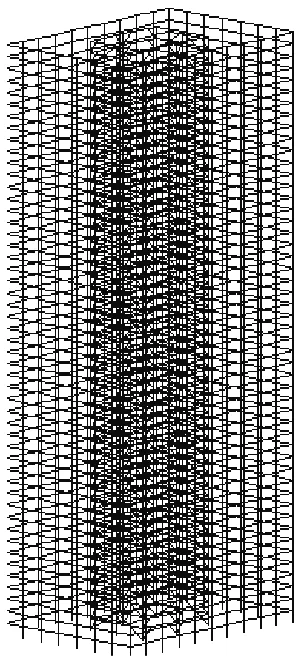
Structure of a certain tall building is described as a 50-storey of 7-bay by 10-bay framework with 2550 nodes and 5100 members shown in Figure 2.
Figure 2. 3D model of the example building
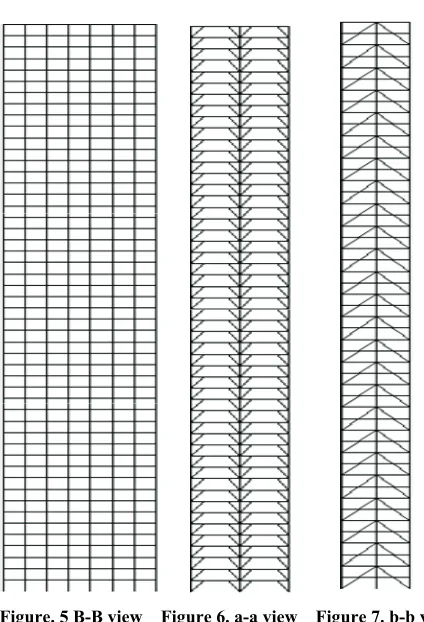
[image:6.595.359.485.222.344.2] [image:6.595.95.246.378.706.2]A bay width is 4.57 m and a storey height is 3.66 m. Details of the framework are shown in its plan view in Figure 3 and elevation views in Figure 4 and 5.
The framework consists of exterior moment frames and a braced core, which are rectangles with the same centre. All beams and columns are rigidly connected while the diagonal braces are simply connected. Two-storey K- bracing modules are used on both the south and north faces of the core, as shown in Figure 4. Single-storey knee- bracing is used in the west and east faces of the core as shown in Figure 4.
[image:6.595.353.494.380.705.2]Figure 3. Plan view of the example
Figure. 5 B-B view Figure 6. a-a view Figure 7. b-b view
The floors between the exterior frames and raced core
are rigid kg /m3,
which is ework
are calculated. American AISC standard sections are used to size the members: Beams are W24 103 shapes, di-agonals are W14 90 shapes, and columns are also W14 233 shapes except that the cruciform columns in the core (See Figure 3) use pairs of two W14 233 shapes ori-ented perpendicular to each other.
e reference height h = 10 m, the designed wind speed at
and third frequencies of natural vibration are given out. They are correspond-ing the bendcorrespond-ing vibration on X-direction, the bendcorrespond-ing vibration on Y-direction and the twist vibration of the tall building respectively.
Firstly, through the modal analysis, the lowest fre-quency and its vibration shape are obtained. They are corresponding to the bending vibration in along-wind direction, i.e. X-direction. Its circular frequency is u =
0.86572 rad/s, its natural frequency is 0.13778 hertz. In Table 2, the translation values of the bending vibra-tion shapes on X-direcvibra-tion (along-wind direcvibra-tion) are listed. The relationship between the vibration shape and mass matrix are uT M u = Mu* = 1. Because the floors
[image:7.595.311.536.419.496.2]be-tween the exterior frames and braced core are rigid, the translation values at all nodes of the same storey are the same.
Table 1. Natural frequencies
mode number
circular frequency
frequency (hertz )
period (sec) The parameters about wind load are given as follows:
th 0
the reference height V h0 = 30.0 m /s 2, the roughness
length of building terrain r0 = 2 m, for Equation (11)
and Equation (12), I r i = r i(h i) /Vo i > 17.4% at nodes
over 22 meters. Non-dimensional decay constants Cy =
C z = 10.0 which is employed when cross-spectrums of
turbulent wind are calculated, The drag coefficients c i of
surface nodes in along-wind direction are shown out as Figure 4.
In Table 1, the first, the second
b . Mass density of the tall building is 150 employed when node masses of this fram
1
8.6572E-01 8.6572E-01 7.2577E+00
2
9.6824E-01 1.5410E-01 6.4893E+00
3
[image:7.595.55.537.535.723.2]1.2926E+00 2.0573E-01 4.8608E+00
Table 2. The bending vibration shapes in along-wind direction
Storey
X-translation Storey X-translation Storey X-translation Storey X-translation Storey X-translation
1
.14613E-05 11 .44215E-04 .11164E-0321 31 .18569E-03 41 .25427E-03
2
.40615E-05 12 .50177E-04 22 .11898E-03 32 .19293E-03 42 .26052E-03
3
.70606E-05 13 .56396E-04 23 .12639E-03 33 .20013E-03 43 .26670E-03
4
.10390E-04 14 .62780E-04 24 .13381E-03 34 .20722E-03 44 .27271E-03
5
.14206E-04 15 .69378E-04 25 .14127E-03 35 .21426E-03 45 .27865E-03
6
.18365E-04 16 .76104E-04 26 .14871E-03 36 .22117E-03 46 .28442E-03
7
.22932E-04 17 .83006E-04 27 .15618E-03 37 .22803E-03 47 .29012E-03
8
.27790E-04 18 .90002E-04 28 .16360E-03 38 .23473E-03 48 .29567E-03
9
.33000E-04 19 .97138E-04 29 .17102E-03 39 .24137E-03 49 .30121E-03
10
S. X. CHEN 297
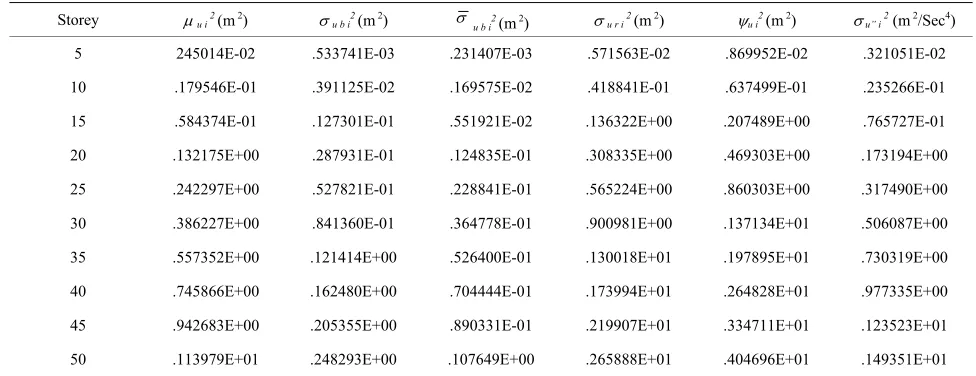
[image:8.595.52.540.94.282.2]espo Table 3. The wind-induced r
Storey u i 2 (m 2) u b i2 (m 2)
nse in along-wind direction
u b i2 (m 2) u r i 2 (m 2) u i2 (m 2) u” i 2 (m 2/Sec4)
5 245014E-02 .533741E-03 .231407E-03 .571563E-02 .869952E-02 .321051E-02
10 .179546E-01 .391125E-02 .1695
15 .584374E-01 .127301E-01 .5519
20 .132175E+00 .287931E-01 .1248
25
75E
21E
35E
.242297E+00 .527821E-01 .228841E .565224E+00 .860303E+00 .317490E+00
78E-01 .90098 .506087E+00
00E-01 8E .197 .7 0
44E-01 .173994E
331E-01 .219907E
49E+00 .265888E .40469
-02 .418841E-01 .637499E-01 .235266E-01
-02 .136322E+00 .207489E+00 .765727E-01
-01 .308335E+00 .469303E+00 .173194E+00
-01
30 .386227E+00 .841360E-01 .3647
35 .557352E+00 .121414E+00 .5264
40 .745866E+00 .162480E+00 .7044
1E+00 .137134E+01
.13001 +01 895E+01 3 319E+00
+01 .264828E+01 .977335E+00
45 .942683E+00 .205355E+00 .890
50 .113979E+01 .248293E+00 .1076
+01 .334711E+01 .123523E+01
+01 6E+01 .149351E+01
According to Equation (39), Equation (44), Equa-tion (46), Equation (45), Equ
(50), we respectively calculate
c r is l n
mean a he qu t ground
displacem u b i the e v u f
th rea pro tur t
gr di espon
ation (38) and Equation d the mean square value of the stati t anslation d p aceme t response u i 2, the
squ re value of t ent response
asi-static turbu
2 , mean squarlen al e o
e un sonable ap ximate quasi-static bulen ound splacement r se
u b i2according eunreasonable approximate Equation (31), the mean
sq val dyn m u nan
placement e u r i 2 me lue e
total displacemen n u i2 an sq re
va ion e ons u” i nsi e g
on e re e lo ncy e
mean a Ta l
paring the s of 2 and
to th uare ue of the a ic t rbulent reso t
r sponse , the an square va of th t respo
he accelerat se
r sp
and the me
e 2. Co d rinua
lue of t
ly th sponse to th west resonant freque , thes squ
Com
re values are listed in value
b e 3.
u b i
u b i2of Table 2,th r latiei re ve error is (u b i 2 –
u b i2) /
u b i2 = 130.6%.Even ( u b i –
u b i) /
u b i = 51.8 stsupports the above-mentioned
corresponding to (I r i 2 + I r j 2) of Equation (30) can not
be ne as Equ for ta gs, since
the neg ting will c or m relat
error for u b i2.
5. Conclusions
For mo n tall bui n urb th a
ger rou ess leng ts of ed r
dom vi ions becom prono e squa
item of turbulence Vr i 2 tion
can not neglected
In th per, a ong-
wind lo trum . On this
pressio rm, anal la of ed d
placement and acceleration response nd
rection ar evelope ammed
As the present usual expression of along-wind load turbulence component, even accurate expression proposed
cc an t exp n
-ly sup .
en
e Factors,” Journal o
ctur asio 1-34.
. Da rt, “ n Spectrum of Horizontal
ines r th High Winds,” 1963, pp.
211
yrb d S “Wi Loa
c-. 06.
. Thorton, L l., O miz ll
Structures for Wind Loading ,” Journal of W
ing erod 36, 1990, p
nlan, “Wind Effcts on Structrures: A Introduction to Wind Engineering,” John Wiley &
Sons ork, 198
P. S Force ng,” P ss,
Oxford, 1978, pp. 12-88. A. Pupleace, “Probability
Pro ucat ing, 1 8.
L. ervic Stat nd
Load, eel
Con
B. J al., Dam nd
Stiffness in Th
ture of W ring ial
Aerodynamics
[10] Ad Hoc Committee on Serviceability Research,
“Struc-tura ty: A raisa ch
Nee f Stru ering o.
12, 6-266
%. This fact rongly
conclusion that the items [5] E. Simiu and R. H. Sca
glected ation (31) ll buildin
lec ause a 50% uch higher ive [6]
der ldings built i an areas wi lar- [8]
ghn th, the effec wind-induc
an-brat e more
component (t) unced. Thof Equa (9)re [9]
be .
is pa
ad spec is proposedmore accurate expression of al the basis of
ex-n fo ysis formu wind-induc
in along-wi .
di-e d d and progr
neglects the square item of an approximate form of the
is more a urate th he present ressio . The exam ple strong ports this conclusion
5. Refer ces
[1] A.G. Dav nport, “Gust Loading f the
Stru al Div n, 1977, pp. 1
[2] A.G
Gust
venpo s Nea
The Predictio e Ground in
194- .
[3] C. D
tures,” John Wiley
ye an . O. Hansen,
& Sons Inc., New York, 1
nd ds on Stru
996, pp 49-1
[4] C. H . Joseph, et a “ pti ation of Ta
ind
Engi-neer and A ynamics, Vol. p. 235-244.
Inc., New Y 6.
achs, “Wind in Engineeri ergamon Pre
[7] , Random Variable and Random
cess”, High Ed ion Press, Beij 983, pp. 18-4
G. Griffis, “S
” Engineering Journal of Am
eability Limit
erican Institute of S es Under Wi
t
struction, 1993, pp. 23-28.
. Vickery, et
e Reduction of “The Role of
Wind Effects ping, Mass a
on
Struc-s,” Journal ind Enginee and Industr
, Vol. 11, 1983, pp. 265-294.
l Serviceabili Critical App l and Resear
d”, Journal o
1986, pp. 264
ctural Engine 4.
1] D. Surry and E. M. F. Stopar, “Wind Loading of Large Studies at the Laboratory of Building Physics,” KU Leu-ven, 2002, pp. 36-66.
Data: Comparing [1
Low Building,” Journal of Civil Engineering, Vol. 16,
1989, pp. 526-542.
[12] F. K. Chang, “Human Response to Motions in Tall
Build-ing,” Journal of Structural Division, Vol. 99, 1973, pp.
1259-1272.
[13] B. Blocken, et al., “Wind, Rain and the Building Envelope:
[14] L. M. Fitzwater and S. R. Winterstein, “Predicting Design
Wind Turbine Loads From Limited
Random Process and Random Peak Models,” Journal of
Solar Energy Engineering, Vol. 123, No. 4, 2001, pp.