Munich Personal RePEc Archive
A methodological contribution for
measuring trade competition
Lopes, Vania and Simoes, Nadia and Crespo, Nuno
Bank of Portugal, Department of Statistics, Instituto Universitário
de Lisboa (ISCTE – IUL), ISCTE Business School Economics
Department, BRU – IUL (Business Research Unit)
2014
Online at
https://mpra.ub.uni-muenchen.de/58042/
A methodological contribution for measuring trade competition
V. Lopesa, N. Simoesb,*, and N. Crespoc
a
Bank of Portugal, Department of Statistics.
b
Instituto Universitário de Lisboa (ISCTE – IUL), ISCTE Business School Economics Department, BRU – IUL (Business Research Unit).
c
Instituto Universitário de Lisboa (ISCTE – IUL), ISCTE Business School Economics Department, BRU – IUL (Business Research Unit).
*Corresponding author. E-mail: [email protected]
Abstract: The traditional approach to evaluate trade competition considers the
competition between two countries in a given destination market and quantifies it
through a measure of structural similarity such as the Krugman index. We explore this
topic further through the discussion of six distinct perspectives. For each of them,
adequate measures are proposed.
Keywords: trade competition, globalization, structural similarity, index.
JEL Codes: F10, F14.
Acknowledgements
I. Introduction
Trade openness, internationalization, and globalization are critical trends of the last
decades (Head and Mayer, 2013), with trade growing faster than GDP since 1980
(Berthelon and Freund, 2008). In an increasingly interdependent world, trade
competition emerges as a fundamental topic, requiring further research concerning
theory, measurement, and empirical analysis. This study contributes to the second
dimension – the measurement of trade competition between countries.
The empirical study of trade competition is usually grounded on the concepts of
competition threat (Jenkins, 2008) and structural similarity (Crespo and Fontoura, 2007;
Palan and Schmiedeberg, 2010), the last one being the dominant approach. Among the
indexes of structural similarity used to evaluate the degree of trade competition, the
Krugman index is the most standard option (Palan, 2013). The underlying assumption is
that greater similarity implies stronger competition. Recently, Crespo and Simoes
(2012) argue that a more comprehensive understanding of the trade competition
between two countries requires a multidimensional index that incorporates not only the
similarity in sectoral shares, as in the Krugman index, but also the degree of intra- and
inter-sectoral similarity.
We contribute to this line of research by providing a broader framework for the study of
trade competition. We argue that the standard perspective that exclusively evaluates
trade competition between two countries in a given destination market is just one of
several perspectives that we could adopt to investigate this complex empirical
phenomenon. Therefore, we discuss six alternative optics of analysis that can be
usefully applied in the empirical exercises. Each of them addresses a specific question
that emerges in the empirical analysis of trade flows and, especially, of trade
competition.
The remainder of the paper is organized as follows. Section II provides an overall
picture of the conceptual framework and Section III presents in a formal way the
II. A Preliminary View of the Measurement of Trade Competition
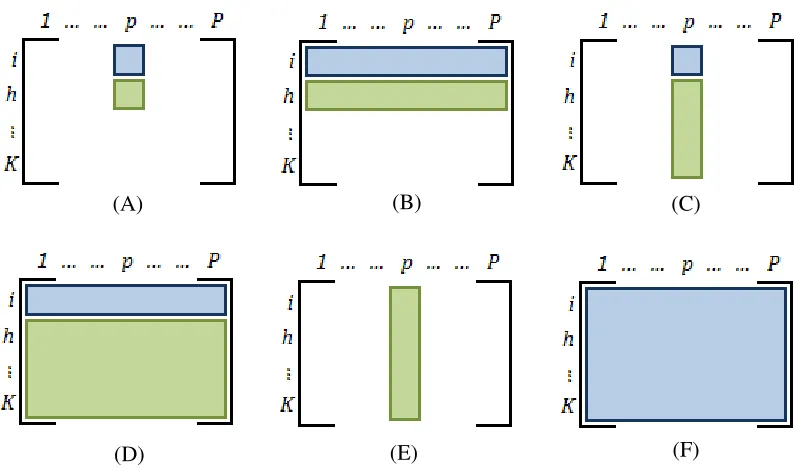
The usual perspective on the measurement of trade competition assumes the exports of
two countries (i, h) for a given destination market (p), as shown in panel (A) of Fig. 1.
Fig. 1. A conceptual framework for the measurement of trade competition
Nevertheless, other useful perspectives of analysis can also be employed:
(B) Competition between two countries in all the markets, i.e., what is the degree of
competition between i and h in all the markets? For example, what is the competition
between France and Germany in overall terms?
(C) Competition that a country faces in a specific destination market, i.e., what is the
degree of competition that country i faces in market p from other countries? For
example, what is the competition faced by France in the Spanish market?
(D) Competition that a country faces in all markets, i.e., what is the degree of
competition that country i faces in all markets from all other countries? For example,
what is the competition faced by France in overall terms?
(A)
(D) (E)
(B) (C)
[image:4.595.87.488.214.450.2](E) Competition in a given market among all the countries, i.e., what is the degree of
competition in market p among all the countries exporting to that country? For example,
what is the competition in the Spanish market?
(F) Global competition, i.e., what is the degree of competition between all countries in
all markets?
The goal of this paper is to discuss how to complement the traditional measurement
approach in order to obtain quantitative answers to all these questions. To that end, the
starting point is the consideration of a trade competition index. Following the dominant
perspective, we consider a modified version of the standard Krugman index expressed
as:
= 1 − − (1)
where and are, respectively, the shares of sector j in the exports of i and h to p.
ranges between 0 and 1. A higher value for indicates a stronger structural
similarity, suggesting more intense trade competition between i and h. Hereinafter we
will designate the trade competition index as in order to make it clear that it may
correspond to alternative indicators, including the multidimensional measures proposed
by Crespo and Simoes (2012).
III. Obtaining the Trade Competition Indexes
The first perspective on trade competition is the traditional one and can be empirically
evaluated through a trade competition index ( ) between countries i and h in a given
market p, which we will designate as . Let us concentrate now on the remaining
The second approach – Panel (B) in Fig. 1 – captures, as does the first, the competition
between two countries but now in overall terms, i.e. in all markets for which they
export. It is therefore a bilateral perspective of trade competition, like the first, but now
measured at the global scale. To obtain such a measure we calculate the weighted
average of the trade competition indexes between i and h in each specific destination
market p:
= (2)
is the total number of destination markets. is the simple average of the share of
market p in the exports of i and h:
= + (3)
in which and correspond, respectively, to the exports of i and h for p and and
are the total exports of i and h.
When a country exports to a given destination market it faces the competition not only
from another specific country but from all of the countries that export to that
destination. This leads us to the third perspective of analysis – Panel (C) in Fig. 1 – in
which we measure the degree of trade competition that a country i faces in a market p
from all the remaining countries that also export to p. In order to obtain an index
corresponding to this perspective of analysis, we follow a strategy very similar to that
used in the second approach. The main difference regards the weights considered. They
now correspond to the share of each origin country h in the total of exports that arrive at
p excluded from the exports from i to p:
=
!"#$
%
Using these weights allows us to give greater representation to the trade competition
indicators that correspond to countries with a higher share of the exports to p. The index
that captures this third optic of analysis can be represented as follows:
= &
' (5)
This index measures the competition faced by i in market p. Another interesting
question is the level of competition faced by i in the full range of destination markets –
Panel (D) in Fig. 1. Constructing an index adequate to quantify this aspect is our task in
the fourth perspective. We start from Equation (5) and calculate the weighted average of
the values obtained for all destination markets in which the corresponding weight is the
share of p in the total exports of i:
= ( (6)
and
( = (7)
While the previous perspectives focus on the exporting markets, the last two concentrate
on the level of trade competition in the destination markets. The fifth perspective –
panel (E) in Fig. 1 – focuses on the competition in a given market p. In this case,
however, we are considering the competition among all countries that export to p. For
calculating this, we can adopt two different approaches. The first considers the indexes
= & ) *
& (8)
In this case, we use as weights the relative importance of each country-pair in total
exports to p:
) = " +, +
-#$ . "
#$ . (9)
The second approach uses the indexes obtained in the third perspective ( ):
= & ) (10)
The share of exports from i to p in the total exports to p is assumed as weight:
) = / (11)
Once more we are giving more importance to the countries that represent a larger
fraction of exports to p since they account for a more important part of trade
competition in this specific market.
The last perspective that we should consider seeks an index that captures trade
competition in the global space under consideration – Panel (F) in Fig. 1. This is a more
complex task because it can be obtained in four different ways. We next discuss each of
The first possibility implies the consideration as starting point of the measures derived
from our first perspective:
= & 0
*
& (12)
Thus, the weights are given by the share of the sum of exports from i and h to p in total
trade, i.e., the exports from all countries to all destination markets. Of course, each
country-pair receives a weight according to its level of exports:
0 = " +1#$, +
-#$ . "
#$ (13)
A second and third way of obtaining an index for this last perspective can be grounded
on two measures that result from the fifth perspective ( and ). The new
indexes are calculated as follows:
= 0 (14)
and
= ′ 0 (15)
Independently of the index chosen, the weights correspond to the weighted average of
the shares of exports to p in total exports:
Finally, we can also adopt as reference the indicators obtained in the second perspective
( ):
= & 0
*
& (17)
In this last case, we assume as weights the share of the sum of exports from 3 and ℎ in
total exports:
0 = "+5 + 6
#$ . "
#$ (17)
IV. Conclusion
The main goal of this study was the proposal of a (simple) method to empirically
evaluate the phenomenon of trade competition. While the common approach to this
issue considers the competition between two countries in a given destination market, we
propose the consideration of five other perspectives of analysis. This allows to address
important alternative questions that arise in the study of international trade competition
and that are impossible to consider in their full extension exclusively through the
standard measure commonly applied.
A remarkable advantage of this methodological contribution is the fact that it is flexible
enough to allow for the consideration of alternative trade competition indexes (i.e.,
others than the standard Krugman index). We believe that the joint consideration of
these six perspectives on the trade competition phenomenon offer a deeper and broader
References
Berthelon, M. and Freund, C. (2008) On the conservation of distance in international
trade, Journal of International Economics, 75, 310-20.
Crespo, N. and Fontoura, M. (2007) Integration of CEECs into EU market: structural
change and convergence, Journal of Common Market Studies, 45, 611-32.
Crespo, N. and Simões, N. (2012) On the measurement of multidimensional concept of
structural similarity, Economics Letters, 116, 115-17.
Head, K. and Mayer, T. (2013), What separates us? Sources of resistance to
globalization, Canadian Journal of Economics, 46, 1196-231.
Jenkins, R. (2008) Measuring the competitive threat from China for other southern
exporters, The World Economy,31, 1351–66.
Krugman, P. (1991) Geography and trade, MIT Press, London.
Lall, S., Weiss, J. and Oikawa, H. (2007) China’s competitive threat to Latin America:
an analysis for 1990-2002, Oxford Development Studies, 33, 163-94.
Palan, N. (2010) Measurement of specialization – the choice of indices, Research
Centre International Economics, FIW Working Papers No. 62, Vienna.
Palan, N. and Schmiedeberg, C. (2010) Structural convergence of European countries,