ISSN Online: 2162-5344 ISSN Print: 2162-5336
Simulation Is Not a Pedagogy
Gwen D. Erlam, Liz Smythe, Valerie Wright-St Clair
Department of Health and Environmental Sciences, Auckland University of Technology (AUT), Auckland, New Zealand
Abstract
Simulation as a teaching/learning tool has evolved at an unprecedented pace which some believe has occurred despite a lack of research into pedagogies appropriate to guide this technology-based learning tool. There seems to be some confusion as to what simulation actually is. Some have called simulation a pedagogy, which is incorrect. Simulation is not a pedagogy, but an immer-sive teaching/learning platform which is a representation of a functioning system or process. Simulation has been used in undergraduate nursing educa-tion in a focused manner for nearly 20 years. Its effectiveness in improving clinical reasoning and critical thinking is not certain if overall instructional design principles do not reflect suitable philosophical paradigms. Simulation as a teaching/learning platform is maximized when instructional design in-cludes the inspiration of behaviorism, cognitivism, and constructivism. Be-haviorist design principles include rote learning, repetition, modular learn-ing, stimulus-response, and conditioning. Cognitivist design principles in-clude observational techniques, bootstrapping, and equilibration in the form of assimilation and accommodation. Constructivist design principles in-clude new habit formation through experience and interaction with a “mature social medium” in the form of a simulation facilitator. All of these philoso-phical underpinnings have the potential to maximize simulation when used as underpinnings in the overall design.
Keywords
Simulation, Undergraduate Nursing Education, Behaviorist, Cognitivist, Constructivist
1. Introduction
There has been some confusion as to the definition and potential uses of simula-tion in the training of undergraduate nurses. Upon researching simulasimula-tion ex-tensively, it has become apparent that there is some confusion around the defi-nition of simulation. Some educators believed simulation to be a pedagogy [1]. How to cite this paper: Erlam, G.D.,
Smythe, L. and Wright-St Clair, V. (2017) Simulation Is Not a Pedagogy. Open Jour-nal of Nursing, 7, 779-787.
https://doi.org/10.4236/ojn.2017.77059
Received: May 31, 2017 Accepted: July 17, 2017 Published: July 21, 2017
Copyright © 2017 by authors and Scientific Research Publishing Inc. This work is licensed under the Creative Commons Attribution International License (CC BY 4.0).
Simulation is not a pedagogy, but an immersive teaching/learning platform which is a representation of a functioning system or process [2]. The aim of this article is to “unpick” some of these language traps in order to better understand how a sound pedagogical approach that includes the use of simulation can maximize learning for undergraduate nurses.
2. What Is Pedagogy?
Pedagogy is rarely made explicit in curricula, and is often assumed or taken for granted. Pedagogy deals with the theory and practice of teaching. The Merriam Webster online dictionary [3] defines pedagogy as the art, science, or profession of teaching. A comprehensive use of pedagogy includes considerations around the nature of knowledge; what is taught; how it is taught; and how learning oc-curs [4]. It is an educator’s pedagogical knowledge which most profoundly in-fluences the teaching/learning environments he or she creates [5]. Designing ef-fective simulation involves a comprehensive understanding of the pedagogical underpinnings which can enhance simulation as a teaching/learning tool. Simu-lation is not a pedagogy in itself; but rather a tool or method used to implement various pedagogies [6].
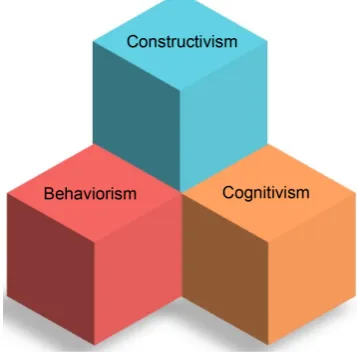
There are at least three philosophical perspectives which underpin sound simulation design: 1) behaviorism [7][8][9]; 2) cognitivism [10][11][12]; and 3) constructivism [13][14][15][16]. These can be seen in Figure 1.
Each of these theoretical frameworks involves, to some degree, repetitive prac-tice, feedback, personal and group reflection, and a safe learning environment. Cognitivism and constructivism involve movement from dependent to inde-pendent learning. All of these theoretical frameworks have contributions to make to a pedagogical approach that includes the use of simulation [6].
2.1. Behaviorism
[image:2.595.282.461.529.705.2]Behaviorism as an educational philosophy is the earliest theoretical underpinning
Figure 1. Building blocks of sound simulation
identified in educational research [8][17] [18]. In behaviorism learning is con-firmed by behavioral responses to specific stimuli [17] [19]. John B. Watson (1878-1958) is generally considered to be the founder and champion of modern behaviorism. Watson believed that behavior was the proper material for study, not methods that dealt with the mind [9]. Internal thought processes are not considered as the focus is on external response to stimuli. The human mind is considered a memory bank for knowledge, with the teacher being responsible for transmission of knowledge, and the learner a passive recipient [20]. Behaviorists espouse that environment shapes behavior and that external factors can be ma-nipulated to produce desirable actions [6][21].
Behaviorist methods employed in simulation include rote learning, repetition of skills, pre-briefing, and modular learning [21]. While basic and often as-sumed, rote learning forms the foundations of any professional healthcare career by providing students with a body of facts (e.g. lab values, physiology, and clini-cal protocols) [19][22]. Application of factual knowledge to clinical problems is the beginning of bridging the theory-practice gap so often noted as an issue in undergraduate nursing education [6].
Conditioning theories of learning, arising from behaviorism, are also helpful in maximizing simulation design [6]. Skinner [7] developed the best-known conditioning theory termed operant conditioning. If a behavior is positively reinforced through conditioning, a response is more likely to occur. Students can therefore be conditioned to respond to certain stimuli (e.g. loss of con-sciousness, rapid pulse,) with appropriate responses (e.g. BP check) in simula-tion. Quickened conditioned responses can improve patient outcomes. Thorn-dike (1874-1949) extended Skinner’s work by making deliberate associations between experiences and responses in what was called connectionism [8][23].
Connectionism espouses that the most fundamental type of learning involves the forming of associations (connections) between sensory experiences (stimuli or events) and neural impulses (responses) that manifest themselves behaviorally [24]. Thorndike [8] proposed the law of exercise, which suggests that practice strengthens the connection between the stimulus and the response, while disuse weakens it. Skill development employing repetition strengthened with the law of exercise can result in modified and improved competence [25][26][27].
practice. This weakness has highlighted a need to seek out other educational philosophies more focused on the student’s ability to problem-solve and criti-cally evaluate clinical situations [6]. Therefore, the influence of cognitivist and constructivist philosophies has proved valuable in simulation design.
2.2. Cognitivism
While behaviorists believe that learning occurs as a response to stimuli, cogni-tivism carries the notion that learning involves the reorganization of experiences [6][29]. Behaviorists stress the role of the environment and the effect on learn-ing, while cognitivists stress what students do with the information. Cognitivists want to know how students attend to, rehearse, transform, code, store, and re-trieve information given [24]. The leading, and most influential, cognitive theor-ist in the West is Piaget [30], while Vygotsky’s work [12] is more influential in Eastern Europe [6][31]. Learning to the cognitivist involves a move away from stimulus-response modes of learning to a focus on students’ beliefs and thought processes, perceptions and insights [5][6][24].
One of the major challenges to behaviorism came from the studies on obser-vational learning conducted by Albert Bandura [10]. Bandura found that people could learn new actions merely by observing others perform. More importantly, observers did not have to perform the actions at the time of learning. This cog-nitivist notion impacts simulation design in the area of pre-briefing material and model simulation clips used to showcase professionals caring for clients in dete-riorating clinical situations. Students can learn by simply observing model clips [6]. They are able to build this learning into cognitive schema before attending simulation sessions. Piaget’s [11] work inspired thoughts on how to maximise the development of such cognitive schema.
According to Piaget [11], equilibration, the drive to produce an optimal state of equilibrium (or adaptation) between cognitive structures and the environ-ment, is the primary motivating force behind cognitive development. To resolve internal conflict in thought, an individual can use one of two component pro- cesses of equilibration: assimilation or accommodation. Assimilation refers to fitting external reality into existing cognitive structures. Accommodation refers to changing internal structures to provide consistency with external reality [24]. Both of these processes inspire learning in simulation as students strive to achieve equilibrium.
con-fidence they were competent to care for such a patient safely [27].
Ironically, one weakness of cognitivism arises from its strength. Whereas schemata can make learning more meaningful, a learner is at a marked disad-vantage when relevant schemata or pre-requisite knowledge do not exist [6] [29]. In this instance, the learner may enter into a process called bootstrapping which involves the creation of new representational resources which are more powerful than those present at the outset [32]. In order for bootstrapping to oc-cur, three processes must arise: 1) the facilitator must specify the innate repre-sentations that provide the building blocks of the target concepts of interest; 2) the facilitator must describe how the target concepts differ from those innate re-presentations currently available and: 3) the facilitator must characterize the learning mechanisms that enable the construction of new concepts out of the prior representations [32]. Facilitator input in the form of situated teaching is essential for bootstrapping to occur [27].
It is the job of the instructional designer to choose tasks which will assist stu-dents to retrieve and work with knowledge as they reorganize experiences in cognitive schemata [6]. Cognitive theory underpins simulation in the area of developing clinical reasoning and problem solving [6][33]. Without considera-tion of cognitive architectural features, instrucconsidera-tional design is likely to be subop-timal [34]. Constructivist philosophy moves simulation design in a different di-rection.
2.3. Constructivism
Constructivist thought draws from a variety of disciplines including education and psychology. John Dewey [14], Jerome Bruner [13], Ernst von Glasersfeld [35], John Mezirow [16], and Malcolm Knowles [15] represent some profound thinkers whose work contributes to contemporary constructivist thought. Con-structivist knowledge develops by a process of active construction and recon-struction of theory and practice [6] [36]. Von Glasersfeld [35] postulates that knowledge is the collection of conceptual structures that are adapted or viable within the subject’s range of experience.
Constructivism holds that learners have some prior knowledge and experience, and are capable of building their own content in order to solve a particular problem [37] [39]. Constructivism is a learner-centric educational paradigm where the learner constructs meaning in a team-based, collaborative learning environment. The needed knowledge is not delivered by the educator, but constructed in the mind of the learner [38]. The learner moves from a passive stance in behaviorism, to an active participant in the learning process in con-structivism [6][19].
(i.e. new habits). Learners must be allowed the freedom to consciously search for new ways of responding, while being given the freedom to find their own solu-tions [6]. These solutions are further refined when students interact with a “ma-tured social medium” [[14] p. 90]. This combination of student search intermin-gled with facilitator input allows for knowledge construction in a manner which situates the learner firmly in the driver’s seat, a concept at the heart of constructivist thought [6][27].
An example of new habit formation encouraged by the presence of a matured social medium occurred when a student forgot to wear her watch and was forced to view another student’s watch. When the other student shifted position, the count was lost. The facilitator pointed out the clock on the wall and the new ha-bit of using the wall clock was formed [6]. The problem was solved and the stu-dent commented:
I did not realize there was a clock on the wall, so I could not effectively mea- sure respiratory rate. It was very supportive that [the educator] told me the loca-tion of the clock. It was good that the educator was with me (Focus Group, Cycle One).
This kind of facilitation becomes essential for students when they are at-tempting to form new habits. They appreciate the interaction with a matured so-cial medium in the form of a simulation facilitator, who can give them feedback during and after the simulation in the form of debriefing [6].
One of the challenges posed with constructivism is that learners may inadver-tently build knowledge that is inaccurate or not the best “fit” for the problem posed [40]. Some pre-existing ideas may be ad hoc or unstable [41]. If the facili-tator is not aware of what a particular student is “thinking”, incorrect solutions may result. This problem can be mitigated by training simulation facilitators to monitor and guide student thinking in the debriefing session [6]. This is one reason why debriefing, to ensure refinement of new knowledge, is an essential component when using simulation as a teaching/learning platform [6][42].
3. Conclusions
this process will be students “fit for purpose” and ready to engage with complex clinical environments for which they are destined.
References
[1] McNeill, J., Parker, R.A., Nadeau, J., Pelayo, L.W. and Cook, J. (2012) Developing Nurse Educator Competency in the Pedagogy of Simulation. Journal of Nursing Education, 51, 685-691. https://doi.org/10.3928/01484834-20121030-01
[2] Simulation Australia (2017) What is Simulation: An Overview of Simulation and Modelling. Retrieved June 15, 2017, from
http://www.simulationaustralasia.com/about/what-is-simulation
[3] Pedagogy (2015) Retrieved March 19, 2015 from Merriam-Webster.com website. http://www.merriam-webster.com/dictionary/pedagogy
[4] Horsfall, J., Cleary, M. and Hunt, G.E. (2012) Developing a Pedagogy for Nursing Teaching-Learning. Nurse Education Today, 32, 930-933.
https://doi.org/10.1016/j.nedt.2011.10.022
[5] Bradshaw, M.J. (2014) Effective Learning: What Teachers Need to Know. In: Brad-shaw, M.J. and Lowenstein, A.J., Eds., Innovative Teaching Strategies. Jones & Bar-tlett Learning, Burlington, MA, 3-18.
[6] Erlam, G., Smythe, E. and Wright-St Clair, V. (2015) Improving Pedagogical Prac-tices with Undergraduate Nursing Students in High-Fidelity Simulation: A Thesis Submitted to Auckland University of Technology in Partial Fulfilment of the Re-quirements for the Degree of Doctor of Health Science, 2015. Auckland University of Technology, Auckland.
[7] Skinner, B.F. (1938) The Behavior of Organisms: An Experimental Analysis. B.F. Skinner Foundation, Cambridge, MA.
[8] Thorndike, E.L. (1913) Education Psychology: Briefer Course. Routledge, New York.
[9] Watson, J.B. (1914) Behavior: An Introduction to Comparative Psychology. Henry Holt & Company, New York. https://doi.org/10.1037/10868-000
[10] Bandura, A. (1977) Social Learning Theory. General Learning Press, New York. [11] Piaget, J. (1952) When Thinking Begins. In: The Origins of Intelligence in Children,
International Universities Press, New York, 25-36.
https://doi.org/10.1037/11494-000
[12] Vygotsky, L. (1980) Mind in Society: The Development of Higher Psychological Processes. Harvard University Press, Cambridge.
[13] Bruner, J. (1960) The Process of Education. Harvard University Press, Cambridge. [14] Dewey, J. (1922) Human Nature and Conduct: An Introduction to Social
Psycholo-gy. Henry Holt, New York.
[15] Knowles, M.S. (1973) The Adult Learner: A Neglected Species. Gulf Publishing Company, Houston.
[16] Mezirow, J. (2000) Learning as Transformation: Critical Perspectives on a Theory in Progress. Jossey Bass, San Francisco.
[17] Skinner, B.F. (1985) Cognitive Science and Behaviourism. British Journal of Psy-chology, 76, 291-301.https://doi.org/10.1111/j.2044-8295.1985.tb01953.x
[18] Watson, J.B. (1925) Behaviorism. W.W. Norton & Company, Inc., New York. [19] Passmore, G.G. (2014) Concept Mapping: A Meaningful Learning Tool to Promote
Lo-wenstein, A.J., Eds., Innovative Teaching Strategies in Nursing and Related Health Professions, Jones & Bartlett Learning, Boston, 6th Edition, 397-415.
[20] Chen, I. (2009) Behaviorism and Developments in Instructional Design and Tech-nology. In: Rogers, P., Berg, G., Boettcher, J., Howard, C., Justice, L. and Schenk, K., Eds., Encyclopedia of Distance Learning, 2nd Edition, 153-172.
https://doi.org/10.4018/978-1-60566-198-8.ch023
[21] Parker, B.C. and Myrick, F. (2009) A Critical Examination of High-Fidelity Human Patient Simulation within the Context of Nursing Pedagogy. Nurse Education To-day, 29, 322-329. http://www.nurseeducationtoday.com/
[22] Lewis, D.Y. and Ciak, A.D. (2011) The Impact of a Simulation Lab Experience for Nursing Students. Nursing Education Perspectives, 32, 256-258.
http://www.nln.org/nlnjournal
https://doi.org/10.5480/1536-5026-32.4.256
[23] Tolman, E.C. (1936) Connectionism; Wants, Interests, and Attitudes. Character & Personality, 4, 245-253.https://doi.org/10.1111/j.1467-6494.1936.tb02126.x
[24] Schunk, D.H. (2014) Learning Theories: An Educational Perspective. 6th Edition, Pearson Prentice Hall, Upper Saddle River.
[25] Clapper, T.C. and Kardong-Edgren, S. (2012) Using Deliberate Practice and Simu-lation to Improve Nursing Skills. Clinical Simulation in Nursing, 8, e109-e113. [26] Erlam, G., Smythe, L. and Wright, V. (2016) Simulation and Millennials—The
Per-fect Storm. Open Journal of Nursing, 6, 688-698. https://doi.org/10.4236/ojn.2016.69071
[27] Erlam, G., Smythe, E. and Wright-St Clair, V. (2016) Six Steps to Coaching Oscar Performances from Under-Graduate Nursing Students in Simulation: An Action Research Study. The Meeting of the SimHealth, Melbourne, 26-29 September 2016. [28] Haw, M.A. (2006) Learning Theories Applied to Nursing Curriculum Development.
In: Keating, S.B., Ed., Curriculum Development and Evaluation in Nursing, Lip-pincott Williams & Wilkins, Philadelphia, 49-60.
[29] McLeod, G. (2003) Learning Theory and Instructional Design. Learning Matters, 2, 35-43. http://www.education.state.mn.us/MDE/Welcome/News/LearnMatter/ [30] Piaget, J. (1973) Main Trends in Psychology. George Allen & Unwin, London. [31] Jarvis, P., Holford, J. and Griffin, C. (2003) The Theory and Practice of Learning.
2nd Edition, Kogan-Page, London.
[32] Carey, S. (2004) Bootstrapping & the Origin of Concepts. Daedalus, 133, 59-68.
http://www.jstor.org/stable/20027897
https://doi.org/10.1162/001152604772746701
[33] Burke, H. and Mancuso, L. (2012) Social Cognitive Theory, Metacognition, and Si-mulation Learning in Nursing Education. Journal of Nursing Education, 51, 543-
548.https://doi.org/10.3928/01484834-20120820-02
[34] Josephsen, J. (2015) Cognitive Load Theory and Nursing Simulation: An Integrative Review. Clinical Simulation in Nursing, 11, 259-267.
[35] Von Glasersfeld, E. (1989) Cognition, Construction of Knowledge, and Teaching. Synthese, 80, 121-140.https://doi.org/10.1007/BF00869951
[36] Foreman-Peck, L. and Murray, J. (2008) Action Research and Policy. Journal of Philosophy of Education, 42, 145-163.
https://doi.org/10.1111/j.1467-9752.2008.00630.x
[37] Piaget, J. (1954) The Construction of Reality in the Child. Basic Books, New York.
[38] Boese, T., Cato, M., Gonzalez, L., Jones, A., Kennedy, K., Reese, C., Borum, J.C., et al. (2013) Standards of Best Practice: Simulation Standard V: Facilitator. Clinical Simulation in Nursing, 9, S22-S25.
[39] Dewey, J. (1938) Experience and Education. Educational Forum, 50, 241-252.
https://doi.org/10.1080/00131728609335764
[40] Kala, S., Isaramalai, S.-A. and Pohthong, A. (2010) Electronic Learning and Con-structivism: A Model for Nursing Education. Nurse Education Today, 30, 61-66. [41] Sjøberg, S. (2010) Constructivism and Learning. In: Peterso, P., Baker, E. and
McGaw, B., Eds., International Encyclopedia of Education, Elsevier, Philadelphia, 485-490.
[42] Crookall, D. (2011) Serious Games, Debriefing, and Simulation/Gaming as a Dis-cipline. Simulation & Gaming, 41, 898-920.
https://doi.org/10.1177/1046878110390784
[43] Bergero, C., Hargreaves, L. and Nichols, A. (2012) Collaborative Healthcare Immer-sive Learning Dynamic: Transitioning to Simulation-Based Learning. Clinical Nurse Specialist, 26, 42-47.https://doi.org/10.1097/NUR.0b013e31823bfacf
Submit or recommend next manuscript to SCIRP and we will provide best service for you:
Accepting pre-submission inquiries through Email, Facebook, LinkedIn, Twitter, etc. A wide selection of journals (inclusive of 9 subjects, more than 200 journals)
Providing 24-hour high-quality service User-friendly online submission system Fair and swift peer-review system
Efficient typesetting and proofreading procedure
Display of the result of downloads and visits, as well as the number of cited articles Maximum dissemination of your research work