A Note on Timing of Endogenous Wage Bargaining:
The Case of Complements
*
Kangsik Choi1, Minhwan Lee2#
1Graduate School of International Studies, Pusan National University, Pusan, South Korea 2Division of Global Finance and Banking, Inha University, Incheon, South Korea
Email: [email protected], #[email protected]
Received November 22, 2012; revised December 23, 2012; accepted January 25, 2013
ABSTRACT
By introducing Cournot and Bertrand competition in adifferentiated goods with the case of complements into Nash bargaining solution problem, we investigate timing of endogenous wage setting where wages can be negotiated either simultaneously or sequentially. Contrary to the case of substitutes, we show that regardless of the bargaining power, the type of product market competition (Cournot or Bertrand) and the degree of complementarity, 1) bargaining over wages is always simultaneous when the goods are complements; and 2) the social welfare under both Cournot and Bertrand competitions can improve when bargaining over wages is simultaneous.
Keywords: Bargaining; Complements; Cournot-Bertrand Competition; Social Welfare
1. Introduction
In the literature on unionized oligopolies, there has been analyzed regarding the bargaining process between the firm and the union. For instance, in a spatial context, Brekke and Straume [1] haveanalyzed how equilibrium locations in location-price games under Hotelling’s model are affected when wage negotiations occur simul- taneously. Specifically, Barcena-Ruiz and Casado-Izaga [2] extend the findings of Brekke and Straume [1] by analyzing a duopoly in which firms choose their location and bargain over wages with their unions when the goods are substitutes. Thus, they showed that both unions prefer sequential wage-setting and that the timing of wage set- ting does not alter the location equilibrium. Moreover, Barcena-Ruiz and Casado-Izaga [2] demonstrate that bargaining over wages is simultaneous if and only if both firms decide when negotiation takes place; otherwise, negotiation takes place sequentially.
However, none of these papers have considered the case in which firms choose to bargain over wages of the endogenous timing when goods are complements. Spe-cifically, Horn and Wolinsky [3] showed that when there is a single input upstream firm, the total profit of down-stream industry is smaller or greater under monopoly than under duopoly according to whether the goods are
substitutes or complements1. However, Horn and Wolin-
sky [3] restricted their attention to the case of substitutes of sequential wage negotiating and they do not analyze how firms and unions choose to bargain over wages of the endogenous timing when goods are complements. Therefore, by introducing differentiated goods with complements under either Cournot or Bertrand competi-tion, we attempt to examine the situation where both firms or unions or one firm and one union can either si-multaneously or sequentially bargain over wages. Thus, we extend Horn and Wolinsky [3], and Barcena-Ruiz and Casado-Izaga [2] by considering the timing of endoge-nous wage-setting and both Cournot and Bertrand com-petitions in a duopoly context where outputs and prices are chosen simultaneously.
Consequently, we demonstrate that regardless of the bargaining power, the type of product market competi-tion (Cournot or Bertrand) and the degree of comple-mentarity, bargaining over wages in unionized duopoly is always simultaneous when the goods are complements. This is because when the goods are complements, each union has a strictly dominant strategy for simultaneous wage-setting, under which the firms pay lower wages and produce more outputs and obtain more profits is obtained in the unionized duopolistic market. Hence, when the
1Barcena-Ruiz and Garzon [4] analyzed a theoretical model for case of
multiproduct firms in which both unions and firms can choose their bargaining structures according to whether the goods are substitutes or complements.
*This work was supported by INHA University Research Grant
(INHA40279-01).
goods are complements to each other, it does not matter whether the timing of wage setting is established by: only the two unions; only the two firms; the two unions and only one firm or one union and both firms. Second, we find that regardless of the bargaining power, the type of product market competition (Cournot or Bertrand) and the degree of complementarity, the social welfare under both Cournot and Bertrand competitions can improve when bargaining over wages in a unionized duopoly is simultaneous. These results, when the choice of timing of endogenous wage setting is set in a unionized duopoly, differ from the standard findings of De Fraja [5], Corneo [6], and Barcena-Ruiz and Casado-Izaga [2]. They show that if the goods are substitutes, unions prefer to play sequentially when wage bargaining is decentralized at the level of the firm.
2. Relationship to the Literature
In this section, we discuss the relationship between our paper and some other previous theoretical papers on the bargaining process between the firm and the union.
For non-spatial contexts, theoretical studies that intro- duce the timing of endogenous wage-setting (i.e., the setting of input costs) into Cournot type of oligopolistic markets include De Fraja [5] and Corneo [6], among others when the goods are substitutes. De Fraja [5] and Corneo [6] show that in aoligopoly, when wage bargain- ing is decentralized at the level of the firm, unions prefer to play sequentially and vice versa. On the other hand, there have been some attempts, namely, Davidson [7], Naylor [8], Dorwrick [9], Horn and Wolinsky [3,10] and Lommerud et al. [11], to introduce the downstream firm negotiating with its labor union into a model of Nash bargaining. Further, as De Fraja [5] and Corneo [6] sug- gested, Horn and Wolinsky [3] showed that a single sup- plier prefers to set the input price with one firm and only then with the other firm in where a single supplier faces two firms that produce substitutes.
In a companion paper, the formal structure of the model is closely related to Choi [12]. Choi [12] considers the case in which both private and public firms choose to set over wages of the endogenous timing in a unionized mixed duopoly without generalized Nash bargaining
between union-firm pair regarding both utility of union and firm’s profit (i.e., wage-setting is modelled as that of a monopoly union). Furthermore, introducing only Cournot-type of product market competition into the en- dogenous timing of wage-setting, Choi [12] investigates social welfare and privatization depending on the nature of goods and the timing of wage-setting in either a un- ionized-mixed or a unionized-privatized duopolistic market. Thus, Choi [12] demonstrates that regardless of the type of unionized duopoly competition (mixed or privatized duopoly) and the degree of complementarity,
wage-setting is always simultaneous if the goods are complements under only Cournot competition. Otherwise, the standard results occur when the goods are substitutes, as De Fraja [5], Corneo [6], and Barcena-Ruiz and Casado-Izaga [2] point out2. Instead, by introducing the
generalized Nash bargaining power into unionized du-opoly, we investigate how firms and unions choose to bargain over wages of the endogenous timing when goods are complements under either Cournot or Bertrand competition. Therefore, present paper is complement to Choi [12], which guarantees the robustness of our result when bargaining between the utility of union and firm’s profit takes places.
3. The Model
Consider a unionized duopoly situation for a differenti-ated good that is supplied by two firms . On the demand side of the market, the representative consumer’s utility is a quadratic function given by
1, 2
i
2 2
12 , ; ,
2
i j i i j j
U x x x cx x x i j i j1, 2,
where xi denotes the output of firmi i
1, 2
. Let
0,1c denote the extent of product differentiation with goods assumed to beim perfect complements3. Thus,
when the goods are complements, the inverse demand is characterized by
1 , : , 1
i j i
p cx x i j i j , 2, (1) where iis firm i’s market price.
To analyze the union’s wage bargaining, we also as-sume that both firms are unionized and that the wages,
p
: 1, 2
i
w i , are determined as a consequence of bargain-ing between firms and their respective unions. The utility of unions is wage bill: ui
wiw L
i. For ease of expo-sition, let w0 and Lidenote the reservation wage and
the number of workers who are employed by firm i, re-spectively. On the other hand, the firms are homogene-ous with respect to productivity. Each firm adopts a con-stant returns-to-scale technology where one unit of labor is turned into one unit of the final good; thus, xiLi. We consider a variant of the right to manage model, where employment is set unilaterally by the firm (see also Booth [14]). Taking w0 as a given, we assume that the wages are determined through Nash bargaining. The solution is wages wi such that wiis the Nash
solu-2Barcena-Ruiz and Campo [13] showed that unions may choose to set
wages simultaneous spending most on R&D if the size of the market is small enough and the efficiency of the R&D technology is great enough.
3In the main body of analysis, we exclude the imperfect substitutability
viz., the case when c 1,0 since the detailed computations of
tion to the bargaining problem between union i and the firm i, given that both expect to agree upon the price wj. That is, given wj, the bargaining problem between
un-ion and the firm i i is described by the payoff pairs
i ix,i wi 0
B w and the disagreement point (0,0), where i is the profit of the firm i. The solution is given by:
arg i log 1 log
i w i i i i
w max a w x a i (2)
where a
0,1a
i
w
i measures the bargaining power of
un-ion i relative to that of the firm i. For ease of exposition, we assume that i j to show our results in a simple
way. The papers that are closest to our representation of the unions’ utilities are Davidson [7], Naylor [8], Dor-wrick [9], Horn and Wolinsky [3,10] and Lommerud et al. [11]. As they suggest, each downstream firm negoti-ates with its labor union, which maximize the input wage level and number of workers. This is a departure from the framework of traditional models that involves each union has the same bargaining power across the firms.
a
Each firm’s profit is as following function
; 1, 2i pi w x ii i (3)
where the price of labor (i.e., wage) that firm i has to pay is denoted by , i1, 2.
Timing of the second-stage game is as follows. In the first stage, either firms or unions simultaneously decide whether to negotiate over wages in either period 1 or period 2. Note that decision of timing of wage bargaining could be taken in each case by the firms, by the union or a firm and its union in lieu of being chosen by firms or unions to decide the production quantities (or equiva-lently, the workforce levels). If the periods of negotiation happen to be identical, the wage bargaining process is simultaneous, in which cases a Cournot- and Bertrand- type game occur respectively; otherwise, the wage bar-gaining process is sequential. In the second stage, each firm simultaneously chooses its quantity or price to maximize its respective objective knowing each union’s choice of the wage level.
4. Cournot Equilibrium under Unionized
Duopoly
In this paper, since we focus on symmetric Nash equilib- rium, we assume that all firms choose the same type of bargaining. Thus, the game is solved by backward induc-tion, i.e., the solution concept used is the subgame per-fect Nash equilibrium.
This section examined the impact of a duopoly in terms of the extent of the timing of wage bargaining, which would be established in the case of a unionized
type unionized-duopoly models of fixed timing.
duopoly. We discuss one Cournot- and two Stackelberg-
4.1. Simultaneous Bargaining over Wages under
In th and solving the first-
Cournot Competition
e second stage, taking as wi
order conditions (3), we obtain, 1wic
2
j i
x
x (4)
Straightforward computation yields each equilibrium output as follows:
2
2 2
4
i j
i
c w cw x
c
(5)
From (5), the each firm’s profit, i, in the unionized duopoly can be rewritten as follows:
22 c 2w cw
2
2 .
4
i j
i
c
(6)
We now move to the first stage of the game. Using (5), the problem for union i is defined as
2
2 2
w c w
4
i i j
i i i
cw u w x
c
The wage wi is determined through Nash bargaining.
Applying the maximization problem in (2) to this situa-tion, we have
22
2 2
2 2
max log
4
2 2
1 log .
4
i
i i j
w
i j
w c w cw
a
c
c w cw
a
c
This implies the following first-order condition
2
4
j i
w (7)
The symmetry across unions yields t th
a c cw
hat (in following e superscript “c” stands for the case of simultaneous bargaining over wages under Cournot competition)
2
a c
4 i
w
ac
(8)
Substituting each wage equilibrium value into (5) yields each equilibrium output c
i
x , firm’s profit and util-ity of union yields that
2
2 2 2
,
2 4
4 2 2 2 2
, .
2 4 2 4
i
c c
i i
x
c ac
a a c a
u
c ac c ac
(9)
2 2
4.2. Sequential Bargaining over Wages under Cournot Competition
In this case, we discuss that the firm i or its union a the leader regarding wage setting. To solve for the back-wards-induction wage setting of this game, we use the
cts as
firm j’s union reaction function wj a
2 c cwi
the case of simultaneou
4
as in s bargaining over wages under Cournot competition4. To distinguish notations, let
the superscript “l” stand for the leader and “f” for the follower. Thus, we obtain each output level as follows;
2 2 4 2 22 4 8
, 4 4
2 2 2
. j l i i f j
c ac ac w
x
c
c a c a w
x (10) c
Hence, the utility of union i is obtained as follows:
22
2 4 8
. 4 4
i i
l i
w c ac ac w
u
c
(11)
it; Straightforward computation yields each firm’s prof
2 2 2 22 4 8
. 16 4
i l
i
c ac ac w c
(12)
As mentioned earlier, the wage wi is determined
through Nash bargaining. Applying maximization problem in (2) to this situation, we have
the
2 2 22 4 8
max log
16 4
i i
i
w c ac ac w a c
Straightforward computation yields each equilibrium wage as follows:
2
2 2 4 4
2 4 8
1 a log
i
w c
c ac ac w
2 2 2 4 , 2 8 . 8 8 l ia c ac w ac ac
Therefore, substituting (13) into (10), (11) and (12) yields each equilibrium output, utility of union and firm’s profit yields that
2 2
2 16 2 2
f j
a c ac c a c w
(13)
2 2 2 4 2 , 8 22 16 2 2
, 4 2 8
l i f j ac a x c
a ac c a c
x c ac (14)
2 22 2 4
,
16 2 8
l i
a c a ac u c ac 2 2 2 2 2
2 2 16 2 2
32 2 8
f j
a c a ac c a c u c ac (15)
2 2 2 22 2 2
2
2 2
4 2
π ,
64 2
2 16 2 2
π
16 2 8
l i f j ac a c
a ac c a c c ac (16)
5. Bertrand Equilibrium under Unionized
Duopoly
In this section, we assume that the product market game in the stage 2 is characterized by Bertrand competition by firms. Thus, we examined the impact of a
terms of the extent of the timing of wage ba
which would be established in the case of a unionized duopoly.
We discuss one Bertrand- and two Stackelberg-type nd its we can rewrite product demand function duopoly in rgaining,
unionized-duopoly models of fixed timing. From (1) a rival firm j,
facing firm i as
2 1
1
i j
i
c p cp x
c
. (17)
Thus, profits of firm i are given by
2 1
i i i j
i
p w 1 c p cp
5.1. Simultaneous Bargaining over Wages under Bertrand Competition
In d solving the first-
or
c
(18)
when goods are complements.
the second stage, taking as wi an
der conditions (18), we obtain,
1 2
i j
i
c w cp p .
yields each equilibrium price and output as follows:
(19)
Straightforward computation
4The case in which wages are bargained first in frim j is symmetric.
21 2 2
, 4
i j
i
c c w cw
p c 5.
he firm i or its union acts as the leader regarding wage setting. To solve for the back-wards-induction wage setting of this game, we use the firm j’s union reaction function
22
1 2 2
4 1
i j
i
c c c w cw
x c (20) 2 c
From (20), the each firm’s profit, i, in the unionized duopoly can be rewritten as follows:
2 2 2 2 21 2 2 i j
i
c c c w cw
4c 1c . (21)
We now move to the first stage of the game. Using (20), the problem for union i is defined as
22 2 .
4 1
i i i
u w x
c c
1 2 2
i i j
w c c c w cw
The wage is determined through Nash bargaining. Applying th mization problem in (2)
tion, we have
i
w
e maxi to this
situa-
2 2 21 2 2
max log
4 1
i
i i j
w
w c c c w cw a c c 2 2 2 2 2
1 2 2
1 log
4 1
i j
c c c w cw a c c .
This implies the following first-order condition
2
1 2
2 2
j i
a c c acw w
c
. (22)
The symmetry across unions yields that (in following the superscript “B” stands for the case of simultaneous bargaining over wages under Bertrand competition)
2 2 1 2 2 21 2 2 2
B i
B i
a c c w
c ac
x
c c c
, (23) 2 2a 2c
.
ac
Substituting each wage equilibrium values into (20) yields each equilibrium output B
i
x , firm’s profit and utility of union as follows;
2 2 2 2 2 2 2 21 2 2
1 2 2 2
2 2 1 2
.
1 2 2 2
B i
B i
c a c c c c ac a a c c c u
c c c ac
, (24)
2. Sequential Bargaining over Wages under Bertrand Competition
In this case, we discuss that t
2
1 2
2 2
i j
a c c acw
w
c
as in the case of simultaneous bargaining over wages under Bertrand competition. To distinguish notations,
uperscript “L” (respectivel
let the s y, “F”) denote the equi-librium value in the case of leadership (respectively, fol-lowership) wage bargaining that the rival firm takes as given. Thus, we obtain each output level as follows:
2
2 2 2
2
2 2
2 1 2 4
L i
c ac
x
c c c
2 2 2
2 2
2 2
+ ,
2 1 2 4
2 1 2
.
2 1 4
i
i F
j
w ac c
c c c
a c c cw
x c c
1c 2c 2 2
(25)
Hence, the utility of union i is obtained as follows:
2
2 2 2
2
2 2 2
2 2 2
1 2 2 2
2 1 2 4
2 2 +
2 1 2 4
i L i
i
w c c c ac
u
c c c
w ac c
c c c
(26)
Straightforward computation yields each firm’s profit;
2 1c 2c 2 2c ac
2
2 2 2
2 2
2 2
2
2 2 2
1 2 2 4
2 2 +
1 2 2 4
L i
i
c c c
w ac c
c c c
(27)
As mentioned earlier, the wage is determined thr
problem
i
w
2
2 2 2 2
2 2
2 2
2 (4 )
i
ac w ac c c c
2
2 2
2 2 2
2
2 2 2
1 2 2 2
max log
2 1
1 2 2 2 2 2
1 log
1 2 2 4
i
i
w
i
w c c c a
c
c c c ac w ac c a
c c c
Straightforward computation yields each equilibrium wage as follows:
2 2 2 2 2 2
2 2
2 2 2 2 2
1 2 2 2 1 2 4 2 ) 2 (2 2
, .
2 2 2 4 2 2 2
L F
i j
a c c c ac a c c c ac c ac a
w w
c ac c c ac
(28)
Therefore, substituting (28) into (25), (26) and (27) yields each equilibrium outputs, utilities of unions and firms’ profits as follows:
2 2 2 2
2 2
2 2
2 2 2 2 4 2 ) 2 (2 2
4 1 2 2 2
a c ac a c ac c ac a c c c ac
2 ,
4 1 2 2
L F
i j
x x
c c c
2
22 2 2 2
2 2 1 2 4 2 2 2 2
2 (1 )(2 ) 2 2
L a a c c c ac F a a c c c ac c ac a
2
2 2 2 , 2 2 2 2
8 1 2 2 2 2 16 2 1 2 2 2
i j
u u
c c c c ac c c c c ac
2 2
2 2 2 2 2
2 2
2 2
2 2 2 2 2
1 2 4 2 2 2 2
1 2 2 2
, .
16 1 2 2 1 4 2 2 2
L F
i j
c a c ac c ac a
c a c ac
c c c c c c ac
6. Choice of Bargaining Timing and Social
Welfare
Having derived the equilibrium for three fixed-timing games in the previous section and using the same nota-tion for the timings as before, we can determine firm’s endogenous timing that each takes the utilities of unions an irms’ profits and social welfare as a given.
-tiv gents (the firms or the unions) have chosen
need to compare utilities of unions. From Table 1, strai-
tforward computations show that
2 2 3 3 3
32 32 0;
128 8 2 0,
c l
i i
c f
i i
u u a ac u u ac a c a c
2
2 2
8 2 1 ;
0 2 .
B L
i i
B F
i i
u u c a ac u u ac a
d f
Let “F” and “S” represent first period and second pe riod with regard to timing choice of wage setting
respec-ely. When a
These inequalities tell us that regardless of whether the type of product market is Cournot or Bertrand competi-tion, each firm’s union prefers simultaneous wage setting to sequential wage setting. So there is a unique subgame perfect Nash equilibrium of wage-setting: (F, F). Thus, we have the following lemma:
Lemma 1. Suppose that the goods are complements an
“F” or “S”, they will play a Cournot- or Bertrand-type game of the wage setting in the first stage; when one firm’s agent has chosen “F” while the other’s agent has chosen “S”, Stackelberg-type game of the wage setting
arises in the second stage and vice versa. d that the decision of the timing of wage setting is
delegated to unions in duopoly market. Then, there can be sustained a unique endogenous order of wage setting. The order is (F, F).
In this section, we will find the Nash equilibrium in the first stage for any given utilities of the unions and the profits of firms under duopoly. The reduced
endoge-nous-timing game among unions can be represented by The intuition in the case of complements is as follows. The fact that the first opportunity of wage setting in du-opoly market is the strictly dominant strategy for all un-ions plays an important role in the derivation of the re-the following payoff table.
Table 1. Timing of wage setting between Union i and Union j.
Union j
Union i F S
F u ui, j
,
i j
u u
S u ui, j
,
i j
u u
Note that * = c, α = l, β = f if Cournot competition and * = B, α = L,β = F if Bertrand competition.
su
plements: Although the number of w
lt.
It is clearly always better to be a leader than a follower. Contrary to the case of substitutes of wage setting, we show that unions choose to wages in the first opportunity when goods are com
orkers employed in the simultaneous case is more than the number employed when the union is a follower (i.e.,
c f l
i i i
x x x and B F L
i i i
x x x ), each union gets higher wages in the leader union (i.e., l c f
i i i
w w w and
L B F
i i i
w w w ). This implies that both unions obtain greater utilities under the simultaneous case than under the s l case. Therefore, regardless of both the b wer, the pe of product market competi- tion urnot or Bertran nd the degree of omple- mentarity, all unions pref to set the wages simultane- ously duopoly market5.
genous-timing game among firms can presented by the following payoff tables.
Firm i F S
equentia ng po
argaini ty
(Co d) a
er
c
in
Similar to the timing of wage setting among unions, the reduced endo
be re
To find the subgame-perfect Nash equilibrium, we need to compare each firm’s profit. Straightforward computations show in Table 2 that
2 2
2 ; 0;
2; 0 ;
c l c f
i i i i
l f B F
i i i i
a a c
c ac
2
2
2 ;2 2 1
i i
L i
ac
c ac c ac
These inequalities tell us that each firm prefers simul-taneous wage setting to sequential wage setting. So there are multiple subgame perfect Nash equilibria in the tim-ing of endogenous wage-setttim-ing: (F, F), (S, S). Thus, we have the following lemma:
2B L
B i
[image:7.595.56.287.110.167.2]Lemma 2.Suppose that the decision of the timing of wage setting is not delegated to the unions in duopoly market. Then, when the goods are complements, duopoly market can always sustain multiple subgame-perfect
Table 2. Timing of wage setting between Firm i and Firm j.
Firm j
,
i j
,
i j
F
,
i j
i, j
S
Note that * = c, α= l, β = f if Cournot competition and * = B, α = L, β = F if Bertrand competition.
equilibri
output realize mo profits, which leads to the
re-su l
i
a; the order is either (S, S) or (F, F).
The intuition of Lemma 2 is as follows. Lemma 2 con-firms that regardless of the bargaining power, the type of product market competition and the degree of comple-mentarity, the simultaneous negotiation of wages yields greater profits. In Lemma 1, we have considered that when the goods are complements, the workers employed in the simultaneous case are more than those in the se-quential case and the unions get lower wages in the si-multaneous case6. From the viewpoint of the firms, in the
simultaneous case, they pay lower wages, produce more s, and re
lts c f
i i
and B F L
i i i
ltaneous case
. As a result, the firm get greater profits than that in the sequential case. Thus, both firms prefer to simultaneously set wages.
. When the goods are complements,
s,
regard-h is to ba
i.e
is
s in the simu
Given Lemma 1 and 2, we obtain the following result.
Proposition 1
bargaining over wages is always simultaneou
less of bargaining power, the degree of complementarity and the type of product market competition (Cournot or Bertrand).
Proof. Regardless of whether the type of product
market is Bertrand or Cournot competition, the proof is the same from the result of Lemmas 1 and 2. Hence, we do not distinguish the type of product market competi-tion.
First, consider the case when both unions decide the timing of wage setting. Then, both unions do not have incentives to play sequentially since there is a dominant strategy for each union, whic rgain at the first opportunity.
Second, consider that both firms decide the timing of wage setting. As shown in Propositions 1 and 2, both firms prefer to play simultaneously regardless of c and a, ., they wish to bargain at either the first or the second opportunity. This case shows that both firms prefer to play simultaneously even though there is no dominant strategy.
Third, consider that the firm i and the firm j’s union decide on the timing of endogenous wage-setting. There a dominant strategy for the firm j’s union, which is to
5In contrast to Barcena-Ruiz and Campo [15], this result is because
wages are strategic “substitutes”. When the goods are substitutes, due
to the fact that l f ,
i i
w w wc i
L F C
i i
w w wi ,
f c l i i i
x x x and
B B i i i
6When the goods are substitutes, due to the fact that f c
i i l i
and
F B i i L
x x x , we obtain the results that union prefers sequential wage
setting: multiple subgame-perfect Nash equilibria can be sustained as (F, S) and (S, F).
L i
, a unique endogenous wage setting can always be
bargain at the first opportunity. Given this, the firm igets a higher profit in the simultaneous case. Then, we have a simultaneous game at the bargaining stage.
Finally, suppose that the game is played by both firms an
ing, then both unions have a dominant st
he goods are complements, Proposition 1 is in co
un
surplus
d unions. In this case, neither union deviates from the first opportunity because both unions have a dominant strategy, which is to play at the first opportunity and be a leader. On the other hand, if one firm prefers to delay wage bargain
rategy, which is to play at the first opportunity and be a leader. Further, the firm does not have an incentive to deviate from the simultaneous case because its firm al-ways prefers to play simultaneously. The same result can be obtained if the game is played by one firm and its un-ion and vice versa. Q.E.D.
When t
ntrast to one of the findings when the goods are sub-stitutes, namely, that only two firms have incentives to play simultaneously (i.e., to bargain at only the second opportunity) regarding endogenous wage-setting, which can be sustained as an equilibrium outcome. In our set-ting, since there is a strictly dominant strategy for each
ion and there is no strictly dominant strategy for each firm in duopoly market when the goods are complements, all the firms and unions prefer to play simultaneously at first opportunity7. It does not matter whether the timing
of wage setting is established only by the two unions, by the unions and only one firm, or by one union and both firms. That is, bargaining over wages is always simulta-neous when the goods are complements.
Noting that the social welfare
2 2
1 i i 1 i i
i i
W U
p x
uwhich consists of consumer
2
1 i i
i
U
p x and producer surplus
i21
iui
, we can compute the social welfare W under either Cour-not or Bertrand competition8. As shown in Propositions 1,the social welfare when the goods are complements is always determined by simultaneous timing of wage bar-gaining in a duopoly. Therefore, we immediately have the following proposition.
Proposition 2. Suppose that each union has same bargaining power. Then, each level of social welfare is determined by
and .
c l f B L F
W W W W W W
Proof. See Appendix A. Q.E.D.
Proposition 2 suggests that regardless of the
bargain-ing arket competition and
the degree of complementary, the social welfare is higher in the simultaneous case than in the sequential one.
plements, larger so- cial welfare ca s of whether t
e and equilibrium price becomes smaller by choosing sequential case, social welfare is larger in
th equential one.
Propo-si
thermore, a limitation of rent bargaining structure considered the preferred
power, the type of product m
Therefore, when the goods are com
n be obtained regardles he timing of wage setting is established only by the two unions, by the unions and only one firm, or by one union and all firms. The intuition behind Proposition 2 is as follows. In this paper, we have assumed that the social welfare depends positively upon quantities produced, which consists of the representative consumer’s utility. Since equilibrium quantities are higher under either Cournot or Bertrand competition, each firm can gain a higher profit, and total output is larger by choosing si-multaneous cas
e simultaneous case than in the s
tion 2 suggests that differences in the implementation of leadership depend on the nature of goods. That is, we find that when the goods are complements, social welfare of simultaneous bargaining over wages is obtained re-gardless of whether the type of product market is Ber-trand or Cournot competition.
7. Concluding Remarks
This study has investigated the changes in the timing of endogenous wage setting when the goods are comple-ments under either Cournout or Bertrand competition. By introducing the timing of endogenous wage setting into the unionized duopoly-framework when the goods are complements, this study provides new insight into the timing of endogenous wage setting. We have found that regardless of the bargaining power and the degree of complementarity, bargaining over wages is always si-multaneous if the goods are complements. This result indicates differences in the implementation of endoge-nous wage setting according to whether the goods are substitutes or complements.
Finally, in this paper, we have used simplifying as-sumption that each firm’s union is allowed to engage in decentralized bargaining. Fur
this study is that there is diffe among the firms, which can be
bargaining structure. Therefore, this paper does not in-vestigate the existence of degree of centralization of un-ion bargaining matters for all firms to choose different bargaining regime for different firms. The extension of our model in these directions remains an agendum for future research.
REFERENCES
[1] K. Brekke and O. R. Straume, “Bilateral Monopolies and Location Choice,” Regional Science and Urban Econom-ics, Vol. 34, No. 3, 2004, pp. 275-288.
7When the goods are substitutes, bargaining over wages is
simultane-ous if and only if both firm decide on the period of time in which bar-gaining takes place. Otherwise, barbar-gaining takes place sequentially.
8Utilities of unions are included as the part of producer surplus, which
doi:10.1016/S0166-0462(03)00046-2
[2] J. C. Barcena-Ruiz and F. J. Casado-Izaga, “Timing in Endogenous Bargaining over Costs and Firm Location,” Journal of Economics, Vol. 95, No. 2, 2008, pp. 149-166.
doi:10.1007/s00712-008-0026-y
[3] H. Horn and A. Wolinsky, “Bilateral Monopolies and Incentives for Merger,” Rand Journal of Economics, Vol. 19, No. 3, 1988, pp. 408-419. doi:10.2307/2555664
[4] J. C. Barcena-Ruiz and M. B. Garzon, “The Organisation of Wage Bargaining in Divisionalised Firms,” Australian Economic Papers, Vol. 41, No. 3, 2002, pp. 305-319.
doi:10.1111/1467-8454.00166
[5] G. De Fraja, “Staggered vs Synchronized Wage Setting in Oligopoly,” European Economic Review, Vol. 37, 1993 pp. 1507-1522. doi:10.1016/0014-2921(93)90119-U
, [6] G. Corneo, “National Wage Bargaining in an
Interna-tional Integrated Product Markets,” European Journal of Political Economy, Vol. 11, No. 3, 1995, pp. 503-520.
doi:10.1016/0176-2680(95)00006-J
[7] C. Davidson, “Multiunit Bargaining in dustries,” Journal of Labor Economi
Oligopolistic In-cs, Vol. 6, No. 3, 1988, pp. 397-422. doi:10.1086/298189
[8] R, A. Naylor, “Industry Profits and Competition under Bilateral Oligopoly,” Economics Letters, Vol. 77, No. 2, 2002, pp. 169-175. doi:10.1016/S0165-1765(02)00107-6
[9] S. Dorwrick, “Union-Oligopoly Bargaining,” Economic Journal, Vol. 99, No. 398, 1989, pp. 1123-1142.
doi:10.2307/2234092
[10] H. Horn and A. Wolinsky, “Worker Substitutability and Patterns of Unionization,” Economic Journal, Vol. 98, 1988, pp. 484-497. doi:10.2307/2233379
[11] K. E. Lommerud, F. Meland and L. Sorgard, “Unionised Oligopoly, Trade Liberalisation and Location Choice,” Economic Journal, Vol. 113, No. 490, 2003, pp. 782-800.
doi:10.1111/1468-0297.t01-1-00154
[12] K. Choi, “Timing of Endogenous Wage Setting and Pri-vatization in a Differentiated Industry: A
Mixed-Approach,” Mimeo, Pusan National University, Pusan, Duopoly
alian Economic 2009.
[13] J. C. Barcena-Ruiz and M. L. Campo, “R&D Investment and Sequential Wage Negotiation,” Austr
Papers, Vol. 48, No. 3, 2009, pp. 183-202.
doi:10.1111/j.1467-8454.2009.00370.x
[14] A. Booth, “The Economics of the Trade Union,” Cam-bridge University Press, CamCam-bridge, 1995.
1016/S0927-5371(99)00040-8
[15] J. C. Barcena-Ruiz and M. L. Campo, “Short-Term or Long-Term Labor Contracts,” Labour Economics, Vol. 7, No. 3, 2000, pp. 249-260.
Appendix
Proof of Proposition 2: Noting that social welfare
(respectively, ) of simultaneous wage bargaining under Cournot (respectively, Bertrand) competition and social welfare (respectively,
c
W
c
W
l
W
ential wage bargaining under Cournot (respectively, Ber-trand) competition, we can compute the social wel- fare
, as follows;
c
W Wl Wf
2
2 2
2 2 14 6 3 2
2 4
c a a c ac ac
W
c ac
,
f
W WLWF) of sequ-
2 2
2 2 2 2
2 2
2 2 2 2
2 8 4 24 16 2 4 2 4 16 2 2 6
.
128 2 8 128 2 8
l a ac ac c ac a a c a ac c a c ac a
W
c ac c ac
2
Comparing social welfare under the simultaneous withthat under sequential wage setting, straightforward
computations show under Cournot competition that9
2 3 2 2 2 3
2 4 2 5 3 2 3 4 3 5 4 3 4 4 4 5
4 6 4 7 5 4 5 5 5 6 5 7 6 6 6 8 7 6
0
29768 16384 32768 16654 8192 8192 8192 2048
7680 512 2048 5888 512 512 384 256
224 64 64 64 80 32 8 14 4
+
c l f
W W W
a c ac ac ac a c a c
a c a c a c a c a c a c a c a c
a c a c a c a c a c a c a c a c a c
34a c7 80.
On the other hand, since comparing WB with
L F
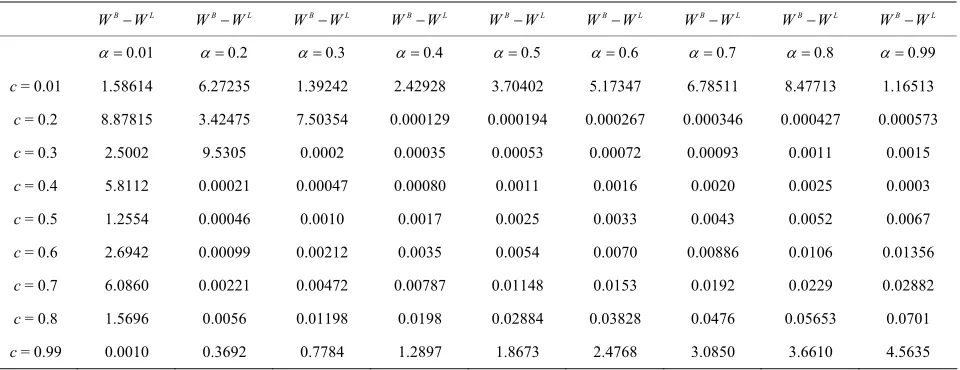
W W becomes complicated, so we need to use nu-merical examples to illustrate the impact of the degree of complementartity. Using this computation, the numerical
analysis of Table A-1 shows that the social welfare of
B
W is larger than that of WL WF under Bertrand
[image:10.595.66.522.172.217.2]competition.
Table A-1. Numerical examples under Bertrand competition.
B L
W W WBWL WBWL WBWL WBWL WBWL WBWL WBWL WBWL
0.01
0.2 0.3 0.4 0.5 0.6 0.7 0.8 0.99
c= 0.01 1.58614 6.27235 1.39242 2.42928 3.70402 5.17347 6.78511 8.47713 1.16513
c= 0.2 8.87815 3.42475 7.50354 0.000129 0.000194 0.000267 0.000346 0.000427 0.000573
c= 0.3 2.5002 9.5305 0.0002 0.00035 0.00053 0.00072 0.00093 0.0011 0.0015
c= 0.4 5.8112 0.00021 0.00047 0.00080 0.0011 0.0016 0.0020 0.0025 0.0003
c= 0.5 1.2554 0.00046 0.0010 0.0017 0.0025 0.0033 0.0043 0.0052 0.0067
c= 0.6 2.6942 0.00099 0.00212 0.0035 0.0054 0.0070 0.00886 0.0106 0.01356
c= 0.7 6.0860 0.00221 0.00472 0.00787 0.01148 0.0153 0.0192 0.0229 0.02882
c= 0.8 1.5696 0.0056 0.01198 0.0198 0.02884 0.03828 0.0476 0.05653 0.0701
c= 0.99 0.0010 0.3692 0.7784 1.2897 1.8673 2.4768 3.0850 3.6610 4.5635
The positive number in each cell depicts that given the degree of complementarity, c or the bargaining power of union, α, the comparisons of social welfare implies WBWLWF.
[image:10.595.60.540.428.613.2]