A Methodology for Identification of Weather Sensitive
Component of Electrical Load Using Empirical Mode
Decomposition Technique
Nahid-Al-Masood, Q. Ahsan
Department of Electrical and Electronic Engineering, Bangladesh University of Engineering and Technology, Dhaka, Bangladesh
Email: [email protected], [email protected]
Received April 18,2013; revised May 20, 2013; accepted May 27, 2013
Copyright © 2013 Nahid-Al-Masood, Q. Ahsan. This is an open access article distributed under the Creative Commons Attribution License, which permits unrestricted use, distribution, and reproduction in any medium, provided the original work is properly cited.
ABSTRACT
The expansion planning and operation of all three sectors, generation, transmission and distribution, of power system essentially require load forecasting. Weather conditions have significant impacts on forecasted load, especially short- term and mid-term. A momentous portion of the electrical energy is consumed, especially in cold or hot countries, to mitigate the impact of weather on the daily life of human society. Usually, weather dependent component of load is identified by fitting appropriate non-linear curve to the scatter plot of weather-load model. This technique some times shows lower correlation with weather variables. This paper proposes a new methodology to identify the weather sensi- tive component of electrical load using empirical mode decomposition (EMD) technique. The proposed methodology is applied to the daily peak load of Dhaka zone of Bangladesh Power System (BPS) of the year 2012. A detailed numeri- cal process to evaluate the weather sensitive portion of the load is also presented. The proposed methodology is vali- dated through statistical error evaluation process. Finally the salient features of the results are discussed.
Keywords: Load; Weather Sensitive Component; EMD; Temperature-Humidity Index; Correlation Coefficient
1. Introduction
Power system expansion planning begins with a forecast of anticipated future load. Estimation of both demand and energy requirements are crucial to effective system planning. Load forecasting is used to determine the tim- ing and characteristics of additional generation, trans- mission and distribution of electric power for system expansion. As saturation level and per capita consump- tion increase, to reflect the wide-spread use of weather- sensitive devices, it is necessary to include weather ef- fects in forecasting future load requirements. It is well documented that most of the system peak demands occur as a direct result of seasonal weather extremes [1].
Statistical approaches usually require a mathematical model that represents load as function of different factors such as time, weather and customer class. The two im- portant categories of such mathematical models are: ad- ditive models and multiplicative models. They differ in whether the forecasted load is the sum (additive) of a number of components or the product (multiplicative) of a number of factors. In additive load model, total load is
represented as a summation of four components. The components are, “normal part of the load”, “weather sen- sitive part of the load”, “special event part of the load” and “random part of the load” [2]. For accurate forecast- ing of load, each component should be forecasted sepa- rately. In this thesis, a methodology has been developed to isolate the weather sensitive portion of the electrical load. This separate evaluation of weather sensitive por- tion of the load will help forecast the electrical load closer to the realistic one.
Several techniques have been developed to incorpor- ate the weather factors to forecast electrical loads [3-9]. Most of these techniques are based on statistical analysis, curve fitting techniques and artificial neural network. Separation of weather dependent component of load is rarely addressed [9]. Weather dependent component of load is identified by fitting appropriate non-linear curve to the scatter plot of weather-load model. This technique some times shows lower correlation with weather vari- ables.
is widely used for noise suppression of speech signal [11- 13] and biomedical signal processing [14-18]. Electrical load has, to some extent, similarity with speech and bio- medical signal. Therefore, like other non-stationary time series signal, electrical load can also be decomposed us- ing EMD technique. After decomposing the load signal, characteristic features of each decomposed component of load is compared with the weather pattern, especially the variation characteristics of temperature and humidity. The characteristics of different combination of compo- nents of load are also compared with that of weather variables. The correlation between load component or that of combination and weather variable is evaluated. From the degree of correlation the weather sensitive components of load is identified.
2. Methodology
This paper proposes a methodology to identify the weather sensitive component of electrical load (Lw) based
on EMD technique. The key part of the EMD method is to decompose any complicated data set into a finite in- trinsic mode functions (IMFs) and a residue. Residue can be either the mean trend of the data or a constant. An intrinsic mode function (IMF) is a function that satisfies two conditions:
1) In the whole data set, the number of extrema and the number of zero crossings must either equal or differ at most by one.
2) At any point, the mean value of the envelope de-fined by the local maxima and the envelope dede-fined by the local minima is zero.
EMD technique can be applied to data with non-zero mean, either all positive or all negative values, without zero crossings. Electrical load is data set with all positive values. But the data has local extremas, i.e. local maxima and local minima. Therefore, the EMD technique can be used to decompose the electrical load into several com- ponents.
Temperature and humidity are the most important weather variables. To incorporate the effect of these wea- ther variables together, a composite weather variable, tem- perature-humidity index, is defined as [19],
THI 1.8 32
0.55 0.0055RH T
1.8T26
(1)where,
THI = Temperature-humidity index, T = Temperature (Degree Celsius) and RH = Relative Humidity (%).
The methodology requires the following steps for the identification of the weather sensitive component of electrical load.
Step-1: In the first step, electrical load signal is
de-composed using EMD technique. Before decomposition, the minimum value of the load is subtracted from the original load signal which results in modified load signal. It can be expressed as,
act
– minL t L t L
(2)
where,
L(t) = Modified load signal or variable load signal. Lact(t) = Actual load signal.
Lmin = Minimum load during the considered period. This subtraction operation is performed because the weather sensitive portion of the electrical load is hidden inside the envelope of the original load signal. To apply EMD on L(t) its upper envelope and lower envelopes are identified. The mean of the upper and the lower enve- lopes is determined and this mean is subtracted from the modified load signal. This is the first iteration to get first IMF. The iteration process continues until the first IMF is separated from the modified load signal. Further, this decomposition process continues. After decomposing L(t) using EMD technique, a finite number of IMFs and a residue, Re(t) are produced. Note that, Re(t) contains all positive values and the IMFs contain both positive and negative values.
Step-2: Since electrical load signal can not be negative in magnitude, so at the second step, the correlation coef- ficient between the residue signal and the weather vari- able THI(t) is determined. In what follows Re(t) and THI(t) will be represented by Re and THI, respectively for clarity. The correlation coefficient of Re and THI is expressed as,
1
2 2
2 2
Re THI Re THI
Re Re THI THI
R
E E E
E E E E
(3)
1
C2f Re IMFn
where R1 = Correlation coefficient of Re and THI. Step-3: In the third step, Re and last decomposed component of load, IMFn are combined to generate a new
load signal, C2f1. That is,
(4) Then the correlation coefficient between C2f1 and THI is determined. Mathematically it is expressed as,
2
1 1
2 2
2 2
1 1
C2f THI C2f THI
C2f C2f THI THI
R
E E E
E E E E
(5)
where,
R2 = Correlation coefficient of C2f1 and THI.
2Re IMF n1
C2f (6) Then the correlation between C2f2 and THI is deter-mined. Mathematically it is expressed as,
3
2 2
2
2 2
2 2
C2f THI C2f
C2f C2f THI
R
E E
E E E
2
THI
THI E
E
1, 2, , n
R R R
R R2, 3, , Rn
(7)
where,
R3 = Correlation coefficient of C2f2 and THI.
Step-5: Following the similar vein, residue signal is added to all the possible combinations of the IMFs and the corresponding correlation coefficient between each combination and THI is determined.
Step-6: In this step, the maximum value among the correlation coefficients is determined. That is,
max max 1,
R R (8)
Step-7: In this step, the value of the signal that corre-sponds to the maximum correlation coefficient is evalu-ated. This signal represents the weather sensitive portion of the electrical load.
3. Numerical Example
A numerical example will amply clarify the proposed methodology. For example, the daily peak load of Dhaka zone of Bangladesh Power System (BPS) of the year 2012 is considered here. The weather sensitive portion of these peak values will be evaluated by applying the pro-posed methodology. For better assimilation, every step of the proposed methodology is discussed chronologically.
a) The daily peak load and average THI of the year 2012 is presented graphically in Figure 1. THI is multi-plied by 15 in order to plot peak load (PL) and THI on the same graph.
The correlation between daily peak load and average THI is 0.50% or 50%. So it is certain that a portion of the daily peak load is generated due to weather variables like
Jan Feb Mar Apr May Jun Jul Aug Sep Oct Nov Dec 500
1000 1500 2000 2500 3000 3500 4000 4500
Month
Loa
d (M
W
),
T
H
I
PL THI*15
Figure 1. Daily peak load and average THI of the year 2012.
temperature and humidity. Now this weather sensitive portion of the load will be identified using the proposed methodology.
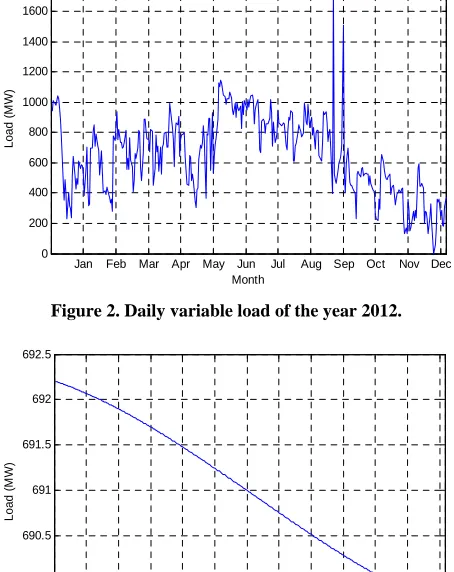
b) Minimum value over the whole year is subtracted from the daily peak values. It represented as, Daily vari-able load = Daily peak load – min (Daily peak load). The daily variable of the year 2012 is represented graphically in Figure 2.
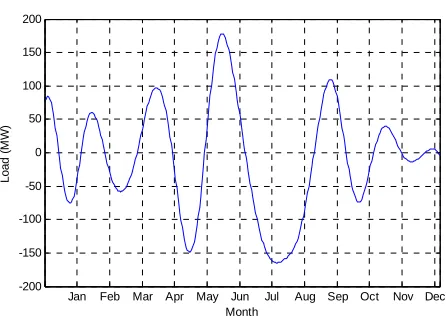
c) Decomposition of the daily variable load of the year 2012 using empirical mode decomposition (EMD) technique results seven IMFs and a residue. The residue and the IMFs are presented graphically in the Figures 3-10.
d) Combining the seven IMFs, residue and the mini-mum value of the daily peak load, Figure 11 is obtained which actually represents the daily peak load of the year 2012. So, it is evident that, total variable load can be segregated into seven IMFs and a residue component.
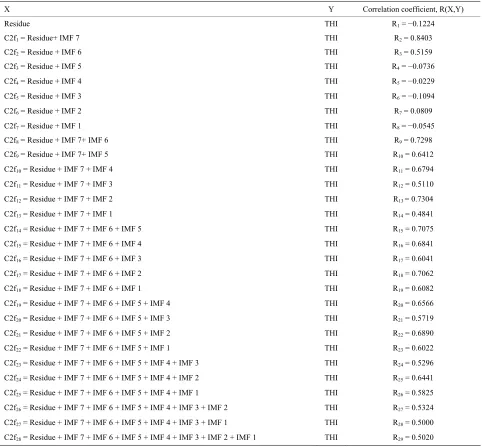
e) Now, the correlation coefficient between the resi-due and combination of the resiresi-due and different IMFs of the variable load of the year 2012 is calculated. The values of these correlation coefficients are listed in Ta-ble 1.
1800
Jan Feb Mar Apr May Jun Jul Aug Sep Oct Nov Dec 0
200 400 600 800 1000 1200 1400 1600
Month
Loa
d (
M
W
[image:3.595.311.536.374.532.2])
Figure 2. Daily variable load of the year 2012.
692.5
Jan Feb Mar Apr May Jun Jul Aug Sep Oct Nov Dec 689.5
690 690.5 691 691.5 692
Month
Lo
ad (
M
W
[image:3.595.310.537.387.673.2])
[image:3.595.60.287.581.717.2]Jan Feb Mar Apr May Jun Jul Aug Sep Oct Nov Dec -150
-100 -50 0 50 100 150
Month
L
oad
(
M
W
)
[image:4.595.61.285.85.239.2]150
Figure 4. 7th IMF of the variable load of the year 2012.
Jan Feb Mar Apr May Jun Jul Aug Sep Oct Nov Dec
-300 -250 -200 -150 -100 -50 0 50 100 150 200
Month
Load (
M
[image:4.595.310.534.88.238.2]W)
Figure 5. 6th IMF of the variable load of the year 2012.
Jan Feb Mar Apr May Jun Jul Aug Sep Oct Nov Dec
-200 -150 -100 -50 0 50 100 150 200
Month
Load
(
M
W)
Figure 6. 5th IMF of the variable load of the year 2012.
f) Maximum value of the correlation coefficient is
de-termined as: 2 . The
load signal corresponds to this maximum value is C2f1. So, the weather sensitive component of the daily peak load of the year 2012 is given by, Lw = C2f1.
1 2 29
max , , ,
R R R R R 0.8403
The graphical representation of the weather sensitive portion of the daily peak load and average THI of Dhaka zone of BPS of the year 2012 is shown in Figure 12. THI
Jan Feb Mar Apr May Jun Jul Aug Sep Oct Nov Dec
-200 -150 -100 -50 0 50 100
Month
L
oad
(M
[image:4.595.310.532.267.422.2]W)
Figure 7. 4th IMF of the variable load of the year 2012.
400
Jan Feb Mar Apr May Jun Jul Aug Sep Oct Nov Dec
-400 -300 -200 -100 0 100 200 300
Month
Loa
d (
M
W
)
Figure 8. 3rd IMF of the variable load of the year 2012.
200
Jan Feb Mar Apr May Jun Jul Aug Sep Oct Nov Dec
-200 -150 -100 -50 0 50 100 150
Month
L
oad
(M
W)
Figure 9. 2nd IMF of the variable load of the year 2012.
is multiplied by 5 to represent Lw and THI on the same
graph.
4. Verification of the Proposed Methodology
[image:4.595.62.283.272.422.2] [image:4.595.310.534.448.602.2] [image:4.595.61.284.450.608.2]4400
Jan Feb Mar Apr May Jun Jul Aug Sep Oct Nov Dec -800
-600 -400 -200 0 200 400 600 800
Month
Loa
d (
M
[image:5.595.310.535.85.238.2]W)
Figure 10. 1st IMF of the variable load of the year 2012.
Jan Feb Mar Apr May Jun Jul Aug Sep Oct Nov Dec
2400 2600 2800 3000 3200 3400 3600 3800 4000 4200
Month
Load (
M
[image:5.595.59.284.89.244.2]W)
Figure 11. Combination of IMFs, residue and minimum value of the daily peak load of the year 2012.
Table 1. Correlation coefficient.
X Y Correlation coefficient, R(X,Y)
Residue THI R1 = −0.1224
C2f1 = Residue+ IMF 7 THI R2 = 0.8403
C2f2 = Residue + IMF 6 THI R3 = 0.5159
C2f3 = Residue + IMF 5 THI R4 = −0.0736
C2f4 = Residue + IMF 4 THI R5 = −0.0229
C2f5 = Residue + IMF 3 THI R6 = −0.1094
C2f6 = Residue + IMF 2 THI R7 = 0.0809
C2f7 = Residue + IMF 1 THI R8 = −0.0545
C2f8 = Residue + IMF 7+ IMF 6 THI R9 = 0.7298
C2f9 = Residue + IMF 7+ IMF 5 THI R10 = 0.6412
C2f10 = Residue + IMF 7 + IMF 4 THI R11 = 0.6794
C2f11 = Residue + IMF 7 + IMF 3 THI R12 = 0.5110
C2f12 = Residue + IMF 7 + IMF 2 THI R13 = 0.7304
C2f13 = Residue + IMF 7 + IMF 1 THI R14 = 0.4841
C2f14 = Residue + IMF 7 + IMF 6 + IMF 5 THI R15 = 0.7075
C2f15 = Residue + IMF 7 + IMF 6 + IMF 4 THI R16 = 0.6841
C2f16 = Residue + IMF 7 + IMF 6 + IMF 3 THI R17 = 0.6041
C2f17 = Residue + IMF 7 + IMF 6 + IMF 2 THI R18 = 0.7062
C2f18 = Residue + IMF 7 + IMF 6 + IMF 1 THI R19 = 0.6082
C2f19 = Residue + IMF 7 + IMF 6 + IMF 5 + IMF 4 THI R20 = 0.6566
C2f20 = Residue + IMF 7 + IMF 6 + IMF 5 + IMF 3 THI R21 = 0.5719
C2f21 = Residue + IMF 7 + IMF 6 + IMF 5 + IMF 2 THI R22 = 0.6890
C2f22 = Residue + IMF 7 + IMF 6 + IMF 5 + IMF 1 THI R23 = 0.6022
C2f23 = Residue + IMF 7 + IMF 6 + IMF 5 + IMF 4 + IMF 3 THI R24 = 0.5296
C2f24 = Residue + IMF 7 + IMF 6 + IMF 5 + IMF 4 + IMF 2 THI R25 = 0.6441
C2f25 = Residue + IMF 7 + IMF 6 + IMF 5 + IMF 4 + IMF 1 THI R26 = 0.5825
C2f26 = Residue + IMF 7 + IMF 6 + IMF 5 + IMF 4 + IMF 3 + IMF 2 THI R27 = 0.5324
C2f27 = Residue + IMF 7 + IMF 6 + IMF 5 + IMF 4 + IMF 3 + IMF 1 THI R28 = 0.5000
[image:5.595.58.540.291.738.2]for proposed methodology and weather-load model tech-nique [9]. The result of the year 2012 and 2011 are shown in Figures 13 and 14, respectively.
The comparisons from Figures 13 and 14 clearly show
Jan Feb Mar Apr May Jun Jul Aug Sep Oct Nov Dec 200
300 400 500 600 700 800 900
Month
Lw (
M
W
),
T
H
I
Lw THI*5
Figure 12. Weather sensitive portion of the daily peak load and average THI of the year 2012.
Jan Feb Mar Apr May Jun Jul Aug Sep Oct Nov Dec 0
0.2 0.4 0.6 0.8 1
Month
R
[image:6.595.60.290.333.500.2]Proposed methodology Weather-load model
Figure 13. Comparison of correlation coefficients of the year 2012.
Jan Feb Mar Apr May Jun Jul Aug Sep Oct Nov Dec 0
0.2 0.4 0.6 0.8 1
Month
R
[image:6.595.59.285.537.707.2]Proposed methodology Weather-load model
Figure 14. Comparison of correlation coefficients of the year 2011.
that the correlation coefficients between the weather sen-sitive portions of the load and THI for the proposed methodology are greater than that of weather-load model. It reveals that the weather sensitive portion of the load results from the proposed methodology is more accurate than that of weather-load model.
5. Results and Discussion
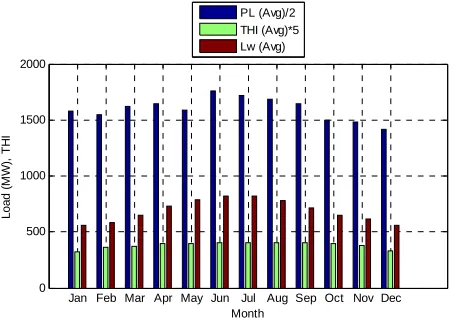
The salient features of the results those obtained by ap-plying the proposed methodology are explained below for the year 2012. For close observation, average peak load, average THI and average weather sensitive com-ponent of the peak load of the year 2012 are presented graphically in Figures 15. Average peak load is divided by 2 and Average THI is multiplied by 5 in order to plot all the quantities on the same graph.
It is observed from Figure 15 that the average THI of February 2012 is much greater than that of January, 2012 but the average peak load of January, 2012 is not that much greater than that of February, 2012. The weather sensitive portion of February, 2012 is greater than that of January 2012 but their difference is very nominal (584.66
− 562.08 = 22.58 MW). In March, 2012 both average THI and average peak load are greater than that of Feb-ruary, 2012. As a consequence, the weather dependent portion of the load of the March, 2012 is greater than that of February, 2012. The same affiliation exists for the month of April, 2012 and March, 2012. This increasing drift of weather sensitive portion of the load continues up to June, 2012. From July, 2012 both monthly average peak load and monthly average THI starts decreasing. As a consequence, monthly average weather dependent por-tion of the load starts decreasing from July, 2012 and continues up to December, 2012.
The average Lw of January, 2012 and December, 2012
are very close. The average peak load of January, 2012 is grater than that of December, 2012 by 332 MW (3158.37
PL (Avg)/2 THI (Avg)*5 Lw (Avg)
2000
Jan Feb Mar Apr May Jun Jul Aug Sep Oct Nov Dec 0
500 1000 1500
Month
Lo
ad (
M
W
),
T
H
I
Figure 15. Average PL, average THI and average Lw of the
[image:6.595.311.537.548.709.2]MW - 2826.37 MW). But average THI of December, 2012 is greater than that of January, 2012 by 2.74 (66.68 - 63.94). As a consequence, the average weather sensitive portions of the load for these two months are very close to each other.
So it is clear that, the weather sensitive portion of the daily peak load varies with two parameters. One pa-rameter is weather condition and the other papa-rameter is daily peak load. If both parameters increase, the weather sensitive portion of the load increases. If both parameter decrease, the weather sensitive portion of the load de-creases. If one parameter increases and other decreases, the weather sensitive portion of the load changes de-pending on the effect of dominating parameter.
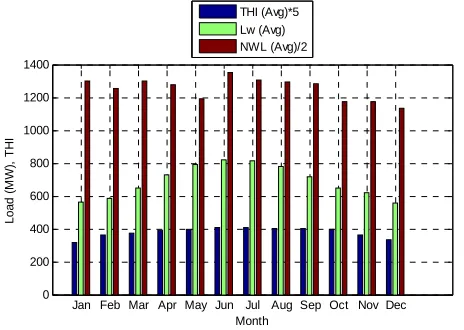
To identify the weather non-sensitive portion of the load (NWL) of Dhaka zone of BPS, weather sensitive portion of the load is subtracted from the daily peak load. Monthly average NWL for the year 2012 is presented graphically in Figures 16. For close observation, corre-sponding average THI and average Lw are also plotted
together. THI is multiplied by 5 and NWL is divided by 2 to facilitate all the quantities on same graph.
From the above graph, it is clearly observed that, the weather sensitive portion of the loads change sharply with THI. But the NWLs do not change with the weather conditions. For example, average THI of January and February, 2012 is 63.94 and 72.50, respectively. Average Lw of the peak loads of these two months are 562.08 MW
and 584.66 MW, respectively. But the average NWL of these two months are 2596.29 MW and 2506.70 MW, respectively. That is, though average THI increases in February, 2012 than January, 2012 but average NWL decreases.
So it can be concluded that NWL are not affected by weather variables like temperature and humidity. It changes due to other factors such as population, educa-tion, industrial development, special events etc.
Jan Feb Mar Apr May Jun Jul Aug Sep Oct Nov Dec 0
200 400 600 800 1000 1200 1400
Month
Loa
d (
M
W)
,
T
H
I
[image:7.595.58.290.543.708.2]THI (Avg)*5 Lw (Avg) NWL (Avg)/2
Figure 16. Average THI, average Lw and average NWL of
the year 2012.
6. Conclusion
In this paper, a new methodology is proposed to identify the weather sensitive portion of the electrical load based on EMD technique. The developed methodology is ap-plied to identify the weather sensitive component of the daily peak of Dhaka zone of BPS of the year 2012. The accuracy of the results is also measured by calculating correlation coefficient between THI and Lw for proposed
methodology and weather-load model technique. In pro-posed methodology, the variable portion of the daily peak demand is decomposed into several components and these components have been correlated with weather parameters. As a result, the monthly variations of demand and weather conditions have been reflected properly. Finally it is observed that the weather sensitive portion of the electrical load varies with two parameters. One pa-rameter is weather variables like temperature and humid-ity and the other parameter is total demand. Though the weather conditions are not that much different from a year to another, but it is observed that the weather sensi-tive portion of the load changes every year by a signifi-cant amount. This is because of the use of electrical ap-pliances that generally increases year by year to mitigate the effect of the weather parameters.
REFERENCES
[1] R. L. Sullivan, “Power System Planning,” Mcgraw-Hill Book Company, New York, 1977.
[2] H. Chen, C. A. Canizares and A. Singh, “ANN-Based Short- Term Load Forecasting in Electricity Markets,” Proceed- ings of the IEEE Power Engineering Society Transmis- sion and Distribution Conference, Vol. 2, pp. 2011, 411-
415.
[3] S. Ruzic, A. Vuckovic and N. Nikolic, “Weather Sensi- tive Method for Short Term Load Forecasting in Electric Power Utility of Serbia,” IEEE Transactions on Power Systems, Vol. 18, No. 4, 2003, pp. 1581-1586.
doi:10.1109/TPWRS.2003.811172
[4] J. W. Taylor and R. Buizza, “Neural Network Load Fore- casting with Weather Ensemble Predictions,” IEEE Tran- sactions on Power Systems, Vol. 17, No. 3, 2002, pp. 626-
632. doi:10.1109/TPWRS.2002.800906
[5] A. Khotanzad, M. H. Davis, A. Abaye and D. J. Maratu- kulam, “An Artificial Neural Network Hourly Tempera- ture Forecaster with Applications in Load Forecasting,”
IEEE Transactions on Power Systems, Vol. 11, No. 2, 1996, pp. 870-876. doi:10.1109/59.496168
[6] S. M. Moghaddas-Tafreshi and M. Farhadi, “A Linear Re- gression-Based Study for Temperature Sensitivity Ana- lysis of Iran Electrical Load,” Proceedings of the IEEE International Conference on Industrial Technology, Cheng- du, 21-24 April 2008, pp. 1-7.
doi:10.1109/SUPERGEN.2009.5347944
tion Effect of Temperature,” Proceedings of the Interna- tional Conference on Sustainable Power Generation and Supply, Nanjing, 6-7 April 2009, pp. 1-4.
[8] E. Contaxi, C. Delkis, S. Kavatza and C Vournas, “The Effect of Humidity in a Weather-Sensitive Peak Load Forecasting Model,” Proceedings of the IEEE Power Sys- tems Conference and Exposition, Atlanta, 29 October-1
November 2006, pp. 1528-1534.
[9] E. G. Contaxi and S. Kavatza, “Application of a Weather- Sensitive Peak Load Forecasting Model to the Hellenic System,” Proceedings of the IEEE Mediterranean, Vol. 3,
2004, pp. 819- 822.
[10] N. E. Huang, Z. Shen, S. R. Long, M. C. Wu, H. Shih, Q. Zheng, N. C. Yen, C. C. Tung and H. H. Liu, “The Em- pirical Mode Decomposition and the Hilbert Spectrum for Nonlinear and Non-Stationary Time Series Analysis,”
Proceedings of the Royal Society A: Mathematical, Phy- sical and Engineering Sciences, Vol. 454, No. 1971, 1998,
pp. 903-995.
[11] K. I. Molla, K. Hirose and N. Minematsu, “Robust De- termination of Periodic Correlation of Speech Signals Us- ing Empirical Mode Decomposition and Higher-Order Spectra,” Proceedings of the Asia-Pacific Conference on Communications, Tokyo, 14-16 October 2008, pp. 1-5. [12] K. Khaldi, M. T.-H. Alouane and A.-O. Boudraa, “Speech
Denoising by Adaptive Weighted Average Filtering in the EMD Framework,” Proceedings of the International Con- ference on Signals, Circuits and Systems, pp 1-5.
[13] N. Chatlani and J. J. Soraghan, “Speech Enhancement using Adaptive Empirical Mode Decomposition,” Pro- ceedings of the IEEE International Conference on Digital Signal Processing, Monastir, 7-9 November 2008, pp. 1-
6.
[14] M. Kiamini, S. Alirezaee, B. Perseh and M. Ahmadi, “Elimination of Ocular Artifacts from EEG Signals Using the Wavelet Transform and Empirical Mode Decomposi- tion,” Proceedings of the International Conference on Elec- trical Engineering/Electronics, Computer, Telecommuni- cations and Information, Pattaya, 6-9 May 2009, pp. 1094-
1097.
[15] Z. D. Zhao and C. Ma, “A Novel Cancellation Method of Power Line Interference in ECG Signal Based on EMD and Adaptive Filter,” Proceedings of the IEEE Interna-tional Conference on Communication Technology,Hang- zhou, 10-12 November 2008, pp. 517-520.
[16] X. J. Guo, X. P. Wu and D. X. Zhang, “Motor Imagery EEG Detection by Empirical Mode Decomposition,”
Proceedings of the IEEE International Joint Conference on Computational Intelligence and Neural Networks, Hong Kong, 1-8 June 2008, pp. 2619-2622.
[17] P. F. Diez, V. Mut, E. Laciar, A. Torres and E. Avila, “Application of the Empirical Mode Decomposition to the Extraction of Features from EEG Signals for Mental Task Classification,” Proceedings of the IEEE Interna- tional Conference onEngineering in Medicine and Bio- logy Society, Vol. 2009, 2009, pp. 2579-2582.
[18] T. Q. Zhu, L. Y. Huang and X. Z. Tian, “Epileptic Sei- zure Prediction by Using Empirical Mode Decomposition and Complexity Analysis of Single-Channel Scalp Elec- troencephalogram,” Proceedings of the IEEE Interna- tional Conference on Biomedical Engineering and Infor- matics, Tianjin, 17-19 October 2009, pp. 1-4.