Munich Personal RePEc Archive
Tax Increment Financing in Pakistan
Shaikh, Salman
IBA Karachi
1 January 2014
1 | P a g e Tax Increment Financing in Pakistan
Salman Ahmed Shaikh1
Abstract
Markets fail in the provision of public goods. Public goods are non-rival and non-exclusive. It creates the problem of free riding. Hence, public goods and infrastructure is often provided by the governments. As discussed in endogenous growth models, the public infrastructure and capital goods can enable the private sector’s production processes to experience increasing returns to scale. This can result in permanent source of economic growth in an economy. Given that public infrastructure is important for economic growth, the issue is how the government of Pakistan can mobilize enough resources to improve the public infrastructure and expand it. We argue that by way of tax increment financing, it can achieve sufficient funds through which the public infrastructure can be provided in urban centers. The rationale for tax increment financing rests on the fact that public infrastructure development leads to positive externalities. If Government owns the unused land which can potentially be used for commercial and residential use, it can lease it on long term basis and generate sufficient lease income. By issuing public securities, it can generate the seed capital and which can be serviced via these lease payments. The seed capital can also come from tax increment financing. This new proposal can help in reducing i) urban congestion, ii) urban crimes, iii) reduce prices of real estate, iv) widen the urban centers, v) generate employment in new urban centers, vi) facilitate closer migration to wide choice of urban centers, vii) create new growth nodes and production zones and viii) reduce ethnical conflicts that arise from ethnical diversity in congested urban centers.
Keywords Public Goods, Tax Increment Financing, Property Tax, Public Infrastructure
JEL Code Q42, Q43, Q48
1. Introduction
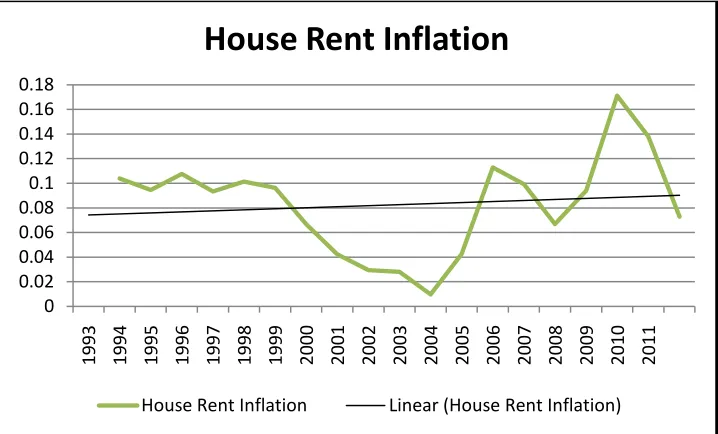
According to World Bank estimates, Pakistan has shortage of 8 million houses currently. It is also a known fact that population growth rate in urban areas is almost twice as much as the overall population growth rate. It is because urban population growth rate is amplified by the rate of net migration rate which is positive in most developing countries like Pakistan which are going through rapid urbanization process. Urban centric development projects also compliment the rapid urbanization process. This leads to increased cost of living in urban areas. Figure 1 shows the house rent inflation during the last 20 years.
1 Salman Ahmed Shaikh teaches Development Economics and Microeconomics at IBA, Karachi. He is pursuing
2 | P a g e
Figure 1: House Rent Inflation during 1993-2012
Source: Economic Survey of Pakistan 2012-13
The need is to develop new cities with comparable level of facilities available in other developed cities so as to reduce burden on already congested cities and their infrastructure.
Paul Romer explains that once a city is developed, it has significant positive and network externality effects. He proposed idea of „Charter Cities‟ in several of his public talks (TED Talks, 2009). But, the problem comes in developing new cities and their infrastructure. Since markets fail in the provision of public goods, government usually has to provide public goods and infrastructure. But, then the government itself has to fund these developments by raising sufficient amount of taxes.
Johnson and Mann (2001) explain that when a public project such as a road, school, or hazardous waste cleanup is carried out, there is often an increase in the value of surrounding real estate and new investment. This increased site value and investment sometimes generates increased tax revenues. The increased tax revenues are the "tax increment". Tax Increment Financing (TIF) dedicates tax increments within a certain defined district to finance debt issued to pay for the project. TIF is a tool to use future gains in taxes to finance current improvements which will create the conditions for those future gains. This tool is widely used in U.S and in Europe.
In this paper, we discuss how tax increment financing can be applied in Pakistan. We proceed as follows. In section 2, we present our mathematical model. In section 3, we discuss the potential challenges that can be faced while applying TIF in Pakistan. Section 4 documents the pre-requisite for using TIF in Pakistan. Section 5 discusses the welfare benefits of applying TIF in Pakistan.
0 0.02 0.04 0.06 0.08 0.1 0.12 0.14 0.16 0.18
1993 1994 1995 1996 1997 1998 1999 2000 2001 2002 2003 2004 2005 2006 2007 2008 2009 2010 2011
House Rent Inflation
3 | P a g e 2. Mathematical Representation of Model
Tax on property (𝑇) function is based on two components, i.e. tax rate on property (𝑡𝑝) and taxable base value of property (𝐵𝑉𝑝).
𝑇 = 𝑡𝑝 𝑥𝐵𝑉𝑝 --- (1)
The taxable base value (𝐵𝑉𝑝) can be decomposed into its own components, i.e. number of properties in a locality (𝑁𝑝) times market value of each property (𝑀𝑉𝑝):
𝑇 = 𝑡𝑝 𝑥 [𝑁𝑝 𝑥𝑀𝑉𝑝] --- (2)
In our model, the number of properties (𝑁𝑝) is a function of three variables:
1. Urban population growth rate (𝑁𝑢) which is a sum of natural rate of increase in population plus the net migration rate.
2. Level of public capital including physical infrastructure for sustaining basic urban lifestyle (𝐾𝑝).
3. Net capital inflows (𝑁𝐶𝐼) into the country which includes remittances and foreign direct investment in production sector. It may include foreign aid as well but it excludes foreign portfolio investment for our model.
𝑁𝑝 = 𝑓(𝑁𝑢,𝐾𝑝,𝑁𝐶𝐼) --- (3)
Hence, 𝜕𝑇
𝜕𝑁𝑝 > 0 and
𝜕𝑇
𝜕𝐵𝑉𝑝 > 0 which implies that
𝜕𝑇
𝜕𝑁𝑝 > 0 and
𝜕𝑇 𝜕𝑀𝑉𝑝 > 0
Assuming a simple Cobb-Douglas functional form for 𝑁𝑝, we have:
𝑁𝑝 = 𝑁𝑢𝛼𝐾𝑝𝛽𝑁𝐶𝐼𝛾 --- (4)
We can represent (𝑀𝑉𝑝) as a function of (𝐾𝑝) and governance (𝐺):
𝑀𝑉𝑝 = 𝐾𝑝 𝑥𝐺 --- (5)
If we put (4) and (5) in (2), we get:
𝑇= 𝑡𝑝 𝑥 [𝑁𝑝 𝑥𝑀𝑉𝑝]
𝑇 = 𝑡𝑝 𝑥𝑁𝑢𝛼𝐾𝑝𝛽𝑁𝐶𝐼𝛾𝑥𝐾𝑝 𝑥𝐺
4 | P a g e Finally, assuming a Laffer curve relation between 𝑡𝑝 and 𝑇, we put 𝑡𝑝𝛿 in place of 𝑡𝑝 where 𝛿 <1 for diminishing marginal contribution in taxes of increase in 𝑡𝑝.
𝑇= 𝑡𝑝𝛿 𝑥𝑁𝑢𝛼𝐾𝑝1+𝛽𝑁𝐶𝐼𝛾𝑥𝐺 --- (6)
In our model, 𝛽 > 0 and hence 1 +𝛽 > 1 and hence we have increasing returns in taxes with additional investment in public infrastructure 𝐾𝑝. In our model, 𝛾 > 0 and has no upper bound as it is possible to have a value greater than 1 for 𝛾 especially in developing countries with high rates of growth. Lastly, we assume that 𝐺 will also be positively related to 𝑀𝑉𝑝 and hence also with amount of 𝑇 that can be collected in the economy.
Hence greater the value of 𝛼,𝛽 and 𝛾 and base values of 𝐾𝑝 and 𝑁𝐶𝐼, greater will be the value of 𝑁𝑝 and hence a circular complimentary process will lead to increase in both 𝑁𝑝 and 𝑇 leading to more accumulation of 𝐾𝑝 and subsequent increase in 𝑀𝑉𝑝 in an iterative process.
3. Possible Hindrances in TIF Application in Pakistan
3.1.Low Rate of Savings.
[image:5.612.127.487.440.656.2]In Figure 2, we provide data on national savings rate, private savings rate and public savings rate. It can be seen that private savings constitute almost 90% of the national savings. On the other hand, public savings share in national savings had been negligible.
Figure 2: National Savings, Private Savings & Public Savings Rate (in proportion)
5 | P a g e It is evident from the graph that savings rate are well below 20% and since 2003, there is a steady decline in rate of savings. Hence, it is hard to attract investment funds in a country with very low rate of savings.
3.2.Tax Haven for Elite Class.
Studies in tax administration and policy in developing countries had been undertaken in past and in general, low tax collection and low tax to GDP ratio in developing countries had been attributed to low documentation, low level of monetization, lack of industrial base and lack of openness (Ahmed, 1994).
Pakistan is classified as lower to middle income country by IMF and it is ironic that among those countries, Pakistan has lowest Tax to GDP ratio, i.e. 9.5%. What is more concerning is the fact that the trend of the dismal tax to GDP ratio has shown even further decline in recent years. Chaudhry & Munir (2010) explained that determinants of low tax revenue in Pakistan include narrow tax base, more dependence on agriculture sector, devaluation, foreign aid, informal economy and low level of literacy rate. They opined that low tax revenue in Pakistan owes to large traditional agriculture sector and other „hard to tax‟ sectors such as small business and shadow economy. Ahmed (2010) mentioned that rent seeking in tax administration has also led to dismal tax collection in Pakistan. Only 2% of the population in Pakistan constitutes registered tax payers.
[image:6.612.126.492.467.659.2]Figure 3 presents Tax to GDP ratio and it shows that the ratio has decreased consistently in last two decades in Pakistan. Still, the income tax collection is not as broad based as it should be and lack of documentation and „un-documentation‟ due to stringent conditions for formal sector has resulted in slow progress in the expansion of tax base.
Figure 3: Tax to GDP Ratio (%)
Source: Ministry of Finance
6 | P a g e income countries. Comparison shows that Pakistan‟s tax to GDP ratio is lowest in comparison to the regional countries and as well as other aggregated categories shown in Figure 3.
Figure 4: Comparison of Tax to GDP Ratio Across regional Countries & Other Categories (% of GDP)
Source: IMF
Due to low tax to GDP ratio, the fiscal deficit has remained largely above 4% of GDP leaving little room for development expenditure as most of the tax and non-tax revenues are eaten up by debt servicing. Development expenditure has in most periods declined with the rise in fiscal deficit as can be seen in Figure 5.
Figure 4: Fiscal Deficit & development Expenditure (% of GDP)
Source: Ministry of Finance 0
5 10 15 20 25 30
India Pakistan Sri Lanka Sub Saharan
Africa
World High Income
Middle Income
Tax to GDP (%)
[image:7.612.127.489.469.675.2]7 | P a g e 3.3.Lack of Documentation.
M. Ali Kemal (2007) estimated that the underground economy in Pakistan ranges between 54.6% of GDP to 62.8% of GDP and tax evasion ranges between 5.7% of GDP to 6.5% of GDP. According to his estimates, underground economy and tax evasion were increasing very rapidly in the early 1980s, but the rate of increase further accelerated in the 1990s.
Hence, it is difficult to implement TIF in an economy where there is lack of documentation and under-reporting of assets. Strong fiscal efforts are necessary to ensure documentation.
3.4.Lack of Investor Confidence in Public Policies.
Often, the policies are reversed in Pakistan with the change in government. Nawaz Sharif‟s government announced Vision 2010 when he was elected as Prime Minister for the second time in 1997. But, after the military coup in 1999, his program was abandoned. Likewise, all too often, several commitments with investors are also not honored. For instance, Engro invested a hefty amount in its Enven plant in Pakistan recently, but the government did not honor its commitment of gas supply to Engro at the agreed terms.
3.5.Inefficiency in Public Sector.
Pakistan ranks very low in governance and corruption indicators. Hence, several DFIs nowadays prefer direct disbursement to NGOs for different projects rather than through the government channel. Hence, it is difficult to expand an already inefficient government to raise funds and steer development on its own.
3.6.Lack of Political Will.
Along with the structural bottlenecks and institutional challenges, we also see lack of political will in all ruling class including democratic as well as military dictatorships. They have all exhibited lack of resolve and autonomy in framing home-grown policies.
Politicians in the capitalistic democracy in Pakistan too contribute in maintaining the status quo by providing token benefits to their voters (even without providing in many cases) and by creating an environment where the poor have no choice than to join hands and support them to safeguard their private property rights.
4. Pre-requisites for TIF in Pakistan
4.1.Engage Remitters & Big Investors for Seed Capital.
8 | P a g e After 9/11, overseas remitters sent increased amount of money to Pakistan which had gone in stock market as well as real estate investments. With two major crashes in stock market in 2005 and 2008 respectively, people now prefer to hold savings in the form of buying commodities like Gold, foreign exchange or real estate.
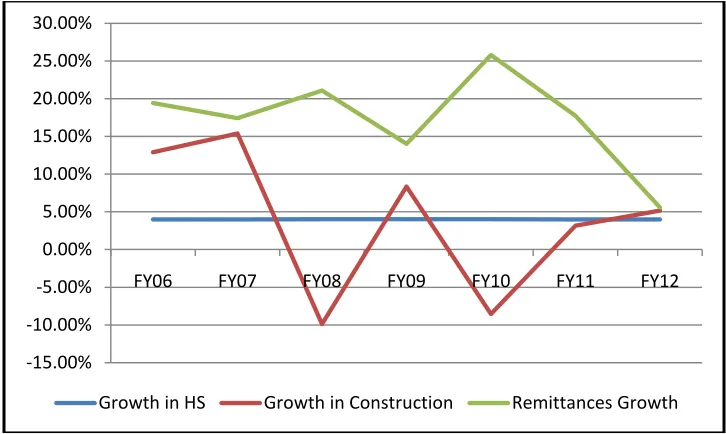
[image:9.612.124.487.221.438.2]It can be seen in Figure 6 that remittances growth or slump leads to growth or slump in construction sector production growth with one year lag. But, the growth in housing services has remained fairly constant during the last 8 years at a rate just below 5%.
Figure 6: Growth in Housing Service (HS), Construction & Remittances during 2006-13
Source: Economic Survey of Pakistan 2012-13
If government issues TIF bonds which can be serviced with later tax payments, overseas remitters can be engaged in buying the bonds as well as investing in new real estate projects. The seed capital can be used to provide public capital goods in the new real estate zones.
4.2.Engage Banking Liquidity for Initial Funding.
Since the last few years, banks in Pakistan have kept themselves away from lending too much to the private sector partly because of security and energy crisis and partly because of high interest rates on government securities and economic slump in domestic and global economy. Islamic banks in particular have a very low advance to deposit ratio (ADR). Figure 7 reports that ADR of Islamic banks has steadily declined during the last 6 years.
-15.00% -10.00% -5.00% 0.00% 5.00% 10.00% 15.00% 20.00% 25.00% 30.00%
FY06 FY07 FY08 FY09 FY10 FY11 FY12
9 | P a g e
Figure 7: Advance to Deposit Ratio in Islamic Banking
Source: Islamic Banking Bulletin, SBP, Various Issues
4.3.Connect TIF with Tax Amnesty.
Tax amnesty scheme could be introduced for people to whiten their money with investments in TIF real estate, infrastructure and securities which hold these assets as underlying. This can increase documentation, tax base and also help in generating revenue and liquidity in the projects.
4.4.Connect TIF with REITs.
Liquidity is one of the most important characteristics in long term securities and investments. Liquidity of real estate investments can be enhanced by involving Real Estate Investment Trusts (REITs). REITs invest in property markets and gain through purchase/sale of properties and rental income.
4.5.Compliment TIF with Energy Financing.
Brunnschweiler (2009) in an empirical study of 119 non-OECD countries using panel data concluded that lack of financing is one of the major obstacles for minimal use of renewable energy in developing countries. Financial sectors of these countries are often underdeveloped and are unable to efficiently channel loans to produce renewable energy.
For estimating the cost of energy on output in Pakistan, Siddiqui et al (2011) estimated the cost of unserved energy using primary data from firms. According to their estimates, the overall industrial sector loss ranges between Rs 269 and Rs 819 billion. The figure roughly equals 1% to 3% of total GDP.
0.00 0.10 0.20 0.30 0.40 0.50 0.60 0.70 0.80 0.90
ADR
10 | P a g e We have seen in our model that provision of public infrastructure is circularly related to market value of property and taxes. Hence, once the development projects are instigated, the chain will continue with complimentary effects of these variables on each other.
5. Welfare Benefits of TIF in Pakistan
Growth literature highlights the importance of capital formation, complimentary investments and physical and social infrastructure. The long term growth literature from Harrod (1939)-Domer (1946), Solow (1956) and to Romer (1986) is almost unanimous on the role of savings and capital accumulation for long term economic growth. Endogenous growth theory sheds light on importance of complimentary investments and public infrastructure that can not only result in increasing returns to scale, but also lead to permanent source of continued long term growth.
As discussed in endogenous growth models, the public infrastructure and capital goods can enable the private sector‟s production processes to experience increasing returns to scale. The rationale for tax increment financing rests on the fact that public infrastructure development leads to positive externalities. If Government owns the unused land which can potentially be used for commercial and residential use, it can lease it on long term basis and generate sufficient lease income. By issuing public securities, it can generate the seed capital and which can be serviced via these lease payments. The seed capital can also come from tax increment financing.
This new proposal can help in reducing i) urban congestion, ii) urban crimes, iii) reduce prices of real estate, iv) widen the urban centers, v) generate employment in new urban centers, vi) facilitate closer migration to wide choice of urban centers, vii) create new growth nodes and production zones and viii) reduce ethnical conflicts that arise from ethnical diversity in congested urban centers.
Conclusion
11 | P a g e References
Abid, Saleem & Afridi, Ghulam S. (2010). “Assessing the Household saving Pattern of Urban and Rural
Households in District Muzaffarabad.” Pakistan Journal of Life & Social Sciences, Vol 8 (2), pp. 137-141.
Ahmed, Ehtesham (2010). “The Political Economy of Tax reforms in Pakistan”. Asia Research Centre, Working Paper No. 33.
Ahmed, Qazi M. (1994). “Determinants of Tax Buoyancy: Evidence from Developing Countries”.
Pakistan Development Review, Vol 33 (4), pp. 1089-1098.
Brunnschweiler, Christa N. (2009), “Finance for Renewable Energy: An Empirical Analysis of
Developing and Transition Economies”, Center of Economic Research at ETH Zurich, Working Paper 09/117.
Chaudhry & Munir (2010). “Determinants of Low Tax Revenue in Pakistan”. Pakistan Journal of Social
Sciences (PJSS), Vol. 30 (2), pp. 439-452.
Domar, Evsey (1946). Capital Expansion, Rate of Growth, and Employment. Econometrica, 14 (2), pp. 137–47.
Harrod, Roy F. (1939). An Essay in Dynamic Theory. The Economic Journal, 49 (193), pp. 14–33.
M. Ali Kemal, 2007. "A Fresh Assessment of the Underground Economy and Tax Evasion in Pakistan: Causes, Consequences, and Linkages with the Formal Economy", PIDE-Working
Papers 2007:13, Pakistan Institute of Development Economics.
Ministry of Finance (2011). “Economic Survey of Pakistan 2012-13”. Government of Pakistan, Islamabad.
Ministry of Finance (2011). “Annual Year Book 2011-12”. Government of Pakistan, Islamabad.
Romer, Paul M., (1986). Increasing Returns and Long-Run Growth, Journal of Political Economy, 94 (5), pp. 1002-37.
Solow, Robert M. (1956). A Contribution to the Theory of Economic Growth, Quarterly Journal of
Economics, 70 (1), pp. 65–94.
Siddiqui, R., Jalil, H. H., Nasir, M., Malik, W. S., & Khalid, M. (2011), „The Cost of Unserved Energy:
Evidence from Selected Industrial Cities of Pakistan‟, PIDE Working Paper No 75.
State Bank of Pakistan [2006-12], Islamic Banking Bulletin, Various Issues.