Using Embedding Masks for Word Categorization
Stefan Ruseti, Traian Rebedea and Stefan Trausan-Matu
University Politehnica of Bucharest
{stefan.ruseti, traian.rebedea, stefan.trausan}@cs.pub.ro
Abstract
Word embeddings are widely used nowa-days for many NLP tasks. They reduce the dimensionality of the vocabulary space, but most importantly they should capture (part of) the meaning of words. The new vector space used by the embeddings al-lows computation of semantic distances between words, while some word embed-dings also permit simple vector operations (e.g. summation, difference) resembling analogical reasoning. This paper pro-poses a new operation on word embed-dings aimed to capturing categorical infor-mation by first learning and then apply-ing an embeddapply-ing mask for each analyzed category. Thus, we conducted a series of experiments related to categorization of words based on their embeddings. Sev-eral classical approaches were compared together with the one introduced in the pa-per which uses different embedding masks learnt for each category.
1 Introduction
The idea of using vector representations of words for various natural language processing (NLP) and machine learning tasks has become more and more popular in the last years. Most of these represen-tations are based on the idea that the meaning of a word can be determined by the context in which each word is used.
Sometimes, additional information about the words is available or can be computed and this might be used along with the embedding for each word. This information may consist of relations between words (e.g. syntactic dependencies), part of speech (POS) tags, word categories, word senses, etc.
In this paper, we propose to encode this extra information in the form of a vector mask that can be applied on the word embedding before being used as an input by any classifier, such as a neural network, or before computing any semantic dis-tance between the word embeddings. We explore the possibility of using vector masks for assign-ing WordNet (Miller, 1995) categories to words. We define a word category as one of the top con-cepts in the WordNet taxonomy as will be later ex-plained in more detail. Using the trained masks for a subset of words, we then test whether they im-prove the accuracy of determining the correct cate-gory for new words that are not part of the training corpus.
2 Related Work
Distributed words’ embeddings based on word co-occurrences can be computed using various mech-anisms and theories. Some of them employ alge-braic decompositions of the original vector space, others use mixture models to compute a distri-bution of words in topics from a large collection of texts, while newer methods make use of neu-ral embeddings to train word representations on even larger corpora of texts than the previous mod-els. All the methods described in this section are completely unsupervised and are based on the frequency of words in documents and their co-occurrences.
Latent Semantic Analysis (LSA) (Landauer and Dumais, 1997) is a commonly used vector rep-resentation for words. The word vectors are ob-tained through a Singular Value Decomposition (SVD). The main reasoning behind LSA is that the decomposed space can generalize the relationships between words and documents existing in the orig-inal term-document matrix and will remove noisy features. While SVD is generally used for LSA,
other matrix factorizations such as Non-negative Matrix Factorization (Lee et al., 2010) have been successfully employed for various tasks.
A newer approach which can also be used for computing embeddings is Latent Dirichlet Alloca-tion (LDA) (Blei et al., 2003). This model assumes that each document is a mixture of topics and each topic is defined as a distribution over the words in the corpus. Although LDA is mainly used for topic modelling, it can also be employed for computing word embeddings, which are represented by the probabilities that each word is included in a topic. One of the most recent and popular models for training word embeddings is Word2Vec (Mikolov et al., 2013a) which makes use of neural embed-ding models. The word representations are com-puted by a neural network that predicts the prob-abilities of a word occuring in a context window. Levy and Goldberg (2014) showed that this model performs, in fact, a factorization of a word-context matrix. The main advantage of this model over other similar ones is the fact that it can be trained on much larger texts, which could produce better embeddings.
GloVe (Pennington et al., 2014) is a word rep-resentation model based on the global word co-occurrence matrix which is reduced to a lower-dimensional representation after normalization and log-smoothing. The model achieves better re-sults than Word2Vec, at least for the word analogy, word similarity and named entity recognition tasks presented in the paper (Pennington et al., 2014).
Recent work was also focused on improving given vector representations. Usually, the vec-tors are computed with an unsupervised method and a post-processing step is applied on the final vectors that do not depend on the representation model. Mrki et al. (2016) use pairs of synonyms and antonyms to bring words closer or apart, while keeping as much of the original topology as pos-sible. A similar method, that uses WordNet rela-tions between words, was proposed by Faruqui et al. (2014).
Tsubaki et al. (2013) proposed a method of im-proving vectors in the training step. For each word and syntactic relations, a group of frequent words was computed. Based on them, the representation of a word can be projected in another space de-pending on the words connected to it.
All representations presented so far learn, for simplicity, only one embedding vector per word.
Neelakantan et al. (2014) propose a Multi-Sense Skip-gram that learns different representations for each sense of a word. The advantage over other multi-sense representations is the fact that sense discrimination and embedding learning are per-formed in the same step.
3 Problem Description
In our approach we considered WordNet for ex-tracting word categories. WordNet contains sets of synonym words (synsets) with various linguis-tic relations between them. In our case, the im-portant relations are hyponymy and hypernymy, which describe specializations/generalizations be-tween concepts. These relations form a tree, with ”entity” as the top concept in the case of nouns.
Our experiment starts from the assumption that word embeddings should partially capture the hy-pernym/hyponym relations from Wordnet. To test this supposition, we decided to split the nouns synset tree into several top-level subtrees rooted in concepts who subsum a somehow similar size set of words. These top-level concepts denote the word categories. We opted to use only a small number of categories, because of their hierarchi-cal structure of the tree. In order to determine a balanced set of categories, a top-down approach was used where a candidate concept for a category was split if its subtree contained too many words or if it had more than one child containing most of the words in that subtree.
One of the problems that we encountered was the fact that there is a many-to-many relation be-tween words and synsets. Since the hierarchy was based on synsets and the embeddings are com-puted on words, a simply greedy approach was chosen by taking the first word for each synset.
In the filtering process, which established the initial balanced categories for our experiment, we kept only the synsets corresponding to single word lemmas that had a corresponding vector in our pre-trained Word2Vec representations.
After computing the mapping between words and categories, a corpus was built in order to test the hypothesis that embeddings can be used to determine the category of a word. The gen-erated dataset consists of triples of the form
4 Vector Operations and Masks for Word Embeddings
We start from the more complex assumption that two adjacent words in a sentence should have a combined meaning depending on their individual senses and the type of syntactical dependency be-tween them. If a mathematical function may be learned for each dependency type, then the mean-ing of the sentence may be recursively computed by combining embeddings two by two.
The word embeddings computed using the skip-gram method presents another interesting feature. Mikolov et al. (2013b) showed that vectors can be combined to resemble analogies. A famous ex-ample is”King−Man+W oman = Queen”, where the operations are applied on the corre-sponding vectors of each word, and the closest vector to the result is the one corresponding to the wordQueen. We hope to detect other relations be-tween words, relations that could be expressed by more complicated mathematical functions in the embedding space.
Assuming that we use word embeddings of size
d, we have to find a function that combines the two vectors and the dependency to produce an-other vector of sized. Considering that the depen-dency also uses some embedding, of size d’, the function to generate the combined embedding can be expressed like Wd,2d+d0 ∗ [w1;w2;dep]. The
problem with this representation is that it cannot capture relations similar tow1 −w2 which exist in the vector space. Thus the dependency should not be added as a distinct feature, but rather define how the two embeddings are combined.
The simplest solution is to consider differ-ent networks for each dependency type. This would allow us to represent any function between the words, but requires a very large number of weights. This might not be possible due to the limited training examples and because some de-pendency types are too rare.
In order to decrease the number of required weights, the dependency can be represented as a mask. The mask can be applied as a point-wise multiplication with the[w1;w2]vector, which al-lows learning transformations likew1−w2.
In a first experiment, we decided to test the vec-tor masks on the word categorization dataset. The assumption is that some part of the representation of words in the same category might be common, while the other corresponds to specific context for
each word. This means that two words can become closer in the vector space by neutralizing the spe-cific dimensions for that category. In order to do this, we computed an embedding for each category in the dataset having the same size with the word embeddings. These category embeddings are used as a mask, multiplying them pointwise with a word embedding. This operation is actually a scaling in the word embedding space which should cluster the words from the same category.
5 Experiments
The solutions below were tested in similar condi-tions on the generated dataset. A brief description of each method was added when needed. Most of the models (Support Vector Machines - SVM, random forest and logistic regression) were devel-oped in Weka 1, while the neural networks were
implemented in Tensorflow2.
Cosine Similarity
A common way of comparing embeddings is using the cosine similarity. A threshold can be used as a boundary between positive and negative exam-ples. For word categorization, the best threshold was chosen based on the training set.
Multilayer Perceptron (MLP)
The network consists of one hidden layer with 100 neurons and an softmax output layer with 2 neurons representing the probabilities for the two classes. The tanh activation function was used and a dropout with probability0.4on the hidden layer was added to reduce the effect of overfitting. For training, we opted for cross-entropy loss function and Adagrad Optimizer for 500 epochs.
Cosine with Vector Mask
Given a word and a category, the embedding of the category is applied as pointwise multiplica-tion both to the embedding of the word and the word depicting the category. The resulting vectors are then compared using cosine. The following loss function was used during training the vector masks:
max((y−y0)2−0.25,0)+α∗s Pww2 noweights (1) , where:
• y the output of the network (the cosine simi-larity between vectors, normalized to 0-1)
• y’ the target value (0 for negative and 1 for
positive examples)
• w a parameter from the network (a value in the category embedding matrix)
The first term tries to achieve a maximum 0.5 difference between the output and the target value, while the second term is a regularizer to avoid overfitting.
Mask + MLP
This network combines the mask embeddings with the same MLP described earlier. First, the word and category embeddings are transformed by ap-plying the mask. The resulting vectors are used as inputs for the MLP.
6 Results
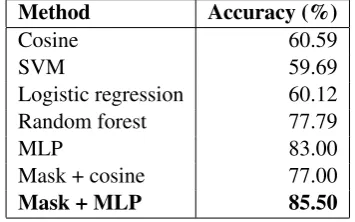
The described methods are compared on the gen-erated dataset for word categorization based on WordNet. The accuracy scores from Table 1 were obtained using 10-fold cross-validation.
Method Accuracy (%)
Cosine 60.59
SVM 59.69
Logistic regression 60.12 Random forest 77.79
MLP 83.00
Mask + cosine 77.00
[image:4.595.92.270.415.526.2]Mask + MLP 85.50
Table 1: Accuracy of the compared methods.
The poor results obtained by the SVM are not very surprising. While the words from the same category might be grouped together in the Word2Vec embedding space, the training exam-ples consisted in pairs of words and categories. Positive pairs have no reason to be close to each other, meaning that the positive and negative ex-amples are not linearly separable in this case.
Comparing cosine similarity with the mask-cosine method, an important improvement of 27% can be observed. This demonstrates that scaling both the word and its category will make them closer, while scaling a word and a different cat-egory will make them more distant. This means that each mask successfully minimizes the effect
of dimensions in the space that are not related to the given category.
It was also expected that the mask+MLP ap-proach to work better than a simple MLP because the first one has more parameters. In our experi-ments, the improvement was not impressive (about 3%), but we observed a much faster training rate. While the MLP needed 500 epochs to reach this accuracy, the version with masks achieved the same performance in 50 epochs. The masks accel-erate training, but also have a tendency to quickly over-fit on the training data.
7 Conclusion
Mask embeddings proved to be useful for the pro-posed word categorization task. Although this is an artificial task (the category of each word is al-ready known from WordNet), the method can be applied in other scenarios. The results show that such masks can learn which dimensions are impor-tant in a given situation. Also, the masks can be learnt much faster than a regular fully-connected layer.
An alternative for masks would be the use of different networks for each category. This solu-tion is more general than the method proposed in this paper which uses embeddings masks and MLP; for this reason they will have more parame-ters than the Mask+MLP technique. Further test-ing is needed on this subject, but masks seem a viable solution for limiting the number of parame-ters of a network, which can be crucial when deal-ing with small datasets.
References
David M. Blei, Andrew Y. Ng, and Michael I. Jordan.
2003. Latent dirichlet allocation. The Journal of
Machine Learning Research, 3:993–1022, mar.
Manaal Faruqui, Jesse Dodge, Sujay K. Jauhar, Chris Dyer, Eduard Hovy, and Noah A. Smith. 2014. Retrofitting Word Vectors to Semantic Lexicons. nov.
Thomas K Landauer and Susan T. Dumais. 1997. A solution to Plato ’ s problem: The Latent Semantic Analysis Theory of Acquisition, Induction, and
Rep-resentation of Knowledge. Psychological Review,
104(2):211–240.
Hyekyoung Lee, Jiho Yoo, and Seungjin Choi. 2010. Semi-Supervised Nonnegative Matrix Factorization.
Omer Levy and Yoav Goldberg. 2014. Neural Word
Embedding as Implicit Matrix Factorization. In
Ad-vances in Neural Information Processing Systems, pages 2177–2185.
Tomas Mikolov, Greg Corrado, Kai Chen, and Jeffrey Dean. 2013a. Efficient Estimation of Word
Rep-resentations in Vector Space. Proceedings of the
International Conference on Learning Representa-tions (ICLR 2013), pages 1–12.
Tomas Mikolov, Wen-tau Yih, and Geoffrey Zweig. 2013b. Linguistic regularities in continuous space
word representations. Proceedings of NAACL-HLT,
(June):746–751.
George A. Miller. 1995. WordNet: a lexical
database for English. Communications of the ACM,
38(11):39–41, nov.
Nikola Mrkˇsi´c, Diarmuid ´O S´eaghdha, Blaise Thom-son, Milica Gaˇsi´c, Lina Rojas-Barahona, Pei-Hao Su, David Vandyke, Tsung-Hsien Wen, and Steve Young. 2016. Counter-fitting Word Vectors to Lin-guistic Constraints. mar.
Arvind Neelakantan, Jeevan Shankar, Alexandre Pas-sos, and Andrew Mccallum. 2014. Efficient Non-parametric Estimation of Multiple Embeddings per
Word in Vector Space. Emnlp-2014, pages 1059–
1069.
Jeffrey Pennington, Richard Socher, and Christopher D Manning. 2014. GloVe: Global Vectors for Word
Representation. Proceedings of the 2014
Confer-ence on Empirical Methods in Natural Language Processing, pages 1532–1543.
Masashi Tsubaki, Kevin Duh, Masashi Shimbo, and Yuji Matsumoto. 2013. Modeling and Learning Se-mantic Co-Compositionality through Prototype
Pro-jections and Neural Networks. In EMNLP, pages