
http://www.scirp.org/journal/jmp ISSN Online: 2153-120X
ISSN Print: 2153-1196
Fundamental Concept of Interdiffusion
Problems
Takahisa Okino
1*, Hiroki Cho
2, Kazu-Masa Yamada
31Applied Mathematics Department, Faculty of Engineering, Oita University, Oita, Japan
2Department of Mechanical Systems Engineering, Faculty of Environment Engineering, University of Kitakyushu, Kitakyushu,
Japan
3Department of Production Systems Engineering, National Institute of Technology Hakodate College, Hakodate, Japan
Abstract
In accordance with the definition of diffusivity, the origin of coordinate sys-tem of the original diffusion equation is set at a point in the solvent material. Kirkendall revealed that Cu atoms, Zn atoms and vacancies move simulta-neously in the interdiffusion region. This indicates that the original diffusion equation is a moving coordinate system for the experimentation system out-side the diffusion region. The diffusion region space which means vacancies and interstices among atoms plays an important role in the diffusion pheno-mena. The theoretical equation of the Kirkendall effect is reasonably obtained as a shift between coordinate systems of the diffusion equation. The situation is similar to the well-known Doppler effect in the wave equation. Boltzmann transformed the original diffusion equation of a binary system into the nonli-near ordinary differential equation in accordance with the parabolic law. In the previous works, the solutions of the diffusion equation transformed by Boltzmann were analytically obtained and we found that the well-known Darken equation is mathematically wrong. In the present study, we found that the so-called intrinsic diffusivity corresponds in appearance to the physical solution obtained previously. However, the intrinsic diffusivity itself con-ceived in the diffusion research history is essentially nonexistent.
Keywords
Interdiffusion, Intrinsic Diffusion, Kirkendall Effect, Parabolic Law
1. Introduction
The heat conduction equation proposed by Fourier in 1822 has been applied to investigating the temperature distribution in materials [1]. In 1855, Fick directly applied the heat conduction equation to diffusion phenomena [2]. As far as the
How to cite this paper: Okino, T., Cho, H. and Yamada, K.-M. (2017) Fundamental Concept of Interdiffusion Problems. Jour-nal of Modern Physics, 8, 903-918. https://doi.org/10.4236/jmp.2017.86056 Received: April 7, 2017
Accepted: May 21, 2017 Published: May 26, 2017 Copyright © 2017 by authors and Scientific Research Publishing Inc. This work is licensed under the Creative Commons Attribution International License (CC BY 4.0).
shape of heat conduction material is unchangeable during a thermal treatment, the coordinate system of heat conduction equation set in a material is a fixed one, since the coordinate system is not influenced by the variation of internal structure in the material. Here, we should notice that the concentration of diffu-sion particles is a real quantity in physics, although the temperature is a ther-modynamic state quantity. It is thus considered that the coordinate system of diffusion equation set in the diffusion field (solvent) is generally a moving one, since the origin of coordinate system is influenced by a variation of the diffusion field. It is thus indispensable for understanding the diffusion problems to discuss their coordinate systems, since the diffusion particles, solvent particles and also the diffusion region space which means vacancies and interstices among atoms move simultaneously against a fixed point outside the diffusion system.
When the Fick’s laws were proposed, the Gauss’s divergence theorem had been already reported in 1840 [3]. Nevertheless, the problem of coordinate sys-tem of diffusion equation was not mathematically investigated in accordance with the divergence theorem in those days. The problems of the coordinate transformation relevant to the diffusion equation had not been thus discussed in the diffusion history for a long time before the previous work [4]. The new find-ings, which are extremely dominant in the diffusion study, were reasonably ob-tained through the coordinate transformation theory then.
It seems that the new fundamental findings different from the existing diffu-sion theories may exert a great influence on the actual diffudiffu-sion problems, just because of the fundamental findings themselves. For example, one of them re-veals that the well-known intrinsic diffusion concept is unnecessary for under-standing the interdiffusion phenomena [5]. However, those findings have not yet been universally known in the concerned research field [6][7][8]. That is the very reason to perform the present work in accordance with an entirely different viewpoint from the previous work.
The solutions of a typical interdiffusion problem were already obtained as analytical expressions in accordance with results of the well-known Boltzmann Matano method [9][10][11]. Using the analytical solutions for the interdiffusion problems, the fundamental problems of diffusivities and diffusion fluxes are discussed in accordance with the mathematical theory. In the present work, the original meaning of the so-called interdiffusion coefficient and that of the intrin-sic diffusion coefficient misunderstood for a long time will be thus clarified in the following.
2. Raft Model of Interdiffusion Problems
diffusion equation is indispensable for understanding diffusion phenomena [4]. Analyzing interdiffusion problems is thus considerably complicated. In the fol-lowing, as an example of problems between coordinate systems, we discuss mo-tions of persons on a raft floating on a pond before the discussion about inter-diffusion problems.
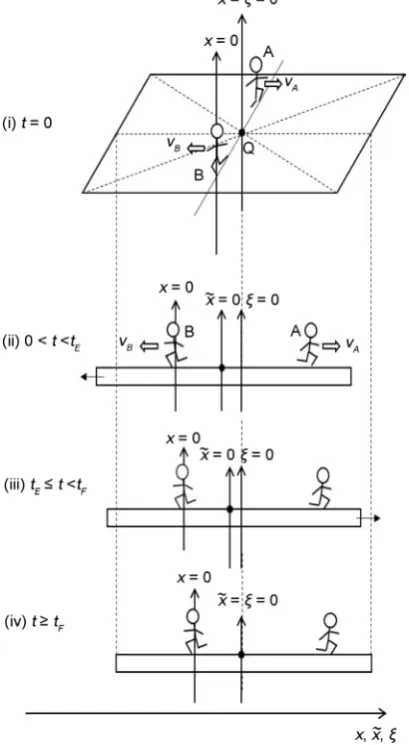
The water in a pond is at rest and a rectangle raft of mass M , length l and
width w floats also at rest in the pond. As shown in Figure 1, the diagonal
lines intersect each other at the point Q then. The origin of x axis along the
length direction is set at the point Q on the raft. Persons A and B with mass
A
[image:3.595.271.476.238.611.2]m and mass mB who are at rest on the line x=0 at the initial time t=0
start walking with an arbitrary velocity for t>0 in the opposite direction from
each other. Under the condition of t=t, the origin of x axis parallel to the x
axis is set at the point P of the mass center of the persons. Under the
condi-tion of τ =t, the origin of
ξ
axis parallel to the x axis is set at a point Ron the bank beside pond on the line x=0 in the initial state.
In the following, we discuss the motion of person A in the isolated system composed of the raft and persons using each of the coordinate systems,
( )
t x , ,( )
t x, and(
τ ζ,)
, under the initial condition x= = =xξ
0 at t= = =t τ 0.In an arbitrary time between 0≤ ≤t tD, we conceive that the persons A and B move in the opposite direction from each other with arbitrary velocities vRA and vRB against the point R and that they stop walking on the raft at the same time t =tD. In that case, the law of momentum conservation yields
(
M+mA+mB)
VR+m vA RA+m vB RB =0 (1) in the isolated system of the raft and persons, where VR is a velocity of the raft against the point R. The mass center in the isolated system is immobile against the point R in accordance with the physical theory then, even if the raft moves against the point R. In other words, the raft moves in accordance with the mo-tion of the persons like the concerned mass center is continually immobile against the point R.The velocities of persons A and B, vQA and vQB, against the point Q are ob-tained as
RA A RA B RA B RB QA RA R
A B
RB B RB A RB A RA QB RB R
A B 2
,
2
.
Mv m v m v m v
v v V
M m m
Mv m v m v m v
v v V
M m m
+ + +
= − =
+ +
+ + +
= − =
+ +
(2)
The relative velocity vBA between persons A and B are then expressed as
BA QA QB RA RB v =v −v =v −v ,
and it does not depend on the coordinate systems
( )
t x , and( )
τ ξ, .The migration length of raft between 0≤ ≤τ τD from the point R is ex-pressed as
D D A RA B RB
r 0 R 0
A B
d m v m v d
V t
M m m
τ τ
ξ
+τ
∆ = = −
+ +
∫
∫
.When the persons on the raft stop walking at the same time t =tD, the rela-tion of vQA =vQB =0 leads to that of vRA=vRB=VR =0 then. If the velocity of water flow v
( )
τ satisfies the relation given by( )
( )
F
D r F
d , 0 for ,
v v
τ
τ τ τ= −∆ξ τ = τ τ≥
∫
the raft returns to the initial position and it has been at rest ever since. The mass center of the isolated system is shifted from the initial state
ξ
=0 to ξ = −∆ξrthen.
the pond. In other words, it is apparent that we cannot understand the motion of person A against the point R only from the relative motion between the persons A and B on the raft.
3. Binary System Interdiffusion
As is known from the unified theory of diffusion problems, the basic concept of diffusion phenomena is in the interdiffusion problems [4]. In the following dis-cussion, the above raft model is reasonably applied to a typical binary system in-terdiffusion problem in accordance with the mathematical physics. In that case, the person A, the person B, the raft and water in the pond correspond to the mass center of diffusion particles, the mass center of solvent particles (diffusion field), the diffusion region space, and space of the diffusion region outside, re-spectively. Here, note that the diffusion region space and the space of diffusion region outside have no mass, whereas the raft and water in the pond have the mass M and a mass.
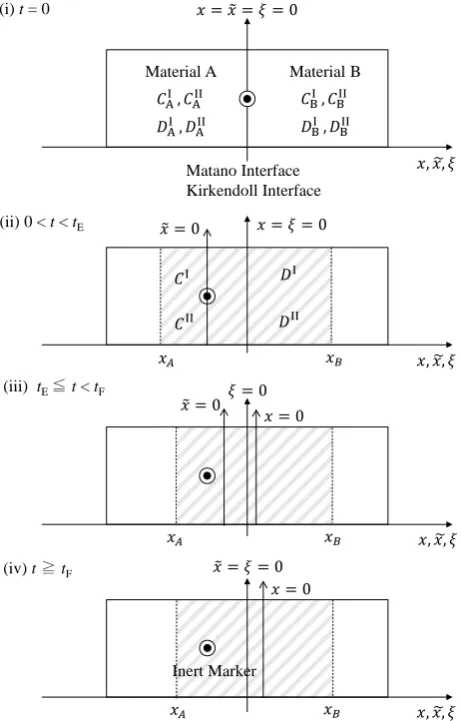
Metal plates A and B with a uniform cross section S are composed of
ele-ments I and II for each other. The concentrations of I and II in the metal plate A are I
A
C and II A
C and their diffusivities are I A
D and II A
D in the initial state,
respectively. The concentrations and diffusivities in the metal plate B are simi-larly I
B
C , II B
C , I B
D and II B
D . In general, those values of concentration and
diffusivity are different from each other. In the following, we discuss the inter-diffusion problem in the inter-diffusion couple composed of the metal plates A and B. As shown in Figure 2, the diffusion couple is smoothly jointed at the interface between A and B. The coordinate axis x perpendicular to the cross section S
is defined as A→B direction. The origin of x axis is set at the point P of a
mass center of diffusion field
(
A B)
2j j
C +C for j=I, II on the initial interface
then. In the same manner, the origin of coordinate axis x parallel to the x
axis is set at a point Q of space on the initial interface. Further, the origin of
coordinate axis
ξ
parallel to the x axis is set at a point R on the line x=0outside the diffusion system in the initial state.
Since the diffusivity depends on an interaction between a diffusion particle and the diffusion field near the diffusion particle itself, the basic diffusion equa-tion with the diffusivity is expressed by the time and space coordinate
( )
t x, . Inrelation to the raft model, however, the diffusion equations expressed by the coordinates
( )
t x , and( )
τ ξ, are necessary for understanding the diffusionphenomena, since the basic diffusion equation is relevant to the relative motion between collective particles of elements I and II. In the present case, the prob-lems of the coordinate transformation of diffusion equation are thus discussed under the initial condition x= = =x
ξ
0 at t= = =t τ 0.We denote the concentrations and diffusivities of I and II by I
C , CII, DI
and II
D in the diffusion region xA≤ ≤x xB during a thermal diffusion. In that case, their boundary values are physically accepted as constant values, I
A
C ,
II A
C , DAI and DAII at x=xA and I B
Figure 2. Typical interdiffusion problem of a diffusion couple. The metal plates A and B composed of elements I and II were used for a diffusion couple. Their diffusivities and concentrations are I II I II
A, A, A, A
D D C C and I II I II B, B, B, B
D D C C in the initial state. Those values
during thermal diffusion are I II I II
, , ,
D D C C in the diffusion region. The inert marker denoted in the figure moves during the diffusion process because of its inert characteris-tic. The time intervals of (i) - (iv) correspond to those of Figure 1, respectively.
differential equations of diffusion.
The basic diffusion equations of I and II are expressed as
for I, II.
j j
j
C C
D j
t x x
∂ = ∂ ∂ =
∂ ∂ ∂ (3)
Since the shape variation of diffusion couple is negligible in the usual experi-mentation, the total particle numbers of I and II on an arbitrary cross section in the diffusion region are considered to be constant with a good approximation. In the typical interdiffusion problems, the relation of
I II 1
C +C = (4)
is thus generally accepted regardless of the coordinate systems, where the nor-malized concentrations are used.
Substituting (4) into (3) yields
Material A Material B
Matano Interface Kirkendoll Interface (i) t= 0
(ii) 0 < t< tE
(iii) tE≦t< tF
(iv) t≧tF
(
)
I III II I II
0,
C C
C C D D
t x x x
∂ + = ∂ ∂ + ∂ =
∂ ∂ ∂ ∂
and it is rewritten as
(
)
II II
0. C
D D
x x
∂ − ∂ =
∂ ∂ (5)
In accordance with the theory of partial differential equation, (5) means that the relation of
(
I II)
CI( )
D D J t
x
∂
− =
∂
must be valid using an arbitrary function J t
( )
of t because of ∂J t( )
∂ =x 0.In the present case, the differential equation is only for J t
( )
=0 in accordancewith the mathematical theory. In other words, the relation of I II
D =D is thus
valid because of I
0
C x
∂ ∂ ≠ in the diffusion region. Their diffusivities are thus commonly expressed as
I II
D =D =D (6)
only in the partial differential equation (3). However, note that it is not generally valid in the actual diffusion phenomena when we substitute the initial and/or boundary values, I
A
D , DAII, I B
D and DBII, into their general solutions I D
and II
D of (3). Substituting (6) into (3) yields
,
C C
D
t x x
∂ = ∂ ∂
∂ ∂ ∂ (7)
where the suffix j is removed because the general solutions are mathematically
in common. Here, CA,DA at x=xA and CB,DB at x=xB are formally used in common for the elements I and II as initial and boundary values of the general solutions of (7).
The Gauss’s divergence theory shows that the diffusion flux of basic diffusion equation (7) is obtained as
P d F eq for F
C
J x J J J D C x
t
∂
= − = + = − ∂ ∂
∂
∫
(8)
by integrating it with respect to x because of ∂Jeq ∂ =x 0. Here, JF is the well-known Fickian first law and Jeq independent of the time and space is the intrinsic diffusion flux defined by the previous work [13]. The intrinsic diffusion flux Jeq plays an important role in the self-diffusion theory of JF =0 and it has a relation with a self-diffusion coefficient Dself yielding
eq self 0 J = −D C l,
where C0 and l are a concentration and a lattice constant in a pure material [4].
Substituting (4) into the Fickian first law JF, the relation of
( )
( )
I II(
)
I II I II
F , F , 0
C C
J t x J t x D D C C
x x x
∂ ∂ ∂
+ = − + = − + =
∂ ∂ ∂
is valid only in the partial differential equation (3). Further, it is clarified that the relation of
I II eq eq 0
J +J = (10)
is valid in the self-diffusion theory in [4]. Equations (8), (9) and (10) yield
( )
( )
I II
P , P , 0
J t x +J t x = (11)
which is valid only in the partial differential equation (3).
When the origin P of x axis moves with the velocity vRP
( )
τ against theorigin R of
ξ
axis, (7) is transformed into the equation ofRP
C C
D v C
τ ξ ξ
∂ = ∂ ∂ −
∂ ∂ ∂ (12)
in the fixed coordinate system outside the diffusion system. Here, the relations of differential operators yielding
RP ,
v
t t t x x x
τ ξ τ ξ
τ ξ τ ξ τ ξ ξ
∂ ∂ ∂ ∂ ∂ ∂ ∂ ∂ ∂ ∂ ∂ ∂ ∂
= + = + = + =
∂ ∂ ∂ ∂ ∂ ∂ ∂ ∂ ∂ ∂ ∂ ∂ ∂
are used for (7), where the relations of
t
τ = and 0 RP
( )
dt
x v
ξ = +
∫
τ τare valid between the coordinate systems
( )
t x, and( )
τ ξ, .4. Solutions of Nonlinear Diffusion Equation
It is generally considered that the diffusivity D of the element I or II between
A B
x ≤ ≤x x depends on the coordinate system
( )
t x, because of theconcentra-tion dependence. In that case, we cannot analytically solve the nonlinear partial differential equation (7) as it is.
In 1894, Boltzmann transformed (7) into the nonlinear ordinary differential equation of
d d d
,
2 d d d
C C
D
ζ
ζ ζ ζ
− =
(13)
using the relation ζ =x t of the parabolic law [9]. Further, (13) can be
re-written as
( )
( ) ( )
d ,d C
J ζ D ζ ζ
ζ = −
(14)
where the relation of
( )
0 0( )
0( ) ( )
0
d
exp d for
d 2
C
J J J D
D ζ
ζ
ζ η
ζ η ζ
ζ η = = − − =
∫
is used [11][14]. Equation (14) is considered to be a diffusion flux in the para-bolic space. In mathematics, that the diffusivity depends on the coordinate sys-tem yields the relation of
d
. d
C C C D
D
ζ ζ ζ
∂ ∂ ∂
= +
∂ ∂ ∂
The general solutions of (13) were obtained as analytical expressions yielding
( )
IF 1 m IFm
int int
erf erf ,
2 2
D D
D D D
D D D ζ ζ ζ − + − = − − +
(16)
( )
IN 1 m INm
int int
erf erf ,
2 2
C C
C C C
C D D ζ ζ ζ − − − = − − + (17)
where (14) and (15) were simultaneously calculated using the integral constants
A
D , DB, CA and CB in common for the elements I and II [11]. The nota-tion of Dint is used as Dint =Dint+ for
ζ
≥0 and Dint =Dint− forζ
≤0. The other notations used here for the general solutions are as follows:(
)
(
)
(
)
(
)
(
) (
)
A B A B A B A B
A B
IF IN A B A B A B IF
A B
m IF A B
IN m int int A B
2 , 2 , 2 , 2 ,
0, 2 , ,
ln ln
, , .
2
m m
D D D D D D C C C C C C
D D
D D D D D D D
D D
D D D D
C C C D D D D
D ζ ζ ∆ ∆ ∆ + − ∆ = + = − = + = − − = = − + = − − + = − = =
When we substitute the boundary values, A A
j
D =D , DB=DBj, CA=CAj
and B B
j
C =C , for j=I, II in the concerned diffusion system into the general
solution of (16) and (17), the physical solutions of (3), i.e., Dj
( )
t x, and( )
, jC t x are obtained as
( )
A B A Bint
, erf
2 2 2
j j j j
j j
j
D D D D x
D t x
D t α + − = − +
(18)
( )
A B A Bint
, erf
2 2 2
j j j j
j j
j
C C C C x
C t x
D t β + − = − +
(19)
between xA≤ ≤x xB, because of ζ =x t. The notations used here are as fol-lows:
1 A B
A B A B
2
erf ,
ln ln
j j
j
j j j j
D D
D D D D
α = − + −
− −
1
IN A B A B
A B A B
int
2
erf ,
2 ln ln
2
j j j j j
j
j j j j
j
C C D D
D D D D
D ζ β − − − + = − + − − −
(
) (
)
IN 2 A B A B A B ,
j D Dj j Dj Dj Dj Dj
ζ = − +
A B
int , int A B.
2
j j
j D D j j j
D + = + D − = D D
[image:9.595.244.499.513.635.2]interdiffusion problems as discussed later. In order to understand the intersion phenomena, however, we must further investigate the behavior of the diffu-sion region space corresponding to the movement of the raft as mentioned above, since the diffusion flux of (3) is different from that of (12) as discussed in detail later even if vRP =0 is valid.
The diffusivities I
( )
,D t x and DII
( )
t x, in the diffusion region shown in Figure 2 are generally different from each other because of the concentration dependence of diffusivity caused by a difference between IA
C and I B
C . The
physical solution of (18) obtained here shows that the relation of
( )
( )
I II
, ,
D t x ≠D t x (20)
is valid between xA≤ ≤x xB. At the same time, the relation of
( )
( )
I II
F , F , 0
J t x +J t x ≠ (21)
is generally valid between the diffusion fluxes obtained by using (18) and (19). Here, note that the difference between (6) and (20) or (9) and (21) has been ignored in the diffusion history. We believe that the Kirkendall effect (K effect) is caused by the relation of (21) [12]. At the same time, as discussed later, we cannot accept the concept of intrinsic diffusion developed in the diffusion history.
In a word, the usual diffusivities I
D and DII shown in Figure 2 have been
thus named as an interdiffusion coefficient D, where (6) is valid only in a
par-tial differenpar-tial equation of diffusion, and the concept is acceptable then. On the other hand, diffusivities I
D and DII obtained as physical solutions of (18)
correspond in appearance to ones named as intrinsic diffusion coefficients from a different viewpoint in those days. Based on the above theory, however, the concept of intrinsic diffusion coefficients is not acceptable, since it is apparent that there is no such especial diffusivity in the concerned diffusion region.
The so-called Darken equation relevant to the interdiffusion coefficient and the intrinsic diffusion coefficients has been used for analyzing interdiffusion problems for a long time [15]. However, we cannot mathematically accept the relation among the interdiffusion coefficient D and the intrinsic diffusion
coefficients I
D and DII in accordance with the above discussion. Here, we
should notice that the Darken equation is also mathematically wrong in the de-rivation process [5].
5. Flux of Diffusion Region Space
The concept of diffusion flux is useful for understanding of diffusion phenome-na. The diffusion flux of the diffusion region space plays an important role to understand interdiffusion phenomena like the motion of persons in the raft model depends on the motion of raft.
The Gauss’s divergence theory shows that the diffusion flux is obtained as
( )
R F RP eq for F
J =J +v C+J
τ
+J J = − ∂ ∂D Cξ
(22)flux of the diffusion region space caused by the migration of diffusion particles and/or solvent ones and it can be observed only from using the coordinate sys-tem
( )
τ ξ, outside the diffusion system.Using the velocity vQP of the origin P of x axis against the origin Q of
x axis, the diffusion equation is obtained as
Q P ,
C C
D v C
t x x
∂ = ∂ ∂ −
∂ ∂ ∂ (23)
and the diffusion flux is
Q F QP eq for F .
J =J +v C+J J = − ∂ ∂D C x (24)
Here, note that the diffusion fluxes of (8), (22) and (24) are valid only in the partial differential equations (7), (12) and (23), respectively. When (8), (22) and (24) are applied to the elements I and II, the relation among diffusion fluxes of
T T T
R P Q
J =J +J (25)
is physically valid as a relation between the inside flux of the diffusion region and the outside one, where T I II
P P P
J =J +J , JQT =JQI +JQII and
T I II
R R R
J =J +J .
Equation (25) yields the relation of
( )
( )
I II
RP QP,
J
τ
+Jτ
= −v +v (26)since I II
F F 0
J +J = , JeqI +JeqII =0 and (4) are valid regardless of the coordinate systems. The diffusion flux of
(
I II)
RQ
v C +C means the flux of diffusion
par-ticles and solvent ones caused by the coordinate transformation, where vRQ is the velocity of the origin Q of x axis against the origin R of
ξ
axis. Therelation of
( )
( )
(
)
I II I II
RQ RQ
J
τ
+Jτ
= −v C +C = −v (27)is thus valid, since the diffusion region space moves in the opposite direction against the diffusion particles.
Equations (26) and (27) yield a physically reasonable relation of
RP RQ QP
v =v +v (28)
to be valid among the velocities of the coordinate systems.
6. Kirkendall Effect
In general, the diffusion experiments are performed at a high temperature be-tween 0≤ ≤τ τD shown in Figure 2 and the temperature of experimental spe-cimen becomes gradually a room temperature between τD≤ ≤τ τF. The diffu-sion region space interacts with the free space outside the diffudiffu-sion system then and subsequently the diffusion system becomes a thermal equilibrium state at
F
τ τ= , where the entropy maximization principle and the free energy minimum
principle stand against each other between τD≤ ≤τ τF. As can be easily seen, the situation corresponds to the motion of the raft and water flow between
D F
τ ≤ ≤τ τ in Figure 1.
the interface x=0 is called the Kirkendall interface (K interface) in the
metal-lurgy field. The number of diffusion particles through the M interface is equal to that of solvent particles, since the shape variation of diffusion system is not ob-served in usual experiments. It seems that the M interface is immobile after a thermal diffusion process in accordance with many experimental results.
It is considered that the diffusion region is an isolated system and the mass center is immobile between 0≤ ≤t tD. In other words, the M interface is the mass center of diffusion region in the initial state and the diffusion region space moves like the M interface is immovable between 0≤ ≤t tD in a similar way to the mass center in the raft model in Figure 1. Subsequently, the diffusion region space moves with the temperature fall in a similar way to the movement of raft between tD ≤ ≤t tF. In that case, the diffusion system gradually reaches a ther-mal equilibrium state at a room temperature. However, the mass center is still immovable between xA≤ ≤x xB, since the diffusion region space has no mass.
The coordinate origin set at a point P on the M interface in the initial state is also immovable, since the M interface is immovable. In other words, the relation of vRP=0 is reasonably valid in the present diffusion system. In that case, (28) yields
RQ QP 0
v +v = (29)
because of vRP =0.
Here, using the initial and/or boundary values for (24), the relation yielding
(
I II)
(
I I)
QP A B A B 2
v = D − D C −C t (30)
is reasonably obtained (See Appendix).
An inert marker set at the K interface moves in accordance with the flow of diffusion region space between 0≤ ≤t tD because of the characteristic of the inert marker itself. The K interface returns subsequently to the initial position of
0
ξ
= between tD ≤ ≤t tF, since the diffusion region space interacts with thefree space outside the diffusion system like the diffusion system becomes a thermal equilibrium state. It is considered that the diffusion region space inte-racts with the free space near the specimen surface between xA≤ ≤x xB. Thus, the marker does not move in the x axis direction then, since the diffusion
re-gion space moves in the surface direction perpendicular to the x axis. The
mi-gration length of diffusion region space in the x axis direction is thus still
vi-sualized by the marker position.
Based on the above mentioned, the migration length of an inert marker is ex-pressed as
(
)
(
)
D I II I I
shift 0 RQd A B A B D
L τ v t D D C C τ
∆ =
∫
= − − − (31)at τ τ= D in accordance with the shift between the coordinate systems
( )
t x, and( )
t x , . The diffusion equation (7) is equal to (12) because ofv
RP=
0
,coor-dinate system of the diffusion region outside. This is the so-called K effect
(
)
eff Lshift
ξ
∆ = ∆ . Here, it is revealed that the K effect is caused by the shift
be-tween the coordinate systems
( )
t x, and( )
t x , in a similar way to thewell-known Doppler effect in the wave equation.
For an arbitrary time τ, the empirical relation of K effect given by
eff m ,
ξ τ
∆ = (32) is well known, where m
( )
>0 is a constant determined from the concernedex-perimental results. The above theoretical equation of K effect is then written as
(
I II)
(
I I)
eff DA DB CA CB .
ξ τ
∆ = − − (33)
Equation (33) shows that the K effect depends not only on the initial diffusiv-ity values but also on the initial concentration values. Here, (33) is derived by using
µ
=2 in Appendix. Therefore, we need reexamine a µ value by usingthe relation of
(
I II)
(
I I)
A B A B
2
m D D C C
µ
= − − (34)
so as to agree with the empirical equation (32).
Hereinbefore, the Kirkendall effect was reasonably explained by the present interdiffusion theory, regardless of the intrinsic diffusion concept. It was thus revealed that the diffusion region space plays an important role in the interdiffu-sion problems. At the same time, the discusinterdiffu-sions of setting coordinate system of diffusion equation are essentially dispensable for understanding the diffusion phenomena.
7. Discussion
The diffusion study is an important subject relevant to basic problems in the fa-brication process of materials such as alloys, semiconductors, functional mate-rials, and so on. Their diffusion problems in detail have been thus widely inves-tigated in accordance with the industrial requirement for a long time. However, some unsolved problems relevant to the fundamental nonlinear diffusion equa-tion, which are extremely dominant in mathematical physics, have been still leaved in the diffusion history. In the cause of them, the physical interpretation of the K effect has been misunderstood for a long time.
As is well known, the physical solutions of a partial differential equation are determined from substituting the given initial and boundary values into the general solutions in mathematics. The difference between the physical solutions and the general solutions in mathematics has been confused in the diffusion history. For example, the expression of the diffusion flux J using the general
solutions is thus apparently different from J using the physical solutions.
Us-ing the expression of the interdiffusion coefficient D of the general solutions
and the diffusivity j
D for j=I or II of the physical solutions, the well-known
Darken equation is expressed as
I II II I .
Based on the present mathematical theory, (35) is apparently wrong, since the left-hand side is a general solution whereas the right-hand is expressed by using physical solutions. Further, it is also revealed that the Darken equation is ma-thematically wrong in the derivation process [5].
8. Conclusions
It had been considered for a long time that the analytical solutions of (3) are impossible. However, we could reasonably obtain the general solutions of (13) as (16) and (17). In other words, the physical solutions of (3) were analytically ob-tained as (18) and (19). In the present work, the fundamental concept of interdif-fusion phenomena was reasonably clarified in accordance with the mathematical theory. Further, the analytical method discussed in the present work is reasona-bly applicable to an interdiffusion problem of many elements system [16].
Here, the present results yield the following conclusions.
1) In general, the discussion about setting the coordinate systems of diffusion equation in the diffusion problems is essentially necessary for understanding of the diffusion phenomena.
2) An element in the interdiffusion region has only one diffusivity value. The so-called interdiffusion coefficient means the unsolved one in the partial diffe-rential equation. On the other hand, the intrinsic diffusion coefficient corres-ponds to the solved one using the given initial and boundary values for the gen-eral solutions. Therefore, such an especial intrinsic diffusion coefficient con-ceived in the diffusion history is essentially nonexistent in accordance with the mathematical theory.
In view of the influence of misunderstanding problems pointed out here on the younger, we hope that the conclusions are universally known in the con-cerned research field as soon as possible, just because of the fundamental matters themselves.
References
[1] Fourier, J.B.J. (1822) Analytique de la Chaleur. Didot, Paris, 499-508. [2] Fick, A. (1855) Philosophical Magazine, 10, 31-39.
[3] Gauss, C.F. (1840) Resultateaus den Beobachtungen des Magnetishen Vereins, 4, 1. [4] Okino, T. (2015) Journal of Modern Physics, 6, 2109-2144.
https://doi.org/10.4236/jmp.2015.614217
[5] Okino, T. (2013) Journal of Modern Physics, 4, 1495-1498. https://doi.org/10.4236/jmp.2013.411180
[6] Haug, K., Keiser, D. and Sohn, Y. (2013) Metallurgical and Materials Transactions A, 44, 738-746. https://doi.org/10.1007/s11661-012-1425-9
[7] Kuhn, P., Horbach, J., Kargl, F. and Meyer, A.Th. (2014) Physical Review B, 90, Ar-ticle ID: 023409. https://doi.org/10.1103/PhysRevA.90.023409
https://doi.org/10.1002/andp.18942891315
[10] Matano, C. (1933) Japanese Journal of Applied Physics, 8, 109-113. [11] Okino, T. (2011) Materials Transactions, 52, 2220-2227.
https://doi.org/10.2320/matertrans.M2011137
[12] Smigelskas, A.D. and Kirkendall, E.O. (1947) Transactions of the Metallurgical So-ciety of AIME, 171, 130-142.
[13] Okino, T. (2012) Journal of Modern Physics, 3, 1388-1393. https://doi.org/10.4236/jmp.2012.310175
[14] Okino, T. (2012) Journal of Modern Physics, 3, 255-259. https://doi.org/10.4236/jmp.2012.33034
[15] Darken, L.S. (1948) Transactions of the Metallurgical Society of AIME, 175, 184- 201.
Appendix
Even if the diffusion couple satisfies I I
A B
C ≥C in the diffusion system shown in Figure 2, the generality of diffusion system holds still. In that case, the particles of element I diffuse from the interface at x =xA into the diffusion region be-tween xA≤ ≤x xB. On the other hand, the particles of element II diffuse from the interface at x =xB into the diffusion region between xA≤ ≤x xB. The dif-fusion junction depths I
jun x
∆ and II jun x
∆ are estimated as
I I
jun A
x µ D t
∆ = and II II
jun A
x µ D t
∆ = , (A-1)
where µ is a parameter and
µ
=2 is tentatively adopted in the present work.Using (A-1) and the concentration difference of boundary values
I I I
B A
C C C
∆ = − and II II II
B A
C C C
∆ = − , the actual diffusion fluxes of elements I and II are expressed as
( )
(
)
( )
(
)
I I I I I I I
Q A jun A A B
II II II II II II II
Q B jun B A B
2 ,
2 .
J t D C x D C C t
J t D C x D C C t
= − ∆ ∆ = −
= − ∆ ∆ = −
(A-2)
Equation (A-2) yields
( )
( )
(
)
(
)
I II I II I I
Q Q A B A B 2 .
J t +J t = D − D C −C t (A-3)
The diffusion flux of (A-3) caused by the coordinate transformation corres-ponds to the flux of diffusion region space given by
(
I II)
(
I II)
(
I I)
RQ A B A B 2 ,
v C +C = − D − D C −C t (A-4)
since the flux of diffusion region space moves in the opposite direction to the diffusion flux of (A-3). Substituting (A-4) into (29) yields
(
I II)
(
I I)
QP A B A B 2 .
v = D − D C −C t (30)
Submit or recommend next manuscript to SCIRP and we will provide best service for you:
Accepting pre-submission inquiries through Email, Facebook, LinkedIn, Twitter, etc. A wide selection of journals (inclusive of 9 subjects, more than 200 journals)
Providing 24-hour high-quality service User-friendly online submission system Fair and swift peer-review system
Efficient typesetting and proofreading procedure
Display of the result of downloads and visits, as well as the number of cited articles Maximum dissemination of your research work
Submit your manuscript at: http://papersubmission.scirp.org/
![figure 3 and figure 4 in [11], the present solutions agree with the results of the](https://thumb-us.123doks.com/thumbv2/123dok_us/7757354.711433/9.595.244.499.513.635/figure-figure-present-solutions-agree-results.webp)
