ISSN Online: 2162-2019 ISSN Print: 2162-2000
Stroke Due to Hypercoagulable State Can Mimic
Multiple Sclerosis: A Case Report
Niknam Zahra
1, Saadat Alireza
2, Nabavi Seyed-Massood
3, Morsali Damineh
4,
Hatami-Sadabadi Farhad
5, Kheirkhahan Meghdad
5, Mehdipour Baharak
5*1Neurologist, Neurology Department, University of Baghiatalahaazam, Tehran, Iran 2University of Baghiatalahaazam, Tehran, Iran
3Department of Regenerative Biomedicine, Cell Science Research Center, Royan Institute for Stem Cell Biology and Technology,
ACECR, Tehran, Iran
4Senior postdoctoral fellow, Neurology department, Texas University, Huston, Texas, USA
5General physician, Kheradmand Clinical Research Center, Medical Affairs Division, Actoverco Pharmaceutical Company,
Tehran, Iran
Abstract
Introduction: Stroke is the second major cause of mortality worldwide and in several cases, and it may lead to disability. Factor V Leiden is a common genetic thrombophilia, which causes activated protein C (APC) resistance. Hyperho-mocysteinemia and factor V Leiden deficiency, two independent coagulopathy factors, can lead to venous and arterial infarctions in multiple small and large arteries and veins anywhere in the body. Case Report: Here, we report a unique case in which both hyperhomocysteinemia and factor V Leiden defi-ciency are documented together with MTHFR (C677T) (Methylene Tetra Hydro Folate Reductase) gene polymorphism and activated protein C resis-tance respectively. Conclusion: More interestingly, the mode of presentation in this case highly resembled that of progressive multiple sclerosis; all signs and symptoms slowly progressed without any systemic signs at first few years. Further studies needed to assess current outcomes.
Keywords
Hyperhomocysteinemia, Thrombophilia V, MTHFR (C677T) Gene Polymorphism, Activated Protein C Resistance, Multiple Sclerosis
1. Introduction
Homocysteine (Hcy) is a sulfur-containing amino acid, which produced during the metabolism of methionine.
Deficiency of vitamin B12 and or folate may cause increased plasma levels of How to cite this paper: Zahra, N., Alireza,
S., Seyed-Massood, N., Damineh, M., Far-had, H.-S., Meghdad, K. and Baharak, M. (2017) Stroke Due to Hypercoagulable State Can Mimic Multiple Sclerosis: A Case Re-port. World Journal of Neuroscience, 7, 267-274.
https://doi.org/10.4236/wjns.2017.73022
Received: January 16, 2017 Accepted: July 3, 2017 Published: July 6, 2017
Copyright © 2017 by authors and Scientific Research Publishing Inc. This work is licensed under the Creative Commons Attribution International License (CC BY 4.0).
Hcy. As well, genetic factors such as C667T can cause elevated Hcy (eHcy). Sev-eral medical conditions, such as multiple sclerosis, epilepsy, eclampsia, Parkin-son’s disease, dementia, cardiovascular disorders, atherosclerosis, myocardial infarction, stroke and minimal cognitive impairment may cause eHcy [1].
Factor V Leiden thrombophilia described by a poor anticoagulant responses to activated protein C.
Hyperhomocysteinemia and factor V Leiden deficiency, two independent coa-gulopathy factors, can lead to venous and arterial infarctions in multiple small and large arteries and veins anywhere in the body.
2. Case Presentation
The patient was a 45-year-old woman who slowly developed progressive paresis in her right lower and left upper extremities within few weeks. She referred to a neurologist and had brain MRI (Magnetic Resonance Imaging) done. Based on her symptoms and the findings from her MRI, Multiple Sclerosis (MS) diag-nosed for her. She received five doses of methylprednisolone (1 g/day) for 5 days and then beta interferon 1-a (Rebif) started but it was halted after 21 days due to non-compliance. She had no follow-up for 2 years, and then she returned due to worsening of presenting symptoms (paresis of right lower and left upper ex-tremities). She advised having a course of hyperbaric oxygen therapy. South Africa neurology consultation (SA neurology consultation) had done within our department and we visited the patient for the first time. At this stage, the origi-nal diagnosis with MS was largely in doubt and therefore hyperbaric oxygen therapy did not seem to be a logical approach; she admitted to our ward for fur-ther examinations to confirm the diagnosis. In her first visit she was alert, awake and had normal Mental Status Examination; cranial nerves were normal, motor power of right lower and left upper extremities were 3/5, distal weaker than proximal. Right upper and left lower extremities were 4/5. Deep tendon reflexes (DTR) were 2/2, both plantar reflexes were flexor. There were no sensory deficit findings (fine touch, pinprick, position sense, and temperature). The patient could hardly walk with walking aid. Findings from routine laboratory examina-tion (CBC, BUN, Cr., electrolytes, lipid profiles and FBS) were normal. Because of a history of abortion 10 years ago and unusual presentation of the neurologic problem, and because lesions in brain MRI were not typical for MS, we did an extended laboratory workup. In hematologic workup, factor V Leiden deficiency and Hyperhomocysteinemia were detected.
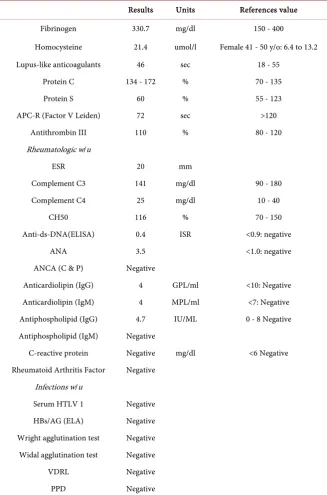
Following the MRI, results were mostly in favor of vascular origin of her brain lesions Warfarin treatment had started. The results of the rheumatologic, hema-tological w/u and blood chemistry results shown in the table (Table 1). She dis-charged after a course of physiotherapy with INR (International Normalized Ra-tio): 2.3 with the same but stable condition.
Table 1. Findings laboratory examination.
Results Units References value
Fibrinogen 330.7 mg/dl 150 - 400
Homocysteine 21.4 umol/l Female 41 - 50 y/o: 6.4 to 13.2 Lupus-like anticoagulants 46 sec 18 - 55
Protein C 134 - 172 % 70 - 135
Protein S 60 % 55 - 123
APC-R (Factor V Leiden) 72 sec >120
Antithrombin III 110 % 80 - 120
Rheumatologic w/u
ESR 20 mm
Complement C3 141 mg/dl 90 - 180
Complement C4 25 mg/dl 10 - 40
CH50 116 % 70 - 150
Anti-ds-DNA(ELISA) 0.4 ISR <0.9: negative
ANA 3.5 <1.0: negative
ANCA (C & P) Negative
Anticardiolipin (IgG) 4 GPL/ml <10: Negative Anticardiolipin (IgM) 4 MPL/ml <7: Negative Antiphospholipid (IgG) 4.7 IU/ML 0 - 8 Negative Antiphospholipid (IgM) Negative
C-reactive protein Negative mg/dl <6 Negative Rheumatoid Arthritis Factor Negative
Infections w/u
Serum HTLV 1 Negative HBs/AG (ELA) Negative Wright agglutination test Negative Widal agglutination test Negative
VDRL Negative
PPD Negative
sion of frontoparietal lobes especially on somatosensory cortices suggestive of atrophic changes.
were all 1/5, and atrophy of the distal parts was obvious. DTR was not detected and both plantar reflexes were extensor. Cranial nerves were normal. Fine touch and pinprick were normal but position and vibration senses were obviously ab-normal.
Imaging
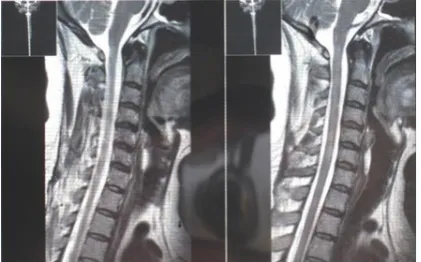
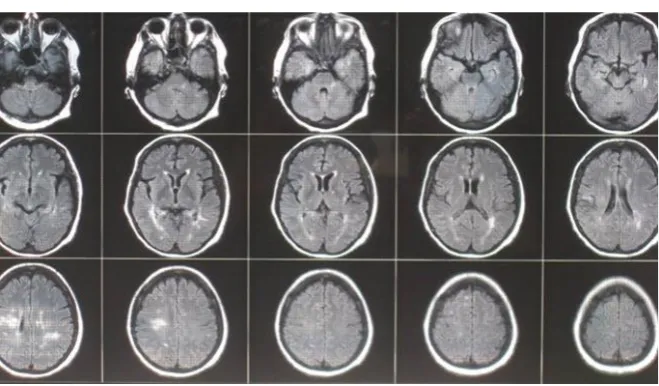
The first brain MRI obtained, at the beginning of the disease onset, was indic-ative of convalescent hyper signal lesions in both parietal lobes on T2WI (T2- weighted spin echo pulse sequences) and were non-enhancing Cervical MRI was normal. Two years later, when we saw the patient for the first time, MRI imaging showed non-enhancing hyper signal lesions in cerebral white matter, corpus callosum, brain stem and cervical cord on T2WI. Some small lesions of centrum semi oval were necrotic. In the last MRI at the last admission, there was a de-fined focus of high signal intensity within cervical cord.
The preceding images (Figures 1-3) were taken in the last admission. No contrast enhancing was noted so the images, which were taken with Gad-en- hancing, are not shown there.
Pathobiology
[image:4.595.260.487.411.541.2]Patient’s peripheral blood leukocyte (WBC) was collected for genomic DNA extraction followed by Real-Time PCR analysis using specific primers. The re-sults were positive for factor V Leiden (G 1691A, heterozygote), and for MTHFR (MethylenTetraHydroFulateReductase) (C677T, homozygote), but negative for Prothrombin (G20210A), factor XIII; tested by PCR-RFLP (Restriction Frag-
Figure 1. Bilateral white matter T2 hyperintense lesions in subcortical and priventricular
area of brain in axial images.
[image:4.595.269.480.583.714.2]Figure 3. Multiple white matter T2 hyper intense lesions in supra and infra tentorial re-gions in axial T2 FLAIR brain images.
ment Length Polymorphism) method and Plasminogen activator inhibitor (PAI)-1 disease which was checked by ARMs-PCR method.
3. Discussion
Epidemiological evidence indicates that moderately elevated plasma homocyste-ine levels constitute an important risk factor for ischemic stroke [2][3].
Various studies have shown a strong association between hyperhomocystei-nemia and the homozygous C677T mutation in the MTHFR gene [4][5].
Moreover, Elkelboom and colleagues have reported that hyperhomocysteine-mia was associated with large artery atherosclerosis [6]. Furthermore, no associ-ation was found between the 677TT genotype and the stroke subtypes [7][8]. However, there is a strong association between Hyperhomocysteinemia and the C677TT genotype in multiple small artery occlusions [9].
In 1994, Bettina and colleagues described a common variation (G 1691A) in the factor V gene as a molecular defect responsible for activated protein C (APC) resistance, a previously unrecognized mechanism of inherited thrombophilia
[10] [11]. The three common gene anomalies associated with venous throm-boembolism (factor V Leiden mutations, prothrombin G20210A mutation and MTHFR C677T mutation) increased the risk of arterial thrombotic events to modest degree especially in patients younger than 55 years [11][12][13].
The case of our patient reported here is unique because:
1- Three systems are involved simultaneously: molecular defect in factor V Leiden (G 1691Avariant), MTHFR C677T mutation and Hyperhomocysteine-mia.
Sclerosis at first, but the case presented here emphasizes the importance of rul-ing out any other possible explanations that resemble signs and symptoms of MS prior to making the definite diagnosis of MS and starting the treatment.
4. Conclusion
More interestingly, the mode of presentation in this case highly resembled that of progressive multiple sclerosis; all signs and symptoms slowly progressed without any systemic signs at first few years. Further studies needed to assess current out-comes.
Acknowledgements
Special thanks to Actoverco Pharmaceutical Company.
Competing Interests
The authors declare that they have no competing interests.
References
[1] Ansari, R., Mahta, A., Mallack, E. and Luo, J. (2014) Hyperhomocysteinemia and Neurologic Disorders: A Review. Journal of Clinical Neurology, 10, 281-288.
https://doi.org/10.3988/jcn.2014.10.4.281
[2] Alfthan, G., Pekkanen, J., Jauhiainen, M., et al. (1994) Relation of Serum Homo-cysteine and Lipoprotein Concentration to Atherosclerotic Disease in a Prospective Finnish Population Based Study. Atherosclerosis, 106, 9-19.
https://doi.org/10.1016/0021-9150(94)90078-7
[3] Satheesan, S.K., Sreedharan, S.T. and Warrier, P.K. (2017) Serum Homocysteine as a Risk Factor in Ischaemic Stroke—A Cross-Sectional Observational Study in a Ter-tiary Care Teaching Hospital in Northern Kerala. Journal of Evidence Based Medi-cine and Healthcare, 4, 163-167.
[4] Boushey, C.J., Beresford, S.A., Omenn, G.S. and Motulsky, A.G. (1995) A Quantita-tive Assessment of Plasma Homocysteine as a Risk Factor for Vascular Disease; Probable Benefits of Increasing Folic Acid Intakes. JAMA, 274, 1049-1057.
https://doi.org/10.1001/jama.1995.03530130055028
[5] Coull, B.M., Malinow, M.R., Beanner, N., Sexton, G., Nordt, F., et al. (1990) Ele-vated Plasma Homocysteine Concentration as a Possible Independent Risk Factor for Stroke. Stroke, 21, 572-576. https://doi.org/10.1161/01.STR.21.4.572
[6] Eikelboom, J.W., Hankey, G.J., Anand, S.S., Lofthouse, E., Staples, N., et al. (2000) Association between High Homocysteine and Ischemic Stroke Due to Large and Small Artery Disease but No Other Etiologic Subtypes of Ischemic Stroke. Stroke, 31, 1069-1075. https://doi.org/10.1161/01.STR.31.5.1069
[7] Markus, H.S., Ali, N., Swaminathen, R., Sankaralingam, A., Molloy, J., et al. (1997) A Common Polymorphism in the Methylenetetrahydrofolate Reductase Gene, Ho-mocysteine, and Ischemic Cerebrovascular Disease. Stroke, 28, 1739-1743.
https://doi.org/10.1161/01.STR.28.9.1739
[8] Szolnoki, Z., Somogyvari, F., Szabó, M. and Fodor, L. (2002) Evaluation of the Inte-ractions of Common Genetic Mutations in Stroke Subtypes. Journal of Neurology, 249, 1391-1397. https://doi.org/10.1007/s00415-002-0848-4
C677T Mutation in the MTHFR Gene as an Independent Risk Factor for Multiple Small-Artery Occlusions. ThrombosisResearch, 111, 39-44.
https://doi.org/10.1016/j.thromres.2003.08.022
[10] Bertina, R.M., Koeleman, B.P.C., Koster, T., Rosendaal, F.R., Dirven, R.J., et al. (1994) Mutation in Blood Coagulation Factor V Associated with Resistance to Ac-tivated Protein C. Nature, 369, 64-67. https://doi.org/10.1038/369064a0
[11] Dahlback, B., Carlson, M. and Svensson, P.J. (1993) Familial Thrombophilia Due to a Previously Unrecognized Mechanism Characterized by Poor Anticoagulant Re-sponse to Activated Protein C. Proceedings of the National Academy of Sciences of USA, 90, 1004-1008. https://doi.org/10.1073/pnas.90.3.1004
[12] Kim, R.J. and Becker, R.C. (2003) Association between Factor V Leiden, Prothrom-bin G20210A, and Methylenetetrahydrofolate Reductase C677T Mutations and Events of the Arterial Circulatory System: A Meta-Analysis of Published Studies.
American Heart Journal, 146, 948-957.
https://doi.org/10.1016/S0002-8703(03)00519-2
Abbreviations
MTHFR: Methylene Tetra Hydro Folate Reductase; APC: Activated Protein C;
Hcy: Homocysteine;
eHcy: elevated Homocysteine; MRI: Magnetic Resonance Imaging;
SA Neurology Consultant: Neurology Consultation in South Africa; MS: Multiple Sclerosis;
CBC: Complete Blood Count; BUN: Blood Urea Nitrogen; Cr.: Creatinine;
FBS: Fasting Blood Sugar;
INR: International Normalized Ratio; CSF: Cerebrospinal Fluid;
SPECT: Single-Photon Emission Computed Tomography; TC 99m-EDC: Technetium 99m-Ethyl Cysteine Dimer; Hgb: Hemoglobin;
RBC: Red Blood Cell Count; DTR: Deep Tendon Reflex;
T2WI: T2-Weighted Spin Echo Pulse Sequences; WBC: White Blood Cell Count;
DNA: Deoxyribonucleic Acid; PCR: Polymerase Chain Reaction;
RFLP: Restriction Fragment Length Polymorphism; PAI: Plasminogen Activator Inhibitor;
ARMs: Amplification-Refractory Mutation System.
Submit or recommend next manuscript to SCIRP and we will provide best service for you:
Accepting pre-submission inquiries through Email, Facebook, LinkedIn, Twitter, etc. A wide selection of journals (inclusive of 9 subjects, more than 200 journals)
Providing 24-hour high-quality service User-friendly online submission system Fair and swift peer-review system
Efficient typesetting and proofreading procedure
Display of the result of downloads and visits, as well as the number of cited articles Maximum dissemination of your research work