The Conservation Laws and Stability of Fluid Waves of
Permanent Form
Troyan A. Bodnar’
Department of Mathematics Technological Institute, Altai State Technical University, Biisk, Russia Email: [email protected]
Received December 13, 2012; revised January 15, 2013; accepted January 23, 2013
ABSTRACT
The solution of Nekrasov’s integral equation is described. By means of this solution the wave kinetic, potential, and full mechanical energies are defined as functions of fluid depth and wavelength.The wave obey the laws of mass and energy conservation. It is found that for any constant depth of fluid the wavelength is bounded from above by a value denoted as maximal wavelength. At maximal wavelength 1) the maximum slope of the free surface of the wave exceeds 38˚ and the value 45˚ is supposed attainable, 2) the wave kinetic energy vanishes. The stability of a steady wave considered as a compound pendulum is analyzed.
Keywords: Nekrasov Integral Equation; Kellogg Method; Successive Approximations Method; Wave Mechanical Energy; Wave Stability
1. Introduction
This paper is based on Nekrasov’s integral equation so- lution obtained in [1,2]. This solution allows us to find the profile and velocity of a gravitational wave, and the calculation of the wave kinetic and potential energy is possible. At fixed depth of fluid the solution of Nekra- sov’s integral equation exists on a limited segment of wavelength
0,max
.
The potential and full mecha- nical energies are monotonically increasing functions on the segment 0,max
. From the law of the change of wave’s kinetic energy presented in [3] as mathematical theorem follows that the kinetic energy vanishes on the boundaries of the segment
0,max
and has the maxi- mum at a point T
0,max
.Thus we observe sym-metry: at the points 0, max the full mechanical
energy consists only of potential energy. The wave of constant shape may be considered as a compound pen- dulum with a suspension center in the origin of co- ordinates arranged on unperturbed surface of fluid.Then the wave stability is spotted as a compound pendulum stability.
The plan of the paper is as follows. In Section 2, we describe the method of Nekrasov’s integral equation so- lution. Here this method has been used for evaluation of the maximum wavelength max boundaries and for esti-
mation of the maximum slope of the wave free surface. In Section 3, geometrical and energy properties of a wave are explored and the theorem about the change of the wave velocity on the segment
0,max
is proved.As a result we have gained the laws of the change of wave’s kinetic and potential energy. Here we have de- fined the wave’s center of mass as a function of depth-to- wavelength ratio and have made some suppositions con- cerning the wave stability considering it as a compound pendulum.
2. Solution of Nekrasov’s Integral Equation
Nekrasov’s integral equation describing steady state waves of unchangeable shape on the surface of a fluid with finite depth h is written as [4]
π π
0 sin
, , d ,
1 sin d
h
K h
h s s
(1.1)where - is the polar angle,
- is the angle that the wave surface makes with the horizontal, - is the wave- length, h h 1,
h - is an arbitrary constant,
1
1 sin
, , tanh 2 π .
3πk
k k
K h k h
k
sin
From Equation (1.1) follows that required function
represents a trigonometric series
1
sin .
k k
a k
(1.2)The evaluation of scalar product
π
π
,sink sink d ,k 1,2, ,
n
taking account of Equations (1.1) and (1.2) gives a system of n nonlinear integral equations
π π 0tanh 2 π sin sin
d ,
3 π 1 sin
1, 2, , ,
n n
k
n n
k h h k
a
k h s ds
k n
(1.3)where the subscript denotes that in Equation (1.1) a truncated kernel
n
n
, ,
K h with instead of n is used. Below the subscript of any function will be omitted if
n
1
π π
max n n ,
(1.4) where - is a suitable from accuracy point of view small number
The system (1.3) containing n1 unknowns
1, , , ,2 n n
a a a h is underdetermined and has a set of solutions including the trivial.
We assume that the first coefficient 1 is independent
of and and can be calculated from the li- nearized on
a
, n ,
h h
n
n
h
0,
a a h
system (1.3) at n1. Thus
0
1 1 1 1 h satisfy the equation
0 π 1 1 01 π 2π
1 0
tanh 2π sin sin
d ,
3π 1 sin d
h h a s s
(1.5)This equation has been solved by Kellogg’s method [5] in [1,2]. Let us remark that the Kellogg method was ap- plied to a non-linear integral equation and the discovered solution is not spectral. In accordance with [2], Equation (1.5) has a unique solution (the motionless point)
0 0
1 0.0474520, 1 πcoth 2π .
a h
0
a a h
Now we fix in (1.3) 1 1 and consider
0 1 h as the initial approximation of After that, the system of Equations (1.3) contains n unknownsn n
.n h
n , ,a
2, ,3a a h
1
n
and has a solution that cannot be trivial.It has been shown [1,2] that coefficient satisfy system (1.3) at if
0 1 a
1, , 1 3.47841, ,
hh h
where
1 0.0113482 (in [2] 1
h h is designated as h
).This means that the solution of the system (1.3) at n1 exists and is unique if the wavelength
0,1max
,where 1maxh h
1 1.The lower boundary of the segment hn, 1
n on which coefficient satisfy system (1.3) at can be obtained by solving the system
0 1 a
π π 0tanh 2 π sin sin
d , 1,2, , , 3π sin d
n n
k
n
k h k
a k n
k s s
(1.6) derived from (1.3) by substitution If re-quirements (1.4) are satisfied, then the function
.n h
is defined on the segment
h
3.48971;
(see [1]), or on the equivalent segment
, , hh h ,
3.48971. (1.7) The system (1.6) containing n unknowns2, , , ,3 n n
a a a h was solved by successive approxima-
tions method at n10 limited by computer’s through- put. The results of calculations of are
given below: 10 1 2
, , , h a a
2 5 8 0 74520, 0.08118 116, 0.101298, 902088, 0.083756 13327. a a a 10 ,a 96, 7, 10 1 3 4 6 7 9 1 0.0482209, 0.04 0.0982136, 0.103 0.0963571, 0.0 0.0774002, 0.07 h a a a a a a a
The function 10
is of low accuracy at the point
h10,10
0.0482209,
0.06.
and allows only to write the inequalities h10h From these inequalities follows that the maximal wavelength max h h
1 7896 . h h max 6667 20.73 is bounded on both sides 16.66
10 0.06 , , ,a a1 2
The results of calculations of
for 10
,a
0.06
h are given below:
10 1
3 4
6 7
9 10
(0.06) = 30.575149, =
= 0.0584506, = 0.04752
= 0.0286028, = 0.02
= 0.0129768, = 0.0098
a a a a a a 2 5 8
0.0474520, = 0.063
04, = 0.0370809,
20196, = 0.0169372,
5512. a a a a 5455,
These numerical results assert that will remain the solution of system (1.3) at for any n
0 1 a 0.06
10 h 10.From the solution of the system (1.6) we obtain the coefficients of the function . This function achi- eves the maximum max
10
0
10 0.670527
at the points
0
10 0.229065.
The maximum slope of the free sur- face in degrees max
010 10 38.418367
exceeds the value 30.3787032466 received in [6]. We suppose that max
0 max
0 0 010 10 0.25π, 10.
3. The Conservation Law of Full Mechanical
Energy and Stability of a Wave
For evaluation of a wave square and full mechanical energy we need the parametric equations of wave’s sur- face coordinates
1 2 3
1 2 3
1 1
sin sin 2 sin 3 ,
,
2π 2 3
1 1
cos cos 2 cos3
2π 2 3
x b b b
y b b b
and the function
exp
1cos 2cos 2 3cos3
.R a a a (2.2)
Coefficients are determined as algebraic ex- pressions of 1 2 [2].
, , b b
, , a a1 2
The coordinate origin O is on vertical line through the wave crest at distance h from the bottom,the axis is directed upward, and the axis to the right. In a coor- dinate system attached to the wave the bottom moves from right to left at velocity [4]
Oy Ox
1 3 2 3 0 . 2π g R c h (2.3) Using (2.1)-(2.3) at fixed h, we obtain the expres- sions for the properties of the wave: the surface area
π
π d ;
w
S
x y (2.4) the coordinates of the center of mass
π π
1
0, d ;
c c w
x y x y y
S
(2.5)the kinetic energy
2 π 2 π d , 2 wc x y
T R
(2.6)where constant denotes the fluid density; the poten- tial energy
;w g S h y w c
(2.7) the full mechanical energy
.
w w w
E T (2.8) The full mechanical energy of an unperturbed fluid layer with depth h and wavelengths is considered as
2 0 0.5g h .
(2.9) Substituting hh1
for in (2.4)-(2.9), we get
2 1 1
3 1
3 1 1
, ,
, 1
w w c c
w w
w c w
S h h S h y h hy h T h g h T h
h g h y h S h
,
and
3 10 h 0.5g h h ,
where
1 1
1 1
1 , 1 ,
1
w w c c
w w
S h S h y h y h
T h g T h
are integrals depending on parameter .h Using these relationships we can write the Equations (2.6)-(2.8) in the form
0 0 0 , , ,w T w
w E
T h C h h C h
E h C h
where 1 (2.10)
1 12 , 2 1
.
T w c w
E T
C h h T h C h h y h S h
C h C h C h
The solution of system (1.3) obtained in [2] allow us to calculate the function C hT
,C h
,C hE
on the segment
0.08,1.4 .
On the boundaries of this segment we have
0.08 0.0585045, 1.4 0.000615295,
0.08 0.202921, 1.4 0.0105552,
T T
C C
C C
0.08
0.261226,
1.4 0.0111705.E E
C C
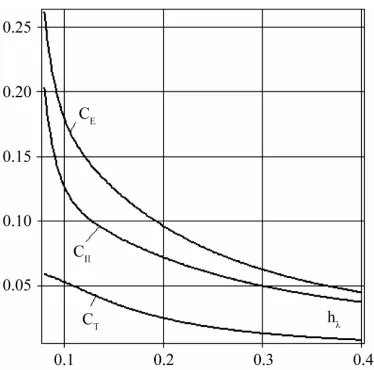
The functions C hT
,C h
,C hE
calculated on the segment
0.08;0.4
are shown on Figure 1. The outcomes of these calculations allow to assert that the wave potential energy w
h as function of parameterh monotonically diminishes on the segment h,.
In order to calculate the greatest value of potential energy of a wave we need the h solution of system
(1.6) instead of h10 (see above).
The law of the wave kinetic energy change is for- mulated in the form of a mathematical theorem in [3]. This theorem asserts that: 1) for any constant depth of fluid h the wavelength
0,max
; 2) at the boun-daries of the segment
0,max
the wave velocity
0
max
0;c c 3) there is a value 0, at which
0dc d0, and the wave velocity is maximum, i.e.
0 max.c c
Let’s prove the points 1) - 3). 1) From (1.7) follows that hh and therefore
1max 0 h h .
2) Suppose the solution h,
of (1.6) is known andsatisfy (1.4). Using this solution we write the integrals
π π
0
tanh 2π sin sin
d , 3π sin d
1, 2, . k h k a s s k
(2.11)The first integral is known the integral k
0
1 1;
aa a
tends to zero as (see [7]). Now it is possible to express the coefficients k from the system (1.6) in terms of the integrals We have
k
, 1,2,
, 1,
k
a k
a k
2,.
tanh 2π
. tanh 2π
k k kh a a k h
(2.12)
Taking into account as from (2.12) follows that series
0
k
a k ,
0R a1 2 is converging
independently of convergence or divergence of the series
1 2
ln a
.
Figure 1. The functions CT(hλ), CII(hλ), CE(hλ) for 0.08 ≤hλ≤
0.4.
Let as remark that the convergence of series
has been proved at a limited in [4] and for a pre- sented as a converging series in [8].3) Since the function c
vanishes at the boun- daries of the interval
0,max
, it follows from the Rolles theorem [7] that exists at least a point
0 0, ma
x such that d
0 0.d c
As the numerator and denominator of right side of Equation (2.3) are strictly increasing functions of the point 0 is
single and c
0 cmax. The values0 10.791072 ,h cmax 0.897495
gh have been calcu-
lated in [2].
The kinetic energy of the wave vanishes at boundaries of the segment
0,max
and reaches the maximum at apoint T 0. (This point is not presented on Figure 1). The full mechanical energy of a wave is a monotonically decreasing function on the segment , but vanishes only at the point
, h
0.
We note also that the profiles of the waves calculated on the segment
0.08
y ,1.4
π hh1. obeythe law of mass conservation S hw The stability of Nekrasov’s waves has been considered in [9]. We proceed from the fact that a liquid maintaining the invariable shape without a vessel, does not suspect that is a fluid.We suppose that a steady state wave can be presented as a compound pendulum with a suspension center in the origin of coordinates. This wave is stable if
0c
y h and unstable if y hc
0. The function
c
y h is presented on Figure 2. This function has the greatest value y hc
0,, is equal to zero
1417c 0.085
y has the minimum
0.133136
0.00889279 ,c
y h
and monotonically in-creases on the interval 0.1331
0c
y 0.
36, reaching the value only at the point If we continue to con-
Figure 2. The dependence ych−1(hλ) for 0.08 ≤hλ≤ 0.4.
sider the wave behaving as a compound pendulum then it is stable at h
0.0851417,
and unstable when
,0.0851417 .
h h
In particular let’s consider a wave of length λ = 1000 m on the surface of a fluid with depth and den- sity
100 m h
2 1000 kg m .
The solution of system (1.3) at the point h 0.1 (see [2]) and the coefficients b1,
b2, …, b7 are given below: μ7(0.1) = 7.449619; a1 =
0.047452; a2 = 0.0195554; a3 = 0.00606262; a4 =
0.00183319; a5 = 0.000565461; a6 = 0.000178475; a7 =
0.0000568810; b1 = 0.047452; b2 = 0.0206812; b3 =
0.00700837; b4 = 0.00233431; b5 = 0.000787255; b6 =
0.000268797; b7 = 0.0000921207. Using these outcomes
in Formulas (2.1)-(2.10) we get the parameters of the wave: the crest coordinate the trough co-
ordinate
0 9 y .7 m;
πy 6.2 m; the amplitude H15.9 m;
the coordinates of mass center c c the kinetic energy the potential energy
w the velocity
0, 0.
x y 6 m;
6 10 kJ; 2.6
w
T 6 10 kJ;
6.2
c 28.1 m s. This wave
similar to a tsunami is stable as
0.1 yc 0.For h100 m and h 0.08 (The solution of the system (1.3) and coefficients b b1, , ,2b10 for h 0.08 are given in [2]) the wave parameters will be:
y 0 14.8 m; y
π 6.9 m; 0.4 m;c c
x y
21.7
H m;
0,
w3.6 10 k 6 J;
w
T 8.910 kJ;6
28.1 m s.
c This wave is unstable as c
0.08
0. In summary it is necessary to note that in the acce- ssible publications we have not discovered materials for comparison, except [6].y
4. Conclusion
Solving the Nekrasov’s integral equation we avoided the “Liapunov-Schmidt” method and other methods of sear- ching the solution in the neighbourhood of eigenvalues of Nekrasov’s linearized equation. We sought the solu- tion of this equation in the neighbourhood of the motion- less point of the nonlinear integral Equation (1.5). This is
the point 0
1 0.0474521226882492;
a
h 3.14159265358983coth 2
πh
0
1
[image:4.595.352.493.87.214.2]REFERENCES
[1] T. A. Bodnar’, “One Approximate Solution of the Nek- rasov Problem,” Journal of Applied Mechanics and Tech- nical Physics,Vol. 48, No. 6, 2007, pp. 818-823.
doi:10.1007/s10808-007-0105-9
[2] T. A. Bodnar’, “On Steady Periodic Waves on the Surface of a Fluid of Finite Depth,” Journal of Applied Mechanics and Technical Physics, Vol.52, No. 3, 2011, pp. 378-384.
doi:10.1134/S0021894411030072
[3] T. A. Bodnar’, “On Steady Waves on the Surface of a Finite-Depth Fluid,” Free Boundary Problems: Theory,
Experiment, and Applications, 3rd All-Russian Confer- ence with International Participation, Biisk, 28 June-3 July 2008, pp. 25-26.
[4] A. I. Nekrasov, “Exact Theory of Steady Waves on the Surface of a Heavy Fluid,” Izd.Akad.Nauk SSSR, Mos- kow, 1951. (In Russian)
[5] R. Courant and D. Hilbert, “Methods of Mathematical Physics,” Interscience, New York, 1953.
[6] G. A. Chandler and I. G. Graham, “The Computation of Water Waves Modelled by Nekrasov’s Equation,” SIAM Journal on Numerical Analysis, Vol. 30, 1993, pp. 1041- 1065. doi:10.1137/0730054
[7] R. Courant, “Differential and Integral Calculus,” Inter- science, New York, 1936.
[8] L. N. Sretenskii, “Theory of Fluid Wave Motion,” Nauka, Moscow, 1977. (In Russian)