Munich Personal RePEc Archive
The Sources of Growth in the Former
SFRY Countries: Comparative Analysis
Popovic, Milenko and Cizmovic, Mirjana
Mediterranean University, Montenegro Business School ,
Mediterranean University, Montenegro Business School
18 July 2013
Online at
https://mpra.ub.uni-muenchen.de/49776/
1
International Scientific Conference:
The Role and Responsibility of State in Ensuring Economic Growth
Faculty of Economics & RifiN, Zagreb, October 2013
THE SOURCES OF GROWTH IN THE FORMER SFRY COUNTRIES:
COMPARATIVE ANALYSIS
by
Milenko POPOVIĆ and Mirjana ČIZMOVIĆ1
Abstract: The topic of this paper is comparative analysis of the economic growth in the former SFRY
countries. The paper is primarily devoted to the analysis of the sources of economic growth in these countries. In this regard, apart from conventional decomposition of growth (contributions of capital, labor and total factor productivity), the demand and the industry composition sides of the sources-of-growth analyses have also been considered. Furthermore, the reserves for further rise in GDP per capita have been identified and estimated on the basis of obtained results. Special attention has been paid to possible increase in the total factor productivity induced by the advance in “broader knowledge” as well as to increase in the labor participation rate. Institutional and policy prerequisites for realization of these reserves of growth are also briefly analysed.
Key Words: sources of growth, growth reserves, convergence
JEL code: O40, O43, O47
1Milenko Popović, Professor at Faculty of Business Studies „Montenegro Business School“, Mediterranean
University, Podgorica, Montenegro
2
The common practice among modern theories of growth is to make distinction between “proximate” and
“fundamental” causes of growth.2 Proximate causes, usually comprised within the sources-of-growth
analysis, are based and developed according to the Solow Growth Model. The end result of this analysis is decomposition of the GDP growth rate into the absolute and relative contribution of the increase in employment, the increase in capital and the increase in the total factor productivity (TFP). The growth rate of the TFP is further decomposed into the contribution of human capital (skills), advance in applied knowledge (sometimes referred to as embodied technological progress), the contribution of organizational
innovation, structural changes and similar.3 In one or the other form, it captures in the long run different
kinds of knowledge and this is why the TFP is sometimes referred to as the advance in “broader knowledge”.
On the other hand, the so-called “fundamental” causes of growth refer mainly to institutional but also to cultural, geographical and some other factors, including pure luck. These factors determine the rate of growth by determining the rate of formation as well as an efficient usage of proximate factors enumerated above. While differences in income levels can be attributed to differences in the proximate causes, the answer to the question of why growth rates differ among countries and within the same country at different times can be obtained only after the analysis of fundamental factors.
This paper is primarily focused on the analysis of proximate causes of growth in the former SFRY countries. In the absence of long-term data series, caused mainly by changes in national accounting systems that took place at the end of the last century, these countries don’t have such kind of analysis,
with the exception of Croatia (IMF, 2012), Serbia (Popović, 2013) and Montenegro (World Bank, 2012;
Popović, 2010). Now, after more than one decade, we have some decent time span data and it seems
appropriate to make such an analysis. Some data are still missing and, for that reason, it was not possible to make a detailed sources-of-growth analysis. For the beginning, this paper estimates only decomposition of the GDP growth rate into the contribution of capital, labor and TFP. This kind of sources-of-growth analysis will, nevertheless, provide some important insight into anatomy of the economic growth of the former SFRY countries. The results are presented in the first and the second section of this paper.
Apart from this conventional sources-of-growth analysis, both the demand and the sectorial side of decomposition of the GDP growth rate are given here too. They are presented in the third and fourth section of this paper. The results of these different sources of growth approaches present a good basis to identify main institutional and policy factors that have determined an anatomy of the economic growth. Thus, first four sections briefly analyse fundamental factors as well. Apart from that, it was a good foundation for identifying and estimating growth reserves for future economic growth. Based on the above stated, it was possible to establish and analyse, although only briefly, policy and institutional prerequisites for liberation of the existing growth reserves and an increase in the future growth rate of the respective countries. This is given in the fifth section of the paper.
This is just the beginning of our research expected to provide all other SEE countries with a similar analysis of growth anatomy as well as to extend its area of research onto the influence of institutional and other fundamental factors on growth of SEE countries.
2
See for example Acemogly (2008).
3
3
1. Sources of Growth Analysis
Sources of growth analysis presented below are based on the Cobb-Douglas (CD) aggregate production
function and Solow Growth Model (1956, 1957).4 The analysis is produced for the period 1995-2011 as
well as for the post-war recovery sub-period 1995-2000, pre-crisis sub-period 2000-2008 which, due to distortion caused by the economic crisis, better reflects long-run characteristics of the path of economic growth than the data pertaining to the entire period. The data about investment and employment were not available for 2012. More importantly, the data about gross value of capital as a common measure of “number of machines”, as well as the data about net value of capital do not exist for respective countries and we approximated it by using perpetual inventory method, based on the data available about
investment.5 In order to compare growth of the respective period with that of the socialist economy we
used results from different measurements given either for the entire SFRY or for specific republics where available. The results are presented in Table 1.
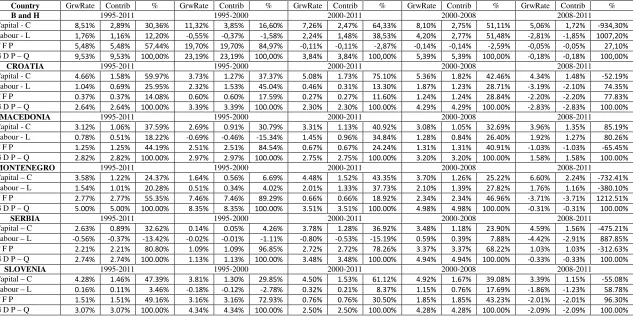
First note significant differences in GDP rates of growth both among different countries and within different sub-periods. Bosnia and Herzegovina have experienced highest rate of growth during the entire period - 9,53%, obviously resulting from the initially low GDP caused by war’s massive destruction. Growth rate of Montenegro’s economy is also significant (5%) being close to its’ 1965-1985 period level (5,14%; Popovic, 2010). GDP growth in all other countries is smaller than it was at its’ pre-war level, varying between 2,64% in Croatia and 3,07% in Slovenia. These rates of growth can be regarded as very low having in mind, on one side, initial low level of GDP caused by war, breakup of SFRY and sanctions imposed by the U.N. Security Council and especially having in mind great potential for catch-up effect, on the other side. It is also noticeable that growth rates were particularly high during first five years of post-war recovery in Bosnia and Herzegovina (23,19%) and Montenegro (8,35%). Strangely enough, growth rates in other countries were not much higher during the first five post-war years than in the following eight years of a pre-crisis period. Naturally, GDP growth rates have dropped significantly during last three post-crisis years. With an exception of Macedonia, it has been negative in all the respective countries.
Looking at the data for the entire period 1995-2011, it can be noticed that the relative contribution of capital to economic growth varies from 24% of growth in Montenegro to almost 60% in Croatia. Looking at different sub-periods, it is noticeable that contribution of capital is much smaller in first five years of a post-war recovery than during the entire period and its’ relative contribution increased significantly in the following eleven years (from around 37% of growth in Serbia to 75% in Croatia). If we compare contribution of capital to economic growth in observed countries with that in the former SFRY or with that in specific republics of the former SFRY, it can be noticed that, while absolute contribution of capital
4
Differentiating and dividing the CD production function = ( ) with Q (GDP) we get the following well known decomposition of the GDP rate of growth: = + (1 − ) + . Note that presents the rate of growth of the variable given in subscript ( for capital, for labor, and for TFP), while and (1 − ) stand for partial elasticity of production with respect to capital and labor respectively. The growth rate of GDP is therefore decomposed in parts that measure the contribution of capital ( ), the contribution of employment ((1 − ) ), and the contribution of total factor productivity ( ). Based on previous measurements and on now widely used practice we assumed in this analysis and (1 − ) to be equal to 0.34 and 0.66 respectively.
5
4
is smaller, its’ relative contribution is quite higher than before breakup of Yugoslavia.6 This contradicting
fact is a result of reduced contribution of labour input.
One of the most obvious results of this measurement is that absolute and relative contribution of employment to economic growth in the whole period is very low for all the respective countries. This is particularly strange having in mind that almost all of those countries, with an exception of Slovenia, have high unemployment rate. In the socialist period the contribution of labor was the most important source of growth, which averagely accounted for 50% of growth in the period 1965 – 1985. Now, absolute contribution of employment in entire period varies from negative value in Serbia (-0,37%) to 1,01% in Montenegro and 1,16% in Bosnia and Herzegovina. In all other countries absolute contribution is well below 1%. We can therefore talk about weak and jobless growth not only in Serbia but in all these countries as well. Note also that situation is much better, although still very unsatisfactory, if we exclude after war recovery period and especially if we look at a pre-crisis period 2000-2008, having in mind high unemployment rate in all respective countries, with an exception of Slovenia.
However, what’s most surprising is very high contribution of the TFP, with puzzling exception of Croatia. TFP’s relative contribution varies during the entire period from 57, 44% for Bosnia and Herzegovina to amazing 80,80% for Serbia, while its’ absolute contribution varies from 5,48% in Bosnia to 2,77% in Montenegro. This contribution of TFP is much higher than in the period of 1973-85 when it was almost negligible. It is even much higher than in SFRY or in any other country during the “bell époque” period of growth of 1945-1973. Again, puzzling exception is Croatia with absolute TFP’s contribution of 0,37% and relative contribution of only 14%. Contribution of TFP was especially high during first five years of post-war recovery: relative contribution of TFP varies from about 73% in Slovenia to 97% in Serbia; Croatia is again an exception and its’ relative contribution of TFP in that period is only 18%. Obviously, high contribution of TFP during the five post-war recovery years is not result of advance in ‘broader knowledge’ but the result of a sudden increase in utilization of existing capital and resulting increase in economic activity caused by peace agreements reached at about the beginning of that period.
Having in mind the above, if we exclude first five years and look only at results for sub-period of 2000-2011, one can notice natural decline in absolute and relative contribution of TFP. Now it is even negative for Bosnia and Herzegovina: absolute contribution is -0,11%. As regards other countries TFP’s relative contribution varies from 11,6% in Croatia to 78,26% in Serbia. The mentioned results are largely influenced by movements that took place throughout post-crisis period and cannot be taken as a basis for approximation of the long-run growth rate of TFP. In order to isolate cyclical effects, it is good to take a look at the TFP growth for the pre-crisis period 2000-2008. The relative contribution of the TFP is now higher and varies from negative value of -2,59% in Bosnia to 68,22% in Serbia. It should also be noted that, with exceptions of Bosnia and Croatia, relative contribution of TFP is higher than 40% in all other countries (41% in Macedonia, 47% in Montenegro, 68% in Serbia, and 43% in Slovenia). This can be regarded as high level of TFP contribution especially having in mind that contribution of TFP was almost negligible in pre-war period. Therefore, we are faced with two puzzles that need to be solved. The first one refers to the issue of low level of TFP in Croatia and Bosnia. The second one refers to high TFP contribution to the growth within the remaining four countries of the former SFRY.
6
5
The jobless growth accompanied by high increase in TFP in above mentioned four countries is puzzling indeed. The contribution of TFP is usually treated as a measure of the contribution of “broader knowledge” which includes the contribution of different forms of knowledge. Having this in mind, a logical question is: Does the recent high growth rate of TFP in Serbia, Macedonia, Montenegro and Slovenia really reflect high increase in “broader knowledge”? Not exactly - high TFP growth mostly results from peculiar privatizations and other economic reforms undertaken in the first decade of this millennium. Similarly, the high contribution of labor and the low contribution of TFP in the socialist period resulted from peculiar socialist economic system.
During the socialism, economic activity was mainly organized within the system of worker self-management characterized by strong “internal” solidarity among workers implying a decent wage flexibility, and low “external” solidarity due to low propensity to saving. In order to preserve power and social peace, the state or political nomenclature, as the company’s main stakeholder (or, better to say, “implicit” stockholder) created hidden unemployment within the company and provided financial assistance for companies in troubles. The implicit social contract between the nomenclature and the working class was that the nomenclature would provide job security to workers in return for political stability (Županov, J. 1983 and 1983a). This is how we got the high contribution of labor and the low contribution of TFP to the economic growth of that period. However, at the end, the implicit social contract between working class and political nomenclature turned out to be unsustainable. By somewhat modifying the prospect of upward mobility (POUM) hypothesis, it can be concluded that the mentioned implicit social contract broke down at the moment when the nomenclature became unable to provide the
prospect of upward mobility to people.7 This is mainly caused by the fact that deruralisation and
urbanization, as the main sources of providing upward mobility and social promotion, were almost exhausted by the middle of the eighties. Even more important cause was lack of internal and external sources of capital necessary to create new jobs for remaining labor force not absorbed by hidden unemployment and emigration as well as to solve numerous other problems created in previous period. The economic crisis was followed with the constitutional and political crisis. The rest is known to everyone in the world.
After brake up of SFRY at the turn of the millennium, economies of new states were in a very bad shape. One decade was lost. The existing capacities were old and technologically obsolete, mainly built to serve the already non-existing Yugoslav market. Instead of adopting an active economic policy directed toward “rediscovering economy” (Hausmann at all, 2005), the new government(s) opted for all kinds of “neoliberal shocks”. These “shocks” almost destroyed the domestic economies. Adopted models of
7
6
privatization were especially bad and destructive. Foreign direct investments, especially at the beginning, were mostly comprised within the so-called “brown-field” investment based on privatized companies. To make a long story short and relevant for the issue being discussed, it is important to emphasize that the new domestic or foreign owners of privatized companies reduced employment in their companies to technologically acceptable level. In other words, hidden unemployment disappeared and became explicit unemployment. New investments in new or old companies, on the other hand, were insufficient to compensate for this effect and increase employment significantly. Apart from that, these new investments were mainly directed toward industrial centers, very rarely to less developed and distant regions, so that number of “closed” companies especially increased in less developed areas that once had labor intensive capacities. As a result, number of employees increased very slowly and even decreased in Serbia (it decreased by about 400,000 workers from 2000 to 2011)?! From the sources of growth point of view the consequence is the reduced contribution of employment and the increased contribution of TFP to the economic growth.
Obviously, the recent high growth rates of TFP in Serbia, Macedonia and Montenegro results from an advance in “broader knowledge” only to a small extent. Most probably, this advancement in these countries was as low as it was in Croatia. The greatest portion of the TFP growth rate results from reduction in hidden unemployment accumulated in the previous phase of economic development. In other words, the TFP increase was the more “revealed” productivity of the already existing technology than the advance in “broader knowledge” brought with new investment. Bearing that in mind and knowing that this reserve of the TFP increase is already exhausted, we may expect this kind of TFP growth rate to retard in the future. On the other hand, having in mind large discrepancy between TFP of these countries and the countries on the technological frontier, we may conclude that possibilities to increase TFP via advance in “broader knowledge” are enormous. The “catch-up” effect, in other words, may be the crucial reserve for future growth of all former SFRY economies. How successfully the countries will exploit this reserve of growth depends crucially on an appropriate policy of the national innovation system (NIS) development. Not less important is the policy directed toward attracting good “green-field” foreign investment with a high degree of technological knowledge and with a strong “spillover” effect on productivity of domestic resources. Looking at the experience of countries that have been successful in implementation of mentioned policies, Ireland for example, we may suppose with a high level of certainty that this reserve might be around 2.40% per year.
7
Table 1: Sources of economic growth
Country GrwRate Contrib % GrwRate Contrib % GrwRate Contrib % GrwRate Contrib % GrwRate Contrib %
B and H 1995-2011 1995-2000 2000-2011 2000-2008 2008-2011
Capital - C 8,51% 2,89% 30,36% 11,32% 3,85% 16,60% 7,26% 2,47% 64,33% 8,10% 2,75% 51,11% 5,06% 1,72% -934,30%
Labour - L 1,76% 1,16% 12,20% -0,55% -0,37% -1,58% 2,24% 1,48% 38,53% 4,20% 2,77% 51,48% -2,81% -1,85% 1007,20%
T F P 5,48% 5,48% 57,44% 19,70% 19,70% 84,97% -0,11% -0,11% -2,87% -0,14% -0,14% -2,59% -0,05% -0,05% 27,10%
G D P – Q 9,53% 9,53% 100,00% 23,19% 23,19% 100,00% 3,84% 3,84% 100,00% 5,39% 5,39% 100,00% -0,18% -0,18% 100,00% CROATIA 1995-2011 1995-2000 2000-2011 2000-2008 2008-2011
Capital - C 4.66% 1.58% 59.97% 3.73% 1.27% 37.37% 5.08% 1.73% 75.10% 5.36% 1.82% 42.46% 4.34% 1.48% -52.19%
Labour - L 1.04% 0.69% 25.95% 2.32% 1.53% 45.04% 0.46% 0.31% 13.30% 1.87% 1.23% 28.71% -3.19% -2.10% 74.35%
T F P 0.37% 0.37% 14.08% 0.60% 0.60% 17.59% 0.27% 0.27% 11.60% 1.24% 1.24% 28.84% -2.20% -2.20% 77.83%
G D P – Q 2.64% 2.64% 100.00% 3.39% 3.39% 100.00% 2.30% 2.30% 100.00% 4.29% 4.29% 100.00% -2.83% -2.83% 100.00% MACEDONIA 1995-2011 1995-2000 2000-2011 2000-2008 2008-2011
Capital - C 3.12% 1.06% 37.59% 2.69% 0.91% 30.79% 3.31% 1.13% 40.92% 3.08% 1.05% 32.69% 3.96% 1.35% 85.19%
Labour - L 0.78% 0.51% 18.22% -0.69% -0.46% -15.34% 1.45% 0.96% 34.84% 1.28% 0.84% 26.40% 1.92% 1.27% 80.26%
T F P 1.25% 1.25% 44.19% 2.51% 2.51% 84.54% 0.67% 0.67% 24.24% 1.31% 1.31% 40.91% -1.03% -1.03% -65.45%
G D P – Q 2.82% 2.82% 100.00% 2.97% 2.97% 100.00% 2.75% 2.75% 100.00% 3.20% 3.20% 100.00% 1.58% 1.58% 100.00% MONTENEGRO 1995-2011 1995-2000 2000-2011 2000-2008 2008-2011
Capital – C 3.58% 1.22% 24.37% 1.64% 0.56% 6.69% 4.48% 1.52% 43.35% 3.70% 1.26% 25.22% 6.60% 2.24% -732.41%
Labour – L 1.54% 1.01% 20.28% 0.51% 0.34% 4.02% 2.01% 1.33% 37.73% 2.10% 1.39% 27.82% 1.76% 1.16% -380.10%
T F P 2.77% 2.77% 55.35% 7.46% 7.46% 89.29% 0.66% 0.66% 18.92% 2.34% 2.34% 46.96% -3.71% -3.71% 1212.51%
G D P – Q 5.00% 5.00% 100.00% 8.35% 8.35% 100.00% 3.51% 3.51% 100.00% 4.98% 4.98% 100.00% -0.31% -0.31% 100.00% SERBIA 1995-2011 1995-2000 2000-2011 2000-2008 2008-2011
Capital – C 2.63% 0.89% 32.62% 0.14% 0.05% 4.26% 3.78% 1.28% 36.92% 3.48% 1.18% 23.90% 4.59% 1.56% -475.21%
Labour – L -0.56% -0.37% -13.42% -0.02% -0.01% -1.11% -0.80% -0.53% -15.19% 0.59% 0.39% 7.88% -4.42% -2.91% 887.85%
T F P 2.21% 2.21% 80.80% 1.09% 1.09% 96.85% 2.72% 2.72% 78.26% 3.37% 3.37% 68.22% 1.03% 1.03% -312.63%
G D P – Q 2.74% 2.74% 100.00% 1.13% 1.13% 100.00% 3.48% 3.48% 100.00% 4.94% 4.94% 100.00% -0.33% -0.33% 100.00% SLOVENIA 1995-2011 1995-2000 2000-2011 2000-2008 2008-2011
Capital – C 4.28% 1.46% 47.39% 3.81% 1.30% 29.85% 4.50% 1.53% 61.12% 4.92% 1.67% 39.08% 3.39% 1.15% -55.08%
Labour – L 0.16% 0.11% 3.46% -0.18% -0.12% -2.78% 0.32% 0.21% 8.37% 1.15% 0.76% 17.69% -1.86% -1.23% 58.78%
T F P 1.51% 1.51% 49.16% 3.16% 3.16% 72.93% 0.76% 0.76% 30.50% 1.85% 1.85% 43.23% -2.01% -2.01% 96.30%
G D P – Q 3.07% 3.07% 100.00% 4.34% 4.34% 100.00% 2.50% 2.50% 100.00% 4.28% 4.28% 100.00% -2.09% -2.09% 100.00%
8
2. GDP per capita Sources of Growth
The analysis of the GDP per capita sources of growth that is given in the following Table 2, will be useful in focusing on and analysing another important reserve for future growth – the increase in the labor participation rate. Basically, taking P to present population and Q to present GDP, the growth of GDP per capita can be decomposed in the following way:
= = ( )= => / = / + / = / + / + (1)
where, as previously, presents the rate of growth of the variable given in subscript. The growth of GDP per capita is decomposed into a part that measures the contribution of the increase in the employment
share in the population (employment population ratio, / ), a part that measures the contribution of the
increase in the capital labor ratio ( / ), and a part that measures the contribution of the TFP ( ).
The results presented in the Table 2 have been obtained by applying the above analytical framework on the existing data pertaining to our sample of countries. Note that the growth of GDP per capita is decomposed, first, into the contribution of the increase in the participation rate (labor-population ratio) and the contribution of the increase in labor productivity. After that, the contribution of labor productivity is decomposed into the contribution of the increase in capital labor ratio and the contribution of TFP. Many interesting conclusions can be derived from these results. We will discuss only those conclusions that are most important for the kind of analysis we intend to do.
Note first that, although far from perfect, the GDP per capita is usually regarded as a good proxy for the level of welfare and standard of living. The less developed the country, the better measure of welfare it is. Numerous researches, especially those related to economic of happiness, revealed that this does not apply
to developed countries.8 Secondly, usually the less developed the country, the more important source of
its’ rate of growth is the increase in the participation ratio. Finally, the increase in the employment population ratio, apart from increasing the standard of living, reduces economic inequality and eradicates poverty. In fact, it is the most powerful channel to reduce poverty. At the same time, it is the only sustainable way to do it.
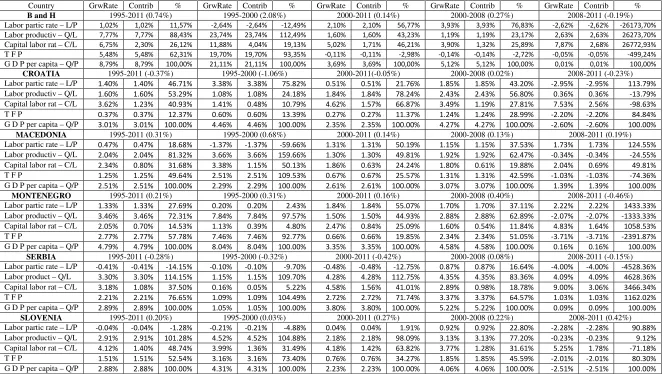
Let us see how former SFRY countries position themselves against these issues. Looking at the entire period of 1995-2011 Bosnia and Herzegovina has again achieved the best result: GDP per capita has grown in this country at an annual rate of 8,79%. Note, however, that this growth is almost entirely attributable to the first five years of post-war recovery when GDP per capita grew at 21,11%. In the following period of 2000-2011 its’ growth rate of GDP per capita does not differ significantly from that of the other countries, varying from 2,51% in Macedonia to 4,79% in Montenegro. No doubt, these are very slow rates of growth having in mind low initial level, high unemployment and high possibilities for catch-up effect. Situation is similar for a sub-period of 2000-2011. If we eliminate effect of economic crisis, and if we look solely at results for a sub-period of 2000-2008, certain improvement can be noticed in all countries. Rates of growth of GDP per capita now vary from 3, 07% in Macedonia to 5, 22% in Serbia and 5, 12% in Bosnia and Herzegovina. Nevertheless, given the initially low level, high level of
8
9
unemployment and high possibilities for catch-up effect, these results cannot be regarded as satisfactory at all.
However, closer look at the anatomy of growth reveals even worse situation, which is considerably far from being welfare improving. In fact, due to the already discussed negligible employment increase, the
participation rate contribution to the GDP per capita growth was insignificant.In the whole period
1995-2011 its’ relative contribution was even negative in Serbia (-14,15%) and Slovenia (-1,28%). In Serbia situation is even worse having in mind that Serbia experienced decline of population during the whole period, what in fact reduced negative impact of labor participation rate. In Bosnia and Herzegovina (11, 57%), Macedonia (18,68%) and Montenegro (27,69%) its’ relative contribution is also very small having in mind high level of unemployment. Exception is Croatia with relative contribution of labor participation rate of 46,71%. Note, however, that almost one third of this contribution is attributable to the decline of population that Croatia has experienced in respective period. In first five years of post-war recovery relative contribution of labor participation rate was negative in Bosnia (12,24%), Macedonia (almost -60%), Serbia (-9,70%) and Slovenia (-4,88%). In Montenegro it was almost insignificant (2,43%). These results are quite compliant with what someone would expect having in mind nature of recovery period: sudden increase in resource utilization and consequent increase in economic activity. Croatia again represents an interesting and puzzling exception: relative contribution of Croatian labor participation rate is even more significant than in the entire period (75,82% versus 46,71%).
If we take look at post recovery sub-period, we can notice that Bosnia and Herzegovina records quite encouraging relative contribution of labor participation rate: 56,77% in sub-period 2000-2011 and 76,83% in pre-crisis period 2000-2008. Note, however, that this period is characterised by negative TFP rate of growth and that productivity growth is entirely explained by an increase in capital labor ratio. In Croatia relative contribution of labor participation is small in whole post-recovery period 2000-2011 - about 22%; it is, however, very decent in pre-crisis period 2000-2008 - around 43%. In the case of Macedonia, relative contribution of labor participation rate is decent in both sub-periods: about 50% in whole period 2000-2011 and 37% in period 2000-2008. Similar situation is with Montenegro: 55% and 37% for same sub-periods respectively. In same sub-periods Serbia and Slovenia show small contribution of labor participation rate, what might be regarded as normal situation as far as Slovenia is concerned, having in mind its’ level of development and low level of unemployment, while it definitely signals deep distortion in chosen path of Serbia’s economic growth. In whole post recovery period 2000-2011 relative contribution of labor participation is even negative, around -13%, while in pre-crisis period it is only 16,64%.
The remaining growth of GDP per capita is further explained by an increase in labor productivity. On the other hand, growth of productivity is explained by an increase in the capital labor ratio and increase in TFP. Plenty of interesting results are, in that respect, presented in the table. To save space we will not further comment them leaving it to the readers.
10
demographic picture of all analysed countries. This reserve of growth, of course, has its limits: once 70% to 75% of the active population becomes employed it is not possible to rely heavily on this source of growth. Taking Serbia for example – simple exercise shows that if we assume those reserves to be exhausted over the next 40 years (assuming no further decline in population), than we can afford the absolute contribution of the participation rate to the growth of GDP per capita to be around 1.75% per year. This is a significantly better result than what we had in the last decade. The more ambitious growth of employment, the one that assumes these reserves to be exhausted over the next 30 years, implies the contribution of the participation rate to be around 2.3% per year. Even more ambitious plan that assumes the labor reserves to be exhausted within next 20 years implies the contribution of the participation rate to be 3.5%. Note that, since we assumed no further decline in population, these rates of growth also present
growth rates of employment.9 Similar exercise can be made for other countries with similar results.
Having in mind that employment is not only the main reserve of growth, but also the most important problem of all analysed countries, we can conclude that even most ambitious plan (the one that assumes the rate of employment growth of 3.5% per year in Serbia and similar for other countries) can bring these countries to a socially acceptable level of employment only after long period of two-decade intensive development. This growth scenario, without doubt, should be taken as a policy target. Note, however, that this scenario is intensive not only regarding the investment rate necessary to support it, but also regarding the institutional reforms and policy prerequisites necessary to make all those investments and other material requirements attainable. In this respect, we should again stress the crucial importance of completing the national innovation system (NIS). As the systematic generator of business ideas, NIS should be especially completed in the less developed regions of analysed countries. After all, capitals of observed states and possibly some other university centers do not have such big problems in generating business ideas. Less developed regions are those in bad need of new business ideas. They have been most heavily wounded by the model of growth inaugurated at the beginning of the century, especially by the liberalization of capital account and the consequent world market arbitrage in local spatial processes. Not less important are social innovations referring to the missing elements of the financial system. On the one side, we need to find way to increase domestic saving as a source of investment and, on the other hand, to find way to support those business ideas that the commercial banking cannot follow. This especially refers to small and medium sized companies located or expected to be located again in less developed regions. A good thing about this regional policy, among plenty of others, is the fact that this orientation allows development of activities that are much less capital intensive or, in other words, activities that require much smaller investment per worker. In other words, regional development oriented toward now neglected regions would require much smaller investment rate necessary to reach the targeted employment growth rate which is supposed to eradicate problem of unemployment within next couple of decades.
9
11
Table 2: Sources of growth of GDP per capita1
Country GrwRate Contrib % GrwRate Contrib % GrwRate Contrib % GrwRate Contrib % GrwRate Contrib %
B and H 1995-2011 (0.74%) 1995-2000 (2.08%) 2000-2011 (0.14%) 2000-2008 (0.27%) 2008-2011 (-0.19%)
Labor partic rate – L/P 1,02% 1,02% 11,57% -2,64% -2,64% -12,49% 2,10% 2,10% 56,77% 3,93% 3,93% 76,83% -2,62% -2,62% -26173,70%
Labor productiv – Q/L 7,77% 7,77% 88,43% 23,74% 23,74% 112,49% 1,60% 1,60% 43,23% 1,19% 1,19% 23,17% 2,63% 2,63% 26273,70%
Capital labor rat – C/L 6,75% 2,30% 26,12% 11,88% 4,04% 19,13% 5,02% 1,71% 46,21% 3,90% 1,32% 25,89% 7,87% 2,68% 26772,93%
T F P 5,48% 5,48% 62,31% 19,70% 19,70% 93,35% -0,11% -0,11% -2,98% -0,14% -0,14% -2,72% -0,05% -0,05% -499,24%
G D P per capita – Q/P 8,79% 8,79% 100,00% 21,11% 21,11% 100,00% 3,69% 3,69% 100,00% 5,12% 5,12% 100,00% 0,01% 0,01% 100,00%
CROATIA 1995-2011 (-0.37%) 1995-2000 (-1.06%) 2000-2011(-0.05%) 2000-2008 (0.02%) 2008-2011 (-0.23%)
Labor partic rate – L/P 1.40% 1.40% 46.71% 3.38% 3.38% 75.82% 0.51% 0.51% 21.76% 1.85% 1.85% 43.20% -2.95% -2.95% 113.79%
Labor productiv – Q/L 1.60% 1.60% 53.29% 1.08% 1.08% 24.18% 1.84% 1.84% 78.24% 2.43% 2.43% 56.80% 0.36% 0.36% -13.79%
Capital labor rat – C/L 3.62% 1.23% 40.93% 1.41% 0.48% 10.79% 4.62% 1.57% 66.87% 3.49% 1.19% 27.81% 7.53% 2.56% -98.63%
T F P 0.37% 0.37% 12.37% 0.60% 0.60% 13.39% 0.27% 0.27% 11.37% 1.24% 1.24% 28.99% -2.20% -2.20% 84.84%
G D P per capita – Q/P 3.01% 3.01% 100.00% 4.46% 4.46% 100.00% 2.35% 2.35% 100.00% 4.27% 4.27% 100.00% -2.60% -2.60% 100.00% MACEDONIA 1995-2011 (0.31%) 1995-2000 (0.68%) 2000-2011 (0.14%) 2000-2008 (0.13%) 2008-2011 (0.19%)
Labor partic rate – L/P 0.47% 0.47% 18.68% -1.37% -1.37% -59.66% 1.31% 1.31% 50.19% 1.15% 1.15% 37.53% 1.73% 1.73% 124.55%
Labor productiv – Q/L 2.04% 2.04% 81.32% 3.66% 3.66% 159.66% 1.30% 1.30% 49.81% 1.92% 1.92% 62.47% -0.34% -0.34% -24.55%
Capital labor rat – C/L 2.34% 0.80% 31.68% 3.38% 1.15% 50.13% 1.86% 0.63% 24.24% 1.80% 0.61% 19.88% 2.04% 0.69% 49.81%
T F P 1.25% 1.25% 49.64% 2.51% 2.51% 109.53% 0.67% 0.67% 25.57% 1.31% 1.31% 42.59% -1.03% -1.03% -74.36%
G D P per capita – Q/P 2.51% 2.51% 100.00% 2.29% 2.29% 100.00% 2.61% 2.61% 100.00% 3.07% 3.07% 100.00% 1.39% 1.39% 100.00% MONTENEGRO 1995-2011 (0.21%) 1995-2000 (0.31%) 2000-2011 (0.16%) 2000-2008 (0.40%) 2008-2011 (-0.46%) Labor partic rate – L/P 1.33% 1.33% 27.69% 0.20% 0.20% 2.43% 1.84% 1.84% 55.07% 1.70% 1.70% 37.11% 2.22% 2.22% 1433.33%
Labor productiv – Q/L 3.46% 3.46% 72.31% 7.84% 7.84% 97.57% 1.50% 1.50% 44.93% 2.88% 2.88% 62.89% -2.07% -2.07% -1333.33%
Capital labor rat – C/L 2.05% 0.70% 14.53% 1.13% 0.39% 4.80% 2.47% 0.84% 25.09% 1.60% 0.54% 11.84% 4.83% 1.64% 1058.53%
T F P 2.77% 2.77% 57.78% 7.46% 7.46% 92.77% 0.66% 0.66% 19.85% 2.34% 2.34% 51.05% -3.71% -3.71% -2391.87%
G D P per capita – Q/P 4.79% 4.79% 100.00% 8.04% 8.04% 100.00% 3.35% 3.35% 100.00% 4.58% 4.58% 100.00% 0.16% 0.16% 100.00% SERBIA 1995-2011 (-0.28%) 1995-2000 (-0.32%) 2000-2011 (-0.42%) 2000-2008 (0.08%) 2008-2011 (-0.15%)
Labor partic rate – L/P -0.41% -0.41% -14.15% -0.10% -0.10% -9.70% -0.48% -0.48% -12.75% 0.87% 0.87% 16.64% -4.00% -4.00% -4528.36%
Labor product – Q/L 3.30% 3.30% 114.15% 1.15% 1.15% 109.70% 4.28% 4.28% 112.75% 4.35% 4.35% 83.36% 4.09% 4.09% 4628.36%
Capital labor rat – C/L 3.18% 1.08% 37.50% 0.16% 0.05% 5.22% 4.58% 1.56% 41.01% 2.89% 0.98% 18.78% 9.00% 3.06% 3466.34%
T F P 2.21% 2.21% 76.65% 1.09% 1.09% 104.49% 2.72% 2.72% 71.74% 3.37% 3.37% 64.57% 1.03% 1.03% 1162.02%
G D P per capita – Q/P 2.89% 2.89% 100.00% 1.05% 1.05% 100.00% 3.80% 3.80% 100.00% 5.22% 5.22% 100.00% 0.09% 0.09% 100.00% SLOVENIA 1995-2011 (0.20%) 1995-2000 (0.03%) 2000-2011 (0.27%) 2000-2008 (0.22%) 2008-2011 (0.42%) Labor partic rate – L/P -0.04% -0.04% -1.28% -0.21% -0.21% -4.88% 0.04% 0.04% 1.91% 0.92% 0.92% 22.80% -2.28% -2.28% 90.88%
Labor productiv – Q/L 2.91% 2.91% 101.28% 4.52% 4.52% 104.88% 2.18% 2.18% 98.09% 3.13% 3.13% 77.20% -0.23% -0.23% 9.12%
Capital labor rat – C/L 4.12% 1.40% 48.74% 3.99% 1.36% 31.49% 4.18% 1.42% 63.82% 3.77% 1.28% 31.61% 5.25% 1.78% -71.18%
T F P 1.51% 1.51% 52.54% 3.16% 3.16% 73.40% 0.76% 0.76% 34.27% 1.85% 1.85% 45.59% -2.01% -2.01% 80.30%
G D P per capita – Q/P 2.88% 2.88% 100.00% 4.31% 4.31% 100.00% 2.23% 2.23% 100.00% 4.06% 4.06% 100.00% -2.51% -2.51% 100.00%
12
3. Demand Side of Sources of Growth
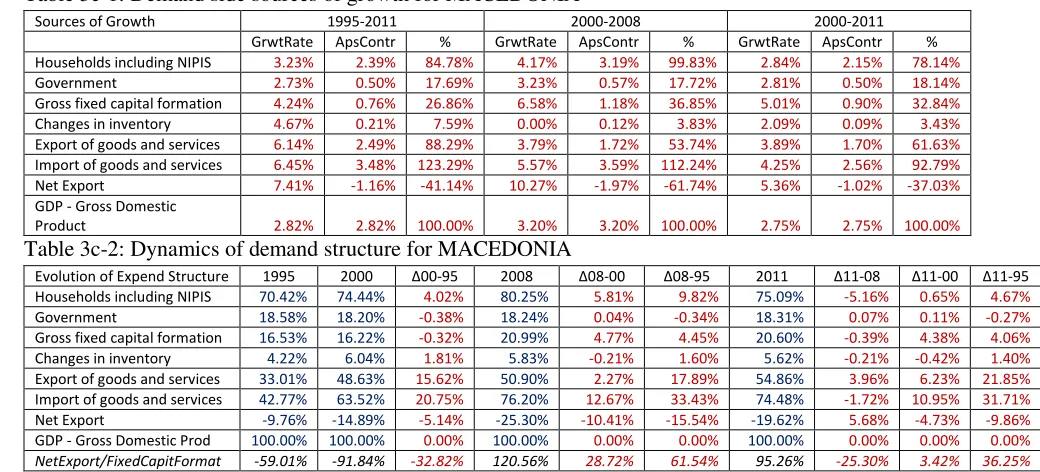
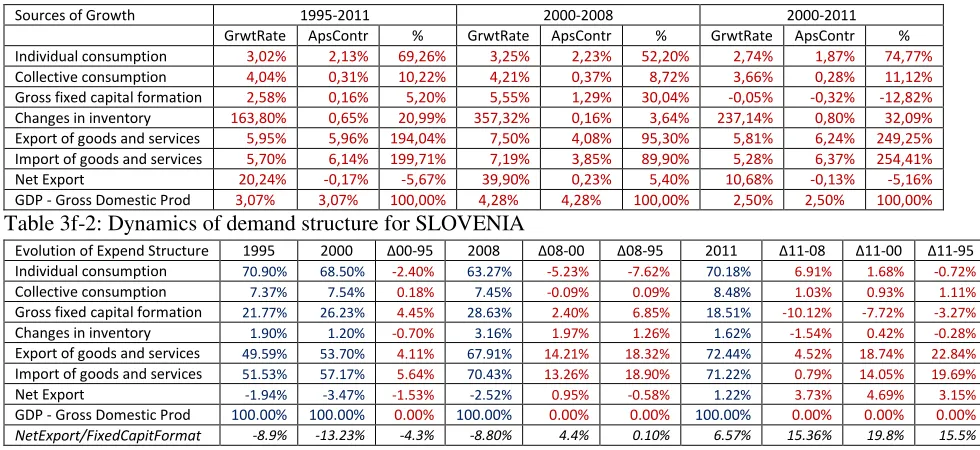
The analysis of the demand side of the sources of growth provides an additional insight into anatomy of economic growth. Results are presented in set of tables whose enumeration start with number 3. Two tables are given for each country. The first table presents absolute and relative contributions of different parts of demand to the GDP growth rate, while the second one outlines structural changes caused by these
movements.10 At the bottom of second table, we presented for each country ratio of net export to gross
capital formation.
As we can see from each country’s first table, the final consumption (household consumption, NPIS, government consumption) is most important part of aggregate demand. In whole period final consumption growth rate is smaller than that of GDP in B&H, Croatia and only slightly in Slovenia. In other countries its’ growth rate is higher than that of GDP. Its’ relative contribution to economic growth in whole period 1995-2011 varies from very high degree in Serbia (138%, data only for period 2000-2010), Montenegro (121%), Macedonia (102%), and B&H (99%) to much smaller degree in Croatia (51%) and Slovenia (79%). Note also that, in Croatia, Serbia, Montenegro and Macedonia relative contribution of final consumption increased in pre-crisis period 2000-2008, while in Slovenia and B&H it declined due to quite different reasons. The second table on the other side, describing development of demand structure in each country, proves that share of final consumption in GDP in B&H has experienced significant decline in all respective years. Similar and clear but less significant trend can be noticed in the case of Croatia. Less clear situation is in Slovenia, characterized by certain decline in final consumption in pre-crisis period (2008 compared to 1995 and 2000) and return to almost same situation in 2011 as a result of economic crisis. In another three countries we have quite opposite situation from that in Croatia and B&H. Final consumption’s share in GDP has especially increased in Montenegro: both household and government part of final expenditure increased significantly in pre-crisis period; in the whole period we can notice same increase in household expenditure and relatively important decline in government part of expenditure. Similar, but less pronounced trend can be noticed in Macedonia. Serbia is the most interesting case. Comparing data for 2008 to that of previous years, we can notice increase in household consumption and significant decline in government part of final consumption. Afterwards we witnessed dramatic changes in only three post-crisis years: both household and government consumption declined dramatically.
Next important element of aggregate demand is the gross fixed capital formation. Generally speaking we may say that it have experienced strong growth and have had significant contribution to the GDP growth rate. Nevertheless, as we already know from previous analysis, it was not at the level that would be of much help in optimizing welfare increase in analysed countries. Its’ relative contribution to the growth rate of GDP in whole period 1995-2011 varies from 21% in Slovenia to around 34% in B&H and Croatia. While in B&H its’ contribution decrease when we compare period 2000-2008 to whole period of analysis (from 34% to 22%) it increase dramatically in the case of Montenegro (from 22% to 81%) and somewhat
10
13
less dramatically in the case of Macedonia (from 27% to 37%) and in the case of Croatia (from 34% to 49%). Not surprisingly, in the period 2000-2011 its’ contribution is, due to economic crisis, less important than in period 2000-2008. Its’ share in GDP increased in period 1995-2008 in all observed countries: in Montenegro for 22%, in B&H for 15%, in Croatia for 14%, in Serbia for 13%, in Slovenia for 7% and in Macedonia for 4,45%. In last three post-crisis years its’ share dropped in all countries as compared to 2008.
Finally and most interestingly, the negative value of net export characteristic for all countries in all years (except for Slovenia), also had the high absolute and relative contribution to the GDP growth rate in almost all countries. Its relative contribution to the GDP growth rate in whole period varies from -47% in Montenegro to -5,67% in Slovenia. Its’ relative contribution especially increased during sub-period 2000-2008. As a consequence, the share of negative net export especially increased during the pre-crisis period between 2000 and 2008. The share of net export in GDP was especially high in Montenegro (-55% in 2008 and -33% in 2011), markedly smaller in Serbia (-27% in 2008 and -17% in 2011), B&H (-29% in 2008 and -21% in 2011) and Macedonia (-25% in 2008 and -20% in 2011), and almost negligible in Croatia (-8% in 2008 and -0,1% in 2011) and Slovenia (-2,52% in 2008 and +1,22% in 2011). So, final consumption and investment expenditures of all countries, with exception of Slovenia and Croatia, can be regarded as highly dependent on negative net export.
14
Table 3a-1: Demand side sources of growth for BOSNIA AND HERZEGOVINA
Sources of Growth 1995-2011 2000-2008 2000-2011 GrwtRate ApsContr % GrwtRate ApsContr % GrwtRate ApsContr % Households including NIPIS 7,51% 7,27% 77,85% 2,85% 2,64% 52,83% 1,96% 1,82% 51,21%
Government 9,00% 1,96% 20,98% 4,72% 0,98% 19,63% 3,94% 0,82% 23,03%
Gross fixed capital formation 12,55% 3,11% 33,33% 5,12% 1,11% 22,26% 0,40% 0,05% 1,35%
Changes in inventory -100,00% -0,25% -2,64% 0,00% -0,18% -3,58% -17,50% -0,23% -6,49%
Export of goods and services 13,46% 3,53% 37,80% 7,06% 2,07% 41,33% 6,02% 1,79% 50,29%
Import of goods and services 7,94% 5,97% 63,97% 2,75% 1,78% 35,48% 1,19% 0,70% 19,74%
Net Export 3,51% -4,14% -44,35% -0,70% 0,15% 2,90% -3,56% 0,83% 23,24%
GDP - Gross Domestic
[image:15.612.71.567.84.319.2]Product 9,53% 9,33% 100,00% 5,39% 5,00% 100,00% 3,84% 3,56% 100,00%
Table 3a-2: Dynamics of demand structure for BOSNIA AND HERZEGOVINA
Evolution of Expend Structure 1995 2000 Δ00-95 2008 Δ08-00 Δ08-95 2011 Δ11-08 Δ11-00 Δ11-95 Households including NIPIS 108,30% 98,24% -10,1% 80,83% -17,41% -27,47% 80,35% -0,48% -17,89% -27,95%
Government 22,77% 20,85% -1,92% 19,82% -1,03% -2,96% 21,08% 1,26% 0,23% -1,69%
Gross fixed capital formation 12,27% 27,46% 15,19% 26,91% -0,55% 14,64% 18,96% -7,95% -8,51% 6,69%
Changes in inventory 7,71% 0,00% -7,71% 1,38% 1,38% -6,33% 0,27% -1,11% 0,27% -7,45%
Export of goods and services 20,41% 28,53% 8,12% 32,37% 3,85% 11,96% 35,85% 3,48% 7,32% 15,44%
Import of goods and services 71,47% 75,07% 3,61% 61,30% -13,77% -10,17% 56,50% -4,80% -18,57% -14,96%
Net Export -51,06% -46,55% 4,51% -28,93% 17,62% 22,13% -20,65% 8,27% 25,89% 30,40%
GDP - Gross Domestic Prod 100,00% 100,00% 0,00% 100,00% 0,00% 0,00% 100,00% 0,00% 0,00% 0,00%
[image:15.612.69.552.382.637.2]NetExport/FixedCapitFormat -416,2% -169,5% 246,7% -107,5% 61,99% 308,65% -108,96% -1,45% 60,54% 307,20% Sources: Authors calculations based on national statistical offices data and on the basis of UN data set.
Table 3b-1: Demand side sources of growth for CROATIA
Sources of Growth 1995-2011 2000-2008 2000-2011 GrwtRate ApsContr % GrwtRate ApsContr % GrwtRate ApsContr % Households 1.86% 1.16% 43.84% 3.69% 2.22% 51.73% 1.96% 1.21% 52.59%
NIPIS 0.68% 0.01% 0.40% -1.78% -0.03% -0.69% -1.46% -0.02% -1.00%
Government 1.01% 0.18% 6.98% 2.04% 0.37% 8.69% 1.20% 0.22% 9.42%
Gross fixed capital formation 4.76% 0.89% 33.88% 9.19% 2.09% 48.61% 2.22% 0.53% 22.83%
Changes in inventory 2.99% 0.07% 2.57% 0.02% 0.50% 11.55% -245.39% 0.28% 12.12%
Export of goods and services 4.14% 1.61% 60.89% 4.41% 1.86% 43.35% 2.32% 1.00% 43.61%
Import of goods and services 2.69% 1.24% 46.99% 5.69% 2.74% 63.71% 1.68% 0.86% 37.37%
Net Export -22.37% 0.25% 9.48% 16.92% -0.89% -20.65% -25.40% 0.06% 2.57%
GDP - Gross Domestic
Product 2.64% 2.64% 100.00% 4.29% 4.29% 100.00% 2.30% 2.30% 100.00%
Table 3b-2: Dynamics of demand structure for CROATIA
Evolution of Expend Structure 1995 2000 Δ00-95 2008 Δ08-00 Δ08-95 2011 Δ11-08 Δ11-00 Δ11-95 Households 65.73% 60.37% -5.36% 57.64% -2.73% -8.09% 58.19% 0.55% -2.18% -7.54%
NIPIS 1.31% 1.45% 0.14% 0.90% -0.55% -0.41% 0.96% 0.06% -0.49% -0.35%
Government 25.67% 22.39% -3.28% 18.79% -3.60% -6.88% 19.88% 1.09% -2.51% -5.79%
Gross fixed capital formation 13.54% 18.95% 5.41% 27.35% 8.40% 13.81% 18.79% -8.56% -0.16% 5.25%
Changes in inventory 2.16% -0.05% -2.21% 3.08% 3.13% 0.92% 2.28% -0.80% 2.33% 0.12%
Export of goods and services 33.13% 41.69% 8.56% 42.06% 0.38% 8.94% 41.78% -0.28% 0.09% 8.65%
Import of goods and services 41.54% 44.80% 3.26% 49.83% 5.03% 8.29% 41.88% -7.95% -2.92% 0.34%
Net Export -8.41% -3.11% 5.30% -7.76% -4.65% 0.65% -0.10% 7.67% 3.02% 8.31%
GDP - Gross Domestic Product 100.00% 100.00% 0.00% 100.00% 0.00% 0.00% 100.00% 0.00% 0.00% 0.00%
15
Table 3c-1: Demand side sources of growth for MACEDONIA
Sources of Growth 1995-2011 2000-2008 2000-2011 GrwtRate ApsContr % GrwtRate ApsContr % GrwtRate ApsContr % Households including NIPIS 3.23% 2.39% 84.78% 4.17% 3.19% 99.83% 2.84% 2.15% 78.14%
Government 2.73% 0.50% 17.69% 3.23% 0.57% 17.72% 2.81% 0.50% 18.14%
Gross fixed capital formation 4.24% 0.76% 26.86% 6.58% 1.18% 36.85% 5.01% 0.90% 32.84%
Changes in inventory 4.67% 0.21% 7.59% 0.00% 0.12% 3.83% 2.09% 0.09% 3.43%
Export of goods and services 6.14% 2.49% 88.29% 3.79% 1.72% 53.74% 3.89% 1.70% 61.63%
Import of goods and services 6.45% 3.48% 123.29% 5.57% 3.59% 112.24% 4.25% 2.56% 92.79%
Net Export 7.41% -1.16% -41.14% 10.27% -1.97% -61.74% 5.36% -1.02% -37.03%
GDP - Gross Domestic
[image:16.612.70.573.112.345.2]Product 2.82% 2.82% 100.00% 3.20% 3.20% 100.00% 2.75% 2.75% 100.00%
Table 3c-2: Dynamics of demand structure for MACEDONIA
Evolution of Expend Structure 1995 2000 Δ00-95 2008 Δ08-00 Δ08-95 2011 Δ11-08 Δ11-00 Δ11-95 Households including NIPIS 70.42% 74.44% 4.02% 80.25% 5.81% 9.82% 75.09% -5.16% 0.65% 4.67%
Government 18.58% 18.20% -0.38% 18.24% 0.04% -0.34% 18.31% 0.07% 0.11% -0.27%
Gross fixed capital formation 16.53% 16.22% -0.32% 20.99% 4.77% 4.45% 20.60% -0.39% 4.38% 4.06%
Changes in inventory 4.22% 6.04% 1.81% 5.83% -0.21% 1.60% 5.62% -0.21% -0.42% 1.40%
Export of goods and services 33.01% 48.63% 15.62% 50.90% 2.27% 17.89% 54.86% 3.96% 6.23% 21.85%
Import of goods and services 42.77% 63.52% 20.75% 76.20% 12.67% 33.43% 74.48% -1.72% 10.95% 31.71%
Net Export -9.76% -14.89% -5.14% -25.30% -10.41% -15.54% -19.62% 5.68% -4.73% -9.86%
GDP - Gross Domestic Prod 100.00% 100.00% 0.00% 100.00% 0.00% 0.00% 100.00% 0.00% 0.00% 0.00%
NetExport/FixedCapitFormat -59.01% -91.84% -32.82% 120.56% 28.72% 61.54% 95.26% -25.30% 3.42% 36.25% Sources: Authors calculations based on national statistical offices data and on the basis of UN data set.
Table 3d-1: Demand side sources of growth for MONTENEGRO
Sources of Growth 1995-2011 2000-2008 2000-2011 GrwtRate ApsContr % GrwtRate ApsContr % GrwtRate ApsContr % Households including NIPIS 6,68% 5,08% 101,55% 8,52% 6,68% 134,02% 6,21% 4,80% 136,64%
Government 3,61% 0,95% 18,99% 5,39% 1,26% 25,23% 2,00% 0,58% 16,46%
Investment in fixed asset 6,11% 1,09% 21,79% 16,29% 4,03% 80,79% 4,91% 0,88% 25,18%
Changes in inventory 1,46% 0,21% 4,29% -5,28% -0,03% -0,66% -7,27% -0,08% -2,17%
Net Export 10,46% -2,33% -46,63% 24,10% -6,94% -139,38% 11,62% -2,67% -76,12%
GDP - Gross Domestic Prod 5,00% 5,00% 100,00% 4,98% 4,98% 100,00% 3,51% 3,51% 100,00%
Table 3d-2: Dynamics of demand structure for MONTENEGRO
Evolution of Expend Struct 1995 2000 Δ00-95 2008 Δ08-00 Δ08-95 2011 Δ11-08 Δ11-00 Δ11-95 Households including NIPIS 72.06% 69.97% -2.09% 91.22% 21.25% 19.16% 92.89% 1.67% 22.92% 20.83%
Government 23.10% 21.93% -1.17% 22.62% 0.69% -0.48% 18.66% -3.96% -3.27% -4.44%
Investment in fixed asset 16.54% 16.87% 0.33% 38.25% 21.38% 21.71% 21.20% -17.05% 4.33% 4.66%
Changes in inventory 2.85% 5.51% 2.67% 2.42% -3.09% -0.43% 0.00% -2.42% -5.51% -2.85%
Net Export -14.56% -14.30% 0.26% -54.52% -40.22% -39.96% -32.75% 21.77% -18.46% -18.20%
GDP - Gross Domestic Prod 100.00% 100.00% 0.00% 100.00% 0.00% 0.00% 100.00% 0.00% 0.00% 0.00%
[image:16.612.73.582.432.616.2] [image:16.612.69.584.434.617.2]16
Table 3e-1: Demand side sources of growth for SERBIA
Sources of Growth 2000-2008 2000-2010 GrwtRate ApsContr % GrwtRate ApsContr % Individual consumption 5,53% 4,90% 99,18% 4,52% 3,97% 108,07%
Collective consumption 0,33% -0,01% -0,17% -0,59% -0,07% -1,83%
Gross fixed capital formation 14,47% 2,29% 46,29% 8,77% 1,17% 31,99%
Changes in inventory -100,76% 1,51% 30,64% -94,10% 0,56% 15,22%
Export of goods and services 24,43% 3,86% 78,09% 20,94% 3,44% 93,84%
Import of goods and services 29,27% 7,61% 154,04% 22,60% 5,41% 147,29%
Net Export 39,68% -3,75% -75,95% 27,86% -1,96% -53,45%
GDP - Gross Domestic Prod 4,94% 4,94% 100,00% 3,67% 3,67% 100,00%
Table 3e-2: Dynamics of demand structure for SERBIA
Evolution of Expend Struct 1997 2000 Δ00-97 2008 Δ08-00 Δ08-97 2011 Δ11-08 Δ11-00 Δ11-97 Individual consumption 81,82% 86,51% 4,69% 90,05% 3,54% 8,23% 77,90% -12,15% -8,61% -3,92%
Collective consumption 12,79% 10,69% -2,10% 7,06% -3,63% -5,73% 6,06% -1,00% -4,63% -6,73%
Gross fixed capital format 10,41% 12,71% 2,30% 23,76% 11,05% 13,35% 19,84% -3,92% 7,13% 9,43%
Changes in inventory 1,28% -4,56% -5,84% 5,97% 10,53% 4,69% -0,61% -6,58% 3,95% -1,89%
Export of goods and servic 18,47% 11,33% -7,14% 31,39% 20,05% 12,92% 37,35% 5,96% 26,02% 18,88%
Import of goods and serv 24,77% 16,69% -8,08% 58,25% 41,56% 33,48% 54,46% -3,79% 37,77% 29,69%
Net Export -6,30% -5,36% 0,94% -26,86% -21,50% -20,56% -17,11% 9,75% -11,75% -10,81%
GDP - Gross Domestic Pr 100.00% 100.00% 0.00% 100.00% 0.00% 0.00% 100.00% 0.00% 0.00% 0.00%
NetExport/FixedCapitFor -60,5% -42,14% 18,4% -113,04% -70,9% -52,53% -86,22% 26,82% -44,1% -25,7%
[image:17.612.64.562.392.619.2]Sources: Authors calculations based on national statistical offices data and on the basis of UN data set.
Table 3f-1: Demand side sources of growth for SLOVENIA
Sources of Growth 1995-2011 2000-2008 2000-2011 GrwtRate ApsContr % GrwtRate ApsContr % GrwtRate ApsContr % Individual consumption 3,02% 2,13% 69,26% 3,25% 2,23% 52,20% 2,74% 1,87% 74,77%
Collective consumption 4,04% 0,31% 10,22% 4,21% 0,37% 8,72% 3,66% 0,28% 11,12%
Gross fixed capital formation 2,58% 0,16% 5,20% 5,55% 1,29% 30,04% -0,05% -0,32% -12,82%
Changes in inventory 163,80% 0,65% 20,99% 357,32% 0,16% 3,64% 237,14% 0,80% 32,09%
Export of goods and services 5,95% 5,96% 194,04% 7,50% 4,08% 95,30% 5,81% 6,24% 249,25%
Import of goods and services 5,70% 6,14% 199,71% 7,19% 3,85% 89,90% 5,28% 6,37% 254,41%
Net Export 20,24% -0,17% -5,67% 39,90% 0,23% 5,40% 10,68% -0,13% -5,16%
[image:17.612.70.560.395.620.2]GDP - Gross Domestic Prod 3,07% 3,07% 100,00% 4,28% 4,28% 100,00% 2,50% 2,50% 100,00%
Table 3f-2: Dynamics of demand structure for SLOVENIA
Evolution of Expend Structure 1995 2000 Δ00-95 2008 Δ08-00 Δ08-95 2011 Δ11-08 Δ11-00 Δ11-95 Individual consumption 70.90% 68.50% -2.40% 63.27% -5.23% -7.62% 70.18% 6.91% 1.68% -0.72%
Collective consumption 7.37% 7.54% 0.18% 7.45% -0.09% 0.09% 8.48% 1.03% 0.93% 1.11%
Gross fixed capital formation 21.77% 26.23% 4.45% 28.63% 2.40% 6.85% 18.51% -10.12% -7.72% -3.27%
Changes in inventory 1.90% 1.20% -0.70% 3.16% 1.97% 1.26% 1.62% -1.54% 0.42% -0.28%
Export of goods and services 49.59% 53.70% 4.11% 67.91% 14.21% 18.32% 72.44% 4.52% 18.74% 22.84%
Import of goods and services 51.53% 57.17% 5.64% 70.43% 13.26% 18.90% 71.22% 0.79% 14.05% 19.69%
Net Export -1.94% -3.47% -1.53% -2.52% 0.95% -0.58% 1.22% 3.73% 4.69% 3.15%
GDP - Gross Domestic Prod 100.00% 100.00% 0.00% 100.00% 0.00% 0.00% 100.00% 0.00% 0.00% 0.00%
NetExport/FixedCapitFormat -8.9% -13.23% -4.3% -8.80% 4.4% 0.10% 6.57% 15.36% 19.8% 15.5%
17
4. Sectoral Side of Sources of Growth
The results of sectoral side sources-of-growth-analysis are presented in the following set of tables which enumeration starts with number 4. Each country is presented with two tables. The analysis of contributions of different sectors to the economic growth is given in the first table. The resulting changes of the sectoral structure of the economy are presented in the second table that follows after that.
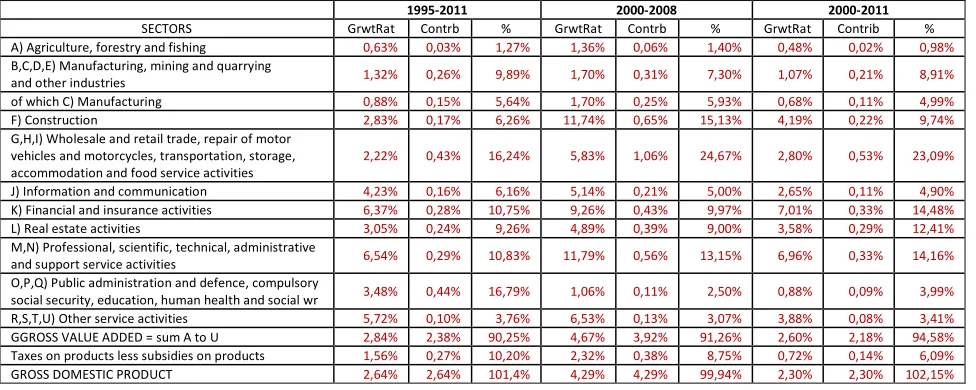
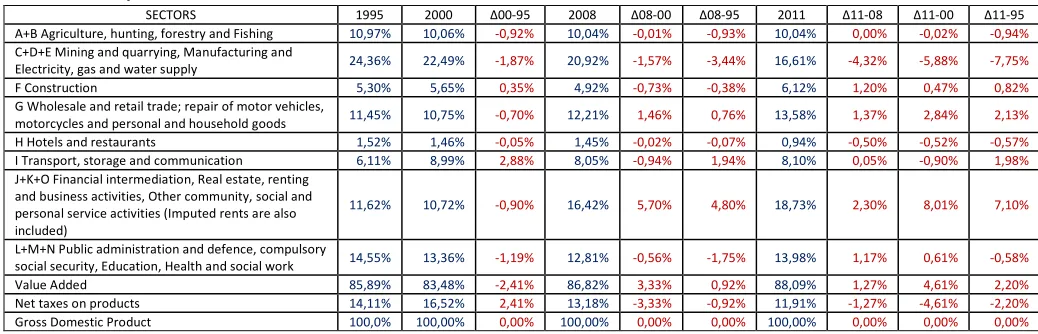
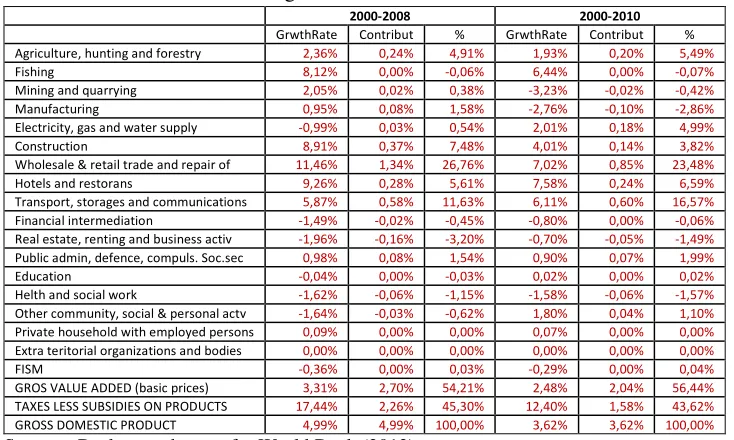
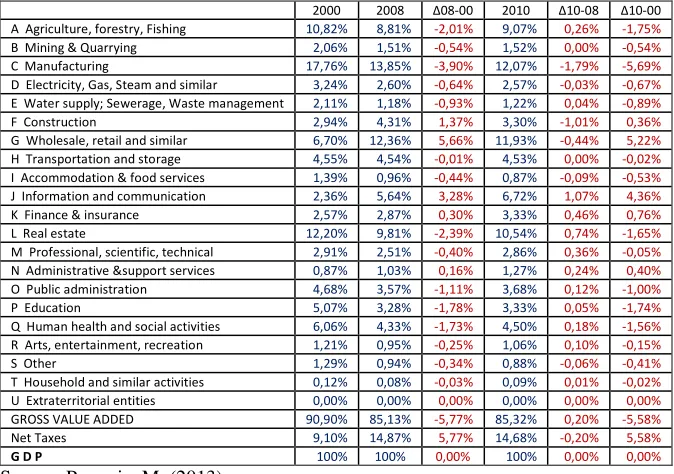
The presented results on trends and structural changes are not surprising, having in mind the existing model of growth in which foreign capital plays the most important role in the dynamics of the economy. Most interesting result is the negligible absolute and relative contribution of industry and within it of manufacturing. As a result, share of whole industry and especially of highly value added manufacturing declined substantially in almost all countries. This trend is especially pronounced in Serbia (decline of industry share in GDP for almost 7% from 2000 till 2010 and decline of manufacturing for 5,69% in a same period), Montenegro (decline of industry share for 6,10% and of manufacturing for 4,70% in respected decade), Macedonia (decline of industry for 7,75 from 1995 till 2011), and Croatia (decline of industry for 4,05% and of manufacturing for 4,41% from 1995 till 2011). Although les pronounced, same trend can be clearly noticed for Slovenia where industry share dropped for 3,23% while manufacturing dropped for 3,79% from 1995 to 2011. Interestingly enough, we cannot notice same trend in the case of Bosnia and Herzegovina: industry share is here almost unchanged in last decade of its growth. Having in mind, however, that its’ share in GDP in respected period, about 17%, is much smaller than what it used to be before war, we can with certainty conclude that B&H have experienced same transformation. In general we can rightfully speak about dramatic deindustrialization of whole region.
Not less obvious are the results on the contribution of the broadly defined “trade” (row G) and other service sectors to the economic growth. Its absolute and relative contribution to the GDP growth rate was significant in all countries. As a consequence, share of these sectors increased dramatically. These changes are in fact mirror image of the above discussed trend of deindustrialisation. Needless to say, there is nothing wrong in development of service sectors. On the contrary, development of nations is followed with increase of service sectors share. However, if we take a closer look at our sample of countries we will notice that service sectors they have been developing so far are speculative in its’ nature and not sustainable in the long run. In that respect Serbia is paradigmatic, where share of broadly defined ‘trade’ almost doubled in respective period: its’ share increased from 6,7% in 2000 to 12,36% in 2008. Similar trend can be noticed in Macedonia (increase of ‘trade’ from 11% to almost 14% in 2011), Bosnia and Herzegovina (increase from 8% to 13%), and even in Slovenia. In the case of Croatia and Montenegro we can’t notice such trend: share of ‘trade’ is almost unchanged in respective periods. However, if we take look at the share of ‘trade’ in these two countries reached at the beginning of respective periods we can notice that it already was at the very high level reached by other countries from our sample during first decade of this century. For example, share of ‘trade’ in 2000 was 12,80% in Montenegro. In Croatia it was a bit lower but still very high – 10,83%. So, we can, with great certainty, conclude that all of the former SFRY countries have experienced speculative ‘trade’ bubble at end of the last and at the beginning of this century.
18
[image:19.612.71.499.184.363.2]a result of the appreciation of the real exchange rate, caused by positive net capital inflow and high level of remittances, the terms of trade in our countries changed in a way that have had the negative effect on the growth of export-related activities, mostly the “industry” sector and especially manufacture, and the positive effect on the growth of import-related activities, such as the broadly defined ‘trade’. Needless to say, this ‘trade’ bubble is the result of the same global processes that produced bubbles in the financial sectors of developed countries.
Table 4a-1: Sectoral sources of growth for BOSNIA AND HERZEGOVINA
2000-2008 2000-2011
SECTORS GrwthRat ApsolCon % GrwthRat ApsolCon %
A+B Agriculture, hunting, forestry and Fishing 2,56% 0,22% 4,11% 1,07% 0,10% 2,72%
C+D+E Mining and quarrying, Manufacturing
and Electricity, gas and water supply 5,82% 0,98% 18,12% 4,25% 0,72% 18,75%
F Construction 4,34% 0,19% 3,58% 0,33% 0,01% 0,21%
G Wholesale and retail trade; repair of motor vehicles,
motorcycles and personal and household goods 11,62% 1,25% 23,14% 8,12% 0,88% 22,96%
H Hotels and restaurants 1,89% 0,05% 0,87% 1,41% 0,04% 0,92%
I Transport, storage and communication 4,53% 0,34% 6,24% 3,44% 0,26% 6,66%
J+K+O Financial intermediation, Real estate, renting and business act, Other community, social and personal service activities (Imputed rents are also included)
3,39% 0,54% 9,94% 3,10% 0,48% 12,53%
L+M+N Public administration and defence, compulsory social security, Education, Health and social work
4,97% 0,85% 15,84% 4,12% 0,71% 18,56%
Less: Financial intermediation services indirectly measured (FISIM) 14,54% 0,29% 5,38% 10,70% 0,22% 5,71%
Value Added 5,06% 4,11% 76,38% 3,64% 2,96% 77,18%
Net taxes on products 6,92% 1,26% 23,44% 4,79% 0,88% 22,98%
GDP - Gross Domestic Product 5,38% 5,38% 100,00% 3,84% 3,84% 100,00%
Table 4a-2: Dynamics of sectoral structure for BOSNIA AND HERZEGOVINA
SECTORS 2000 2008 Δ08-00 2011 Δ11-08 Δ11-00
A+B Agriculture, hunting, forestry and Fishing 9,29% 7,48% -1,81% 6,90% -0,57% -2,38%
C+D+E Mining and quarrying, Manufacturing
and Electricity, gas and water supply 17,04% 17,61% 0,57% 17,81% 0,20% 0,77%
F Construction 5,86% 5,41% -0,45% 4,02% -1,40% -1,84%
G Wholesale and retail trade; repair of motor vehicles,
motorcycles and personal and household goods 8,41% 13,33% 4,91% 13,13% -0,20% 4,72%
H Hotels and restaurants 2,63% 2,01% -0,62% 2,03% 0,02% -0,60%
I Transport, storage and communication 7,16% 6,71% -0,45% 6,86% 0,15% -0,30%
J+K+O Financial intermediation, Real estate, renting and business act, Other community, social and personal service activities (Imputed rents are also included)
16,13% 13,84% -2,28% 14,92% 1,07% -1,21%
L+M+N Public administration and defence, compulsory social
security, Education, Health and social work 18,33% 17,76% -0,57% 18,88% 1,12% 0,55%
Less: Financial intermediation services indirectly measured (FISIM) 1,42% 2,76% 1,34% 2,87% 0,11% 1,45%
Value Added 83,43% 81,40% -2,04% 81,69% 0,29% -1,75%
Net taxes on products 16,57% 18,60% 2,04% 18,31% -0,29% 1,75%
GDP - Gross Domestic Product 100,00% 100,00% 0,00% 100,00% 0,00% 0,00%
[image:19.612.71.476.412.577.2]19
Table 4b-1: Sectoral sources of growth for CROATIA
1995-2011 2000-2008 2000-2011
SECTORS GrwtRat Contrb % GrwtRat Contrb % GrwtRat Contrib %
A) Agriculture, forestry and fishing 0,63% 0,03% 1,27% 1,36% 0,06% 1,40% 0,48% 0,02% 0,98%
B,C,D,E) Manufacturing, mining and quarrying
and other industries 1,32% 0,26% 9,89% 1,70% 0,31% 7,30% 1,07% 0,21% 8,91%
of which C) Manufacturing 0,88% 0,15% 5,64% 1,70% 0,25% 5,93% 0,68% 0,11% 4,99%
F) Construction 2,83% 0,17% 6,26% 11,74% 0,65% 15,13% 4,19% 0,22% 9,74%
G,H,I) Wholesale and retail trade, repair of motor vehicles and motorcycles, transportation, storage, accommodation and food service activities
2,22% 0,43% 16,24% 5,83% 1,06% 24,67% 2,80% 0,53% 23,09%
J) Information and communication 4,23% 0,16% 6,16% 5,14% 0,21% 5,00% 2,65% 0,11% 4,90%
K) Financial and insurance activities 6,37% 0,28% 10,75% 9,26% 0,43% 9,97% 7,01% 0,33% 14,48%
L) Real estate activities 3,05% 0,24% 9,26% 4,89% 0,39% 9,00% 3,58% 0,29% 12,41%
M,N) Professional, scientific, technical, administrative
and support service activities 6,54% 0,29% 10,83% 11,79% 0,56% 13,15% 6,96% 0,33% 14,16%
O,P,Q) Public administration and defence, compulsory
social security, education, human health and social wr 3,48% 0,44% 16,79% 1,06% 0,11% 2,50% 0,88% 0,09% 3,99%
R,S,T,U) Other service activities 5,72% 0,10% 3,76% 6,53% 0,13% 3,07% 3,88% 0,08% 3,41%
GGROSS VALUE ADDED = sum A to U 2,84% 2,38% 90,25% 4,67% 3,92% 91,26% 2,60% 2,18% 94,58%
Taxes on products less subsidies on products 1,56% 0,27% 10,20% 2,32% 0,38% 8,75% 0,72% 0,14% 6,09%
GROSS DOMESTIC PRODUCT 2,64% 2,64% 101,4% 4,29% 4,29% 99,94% 2,30% 2,30% 102,15%
Table 4b-2: Dynamics of sectoral structure for CROATIA
SECTORS 1995 2000 Δ00-95 2008 Δ08-00 Δ08-95 2011 Δ11-08 Δ11-00 Δ11-95
A) Agriculture, forestry and fishing 6,06% 5,38% -0,68% 4,28% -1,10% -1,78% 4,41% 0,13% -0,97% -1,65%
B,C,D,E) Manufacturing, mining and quarrying
and other industries 21,61% 20,1% -1,55% 16,40% -3,67% -5,21% 17,56% 1,16% -2,51% -4,05%
of which C) Manufacturing 18,26% 16,5% -1,76% 13,50% -3,01% -4,76% 13,85% 0,35% -2,66% -4,41%
F) Construction 4,98% 4,19% -0,79% 7,28% 3,08% 2,30% 5,13% -2,15% 0,94% 0,15%
G,H,I) Wholesale and retail trade, repair of motor vehicles and motorcycles, transportation, storage,
accommodation and food service activities 18,61% 16,5% -2,11% 18,55% 2,04% -0,06% 17,42% -1,13% 0,91% -1,19%
of which G) Trade and similar 10,83% 9,04% -1,79% 10,73% 1,69% -0,10%
J) Information and communication 3,26% 4,02% 0,75% 4,28% 0,27% 1,02% 4,17% -0,11% 0,15% 0,91%
K) Financial and insurance activities 3,59% 3,87% 0,29% 5,62% 1,74% 2,03% 6,35% 0,74% 2,48% 2,77%
L) Real estate activities 8,68% 8,08% -0,61% 8,45% 0,38% -0,23% 9,26% 0,80% 1,18% 0,57%
M,N) Professional, scientific, technical, administrative
and support service activities 3,33% 3,70% 0,37% 6,46% 2,75% 3,12% 6,05% -0,41% 2,34% 2,72%
O,P,Q) Public administration and defence, compulsory
social security, education, human health and social wr 11,61% 15,4% 3,80% 11,98% -3,44% 0,36% 13,22% 1,24% -2,19% 1,61%
R,S,T,U) Other service activities 1,35% 1,83% 0,48% 2,17% 0,34% 0,82% 2,17% 0,00% 0,34% 0,82%
GGROSS VALUE ADDED = sum A to U 83,09% 83,1% -0,03% 85,46% 2,40% 2,37% 85,73% 0,27% 2,67% 2,64%
Taxes on products less subsidies on products 16,91% 16,9% 0,03% 14,54% -2,40% -2,37% 14,27% -0,27% -2,67% -2,64%
GROSS DOMESTIC PRODUCT 100,00% 100% 0,00% 100,00% 0,00% 0,00% 100,00% 0,00% 0,00% 0,00%
[image:20.612.70.588.356.551.2]20
Table 4c-1: Sectoral sources of growth for MACEDONIA
1995-2011 2000-2008 2000-2011
SECTORS GrwtRat Contrb % GrwtRat Contrb % GrwtRat Contrib %
A+B Agriculture, hunting, forestry and Fishing 2,20% 0,23% 8,17% 3,18% 0,33% 10,18% 2,48% 0,25% 10,16%
C+D+E Mining and quarrying, Manufacturing and
Electricity, gas and water supply 0,22% 0,06% 2,30% 2,27% 0,45% 13,93% -0,06% 0,00% 0,15%
F Construction 3,80% 0,21% 7,46% 1,42% 0,08% 2,60% 3,18% 0,18% 7,09%
G Wholesale and retail trade; repair of motor vehicles,
motorcycles and personal and household goods 3,99% 0,49% 17,45% 4,86% 0,60% 18,67% 4,52% 0,56% 22,47%
H Hotels and restaurants -0,38% 0,00% 0,12% 3,03% 0,04% 1,40% -1,18% -0,01% -0,33%
I Transport, storage and communication 4,76% 0,36% 12,73% 1,78% 0,14% 4,45% 1,60% 0,12% 4,99%
J+K+O Financial intermediation, Real estate, renting and business activities, Other community, social and personal service activities (Imputed rents are also included)
6,14% 0,87% 30,99% 8,85% 1,20% 37,56% 7,38% 1,06% 42,28%
L+M+N Public administration and defence, compulsory
social security, Education, Health and social work 2,54% 0,35% 12,38% 2,65% 0,36% 11,16% 2,88% 0,39% 15,59%
Value Added 2,99% 2,57% 91,19% 3,70% 3,17% 99,00% 2,96% 2,54% 101,66%
Net taxes on products 1,66% 0,23% 8,33% 0,33% 0,01% 0,18% -0,26% -0,06% -2,25%
[image:21.612.70.589.336.503.2]Gross Domestic Product 2,81% 2,81% 100,0% 3,20% 3,20% 100,00% 2,50% 2,50% 100,00%
Table 4c-2: Dynamics of sectoral structure for MACEDONIA
SECTORS 1995 2000 Δ00-95 2008 Δ08-00 Δ08-95 2011 Δ11-08 Δ11-00 Δ11-95
A+B Agriculture, hunting, forestry and Fishing 10,97% 10,06% -0,92% 10,04% -0,01% -0,93% 10,04% 0,00% -0,02% -0,94% C+D+E Mining and quarrying, Manufacturing and
Electricity, gas and water supply 24,36% 22,49% -1,87% 20,92% -1,57% -3,44% 16,61% -4,32% -5,88% -7,75%
F Construction 5,30% 5,65% 0,35% 4,92% -0,73% -0,38% 6,12% 1,20% 0,47% 0,82%
G Wholesale and retail trade; repair of motor vehicles,
motorcycles and personal and household goods 11,45% 10,75% -0,70% 12,21% 1,46% 0,76% 13,58% 1,37% 2,84% 2,13%
H Hotels and restaurants 1,52% 1,46% -0,05% 1,45% -0,02% -0,07% 0,94% -0,50% -0,52% -0,57%
I Transport, storage and communication 6,11% 8,99% 2,88% 8,05% -0,94% 1,94% 8,10% 0,05% -0,90% 1,98%
J+K+O Financial intermediation, Real estate, renting and business activities, Other community, social and personal service activities (Imputed rents are also included)
11,62% 10,72% -0,90% 16,42% 5,70% 4,80% 18,73% 2,30% 8,01% 7,10%
L+M+N Public administration and defence, compulsory
social security, Education, Health and social work 14,55% 13,36% -1,19% 12,81% -0,56% -1,75% 13,98% 1,17% 0,61% -0,58%
Value Added 85,89% 83,48% -2,41% 86,82% 3,33% 0,92% 88,09% 1,27% 4,61% 2,20%
Net taxes on products 14,11% 16,52% 2,41% 13,18% -3,33% -0,92% 11,91% -1,27% -4,61% -2,20%
Gross Domestic Product 100,0% 100,00% 0,00% 100,00% 0,00% 0,00% 100,00% 0,00% 0,00% 0,00%