Acta Cryst.(2003). E59, i83±i85 DOI: 10.1107/S1600536803009553 Alexandra Goriounovaet al. TbB3O6
i83
inorganic papers
Acta Crystallographica Section E Structure Reports Online
ISSN 1600-5368
Monoclinic modification of polymorphic
TbB
3O
6Alexandra Goriounova, Peter Held,* Petra Becker and Ladislav BohatyÂ
Institut fuÈr Kristallographie, UniversitaÈt zu KoÈln, ZuÈlpicher Straûe 49b, D-50674 KoÈln, Germany
Correspondence e-mail: [email protected]
Key indicators Single-crystal X-ray study
T= 293 K
Mean(O±B) = 0.005 AÊ
Rfactor = 0.036
wRfactor = 0.082
Data-to-parameter ratio = 33.4
For details of how these key indicators were automatically derived from the article, see http://journals.iucr.org/e.
#2003 International Union of Crystallography Printed in Great Britain ± all rights reserved
Terbium triborate, TbB3O6, is con®rmed to adopt at least two different structural modi®cations. Its monoclinic modi®cation represents the terminal member of the isostructural series of REB3O6 with RE = La±Tb, and crystallizes in space group I2/a. The structure consists of chains of [B6O12]n6ÿ building
units, that run parallel to thecaxis, and tenfold coordinated Tb3+which link the borate chains to give a three-dimensional framework.
Comment
Among the binary rare earth oxoborates of the general compositionREB3O6only the compounds LaB3O6(Ysker & Hoffmann, 1970; Abdullaevet al., 1981), NdB3O6(Pakhomov et al., 1972), SmB3O6and GdB3O6(Abdullaevet al., 1975) are fully structurally characterized. They form an isostructural series and crystallize in the monoclinic space groupI2/a. For REB3O6 with RE= Dy±Lu, only a somewhat doubtful indi-cation of their existence can be found in the literature (Tananaevet al., 1975). In earlier works on cell parameters of TbB3O6(Bambaueret al., 1969, Weidelt, 1970), the compound is described as crystallizing with monoclinic symmetry, similar
Received 11 April 2003 Accepted 30 April 2003 Online 9 May 2003
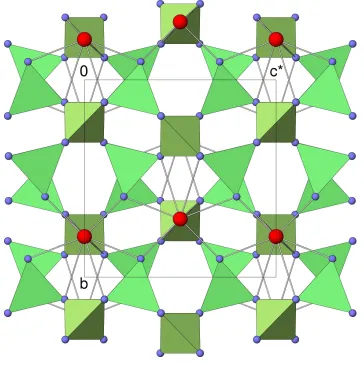
Figure 1
Projection of the structure of the title compound along [100]. Tb atoms are shown as red spheres, O atoms as small blue spheres; [BO4] groups
inorganic papers
i84
Alexandra Goriounovaet al. TbB3O6 Acta Cryst.(2003). E59, i83±i85toREB3O6withRE= La±Gd, while a later structural analysis on single crystals of TbB3O6 reveals an orthorhombic symmetry (Pbnm orPbn21) of the compound (Pakhomovet al., 1971). Very recently the crystal structure of orthorhombic TbB3O6 has been solved by Nikelski & Schleid (2003); the results of our own structure determination of the ortho-rhombic structure of TbB3O6are in good agreement with the data of these authors. Orthorhombic TbB3O6 crystallizes in space group Pnma (No. 62); a = 15.9770 (7) AÊ, b = 7.4136 (3) AÊ,c= 12.2905 (6) AÊ andZ= 16.
During our systematic investigations of the crystal chem-istry and crystal-growth conditions of binary rare earth borates, methods of synthesis from ternary systems were established that led to single crystals ofREB3O6 with RE= La±Tb. Depending on the composition of the ternary system used, orthorhombic as well as monoclinic crystals of TbB3O6 were grown. The crystal structure of the monoclinic modi®-cation of TbB3O6is presented here for the ®rst time. Mono-clinic TbB3O6is isostructural withREB3O6withRE= La, Nd, Sm and Gd, and crystallizes in space groupI2/a(No. 15). The structure consists of in®nite chains of [B6O12]n6ÿrunning along
thecaxis. Tenfold coordinated Tb atoms link the borate chains to give a three-dimensional framework. The complex borate polyanion (4D2T:D<DTDT>D; Becker, 2001) is composed of [BO4] tetrahedra that are linkedviatwo [BO3] triangles to the adjacent [BO4] tetrahedra on both sides. Each [BO3] is connected to two [BO4], and the bridging O atoms belong also to the coordination polyhedron of one Tb. Each of the non-bridging O atoms of the [BO3] groups coordinates to two Tb atoms. The irregular [TbO10] coordination polyhedra are connectedviaedges to form in®nite chains along thecaxis.
The mean BÐO distances of 1.370 AÊ for [BO3] and 1.465 AÊ for [BO4] ®t well into the range of BÐO distances found for many other borate structures [see, for comparison, Zobetz (1982) and Zobetz (1990)]. However, the [BO3] triangles are substantially distorted, with a BÐO distance of non-bridging atoms O2 that is signi®cantly shorter than the BÐO distances of bridging atoms O1 and O3 (see Table 1).
According to the results of structural investigations of TbB3O6, the compound seems to play the role of a transient point within the series ofREB3O6withRE= La±Lu. TbB3O6 shows a structural ¯exibility that allows it to be on one hand the terminal member of the isostructural monoclinic series of REB3O6withRE= La±Tb, but probably also the starting point of an assumed orthorhombic series for the smaller lanthanides Dy±Lu, that still has to be synthesized.
This structural variability of TbB3O6is further corroborated by a structural phase transition at about 143 K that was recently discovered in our group.
Experimental
Crystals of monoclinic TbB3O6were grown in the ternary system
Tb2O3ÐB2O3ÐPbO. A homogenized powder mixture of Tb4O7
(99.9%, Alfa Aesar), H3BO3(99.8%, Merck) and PbO (99%, Riedel
de HaeÈn), in a mol% ratio of 1.1:87.9:11.0, was heated in a covered platinum crucible to 1213 K and subsequently cooled at a rate of
about 3.4 K hÿ1to 943 K. Transparent single crystals of the title
compound were separated from the lead borate ¯ux using hot dilute HCl.
Crystal data
TbB3O6 Mr= 287.35
Monoclinic,I2=a a= 6.2147 (4) AÊ b= 8.0225 (5) AÊ c= 7.8111 (7) AÊ
= 93.44 (1)
V= 388.74 (5) AÊ3 Z= 4
Dx= 4.910 Mg mÿ3
MoKradiation Cell parameters from 25
re¯ections
= 12.3±19.1
= 18.13 mmÿ1 T= 293 (2) K
Parallelepiped, colourless 0.150.130.11 mm
Data collection
Nonius MACH3 diffractometer
!/2scans
Absorption correction: scan MolEN(Fair, 1990) Tmin= 0.082,Tmax= 0.136 5729 measured re¯ections 1602 independent re¯ections 1321 re¯ections withI> 2(I)
Rint= 0.094
max= 44.9 h=ÿ12!12 k=ÿ15!15 l=ÿ15!15 3 standard re¯ections
frequency: 60 min intensity decay: 4.5%
Re®nement
Re®nement onF2 R[F2> 2(F2)] = 0.036 wR(F2) = 0.082 S= 1.07 1602 re¯ections 48 parameters
w= 1/[2(F
o2) + (0.0215P)2
+ 2.4096P]
whereP= (Fo2+ 2Fc2)/3
(/)max< 0.001
max= 2.91 e AÊÿ3
min=ÿ2.45 e AÊÿ3
Extinction correction:SHELXL97 Extinction coef®cient: 0.0023 (4)
Table 1
Selected geometric parameters (AÊ).
Tb1ÐO2i 2.323 (3)
Tb1ÐO3ii 2.460 (3)
Tb1ÐO2 2.477 (3)
Tb1ÐO1iii 2.485 (3)
Tb1ÐO1 2.823 (4)
B1ÐO1 1.414 (5)
B1ÐO2 1.311 (6)
B1ÐO3 1.385 (5)
B2ÐO3iv 1.440 (5)
B2ÐO1 1.489 (6)
Symmetry codes: (i)x;3
2ÿy;12z; (ii)12x;12y;12z; (iii) 1ÿx;1ÿy;1ÿz; (iv) x;1
2ÿy;12z.
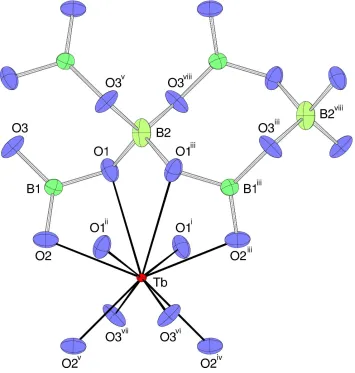
Figure 2
The highest peak and deepest hole are located 0.61 and 0.97 AÊ, respectively, from Tb1.
Data collection:MACH3 (Enraf±Nonius, 1993); cell re®nement:
MACH3; data reduction:MolEN (Fair, 1990); program(s) used to solve structure:SHELXS97 (Sheldrick, 1997); program(s) used to re®ne structure:SHELXL97 (Sheldrick, 1997); molecular graphics:
ATOMS(Dowty, 2002) andORTEPIII (Burnett & Johnson, 1996); software used to prepare material for publication:SHELXL97.
References
Abdullaev, G. K., Mamedov, Kh. S. & Dzhafarov, G. G. (1975).Sov. Phys. Crystallogr.20, 161±163.
Abdullaev, G. K., Mamedov, Kh. S. & Dzhafarov, G. G. (1981).Sov. Phys. Crystallogr.26, 473±474.
Bambauer, H. U., Weidelt, J. & Ysker, J. St (1969).Z. Kristallogr.130, 207±213. Becker, P. (2001).Z. Kristallogr.216, 523±533.
Burnett, M. N. & Johnson, C. K. (1996).ORTEPIII. Report ORNL-6895. Oak Ridge National Laboratory, Tennessee, USA.
Dowty, E. (2002).ATOMS. Version 6.0. Shape Software, 521 Hidden Valley Road, Kingsport, TN 37663, USA.
Enraf±Nonius (1993).MACH3Server Software. OpenVMS version. Nonius, Delft, The Netherlands.
Fair, C. K. (1990).MolEN.Enraf±Nonius, Delft, The Netherlands. Nikelski, T. & Schleid, T. (2003).Z. Anorg. Allg. Chem.In the press. Pakhomov, V. I., Sil'nitskaya, G. B. & Dzhurinskii, B. F. (1971).Inorg. Mater.7,
476±477.
Pakhomov, V. I., Sil'nitskaya, G. B., Medvedev, A. V. & Dzhurinskii, B. F. (1972).Inorg. Mater.8, 1107±1110.
Sheldrick, G. M. (1997). SHELXS97 and SHELXL97. University of GoÈttingen, Germany.
Tananaev, I. V., Dzhurinskii, B. F. & Chistova, V. I. (1975).Inorg. Mater.11, 69± 72.
Weidelt, J. (1970).Z. Anorg. Allg. Chem.374, 26±34.
Ysker, J. St & Hoffmann, W. (1970).Naturwissenschaften,57, 129±130. Zobetz, E. (1982).Z. Kristallogr.160, 81±92.
Zobetz, E. (1990).Z. Kristallogr.191, 45±57.
Acta Cryst.(2003). E59, i83±i85 Alexandra Goriounovaet al. TbB3O6
i85
supporting information
sup-1
Acta Cryst. (2003). E59, i83–i85
supporting information
Acta Cryst. (2003). E59, i83–i85 [doi:10.1107/S1600536803009553]
Monoclinic modification of polymorphic TbB3O6
Alexandra Goriounova, Peter Held, Petra Becker and Ladislav Bohat
ý
S1. Comment
Among the binary rare earth oxoborates of the general composition REB3O6 only the compounds LaB3O6 (Ysker &
Hoffmann, 1970; Abdullaev et al., 1981), NdB3O6 (Pakhomov et al., 1972), SmB3O6 and GdB3O6 (Abdullaev et al., 1975)
are fully structurally characterized. They form an isostructural series and crystallize in monoclinic space group I2/a. For
REB3O6 with RE = Dy—Lu only a somewhat doubtful indication of their existence can be found in the literature
(Tananaev et al., 1975). In earlier works on cell parameters of TbB3O6 (Bambauer et al., 1969, Weidelt, 1970), the
compound is described as crystallizing with monoclinic symmetry, similar to REB3O6 with RE = La—Gd, while a later
structural analysis on single crystals of TbB3O6 reveals an orthorhombic symmetry Pbnm or Pbn21 of the compound
(Pakhomov et al., 1971). Very recently the crystal structure of orthorhombic TbB3O6 has been solved by Nikelski &
Schleid (2003), the results of our own structure determination of the orthorhombic structure of TbB3O6 are in good
agreement with the data of these authors. Orthorhombic TbB3O6 crystallizes with symmetry Pnma (No. 62) and a =
15.9770 (7) Å, b = 7.4136 (3) Å, c = 12.2905 (6) Å and Z = 16.
During our systematic investigations of the crystal chemistry and crystal-growth conditions of binary rare earth borates,
methods of synthesis from ternary systems were established that led to single crystals of REB3O6 with RE= La—Tb.
Depending on the composition of the ternary system used, orthorhombic as well as monoclinic crystals of TbB3O6 were
grown. The crystal structure of the monoclinic modification of TbB3O6 is presented here for the first time. Monoclinic
TbB3O6 is isostructural with REB3O6 with RE = La, Nd, Sm and Gd, and crystallizes in space group I2/a (No. 15). The
structure consists of infinite chains of [B6O12]n6− running along the c axis. Tenfold coordinated Tb atoms link the borate
chains to a three-dimensional framework. The complex borate polyanion (4D2T:D<DTDT>D; Becker, 2001) is
composed of [BO4] tetrahedra that are linked via two [BO3] triangles at a time to the adjacent [BO4] tetrahedra on both
sides. Each [BO3] is connected to two [BO4], the bridging O atoms belong also to the coordination polyhedron of one Tb.
The nonbridging O atoms of the [BO3] groups coordinate two Tb simultaneously, each. The irregular [TbO10]
coordination polyhedra are connected via edges to infinite chains along the c axis.
The mean B—O distances of 1.370 Å for [BO3] and of 1.465 Å for [BO4] fit well into the range of B—O distances
found for many other borate structures [see, for comparison, Zobetz (1982) and Zobetz (1990)]. However, the [BO3]
triangles are substantially distorted with a B—O distance of non-bridging atoms O2 that is significantly shorter than the B
—O distances of bridging atoms O1 and O3 (see Table 1).
According to the results of the structure work on TbB3O6, the compound seems to play the role of a transient point
within the series of REB3O6 with RE = La—Lu. TbB3O6 shows a structural flexibility that allows to be on one hand the
terminal member of the isostructural monoclinic series of REB3O6 with RE = La—Tb, but as well to be probably the
supporting information
sup-2
Acta Cryst. (2003). E59, i83–i85
The found structural variability of TbB3O6 is further corroborated by a structural phase transition at about 143 K that
was recently discovered in our group.
S2. Experimental
Crystals of monoclinic TbB3O6 were grown in the ternary system Tb2O3–B2O3–PbO. A homogenized powder mixture of
Tb4O7 (99.9%, Alfa Aesar), H3BO3 (99.8%, Merck) and PbO (99%, Riedel de Haën), in a mol% ratio of 1.1:87.9:11.0,
was heated in a covered platinum crucible to 1213 K and subsequently cooled at a rate of about 3.4 K h−1 to 943 K.
[image:5.610.125.489.190.555.2]Transparent single crystals of the title compound were separated from the lead borate flux using hot diluted HCl.
Figure 1
Projection of the structure of the title compound along [100]. Tb atoms are shown as red spheres, O atoms as small blue
supporting information
sup-3
[image:6.610.129.484.72.445.2]Acta Cryst. (2003). E59, i83–i85 Figure 2
ORTEPIII projection (Burnett & Johnson, 1996) of the tenfold Tb coordination and the main features of the borate chains of title compound with atom-numbering scheme (projection along [100]). Atoms are shown as 50% probability ellipsoids.
Terbium(III) trioxoborate
Crystal data
TbB3O6
Mr = 287.35
Monoclinic, I2/a
Hall symbol: -I 2ya
a = 6.2147 (4) Å
b = 8.0225 (5) Å
c = 7.8111 (7) Å
β = 93.44 (1)°
V = 388.74 (5) Å3
Z = 4
F(000) = 512
Dx = 4.910 Mg m−3
Mo Kα radiation, λ = 0.71073 Å Cell parameters from 25 reflections
θ = 12.3–19.1°
µ = 18.13 mm−1
T = 293 K
supporting information
sup-4
Acta Cryst. (2003). E59, i83–i85 Data collection
Nonius MACH3 diffractometer
Radiation source: fine-focus sealed X-ray tube Graphite monochromator
ω/2θ scans
Absorption correction: ψ scan
MolEN (Fair, 1990)
Tmin = 0.082, Tmax = 0.136 5729 measured reflections
1602 independent reflections 1321 reflections with I > 2σ(I)
Rint = 0.094
θmax = 44.9°, θmin = 3.6°
h = −12→12
k = −15→15
l = −15→15
3 standard reflections every 60 min intensity decay: 4.5%
Refinement
Refinement on F2 Least-squares matrix: full
R[F2 > 2σ(F2)] = 0.036
wR(F2) = 0.082
S = 1.07 1602 reflections 48 parameters 0 restraints
Primary atom site location: structure-invariant direct methods
Secondary atom site location: difference Fourier map
w = 1/[σ2(F
o2) + (0.0215P)2 + 2.4096P] where P = (Fo2 + 2Fc2)/3
(Δ/σ)max < 0.001 Δρmax = 2.91 e Å−3 Δρmin = −2.45 e Å−3
Extinction correction: SHELXL97, Fc*=kFc[1+0.001xFc2λ3/sin(2θ)]-1/4 Extinction coefficient: 0.0023 (4)
Special details
Geometry. All e.s.d.'s (except the e.s.d. in the dihedral angle between two l.s. planes) are estimated using the full covariance matrix. The cell e.s.d.'s are taken into account individually in the estimation of e.s.d.'s in distances, angles and torsion angles; correlations between e.s.d.'s in cell parameters are only used when they are defined by crystal symmetry. An approximate (isotropic) treatment of cell e.s.d.'s is used for estimating e.s.d.'s involving l.s. planes.
Refinement. Refinement of F2 against ALL reflections. The weighted R-factor wR and goodness of fit S are based on F2, conventional R-factors R are based on F, with F set to zero for negative F2. The threshold expression of F2 > σ(F2) is used only for calculating R-factors(gt) etc. and is not relevant to the choice of reflections for refinement. R-factors based on F2 are statistically about twice as large as those based on F, and R- factors based on ALL data will be even larger.
Fractional atomic coordinates and isotropic or equivalent isotropic displacement parameters (Å2)
x y z Uiso*/Ueq
Tb1 0.7500 0.70532 (4) 0.5000 0.00547 (7) O1 0.6011 (4) 0.3864 (5) 0.3960 (3) 0.0095 (4) O2 0.6961 (5) 0.5921 (4) 0.2056 (4) 0.0108 (5) O3 0.6040 (4) 0.3171 (4) 0.1002 (4) 0.0083 (4) B1 0.6367 (6) 0.4370 (6) 0.2267 (5) 0.0060 (5) B2 0.7500 0.2756 (10) 0.5000 0.0093 (10)
Atomic displacement parameters (Å2)
U11 U22 U33 U12 U13 U23
supporting information
sup-5
Acta Cryst. (2003). E59, i83–i85 Geometric parameters (Å, º)
Tb1—O2i 2.323 (3) B1—O2 1.311 (6) Tb1—O3ii 2.460 (3) B1—O3 1.385 (5) Tb1—O2 2.477 (3) B2—O3iv 1.440 (5) Tb1—O1iii 2.485 (3) B2—O3v 1.440 (5) Tb1—O1 2.823 (4) B2—O1vi 1.489 (6) B1—O1 1.414 (5) B2—O1 1.489 (6)
O1iii—Tb1—O1vii 145.55 (18) O2—Tb1—O1vii 70.14 (9) O1—Tb1—O1vi 50.04 (11) O2i—Tb1—O1 140.75 (10) O2i—Tb1—O2viii 91.21 (17) O2viii—Tb1—O1 119.57 (10) O2—Tb1—O2vi 136.98 (17) O3ii—Tb1—O1 133.89 (10) O3ii—Tb1—O3ix 137.26 (16) O3ix—Tb1—O1 88.12 (10) O2i—Tb1—O3ii 71.84 (10) O2—Tb1—O1 51.46 (10) O2viii—Tb1—O3ii 78.57 (11) O2vi—Tb1—O1 87.63 (10) O2i—Tb1—O2 151.81 (11) O1iii—Tb1—O1 63.03 (12) O2viii—Tb1—O2 68.38 (14) O1vii—Tb1—O1 85.23 (8) O3ii—Tb1—O2 119.84 (9) O2—B1—O3 126.8 (4) O3ix—Tb1—O2 76.68 (11) O2—B1—O1 116.8 (4) O2viii—Tb1—O1vii 79.36 (11) O3—B1—O1 116.3 (4) O2viii—Tb1—O1iii 126.79 (10) O3iv—B2—O3v 117.9 (6) O3ii—Tb1—O1iii 142.20 (9) O3iv—B2—O1 102.33 (16) O3ix—Tb1—O1iii 54.95 (10) O3v—B2—O1 113.77 (17) O2—Tb1—O1iii 97.04 (10) O1vi—B2—O1 106.7 (6)