C o l l a b o r a t i o n a n d
C o m p o s i t i o n :
I s s u e s f o r a S e c o n d
G e n e r a t i o n P r o c e s s
L a n g u a g e .
B.C. Warboys
1, D. Balasubramaniam
2, R.M. Greenwood
1,
G.N.C. Kirby
2, K. Mayes
1, R. Morrison
2, D.S. Munro
3.
Department of Computer Science, University of Manchester1
School of Mathematical and Computational Sciences, University of St Andrews2 Department of Computer Science, University of Adelaide3
Abstract. Over the past decade a variety of process languages have been defined and applied to software engineering environments. The idea of using a process language to encode a software process as a “process model”, and enacting this using a process-sensitive environment is now well established. Many prototype process-sensitive environments have been developed; but their use in earnest has been limited. We are designing a second generation process language which is a significant departure from current conventional thinking. Firstly a process is viewed as a set of mediated collaborations rather than a set of partially ordered activities. Secondly emphasis is given to how process models are developed, used, and enhanced over a potentially long lifetime. In particular the issue of composing both new and existing model fragments is central to our development approach. This paper outlines these features, and gives the motivations behind them. It also presents a view of process support for software engineering drawing on our decade of experi-ence in exploiting a “first generation” process language, and our experiexperi-ence in designing and exploiting programming languages.
Keywords: process languages, process-based environments, persistence, concurrency control, hyper-programming
1. Informatics Process Group (IPG), Department of Computer Science, University of Manchester, Oxford Road, Manchester, M13 9PL, UK.
email{brian,markg,ken}@cs.man.ac.uk
1
Introduction
There is a long association between process languages and efforts to provide computer support for software engineering. Initially there was considerable work which concen-trated on providing integrated project support environments to support users working together. The emphasis was mostly on tool integration; ensuring that the design tools, compilers, debuggers etc. could work together. It became apparent that support envi-ronments could make a greater contribution if they had knowledge of the process in which their users were involved. This led to further research on process-based environ-ments [1,5,7]. The recognition that software processes can themselves be described as software is attributed to Osterweil [19], and has led to the development of process pro-gramming as part of software engineering, and ongoing research into process-centred environments.
More recently the interest in understanding and designing business processes, in particular the vogue for business process re-engineering, has led to an expansion of in-terest in process languages outside the software area. In general these have been simple languages specialised for an application area. For example, many forms-based work-flow systems have a language based on the notion of passing an electronic document around an organization [14]. The concentration has been on high-volume processes where standards are key to operational efficiency, e.g. car loan credit checking.
Over the past decade the Informatics Process Group (IPG) at Manchester has devel-oped a number of process models using the first-generation language of ICL’s Process-Wise Integrator (PWI) [20,24] and more recently ProcessWeb [9,29] which combines PWI with a Web interface. We believe that our experience has been typical. First-gen-eration languages, and the systems which evaluate them to provide process systems, are technically feasible and promising [7]. However the costs of developing process models are too high. Too great a knowledge of the language implementation is needed to devel-op effective models, and the code, when completed, tends to give a somewhat obscure representation of the process flow. This is partly because many first-generation lan-guages have adopted specific implementations, particularly with respect to modelling collaboration, which have restricted their range of applicability.
Research in the Persistent Programming Research Group (PPRG) at St Andrews has tackled the problems of constructing and maintaining large, long-lived application systems, including software development environments [16,18]. Many of these prob-lems are closely related to process language issues and therefore the techniques devel-oped can be refined and incorporated in a process language. The two techniques dis-cussed in this paper are Communicating Actions Control System (CACS) [22] and hy-per-programming [13,17]. CACS addresses the problem of providing flexible concurrency control mechanisms to support collaborative working. Hyper-program-ming provides a novel approach to developing long-lived systems through allowing new code to be not just text but both text and explicit links to existing code and data.
im-portance as systems are increasingly knitted together from existing components, and must have the flexibility to adapt in response to business changes. Automation involves introducing new IT systems into existing systems and changing the business processes to exploit them. This has led us to place emphasis on how our second generation lan-guage represents collaboration, and how models can be developed by composing com-ponents.
In designing a process language we are addressing the problems which we have ex-perienced with first generation languages. We also have a view of the kind of process system which we want to express in our new language which derives from our work on process modelling methods.
2
Motivation - A Process System
A number of process systems which execute programs in process languages have been developed. These systems have been strongly influenced by factors such as tool invo-cation, visualisation, and meta-processes which do not figure so highly in traditional program language design. There are a number of contributing factors:
• The contribution of people is part of the process. A process system can support the people involved by ensuring that the right information is in the right place, at the right time. However, people are biddable rather than controllable by the proc-ess system. For example, if input is requested there is no control over how long a user will take to respond.
• Processes can last for a long time. Software projects may last for weeks, months or even years. To support such processes, process systems must themselves last just as long.
• Process models are developed over a period of time. Early parts of a software de-velopment project often involve investigating alternatives and making decisions about the future course of the project. To support this a process model cannot be fully defined when its enactment starts. A process system must support the incre-mental development of models and provide facilities which bind new and existing model fragments.
The general scheme adopted by most process languages is to model the process as a pro-duction system. The software product is the output of the software development proc-ess. This process is usually described in terms of a set of partially ordered tasks (activ-ities) with output to input connections between them. This leads to a factory view where there is a “master process program” which provides the instructions to keep everything running efficiently; the emphasis is on design for efficiency.
supports its users, a served system [3]. To be viable a process system must continue to support the changing requirements of its users; design for evolution is a key theme [25]. This implies a need to separate existing models into fragments which can be composed in new ways to address future requirements.
For a process system to support the collaboration requirements of its users, its proc-ess language must be able to exprproc-ess a rich range of collaborations. A procproc-ess language needs to provide high-level concepts which offer flexibility in modelling and enable ef-fective and efficient support systems to be developed.
3
Collaboration
Our experience, from prototype systems, industrial case studies, and developing a proc-ess modelling method, is that a focus on collaboration is an effective way of modelling processes [8,12,27]. Unfortunately whilst many first-generation languages offer good abstractions for activity, they offer only low-level communication mechanisms, without any real abstractions, with which to realistically model coordination [10].
In PWI’s Process Management Language (PML) this collaboration is modelled in terms of explicit message passing using typed buffers called interactions [2,11]. Our second generation approach is to adopt a more abstract general view of collaboration as mediated access to shared data. The specific implementation of message passing in PWI’s PML interactions can then be defined using this more abstract view. However many other forms of collaboration can also be defined.
3.1 A Small Example
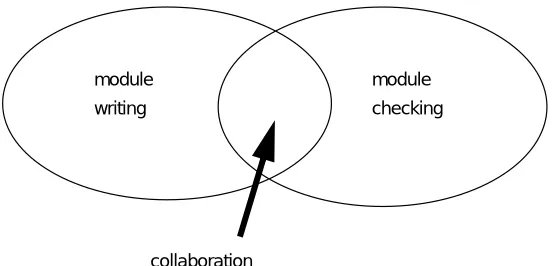
Consider the case of a sub-process where there is one software engineer who writes or updates a module, and another who must check it. One implementation of this involves a “module writing” activity which results in a revised module delivered to a “module checking” activity. This latter activity either outputs a “checked module” for input to the next sub-process or delivers the module and comments back to “module writing”. This implementation means that the module checker cannot start until the module writer has finished writing, and once the writer has submitted the module for checking, further module writing must wait until the checker finishes. In many cases, however, this is not how work progresses in reality: the module writer may deliver a draft version for check-ing and continue writcheck-ing; a checker’s comments may include updates to the module. What matters is that the two people involved have an agreed protocol for manipulating the module, and deciding when their tasks are complete.
Similarly, we may want to change the details of how a module is checked without mak-ing changes to the collaboration protocol. This separation is one example of the kind of structuring which needs to be applied to process models in order to maintain their clar-ity.
We have written a series of related writer-checker processes in PWI’s PML [2,11], Java, and Little-JIL [21,28]. In these implementations, the collaboration protocol was a significant proportion of the effort, and it became closely interwoven with the rest of the process. This restricted our ability to reuse fragments between related processes; our library of re-usable process components just did not grow as we had envisaged.
3.2 Communicating Actions Control System (CACS)
Communicating Actions Control System (CACS) is an abstract operational model de-signed to allow the specification of coherency protocols for accessing shared data [22]. The CACS model consists of actions (computations) that access objects (shared data).
A particular coherency protocol, for example atomic (ACID) transactions, is de-fined by a set of significant events and a set of rules. The significant events specify the operations on shared data that need to be coordinated by the protocol. The rules specify the details of this coordination. For example, consider the atomic transaction protocol:
• The significant events are: begin, commit, abort, read and write.
• The rules give an operational specification of how the ACID transaction proper-ties are to be enforced.
As it runs, each action generates a sequence of significant events, which are handled by the CACS controller, according to the rules. Each rule specifies what the controller should do in response to a particular significant event. In addition to performing arbi-trary computation, the controller may suspend and resume actions, and generate addi-tional, synthetic events that are added to the incoming event stream.
module writing
module checking
[image:5.595.150.428.165.298.2]collaboration
This architecture gives considerable flexibility both in defining new coherency pro-tocols, and in varying the policy implementing a particular protocol. For example, both optimistic and pessimistic flavours of atomic transactions could be defined in a similar way. The significant events would be the same in each case, but the bodies of the rules would vary. For an optimistic scheme the controller would allow actions to read and write shared data without restriction, recording which data objects had been accessed. On a commit event, the controller would test for conflict with other transactions, and generate an abort event for each conflicting transaction. For pessimistic transactions the controller would suspend an action on the first attempted conflicting access to shared data.
In general it is not possible for the CACS system to deduce automatically the points in an action at which significant events are generated. The source program must thus be annotated to indicate these. In some special cases, however, this may be done automat-ically. For example with atomic transactions the system may deduce where read and
write events occur, but not begin, commit or abort.
CACS specifications, in terms of events and rules, can be written for a wide variety of coherency protocols. These include traditional schemes such as atomic transactions and monitors, and more complex application-specific schemes. The programming in-volved in the correct implementation of these schemes can be defined and placed in a library for reuse. The writer of a CACS action, a process computation in our case, thus does not have to write CACS specifications in cases where standard coherency proto-cols are sufficient, but has the flexibility to define new schemes if required. For exam-ple, it is possible to implement CACS rules to give the particular message-passing se-mantics which are currently offered by interactions in PWI’s PML.
In the writer-checker example, one useful coherency protocol is that offered by a single element buffer. A data item must be written before it is read. Once written, the “buffer” is full and the item must be read before it can be written again. In CACS terms, a read event may suspend because it must wait for the corresponding write event, and a write event may suspend until the value from the previous write has been read. There would be two CACS rules, one handling read events and one handling write events. Figure 2 illustrates pseudo-code for the write rule.
let writerule[write,%id,%v] =
if there is an unread write of shared data item %v then suspend %id on write %v
else begin
update %v
if there is a read %id2 suspended on write %v do unsuspend %id2
end
One of the benefits of the CACS approach is that it does not restrict the number of computations which access a specific shared data area. This means that collaborations involving more than two parties can be modelled more naturally than with a message passing style. This was a particularly unpleasant problem to implement using the mes-sage-passing semantics of PWI’s PML interactions.
An example checker is given in Figure 3, corresponding to the checker action shown in Figure 4. As the shared data is explicitly identified, we can anticipate that the compiler will be able to generate the CACS events, here shown in comments. The shared data, checksd, is shared between checker and writer. It contains two fields,
mod-ule and comnts. This checker simply loops through four steps. The first step is to read
the module from the shared data, checksd, and assign it to checker’s local variable,
chModule. It is at this point that checker will suspend if the module is not available. The
second step makes the module available to the checker user, and the third step reads the comments from the user when they are available. The fourth step is to write those com-ments to the shared data, checksd, and so make them available to the writer. The func-tion checkernotfinished returns a boolean value which is true when the process is com-plete. If there is only one checker this is simply when the comments indicate the module is acceptable, but with multiple checkers this can be more complicated.
3.3 User and Tool Interaction as Collaboration
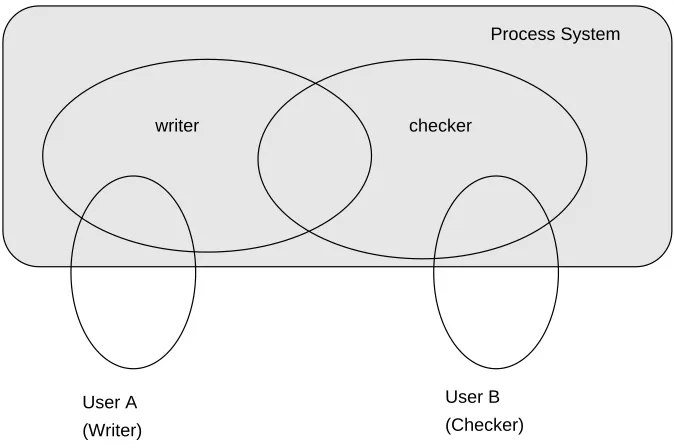
Figure 3 is code which will be executed by the process system to support the user re-sponsible for the checking. It makes the module available to this user by writing to a shared data area. Figure 4 depicts an overview of the module example showing the two users. Over time the boundary between what is done by the system and what is done by the users may change. For example, if checking only involved ensuring that the module
Checker
shared data - checksd, cuisd let chModule := nullModule let chComments := nullComments while checkernotfinished() do begin
chModule := checksd.module
! CACS event -[read,my_aid,checksd.module] cuisd.module := chModule
! CACS event -[write,my_aid,cuisd.module] chComments := cuisd.comnts
! CACS event -[read,my_aid,cuisd.comnts] checksd.comnts := chComments
! CACS event -[write,my_aid,checksd.comnts] end
compiled and conformed to coding standards, then the organization might decide to in-vest in tools to automate this. In our process language we want to be able to model such automation. This gives us a requirement that collaboration with the external world, both users and external tools, should be handled in the same way as collaboration within the process system. This is represented as the manipulation of data shared between a com-putation within the process system and an “external comcom-putation” carried out by a user or another software tool.
A process model in our system is represented by a persistent, strongly typed collec-tion of data and programs held within the system, interacting with other software and users outside the system. The hyper-program, to be described in the next section, is a representation which provides a single consistent description format for everything within the system. Input/output then involves a translation between the strongly typed internal form and other external forms. For interaction with a user these external forms might be X-Windows events or HTTP streams; for interaction with other tools they might be raw bytes, database relations etc.
A particular sequence of Input/Output can itself be viewed as a collaboration be-tween the outside world and an action within the process model that implements the re-quired translation. CACS rules can thus be used to coordinate the Input/Output. Again, a library of pre-defined rule sets for standard Input/Output patterns can be provided.
writer checker
Process System
User A User B
[image:8.595.129.466.159.383.2](Writer) (Checker)
4
Composition
A significant motive for our focus on collaboration was the kind of process systems which our experience tells us it is desirable to build. Similarly, the way we build such systems is a significant motive for our composition focus. In this context there is a need to address not only the issue of how components are composed, but also the facilities to decompose assemblies of components and re-compose them in new ways.
Our view is that a model developer should be thinking about composing fragments, rather than writing a model from scratch. This gives a close mapping between the way that a model is understood as a set of mediated collaborations, and the way that it is de-veloped. One motivation for this is to encourage re-use of existing model fragments as a standard part of model development. A second motivation stems from the potential longevity of our process models.
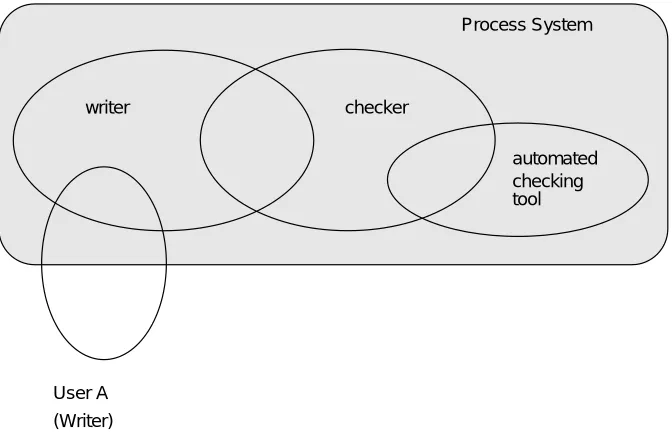
Figure 5 depicts the automation of the checking in our example through replacing “User B” with a computation within our process system. If the “automated checking tool” uses the same shared data and protocol as “User B” there is no need for any chang-es to “checker”. If we had replaced “User B” with an external tool, the diagram would have been the same as Figure 4 with “User B” re-labelled “external checking tool”. Again our focus would have been on the collaboration between this tool and “checker”. The examples in Figure 4 and Figure 5 show a close relationship between model-ling based around collaboration and a modelmodel-ling method in which composition plays a
writer checker
Process System
User A
automated checking
(Writer)
[image:9.595.131.467.171.387.2]tool
strong role. The intuition from the figures is that in both cases “writer” and “checker” will be composed in the same way. A typical concrete approach to sharing such as in-teractions, also defines, by implication, a composition approach. Our abstract sharing model does not. We need to have composition facilities to enable us to construct spe-cific sharing implementations in the language.
In the context of our small example, there are many possible enhancements to a model which supports a single writer and single checker. In some situations it may be better to have two checkers who must both agree that the module is acceptable. This could be made visible to the writer, or it could be hidden so that the writer collaborates with one, two, or more checkers in exactly the same fashion. With more than two check-ers there might be some kind of voting algorithm to determine if the module was accept-able. Writing and checking might form part of a larger quality control process, such as Fagan inspections. Our goal in using CACS is to allow the programmer to carry out these kinds of adaptations as easily as possible.
4.1 Hyper-Programming for Model Development
The technique which we adopt is to base our model development on hyper-program-ming [13,17]. Traditionally, a program which accesses another potentially shared object during its execution, contains a textual description of how to locate the object. This de-scription is subsequently resolved, commonly during linking for code objects and dur-ing execution for data objects. This resolution is necessary because programs are con-structed and stored in some long-term storage facility, such as a file system, which is separate from the run-time environment which disappears at the end of each program’s execution. By contrast in a persistent programming system, programs may be construct-ed and storconstruct-ed in the same environment as that in which they will subsequently be exe-cuted. This means that objects accessed by a program may already exist when the pro-gram is composed. Direct links to the objects can be included in the propro-gram rather than textual descriptions of the access paths by which they can be located at execution time. A program containing both text and links to objects is a hyper-program.
There are a number of benefits of hyper-programming [13].
• early checking - access path checking and type checking for linked components can be performed during program construction,
• associations between executable programs and their source programs can be maintained automatically,
• source representations of all programs, including those that may, due to the con-text in which they were defined, contain references to other existing data - it is difficult to fully describe such programs with a purely textual notation.
to have hyper-program representations for both source and run-time makes incremental definition of long-lived models significantly simpler.
4.2 Returning to our Small Example
Hyper-programming is very helpful in enabling a development by composition ap-proach. We can develop the components separately and then use hyper-links to make the appropriate connections. We can also unlink and re-link as required. If we consider the writer-checker example there are several possibilities for components being devel-oped at different times. CACS specifications for common coherency protocols are available in a library when the writer-checker model is being developed. Hyper-pro-gramming enables the use of these in writer-checker to be checked at compile time. Simple mistakes can be eliminated when the model is being developed rather than only becoming evident at run-time. Another process might want to use the checked module once writer-checker is complete. A compositional development approach, supported by hyper-program links to existing fragments (objects), is well suited to developing mod-els and libraries over a period of time.
In most first generation process languages the traditional development sequence is: write a process definition; specialise the definition into an enactable process; and spark the enactable process to yield an enacting process [6]. This means that a single process definition can be specialised and sparked many times to give separate enacting process-es. The distinction between the definition (source) and enacting (run-time) representa-tions makes it more difficult to compose new definirepresenta-tions with fragments of existing en-acting processes. In progressing from the definitions of the separate components in
writer-checker to an enacting model, which is supporting two users writing and
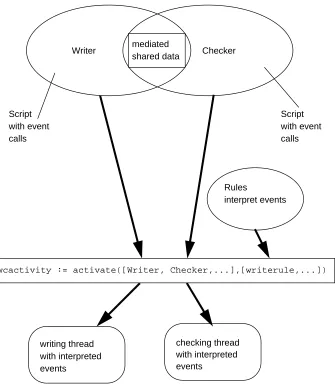
check-ing a particular module, we make use of the ability of hyper-programs to provide both source and run-time representations. When writer and checker are developed they are defined as scripts. A script corresponds to a CACS action. It records business rules in terms of the sequencing of operations which manipulate local script data and mediated shared data. (For example Checker in Figure 3.) A script is a piece of code and suspend-ed thread. When definsuspend-ed it is suspendsuspend-ed at the start of its execution. The hyper-program which is compiled to produce a script is also the hyper-program which represents the script in its initial suspended state. The system has a built in function activate which is used to spark a collection of scripts, returning an activity. (An activity thus corresponds to a set of CACS actions, along with associated shared data and rules.)
writing thread checking thread Writer mediated Checker
shared data
Script with event calls
Script with event calls
Rules
interpret events
with interpreted events
with interpreted events
[image:12.595.132.467.164.552.2]wcactivity := activate([Writer, Checker,...],[writerule,...])
There is also a decompose function which takes an activity and returns the scripts in a suspended state. An activate following a decompose restarts the scripts from their suspension point as if the decompose had never occurred. It is also possible to use de-compose and activate to dynamically de-compose or change enacting models. It may be that after decomposition some new scripts are added to the collection before it is acti-vated, or individual scripts might be replaced, as shown in Figure 7.
5
Related Work
There are different schools of thought about the appropriate current research goals in the area of process languages. There are those who see new languages as an irrelevance which create artificial barriers between the research community and industrial practi-tioners. They place emphasis on exploiting and inter-operating with existing tools such as configuration management systems, workflow systems, object request brokers etc. [4]. This work is important but this does not mean that there is no need for further re-search on process languages. It has been noted that despite the considerable rere-search in process languages, almost no novel approaches to software development have emerged. This suggests that the first-generation languages have been overly constrained by the emphasis on describing, promoting and supporting existing software processes. It also supports our thesis that many of these languages made an early commitment to partic-ular mechanisms, which both make them difficult for inexpert modellers to use, and make it clumsy, or impossible, to represent some forms of collaboration.
The “second generation” school advocate that the lessons learned from first gener-ation languages now need to be consolidated and exploited through the development of new process languages. Here the chief difference seems to be between those who be-lieve the most promising approach is a set of sub-languages which can be factored to-gether as and when required [23], and those like ourselves who are concentrating on a better core language [15]. One common theme is the issue of managing concurrency.
! suspend activity and extract a script suspendedwc := decompose ( wcactivity ); suspendedChecker :=
suspendedwc.scriptvector[checkerIndex];
! revise script and replace in suspended activity revisedChecker := changefunction( suspendedChecker ); suspendedwc.scriptvector[checkerIndex] := revisedChecker;
! restart the suspended activity
wcactivity := activate( suspendedwc );
Little-JIL [21] is a sub-language of the second generation process language JIL [23] which concentrates on the coordination of activities and agents. It has a visual syntax and is aimed at making it easier for practitioners to experiment with process programs. This emphasis on coordination is closely related to our view of processes as sets of me-diated collaborations. In both it is recognised that an important part of managing con-currency is expressing how shared resources are handled. Another common theme is the importance of well-defined semantics to enable reasoning about processes written in second generation languages. This is one area in which our process modelling method [27] needs further improvement.
6
Conclusions
Interest in understanding processes and how we can apply computer systems to support them continues to drive the development and use of process languages. In general mod-elling software engineering processes has turned out to be particularly challenging and has therefore often acted as the driver in process language design. However, process languages should not be evaluated just on how accurately they can reflect established best practice in software engineering, producing traditional applications in traditional ways. There is a need to support rich collaborative protocols between a process system and users, and between a process system and other software tools. Viewing a process as a set of mediated collaborations is clearly a very general approach, within which partic-ular collaboration styles can be defined. A common approach to collaboration whether within the process system or across its boundaries supports a clean and general ap-proach to modelling process automation.
As processes may be developed incrementally over a period of time, the models to support them must be incrementally developed too. The process language and system must provide facilities which combine new process model fragments and existing en-acting models. A collaborative viewpoint matches well with an approach based on ge-neric composition facilities. These can be used to recombine existing process model fragments, and further to retain the composition structure to assist future understanding and change.
In developing a second generation process language we have been motivated by the problems in using existing languages, and a recognition of the key role of process guages in modern flexible architectures. We need a better understanding of process lan-guages in order to meet the next challenge of developing appropriate architectures for the support and integration of process systems. By exploiting CACS and hyper-pro-gramming we are able to solve the issues of collaboration and composition in the style shown. This gives us an abstract machine which addresses collaboration and composi-tion at a basic level and can be used as the target for other higher-level process repre-sentations.1
Bibliography
[1] Ambriola, V., Conradi, C. and Fuggetta, A. “Assessing Process-Centered Software Engi-neering Environments”. ACM Transactions on Software EngiEngi-neering and Methodology, 6(3), pp 283–328, July 1997.
[2] Bruynooghe, R.F., Parker, J.M. and Rowles, J.S. “PSS: A System for Process Enactment”, in Proceedings of the First International Conference on the Software Process, pp 142–158, Redondo Beach, California, USA, 1991.
[3] Checkland, P. and Holwell, S. “Information, Systems and Information Systems: making sense of the field”. John Wiley and Sons Ltd. 1998.
[4] Conradi R. and Liu, C. “Process Modelling Languages: One or Many”, in Schafer, W. (Ed) Software Process Technology: Fourth European Workshop EWSPT’95, pp 98–118, Noordwijkerhout, The Netherlands, Springer-Verlag LNCS 913, 1995.
[5] Derniame, J.-C., Kaba, B.A. and Wastell, D. (Eds) “Software Process: Principles, Meth-odology, and Technology”. Springer-Verlag LNCS 1500, 1999.
[6] Feiler, P.H. and Humphrey, W.S. “Software Process Development and Enactment: Con-cepts and Definitions”, in Proceedings of the Second International Conference on the Soft-ware Process. pp 28–40, Berlin, Germany. IEEE Computer Society Press, 1993. [7] Finkelstein, A., Kramer, J. and Nuseibeh, B, (Eds) “Software Process Modelling and
Tech-nology”. Research Studies Press Ltd. 1994.
[8] Greenwood, R.M., Robertson, I., Snowdon, R.A., Warboys, B.C. “Active Models in Busi-ness”, in Proceedings of 5th Annual Conference on Business Information Technology (BIT’95), Department of Business Information Technology, Manchester Metropolitan University. 1995.
[9] Greenwood, R.M. and Warboys, B.C. “ProcessWeb - Process Support for the World Wide Web”, in Montangero, C. (Ed) Software Process Technology: Fifth European Workshop EWSPT’96, pp 82–185, Nancy, France, Springer-Verlag LNCS 1149, 1996.
[10] Henderson, P and Pratten, G.D. “POSD - A notation for presenting complex systems of processes”, Proceedings of the First IEEE International Conference on Engineering Com-plex Computer Systems, 1995.
[11] ICL. “ProcessWise Integrator PML Reference”, ICL/PW/635/01, issued with Release 4.1, 1996.
[12] Kawalek, P., “A Method for Designing the Software Support of Coordination”, Ph.D. The-sis, University of Manchester, UK, 1996.
[13] Kirby, G.N.C., Connor, R.C.H., Cutts, Q.I., Dearle, A., Farkas, A.M. and Morrison, R. “Persistent Hyper-Programs”. In Persistent Object Systems, Albano, A. & Morrison, R. (ed), Springer-Verlag, Proc. 5th International Workshop on Persistent Object Systems, San Miniato, Italy. In Series: Workshops in Computing, van Rijsbergen, C.J. (series ed) pp 86–106, 1992.
[14] Lawrence, P. (Ed) “Workflow Handbook 1997”, John Wiley and Sons (in association with Workflow Management Coalition WfMC), 1997.
[16] Morrison, R., Connor, R.C.H., Cutts, Q.I. and Kirby, G.N.C. “Persistent Possibilities for Software Environments”. In The Intersection between Databases and Software Engineer-ing, IEEE Computer Society Press, Proceedings ICSE-16 Workshop on the Intersection between Databases and Software Engineering, Sorrento, Italy, pp 78–87, 1994. [17] Morrison, R., Connor, R.C.H., Cutts, Q.I., Dunstan, V.S. and Kirby, G.N.C. “Exploiting
Persistent Linkage in Software Engineering Environments”. Computer Journal 38 (1) pp 1–16, 1995.
[18] Morrison, R., Dearle, A., Bailey, P.J., Brown, A.L. and Atkinson, M.P. “The Persistent Store as an Enabling Technology for Integrated Project Support Environments”. In Pro-ceedings of the Eighth International Conference in Software Engineering, pp 166–172, London, UK. IEEE Computer Society Press. 1985.
[19] Osterweil, L.J. “Software Processes are Software Too”, in Proceedings of the Ninth Inter-national Conference on Software Engineering, pp 2–14, Monterey, California, USA. IEEE Computer Society Press. 1987.
[20] Snowdon, R.A. “An Introduction to the IPSE 2.5 Project”. ICL Technical Journal 6 (3) pp 467–478, 1989.
[21] Staudt Lerner, B., Osterweil, L.J., Sutton Jr., S.M., and Wise, A. “Programming Process Coordination in Little-JIL”, in Gruhn, V. (Ed) Software Process Technology: Sixth Euro-pean Workshop EWSPT’98, pp 127–131, Weybridge, UK, Springer-Verlag LNCS 1487, 1998.
[22] Stemple, D. and Morrison, R. “Specifying Flexible Concurrency Control Schemes: An Abstract Operational Approach”. in Proceedings of 15th Australian Computer Science Conference, pages 873–891, Hobart, Tasmania, 1992.
[23] Sutton Jr., S.M. and Osterweil, L.J. “The Design of a Next-Generation Process Language” in Proceedings of the Joint Sixth European Software Engineering Conference and the Fifth ACM SIGSOFT Symposium on the Foundations of Software Engineering, pp 142–158, Zu-rich, Springer-Verlag LNCS 1301, 1997.
[24] Warboys, B.C. “The IPSE 2.5 Project: Process Modelling as the basis for a Support Envi-ronment”, in Proceedings of the First International Conference on Software Development, Environments and Factories, Berlin. Pitman Publishing, 1989.
[25] Warboys, B.C., “The Software Paradigm”, ICL Technical Journal, 10 (1) May 1995. [26] Warboys, B.C., Balasubramaniam, D., Greenwood, R.M., Kirby, G.N.C., Mayes, K.,
Mor-rison, R. and Munro, D. “Instances and Connectors: Issues for a Second Generation Proc-ess Language”, in Gruhn, V. (Ed) Software ProcProc-ess Technology: Sixth European Work-shop EWSPT’98, pp 137–142, Weybridge, UK, Springer-Verlag LNCS 1487, 1998. [27] Warboys, B.C., Kawalek, P., Robertson, I. and Greenwood, R.M. “Business Information
Systems: a Process Approach”. McGraw-Hill. 1999.
[28] Wise, A. “Little-JIL 1.0 Language Report”. Technical Report 98-24, Department of Com-puter Science, University of Massachusetts at Amherst, April, 1998.