APPLYING CONTEXTUAL INTEGRITY TO THE STUDY OF
SOCIAL NETWORK SITES
Luke Hutton
A Thesis Submitted for the Degree of PhD
at the
University of St Andrews
2015
Full metadata for this item is available in
Research@StAndrews:FullText
at:
http://research-repository.st-andrews.ac.uk/
Please use this identifier to cite or link to this item:
http://hdl.handle.net/10023/7795
Applying contextual integrity to the study
of social network sites
Luke Hutton
This thesis is submitted in
partial fulfilment for the
degree of Doctor of Philosophy
at the University of St Andrews
Abstract
Social network sites (SNSs) have become very popular, with more than 1.39 bil-lion people using Facebook alone. The ability to share large amounts of personal information with these services, such as location traces, photos, and messages, has raised a number of privacy concerns. The popularity of these services has enabled new research directions, allowing researchers to collect large amounts of data from SNSs to gain insight into how people share information, and to identify and resolve issues with such services. There are challenges to con-ducting such research responsibly, ensuring studies are ethical and protect the privacy of participants, while ensuring research outputs are sustainable and can be reproduced in the future.
Declarations
Candidate’s declarations
I, Luke Hutton, hereby certify that this thesis, which is approximately 36,000
words in length, has been written by me, and that it is the record of work carried out by me, or principally by myself in collaboration with others as ac-knowledged, and that it has not been submitted in any previous application for a higher degree.
I was admitted as a research student in September 2011 and as a candidate for the degree of Doctor of Philosophy in September 2011; the higher study of which this is a record was carried out in the University of St Andrews between 2011 and 2015.
date signature of candidate
Supervisor’s declarations
I hereby certify that the candidate has fulfilled the conditions of the Resolution and Regulations appropriate for the degree of Doctor of Philosophy in the Uni-versity of St Andrews and that the candidate is qualified to submit this thesis in application for that degree.
Permission for publication
In submitting this thesis to the University of St Andrews I understand that I am giving permission for it to be made available for use in accordance with the regulations of the University Library for the time being in force, subject to any copyright vested in the work not being affected thereby. I also understand that the title and the abstract will be published, and that a copy of the work may be made and supplied to any bona fide library or research worker, that my thesis will be electronically accessible for personal or research use unless exempt by award of an embargo as requested below, and that the library has the right to migrate my thesis into new electronic forms as required to ensure continued access to the thesis. I have obtained any third-party copyright permissions that may be required in order to allow such access and migration, or have requested the appropriate embargo below.
The following is an agreed request by candidate and supervisor regarding the publication of this thesis:
PRINTED COPY
No embargo on print copy
ELECTRONIC COPY
No embargo on electronic copy
signature of candidate signature of supervisor
There’s a path stained with tears,
Could you talk to quiet my fears?
Could you pull me aside,
Just to acknowledge that I’ve tried?
…
And as your last breath begins,
You find your demon’s your best friend.
And we all get it in
The end.
Contents
1 Introduction 1
1.1 Thesis statement . . . 4
1.2 Outline . . . 4
1.3 Publications . . . 5
2 Background 7 2.1 Social network sites . . . 7
2.2 Location-based social networks . . . 15
2.3 Studying social network sites . . . 20
2.3.1 Research ethics . . . 20
2.3.2 Human subjects research . . . 22
2.3.3 Informed consent . . . 24
2.3.4 Ethics controversies in recent SNS research . . . 26
2.3.5 Reproducibility . . . 28
2.4 Summary . . . 36
3 State of the art 39 3.1 Resolving privacy challenges in location-based social networks . 39 3.2 Informed consent . . . 43
3.3 Reproducibility in SNS research . . . 45
3.3.1 Explanation of criteria . . . 49
3.3.2 Few SNS researchers share their data . . . 56
3.3.3 Social scientists rarely share code for experiments and ana-lyses . . . 56
3.3.4 Reporting of core experimental parameters is strong . . . . 57
3.3.5 Participant-handling and ethical considerations are not dis-cussed . . . 58
3.4 Studying SNSs with contextual integrity . . . 59
3.5 Summary . . . 61
4 A framework for ethical SNS research 63 4.1 The PRISONER architecture . . . 65
4.1.1 Social objects . . . 66
4.1.2 Privacy policies . . . 67
4.1.3 Participation clients . . . 69
4.1.4 Social activity clients . . . 69
4.1.6 Designing for contextual integrity . . . 74
4.1.7 Dealing with API changes . . . 75
4.2 Reproducing an experiment with PRISONER . . . 77
4.3 Addressing the requirements . . . 86
4.4 Summary . . . 88
5 Improving SNS research methodologies with contextual integrity 91 5.1 Method . . . 93
5.1.1 Willingness-to-share norms . . . 93
5.1.2 User study . . . 95
5.1.3 Applying the PRISONER framework . . . 99
5.2 Results . . . 100
5.2.1 Evaluating the norms dataset . . . 101
5.2.2 Is there a relationship between burden and accuracy? . . . . 102
5.2.3 Does contextual integrity reduce participant burden? . . . . 105
5.2.4 Does contextual integrity significantly reduce accuracy? . . 106
5.2.5 Who does contextual integrity work for? . . . 107
5.2.6 Is contextual integrity robust to temporal changes in will-ingness to share? . . . 112
5.3 Summary . . . 114
6.1 Applying the decision heuristic to ILS . . . 119
6.1.1 Information flows . . . 120
6.1.2 Information subjects, senders, and recipients . . . 120
6.1.3 Information attributes . . . 121
6.1.4 Transmission principles . . . 122
6.1.5 Entrenched informational norms . . . 123
6.1.6 Method . . . 125
6.1.7 Results . . . 130
6.1.8 Implications . . . 137
6.2 Summary . . . 140
7 Conclusion 143 7.1 Contributions . . . 144
7.2 Discussion and further work . . . 145
A Glossary 149
B Ethics approval 153
List of Figures
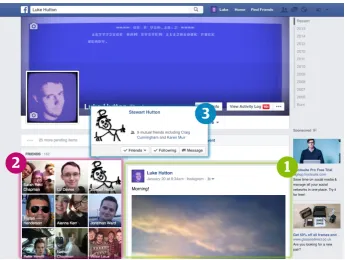
2.1 A screenshot of a Facebook profile, illustrating its implementation of the three fundamental SNS concepts: 1) A profile consisting of content decided by the user. 2) A list of friends curated by the user. 3) Connections between friends are exposed, allowing tra-versal between profiles. . . 9
2.2 A screenshot of a Last.fm profile, illustrating how these same three SNS concepts manifest in more niche services, with: 1) A profile consisting of attributes disclosed by the user. 2) A list of friends curated by the user. 3) Friends can post messages on each other’s wall, encouraging engagement between profiles. . . 10
2.4 The Facebook audience selector allows a user to decide which sub-set of their social network can see the content they publish, or whether to make it publicly accessible. In this case, the user has created many friends lists that allow content to be targeted at pre-determined subsets of people, however controlling the audience in such a way is not common [76]. . . 13
2.5 Screenshot of the cashback service Quidco that incentivises checking-in with commercial partners and sharchecking-ing this with one’s social network. . . 16
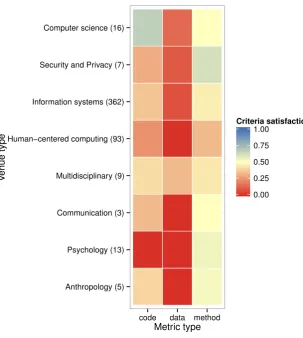
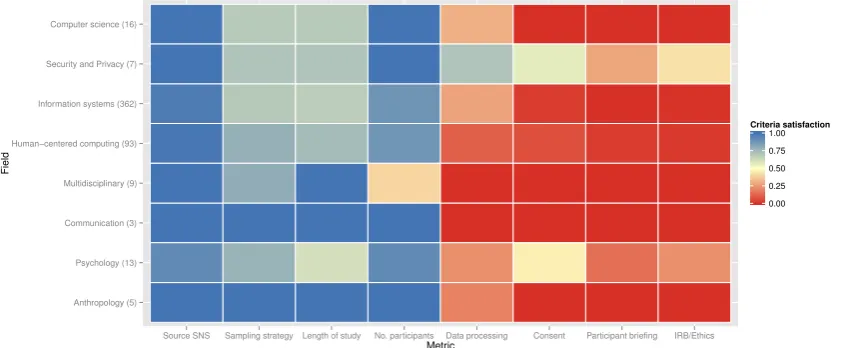
3.1 Heatmap showing how different fields achieve our three criteria types. Data-sharing is particularly poor across most disciplines, while reporting of methodologies is generally stronger. . . 54
3.2 Heatmap showing how well each type of venue achieve our three criteria types. Data-sharing and methodology reporting are sim-ilar, however conferences and magazines are better at sharing code.
. . . 55
3.3 Breakdown of the eight criteria we assess for “methods”. Gener-ally, papers successfully report descriptive attributes of their study, but often, participant handling and data processing are not suffi-ciently explained. . . 58
4.2 Part of the consent form that participants would be shown before taking part in the reproduced experiment. The form outlines the data collection practices of the study in a readable format. Parti-cipants who want to learn more about how their information is handled can read detailed descriptions of the sanitisations em-ployed. . . 81
4.3 The result of making requests to Facebook with a PRISONER policy applied. Only the permitted objects and attributes are extracted, and are sanitised as outlined in the policy. . . 83
4.4 Illustration of how a request for data is handled by PRISONER. An experimental application makes a request to PRISONER’s social ob-jects gateway for an object, which is delegated to the appropriate social network. The object is returned and handled by PRISONER’s policy processor, which invokes the privacy policy for the exper-iment to ensure the data are suitably sanitised. In this example, the participant’s birthday has been reduced to a bit indicating its presence before being returned to the application. . . 84
5.1 Boxplot showing sharing rates of different data types for users in the sustained consent condition in the 2014 study. For comparison, the white diamonds represent the mean sharing rate of that type in the 2012 dataset, constituting the prevailing norm. Willingness to share data with researchers has increased on all fronts in this period. . . 94
5.3 A screenshot of the performance evaluation step. Participants are shown the content collected according to their consent policy, and asked to remove any items they deem inappropriate to share. The proportion of items selected determines the accuracy of the method.
. . . 98
5.4 Scatterplot showing the relationship between accuracy and bur-den in all three conditions. Accuracy is the most variable for those in the secured consent condition, whereas in the case of contex-tual integrity, a small loss in accuracy is met with a greater time burden saving. Note that the points have been jittered to improve readability. . . 103
5.5 Boxplot showing how accuracy differs between participants in the contexutal integrity condition depending on their norm conform-ity. Norm-conformant people achieve higher, and less variable, accuracy rates than those who deviate from norms. . . 104
5.6 In all three conditions, median accuracy is high, although variab-ility increases as the number of questions asked is reduced. . . . 106
5.7 Scatterplot showing the relationship between norm conformity and accuracy. As indicated by the cluster after 5 questions (5% burden), high accuracy can be preserved when norm conformity is detected quickly, although the technique is not useful for people who are highly norm deviant. Note that the points have been jittered to improve readability. . . 108
5.9 Boxplot showing how robust each condition is to temporal change by using the consent policy from the first week to predict the parti-cipant’s responses in the second week. All conditions exhibit over-sharing, highlighting the difficulty of capturing consent at a single point in time. . . 111
6.1 Screenshot of the incentivised location sharing application created for our user study. One group of participants are shown informa-tion about the flow of PII before confirming a check-in. . . 126 6.2 Participants who receive higher incentives but no additional
feed-back (HighNo) check in more often, whereas those given feedfeed-back about PII flows (HighYes) check in the least often. . . 131 6.3 Diverging stacked bar chart showing how participants responded
to a questionnaire about online privacy concerns before and after participating in the study. For each dimension tested, positive an-swers indicate increased concern or awareness about relevant pri-vacy practices. Participants reported high concern and awareness about online privacy issues generally, and these were reinforced when more feedback about PII flows was provided by the applic-ation. Many believed, however, that companies are “entitled” to personal information in exchange for money, and comfort with this practice increased with use of a mobile advertising check-in ap-plication, as shown by the positive tendency on the ILS dimension.
. . . 133 6.4 The frequency of self-reported motivations for checking in to our
List of Tables
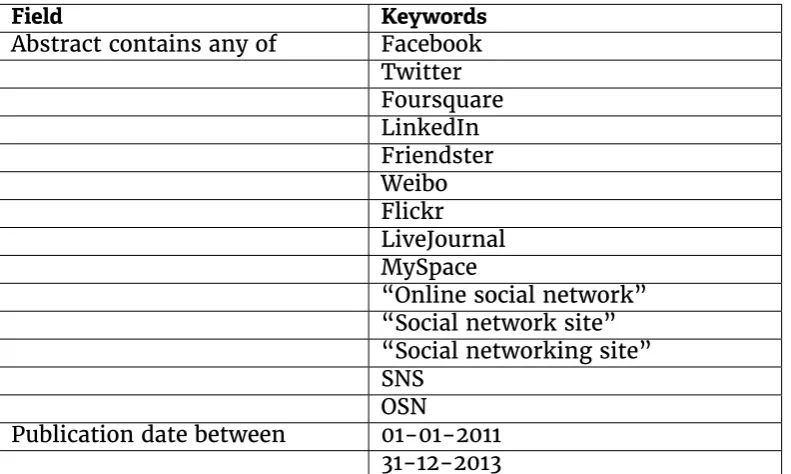
3.1 The semantics of the search term used to identify papers in the study (the exact syntax for expressing the search varied from source to source). . . 49 3.2 Breakdown of the surveyed papers by venue. The “total” column
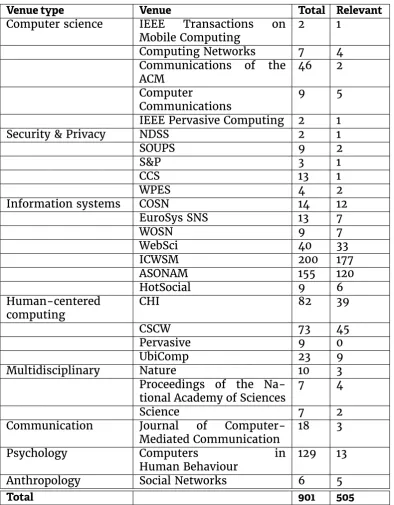
indicates how many papers matched our search term, while the “relevant” column indicates how many used OSN data, meriting further study. . . 50
5.1 Participants were assigned to one of the three conditions at ran-dom, and participation was broadly equal. . . 100 5.2 Comparison of demographics in our study to those of Facebook
in the UK. Demographics are derived from data made available to Facebook advertisers, correct as of January 2015. . . 100
Acknowledgements
Getting to this point hasn’t always been easy, and nor should it be. It certainly wouldn’t have been possible without the endless support of some amazing people.
First of all, I thank my supervisor, Tristan Henderson, for his belief that I would get here even when I was losing hope, and for every friendly nudge to submit submit submit. His supervision was methodical, sometimes intense, always appreciated. My thanks also to my second supervisors and reviewers, Saleem Bhatti, Per Ola Kristens-son, and John Thomson for their feedback and support. I also wish to thank Judi Robertson in CS, and Ruth Unsworth for all their help.
I am lucky to be surrounded by so many wonderful friends. In St Andrews, the Taint: CJ Davies, Ruth Hoffmann, and Jaunty Ward have provided endless gallows humour, gin, and sloth GIFs, and they have no idea how much I love them for it. A special thanks to Davie and Ruth Letham for the chat, Pokémon, and vegan noms. To everyone else in CS and beyond, past and present, who’s trawled to the pub and put up with me, thank you. Beyond the bubble, Sarah and Nathan Chapman and Alanna Kerr earn every bit of their Team FAB moniker every day, even surviving pilotgate (“the greatest test of our
friendship so far”) while being forever fantastically awesome. This one’s for Nickelback.
I thank Lisa Campbell whose support and belief has been phenomenal, and for knowing that pizza and beer is the answer to most of my problems; and Kath and Emma Carrick, for wine, for great food, for understanding, and a place to play Civilization.
Chapter 1
Introduction
data [71], they are trusted to protect data from external attack, which is con-sidered a growing threat [108].
These issues, and the difficulty of defining privacy itself, has motivated many attempts to solidify privacy within a theoretical framework. Helen Nis-senbaum’s model of contextual integrity is one such effort [100], which determ-ines privacy violations emerge when people’s context-specific norms about ac-ceptable information sharing are not met. The model can be used as a dia-gnostic tool to identify potential sources of privacy breaches by determining when existing norms are perturbed by a new process that changes what types of information are collected and transmitted.
The popularity of SNSs, and concern about such privacy challenges has opened new research directions concerning their design and the behaviour of the people who use them. These studies can provide useful insights, but it is important to consider how to conduct such research responsibly, by ensuring its outcomes benefit a variety of stakeholders, and society at large [119]. Acknowledging both the ethical challenges associated with collecting and processing such sensitive data, and the sustainability challenges of making such research reproducible in the future, can make progress towards making SNS research more responsible. As there is no consensus about whether all studies using social network sites constitute human subjects research, there is a lack of consistency about the amount of ethical oversight such research receives, with previous stud-ies attracting attention because of failures to preserve the anonymity of par-ticipants [147], or gaining their informed consent [49]. This places great re-sponsibility on researchers to adequately protect their participants, specifically when considering sharing data with others, which could reveal sensitive in-formation about participants, with it being possible to reidentify participants when data are not sufficiently sanitised [97, 22].
been considered a fundamental part of the scientific method [78], can signi-ficantly contribute to this. SNS research is particularly difficult to execute in a reproducible manner, however, as the design of services often change or are made obsolete, requiring constant maintenance of code that accesses SNS data, and in some cases, experiments simply cannot be run again. Additionally, lim-ited reporting of methodological details such as how participants were sampled, or how informed consent was sought, can make it more difficult to reproduce such studies, with no standards for encoding and sharing the workflow of SNS experiments being adopted.
As the use of SNSs continues to rise, new services emerge, with at least 200 operating as of 2015 [140]. With outstanding privacy challenges with the ser-vices themselves, and concerns about the responsible conduct of SNS studies, it remains unknown whether a single conceptual framework can be leveraged to identify and address these issues in a holistic manner. While Nissenbaum’s model of contextual integrity has been used to investigate a range of privacy concerns [42, 59, 75, 113], it has not been used to identify privacy breaches in emerging SNSs where existing norms might be disrupted. Furthermore, whether it can be used to evaluate and improve the conduct of SNS research remains unknown.
In this thesis, we address the following research questions:
RQ1: Is contextual integrity an appropriate framework for understanding and mitigating ethical concerns in SNS research?
1.1 Thesis statement
We make the following thesis statement:
Contextual integrity can be used to conduct reproducible and privacy-preserving experiments using social network sites, and can detect po-tential privacy violations in new services in order to mitigate their impact.
In support of this, we make three contributions. We demonstrate that:
1. Using an architecture informed by contextual integrity to conduct SNS studies can better protect the privacy of participants and lead to more re-producible experiments, than directly accessing the APIs provided by SNSs. 2. Contextual integrity can be leveraged to acquire consent in SNS studies to better meet the expectations of participants and mitigate the ethical issues associated with failing to gain informed consent.
3. Contextual integrity can be used to detect privacy breaches in emerging SNSs, and to identify how the design of these services can be altered to avoid such violations.
1.2 Outline
This thesis is structured as follows.
Chapters 2 and 3 outline the research context, and the state of the art.
• Chapter 3 examines the recent literature that attempts to resolve some of the challenges we identified in Chapter 2, noting the open problems we will address.
Chapters 4, 5, and 6 describe our three contributions to support our thesis.
• In Chapter 4, we introduce an architecture we have developed to improve the ethical conduct of SNS studies, the effectiveness of which we demon-strate by reproducing an existing study.
• In Chapter 5, we tackle a specific ethical challenge in SNS consent, demon-strating that a method for acquiring consent for SNS studies that main-tains contextual integrity can meet the expectations of participants while reducing the burden placed on them.
• In Chapter 6, we conduct two case studies to show how contextual in-tegrity can be used to detect breaches in two types of SNSs, and how the framework guides the design of the services to mitigate these breaches. Finally, we conclude with a summary of the contributions we have made, and outline directions for future research.
1.3 Publications
This thesis is entirely my work, but has been supported by a number of col-laborators. Throughout this thesis, I use the word “we” to acknowledge the contribution these collaborators have made to this work.
• Luke Hutton and Tristan Henderson. “Towards reproducibility in online social network research”. In: IEEE Transactions on Emerging Topics in Com-puting(2015). doi: 10.1109/tetc.2015.2458574
• Luke Hutton and Tristan Henderson. “Making social media research re-producible”. In: Proceedings of the ICWSM Workshop on Standards and Practices in Large-Scale Social Media Research. Oxford, UK, May 2015
• Luke Hutton and Tristan Henderson. ““I didn’t sign up for this!”: In-formed consent in social network research”. In: Proceedings of the 9th In-ternational AAAI Conference on Web and Social Media (ICWSM). May 2015. url: http://tristan.host.cs.st-andrews.ac.uk/research/pubs/icwsm2015.pdf • Luke Hutton and Tristan Henderson. “An architecture for ethical and
privacy-sensitive social network experiments”. In: SIGMETRICS Perform-ance Evaluation Review 40.4 (Apr. 2013), pp. 90–95. doi: 10.1145/2479942. 2479954
• Luke Hutton, Tristan Henderson and Apu Kapadia. ““Here I Am, Now Pay Me!”: Privacy Concerns in Incentivised Location-sharing Systems”. In: Proceedings of the 2014 ACM Conference on Security and Privacy in Wireless & Mobile Networks. WiSec ’14. Oxford, UK: ACM, July 2014, pp. 81–86. doi: 10.1145/2627393.2627416
• Sam McNeilly, Luke Hutton and Tristan Henderson. “Understanding eth-ical concerns in social media privacy studies”. In: Proceedings of ACM CSCW Workshop on Measuring Networked Social Privacy: Qualitative & Quantitative
Chapter 2
Background
In this chapter, we outline the nature of the social network sites that we study in this thesis. We also discuss the prevailing methodological approaches adopted in the research of such systems, and the ethical challenges associated with these methods.
2.1 Social network sites
In its early years, the World Wide Web was a distributed repository of largely static information, where the majority of users only consumed content [19]. Beginning in the early 2000s, the development of technologies such as AJAX allowed more sophisticated applications to be delivered through Web browsers, encouraging users of the Web to become creators. These applications allowed people to share photos, write blog posts, and comment on the content generated by others, adding a social dimension that had been largely absent from the Web until then, in a movement widely known as “Web 2.0” [19].
to their desktop counterparts [15]. The quick adoption of smartphones coupled with acknowledgement of their limitations with respect to input modalities and display size, has led to efforts to optimise websites for such devices, and to de-liver native applications which can use their full capabilities and achieve higher performance [14]. The additional capabilities of smartphones, such as location-sensing and cameras, coupled with the increasing availability of high-speed mobile Internet connections, has enabled new services which allow people to share photos, videos, and their current location [15]. These abilities have led to a change in how people access the Web, with more than 37% of all Web traffic coming from mobile devices as of February 2015 [121].
The social functionality which began to emerge in websites evolved into a set of applications that were designed around the concept of managing a set of friends with which information could be shared: the social network site. In 2007, boyd and Ellison defined social network sites as Web-based services which meet the following criteria [11]:
1. Users can create a profile, which might be public or visible to a subset of people.
2. Users can curate a list of other users of the service they are connected to. 3. Users can traverse these connections, and the connections made by others,
to see their profiles and other content.
This definition is intentionally sparse. While individual SNSs vary in design and purpose they share some structural components. All provide a service over the Internet, and implement an eponymous social network; a graph where nodes are individual people, and the edges a semantically-appropriate social connection between them, such as friendship or physical co-location. In many cases, it is the semantics of the connections within that network which define the purpose of the service.
Figure 2.1: A screenshot of a Facebook profile, illustrating its implementation of the three fundamental SNS concepts: 1) A profile consisting of content decided by the user. 2) A list of friends curated by the user. 3) Connections between friends are exposed, allowing traversal between profiles.
has rapidly grown to become one of the world’s most popular SNSs, with 1.39 billion active users as of December 2014.1 It allows its users to share and engage
with photos, videos, links to websites and text-based status updates posted by peers, via its website or mobile applications, the latter becoming increasingly popular, as we will discuss later. Facebook meets the SNS criteria identified by boyd and Ellison through one of its core products, Profile. As shown in Fig-ure 2.1, the product aggregates content published by the user, which is visible to an audience determined by its author. The profile exposes the “friends list” of the user, an egocentric social network of their direct connections. This mech-anism allows the user to traverse profiles of their friends, with mutual friends and recommended connections surfaced through the structure of the global so-cial network. While initially designed to represent friendships between college students, this concept has extended to model familial relationships, dynamics between colleagues, or even between businesses and their customers.
Figure 2.2: A screenshot of a Last.fm profile, illustrating how these same three SNS concepts manifest in more niche services, with: 1) A profile consisting of attributes disclosed by the user. 2) A list of friends curated by the user. 3) Friends can post messages on each other’s wall, encouraging engagement between profiles.
pite the development of new products by Facebook, the fundamental purpose of the profile is remarkably similar to that of its predecessors, such as Friend-ster (founded in 2002) and MySpace (founded in 2003). These services, among many others which emerged in the early 2000s, have waned in popularity since Facebook’s dominance took hold, but despite superficial advances, Facebook’s structure deviates little from these services.
Figure 2.3:A screenshot of a Twitter profile, showing how it implements the three SNS concepts: 1) A profile consisting of tweets shared by the user. 2) The directed nature of the Twitter graph means that the indegree and outdegree of each user is reported in-dependently, with the outdegree (“following”) determined by the user. 3) The profiles of others can be traversed to view the tweets they have recently published.
activity on the service.
While boyd and Ellison do not make explicit references to the graph which underpins the connections between these services, the design of this graph has significant implications for the services built on top of them. The SNSs we have discussed so far all employ an undirected graph in their core network, where friendships are modelled as symmetric connections.2 A friendship, initiated by one party, must be accepted by the other to forge a connection on the graph, and allow content to flow bidirectionally between peers. Another major SNS, Twitter, does not employ this approach.
Depicted in Figure 2.3, Twitter allows users to broadcast short text mes-sages, known as tweets. Its underlying social graph is directed, allowing users to choose which of their peers to follow, without necessarily being reciproc-ated. This approach allows people to access a stream of tweets from the users they follow, enabling an asymmetry where a user’s reach is dictated by their number of followers, and not by the size of their egocentric network, enabling
2Facebook’s graph can also include directed connections, allowing users to follow updates
celebrities and large organisations to reach a large audience. This subtle design choice has enabled a new class of communication, including more social forms of advertising which we will consider later, but again reflects the robustness of boyd and Ellison’s definition.
Privacy challenges
The sudden popularity of SNSs, and their ability to connect large numbers of people around the sharing of potentially sensitive information has given rise to a number of privacy risks.
Figure 2.4:The Facebook audience selector allows a user to decide which subset of their social network can see the content they publish, or whether to make it publicly ac-cessible. In this case, the user has created many friends lists that allow content to be targeted at predetermined subsets of people, however controlling the audience in such a way is not common [76].
one [85]. As SNSs depend on ongoing disclosures, they usually encourage users to broadcast disclosures to their entire social network, without consideration for whether that disclosure is relevant, of interest, or appropriate to everyone. As Marwick and boyd argue, this leads either to blandness where people only make lowest-common denominator disclosures, or over-sharing of informa-tion to a subset of the user’s audience. Marder et al. argue that the difficulty of balancing these distinct social spheres can lead to social anxiety, leading to a withdrawal from making disclosures if over-exposure is anticipated [83].
discussed in the literature. One issue are the user interfaces used by SNSs to let users choose the audience for their disclosures. In an attempt to mitigate context collapse, Facebook provides fine-grained control of the audience for individual disclosures, allowing users to explicitly choose which of their peers can and cannot see a post, or to create lists of people who are able to see subsets of content, as shown in Figure 2.4. Liu et al. found, however, that only a third of people change the default audience of their posts, which means for most people, all peers in the social network can see it. More concerningly, the actual audience is the same as the user’s expected audience in only 37% of cases, with content exposed to a larger audience in most cases [76].
Trust is an important component governing disclosures in SNSs, and is con-sidered to be a key factor in people’s privacy calculus when using SNSs. Privacy calculus can be considered the risk-benefit analysis people perform when de-ciding whether to disclose information, balancing the potential effects of being exposed against the utility that might be gained [73]. Krasnova et al. model disclosure behaviours considering the trust people place in their peers, and in the integrity of the SNS itself, as a factor in the privacy calculus when choosing to make a disclosure [71]. Attacks have been demonstrated which can com-promise this trust relationship, and risk the privacy of users. Nagle and Singh found that Facebook users are more likely to accept friend requests and share sensitive information with a stranger if they have a mutual friend in the social network [96], taking advantage of the implicit trust signal given by the mutual friend.
poster later felt embarrassed by [136], while Bauer et al. found that people of-ten wanted to restrict the audience of their posts, even within a week of having shared them [5].
2.2 Location-based social networks
The increasing popularity of smartphones has enabled a new class of SNS, de-signed around the purpose of sharing location data with one’s social network. Zheng defines location-based social networks (LBSNs) as a form of social net-work site, where people can record their current location, and accumulate a profile of historic location records. These are distinguished from SNSs which may add location-based elements, as the context and purpose of the system is defined by the dependency on generating and sharing location data [146].
These services build on the work of early location-based services (LBSs), which used self-reported locations or GSM localisation on mobile phones to deliver simple services over standard cellular technologies such as Wireless Application Protocol (WAP) or Short Message Service (SMS), such as recom-mendations for nearby points of interest [133], marketers sending location-appropriate adverts by SMS [4], or the ability to send messages to physically co-located peers. In recent years, encouraged by the growth of the smart-phone market, LBSs have increased in sophistication, taking advantage of the improved location-sensing capabilities of phones equipped with GPS receiv-ers, and the availability of higher-bandwidth cellular Internet connections to provide richer services such as high-resolution mapping with turn-by-turn directions and real-time road closure and traffic incident alerts, and the ability to share one’s location with their peers via an existing SNS or one managed by the LBS provider [129].
Figure 2.5:Screenshot of the cashback service Quidco that incentivises checking-in with commercial partners and sharing this with one’s social network.
or social-driven, where people choose to share their location as an act of im-pression management, and not because the information is necessarily useful to someone else [126]. In recent years, a number of prominent social-driven LBSNs have emerged, such as Foursquare,3 which allows a user to “check-in” to a place of interest they are currently visiting, and share this with their peers on the service, or to a third-party SNS such as Facebook. As well as differ-ent motivations for disclosures, the frequency of location-sharing often varies between these two forms. In purpose-driven services such as Apple’s Find My Friends, a user’s location is tracked continuously and made available to a sub-set of peers, while social-driven services often rely on users making discrete check-ins [142].
In recent years, the operators of LBSNs have looked for ways to make rev-enue from their services, which are usually provided for free. As with many other online enterprises, this has often meant incorporating advertising into
their services, and the commercialisation of their users’ data. The current loc-ation of users is a rich commodity, which had been acknowledged long before such services became commonplace [133]. Using demographic data disclosed by users or drawn from their online presence, advertisers are able to reach highly-targeted groups of people when they are located in a commercially useful area. The perceived value of such services to its users might come from the ability to offer context-specific discounts. Some LBSNs later partnered with advertisers to offer discounts if a user checks-in to a specific business, thus making the user a complicit advertising agent by promoting the brand to their social net-work for compensation. Foursquare employed a gamification element which crowned users the “mayor” of a particular location if they checked in there the most. In 2010, Foursquare partnered with Starbucks to offer coupons to users who became mayor of a Starbucks outlet [118], a direct form of compensation for users who promoted the brand to their social network. Other examples in-clude sending text messages to people who are near a particular business [89], and electronics retailer Radioshack’s partnering with Foursquare to offer dis-counts to users who achieved a certain number of “badges” by checking in to a set of locations [110]. While these developments augment existing LBSNs with commercial elements, there have also been applications which are built around an entirely commercial premise. Quidco4 is an online cashback provider, who developed a mobile application where users could see a list of nearby businesses and check-in for a small cash incentive or coupon at a retailer, or receive an additional incentive if this check-in was shared with the user’s social network, as shown in Figure 2.5. In addition, Quidco shares user data with its partners when providing this service.5 We term these new systemsincentivised location sharingservices.
4Quidco: http://www.quidco.com/
Privacy challenges
The ability to share one’s location builds a historic record of a person’s mo-bility, constituting a particularly sensitive aspect of context. Over-exposure of someone’s current or historic locations can risk revealing their home address or mobility patterns to an unknown adversary.
Previous work has shown that the users of LBSNs primarily exhibit concern about the context in which someone is making a request for their location, and to a lesser extent, what the purpose of the request is [74]. Barkhuus and Dey found that services which employed continuous tracking by other people induced greater concern than services which detected location for the direct delivery of a service to the user, because of the lack of perceived utility for the person being tracked [3]. Similar concerns were articulated by participants in a user study by Consolvo et al., where location-sharing services which allowed others to request one’s location felt “creepy” and could affect relationships with those making inappropriate requests [18].
As with other SNSs, the trustworthiness of LBSNs is a significant concern. Tsai et al.’s survey of LBSNs found that a third of services did not have a privacy policy to explain how users’ data would be processed [131], and that the major-ity of services which did have policies retained permissions to store personally-identifiable information (PII) indefinitely, which includes any data which can be used to uniquely distinguish an individual [86]. The context-dependent sens-itivity of location disclosures places great responsibility on the user to manage the interfaces used to control who can view check-ins. The authors also noted that while three-quarters of services expose some privacy controls, these are often not made obvious to users.
service Grindr is popular with men who have sex with men to discover and talk to others who are nearby. Fiebig et al. found significant security shortcomings which allowed user profiles and social networks to be exposed by fabricating requests to the service [29], while a report by Synack researchers found that the exact location of users could be identified through trilateration when making spoof requests [125]. This has implications in cultures where people may not be able to be forthcoming about their sexual identity and could be the subject of abuse or implicated criminally, with Toch and Levi noting that harassment of users of such services was not uncommon [130].
Concerns with LBSNs that employ mobile advertising have been identified. King and Jessen note that data protection regulation in the EU and US have gaps which could lead to abuses of behavioural advertising, specifically citing the lack of consent being sought before collecting or using personal data, surveillance of people’s behaviour, and unwanted solicitation of commercial activity [67]. This is of particular concern considering the sensitivity of data being collected and shared between partners. Consent is found to be an important feature in acceptance of mobile advertising, with Scharl et al. observing that the intrus-iveness of mobile advertising is liable to being perceived as spam if people do not feel in control of what they receive [112]. Similarly, Xu and Teo’s theoretical study of privacy concerns in such applications found that the perceived benefit, particularly if the implementation of advertising was considered entertaining, was a significant predictor of people’s acceptance of having advertisements tar-geted to them [145].
In this section, we have introduced some instantiations of social network sites and location-based social networks. The novelty of these services, and the blending roles between them, has significant implications for how people consider and use these services.
2.3 Studying social network sites
SNSs have become popular over a short period of time, around which a new field of research has quickly formed. SNSs are an attractive set of technologies to ex-amine for myriad fields. For social network analysts and graph theorists, they provide an explicitly defined social network with no need to infer the struc-ture, representing an advance on previous sources of social network data such as email correspondence and phone logs [25], allowing for rich analysis of the properties of the underlying network [132]. For social scientists, the wealth of data held by SNS operators allows for observation of social dynamics and human behaviour on an unprecedented scale, with the ability to target niche audiences that might otherwise be difficult to recruit for such studies. Wilson et al. con-ducted a comprehensive review of the range of social science research enabled by Facebook [141]. Examples of the research that has been enabled includes Getty et al.’s study of how people use Facebook to grieve [37] and Powell et al.’s study of how insomnia sufferers use Twitter to discuss their condition [106]. The insights such research yield can be of high value, but perhaps due to the relative novelty of the field, and its quick pace of development, there has been little consideration of the implications of conducting experiments which use data derived from SNSs, and a lack of best practices for researchers to follow.
In this section, we outline some fundamental aspects of conducting human subjects research, and consider how these relate to the study of SNSs.
2.3.1 Research ethics
Ethics is a broad area of philosophy, attracting study across many disciplines, and can be considered the norms for conducting one’s self to allow acceptable and unacceptable behaviour to be detected [109].
in nature. The former suggests that individuals and groups have duties which must be upheld, irrespective of the actual consequences of executing these du-ties, and is articulated in Kant’s formulation of the Universal Law, allowing an ethical judgement about the appropriateness of an action to be made if one can expect all reasonable people in the same context to make the same de-cision [62]. Conversely, consequentialist ethics holds that the appropriateness of an action is determined by its actual impacts. This utilitarian approach to ethics is articulated by Bentham, who suggests ethical decisions are reached based on maximising the benefit to the greatest number of people [7].
While both approaches may reflect common ethical thinking, they have been criticised. Hegel rejects Kantian deontological ethics by demonstrating situ-ations in which universality cannot be reached, incorrectly judging an action as immoral [46]. Kagan criticised consequentalist ethics for suggesting that people would make dispassionate decisions which are likely to negatively im-pact their immediate social network in favour of the greater number of strangers who may be impacted by a decision, known as the demandingness objection [60].
The Belmont Report articulates a consensus of how these ideals can be ap-plied to the research context, identifying four principles: autonomy, benefi-cence, non-malefibenefi-cence, and justice [127]. In this thesis, we primarily consider autonomy, which the acquisition of consent and appropriate handling of per-sonal data aim to uphold.
Resnik argues that research ethics ensure the following are true [109]:
1. research artefacts, such as papers, do not misrepresent what the data show, and truthfully reflect what was found.
2. collaborations can be achieved in a culture of mutual respect and trust. 3. publicly funded research can be held accountable by mandating protections
for human subjects and animals, and to avoid misconduct.
manner in which it is conducted.
5. research promotes moral and social values by protecting human subjects, the welfare of animals, and being socially responsible.
In this thesis, we are particularly concerned with final objective, as we con-sider the wider social ramifications of SNS research which does not uphold ap-propriate ethical norms.
Funding agencies and professional bodies have provided guidance on how to ethically conduct research, which collectively forms the norms against which the conduct of research can be assessed. The Association of Internet Research-ers provide a comprehensive process for considering and addressing ethical is-sues in online research [84] which provides more relevant guidance than policy which is optimised for printed materials and face-to-face interventions. These guidelines include some consideration of challenges in SNS research, such as the ability to reidentify participants by combining data from multiple SNSs, but does not specifically address the issues posed by SNSs. Next, we consider the protections and mechanisms which aim to support ethical research, and their applicability to the SNS domain.
2.3.2 Human subjects research
Walther defines human subjects research as:
“That in which there is any intervention or interaction with an-other person for the purpose of gathering information, or in which information is recorded by the researcher in such a way that a person can be identified directly or indirectly with it.” [135]
and civilians during the Nazi regime in the Second World War, and subsequent Nuremberg trials, led to the formulation of a ten-point code which could be used to identify legitimate medical research [8]. While not immediately ad-opted, it led to international discussion on how to appropriately address the newly-acknowledged issue of research ethics. The inconsistent application of the Nuremberg Code by individual countries, and perceived restrictions on re-search by its absolute requirement for informed consent [6], led to the De-claration of Helsinki as an expression of international consensus regarding re-search ethics, acknowledging instances in which consent may not be neces-sary, or feasible to acquire, and permitting the use of proxies to make consent decisions [144]. As a result, most research institutions, and even some legis-latures, have mandated ethical requirements for conducting human subjects research, administered by what are generally known as ethics committees or institutional review boards (IRB). These requirements were originally designed to ensure that subjects of biomedical research were sufficiently protected, and to act as a liability shield for institutions. Over time, the role of IRBs increased in scope, becoming enshrined in law, with IRB oversight required to secure fed-eral funding for such research in the United States. Also, IRBs routinely began to monitor a wider range of human subjects research, including social sciences, legal studies, and the humanities [64]. Despite this evolution in purpose, how-ever, IRB remains optimised towards conducting biomedical research, and the appropriateness of the ethical instruments it prescribes for certain kinds of re-search is unclear, with some information and communications technology (ICT) researchers considering IRB oversight to be an irrelevant hindrance, with overly bureaucratic procedures [120].
ex-amination of the decision charts used to determine whether a study is eligible for IRB scrutiny found they have ambiguous applicability to many forms of online research, raising concerns about the dehumanising effects this fram-ing can have when conductfram-ing research online [87]. Solberg argues that data mining from SNSs is low-risk as the Internet is a public space and Facebook users have limited expectations of privacy. As a result, she suggests that this should not bes considered human subjects research and exempt from further scrutiny [116]. McKee and Porter contend, however, that even without direct in-tervention between researchers and participants, researchers will feel a greater sense of obligation to participants when considering the artefacts of research as coming from human participants, and not just mining digital texts. They argue that having material published on the Web should not be considered explicitly public in the way that a printed publication might, and that such policies do not sufficiently capture the nuances of online publishing [87].
2.3.3 Informed consent
The Nuremberg Code encoded the importance of consent in research studies. Subsequently, the importance of consent being informed has been adopted by the research community, which the Council for International Organisations of Medical Sciences defines as:
“A decision to participate in research, taken by a competent in-dividual who has received the necessary information; who has ad-equately understood the information; and who, after considering the information, has arrived at a decision without having been subjected to coercion, undue influence or inducement, or intimidation.” [20]
The European Union’s Data Protection Directive defines that in any data pro-cessing context, consent means:
by which the data subject signifies his agreement to personal data relating to him being processed.” [28]
Friedman et al. propose a model for acquiring informed consent online, consisting of five components [33]:
1. Disclosure: Providing information about the potential benefits and harms of participating in research.
2. Comprehension: Determining that the participant understands what is be-ing disclosed, perhaps by restatbe-ing it in their own words, or bebe-ing given the opportunity to ask questions of the researcher.
3. Voluntariness: Ensuring that participation has not been coerced.
4. Competence: Ensuring the participant has the emotional, mental, and phys-ical faculties to give informed consent.
5. Agreement: Providing an explicit opportunity to accept or decline to take part.
course of an experiment, characterised by studies such as Sleeper et al.’s [115] examination of self-censorship on Facebook, where participants chose when to share information with researchers over a period of time. This approach has the advantage of directly gaining consent in the context of the data collection, meaning participants are better placed to make an informed decision about in-dividual disclosures, rather than sanctioning a wider, less well defined period of data collection. This comes at a cost, with participants required to spend longer making consent decisions, which may prove frustrating and contribute to attri-tion, which is a common challenge in experience-sampling experiments [47].
As with the ambiguity of whether studying SNSs constitutes human subjects research, the applicability of informed consent to the study of SNSs is conten-tious. Neuhaus and Webmoor suggest that obtaining informed consent when conducting large-scale SNS studies, which may involve hundreds of thousands of participants, is impractical, and that simply importing ethical practices from the “offline” world is impractical [98].
2.3.4 Ethics controversies in recent SNS research
The ethical issues associated with SNS research have been highlighted by two studies which have attracted debate.
authors noting that because the researchers did not directly communicate with the people whose data were collected, it was not a source of concern [147]. This case highlights the limitations of the IRB model when those tasked with review-ing experiment protocols are not sufficiently aware of the risks to participants in online research. As discussed earlier, this returns to the fundamental ques-tion of whether the subjects of remote data collecques-tion are “participants” at all, and what responsibility researchers have to them. Zimmer concludes that the availability of information on an SNS does not make it fair game for research-ers [147].
In 2012, researchers at Facebook’s Data Science Team conducted a large scale experiment on 689,003 Facebook users. The study manipulated the presenta-tion of stories in Facebook’s News Feed product, which aggregates recent con-tent published by a user’s social network, to determine whether biasing the emotional content of the news feed affected the emotions people expressed in their own disclosures [70]. The study attracted attention because of several ethical concerns:
1. Commercial exemption from IRBAs discussed earlier, academic research in the US, and many other countries, is subject to IRB oversight if the research is deemed to involve human subjects. Commercial researchers, includ-ing Facebook, have no such regulatory obligation. Although researchers at Cornell University were co-investigators, their institution did not re-quire IRB review because the data collection was handled exclusively by Facebook.6 Fiske and Hauser argue that as the intent of Facebook’s study
was to contribute to “generalizable knowledge”, and not exclusively for internal product improvement, their responsibility should equal that of academic institutions [31].
2. Asymmetry of commercial data collection: Commercial organisations, such as SNS providers and telecommunications operators regularly publish re-search which has only been possible because of their ability to repurpose
6Cornell statement: http://mediarelations.cornell.edu/2014/06/30/
vast amounts of internal proprietary data which no academic institutions can likely reproduce, because the data are both unique to such organisa-tions, and generally not made available to other researchers. This makes studies such as Facebook’s unreproducible, meaning the academic com-munity is unable to validate their findings. Neuhaus and Webmoor reflect on this asymmetry from a different perspective, noting that academic re-searchers have a greater ethical obligation, because unlike commercial op-erators, they are not using data from people in exchange for a service which returns benefit to the individual [98].
3. Informed consent: As discussed earlier, acquiring informed consent is con-sidered a key instrument when conducting human subjects research, as mandated by IRBs. The Facebook study was conducted, however, without participants’ knowledge. As of January 2015, Facebook’s Data Policy con-tains a clause stating “We use all of the information we have to help us provide and support our Services...We conduct surveys and research, test features in development, and analyze the information we have to evalu-ate and improve products and services, develop new products or features, and conduct audits and troubleshooting activities.” 7 Before this, a
sim-ilar clause declared that user data was used “for internal operations, in-cluding troubleshooting, data analysis, testing, research and service im-provement”. Harriman and Patel argue that this clause implies research was only for internal product development, and not for academic public-ation [45]. The intended reach of this clause is rendered irrelevant, as at the time the study was conducted, this policy did not include any reference to research [49], avoiding any semblance of consent from users.
2.3.5 Reproducibility
So far, we have considered the ethical issues concerning the relationship between researchers and the participants of SNS research. We now consider the
ibility researchers have to other stakeholders including funding agencies, the wider academic community, and the general public who benefit from and often fund research activity. The conduct of research in a manner which satisfies these stakeholders, and considers its ethical and sustainability impacts, is con-sidered responsible research and innovation (RRI) [119]. An important consid-eration is the reproducibility of experiments [128]; that a researcher ought to be able to take a previous experiment and perform it again, or build on it to create a new study, which is considered critical to the scientific method [26]. To ensure reproducibility, the entire experimental workflow must be considered, from the initial collection of data, its processing and analysis, and the dissemination of artefacts such as research papers. Thompson and Burnett [128] suggest that reproducibility consists of three elements:
1. Supporting computationally intensive research, by sharing source code, tools, and workflows for executing these tools.
2. Supporting structured analysis, by encoding the scripts that conduct ana-lyses and produce components of publications such as tables and figures. 3. Allowing the dissemination of research artefacts, such as papers, and raw
data. Rather than treating papers as a static piece of text, they should include, or provide access to executable code, and other resources needed for replication.
We can think of these elements as broadly encapsulating three key themes: code, methods, and data, respectively.
reactive to the phenomenon being observed, and are often difficult to repro-duce. The publication of Goffman’s ethnographic study of an underprivileged neighbourhood in Philadelphia [39] drew attention to the challenge of valid-ating ethnographic research because of attempts to anonymise participants, and insufficient documentation of people’s accounts made it difficult for oth-ers to verify the accuracy of her findings [99]. When social scientists turn to computational methods, including the study of SNSs, the lack of an embedded reproducibility culture can impede progress towards sharing of methodological details. Expectations of reproducibility in different communities often relate to the inconsistent application of terminology and their implications. Drummond distinguishes between replicability and reproducibility, where the former aims to completely replicate a previous experiment without deviation, while the lat-ter means designing a unique experiment which arrives at the same result as a previous study [27]. Again, while this realisation of reproducibility may be an attractive ambition in many computational and physical sciences, attempting to design an independent social science study which produces the exact same result as a previous study is unlikely, and arguably not particularly desirable. From these interdisciplinary disagreements, sharing of best practices between disciplines should be encouraged, however there are SNS-specific challenges which can make reproducibility difficult.
Most major SNSs, such as Facebook and Twitter, provide fettered access to their data through application programming interfaces (APIs), the use of which is subject to a license agreement. These providers assert control over how the data that they host are used, and actively disallow large datasets of their content to be published.8,9 This may impede the third tenet of reproducible research,
particularly when work concerns a specific corpus of content, such as Denef et al.’s examination of tweets during the 2011 London riots [24], rather than a random sample of content generated by a certain population. If SNS data cannot be directly shared, then it might be possible to instead repeat the ex-periment, but only if the sampling strategy of the original experiment can be
replicated. This is challenging, however, when papers do not sufficiently dis-close how their participants were recruited, and data were collected. In user studies where users interact with SNSs, the range of variables make it diffi-cult to replicate the participant’s experience, from the text used in prebriefing and consent documentation, through to the implementation of user interface elements, which can affect how people engage with the study [88].
Where research is dependent on the use of APIs provided by SNSs, there are additional challenges to reproducibility. Code that evokes certain API en-dpoints is dependent on that API being online and its design remaining con-sistent, which may be an impractical expectation for actively developed services where new features are developed and retired over time. In 2013 alone, Face-book announced seven sets of “breaking” changes, where developers needed to amend their code if it used certain features, incorporating the change or with-drawal of 47 API endpoints.10 As some of these changes concern the removal of
features, some legacy code will not be usable even if actively maintained. This is a significant challenge to reproducing results dependent on live SNS data. More recently, Facebook has introduced an API versioning scheme which will go some way to improving this situation, but retired API versions will only re-ceive support for one to two years11, and such approaches are not common to all SNSs.
Twitter provides two APIs for accessing tweets that are published in real-time. Their “streaming” API, which is widely available, allows developers to access a small sample of the tweets that are generated, which might be appro-priate for visualisations of overall activity, but without the full fidelity necessary to investigate smaller populations. A “firehose” API is made available to cer-tain commercial partners, and provides unfettered access to the tweets being generated 12. Morstatter et al. find that the firehose API provides a signific-antly different sample of tweets than the streaming API [93]. These challenges
10Facebook Platform Roadmap: https://developers.facebook.com/roadmap/
completed-changes
restrict researchers’ ability to replicate studies if they are not able to collect a similar distribution of content, depending on their license agreement with the SNS provider. For example, De Choudhury et al. leveraged their corporate fire-hose access to collect depression-indicative content which others might not be able to recreate [23]. In many cases, access to the original data is not necessary. Unlike some more theoretical fields where reproducibility may concern the rep-lication of results by seeding a simulation with data, or evaluating a statistical model, many SNS papers consist of user studies which use SNSs as a conduit for examining behaviour of a population. In such instances, replication of meth-ods is key. For example, even subtle changes in the presentation of consent forms can have an impact on how people interact with an experiment [88], and even the act of asking for consent may bias results [111]. Failure to encode such methodological details can make it difficult to accurately replicate studies and meaningfully compare results.
The difficulty of adequately anonymising sensitive SNS data is another chal-lenge. Anonymisation has a temporal quality - what might be sufficiently ob-fuscated today may be deanonymised tomorrow. Narayanan and Shmatikov demonstrate how many apparently anonymised datasets simply replace names with random identifiers, rather than obfuscating uniquely identifying attrib-utes, permitting re-identification [97]. Dawson surveyed 112 articles to show participants quoted from public Web sources could trivially be reidentified [22]. Sufficiently protecting the privacy of participants after their data have been re-leased, while maintaining their utility in further studies, is a constant tension for SNS research.
2.3.6 Operationalising privacy with contextual integrity
Privacy is an ever-evolving concept with myriad, and often conflicting, defin-itions and applications. Warren and Brandeis’ late 19th century definition of privacy as “the right to be left alone” [137] informed substantial public de-bate about privacy throughout the next century, in a culture where technology risked exposing the lives of the individual to the masses. Rejecting the breadth of this definition, Gavison defines privacy as concern for limited access to the self: the extent to which we are known, physically accessible, or the subject of others’ attention [35], and rejects the notion that privacy is a form of control over information, as articulated by Westin [138].
for what purpose. Individuals, organisations, and sections of society each have their expectations about what constitutes the appropriate flow of information, and any actor can perceive a privacy violation if these expectations are not met. For example, in order to receive a diagnosis for a medical condition, a patient accepts that they must communicate sensitive information about their health to a doctor. The information might generally be considered “private”, but both actors have an understanding of the norms governing this sharing of inform-ation, and thus there is no privacy violation. If, however, that doctor was to subsequently gossip about this condition to someone else, the expectations of the patient have been violated, and so has their privacy.
Decision heuristic
To aid the analysis of information-sharing practices with contextual integrity, Nissenbaum provides a nine-step “decision heuristic” to analyse the signific-ant points of departure created by a new process, thus determining if the new practice represents a potential violation of privacy. The first six steps involve modelling the existing and new contexts, allowing a prima facie judgement to be rendered as to whether the new process significantly violates the entrenched norms of the context. The final steps of the heuristic involve a wider examin-ation of the moral and political implicexamin-ations of the process to make a recom-mendation as to whether the new practice should be adopted. These steps are as follows:
1. Describe the new practice in terms of its information flows.
2. Identify the prevailing context in which the practice takes place, which should be suitably broad such that the impacts of any nested contexts can be considered.
3. Identify the subjects, senders, and recipients of information.
4. Identify the transmission principles: the conditions under which inform-ation ought (or ought not) to be shared between parties. These might be social or regulatory constraints, such as the expectation of reciprocity when friends share news, or the obligation for someone with a duty of care to report when their ward is in danger.
5. Identify any applicable entrenched informational norms in the context, and identify any points of departure the new practice introduces.
6. Making a prima facie assessment: there may be a violation if there are discrepancies in these parameters, or if there are incomplete normative structures in the context to support the new practice.
it affect people’s freedom or autonomy, impact on power structures, justice, or the execution of democracy?
8. How does the new practice affect the goals or values of the prevailing con-text? If there were any implications identified in the previous step, how do they effect the goals of this context?
9. Finally, make a determination as to whether the new process violates con-textual integrity based on a consideration of these wider factors.
As a diagnostic tool, the decision heuristic further supports our decision to study privacy with contextual integrity, as it provides a consistent mechanism for assessing the impacts of an emerging process, which consumer-focused privacy scales do not extend to.
2.4 Summary
In this chapter, we have introduced the range of social network sites that we will consider in the remainder of this thesis, and discussed the ethical issues associated with conducting research of such systems. We note the following:
• SNSs use knowledge of the relationships between people to deliver socially-appropriate services over the Internet.
• SNSs such as Facebook and LBSNs such as Foursquare are becoming in-creasingly popular with people; however each raises serious privacy im-plications.
• The increasing popularity of such services is encouraging research into how they are used, and how they can be improved, but such research is fraught with a number of ethical and methodological challenges.
Chapter 3
State of the art
In this chapter, we explore recent research that attempts to resolve the pri-vacy challenges we identified earlier with several forms of social network sites (SNSs). We also survey the SNS literature to determine the extent to which work in this domain tackles the issues of ethics and reproducibility discussed in Chapter 2.
3.1 Resolving privacy challenges in location-based
so-cial networks
In Chapter 2.2 we outlined a number of privacy challenges identified in the literature concerning LBSNs. In this section, we discuss recent efforts to resolve these issues and identify open problems.