A BEHAVIOURAL ANALYSIS OF "CHOKING" IN
SELF-PACED SKILLS
Robin C. Jackson
A Thesis Submitted for the Degree of PhD at the
University of St Andrews
1998
Full metadata for this item is available in Research@StAndrews:FullText
at:
http://research-repository.st-andrews.ac.uk/
A Behavioural Analysis of 'Choking' in
Self-paced Skills
Robin C. Jackson
ACKNOWLEDGEMENTS
Many experiences that are not documented in this thesis did, nevertheless, shape the finished product ...
Thanks to ...
Chris Cullen for backing my original proposal for research and to Rob Willson for taking over supervision when Chris couldn't take any more and left for Keele! The original jungleballers (<<chopper" Campbell, "red sock hypothesis" Carey, Kev ''knackered'' Allan, "duracell" Castles, Ed «slightly competitive" Wilding, Mike «nutmeg" Doyle, Eric "the wall" Bowman, Rob "stick bag" Willson, Ian ''Berts'' Gregory, I «dodgy knees" PV), for enabling me to see how selection by consequences, together with some bizarre mutations (Carey scoring) can result in an entirely novel sport. To Paul for warning me about the perils of marriage ... and inviting me to his wedding! To Ed W for teaching me the art of combining alcohol, sport and more alcohol.
To the original hoofers for some excellent times- Dunc, Paul and Fi Fi La Rue. To inspirational people: Bob Geldof, Billy Connolly and Rolf Harris.
To all the korfballers for the roadtrips ... (went to Cardiff and liked it so much we stayed) ... and ferry journeys.
Finally, two huge thank you's. Firstly, to Mum and Dad for all their support and encouragement in this and in all aspects of life. What's the quote? ''When I was 16 I couldn't believe how stupid my parents were- By the time I was 20 I was amazed at how much they had learned".
I, Robin Jackson, hereby certify that this thesis, which is approximately 60,000 words in length, has been written by me, that it is a record of my own work and that it has not been submitted in any previous application for a higher degree.
Signature of candidate
I was admitted as a candidate for the degree of Ph. D. in October, 1993; the higher study for which this is a record was carried out in the University of St. Andrews between 1993 and 1997.
Date ...
tr/?:
!91. ..
Signature of candidateI hereby certify that the candidate has fulfilled the conditions of the Resolution and Regulations appropriate for the degree of Ph. D. in the University of St. Andrews and that the candidate is qualified to submit this thesis in . for that
S
'J~)
'b
Date ... . Signature of supervisor
In submitting this thesis to the University of St. Andrews I understand that I am giving permission for it to be made available for use in accordance with the regulations of the University Library for the time being in force, subject to any copyright vested in the work not being affected thereby. I also understand that the title and abstract will be published, and that a copy of the work may be made and supplied to any bona fide library or research worker.
~'t:/1.
('1
ABSTRACT
This thesis is about "choking" in self-paced skills. Choking refers to ''the occurrence of inferior perfonnance despite striving and incentives for superior
perfonnance" (Baumeister and Steinhilber, 1986, p. 361). Self-paced skills are skills in which perfonnance is initiated by the athlete. This research set
out
to investigate the cause of choking in self-paced skills within the theoretical framework of behaviour analysis. The main focus of the research relates to the distinction between behaviour under the control of verbal antecedents (rule-governed behaviour) and behaviour that is shaped by its consequences (contingency-shaped b.ehaviour).It was originally hypothesised that the insensitivity of rule-governed behaviour to changes in the contingencies of reinforcement could he beneficial in situations where these changes led to greater perfonnance pressure. Specifically, it was predicted that perfonnance under the control of verbal antecedents would be less susceptible to choking. In the first experiment, no support was found for the hypothesis and,
furthennore, rule-governed perfonnance appeared to be inferior to contingency-shaped perfonnance in the early stages of acquisition.
In light of these results, and after a detailed examination of the behaviour analysis distinction between these two fonns of behaviour, evidence was presented
which suggested that verbal control of the topography, or form, of behaviour would be likely to disrupt perfonnance in self-paced skills. In subsequent experiments, it was found that using simple verbal cues was an effective means of preventing choking under pressure. It was hypothesised that the function of these cues was in preventing
reinvestment of too many technical instructions in the moments before perfonnance initiation. The assumptions upon which the reinvestment theory of choking is based were also examined with results providing general support for the theory but also suggesting that it needs to be refined to account for verbal antecedents that do not
TABLE OF CONTENTS
Abstract ... i
Table of Contents ... ii
List of Figures/Tables ... ix
Chapter 1- Introduction to the Study of Stress and Performance in Sport 1.1. Introduction ... l 1.2. Defining Choking ... 2
1.3. The Study of the Relationship Between Stress and Performance ... .4
1.3.1. Drive Theory ... 4
1.3.2. The Inverted-U Hypothesis ... 5
1.3.2.1. Use of the Tenn 'Arousal' ... .5
1.3 .2.2. Empirical Evidence ... 6
1.3.3. Anxiety and Perfonnance ... 7
1.3.3.1. Measuring Anxiety ... 8
1.3.3.2. The Relationship Between Anxiety and Perfonnance ... 9
1.4. Behaviour Analysis ... 11
1.4.1. Operant Behaviour and the Three-Tenn Contingency ... ll 1.4.2. Rule-Governed and Contingency-Shaped Behaviour ... 12
1. 4 .2.1. Implications for Skilled Perfonnance ... 14
1.4.2.2. Open and Closed Skills ... 15
1.4.3. Pressure as a Change in the Contingencies ofReinforcement.. ... 16
1.5. Summary ... . 17
Chapter 2- The Sensitivity of Rule-governed and Contingency-shaped Behaviour to a Pressure Manipulation 2.1. Introduction ... 18
2.2. Behaviour Analysis in Sport ... 18
Experiment 1 ... 21
2.3. Method ... 21
2.3.1. Subjects ... 21
2.3.2. Task/Apparatus ... 22
2.3.3. Design ... 22
2.3.4. Procedure ... 24
2.3.4.1. All Groups ... 24
2.3.4.2. Rule-governed and Rule-governed Control Groups ... 24
2.3.4.3. Competition Stage ... 25
2.3.4.4. Post-experimental Questionnaire ... 25
2.4. Results ... 28
2.4.1. Acquisition stage ... 28
2.4.1.1. Points Scored ... 28
2.4.1.2. Variable Error ... 29
2.4.2. Retention stage ... 29
2.4.2.1. Points Scored ... 29
2.4.2.2. Variable Error ... 29
2.4.3. Competition Stage ... 30
2.4.3.1. Points Scored ... 30
2.4.3.2. Variable Error ... 30
2.4.4. Analysis of Instruction Following ... 32
2.4.5. Post-experimental Questionnaire ... 32
2.4.5.1. Additional Strategies ... .32
2.5. Discussion ... 3 3 Experiment 2- Testing the Disruptive Effect of Verbalising Throw-action Instructions Using a Within-subjects Design ... 35
2.6. Introduction ... 3 5 2.7. Method ... 35
2.7.1. Subjects ... : ... 35
2.7.2. Apparatus/Task/Design ... 3 5 2.7.3. Procedure ... 35
2.8. Results ... 36
2.9. General Discussion ... 36
2.10. Conclusion ... 39
Chapter 3-A Critique of the Behaviour Analysis Distinction Between Rule-governed and Contingency-shaped Behaviour 3.1. Introduction ... 40
3.2. The Distinction Between Rule-governed and Contingency-shaped Behaviour ... 40
3.2.1. The Benefits oflnstructional Control ... .41
3.2.2. Contingencies that Maintain Instruction Following ... .43
3.2.2.1. Pliance and Tracking ... 44
3.2.3. Theories for the Insensitivity of Rule-governed Behaviouf.. ... .45
3.2.3.1. The Preclusion Hypothesis ... .46
3.2.3.2. Discrimination Theory ... .46
3.2.3.3. Variability of Responding Hypothesis ... .47
3.3. Applying the Traditional Distinction to Sports Behaviour ... .4 7 3.3.1. Rule-following Behaviour in Sport ... .48
3.3.2. Human Contingency-shaped Behaviour ... 48
3.3.2.1. Human "Schedule Performance" Task. ... .49
3.4. A Three Level Distinction Between Rule-governed and Contingency-shaped Behaviour ... 50
3.4.1. Strategic Level ... 51
3.4.2. Topographical Level ... 52
3.4.3. Metastrategic level ... 53
3.4.4. Summary of the Three-level Distinction ... 54
3.5. Limitations of the traditional distinction ... 54
3.6. Advantages of a Three Level Analysis ... 56
3.6.1. Simultaneous Classification of Behaviour ... 56
3.6.2.2. Procedural and Declarative Knowledge in Sports
Perfonnance ... 59
3.6.3. More Detailed Understanding of the Relationship Between Verbal Behaviour and Motor Perfonnance ... 59
3.7. Summary ... 60
Chapter 4- Does Using Verbal Cues Prevent Choking? 4.1. Introduction ... 62
4.2. Evidence that Skilled Motor Behaviour Must be Contingency-shaped ... 63
4.2.1. Stages of Motor Skill Learning ... 63
4.2.2. Sensitivity Requirements of Skilled Perfonnance at the Strategic Level ... 64
4.2.3. Sensitivity Requirements of Skilled Perfonnance at the Topographical Level ... 65
4.2.4. Optimal Perfonnance States ... 66
4.2.4.1. Peak Perfonnance and Flow ... 66
4.2.4.2. Inner Game Theory ... 67
4.2.4.3. Trust ... 68
4.3. Choking: Rule-governed Behaviour at the Topographical Level? ... 68
4.3.1. Self-consciousness ... 69
4.3 .1.1. The Home Field Disadvantage ... 70
4.3.2. Attention Research ... 71
4.3.3. Reinvestment ... 72
4.3.2.1. Evaluation of Masters' Experiment ... 74
4.3.2.2. Implications for the relationship between learning and perfonnance ... 74
4.4. Verbal Cues and the Prevention Hypothesis ... 76
Experiment 3- A Test of the Prevention Hypothesis in Rugby Goal-Kicking ... 77
4.5. Introduction ... 77
4.6. Method ... 77
4.6.1. Subjects ... 77
4.6.2. Task/Apparatus ... 78
4.6.3. Design ... 78
4.6.3.1. Accuracy Score ... 78
4.6.3.2. Pressure Manipulation ... 78
4.6.4. Procedure ... 78
4.6.4.1. Intervention ... 80
4.7. Results ... 81
4.7.1. Percentage Success and Mean Point Scores ... 81
4.7.2. Comparison of Point and Percentage Data ... 81
4.8. Discussion ... 85
4.8.1. Sensitivity of the Dependent Variable ... 85
4.8.2. Subject and Kick Sample Size ... 86
4.8.3. The Pressure Manipulation ... 86
4.8.4. Verbalising of the Kick Thought ... 87
4.9. Conclusion ... 87
Experiment 4- Testing the Prevention Hypothesis Using a Golf Putting
Task ... 87
4.10. Introduction ... 87
4.10.1. A New Pressure Manipulation ... 88
4.11. Method ... 89
4.11.1. Subjects ... 89
4.11.2. Apparatus!T ask. ... 89
4.11.3. Design ... 91
4.11.4. Procedure ... 91
4.11.4.1. Stage 1- Warm-up ... 92
4.11.4.2. Stage 2- Baseline ... 92
4.11.4.3. Stage 3- Intervention ... 92
4.11.4.4. Stage 4- Pressure Manipulation ... 94
4.12. Results ... 95
4.12.1. Points Scored ... 95
4.12.2. Block Effect ... 96
4.12.3. Error Scores ... 96
4.12.3.1. Radial ErroL ... 100
4.12.3.2. Vertical and Horizontal Unsigned Error ... 100
4.12.3.3. Vertical and Horizontal Signed Error ... l 03 4.12.4. Consistency of Performance ... 1 03 4.12.5. Routine Analysis ... l 03 4.12.5.1. Routine Times ... 103
4.12.5.2. Routine Behaviour ... 1 05 4.12.6. Post-Experimental Questionnaire ... 105
4.12.6.1. Pressure Ratings in Baseline and Competition Stages ... 105
4.12.6.2. Routine Consistency Ratings ... 105
4.12.6.3. Correlations of Background Information with Performance Measures ... l 06 4.13. Discussion ... l 06 4.13.1. Performance of the RGYB Group ... 108
4.13 .2. Vertical and Horizontal Unsigned Error ... 109
4.13.3. Ecological Validity of Task ... 109
4.13.1. Pressure Manipulation ... 110
4.14. Conclusion ... 110
Chapter 5- An Examination of the Underlying Assumptions of the Reinvestment Theory of Choking Experiment 5- The Effect of Attending to Technical Instructions Relating to the Set-up and Putting Stroke ... 112
5.1. Introduction ... 112
5.2. Method ... 115
5.2.1. Subjects ... 115
5.2.2. Task / Apparatus ... 115
5.2.3. Design ... 115
5.2.3.1. Selection of Instructions ... 116
5.2.4. Procedure ... 116
5.2.4.2. Baseline ... 118
5.2.4.3. Set-up 8 ... 118
5.2.4.4. Set-up 16 ... 119
5.2.4.5. Swing 8 ... 119
5.2.4.6. Swing 16 ... 120
5.3. Results ... 120
5.3.1. Point Scores in each Condition ... 120
5.3.2. Block Scores ... 121
5.3.3. Pre-shot Routine Analysis ... 121
5.3.3.1. Concentration Times ... 121
5.3.3.2. Concentration Time Consistency ... 126
5.3.3.3. "Additional Thinking Time" ... 126
5.3.4. Questionnaire Analysis ... 127
5.3.4.1. Difficulty of Carrying Out Instructions ... 127
5.3.4.2. Performance Ratings for Instructions ... 130
5.4. Discussion ... 130
5.4.1. Implications for the Reinvestment Theory of Choking ... 131
5.4.2. Why did Reinvestment of Set-up Instructions not Disrupt Performance? ... 132
5.5. Conclusion ... 133
Experiment 6- The Effect of Attending to Two Swing Instructions ... 133
5.6. Introduction ... 133
5.7. Method ... 134
5.7.1. Subjects ... 134
5.7.2. Task I Apparatus ... 134
5.7.3. Design ... 135
5.7.3.1. Instructions I Verbal Stimuli ... 13 5 5.7.4. Procedure ... 136
5.S. Results ... 137
5.8.1. Point Scores in each Condition ... 137
5.8.2. Block Scores ... 137
5.8.3. Concentration Times ... 140
5.8.4. Adjusted Concentration Time ... 140
5.8.5. Concentration Time Consistency ... 140
5.8.6. Questionnaires ... 144
5.8.6.1. Difficulty of Carrying Out Instructions ... 144
5.8.6.2. Competence Ratings ... 144
5.9. Discussion ... 144
5.9.1. Block Scores ... 145
5.9.2. Additional Concentration Times ... 145
5.9.3. Difficulty of Carrying Out Instructions ... 146
5.10 Overall Summary ... 146
Chapter 6- Using Verbal Cues to Prevent Choking: Testing the Effect of the Source and Focus of the Cue Experiment 7 ... 148
6.1. Introduction ... 148
6.2. Method ... 149
6.2.1. Subjects ... 149
6.2.2. ApparatuslTask. ... 149
6.2.3. Design ... 149
6.2.4. Procedure ... 150
6.2.4.1. Stage 1- Warm-up ... 150
6.2.4.2. Stage 2- Baseline ... 151
6.2.4.3. Stage 3- Intervention ... 151
6.2.4.4. Stage 4- Pressure Manipulation ... 154
6.3. Results ... 154
6.3.1. Points Scored ... 154
6.3.2. Radial Error ... 155
6.3.3. Block Effect ... 155
6.3.4. Vertical and Horizontal Error Scores ... 160
6.3.4.1. Vertical and Horizontal Error (unsigned) ... 160
6.3.4.2. Vertical and Horizontal Error (signed) ... 160
6.3.5. Consistency of Performance ... 163
6.3.6. Routine Analysis ... 163
6.3.6.1. Mean Routine and Concentration Times ... 163
6.3.6.2. Consistency of Routine and Concentration Times ... 165
6.3.6.3. Routine Behaviour ... 165
6.3.7. Experimental Questionnaire ... 169
6.3.7.1. Number of Rules ... 169
6.3.7.2. Routine Consistency Ratings ... 169
6.3.7.3. Pressure Ratings ... 169
6.3.7.4. Correlations ... 173
6.4. Discussion ... 173
6.4.1. Routine and Concentration Times ... 175
6.4.2. Block Scores ... 175
6.4.3. Vertical and Horizontal Error Scores ... 176
6.5. Conclusion ... 176
Chapter 7- General Discussion 7.1. Introduction ... 177
7.2. Summary of Findings from Experiments ... 177
7.3. Implications for Behaviour Analysis ... 180
7.3 .1. The Distinction Between Rule-governed and Rule-following Behaviour: Implications for Applying "Sensitivity" Research to Sport ... 180
7.3.2. Implications of the Three Level Distinction Between Rule-governed and Contingency-shaped Behaviour ... 181
7.3.3. Fluency ... 182
7.4. Implications for Choking Research ... 183
7.4.1. Reinvestment Theory ... 183
7.4.1.1. Verbal Reinvestment and Reinvestment of Controlled Processing ... 183
7.4 .1.2. Reinvestment in Open, Externally-paced Skills ... 184
7.4.1.3. Decision Making in Self-paced Skills ... 186
7.4 .2. Support for the Importance of a Pre-shot Routine ... 187
7.5.1. Generalisation of Results ... 187
7.5.1.1. Generalisation to Real Golf Putting ... 187
7.5.1.2. Generalisation to ''Elite'' Golfers in Real Pressure Situations ... 188
7.6. Suggestions for Future Choking Research ... 189
7.7. Conclusion ... 190
References ... 191
Appendix 2-A Experiment 1- Questionnaire ... 209
Appendix 2-B Experiment 1- Variable error scores ... 211
Appendix 4-A Experiment 3- Questionnaire ... 212
Appendix 4-B Experiment 4- Chart of how scores were yoked to baseline performance ... 216
Appendix 4-C Experiment 4- Swing thoughts of Verbal Cue group ... 217
Appendix 4-D Experiment 4- Example of competition presentation ... 218
Appendix 4-E Experiment 4- Questionnaire ... 219
Appendix 4-F Experiment 4- Warm-up scores of each group by block ... 222
Appendix 4-G Experiment 4- Intervention scores of non-control groups by block ... 223
Appendix 4-H Experiment 4- Verbal Cue group block scores in all stages ... 224
Appendix 5-A Experiment 5- Questionnaire ... 225
Appendix 5-B Experiment 6- Questionnaire ... 229
Appendix 6-A Experiment 7- Questionnaire ... 232
Appendix 6-B Experiment 7- Swing thoughts of Set-up (self) and Swing (self) groups ... 235
FIGURES
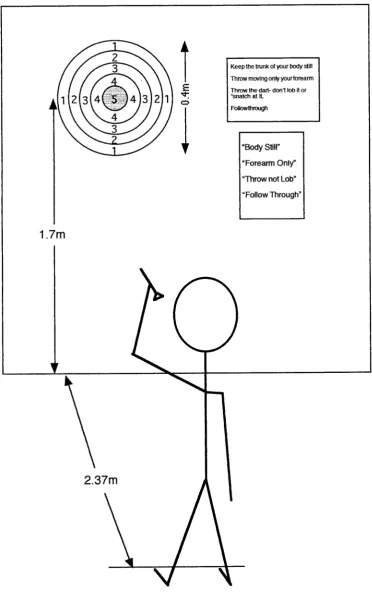
Figure 2.1. Experiment 1- Dart throwing apparatus ... 23
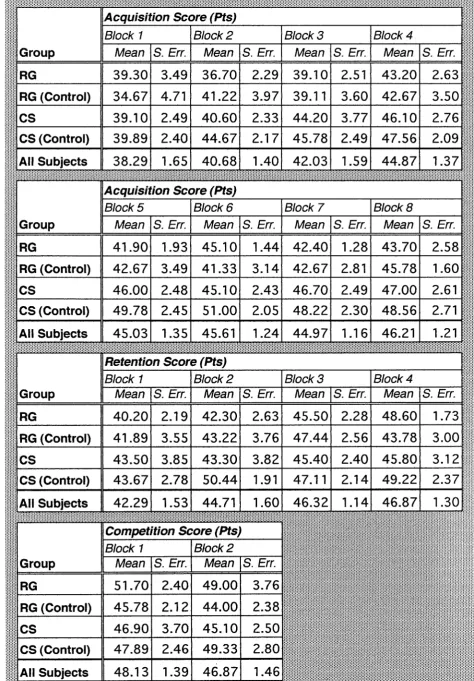
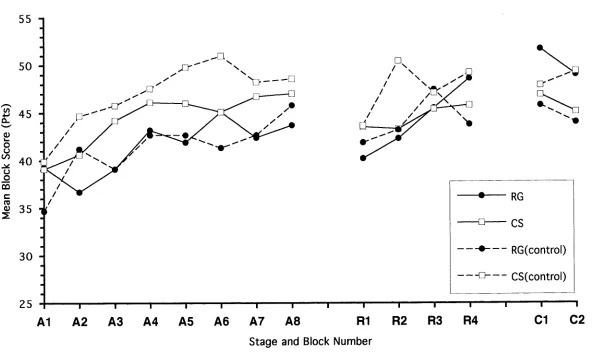
Figure 2.2. Experiment 1- Graph of group scores over successive blocks of 15 darts ... 27
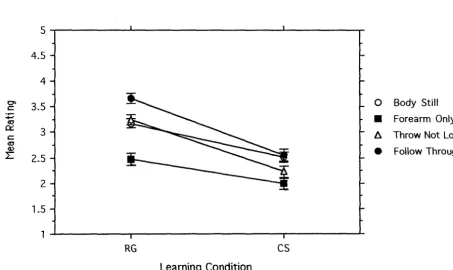
Figure 2.3. Experiment 1- Mean observer ratings of subject throw actions ... 31
Figure 2.4. Experiment 2- Comparison of block scores ofCS-RG subjects with acquisition stage scores of groups in Experiment L ... 3 7 Figure 4.1. Experiment 3- Rugby kicking scoring system and set-up ... 79
Figure 4.2. Experiment 3- Graph of percentage success data ... 83
Figure 4.3. Experiment 3- Graph of mean point data ... 83
Figure 4.4. Experiment 4- Golf putting apparatus ... 90
Figure 4.5. Experiment 4- Total point scores in the baseline and competition stages ... 98
Figure 4.6. Experiment 4- illustration of the error variables used to assess performance during the competition stage ... 10 1 Figure 5.1. Experiment 5- Total point scores in the five conditions ... 123
Figure 5.2. Experiment 5- Interaction plot between block and condition ... 123
Figure 5.3. Experiment 5- Mean concentration times in the five conditions ... 125
Figure 5.4. Experiment 5- Mean adjusted concentration times ... 125
Figure 5.5. Experiment 5- Difficulty ratings for the set-up and swing instructions ... 129
Figure 5.6. Experiment 6- Total point scores in the five conditions ... 139
Figure 5.7. Experiment 6- Interaction plot between block and condition ... 139
Figure 5.8. Experiment 6- Mean concentration times in the five conditions ... 142
Figure 5.9. Experiment 6- Mean adjusted concentration times ... 142
Figure 5.10. Experiment 6- Difficulty ratings for the swing instructions ... 143
Figure 6.1. Experiment 7- Total point scores in the baseline and competition stages ... 157
Figure 6.2. Experiment 7- Radial Error scores in the baseline and competition stages ... 157
Figure 6.3. Experiment 7- Interaction plot between block and stage ... 159
Figure 6.4. Experiment 7- Vertical unsigned error means in the competition stage ... 162
Figure 6.5. Experiment 7- Horizontal unsigned error means in the competition stage ... 162
Figure 6.6. Experiment 7- Routine times in comparison and competition stages ... 167
Figure 6.7. Experiment 7- Concentration times in comparison and competition stages ... 167
Figure 6.8. Experiment 7- Consistency ratings for baseline and competition stages ... 171
Table 2.2. Experiment 1- Ratings for how well subjects performed the actions
specified by the instructions ... 31
Table 2.3. Experiment 2- Block scores, compared with groups from Experiment 1 ... 3 7 Table 4.1. Experiment 3- Mean point scores and percentage success for each subject ... 82
Table 4.2. Experiment 3- Comparison between actual and predicted percentage scores, based on mean point score data ... 84
Table 4.3. Experiment 4- Total point and radial error scores for each group ... 97
Table 4.4. Experiment 4- Block scores for each group in the baseline and competition stages ... 99
Table 4.5. Experiment 4- Vertical and horizontal signed and unsigned error scores in the competition stage ... 102
Table 4.6. Experiment 4- Routine data for each group in the comparison (baseline or intervention) and competition stages ... 1 04 Table 4.7. Experiment 4- Correlation matrix between background information and performance variables ... 107
Table 5.1. Experiment 5- Total scores and block scores in all conditions ... 122
Table 5.2. Experiment 5- Concentration time data ... 124
Table 5.3. Experiment 5- Instruction difficulty and performance ratings ... 128
Table 5.4. Experiment 6- Total scores and block scores in all conditions ... 138
Table 5.5. Experiment 6- Concentration time data ... 141
Table 5.6. Experiment 6- Instruction difficulty and performance ratings ... 143
Table 6.1. Experiment 7- Total point scores and radial error scores in the baseline and competition stages ... 156
Table 6.2. Experiment 7- Block scores for each group in the baseline and competition stages ... 158
Table 6.3. Experiment 7- Vertical and horizontal signed and unsigned error scores in the baseline and competition stages ... 161
Table 6.4. Experiment 7- Variable error data in the baseline and competition stages ... 164
Table 6.5. Experiment 7- Routine and concentration time data in the comparison and competition stages ... 166
Table 6.6. Experiment 7- Routine behaviours in the comparison and competition stages ... 168
Table 6.7. Experiment 7- Background information plus consistency and pressure ratings ... 170
Table 6.8. Experiment 7- Correlation matrix between, background information and competition performance variables ... 172
Chapter 1- Introduction to the Study of Stress and Performance in Sport
1.1. Introduction
''Human beings under pressure are wonderfully unpredictable; their nature is a
puzzle to us all, and psychology has only scratched the surface. When human
beings are placed in an arena, and their hopes and fears exposed in front of
thousands of observers, they are likely to do extraordinary things."
(Patmore, 1986, p. 7)
In 1997, sportsmen and women still do "extraordinary things" in competitive
situations. Sometimes, they achieve extremely high levels of performance: athletes
break world records, golfers shoot course records and rugby goal kickers are successful
with all their kicks. At other times, these extraordinary things are associated with
inexplicably poor performance. In 1996, Greg Norman played exceptional golf over the
first three rounds of the U.S. Masters (one of the four "major" championships in mens'
golf) to build up a six shot lead entering the last round. It was considered a formality
that he would go on to win the tournament. Unfortunately for Norman, he took 78
shots in the final round to finish runner-up to Nick Faldo by five strokes. In 1993, Jana
Novotna led 4-1,40-30 in the final set ofthe Wimbledon ladies' final against Steffi
Graf Suddenly she started to serve double faults, missed routine volleys and went on to
lose the match. In 1995, Novotna was the subject of an even more spectacular collapse
at the French Open, where she lost a match against Chanda Rubin having led 5-0, 40-0
in the final set.
It is the latter type of performance, colloquially referred to as "choking", that is
the subject of the current thesis. In particular, why such poor performance occurs and
what can be done to prevent choking form the central foci of the research. As the title
states, this thesis is a behavioural analysis of choking. Adoption of this framework does
not, however, imply a combative position with respect to other, more mainstream
approaches to the study of behaviour. Indeed, after the original experiments, presented
in Chapter 2, the position throughout the thesis, is one of attempting to bridge the
schism between cognitive and behavioural analyses (Slocum and Butterfield, 1994). In
particular, similarities in the behaviour analysis distinction between rule-governed and
contingency-shaped behaviour and the cognitive distinction between explicit and
implicit learning forms a common theme.
This introduction begins with a section examining the definition of choking.
the relationship between stress and performance in sport. Having provided this
background a summary of the basic tenets of behaviour analysis and a description of the
distinction between rule-governed and contingency-shaped behaviour is presented.
Finally, possible implications of this distinction for the performance of two types of
motor skill are described.
1.2. Defining Choking
When talking about "choking" it is important to make a distinction between the
colloquial and scientific use of the term. In the media, for example, choking has been
used in verb form ("she choked"), noun form ("that was a choke") or as an adjective
("he is a choker") to describe just about any sub-optimal sports performance. Such use
fits with a rather vague early definition of choking as ''the inability to perform up to
previously exhibited standards" (Daniel, 1981). To be useful as a scientific term,
however, a definition of choking must distinguish between performance that can and
cannot be explained by random variation. An example of the problem with the
colloquial use of the term concerns a golf putt that Bernhard Langer had to hole for
Europe to retain the 1991 Ryder Cup. To briefly summarise the situation, the Ryder
Cup is the most prestigious team event in mens' golf and is contested every two years
by the top twelve professional golfers from Europe and the United States of America.
In 1991, the outcome of the contest rested on the result of the final match. More
specifically, Bernhard Langer needed to hole a putt of approximately six feet on the
final hole for Europe to retain the Cup. In the event he missed the putt by a fraction.
This has been interpreted by many in the popular press as being an example of choking
(e.g. Roberts, 1993), despite the fact that many putts of this length are missed in golf
tournaments without choking being inferred. Indeed, Bernhard Langer himself describes
this putt as an example of how he managed to make a good smooth putting stroke in a
pressure situation (Fine, 1993).
Related to the problem of making inferences based on small sample sizes,
Gilden and Wilson (1995) have looked at "streaks" in skilled performance. They found
that people are poor judges of what a random sequence looks like and are "not
competent to discriminate chance occurrence from truly remarkable performance" (p.
260). A similar conclusion was reached by Gilovich, Vallone and Tversky (1985) who
argued that observers' detection of hot streaks could be attributed to a misconception
of chance. The implications for choking are clear: not all sub-optimal performances are
instances of choking and the use of statistical analyses are required for a valid scientific
use of the term.
As a scientific term "choking" has been defined as "performance decrements
under circumstances that increase the importance of good or improved performance"
(Baumeister, 1984, p. 610). Similarly, Baumeister and Showers (1986) used the term
"paradoxical performance effects" which they defined as ''the occurrence of inferior
performance despite striving and incentives for superior performance" (p. 361). Both of
these definitions encapsulate two elements that are necessary for correct use of the
term: poor performance and situational incentives for good performance. These are not
sufficient for a technical definition, however, because poor performance in such
situations could result from other factors such as injury, or adverse weather conditions.
Choking is, therefore, the occurrence of inferior performance despite striving and
incentives for a high level of performance, in the absence of another explanation for that
performance, such as occurrence of injury or adverse weather conditions.
The above definition remains flexible with regard to the specific comparisons
that can be made to determine choking. For example, Leith (1988) described three
different types of performance to which the term choking could be applied:
i) ''when an athlete performs flawlessly in practice but not in a game situation"
ii) ''when an athlete plays well in every game except the big one, or the one that
really counts"
iii) ''where the athlete plays well throughout the game but folds in clutch
situations"
(Leith, 1988, p. 59)
Thus choking may be inferred by comparing practice and competition data as
well as by comparing data from different situations within a game, match or event. For
example, in analysing the percentage of successful first serves in tennis, a number of
different comparisons could be made. Firstly, figures in practice and competition could
be compared. Secondly, to analyse performance associated with different match
situations, figures early in a set could be compared with figures late in a set, or figures
associated with critical points (e.g. break points) could be compared with non-critical
points. This degree of flexibility is important to allow choking to be identified for both
the competitor who performs worse in competition than in practice, and in the
1.3. The Study of the Relationship Between Stress and Performance
The question of which factors determine perfonnance in stressful situations has been a long standing one in psychology. Accordingly, it is not surprising to find that some of the main theories from other areas of psychology have been tested in the context of stress and perfonnance in sport. Thus, "drive theory" (Hull, 1943; Spence and Spence, 1966) and "the Inverted-U hypothesis" (Yerkes and Dodson, 1908) fonned the basis of much of the early research in this area. More recently, research into the relationship between anxiety and perfonnance has become the dominant approach
for investigating the relationship between stress and perfonnance (Martens, Vealey and Burton, 1990). A review of the vast literature pertaining to each of these areas is beyond the scope of this thesis, but a summary of each approach is outlined below.
1. 3.1. Drive Theory
Based on the work of Hull (1943) and Spence and Spence (1966) and
conceptualised within an early behavioural "stimulus-response" approach to the study of behaviour (y.1 atson, 1925), drive theory predicts that the likelihood of a particular behaviour will be a function of the organism's "drive state" and "habit strength". Drive state is considered to be a hypothetical construct defined as "the sum of all of the energetic components affecting an individual at the time of the behaviour" (Hackfort and Schwenkmezger, 1993, p. 343). Habit strength refers to the probability that a particular response will follow a particular stimulus. For well learned skills, therefore, drive theory predicts that an individual's level ofperfonnance (represented by the
probability of the dominant response) will be positively related to his or her drive state. Data supporting a drive theory explanation of choking is conspicuous by its absence (Neiss, 1988). Thus, although limited support for the theory exists in the context of social facilitation theory (Zajonc, 1965; Singer, 1970), a great deal of anecdotal and empirical evidence has been gathered indicating that high levels of physiological arousal often have a detrimental effect on the performance of skills, particularly complex skills. For example, Kimble and Rezabek (1992) found that, contrary to the predictions of social facilitation theory, good players perfonned worse in the presence ofan audience on both simple and complex games (pinball and tetris).
The practical implication of drive theory for the perfonners of motor skills is that when the dominant response is the correct one, it should be more likely to be perfonned correctly under pressure than in a situation associated with low drive state.
This prediction reveals an obvious limitation of drive theory, which is that it cannot easily account for poor perfonnance of well-learned skills under pressure. For example, consider a basketball player who, although successful with 70% of free-throw attempts
in practice is only successful with 30% in match situations. If one assumes that the game situation is accompanied by an increased drive state then drive theory cannot account for such performance. In effect, drive theory predicts that choking should not occur in skills that are well-learned.
1.3.2. The Inverted-U Hypothesis
Partly due to its failure to adequately account for the poor performance of highly skilled individuals in situations considered likely to invoke high drive states, the "inverted-U hypothesis" (Oxendine, 1970) superceeded drive theory as the dominant theory in stress-related sport research during the 1970's and early 1980's.
Based on research carried out at the beginning of the century into the rate of habit formation in mice (Yerkes and Dodson, 1908), the inverted-U hypothesis predicts a curvilinear relationship between arousal and performance (Oxendine, 1970).
Specifically, it predicts that there is an optimal level of arousal, above and below which performance becomes progressively worse in proportion to the deviation from this leveL Two advantages the inverted-U hypothesis has over drive theory are, firstly, it is able to account for debilitative effects of high levels of arousal. Secondly, it is more flexible than drive theory. For example, in accordance with animal research, Oxendine (1970) proposed that the optimum level of arousal for performing complex motor skills would be lower, with a narrower bandwidth than for performing simpler skills. More
recently, it has been proposed that task complexity should be further broken down into different factors relating to the decision making, perceptual and muscular requirements of the task in order to determine the likely optimum level of arousal (Landers and Boutcher, 1993).
Despite these advantages, as well as its intuitive appeal, the inverted-U
hypothesis has recently been criticised on several fronts. Some of these criticisms reflect dissatisfaction with the inverted-U hypothesis in particular, but others reflect a more general dissatisfaction with the construct of arousal and how it is measured.
1.3.2.1. Use of the Term 'Arousal'
Arousal was recently defined as "general physiological and psychological activation of the organism that varies on a continuum from deep sleep to intense excitement" (Gould and Krane, 1992, p. 121). This definition is indicative ofthe
that some of the predictions of the inverted-U hypothesis are effectively irrefutable. For example, it could be argued that any experiment failing to reveal poor performance at high levels of physiological arousal simply did not increase arousal to a sufficiently high level to induce performance decrements for that task.
Further evidence against a general relationship between arousal and
performance comes from a recent experiment by Molander and Backman (1994). On a golf putting task, they found a dissociation between the effects of increased
physiological arousal on performance in older and younger skilled performers. Specifically, it was found that increased heart rate was associated with decreased putting accuracy in two older groups (aged 50-57 and 58-73 years), whilst similar increases in heart rate were associated with higher accuracy in the two younger groups (aged 15-19 and 25-35 years). Such results cannot be easily accommodated within the inverted-U hypothesis.
1.3.3. Anxiety and Performance
Since the late 1970's there has been a large increase in the amount of research examining the role of anxiety in the relationship between stress and sports performance. Recently, anxiety was defined as:
"the cognitive/emotional reaction that occurs when a perceived imbalance between environmental demand and individual capability to meet the demand is interpreted as threatening"
(Wrisberg, 1994, p. 61)
A number of self-report measures have been developed to measure anxiety in sport. The first sport-specific test, the Sport Competition Anxiety Test (Martens, 1977), was designed to measure trait anxiety in competitive situations. Following validation research for this test, the Competitive State Anxiety Inventory (CSAI) was designed by modifying Spielberger's State Anxiety Inventory (Martens, 1990). This test was then further modified to reflect the multidimensional nature of anxiety, taking into account the distinction between the cognitive and somatic components of anxiety. The resulting CSAI-2 inventory consisted of27 items, 9 in each of the cognitive and somatic components and 9 which measured self-confidence, a sub-scale that emerged during earlier work on development of the modified version.
Given that anxiety based research using this and other tests is the most widely used approach to investigating fluctuations in competitive performance, it is useful to consider reasons why this theoretical framework was not adopted as the basis for the
present research. To this end there are two factors in particular that are worth considering.
1.3.3.1. Measuring Anxiety
From a purely practical point of view, the main problem with anxiety based research is that the tests themselves cannot usually be administered during performance. This means that they cannot account for performance variations that occur after
completion of the test. This is particularly important when considering that choking often occurs during specific situations within a game, match or event. For example, in the 1993 Wimbledon Ladies' final between Jana Novotna and Steffi Graf, Novotna is credited with playing extremely good tennis for the majority of the match before performing extremely poorly from midway through the final set. Clearly, a pre-performance measure of state anxiety is unable to explain such fluctuations in
performance. To use a research-based example, Davis and Harvey (1992) analysed the batting averages of300 US major league baseball players in the 1989 season. They used different game situations to compare performance in pressure and no pressure situations. The authors found that performance was poorer for 80% of 156
comparisons made using the team data (26 clubs, compared in 6 pressure/no pressure situations). Again, while this data demonstrates the extent of choking in sport, it is difficult to see how pre-game measures of anxiety could explain these differences. Related to this point one could also question the validity of an assumption that pre-performance anxiety is predictive of anxiety during the pre-performance itself (Jones, Mace and Stockbridge, 1997).
In the one study that has attempted to assess anxiety during game situations, a complicated picture of the relationship between anxiety and performance has been found. In their research Krane, Joyce and Rafeld (1994) administered a modified version of the ''Mental Readiness Form" to members ofa womens' softball team just before they went to bat. The form required performers to rate how they felt on two
11-point Likert type scales from "calm" to "worried" and from ''tense'' to "relaxed". This scale was designed to give a measure that was quick to complete and which
corresponded to the cognitive and somatic anxiety components of the CSAI-2 scale. Over the course of five games during a tournament, each player used the two scales to rate how they felt just before going to bat. A number of pressure situations were defined and given a "situation criticality" value ranging from '1' to '5'. Each performance was then rated by six independent obs~rvers.
somatic anxiety scale. Secondly, it was found that the relationship between somatic anxiety and performance was dependent on the source of the game pressure. When the
score was the source of pressure a curvilinear relationship was found between somatic anxietY and performance in high pressure situations but not in low pressure situations. By contrast, when using base pressure (runner on third base or not) a curvilinear relationship between somatic anxiety and performance was evident in the low pressure
situation, but not in the high pressure situation. The authors did not conduct similar tests using cognitive anxiety but the somatic anxiety data, at least, suggest that the
relationship between anxiety and performance during actual performance might be extremely complex.
A second limitation with anxiety based research concerns the reliance on self-report measures. This leads to potential problems associated with response biases and questions concerning the reliability and validity of the tests. For example, Williams and Krane (1989) found that the scores of 58 female collegiate golfers on the CSAI-2 sub-scales were significantly correlated with their scores on a social desirability scale. Response distortions such as these previously led Rushall (1975) to comment that "on the hierarchy of preferred methods for assessing personality and behaviour,
questionnaires are at the very bottom" (p. 79). More than twenty years later, the use of self-report measures is more prevalent than ever in sport psychology leading Fogarty
(1995) to caution that ''we must acknowledge that testing has serious limitations, particularly when we are forced to rely upon self-report instruments" (p. 168).
1.3.3.2. The Relationship Between Anxiety and Performance
Even if tests are demonstrated to be reliable and valid and the problem of
response biases is taken into account, and even if the practical problems of
administering the tests can be overcome, two related questions remain. First, what is the relationship between anxiety and performance, and, second, what does any relationship indicate about how to prevent choking in pressure situations?
Regarding the first of these questions the results are somewhat equivocal. No
straightforward relationship between CSAI-2 sub-scales and performance has been demonstrated and many researchers have argued that none exists. For example, Imlay et aI., (1995) proposed that rather than there being a general optimal level of state anxiety, each individual has a "zone of optimal functioning". They proposed that intraindividual state anxiety scores should be used for the purpose of comparison, rather than assessing the relationship between gross scores and performance. Adopting this methodology, Burton (1988) used intraindividual measures of both CSAI-2 sub-scale scores (cognitive anxiety, somatic anxiety, and self-confidence) and performance
to test the relationship between anxiety and swimming performance. The results
indicated a negative linear relationship between cognitive anxiety and performance, a positive linear relationship between self-confidence and performance, and an inverted-U shape relationship between somatic anxiety and performance.
Despite this progress, it has been argued that even when using intraindividual scores "multidimensional anxiety theory" is flawed because it does not explain how the different components interact to influence performance (Hardy, 1990). To this end, Hardy (1990) outlined a "cusp catastrophe model" of the relationship between
physiological arousal, cognitive anxiety and performance. In this model, the interaction between these three factors is considered in terms of a three-dimensional performance surface. Specific predictions are made regarding how performance will be affected by changes in each factor or combination of factors. In particular, it is predicted that at low levels of cognitive anxiety, changes in physiological arousal will have small effects
on performance, although it is suggested that any effects might take the form of an inverted-U shape. For high levels of cognitive anxiety, however, it is predicted that increases in physiological arousal will follow an inverted-U shape up to a point whereupon a "sudden and dramatic decline in performance" will occur (Hardy, Jones and Gould, 1996, p. 152). To regain a high level of performance, catastrophe theory predicts that physiological arousal must first be significantly reduced.
Other developments in anxiety research paint an increasingly complicated picture regarding its relationship with performance (Burton, 1993). In fact, it has been suggested that measures of anxiety need to be further modified to take into account its "direction". The argument for doing this is that the same level of cognitive anxiety could be perceived as being either facilitative or debilitative (Jones, Swain and Hardy, 1993; Jones and Swain, 1995). The implications for choking interventions are that it is
unclear what to recommend. If a causal relationship does exist between components of anxiety and performance then it appears to be highly complex. This might help to explain why some applied studies that have successfully decreased pre-performance anxiety have failed to reveal any differences in performance measures (Murphy and Woolfolk, 1987; Maynard, Hemmings and Warwick-Evans, 1995). Even using individual zones of optimal functioning, formed by assessing cognitive anxiety in the
moments before season best performances, Imlay et al. (1995) found that 37% of second best performances occurred outside of these zones, whilst 31 % of worst performances occurred within these zones. At the present time, assessing pre-performance anxiety does not seem to offer a viable explanation of why choking
1.4. Behaviour Analysis
An alternative approach to studying choking that has yet to be explored in any detail is the use of the theoretical framework of behaviour analysis. In the following section the basic tenets of this approach are described and some of the main terms are defined. The historical reason for the distinction between rule-governed and
contingency-shaped behaviour is then described along with possible implications for the performance of different types of skill.
1. 4.1. Operant Behaviour and the Three- Term Contingency
The basic tenets of behaviour analysis are that behaviour is analysed in terms of the antecedents, or the circumstances that set the occasion for behaviour, the behaviour itself, and the consequences of that behaviour. This is sometimes referred to as the three-term contingency or the A-B-C of behaviour. Contingency-shaped, or operant behaviour is the term used for behaviour that can be modified by its consequences and because of this relationship with consequences is described as being emitted rather than elicited (Catania, 1992). Reinforcement is used to refer to the process whereby
responding increases as a result of the delivery of consequences following a response. Conversely, punishment is used to refer to the process whereby responding decreases as a result of the delivery of consequences following a response (Catania, 1992).
Discrimination refers to a difference in responding "resulting from differential consequences of responding in the presence of different stimuli" (Catania, 1992, p. 372). For example, if the lever pressing behaviour of a rat is reinforced when a light is
on but not when it is off, the behaviour will, over time, increase when the light is on and decrease when the light is off The controlling stimulus is referred to as the
discriminative stimulus and is said to occasion the response (Michael, 1980). Shaping refers to the process of "gradually modifying some property of responding by differentially reinforcing successive approximations to a target operant class" (Catania, 1992, p. 395). Of particular relevance to choking is the distinction that is made in behaviour analysis between operant, or contingency-shaped behaviour, and behaviour that is under the control of verbal antecedents, or prior
contingency-specifying stimuli (Skinner, 1966). This second form of behaviour has become known as rule-governed behaviour, a class of behaviour distinguished from
contingency-shaped behaviour by its apparent insensitivity to any changes in the programmed contingencies of reinforcement (Catania, Matthews and Shimoff, 1990).
1.4.2. Rule-Governed and Contingency-Shaped Behaviour
The original distinction between rule-governed and contingency-shaped behaviour was made because of differences in the patterns of behaviour that were observed in human and infrahuman subjects on various schedules of reinforcement. This finding was important because the applicability of the principles of behaviour analysis to human behaviour relied on the continuity assumption, which simply stated that the principles of behaviour, established using infrahuman subjects, would prove equally
applicable to human behaviour (Hayes and Wilson, 1993).
Many of the findings from research using non-human organisms were indeed also found in studies of human behaviour. For example, using a simple button pressing apparatus in which the subject earned points for pressing in accordance with various programmed contingencies, human subjects were found to emit high
inter-reinforcement response rates under variable interval (VI) schedules of inter-reinforcement
(where the first target response after a variable period of time with a pre-programmed mean value is reinforced). For other schedules of reinforcement, however, the pattern of human responding was found to differ from infrahuman performance. In particular, it was firstly found that on fixed-interval (FI) schedules, where only the first response after a fixed period of time is reinforced, human performance did not usually display the temporal patterning of responses displayed by non-humans (Weiner, 1964, 1969; Leander, Lippman and Meyer, 1968; Matthews, Shimoff, Catania and Sagvolden, 1977; Lowe, Harzem and Hughes, 1978). Secondly, the response rates of human subjects on FI schedules were found to be a function oftheir conditioning history. For example, Weiner (1964) found that subjects trained on a fixed ratio (FR) schedule exhibited high
rates of continuous inter-reinforcement button pressing when an FI schedule was programmed for the test session whilst subjects trained on a differential reinforcement of low rate responding (DRL) schedule continued to exhibit low rates of pressing.
A third finding of this early research was that the instructions that subjects received concerning how to maximise reinforcement during the experiment exerted powerful control over subsequent responding to the extent that behaviour became insensitive to the programmed contingencies of reinforcement. In what effectively constituted the first experiments on rule-governed behaviour, Kaufman, Baron and Kopp (1966) conducted three studies investigating the effects of instructions on human operant behaviour.
The main finding came from the first two experiments, in which 31 subjects were presented either minimal instructions (M), minimal + response instructions (MR), or minimal + response + contingency instructions (MRC). The M group were simply shown the apparatus and asked to obtain as high a reading as possible on the scoring
Specifically, they were told that pressing the response key would sometimes turn on a green light and that this light was a signal to press one of the choice keys. A correct choice would then turn on the light above the chosen key and a point would be registered on the counter. The MRC group received additional information regarding the contingency that was allegedly programmed for their session (either variable ratio, variable interval or fixed interval). In fact in all cases a variable interval one-minute schedule was in effect.
Kaufinan et al. (1966) found that subjects in the MR and MRC groups emitted
response rates that were consistent with the instructions they had been given. The responding of subjects in these groups was found to be «insensitive" to the actual programmed contingencies, so that even subjects given false contingency instructions continued to emit behaviour appropriate for such instructions.
Finally, Leander, Lippman and Meyer (1968) found that subjects' own verbalisations concerning the contingencies could have powerful control over responding. In their experiment subjects ranked four possible descriptions of the
contingencies for reinforcement and it was found that subsequent response rates on an FI schedule of reinforcement could be predicted from their «verbalisation" of the contingencies.
Skinner (1966) made a formal distinction between operant behaviour and behaviour under the control of instructions in the chapter entitled "An operant analysis of problem solving", later reprinted in Skinner's (1969) book entitled «Contingencies of reinforcement: A theoretical analysis". Thus, the term rule-governed behaviour was introduced in the context of human problem solving behaviour:
«Behaviour which solves a problem may result from direct shaping by contingencies or from rules constructed either by the problem solver or by others. Because
different controlling variables are involved, contingency-shaped behaviour is never exactly like rule-governed behaviour."
(Skinner, 1966, reprinted in Catania and Hamad, 1988, p. 218)
He went on to say:
'We refer to contingency-shaped behaviour alone when we say that an organism behaves in a given way with a given probability because the behaviour has been followed by a given kind of consequence in the past. We refer to behaviour under
the control of prior contingency-specifying stimuli when we say that an organism
behaves in a given way because it expects a similar consequence to follow in the foture."
(Skinner, 1966, reprinted in Catania and Hamad, 1988, p. 227, italics in original)
In other words, human behaviour could be gradually shaped by its consequences
or it could be controlled by verbal statements of the contingencies believed to be in effect in that environment, as when an individual receives instructions on the best way to do something. For example, in learning how to swing a golf club, a golfer might be given a series of technical instructions designed to facilitate acquisition. Alternatively, the behaviour might be shaped by its consequences, with the differential reinforcement associated with different qualities of shot leading to an increase in the behaviour
associated with good strikes and a corresponding decrease in behaviour resulting in poor strikes. The importance of this distinction with respect to choking concerns the implications for skilled performance on tasks with different requirements regarding the sensitivity of performance.
1.4.2.1. Implicationsfor SkilledPerjormance
By definition, contingency-shaped behaviour must be sensitive to any change in the contingencies. This sensitivity, and the corresponding insensitivity of rule-governed behaviour, has important implications for the performance of much skilled behaviour. In
particular, a defining feature of most skilled performance is its moment by moment sensitivity to continuously changing contingencies. In behaviour analysis this has been
studied in social skills, where skilled behaviour is said to be characterised by a "social sensitivity" to the context in which it occurs (Azrin and Hayes, 1984).
Azrin and Hayes argued that because of the insensitivity of rule-governed behaviour more skilled social behaviour (characterised by improved sensitivity to changes in the contingencies) would result from a contingency-shaped approach to teaching the skills as opposed to the more traditional rule-governed, or instructional approach. To test their hypothesis, an experiment was set up in which 89 males, approximately half of whom responded to an advert offering a program for improving
social interaction, observed twenty, one-minute videos of a female interacting with an unseen male. After each video the subjects rated the level of interest shown by the
final, post-assessment phase, subjects performed the same task as in the pre-assessment
stage, using a new set of videos.
The results indicated that, over the course of the experiment, subjects who received feedback became increasingly successful at discriminating the true level of interest being shown by the woman on the tape. Secondly, it was found that this ability generalised to videos of previously unviewed females. Finally, subjects from the feedback group also displayed improved actual social skills in subsequent role-playing situations, indicating that the sensitivity of their behaviour to changes in context had
been enhanced.
In skilled motor behaviour moment by moment sensitivity to changes in context, particularly visual context is found to be a characteristic of the performance of many skills, an observation which Bartlett (1932) made:
"When I make the stroke I do not, as a matter of fact, produce something absolutely new, and I never merely repeat something old. The stroke is literally manufactured out of the living visual and postural "schemata" of the moment and their interrelations"
(Bartlett, 1932, p. 89)
More recently, Catania (1992) went so far as to suggest that because ofthe insensitivity of rule-governed behaviour, skilled performance "must be contingency-shaped instead" (p. 249). To illustrate his point Catania included the examples of the behaviour of an American Football quarterback in which sensitivity allows him to anticipate the movements of an opposing player, and the behaviour of a ballet dancer which accommodates slight deviations in a partner's movements. There are numerous other examples from different sports in which moment by moment sensitivity to
changing contingencies is a defining characteristic of skilled performance, including open play in team sports such as basketball, football and korfball, and individual sports such as squash and badminton.
1.4.2.2. Open and Closed Skills
It is tempting to assert, as Catania does, that sensitivity might be a defining characteristic of all skilled behaviour, however, not all skills are performed in an environment of continuously changing contingencies. In the motor skill learning literature, skills that take place in an unpredictable or changing environment are
classified as open skills (Gentile, 1972). By contrast, the term closed skill refers to skills that take place under fixed, unchanging environmental conditions (Gentile, 1972). With
respect to the requirements for sensitivity to moment by moment changes in the
contingencies, open skills require such sensitivity but closed skills do not. An example of a closed skill would be taking a "free-throw" in basketball. Thus, the hoop is at a specified height and a set distance from the free-throw line, and the task is to throw a regulation size basketball through the stationary hoop. For closed skills the behaviour does not need to be contingency-shaped in terms of the sensitivity requirements
outlined above. Furthermore, the level of performance that an individual attains may benefit from an insensitivity to other changes in the contingencies of reinforcement, particularly changes that increase the "pressure" associated with performance.
1.4.3. Pressure as a Change in the Contingencies of Reinforcement
Baumeister and Showers (1986) defined pressure as 'lhe presence of situational incentives for optimal, maximal or superior performance" (p. 362). Using the locution of behaviour analysis, pressure in sport can be defined as the presence of additional
contingencies that increase the perceived importance of optimal performance at any given time. To use the example ofa golf putt, in a practice situation no contingencies
are present other than the naturally occurring consequences associated with different quality shots. When putting in a competitive situation, however, additional
consequences are made contingent upon successful performance. These may be financial, as when a golfer has a putt to win a certain amount of prize money, or may simply relate to intrinsic motivation as in the case of "friendly" matches. In terms of the present discussion, choking can be viewed as behavioural sensitivity to the addition of pressure related contingencies. In such cases, insensitivity would be beneficial in that performance would be unaffected by these additional contingencies.
Recently, Martin (1992) and Martin and Pear (1992) have argued that an intervention to eliminate differences between performance in practice and competition could be conceptualised within the behaviour analysis framework of rule-governed behaviour. Specifically, Martin (1992) suggested that performers could capitalise on the
1.5. Summary
Previous research examining the relationship between stress and performance
has focussed on anxiety and physiological arousal. No simple relationship has been
found and the implications for preventing choking are unclear. A previously unexplored
possibility is that the insensitivity associated with verbally controlled human behaviour
could prove beneficial when performing closed skills under pressure.
Chapter 2- The Sensitivity of Rule-governed and Contingency-shaped Behaviour
to a Pressure Manipulation.
"Rarely does a player... produce his best performance on the day. On the day, he finds himself suddenly a stranger in his own sport. He comes believing it to be a
game, and finds it is something else. What happens? For a start, he finds his whole identity is involved in a sort of side-bet, and that everyone is looking at him in a meaningful way. His arms tum to sausages. His knees sag. His hands swell up like soft crabs. He can't hear properly, or see straight. His skill deserts him. His mouth
goes dry. He loses".
(patmore, 1986, p. 23)
2.1. Introduction
In the previous chapter, it was suggested that the conceptual framework of behaviour analysis provides an alternative approach to investigating choking. In the present chapter, the history of applying the principles of behaviour analysis to the study of sport behaviour is outlined. This leads in to a description of the hypothesis to be tested in the first experiment. After considering the results of this experiment a
follow up experiment is then described followed by a general discussion of the implications of the two experiments.
2.2. Behaviour Analysis in Sport
The principles of behaviour analysis have been applied in a variety of settings, most notably in the treatment of people with learning difficulties and in clinical
psychology in general (Zettle and Hayes, 1982). The focus of interventions employing these principles is extremely variable, ranging from attempts to decrease self-injurious behaviour to devising methods for individual performance management (Ackley and Bailey, 1995). Several excellent papers have also been written which demonstrate the effectiveness of applying operant techniques in the modification of sport and exercise
behaviour. Lee (1993) recently reviewed many of these studies which can be divided into two main areas. The first concerns interventions that relate to behaviour in the clinical sense of the word. As Rushall (1975) notes, "unfortunately most critics believe that this is the only application" (p. 76), but there is a second group of studies that
With respect to the first group of studies, Rushall (1975) described an
intervention in which the behaviour of a swimming coach was changed over a period of several months from being predominantly negative and critical to being more positive and rewarding of desirable behaviours. In the intervention, the coach developed an appropriate vocabulary that enabled him to reinforce desirable behaviours and provide
positive feedback to his swimmers. Rushall also notes that the coach's more positive, less critical approach generalised to his day-to-day social interactions. The topic of coaching behaviour, particularly in youth sports, has been the area of sport that has received most attention from researchers using the principles of applied behaviour analysis, most notably in the work of Smith and Smoll (e.g. Smith, 1993; Smoll and Smith, 1993). The "positive approach" to coaching (Smith, 1993) has been
demonstrated to be effective in a range of different sports, including football (Rush and Ayllon, 1984), tennis (Buzas and Ayllon, 1981), gymnastics (Allison and Ayllon,
1980), and swimming (Koop and Martin, 1983).
Considering research relating to sports performance, the number of studies using a behaviour analysis framework is more limited. Rushall (1975) was the first scholar to outline the potential benefits of applying the principles of behaviour analysis in this area. His paper described a number of studies, including the use of a punishment procedure to decrease the frequency of the incorrect ''trudgeon'' kick in a young swimmer. This procedure involved shining a light in the swimmer's eyes each time he performed an incorrect kick and recording only the lengths that were performed to a criterion level on the swimmer's progress chart. From a baseline level offifteen
incorrect kicks per length the criterion level was set at four incorrect kicks per length on day two, two per length on day three and no incorrect kicks on day four. By the 35th length of the intervention the trudgeon kick had been eliminated and the
punishment procedure "completely and permanently changed the swimmer's form of kicking" (Rushall, 1975, p. 77).
Also related to sports performance, Rushall (1975) discussed a device designed to facilitate the shaping of an aspect of rowing behaviour that was normally dependent
on direct instruction from a coach over a period of approximately two months. The device involved an alarm that sounded whenever the boat tilted beyond a pre-set angle. Over the course of several weeks the critical angle was reduced, so that at each point the sculler's rowing behaviour would be shaped towards an increasingly stable form.
In a very different environment, the range of applications of behaviour analysis is demonstrated by Komaki and Barnett (1977) who used a behavioural intervention to improve three backfield plays of a youth American Football team. Each play was divided into five distinct behaviours from which check-lists were drawn up to provide a basis for giving feedback to the players involved in the execution of each skill. The intervention consisted of the coach telling the players how they had done after each
play, pointing out both what had been done incorrectly and reinforcing correct behaviours. Using a multiple baseline design across the three plays, the percentage of correct behaviours increased from 61.7% to 81.5% for Play A, 54.4% to 82.0% for Play Band 65.5% to 79.8% for Play C.
All of the above studies are examples of the application of operant strategies to the study of sport behaviours (Lee, 1993). As outlined in chapter one, however, the characteristic patterns of responding found when using non-human subjects are not always found in humans (e.g. Weiner, 1964, 1969; Leander, Lippman and Meyer, 1968, Matthews, Shimoff, Catania and Sagvolden, 1977; Lowe, Harzem and Hughes, 1978). For example, whereas interval and ratio schedules maintain different rates of
responding in animal subjects, the same is not true of human subjects, who often display continued high rates of responding during extinction on these schedules (e.g. Kaufinan, Baron and Kopp, 1966; Shimoff, Matthews and Catania, 1986). As mentioned in the previous chapter, this led to Skinner (1966, 1969) making a distinction between operant behaviour and behaviour under the control of verbal antecedents. Rule-governed behaviour was the name given to the latter and was distinguished from contingency-shaped behaviour by its insensitivity to changes in the contingencies of reinforcement (Catania, Matthews and Shimoff, 1990).
With respect to sports behaviour, very few studies have made reference to this distinction. Thus, although Martin (1992) notes that some "sport psyching"
interventions have involved verbal behaviour conceptualised within the applied behaviour analysis framework, these papers have not made any reference to rule-governed behaviour. For example, Rushall (1984), and Rushall, Hall, Roux, Sasseville and RushaIl (1988) looked at the effects of different self-talk instructions on rowing and skiing performance respectively. Similarly, Zieglar (1987) studied the effect of using verbal cues on the acquisition of tennis service returns in novice players. Despite not making reference to rule-governed behaviour, Martin (1992) notes that a common thread in these studies is that athletes are taught to bring their behaviour under the control of cue words or self-talk during practice, with the aim being to cue the same level of performance in competitive situations. This approach, Martin argues,
"capitalises on rule-governed control of behaviour and uses a generalisation
programming strategy referred to as "program common stimuli"" (p. 238). Recently,