Sentence Position revisited:
A robust light-weight Update Summarization ‘baseline’ Algorithm
Rahul Katragadda rahul [email protected]
Prasad Pingali [email protected]
Language Technologies Research Center IIIT Hyderabad
Vasudeva Varma [email protected]
Abstract
In this paper, we describe a sentence po-sition based summarizer that is built based on a sentence position policy, created from the evaluation testbed of recent summariza-tion tasks at Document Understanding Con-ferences (DUC). We show that the summa-rizer thus built is able to outperform most sys-tems participating in task focused summariza-tion evaluasummariza-tions at Text Analysis Conferences (TAC) 2008. Our experiments also show that such a method would perform better at pro-ducing short summaries (upto 100 words) than longer summaries. Further, we discuss the baselines traditionally used for summarization evaluation and suggest the revival of an old baseline to suit the current summarization task at TAC: the Update Summarization task.
1 Introduction
Document summarization received a lot of atten-tion since an early work by Luhn (1958). Statis-tical information derived from word frequency and distribution was used by the machine to compute a relative measure of significance, first for individ-ual words and then for sentences. Later, Edmund-son (1969) introduced four clues for identifying sig-nificant words (topics) in a text. Among them title
andlocationare related to position methods, while the other two are presence of cue words and high frequency content words. Edmundson assigned pos-itive weights to sentences according to their ordinal position in the text, giving more weight to the first sentence in the first paragraph and last sentence in the last paragraph.
Position of a sentence in a document or the po-sition of a word in a sentence give good clues to-wards importance of the sentence or word respec-tively. Such features are called locational features, and asentence positionfeature deals with presence of key sentences at specific locations in the text. Sentence Position has been well studied in summa-rization research since its inception, early in Ed-mundson’s work (1969). Earlier, Baxendale (1958) investigated a sample of 200 paragraphs to deter-mine where the important words are most likely to be found. He concluded that in 85% of the para-graphs, the first sentence was a topic sentence and in 7% of the paragraphs, the final one.
Recent advances in machine learning have been adapted to summarization problem through the years and locational features have been consistently used to identify salience of a sentence. Some represen-tative work in ‘learning’ sentence extraction would include training a binary classifier (Kupiec et al., 1995), training a Markov model (Conroy et al., 2004), training a CRF (Shen et al., 2007), and learn-ing pairwise-ranklearn-ing of sentences (Toutanova et al., 2007).
In recent years, at the Document Understand-ing Conferences (DUC1), Text Summarization re-search evolved through task focused evaluations ranging from ‘generic single-document summariza-tion’ to ‘query-focused multi-document summariza-tion(QFMDS)’. The QFMDS task models the real-world complex question answering task wherein, given a topic and a set of 25 relevant documents, the
1http://duc.nist.gov/
task is to synthesize a fluent, well-organized 250-word summary of the documents that answers the question(s) in the topic statement. Recent focus in the community has been towards query-focused update-summarization task at DUC and the Text Analysis Conference (TAC2). The update task was to produce short (~100 words) multi-document update summaries of newswire articles under the assump-tion that the user has already read a set of earlier articles. The purpose of each update summary will be to inform the reader of new information about a particular topic.
The rest of the paper is organized as follows. In Section 2, we describe a Sub-optimal Position Pol-icy (SPP) based on Pyramid Annotated Data, then we derive a simple algorithm for summarization based on the SPP in Section 3, and show evaluation results. Next, in Section 4, we explain the current baselines and evaluation for Multi-Document Sum-marization and finally in Section 5, we discuss the need for an older baseline in the current context of the short summary task of update summarization.
2 Sub-Optimal Sentence Position Policy
Given a large text collection and a way to approxi-mate the relevance for a reasonably large subset of sentences, we could identify significant positional attributes for the genre of the collection. Our ex-periments are based on the work described in (Lin and Hovy, 1997), whose experiments using the Ziff-Davis corpus gave great insights on the selective power of the position method.
2.1 Sentence Position Yield and Optimal Position Policy (OPP)
Lin and Hovy (1997) provide an empirical validation for the position hypothesis. They describe a method of deriving an Optimal Position Policy for a collec-tion of texts within a genre, as long as a small set of topic keywords is defined for each text. They de-finedsentence yield(strength of relevance) of a sen-tence based on the mention of topic keywords in the sentence.
Thepositional yieldis defined as the average sen-tence yield for that position in the document. They
2http://www.nist.gov/tac/
computed the yield of each sentence position in each document by counting the number of different key-words contained in the respective sentence in each document, and averaging over all documents. An Optimal Position Policy (OPP) is derived based on the decreasing values ofpositional yield.
Their experiments grounded on the assumption that abstract is an ideal representation of central topic(s) of a text. For their evaluations, they used the abstract to compare whether the sentences found based on their Optimal Position Policy are indeed a good selection. They used precision-recall measures to establish those findings.
At our disposal we had data from pyramid eval-uations that provided sentences and their mapping to any content units in the gold standard summaries. The annotations in the data provide a unique prop-erty that each sentence can derive for itself a score for relevance.
2.2 Documents
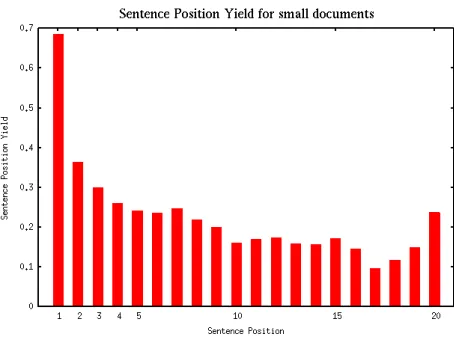
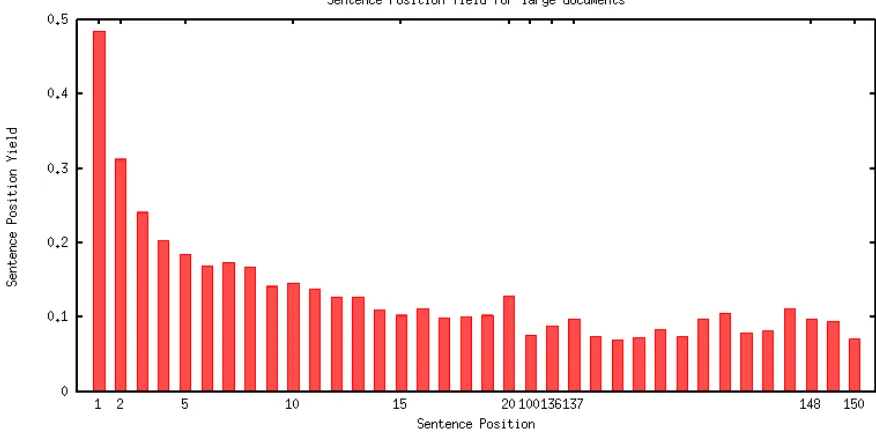
There are a wide variety of document types across genre. In our case of newswire collection we have identified two primary types of documents: small document and large document. This distinction is made based on the total sentences in the document. All documents that have the number of sentences above a threshold should be considered large. We experimented on thresholds varying from 10 to 35 sentences and figured out that documents’ distribu-tion into the two categories was acceptable when threshold-ed at 20 sentences. This decision is also well supported by the fact that the last sentences of a document were more important than the others in the middle (Baxendale, 1958).
Figure 1: A sample mapping of SCU annotation to source document sentences. An excerpt from mapping of topic D0701A of DUC 2007 QF-MDS task.
Figure 2: Sentence Position Yield for small documents.
2.3 Pyramid Data
Summary content units, referred as SCUs hereafter, are semantically motivated, sub-sentential units that are variable in length but not bigger than a sentential clause. SCUs emerge from annotation of a collec-tion of human summaries for the same input. They are identified by noting information that is repeated across summaries, whether the repetition is as small as a modifier of a noun phrase or as large as a clause. The weight an SCU obtains is directly proportional to the number of reference summaries that support that piece of information. The evaluation method that is based on overlapping SCUs in human and automatic summaries is described in the Pyramid method (Nenkova et al., 2007).
The University of Ottawa has organized the pyra-mid annotation data such that for some of the sen-tences in the original document collection (those
that were picked by systems participating in pyra-mid evaluation), a list of corresponding content units is known (Copeck et al., 2006). We used this data to identify locations in a document from where most sentences were being picked, and which of those lo-cations were being most content responsive to the query.
A sample of SCU mapping is shown in figure 1. Three sentences are seen in the figure among which two have been annotated with system IDs and SCU weights wherever applicable. The first sentence has not been picked by any of the summarizers partici-pating in Pyramid Evaluations, hence it is unknown if the sentence would have contributed to any SCU. The second sentence was picked by 8 summarizers and that sentence contributed to an SCU of weight 3. The third sentence in the example was picked by one summarizer, however, it did not contribute to any SCU. This example shows all the three types of sentences available in the corpus: unknown sam-ples, positive samples and negative samples.
For each SCU, a weight is associated in pyramid annotations. Thus a sentential score could be de-fined as sum of weights of all the contributing SCUs of the sentence. For an unknown sample and a neg-ative sample, sentential score is 0. For example, in the second sentence in figure 1 the score is 3, con-tributed by a single SCU. While the same for the first and third sentences is 0.
Pol-Figure 3: Sentence Position Yield for large documents
icy was framed as shown below. A position policy is an ordered set consisting of elements in the order of most importance. Within a subset, each sub-element is equally important and treated likewise.
{s1, S1,{s2, S2, s3},{S3, s4, s5, s6, s7, s8, s20}, {S4, s9}. . .}
In the above position policy, sentences from small documents and large documents are represented by siandSjrespectively.
The position policy described above provides an ordering of ranked sentence positions based on a very accurate ‘relevance’ annotations on sentences. However, there is a large subset of sentences that are not annotated with either positive or negative rele-vance judgment. Hence, the policy derived is based on a high-precision low-recall corpus3 for sentence relevance. If all the sentences were annotated with such judgements, the policy could have been differ-ent. For this reason we call the above derived policy, a Sub-optimal Position Policy (SPP).
3 SPP as an algorithm
The goal of creating a position policy was to identify its effectiveness as a summarization algorithm. The
3DUC 2005 and 2006 data has been used for learning the
SPP. In further experiments in section 3, DUC 2007 and TAC 2008 data have been used as test data.
above simple heuristic was easily incorporated as an algorithm based on simple scoring for each distinct set in the policy. For instance, based on the policy above, alls1get the highest weight followed by next best weight to allS1and so on.
As it can be observed, only the first sentence of each document could end up comprising the sum-mary. This is okay, till we don’t get redundant infor-mation in the summary. Hence we also used a sim-ple unigram match based redundancy measure that doesn’t allow a sentence if it matches any of the al-ready selected sentences in at least 40% of content words in it. We also dis-allow sentences greater than 25 content words.
We applied the above algorithm to generate multi-document summaries for various tasks. We have ap-plied it to Query-Focused Multi-Document Summa-rization (QF-MDS) task of DUC 2007 and Query-Focused Update Summarization task of TAC 2008.
3.1 Query-Focused Multi-Document Summarization
The query-focused multi-document summarization
[image:4.612.85.523.70.287.2]state-ment/narration.
The summaries from the above algorithm for the QF-MDS were evaluated based on ROUGE met-rics (Lin, 2004). The average4recall scores are re-ported for ROUGE-2 and ROUGE-SU4 in Table 1. Also reported are the performance of the top per-forming system and the official baseline(s). This al-gorithm performed worse than most systems partic-ipating in the task that year and performed better5 than only the ‘first x words’ baseline and 3 other sys-tems.
system ROUGE-2 ROUGE-SU4
‘first x words’ baseline 0.06039 0.10507 ‘generic’ baseline 0.09382 0.14641
SPP algorithm 0.06913 0.12492
system 15 (top system) 0.12448 0.17711
Table 1: ROUGE 2, SU4 Recall scores for two base-lines, the SPP algorithm and a top performing system at Query-Focused Multi-Document Summarization task, DUC 2007.
3.2 Update Summarization Task
The update summarization task is to produce short (~100 words) multi-document update summaries of newswire articles under the assumption that the user has already read a set of earlier articles. The initial document set is calledcluster Aand the next set of articles are calledcluster B. For cluster A, a query-focused multi-document summary is expected. The purpose of each ‘update summary’ (summary of
cluster B) will be to inform the reader of new in-formation about a particular topic. Summaries from the above algorithm for the Query Focused Up-date Summarization task were evaluated based on ROUGE metrics. This algorithm performed surpris-ingly better at this task when compared to QF-MDS. The rouge scores suggest that this algorithm is well above the median for cluster A and among the top 5 systems for cluster B.
It must be noted that consistent performance across clusters (both A and B) shows therobustness of the ‘SPP algorithm’ at the update summarization task. Also, it is evident that such an algorithm is computationally simple andlight-weight.
4Averaged over all the 45 topics of DUC 2007 dataset. 5Better in a statistical sense, based on 95% confidence
inter-vals of the two systems’ evaluation based on ROUGE-2.
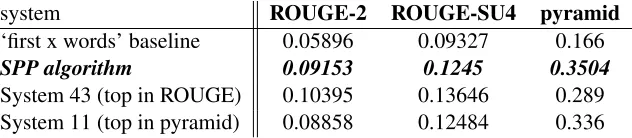
These surprisingly high scores on ROUGE met-rics prompted us to evaluate the summaries based on Pyramid Evaluation (Nenkova et al., 2007). Pyramid evaluation provides a more semantic approach to evaluation of content based on SCUs as discussed in Section 2.3. The average6modified pyramid scores of cluster A and cluster B summaries is shown in Table 2, along with the average recall scores for ROUGE-2, ROUGE-SU4 scores. The pyramid eval-uation7suggests that this algorithm performs better than all other automated systems at TAC 2008. Ta-ble 3 shows the average performance (across clus-ters) of ‘first x words’ baseline, SPP algorithm and two top performing systems (System ID=43 and ID=11). System 43 was adjudged best system based on ROUGE metrics, and system 11 was top per-former based on pyramid evaluations at TAC 2008.
ROUGE-2 ROUGE-SU4 pyramid
cluster A 0.08987 0.1213 0.3432
cluster B 0.09319 0.1283 0.3576
Table 2: Cluster wise ROUGE 2, SU4 Recall scores and modified Pyramid Scores for SPP algorithm at the Update Summarization task.
3.3 Discussion
It is interesting to observe that the algorithm that performs very poorly at QF-MDS, does very well in the Update Summarization task. A possible ex-planation for such behavior could be based on sum-mary length. For a 250 word sumsum-mary in the QF-MDS task, human summaries might provide a de-scriptive answer to the query that includes tion nuggets accompanied by background informa-tion. Indeed, it has been earlier reported that humans appreciate receiving more information than just the answer to the query, whenever possible (Lin et al., 2003; Bosma, 2005).
Whereas, in the case of Update Summarization task the summary length is only 100 words. In such a short length humans need to trade-off between an-swer sentences and supporting sentences, and usu-ally answers are preferred. And since our method
6Averaged over all the 48 topics of TAC 2008 dataset. 7Pyramid Annotation were done by a volunteer who also
system ROUGE-2 ROUGE-SU4 pyramid
‘first x words’ baseline 0.05896 0.09327 0.166
SPP algorithm 0.09153 0.1245 0.3504
System 43 (top in ROUGE) 0.10395 0.13646 0.289
[image:6.612.151.467.63.132.2]System 11 (top in pyramid) 0.08858 0.12484 0.336
Table 3: Average ROUGE 2, SU4 Recall scores and modified Pyramid Scores for baseline, SPP algorithm and two top performing systems at TAC 2008.
identifies sentences that are known to be contribut-ing towards the needed answers, it performs better at the shorter version of the task.
Another possible explanation is that as a shorter summary length is required, the task of choosing the most important information becomes more difficult and no approach works well consistently. Also, it has often been noted that this baseline is indeed quite strong for this genre, due to the journalistic conven-tion for putting the most important part of an article in the initial paragraphs.
4 Baselines in Summarization Tasks
Over the years, as summarization research followed trends from generic single-document summariza-tion, to generic multi-document summarization, to
focused multi-document summarization there were two major baselines that stayed throughout the eval-uations. Those two baselines are:
1. FirstN words of the document (or of the most re-cent document).
2. First sentence from each document in chronological order until the length requirement is reached.
The first baseline was in place ever since the first evaluation of generic single document summariza-tion took place in DUC 2001. For multi-document summarization, first N words of the most recent document (chronologically) was chosen as the base-line 1. In the recent summarization evaluations at Text Analysis Conference (TAC 2008), where up-date summarization was evaluated; baseline 1 still persists. This baseline performs pretty poorly at con-tent evaluations based on all manual and automatic metrics. However, since it doesn’t disturb the orig-inal flow and ordering of a document, linguistically these summaries are the best. Indeed it outperforms all the automated systems based on linguistic quality evaluations.
The second baseline had been used occasionally with multi-document summarization from 2001 to 2004 with both generic multi-document summariza-tion and focused multi-document summarizasummariza-tion. In 2001 only one system significantly outperformed the baseline 2 (Nenkova, 2005). In 2003 QF-MDS how-ever, only one system outperformed the baseline 2 above, while in 2004 at the same task, no system significantly outperforms the baseline. This baseline as can be seen, over the years has been pretty much untouched by systems based on content evaluation. However, the linguistic aspects of summary quality would be compromised in such a summary.
Currently, for the Update Summarization task at TAC 2008, NIST’s baseline is the baseline 1 (‘first x words’ baseline). And all systems (except one) per-form better than the baseline in all per-forms of content evaluation. Since the task is to generate 100 word summaries (short summaries), based on past experi-ences, there is no doubt that baseline 2 would per-form well.
5 Discussion and Conclusion
Baselines 1 and 2 mentioned above, could together act as a balancing mechanism to compare for lin-guistic quality and responsive content in the sum-mary. The availability of a stronger content respon-sive summary as a baseline would enable steady progress in the field. While all the linguistically motivated systems would compare themselves with baseline 1, the summary content motivated systems would compare with the stronger baseline 2 and get better than it.
Over the years to come, the usage of ‘baseline 1’ doesn’t help in understanding whether there has been significant improvement in the field. This is be-cause almost every simple algorithm beats the base-line performance. Having a better basebase-line, like the one based on the position hypothesis, would raise the bar for systems participating in coming years, and tracking progress of the field over the years is easier.
In this paper, we derived a method to identify a ‘sub-optimal position policy’ based on pyramid an-notation data, that were previously unavailable. We also distinguish small and large documents to obtain the position policy. We described the Sub-optimal Sentence Position Policy (SPP) based on pyramid annotation data and implemented the SPP as an al-gorithm to show that a position policy thus formed is a good representative of the genre and thus per-forms way above median performance. We further describe the baselines used in summarization evalu-ation and discuss the need to bring back baseline 2 (or the ‘SPP algorithm’) as an official baseline for
update summarizationtask.
Ultimately, as Lin and Hovy (1997) suggest, the position method can only take us certain distance. It has a limited power of resolution (the sentence) and its limited method of identification (the position in a text). Which is why we intend to use it as a baseline. Currently, as we can see the algorithm generates a
generic summary, it doesn’t consider the topic or query to generate aquery-focusedsummary. In fu-ture we plan to extend the SPP algorithm with some basic method for bringing in relevance.
References
P. B. Baxendale. 1958. Machine-made index for tech-nical literature – an experiment. IBM Journal of
Re-search and Development, 2(Non-topical Issue). Wauter Bosma. 2005. Extending answers using
dis-course structures. In Horacio Saggion and J. L. Minel, editors,RANLP workshop on Crossing Barriers in Text
summarization Research, pages 2–9. Incoma Ltd.
John M. Conroy, Judith D. Schlesinger, Jade Goldstein, and Dianne P. O’leary. 2004. Left-brain/right-brain multi-document summarization. Inthe proceedings of
Document Understanding Conference (DUC) 2004.
Terry Copeck, D Inkpen, Anna Kazantseva, A Kennedy, D Kipp, Vivi Nastase, and Stan Szpakowicz. 2006. Leveraging duc. Inproceedings of DUC 2006.
H. P. Edmundson. 1969. New methods in automatic ex-tracting. In Journal of the ACM, volume 16, pages 264–285. ACM.
Julian Kupiec, Jan Pedersen, and Francine Chen. 1995. A trainable document summarizer. Inthe proceedings
of ACM SIGIR’95, pages 68–73. ACM.
Chin-Yew Lin and Eduard Hovy. 1997. Identifying top-ics by position. InProceedings of the fifth conference
on Applied natural language processing, pages 283–
290. ACL.
Jimmy Lin, Dennis Quan, Vineet Sinha, Karun Bakshi, David Huynh, Boris Katz, and David R. Karger. 2003. The role of context in question answering systems. In
the proceedings of CHI’04.ACM.
Chin-Yew Lin. 2004. Rouge: A package for automatic evaluation of summaries. In the proceedings of ACL
Workshop on Text Summarization Branches Out. ACL.
H.P. Luhn. 1958. The automatic creation of literature ab-stracts. InIBM Journal of Research and Development, Vol. 2, No. 2, pp. 159-165, April 1958.
Ani Nenkova, Rebecca Passonneau, and Kathleen McK-eown. 2007. The pyramid method: Incorporating hu-man content selection variation in summarization eval-uation. In ACM Trans. Speech Lang. Process., vol-ume 4, New York, NY, USA. ACM.
Ani Nenkova. 2005. Automatic text summarization of newswire: Lessons learned from the document under-standing conference. In Manuela M. Veloso and Sub-barao Kambhampati, editors,AAAI, pages 1436–1441. AAAI Press / The MIT Press.
Dou Shen, Jian-Tao Sun, Hua Li, Qiang Yang, and Zheng Chen. 2007. Document summarization using condi-tional random fields. Inthe proceedings of IJCAI ’07., pages 2862–2867. IJCAI.
Kristina Toutanova, Chris Brockett, Michael Gamon, Ja-gadeesh Jagarlamundi, Hisami Suzuki, and Lucy Van-derwende. 2007. The pythy summarization system: Microsoft research at duc 2007. Inthe proceedings of