Representation of Morphosyntactic Units and Coordination Structures
in the Turkish Dependency Treebank
Umut Sulubacak G ¨uls¸en Eryi˘git
Department of Computer Engineering Istanbul Technical University
Istanbul, 34469, Turkey
{sulubacak, gulsen.cebiroglu}@itu.edu.tr
Abstract
This paper presents our preliminary conclu-sions as part of an ongoing effort to construct a new dependency representation framework for Turkish. We aim for this new framework to ac-commodate the highly agglutinative morphol-ogy of Turkish as well as to allow the annota-tion of unedited web data, and shape our deci-sions around these considerations. In this pa-per, we firstly describe a novel syntactic repre-sentation for morphosyntactic sub-word units (namely inflectional groups (IGs) in Turkish) which allows inter-IG relations to be discerned with perfect accuracy without having to hide lexical information. Secondly, we investigate alternative annotation schemes for coordina-tion structures and present a better scheme (nearly11%increase in recall scores) than the one in Turkish Treebank (Oflazer et al., 2003) for both parsing accuracies and compatibility for colloquial language.
1 Introduction
In recent years, dependency parsing has globally seen great deal of attention, and has constituted the underlying framework for the syntactic
pars-ing of many multilpars-ingual studies. Even though
constituency parsing and grammars are still the preferred formalism for some well-researched lan-guages, others may have certain traits that put con-stituency parsing in an unfavorable position against dependency parsing, such as flexible constituent or-dering, which is typical of several prominent lan-guages including Turkish. Although Turkish is de-cidedly more workable over the dependency for-malism, it has invariably fallen short of usual
pars-ing accuracies compared to other languages, as seen clearly in some recent works such as (McDonald and Nivre, 2011).
There are more parameters to parsing than the for-malism alone, among which the correctness of the corpora used in learning procedures and the annota-tion schemes of syntactic relaannota-tions are held in con-sideration as part of this work. Between the two, the emphasis is on the annotation scheme, which is proven to significantly affect the parsing per-formance (Bosco et al., 2010; Boyd and Meurers, 2008). Our motivation for this research is that these factors must also contribute to some extent to the performance deficiency in parsing Turkish, besides the inherent difficulty of parsing the language. Our aim is to investigate these points and suggest im-provements where applicable.
2 Parsing Framework and Data Set
As our parsing framework, we use MaltParser (Nivre et al., 2007) which is a data-driven dependency parser with an underlying SVM learner based on
LIBSVM (Chang and Lin, 2001). MaltParser is
widely used and has shown high performances across various languages (Nivre et al., 2006a). We run MaltParser with Nivre’s Arc-Standard parsing algorithm (Nivre, 2003) and use the same optimized parameters as in (Eryi˘git et al., 2008). We also use the learning features from the last cited work as our baseline feature set and an updated version from (Eryi˘git et al., 2011) of the same data set (Oflazer, 2003). The only difference from the configuration of (Eryi˘git et al., 2011) is that our baseline parser does not exclude non-projective sentences from the corpus for training, which explains the baseline
Figure 1: The original and the novel IG representations for the wordsa˘glamlas¸tırılmasının, which respectively comes to meanstrong,to become strong,to strengthen,to be strengthenedandof the strengthening of after each derivation. The new morphological tags introduced after each derivation pertain to the relevant IG, and common morphological features for the IGs of a single word such as the agreement are given under the final IG. Model I is the original representation, while Model II is the new representation we propose.
curacy differences (e.g. 67.4%against our65.0%in
labelled attachment score).
3 Proposed Annotation Schemes
3.1 IGs
Within the context of data-driven parsing, the most apparent problem of languages with productive derivational morphology is that words can poten-tially yield a very large morphological tag set, which causes severe sparsity in the morphological features
of words. To alleviate this problem, words are
split into morphosyntactic parts called inflectional groups (IGs), taking intermediate derivational af-fixes as boundaries. It is a known fact that analyz-ing sentences as beanalyz-ing composed of IGs rather than surface word forms yields better results in major NLP problems such as morphological disambigua-tion (Hakkani-T¨ur et al., 2002) and syntactic parsing (Eryi˘git et al., 2008).
Within the domain of dependency parsing, IGs as syntactic tokens are not as free as independent words, since the IGs of each word must be con-nected to each other with an exclusive dependency
relation named DERIV. However, other tokens are
free to be connected to an arbitrary IG of a word, with the added benefit of more compact morpholog-ical feature sets to help make the distinction.
Other languages with productive derivation, such as Uralic or Ugric languages, or those orthographi-cally differing from the well-studied European
lan-guages, such as Semitic lanlan-guages, can also benefit from using non-word-based morphosyntactic pars-ing tokens, as evidenced for instance by the recent considerations of splitting up tokens based on mor-phemes for Hebrew (Tsarfaty and Goldberg, 2008).
3.1.1 Current IG Representation
Since MaltParser accepts input in the standard data format of the CoNLL-X Shared Task (Buch-holz and Marsi, 2006), the ways in which IGs can be represented for the parser are limited. The stan-dard method for annotating IGs using the CoNLL-X data fields, as described in (Eryi˘git et al., 2008),
in-volves marking up theFORMandLEMMAfields with
underscores rather than with lexical data as shown in Figure 1. At first, this method is convenient, as cur-rent feature vectors readily take lexical information into account, and as such, a linear transition-based parser would easily learn to connect adjacent words as IGs of the same word as long as the head word has an underscore for a stem. However, an obvious drawback is that the actual lexical information gets lost in favor of marking IGs, preventing the potential usage of that information in deciding on inter-word dependencies.
3.1.2 Proposed IG Representation
a new column namedIG. This new column takes a boolean value that is true for non-final IGs of
multi-IG words much like the originalFORMcolumn,
ef-fectively marking the dependents that must be con-nected to the next token in line with the dependency
relation DERIV. Once this representation gets
inte-grated, lexical information may be assigned to the
FORM and LEMMA columns, of which the former gets surface lexical forms of the current stage of
derivation, and the latter gets the FORMdata of the
previous IG.
3.2 Coordination Structures
Among the most controversial annotation schemes are those of coordination structures (CS), which are groups of two or more tokens that are in coordina-tion with each other, usually joined with
conjunc-tions or punctuation, such as an“and”relation. The
elements in coordination are theconjunctsof the CS,
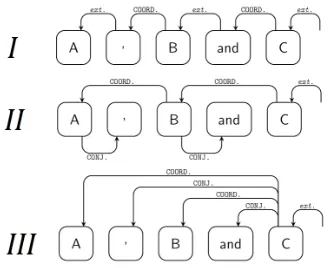
all of which are semantically linked to a single ex-ternal head. A large variety of annotation methods are employed by different corpora, as thoroughly explained in (Popel et al., 2013). We chose three schemes to compare for our parser, which are il-lustrated in Figure 2. There does not seem to be a standard annotation rising as the best scheme, which is convenient because different schemes would have advantages and disadvantages against different for-malisms and algorithms.
Figure 2: I) The original annotation scheme in the Turk-ish Treebank. II)Swedish Style, an alternative scheme in the manner of Talbanken (Nivre et al., 2006b). III) Stan-ford Style, another alternative scheme in the manner of the Stanford dependencies (De Marneffe and Manning, 2008), all with a head-right configuration as per (Popel et al., 2013), as would be appropriate for the predominantly head-final Turkish.
3.2.1 Current Coordination Representation
In the original Turkish Treebank, CSs are anno-tated as shown in scheme I in Figure 2, which ap-pears to be problematic in several ways. This struc-ture requires a prior conjunct to be connected to an intermediate conjunction, which in turn would be connected to a posterior conjunct, completing the coordination. The CS is then represented by the posterior conjunct, and the dependency relation be-tween the prior conjunct and the conjunction must be identical to the dependency relation between the posterior conjunct and the external head, even if it would not semantically make sense.
Considering the tokens are processed incremen-tally from left to right during parsing, one difficulty with this method lies in correctly guessing the de-pendency relation between the prior argument and the conjunction before the posterior argument and the external head are even encountered, and unsur-prisingly, directional parsers fail at this task more often than usual, resulting in added recall error for many dependency relations not necessarily related to coordinations. Another problem is that the scheme requires an intermediate conjunction or punctuation to work, which cannot be relied on even for edited texts, and would fare much worse if applied on web data. One final drawback of this method is that it is arguably more confusing for human annotators com-pared to a straightforward method in which the argu-ments in coordination are directly connected.
3.3 Proposed Coordination Representation
The drawbacks we have identified in the original CS annotation scheme encourage us to explore alterna-tive approaches to coordinations. After investigating many annotation methods, we expect that the
repre-sentation shown as theSwedish Stylein Figure 2 will
have the best performance in alleviating the issues described in Section 3.2.1.
Evaluating the Swedish Style representation, we
[image:3.612.101.265.453.587.2]and decreases the risk of annotation errors, which are very common in the Turkish Treebank.
4 Experiments
In order to practically evaluate our proposed IG and coordination representations, we first took our ini-tial data set as our baseline, and then applied certain manual and automatic transformations to the data in order to create the experimental data sets. Since all of our data were based on a training corpus without an exclusive validation set, we decided to apply 10-fold cross-validation on all of our models to better evaluate the results.
For our tests on IG representations, we attempted to automatically transform our baseline corpus by
populating the new IG column with boolean data
derived from the IG relations in the gold-standard, and then automatically fill out the null lexical fields by an automatic morphological synthesis procedure using our morphological tool (Oflazer, 1994). The synthesis procedure, albeit a non-trivial
implemen-tation, successfully covered the majority (over95%)
of the lexical data, and we were able to manually an-notate the remaining unrecognized tokens. To allow MaltParser to recognize the new fields, the CoNLL-X sentence format has been slightly adjusted and submitted as a custom input data format, and the baseline feature vector has been augmented with two extra features for the IG column information from the tokens on top of the Stack and Input pipes. The
final model is named theLexedIGmodel.
On the other hand, we needed to perform a com-plete selective manual review of the corpus and cor-rect numerous annotation errors in CSs before a healthy conversion could be made. Afterwards, we ran automatic conversion routines to map all CSs
to the aforementioned Swedish Style and the
com-monly usedStanford Stylein order to compare their
specific performances. Since a sizeable amount of manual corrections were made before the conver-sions, we took the manually reviewed version as an intermediate model in order to distinguish the contri-bution of the automatic conversions from the manual review.
4.1 Metrics
For every model we evaluated via cross-validation, we made specific accuracy analyses and report the
precision (P), recall (R) and F scores per
depen-Baseline LexedIG
P R F P R F
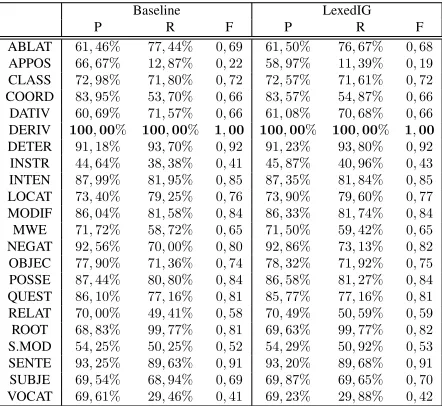
ABLAT 61,46% 77,44% 0,69 61,50% 76,67% 0,68 APPOS 66,67% 12,87% 0,22 58,97% 11,39% 0,19 CLASS 72,98% 71,80% 0,72 72,57% 71,61% 0,72 COORD 83,95% 53,70% 0,66 83,57% 54,87% 0,66 DATIV 60,69% 71,57% 0,66 61,08% 70,68% 0,66 DERIV 100,00% 100,00% 1,00 100,00% 100,00% 1,00
[image:4.612.313.534.57.260.2]DETER 91,18% 93,70% 0,92 91,23% 93,80% 0,92 INSTR 44,64% 38,38% 0,41 45,87% 40,96% 0,43 INTEN 87,99% 81,95% 0,85 87,35% 81,84% 0,85 LOCAT 73,40% 79,25% 0,76 73,90% 79,60% 0,77 MODIF 86,04% 81,58% 0,84 86,33% 81,74% 0,84 MWE 71,72% 58,72% 0,65 71,50% 59,42% 0,65 NEGAT 92,56% 70,00% 0,80 92,86% 73,13% 0,82 OBJEC 77,90% 71,36% 0,74 78,32% 71,92% 0,75 POSSE 87,44% 80,80% 0,84 86,58% 81,27% 0,84 QUEST 86,10% 77,16% 0,81 85,77% 77,16% 0,81 RELAT 70,00% 49,41% 0,58 70,49% 50,59% 0,59 ROOT 68,83% 99,77% 0,81 69,63% 99,77% 0,82 S.MOD 54,25% 50,25% 0,52 54,29% 50,92% 0,53 SENTE 93,25% 89,63% 0,91 93,20% 89,68% 0,91 SUBJE 69,54% 68,94% 0,69 69,87% 69,65% 0,70 VOCAT 69,61% 29,46% 0,41 69,23% 29,88% 0,42
Table 1: Specific accuracies per dependency relation for the IG-related models.
dency relation. Furthermore, we also calculated gen-eral accuracies as micro-averages from the cross-validation sets, for which we used two metrics,
namely the labelled attachment score ASL and the
unlabelled attachment score ASU, which are both
accuracy metrics that compute the percentage of cor-rectly parsed dependencies over all tokens, where the unlabelled metric only requires a match with the correct head, and the labelled metric additionally re-quires the correct dependency relation to be chosen.
4.2 Results and Discussion
Our test results with the LexedIG model suggest
that our proposed IG representation works perfectly well, as the perfect precision and recall scores of the
original model for DERIV relations are preserved
Baseline Corrected Swedish Style Stanford Style
P R F P R F P R F P R F
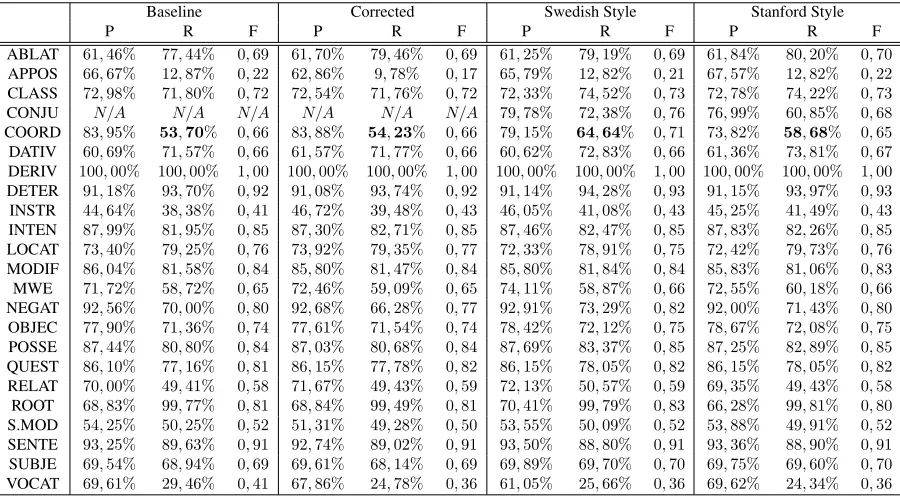
ABLAT 61,46% 77,44% 0,69 61,70% 79,46% 0,69 61,25% 79,19% 0,69 61,84% 80,20% 0,70
APPOS 66,67% 12,87% 0,22 62,86% 9,78% 0,17 65,79% 12,82% 0,21 67,57% 12,82% 0,22
CLASS 72,98% 71,80% 0,72 72,54% 71,76% 0,72 72,33% 74,52% 0,73 72,78% 74,22% 0,73
CONJU N/A N/A N/A N/A N/A N/A 79,78% 72,38% 0,76 76,99% 60,85% 0,68
COORD 83,95% 53,70% 0,66 83,88% 54,23% 0,66 79,15% 64,64% 0,71 73,82% 58,68% 0,65
DATIV 60,69% 71,57% 0,66 61,57% 71,77% 0,66 60,62% 72,83% 0,66 61,36% 73,81% 0,67
DERIV 100,00% 100,00% 1,00 100,00% 100,00% 1,00 100,00% 100,00% 1,00 100,00% 100,00% 1,00
DETER 91,18% 93,70% 0,92 91,08% 93,74% 0,92 91,14% 94,28% 0,93 91,15% 93,97% 0,93
INSTR 44,64% 38,38% 0,41 46,72% 39,48% 0,43 46,05% 41,08% 0,43 45,25% 41,49% 0,43
INTEN 87,99% 81,95% 0,85 87,30% 82,71% 0,85 87,46% 82,47% 0,85 87,83% 82,26% 0,85
LOCAT 73,40% 79,25% 0,76 73,92% 79,35% 0,77 72,33% 78,91% 0,75 72,42% 79,73% 0,76
MODIF 86,04% 81,58% 0,84 85,80% 81,47% 0,84 85,80% 81,84% 0,84 85,83% 81,06% 0,83
MWE 71,72% 58,72% 0,65 72,46% 59,09% 0,65 74,11% 58,87% 0,66 72,55% 60,18% 0,66
NEGAT 92,56% 70,00% 0,80 92,68% 66,28% 0,77 92,91% 73,29% 0,82 92,00% 71,43% 0,80
OBJEC 77,90% 71,36% 0,74 77,61% 71,54% 0,74 78,42% 72,12% 0,75 78,67% 72,08% 0,75
POSSE 87,44% 80,80% 0,84 87,03% 80,68% 0,84 87,69% 83,37% 0,85 87,25% 82,89% 0,85
QUEST 86,10% 77,16% 0,81 86,15% 77,78% 0,82 86,15% 78,05% 0,82 86,15% 78,05% 0,82
RELAT 70,00% 49,41% 0,58 71,67% 49,43% 0,59 72,13% 50,57% 0,59 69,35% 49,43% 0,58
ROOT 68,83% 99,77% 0,81 68,84% 99,49% 0,81 70,41% 99,79% 0,83 66,28% 99,81% 0,80
S.MOD 54,25% 50,25% 0,52 51,31% 49,28% 0,50 53,55% 50,09% 0,52 53,88% 49,91% 0,52
SENTE 93,25% 89,63% 0,91 92,74% 89,02% 0,91 93,50% 88,80% 0,91 93,36% 88,90% 0,91
SUBJE 69,54% 68,94% 0,69 69,61% 68,14% 0,69 69,89% 69,70% 0,70 69,75% 69,60% 0,70
[image:5.612.79.529.57.306.2]VOCAT 69,61% 29,46% 0,41 67,86% 24,78% 0,36 61,05% 25,66% 0,36 69,62% 24,34% 0,36
Table 2: Specific accuracies per dependency relation for the coordination-related models.
the web, sparse data will no longer be a significant problem, and lexical data will gain further value.
A comparison of the alternative CS models with the baseline suggests that, while the manual cor-rection itself did not cause a noticeable change, the automatic conversion procedures that it made possible resulted in significant improvements. The
Swedish Style and Stanford Style models fared slightly better in the accuracy of some dependency
types commonly joined in CSs such as SUBJECT,
OBJECT, and DATIVE, INSTRUMENTAL and
ABLATIVE.ADJUNCTs, but not always enough to warrant statistical significance. Apart from those,
the largest improvement is in theCOORDINATION
relation itself, which had a slight drop in precision for both final models (likely due to the increased av-erage dependency distances) but at the great benefit
of the recall increasing from53.70%to58.68%for
theStanford Styleand64.64%for theSwedish Style.
5 Conclusion
In this paper, we proposed novel annotation schemes for Turkish morphosyntactic sub-word units and co-ordination structures that are superior to the Turk-ish Treebank representations in terms of ease of use, parsing performance and/or compatibility with
sen-ASU ASL
Baseline 74.5%±0.2 65.0%±0.2
LexedIG 74.6%±0.1 65.1%±0.2
Baseline 74.5%±0.2 65.0%±0.2
Corrected 74.5%±0.1 65.0%±0.2
Swedish Style 74.5%±0.2 65.6%±0.2
Stanford Style 73.2%±0.2 64.1%±0.2
Table 3: General parsing accuracies for all models, in-cluding standard error.
tences that are not well-formed. Our findings sub-stantiate our thesis that annotation schemes have both room for improvement and a high impact po-tential on parsing performance. In the light of our results, we intend to sustain our research and draw better annotation schemes for other syntactic struc-tures such as copulae and modifier sub-types to serve not only Turkish, but also other languages with rich morphology.
Acknowledgments
The authors would like to acknowledge that this work is part of a research project supported by ICT
COST Action IC1207 and T ¨UB˙ITAK 1001 (Grant
[image:5.612.318.527.347.446.2]References
Cristina Bosco, Simonetta Montemagni, Alessandro Mazzei, Vincenzo Lombardo, Felice dell’Orletta, Alessandro Lenci, Leonardo Lesmo, Giuseppe Attardi, Maria Simi, Alberto Lavelli, et al. 2010. Comparing the influence of different treebank annotations on de-pendency parsing. InLREC.
Adriane Boyd and Detmar Meurers. 2008. Revisiting the impact of different annotation schemes on pcfg pars-ing: A grammatical dependency evaluation. In Pro-ceedings of the Workshop on Parsing German, pages 24–32. Association for Computational Linguistics. Sabine Buchholz and Erwin Marsi. 2006. Conll-x shared
task on multilingual dependency parsing. In Proceed-ings of the Tenth Conference on Computational Nat-ural Language Learning, pages 149–164. Association for Computational Linguistics.
Chih-Chung Chang and Chih-Jen Lin, 2001.LIBSVM: A Library for Support Vector Machines. Software avail-able at http://www.csie.ntu.edu.tw/∼cjlin/libsvm. Marie-Catherine De Marneffe and Christopher D
Man-ning. 2008. The stanford typed dependencies repre-sentation. InColing 2008: Proceedings of the work-shop on Cross-Framework and Cross-Domain Parser Evaluation, pages 1–8. Association for Computational Linguistics.
G¨uls¸en Eryi˘git, Tugay Ilbay, and Ozan Arkan Can. 2011. Multiword expressions in statistical dependency pars-ing. InProceedings of the Second Workshop on Sta-tistical Parsing of Morphologically Rich Languages (IWPT), pages 45–55, Dublin, Ireland, October. As-sociation for Computational Linguistics.
G¨uls¸en Eryi˘git, Joakim Nivre, and Kemal Oflazer. 2008. Dependency parsing of Turkish. Computational Lin-guistics, 34(3):357–389.
Dilek Hakkani-T¨ur, Kemal Oflazer, and G¨okhan T¨ur. 2002. Statistical morphological disambiguation for agglutinative languages. Journal of Computers and Humanities, 36(4):381–410.
Ryan McDonald and Joakim Nivre. 2011. Analyzing and integrating dependency parsers. Computational Linguistics, 37(1):197–230.
Joakim Nivre, Johan Hall, Jens Nilsson, G¨uls¸en Eryi˘git, and Stetoslav Marinov. 2006a. Labeled pseudo-projective dependency parsing with support vector machines. In Proceedings of the 10th Conference on Computational Natural Language Learning, pages 221–225, New York, NY.
Joakim Nivre, Jens Nilsson, and Johan Hall. 2006b. Tal-banken05: A swedish treebank with phrase structure and dependency annotation. InProceedings of the fifth International Conference on Language Resources and Evaluation (LREC), pages 1392–1395.
Joakim Nivre, Johan Hall, Jens Nilsson, Atanas Chanev, G¨uls¸en Eryi˘git, Sandra K¨ubler, Stetoslav Mari-nov, and Erwin Marsi. 2007. Maltparser: A language-independent system for data-driven depen-dency parsing. Natural Language Engineering Jour-nal, 13(2):99–135.
Joakim Nivre. 2003. An efficient algorithm for projec-tive dependency parsing. InProceedings of the 8th In-ternational Workshop on Parsing Technologies, pages 149–160, Nancy.
Kemal Oflazer, Bilge Say, Dilek Z. Hakkani-T¨ur, and G¨okhan T¨ur. 2003. Building a Turkish treebank. In A. Abeill´e, editor,Treebanks: Building and Using Parsed Corpora, pages 261–277. Kluwer, London.
Kemal Oflazer. 1994. Two-level description of Turk-ish morphology. Literary and Linguistic Computing, 9(2):137–148.
Kemal Oflazer. 2003. Dependency parsing with an ex-tended finite-state approach. Computational Linguis-tics, 29(4):515–544.
Martin Popel, David Mareˇcek, Jan ˇStˇep´anek, Daniel Ze-man, and Zdˇenˇek ˇZabokrtsk´y. 2013. Coordination structures in dependency treebanks. InProceedings of the 51st Annual Meeting of the Association for Computational Linguistics (Volume 1: Long Papers), pages 517–527, Sofia, Bulgaria, August. Association for Computational Linguistics.