Nonparametric Bayesian Word Sense Induction
Xuchen Yao1 and Benjamin Van Durme1,2 1Department of Computer Science
2Human Language Technology Center of Excellence
Johns Hopkins University
Abstract
We propose the use of a nonparametric Bayesian model, the Hierarchical Dirichlet Process (HDP), for the task of Word Sense Induction. Results are shown through comparison against Latent Dirich-let Allocation (LDA), a parametric Bayesian model employed by Brody and Lapata (2009) for this task. We find that the two models achieve similar levels of induction quality, while the HDP confers the ad-vantage of automatically inducing a variable num-ber of senses per word, as compared to manually fixing the number of sensesa priori, as in LDA. This flexibility allows for the model to adapt to terms with greater or lesser polysemy, when ev-idenced by corpus distributional statistics. When trained on out-of-domain data, experimental results confirm the model’s ability to make use of a re-stricted set of topically coherent induced senses, when then applied in a restricted domain.
1 Introduction
Word Sense Induction (WSI) is the task of automat-ically discovering latentsensesfor each wordtype, across a collection of that word’stokenssituated in context. WSI differs from Word Sense Disambigua-tion (WSD) in that the task does not assume access to some prespecified sense inventory. This amounts to a clustering task: instances of a word are parti-tioned into the same bin based on whether a sys-tem deems them to have the same underlying mean-ing. A large body of related work can be found in (Sch¨utze, 1998; Pantel and Lin, 2002; Dorow and Widdows, 2003; Purandare and Pedersen, 2004; Bordag, 2006; Niu et al., 2007; Pedersen, 2007; Brody and Lapata, 2009; Li et al., 2010; Klapaftis and Manandhar, 2010).
Brody and Lapata (2009) (B&L herein) showed that the parametric Bayesian model, Latent
Dirich-let Allocation (LDA), could be successfully em-ployed for this task, as compared to previous re-sults published for the WSI component of SemEval-20071(Agirre and Soroa, 2007). A deficiency of the LDA model for WSI is that the number of senses needs to be manually specifieda priori, either sepa-rately for each word type, or (as done by B&L) some fixed value that is shared globally across all types.
Nonparametric methods instead have the flexibil-ity of automatically deciding the number of sense cluters (Vlachos et al., 2009; Reisinger and Mooney, 2010). In this work we first independently verify the results of B&L, and then tackle the limitation on fixing the number of senses through the use of the Hierarchical Dirichlet Process (HDP) (Teh et al., 2006), a nonparametric Bayesian model. We show this approach leads to results of similar quality as LDA, when using a bag-of-words context model, in addition to allowing for variability in the number of senses across different words and domains. When trained on a restricted domain corpus for which manually labeled sense data was present, we verify that the model may be tuned to posit a similar num-ber of senses as determined by human judges. When trained on a broader domain collection, we show that the number of induced senses increase, in line with the intuition that a wider set of genres should lead to a greater diversity in underlying meanings. Auto-matically inducing the proper number of senses has great practical implications, especially in areas that require word sense disambiguation. For instance, in-ducing more senses for bank helps to tell
differ-1Klapaftis and Manandhar (2010) and Brody and Lapata
(2009) reported the best scores so far on this dataset.
ent word senses apart for naturally more ambigu-ous words, and inducing less senses for job helps to prevent assigning too fined-grained senses in case the same words in two similar contexts are mistak-enly regarded as carrying different senses.
2 Bayesian Word Sense Induction
wm , n
sm , n
m
k
n∈[1,Nm]
m∈[1,M]
[image:2.612.375.478.63.265.2]k∈[1,K]
Figure 1:Latent Dirichlet Allocation (LDA) for WSI.
As in prior work including B&L, we rely on the intuition that the senses of words are hinted at by their contextual information (Yarowsky, 1992). From the perspective of a generative process, neigh-boring words of a target are generated by the target’s underlying sense.2
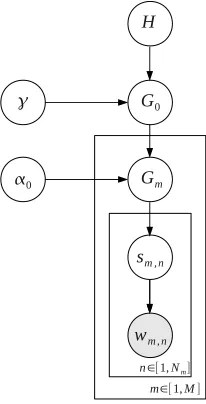
Both LDA and HDP define graphical models that generate collections of discrete data. The sense of a target word is first drawn from a distribution and then the context of this word is generated according to that distribution. But while LDA assumes a fixed, finite set of distributions, the HDP draws from an infinite set of distributions generated by a Dirichlet Process. This section details the distinction.
Figure 1 shows the LDA model for word sense induction. The conventional notion of document is replaced by apseudo-document, consisting of every word in anNm-word window centered on the target item. wm,n is the n-th token of the m-th pseudo-document for target wordw.sm,nis the
correspond-ing sense forwm,n. Suppose there areK senses for the target wordw, then the distribution over a con-text wordwm,nis:
2For instance, given the word bankwith a senseriver
bank, it is more likely that the neighboring words areriver,
lakeandwaterthanfinance,moneyandloan.
wm , n sm , n Gm
0
n∈[1,Nm]
m∈[1,M]
G0 H
Figure 2:Hierarchical Dirichlet Process (HDP) for WSI.
p(wm,n) =
K X
k=1
p(wm,n |sm,n=k)p(sm,n =k).
Let the word distribution given a sense be
p(wm,n | sm,n = k) = ϕ~k, which is a vector of
length V (vocabulary size) that is generated from a Dirichlet distribution: ϕ~k ∼ Dir(β~). Let the
sense distribution given a document bep(sm,n |d= m) =~θm, which is a vector of lengthKthat is gen-erated from a Dirichlet distribution: ~θm ∼Dir(~α).
The generative story for the data under LDA is then:
Fork∈(1, ..., K)senses:
Sample mixture component: ϕk~ ∼Dir(β~).
Form∈(1, ..., M)pseudo-documents:
Sample topic components~θm ∼Dir(~α).
Forn∈(1, ..., Nm)words in pseudo-documentm:
Sample sense indexsm,n ∼M ult(θ~m).
Sample wordwm,n ∼M ult(ϕs~ m,n).
The sense distribution over a word is captured as K mixture components. In the HDP however, we assume the number of active components is un-known, and should be inferred from the data. For each pseudo-document, the sense component sm,n
for wordwm,n has a nonparametric priorGm. Gm
[image:2.612.120.251.173.310.2]more and moreGm’s. However, the mixture com-ponentsm,n, drawn fromGm, can be shared among pseudo-documents. Thus the number of senses do not simply multiply out asm grows. BothG0 and
Gm’s are distributed according to a Dirichlet Process (DP) (Ferguson, 1973). The generative story is:
Select base distributionG0∼DP(γ, H)which provides an unlimited inventory of senses.
Form∈(1, ..., M)pseudo-documents:
DrawGm∼DP(α0, G0).
Forn∈(1, ..., Nm)words in pseudo-documentm:
Samplesm,n ∼Gm.
Samplewm,n ∼M ult(ϕ~sm,n).
Hyperparametersγ andα0 are the concentration parameters of the DP, controlling the variability of the distributionsG0andGm. In a Chinese restaurant franchise metaphor of the HDP, multiple restaurants (documents) share a set of dishes (senses). Then
γ controls the variability of the global sense distri-bution and α0 controls the variability of each cus-tomer’s (word) choice of dishes (senses).3
3 Experiment Setting
Model B&L experimented with variations to the LDA model that allowed for generating multiple lay-ers of features, such as smaller (5w) and larger (10w) bag-of-word contexts, and syntactic features. The additional complexity beyond the standard model led to only tenuous performance gains. Normal LDA, when trained on pseudo-documents built from 10 words of surrounding context, performed only slightly below their best reported results.4 Espe-cially as our goal here was to investigate the sense-specification problem, rather than eking out further improvements in the base WSI evaluation measure, we chose to compare a standard LDA model to HDP, both strictly using a 10 word context.5
Test Data Following B&L, we perform WSI on nouns. The evaluation data comes from the WSI task of SemEval-2007 (Agirre and Soroa, 2007). It is derived from the Wall Street Journal portion of
3
Gibbs sampling (Geman and Geman, 1990) can be applied for inference. Specifically, Teh et al. (2006) describes the pos-terior sampling in the Chinese restaurant franchise.
4
F-score of 86.9% (10w), as compared to 87.3% (10w+5w).
5We relied on implementations of LDA and HDP
respec-tively from MALLET (McCallum, 2002), and Wang (2010).
the Penn TreeBank (Marcus et al., 1994) and con-tains 15,852 instances of excerpts on 35 nouns. All the nouns are hand-annotated with their OntoNotes senses (Hovy et al., 2006), with an average of 3.9 senses per word.
Evaluation Method WSI is an unsupervised task that results in sense clusters with no explicit map-ping to manually annotated sense data. To derive such a mapping, we follow thesupervised evalua-tion strategy of Agirre and Soroa (2007). Anno-tated senses from SemEval-2007 are partitioned into a standard mapping set (72%), a dev set (14%) and a test set (14%). After an WSI system has tagged the elements in the mapping set with their “cluster IDs”, then a cluster to sense derivation is constructed by simply assigning to each cluster the manual sense label that has the highest in-cluster frequency. Once such a mapping has been established, then results on the dev or test set are reported based on treating cluster assignment as a WSD operation.
Training Data As out-of-domain source, we ex-tracted 930K instances of the 35 nouns from the British National Corpus (BNC) (Clear, 1993). As domain source we extracted another 930K in-stances from WSJ in years 87/88/90/94. All pseudo-documents use the±10contextual window.
4 Evaluation
We trained the LDA and HDP models on the WSJ and BNC datasets separately. In their experiments with LDA, B&L iteratively tried 3 up to 9 senses, and then reported the number that led to best re-sults in evaluation (4 senses for WSJ, 8 for BNC). We repeated this approach for LDA, with hyper-parametersα = 0.02 andβ = 0.1. For the HDP model, we tuned hyper-parameters on the SemEval-2007 dev set.6 See Table 1 for results, averaged over 5 runs of LDA and 3 runs of HDP.
We report several findings based on this experi-ment. First, for the LDA models trained on WSJ and BNC, our F1 measures are 0.8% lower than reported by B&L.7 Second, based on our own ex-periment, the HDP model performance is slightly better than that of LDA when training with BNC.
6Final parameters:H = 0.1,α
0 ∼Gamma(0.1,0.028),
γ∼Gamma(1,0.1).
7We consider this acceptable experimental deviation, given
WSJ BNC
LDA-4s* 86.9 LDA-8s* 84.6 LDA-4s 86.1 LDA-8s 83.8
[image:4.612.110.262.53.98.2]HDP 86.7 HDP 85.74
Table 1:F-measure when training with WSJ (in-domain) and BNC (out-of-domain). Results with * are taken from B&L.4
or 8senses were used per word. 4: statistically significant against LDA-8s by paired permutation test withp < 0.001. The standard baseline, always picking the most frequent sense observed in training, scores 80.9.
WSJ BNC
Train Test Train Test
LDA 4.0 3.9 8.0 7.4
[image:4.612.328.502.57.174.2]HDP 5.8 3.9 9.4 4.6
Table 2: The average number of senses the LDA and HDP models output when training with WSJ/BNC and testing on SemEval-2007, which has 3.9 senses per word on average.
Third, the HDP model appears to better adapt to data in other domains. When switching the training set from WSJ (in-domain) to BNC (out-of-domain), we, along with B&L, found a2.3%drop with LDA mod-els. However, with the HDP model, there is only a
1%drop in F1. Moreover, even trained on out-of-domain data, HDP can still better infer the number of senses from the test data, which is illustrated next. Table 2 shows the number of senses induced from each dataset. When training on WSJ and test on SemEval-2007, HDP induced the correct number of senses (3.9 on average) from test, while LDA did this by assuming 4 senses from the training data. When there is a domain mismatch between train-ing (BNC) and test (SemEval-2007, which comes from the 1989 WSJ), the LDA model preferred far more than the annotated number of senses (7.4 vs. 3.9), largely due to the fact that it assumed 8 senses during training. However, even though the HDP model induced more senses (9.4) when training on the broader coverage BNC set, it still inferred a much reduced average of 4.6 senses on test.
The BNC, being abalanced corpus, covers more diverse genres than the WSJ: we would expect it to lead to a more inclusive model of word sense. Fig-ure 3 illustrates this comparison through the differ-ence between sense numbers. For the 35 human-annotated nouns, HDP induced the number of senses mostly within an error of±2, whereas LDA tended to prefer3−6more senses than recognized by
an--4 -3 -2 -1 0 1 2 3 4 5 6
0 2 4 6 8 10 12
HDP LDA
# induced senses - # annotated senses
fr
eq
ue
nc
y
Figure 3: The difference between induced number of senses and annotated senses. The training set is BNC. The test set is SemEval-2007, containing 35 nouns with 3.9 senses. LDA induced 7.4 senses and HDP induced 4.6 senses on average.
WSJ BNC
[image:4.612.109.262.187.229.2]LDA-5.8s 86.0 LDA-9.4s 82.7 LDA-3.9s 85.3 LDA-3.9s 81.4 HDP-5.8s 86.7 HDP-9.4s 85.74
Table 3:F1 measure when training LDA with three other set-tings: 5.8s, 9.4s and 3.9s. 4: statistically significant against both LDA-9.4s and LDA-3.9s (for BNC) by paired permutation test withp <0.001.
notators (on average the HDP model was off by 1.6 senses, as compared to 3.6 by LDA). Finally, the F1 performance of HDP is 1.9% better than LDA (85.7%vs.83.8%).
We further evaluated the LDA model by training separately for each of the 35 nouns, first setting as the number of topics the amount induced by HDP (on average, 5.8/9.4 senses for WSJ/BNC), then us-ing the number of senses as used by the human anno-tators in SemEval-2007 (an average of 3.8). As seen in Table 3, in each of these cases HDP remained the superior model.
5 Conclusion
[image:4.612.349.502.250.293.2]References
Eneko Agirre and Aitor Soroa. 2007. Semeval-2007 Task 02: Evaluating Word Sense Induction And Discrimination Sys-tems. InProceedings of the 4th International Workshop on Semantic Evaluations, SemEval ’07, pages 7–12.
Stefan Bordag. 2006. Word Sense Induction: Triplet-Based Clustering And Automatic Evaluation. InProceedings of the 11th EACL, pages 137–144.
Samuel Brody and Mirella Lapata. 2009. Bayesian Word Sense Induction. InEACL ’09: Proceedings of the 12th Confer-ence of the European Chapter of the Association for Compu-tational Linguistics, pages 103–111.
Jeremy H. Clear, 1993.The British national corpus, pages 163– 187. MIT Press, Cambridge, MA, USA.
Beate Dorow and Dominic Widdows. 2003. Discovering Corpus-Specific Word Senses. InProceedings of the tenth conference on European chapter of the Association for Com-putational Linguistics, EACL ’03, pages 79–82.
T. S. Ferguson. 1973. A Bayesian Analysis of Some Nonpara-metric Problems.The Annals of Statistics, 1(2):209–230. S. Geman and D. Geman, 1990. Stochastic Relaxation, Gibbs
Distributions, And The Bayesian Restoration Of Images, pages 452–472.
Eduard Hovy, Mitchell Marcus, Martha Palmer, Lance Ramshaw, and Ralph Weischedel. 2006. OntoNotes: the 90% solution. In Proceedings of the Human Language Technology Conference of the NAACL, Companion Volume: Short Papers, NAACL-Short ’06, pages 57–60.
Ioannis Klapaftis and Suresh Manandhar. 2010. Word Sense Induction & Disambiguation Using Hierarchical Random Graphs. InProceedings of the 2010 Conference on Empir-ical Methods in Natural Language Processing, pages 745– 755, October.
Linlin Li, Benjamin Roth, and Caroline Sporleder. 2010. Topic Models For Word Sense Disambiguation And Token-Based Idiom Detection. InProceedings of the 48th Annual Meeting of the Association for Computational Linguistics, ACL ’10, pages 1138–1147.
Mitchell P. Marcus, Beatrice Santorini, and Mary A. Marcinkiewicz. 1994. Building a Large Annotated Corpus of English: The Penn Treebank. Computational Linguistics, 19(2):313–330.
Andrew Kachites McCallum. 2002. MALLET: A Machine Learning for Language Toolkit.
Zheng-Yu Niu, Dong-Hong Ji, and Chew-Lim Tan. 2007. I2R: Three Systems For Word Sense Discrimination, Chinese Word Sense Disambiguation, And English Word Sense Dis-ambiguation. InProceedings of the 4th International Work-shop on Semantic Evaluations, SemEval ’07, pages 177– 182.
Patrick Pantel and Dekang Lin. 2002. Discovering Word Senses From Text. In Proceedings of the eighth ACM SIGKDD international conference on Knowledge discovery and data mining, KDD ’02, pages 613–619.
Ted Pedersen. 2007. UMND2: SenseClusters applied to the sense induction task of Senseval-4. InProceedings of the 4th International Workshop on Semantic Evaluations, SemEval ’07, pages 394–397.
Amruta Purandare and Ted Pedersen. 2004. Word Sense Dis-crimination by Clustering Contexts in Vector and Similarity Spaces. InProceedings of CoNLL-2004, pages 41–48.
Joseph Reisinger and Raymond J. Mooney. 2010. A Mixture Model with Sharing for Lexical Semantics. InProceedings of the Conference on Empirical Methods in Natural Lan-guage Processing (EMNLP-2010), pages 1173–1182, MIT, Massachusetts, USA.
Hinrich Sch¨utze. 1998. Automatic Word Sense Discrimination.
Comput. Linguist., 24:97–123, March.
Y. W. Teh, M. I. Jordan, M. J. Beal, and D. M. Blei. 2006. Hierarchical Dirichlet Processes. Journal of the American Statistical Association, 101(476):1566–1581.
Andreas Vlachos, Anna Korhonen, and Zoubin Ghahramani. 2009. Unsupervised and constrained Dirichlet process mix-ture models for verb clustering. InProceedings of the Work-shop on Geometrical Models of Natural Language Seman-tics, GEMS ’09, pages 74–82.
Chong Wang. 2010. An implementation of hierarchical dirich-let process (HDP) with split-merge operations.