A Cloud-Based Editor for Multilingual Grammars
Thomas Hallgren Ramona Enache Aarne Ranta Department of Computer Science and Engineering
Chalmers University of Technology and University of Gothenburg
[email protected] [email protected] [email protected]
Abstract
Writing deep linguistic grammars has been considered a highly specialized skill, requiring the use of tools with steep learn-ing curves and complex installation proce-dures. As the use of statistical methods has increased, new generations of compu-tational linguists are getting less and less prepared for grammar writing tasks. In an aim to provide a better learning expe-rience for grammar writers, we present a grammar engineering tool that resides in the cloud. It has been used in several tu-torial courses and self-studies, and it al-lows absolute beginners to write their first grammars and parse examples in 10 min-utes. The cloud-based grammar engineer-ing tool is built on top of GF (Grammatical Framework), a grammar formalism that has an explicit tecto/phenogrammar dis-tinction, is based on ideas from type theory and functional programming and comes equipped with a grammar library support-ing 30 languages.
1 Introduction
Writing deep linguistic grammars has been con-sidered a highly specialized skill. As the use of statistical methods has increased, new generations of computational linguists are getting less and less prepared for grammar writing tasks. A part of the problem is the steep learning curve in tools: systems like LKB (Copestake, 2002) and XLE (Xerox Linguistic Environment) are designed for professional linguists. Getting started with their use requires substantial training, and installing the tools requires large and unfamiliar software pack-ages, in addition to a firm knowledge of operating system command-line tools.
GF (Ranta, 2004) is a more recent grammar for-malism, born so to say in the middle of the
statis-tical era. GF shares the ambition of the “classi-cal” formalisms to enable deep linguistic descrip-tions, which it wants to support with some new ideas: type theory, functional programming, and an explicit tecto/phenogrammar distinction. How-ever, GF was also meant to be a formalism for “ordinary” programmers without linguistic train-ing. Thus the majority of the currently 30 lan-guages included in the GF Resource Grammar Li-brary (Ranta, 2009a) are in fact written by students and scholars in computer science, who find the GF style of programming familiar from other con-texts, in particular compiler construction (Appel, 1998).
However, the GF approach has a “nerdy” flavour to it, in particular requiring coping with command line tools, text editors, and Haskell li-braries. Some programmers are helped by the Eclipse plug-in (Camilleri, 2012), but installing both GF and Eclipse on a personal computer can be a daunting task for many.
The present paper describes an attempt to elim-inate all trouble with software installation from linguistic grammar writing. We describe a gram-mar engineering tool that resides in the cloud and can be used in ordinary web browsers. The tool supports writing grammars in the cloud, compil-ing them to executable parsers and translation sys-tems, and finally running and testing them in the cloud. Thus an entire grammar project can be written and used without installing any specific software. The project can also be published and shared, so that many users can work on the same grammars (although not simultaneously yet in the current version).
The cloud-based GF editor has been used on several tutorial courses and self-studies. It enables absolute beginners to write their first grammar and parse examples in 10 minutes. It scales up to most of the grammars described in the GF book (Ranta, 2011), although it has some limitations, in
abstract Foods = {
flags startcat = Comment;
cat Comment; Kind; Item; Quality;
fun Pred : Item -> Quality -> Comment;
This, That : Kind -> Item;
Bread, Fish, Wine : Kind;
Very : Quality -> Quality; Bad, Good : Quality; Cold, Warm : Quality; }
Figure 1: Abstract syntaxFood.gf.
ular a simplified module system, which makes it unpractical for larger tasks. But students who have got the first experience of grammar writing with-out the overhead of installation troubles are more likely to proceed to the full-scale systems when they feel the need for it.
1.1 Grammar development with GF
Writing a multilingual grammar in GF consists of writing (1) an abstract syntax that captures the meanings of interest and (2) a number of concrete syntaxes that map the meanings of the abstract syntax to concrete representations in the natural (or formal) languages relevant to the application.
Traditionally, GF grammars are created in a text editor. For example, to create a grammar for com-ments about food, the grammar author would cre-ate an abstract syntax fileFood.gf(Figure 1) and perhaps a concrete syntax file FoodsGer.gf for German (Figure 2). But text editors know very little (if anything) about the syntax of GF gram-mars, and thus provide little guidance for novice GF users. Instead, to be able to write grammars like the one above, users have to rely on sepa-rately available documentation (manuals, tutorials and books) for guidance.
For testing, grammars can be loaded in the GF shell. For example, by loadingFoodsGer.gf, the user can check that the German sentence dieses Brot ist sehr gutcan be parsed and represented as Pred (This Bread) (Very Good)in the abstract syntax.
GF grammar source files can also be compiled to Portable Grammar Format files (Angelov et al., 2010) that can be used with the GF run-time li-brary to include natural language processing in
ap-concrete FoodsGer of Foods =
open SyntaxGer, LexiconGer in {
lincat Comment = Utt; Kind = CN; Item = NP; Quality = AP;
lin
Pred item qual = mkUtt(mkCl item qual); This kind = mkNP this_Det kind;
That kind = mkNP that_Det kind; Bread = mkCN bread_N;
Fish = mkCN fish_N; Wine = mkCN wine_N;
Very quality = mkAP very_AdA quality; Bad = mkAP bad_A;
Good = mkAP good_A; Cold = mkAP cold_A; Warm = mkAP warm_A; }
Figure 2: Concrete syntaxFoodGer.gf.
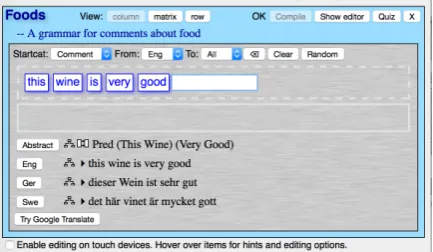
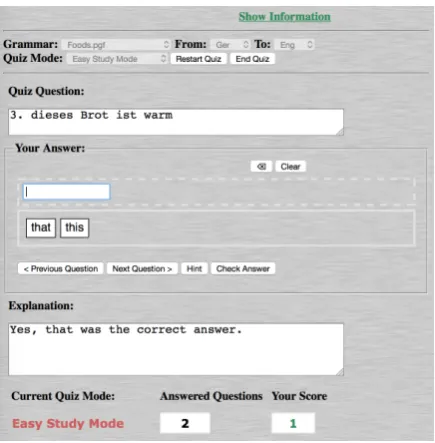
plications. The key operations provided by the run-time library are parsing, generation, and (by combining the former two) translation. The GF run-time library is also available as a web service, which can be used to create interactive natural language web applications (Bringert et al., 2009; Ranta et al., 2010). Examples can be seen in Fig-ures 6 and 7.
While applications based on GF grammars could be made available online by using the GF web service, until now the grammars themselves had to be created with offline tools that the gram-mar developer had to download and install on his/her own computer. With the cloud-based editor presented here, the grammars can also be created online.
1.2 Outline
Figure 3: GF online editor for simple multilingual grammars
2 The GF online grammar editor
As the name suggests, the GF online editor for simple multilingual grammarsis available online (Hallgren, 2013), so all that is needed to use the editor is a device with a reasonably modern web browser. Even smartphones and tablets can be used. To help novice grammar authors, the editor provides some guidance, e.g. by showing a skele-ton grammar file and hinting how the parts should be filled in. When a new part is added to the gram-mar, it is immediately checked for errors.
Figure 3 illustrates what the editor looks like. Editing operations are accessed by clicking on editing symbols embedded in the grammar dis-play: +, x and % to add, delete and edit items. These are revealed when hovering over items. On touch devices, hovering is in some cases simulated by tapping, but there is also a button to ”Enable editing on touch devices” that reveals all editing symbols.
The current version of the editor supports a small but useful subset of the GF grammar nota-tion. Grammars consist of one module for the ab-stract syntax, and a number of modules for con-crete syntaxes. Proper error checking is done on the fly for abstract syntax, but not (yet) for con-crete syntax.
Grammars can import modules from the Re-source Grammar Library(Ranta, 2009a), freeing the grammar author from dealing directly with the linguistic complexities of natural languages, such as inflection and agreement.
2.1 Abstract syntax
The definition of an abstract syntax consists of
• a list of inherited abstract syntaxes,
• a list ofcategory names,C1;... ;Cn,
• a list offunctions,Funi :Ci1 →...→Cin • and the designation of astart category.
This is somewhat restricted compared to the full GF grammar formalism, e.g. dependent types are not supported.
Available editing operations include:
• Inherited abstract syntaxes can be added and removed.
• Categories can be added, removed and re-named. When renaming a category, occur-rences of it in function types will be updated accordingly.
• Functions can be added, removed, renamed and edited. Concrete syntaxes are updated to reflect changes.
• Functions can be reordered using drag-and-drop.
Figure 4: Adding a new concrete syntax
2.2 Concrete syntax
When adding a new concrete syntax to a gram-mar, the editor shows a list of supported natural languages and the user just picks one. See Fig-ure 4. The name of the new module is filled in automatically based on naming conventions, e.g. FoodsEngif abstract syntax is calledFoodsand we are adding a translation to English. The body of the new concrete syntax can be created by copy-ing and modifycopy-ing an existcopy-ing concrete syntax, or by starting with a skeleton based on the abstract syntax.
The key components of a concrete syntax are linearization types for the categories and lin-earizations for the functions in the abstract syn-tax. The editor automatically provides correct left-hand sides for these, since they are determined by the abstract syntax, while the right-hand sides can be edited freely.
The editor allows a concrete syntax to open some of the relevant Resource Grammar Library modules. A list of suitable library modules is shown, e.g., SyntaxEng and LexiconEng in a concrete syntax for English, so the user does not need to know their names by heart. See Figure 5.
The editor also supports definitions of param-eter typesand auxiliaryoperations, but usually it is enough to rely on the types and operations pro-vided by the Resource Grammar Library.
The editor checks all user editable parts of the concrete syntax for syntactic correctness as they are entered. Duplicated definitions of parameter types or operations are highlighted. Checks for other semantic errors are delayed until the
gram-Figure 5: Opening modules from the Resource Grammar Library
Figure 6: Testing grammars in the Minibar
mar is compiled.
2.3 Compiling and testing grammars
When pressing theCompile button, the grammar is uploaded to the server and compiled with GF, and any errors not detected by the editor will be reported. Error-free grammars can be tested by clicking on the the Minibar button, which is a web-based translation tool, and the Quiz button, which is a web-based language training tool (Abo-lahrar, 2011). See Figures 6 and 7.
2.4 Grammars in the cloud
While grammars created in the editor are stored locally in the device by the browser, it is also pos-sible to store grammars in the cloud. Each device is initially assigned to its own unique cloud and has its own set of grammars, but it is also possible to merge clouds and share a common set of gram-mars between multiple devices.
[image:4.595.73.289.70.244.2] [image:4.595.309.526.297.423.2]Figure 7: Testing grammars in the Translation Quiz
grammars visible to all users of the cloud-based grammar editor.
3 Example-based grammar writing The example-based grammar writing mechanism is aimed at helping users who build concrete gram-mars using the resource grammar for the given language. The resource library provides over 300 functions for building grammatical constructs such as predication, complementation, etc (Ranta, 2009b). Using the resource library is advanta-geous on one hand, because it alleviates the dif-ficulty of reimplementing language-specific fea-tures every time when writing a grammar for the language, but on the other hand it assumes a work-ing knowledge of the resource library, which could lead to a larger overall effort. We aim at freeing users from this burden by making it possible for them to write function linearizations by giving ex-ample of their usage. In the current scenario, we assume that a large lexicon covering the words that could be used in the grammar is available already. We will use the resource grammar enhanced with the larger dictionary for parsing the examples from the user in order to infer the right linearization form.
Since the functions from the grammar could take arguments, in order to give an example for the usage of a certain function, we need to have one example for each of its arguments in order to get more precise information about the behavior
Figure 8: Example-based grammar construction
of the function. For this reason, only the function for which all arguments can be found among the already implemented functions, are highlighted as available for the example-based method.
In order to clarify the usage of a certain func-tion, its context is made explicit by embedding the function into a tree returning the start category, like in Figure 8 where ”this fish” is used to make phrases like ”this fish is delicious”. Since certain parts of the phrase are not relevant for the task, they are underspecified by using ”?” instead. In case that the grammar returns more than one parse tree, the results are ranked in the descending or-der of their probability (defined in the correspond-ing resource grammar or defined by the user), and the first tree from which the arguments can be ab-stracted is chosen as the linearization tree.
The technique has been used as an experimental way for developing a tourist phrasebook grammar in GF for 4 languages (Ranta et al., 2011), but no tool support was available at that time. The pos-itive results obtained were a strong motivation to make the method available to end users as part of a GF grammar writing system.
[image:5.595.309.524.76.292.2]4 Implementation
The implementation of the cloud-based editor con-sists of a client-side part and a server-side part.
The client-side part is written directly in JavaScript. In total, roughly 6350 lines of JavaScript (180KB) is loaded by the browser when opening the editor. This divides roughly into 2800 lines written specifically for the editor, 2600 lines of code for other components (the minibar) and 750 lines of supporting library code.
All server-side code is written in Haskell. This includes the GF grammar compiler, the PGF run-time library and the PGF web service (Bringert et al., 2009). We created a new GF cloud service API (Hallgren, 2014) to support the editor. It in-cludes functionality for grammar syntax checking, grammar upload, grammar compilation and access to the GF shell. It’s implemented as 500 lines of Haskell code.
To support example-based grammar writing, we added 200 lines of client-side JavaScript code and 680 lines of Haskell code in the server.
5 Related work
GF is a grammar formalism comparable in expres-sive power to HPSG (Pollard and Sag, 1994) and LFG (Bresnan, 1982), but different due to the dis-tinction between the abstract and concrete dimen-sion of a grammar, along with the possibility to share the abstract syntax which makes translation between any pair of languages possible. In the same way, the GF resource library could be com-pared to two other multilingual resources based on the above-mentioned formalisms: LinGO Gram-mar Matrix (Bender et al., 2002) for HPSG and ParGram (Butt et al., 2002) for LFG.
Since the task of developing a multilingual grammar within such a grammar formalism poses specific challenges, each system comes equipped with its own IDE/editor that aids the grammar development process. LinGO Grammar Matrix has a grammar-customization system (Bender et al., 2010) and ParGram has XLFG, a customized IDE (Cl´ement, 2009). While XLFG allows storing and editing grammars, it is only available for En-glish and French. The customization system from LinGO Grammar Matrix allows specifying lin-guistic features of certain grammar constructions in the shape of a questionnaire and it is mainly used for developing new language resources for the Matrix library. The further use of the resources
is supported by a parser, sentence generator and fa-cilities for profiling and regression testing (Oepen and Flickinger, 1998).
In addition to the cloud-based IDE, GF also has a desktop IDE, implemented as an Eclipse plugin (Camilleri, 2012).
6 Future work
The GF grammar editor described here already supports a useful subset of the GF grammar no-tation. Some of the guidance and error checking is done in the editor on the client side (resulting in well integrated user friendly error indications), some is delegated to the server (resulting in less user friendly error messages). We do not expect to create a full implementation of GF that runs in the web browser.
If we want to support the full-fledged GF gram-mar formalism, the easy way out would be to duplicate a typical desktop development environ-ment in the browser, i.e. create an environenviron-ment with a text editor and command line tools, or per-haps a more integrated Eclipse-like environment. But we would prefer to create something that is more interactive and provides more guidance for novice users, so we are thinking of an interactive development environment in the style of proof as-sistants based on type theory, such as Alfa (Hall-gren, 2004) and Agda (Norell, 2007). However, being a batch compiler, GF does currently not pro-vide an API that makes it easy to create this kind of development environment. If a GF server with an appropriate API becomes available, it should be possible to extend the editor to support a larger fragment of GF, to provide more user guidance, more user friendly error reporting, and in general make more of the functionality in the existing GF tools accessible directly from the online editor.
More work is needed on the grammar cloud storage service. In particular, it is currently not suitable for multiple users developing a grammar in collaboration. This could be done by interfacing with a online collaboration tool (like GitHub), or by allowing concurrent access to shared grammars and propagating edits to all users in real-time (like in Google Docs).
in Figure 7) that instructors or students can cus-tomize for training or testing a particular vocab-ulary or particular grammatical forms. It should be possible to make this kind of customizations in minutes, without installing any software.
Future work on the example-based method in-cludes combining it with traditional grammar writ-ing and the possibility to develop more languages in parallel and use one as an example for the other. Moreover, since currently the method works for the case when the linearization type is a category from the resource library (noun phrase, sentence, etc.), one could also extend the algorithm in or-der to handle record types comprising more such syntactic categories. Last but not least, we aim at covering languages for which large dictionaries are not available by making the method robust to unknown words that could be later implemented by the user.
References
Elnaz Abolahrar. 2011. Multilingual Grammar-Based Language Training: Computational Methods and Tools. Master’s thesis, Chalmers University of Technology.
Krasimir Angelov, Bj¨orn Bringert, and Aarne Ranta. 2010. PGF: A Portable Run-time Format for Type-theoretical Grammars. Journal of Logic, Language and Information, 19:201–228. 10.1007/s10849-009-9112-y.
Andrew W. Appel. 1998. Modern Compiler Imple-mentation in ML. Cambridge University Press. Emily M. Bender, Dan Flickinger, and Stephan Oepen.
2002. The grammar matrix: an open-source starter-kit for the rapid development of cross-linguistically consistent broad-coverage precision grammars. In COLING-02 on Grammar engineering and evalua-tion, pages 1–7, Morristown, NJ, USA. Association for Computational Linguistics.
Emily M. Bender, Scott Drellishak, Antske Fokkens, Laurie Poulson, and Safiyyah Saleem. 2010. Gram-mar Customization.Research on Language & Com-putation, 8(1):23–72. 10.1007/s11168-010-9070-1. Joan Bresnan. 1982. The Mental Representation of
Grammatical Relations. MIT Press.
Bj¨orn Bringert, Krasimir Angelov, and Aarne Ranta. 2009. Grammatical framework web service. In Proceedings of the Demonstrations Session at EACL 2009, pages 9–12, Athens, Greece, April. Associa-tion for ComputaAssocia-tional Linguistics.
Miriam Butt, Helge Dyvik, Tracy Holloway King, Hi-roshi Masuichi, and Christian Rohrer. 2002. The
Parallel Grammar project. InCOLING-02 on Gram-mar engineering and evaluation, pages 1–7, Morris-town, NJ, USA. Association for Computational Lin-guistics.
John J. Camilleri. 2012. An IDE for the Grammatical Framework. Gothenburg, Sweden, June.
Lionel Cl´ement. 2009. XLFG5
Documenta-tion. https://signes.bordeaux.inria.
fr/xlfg5/doc/en/, October.
Ann Copestake. 2002. Implementing typed feature structure grammars, volume 110. CSLI publica-tions Stanford.
Thomas Hallgren. 2004. Home Page of the
Proof Editor Alfa. www.cse.chalmers.se/
˜hallgren/Alfa/.
Thomas Hallgren. 2013. GF online editor for
sim-ple multilingual grammars. http://cloud.
grammaticalframework.org/gfse/.
Thomas Hallgren. 2014. GF Cloud Service API.
http://cloud.grammaticalframework.
org/gf-cloud-api.html.
Ulf Norell. 2007. Towards a practical programming language based on dependent type theory. Ph.D. thesis, Department of Computer Science and En-gineering, Chalmers University of Technology, SE-412 96 G¨oteborg, Sweden, September.
Stephan Oepen and Daniel P. Flickinger. 1998. To-wards Systematic Grammar Profiling Test Suite Technology Ten Years After. Special Issue on Eval-uation), 411, 12:411–436.
Carl Pollard and Ivan A. Sag. 1994. Head-Driven Phrase Structure Grammar. University of Chicago Press.
Aarne Ranta, Krasimir Angelov, and Thomas Hall-gren. 2010. Tools for multilingual grammar-based translation on the web. InProceedings of the ACL 2010 System Demonstrations, pages 66–71, Upp-sala, Sweden, July. Association for Computational Linguistics.
Aarne Ranta, Ramona Enache, and Gr´egoire D´etrez. 2011. Controlled Language for Everyday Use: the MOLTO Phrasebook. Proceeding of the 2nd Work-shop on Controlled Natural Languages (CNL 2010). Aarne Ranta. 2004. Grammatical Framework: A Type-Theoretical Grammar Formalism. The Jour-nal of FunctioJour-nal Programming, 14(2):145–189. Aarne Ranta. 2009a. The GF resource grammar
li-brary. Linguistic Issues in Language Technology, 2(2).
Gilles Kahn, pages 281–308. Cambridge
Univer-sity Press. http://www.cse.chalmers.se/
˜aarne/articles/libraries-kahn.pdf.