D S Sharma, R Sangal and E Sherly. Proc. of the 12th Intl. Conference on Natural Language Processing, pages 303–307, Trivandrum, India. December 2015. c2015 NLP Association of India (NLPAI)
Augmenting Pivot based SMT with word segmentation
Rohit More†, Anoop Kunchukuttan†, Pushpak Bhattacharyya† †Department of Computer Science
And Engineering IIT Bombay, India
{rohit,anoop,pb}@cse.iitb.ac.in,
Raj Dabre‡,
‡Graduate School of Informatics
Kyoto University Japan
Abstract
This paper is an attempt to bridge two well known performance degraders in SMT,
viz., (i) difference in morphological char-acteristics of the two languages, and (ii) scarcity of parallel corpora. We address these two problems using “word segmen-tation” and through “pivots” on the mor-phologically complex language. Our case study is Malayalam to Hindi SMT. Malay-alam belongs to the Dravidian family of languages and is heavily agglutinative. Hindi is a representative of the Indo-Aryan language family and is morphologically simpler. We use triangulation as pivoting strategy in combination with morphologi-cal pre-processing. We observe that (i) sig-nificant improvement in translation qual-ity over direct SMT occurs when a pivot is used in combination with direct SMT, (ii) the more the number of pivots, the better the performance and (iii)word segmenta-tion is a must. We achieved an improve-ment of 9.4 BLEU points which is over 58% compared to the baseline direct sys-tem. Our work paves way for SMT of lan-guages that face resource scarcity and have widely divergent morphological character-istics.
1 Introduction
Hindi (hin) and Malayalam (mal) are two impor-tant languages from Indian sub-continent. Hindi is a language belonging to Indo-Aryan family with 300 million native speakers. Malayalam belongs to the Dravidian language family. It is spoken by over 38 million people.
The task of translation between Hindi and Malayalam proves to be a difficult one. This is due to scarcity of available parallel corpus and
high agglutinative nature of Malayalam. Malay-alam is a morphologically rich, agglutinative lan-guage in which complex words are formed by concatenating morphemes together. For exam-ple, “अगर बादल नहीं बरसे तो भी” (if cloud not rain_verb then also) in Hindi (5 words) would translate to “മഴാ െപ ുതിെല ിലും” (rain_noun rain_verb+not+even_if+then_also) in Malayalam (2 words).
In this paper, we present a case of translation from Malayalam to Hindi. Our approach is based on combined use of pivot strategies for Statistical Machine Translation (SMT) and word segmenta-tion techniques. We show that word segmentasegmenta-tion of source language as well as pivot language helps to improve the translation quality. Section 2 con-tains details about relevant work done in the field. Section 3 explains the design of our system in de-tail. Section 4 describes the experimental setup. Results of the experiments are discussed in Sec-tion 5. SecSec-tion 6 includes concluding remarks on the mal-hin translation task.
2 Related Work
There is substantial amount on pivot-based SMT. De Gispert and Marino (2006) discuss translation tasks between Catalan and English with the use of Spanish as a pivot language. Pivoting is done us-ing two techniques: pipelinus-ing of source-pivot and pivot-target SMT systems and direct translation using a synthesized Catalan-English. In Utiyama and Isahara (2007), the authors propose the use of pivot language through - phrase translation (phrase table creation) and sentence translation. Wu and Wang (2007) compare three pivot strategies viz.
- phrase translation (i.e. triangulation), trans-fer method and synthetic method. Nakov and Ng (2012) try to exploit the similarity between resource-poor languages and resource-rich lan-guages for the translation task. Dabre et al. (2014) used multiple decoding paths (MDP) to overcome
the limitation of small sized corpora.Paul et al. (2013) discusses criteria to be considered for se-lection of good pivot language. Use of source-side segmentation as pre-processing technique has been demonstrated by (Kunchukuttan et al., 2014). Goldwater and McClosky (2005) investigates sev-eral methods for incorporating morphological in-formation to achieve better translation from Czech to English.
Most of the pivot strategies mentioned above focus on the situation of resource-poor languages where direct translation is either very poor or not available. Our approach, like Dabre et al. (2014), tries to employ pivot strategy to help improve the performance of existing SMT systems. To the best of our knowledge, our work is the first attempt to integrate word segmentation with pivot-based SMT.
3 Our System
We propose a system which integrates word seg-mentation with triangulation and combines more than one SMT systems. The required concepts are explained as follows.
3.1 Pivoting by Triangulation
Wu and Wang (2007) discuss triangulation as a pivoting strategy. In this method, the source-pivot models and pivot-target models are trained us-ing source(Ls)-pivot(Lp) and pivot(Lp)-target(Lt) corpora respectively. Using these two models, we induce a source-target model. The two important components to be calculated are - 1) phrase trans-lation probability and 2) lexical weight.
The Phrase translation probability is esti-mated by marginalizing over all possible pivot phrase, along with the assumption that the target phrases are independent of the source phrase given the pivot phrase. The phrase translation probabil-ity can be calculated as shown below:
ϕ(⃗s∥⃗t)=∑
⃗ p
ϕ(⃗s∥⃗p)ϕ(p⃗∥⃗t) (1)
Where,⃗s,⃗p,⃗tare phrases in languagesLs,Lp, Ltrespectively.
TheLexical Weight, according to Koehn et al. (2003), depends on - 1) word alignment informa-tionain a phrase pair(s, t)and 2) lexical transla-tion probabilityw(s|t).
Lexical weight can be modeled using following
equation,
pw
(
⃗
f∥⃗e, a)=
n
∏
i=1
1 ∥j|(i, j)∈a∥
∑
∀(i,j)∈a
w(fi∥ej)
(2) Wu and Wang (2009) discuss in detail about alignments information and lexical translation probability.
3.2 Word segmentation
We use unsupervised word segmentation as pre-processing technique. For this purpose, Morfessor (Virpioja et al., 2013) is used. It performs mor-phological segmentation of words of a natural lan-guage, based solely on raw text data. Morfessor uses probabilistic machine learning methods to do the task of segmentation. The trained models for word segmentation of Indian languages are avail-able to use1.
3.3 Integrating word segmentation with Triangulation
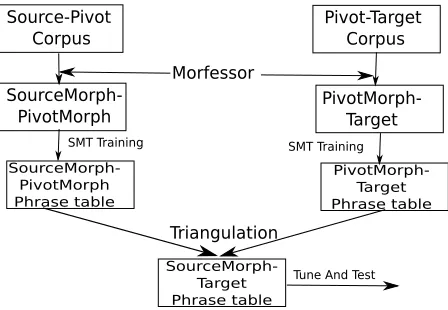
In our system, we use both phrase table triangu-lation and word-segmentation. The words in the source and pivot language training corpora are seg-mented before training the SMT systems. The tar-get language is left unchanged. The phrase tables are then triangulated. This process is shown in Fig-ure 1.
Source-Pivot Corpus
Morfessor
SourceMorph-PivotMorph Phrase table
SourceMorph-PivotMorph
Pivot-Target Corpus
PivotMorph-Target
PivotMorph-Target Phrase table
SourceMorph-Target Phrase table Triangulation
SMT Training SMT Training
[image:2.612.318.542.435.590.2]Tune And Test
Figure 1: Integration of word segmentation with triangulation
3.4 Multiple Decoding Paths
We use the triangulated phrase table to supple-ment the direct phrase table. In order to inte-grate these two phrase tables, we use the multi-ple decoding paths (MDP) feature provided by the
1
Moses decoder. Multiple decoding paths (Koehn and Hoang, 2007) allows us to lookup multiple translation models for hypothesis at decoding time, and the choice of best hypothesis at decoding time based on available evidence. We use MDP to com-bine one or more pivot-based MT systems with the direct MT system. This constitutes ourfinal de-coding system. We preferred this option over of-fline linear interpolation of phrase tables since the framework can dynamically consider phrases from multiple phrase tables and wouldn’t need any hy-perparameter tuning.
4 Experiments
The aim of experiments is to study impact of pivot strategies and word segmentation, separately and together.
4.1 Resource Details
We used the ILCI (Jha, 2010) multilingual cor-pora of around 50K sentences. The corcor-pora be-longs to Health and Tourism domain. Indian lan-guages used in experiments are Bengali (ban), Gu-jarati (guj), Hindi (hin), Konkani (kok), Malay-alam (mal), Marathi (mar), Panjabi (pan), Tamil (tam) and Telugu (tel).
Our data split was as follows: 46277 sentences are used for training, 500 sentences are used for tuning and 2000 sentences are used for testing.
For the experiments, we use phrase-based SMT training and 5-gram SRILM language model. Tun-ing is done usTun-ing the MERT algorithm. The tri-angulated MT systems use default distance based reordering while direct systems use wbe-msd-bidirectional-fe-allff model
4.2 Experimental Setup
We trained various phrase based SMT systems by combining the basic systems mentioned in Sec-tion 3. We use a threshold of 0.001 for phrase translation probability to manage size of triangu-lated phrase table. The performance metric used is BLEU (Papineni et al., 2002). The following are the configurations we experimented with:
1. DIR: MT system trained on direct Source-Target corpus.
2. DIR_Morph: DIRsystem with source-text word-segmented.
3. PIVOT: MT system based on triangulated phrase table of Source-Target using a single Pivot language.
4. PIVOT_Morph: PIVOT system with both Source and Pivot texts segmented.
5. PIVOT_SourceMorph: PIVOT system
with only Source text segmented.
6. DIR+PIVOT: MT system based on integra-tion of DIRandPIVOTphrase tables using MDP.
7. DIR_Morph+PIVOT_Morph: MT system based on integration of DIR_Morph and
PIVOT_Morphusing MDP.
8. DIR+All-PIVOT: MT system based on inte-gration of DIRand all 7PIVOTsystems us-ing MDP.
9. DIR_Morph+All-PIVOT_Morph: MT
system based on integration of DIR_Morph
and all 7 PIVOT_Morph systems using MDP.
[image:3.612.317.516.401.541.2]5 Results and Discussions
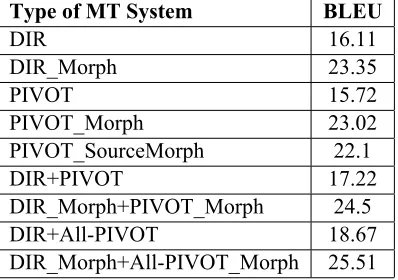
Table 1 shows BLEU scores for best performing MT systems for each experiment. Wherever a sin-gle pivot is used, it refers to the best supplement-ing pivot. In all the experiments, Punjabi was ob-served to be the best pivot.
Type of MT System BLEU
DIR 16.11
DIR_Morph 23.35
PIVOT 15.72
PIVOT_Morph 23.02 PIVOT_SourceMorph 22.1
DIR+PIVOT 17.22
DIR_Morph+PIVOT_Morph 24.5 DIR+All-PIVOT 18.67 DIR_Morph+All-PIVOT_Morph 25.51
Table 1: BLEU Scores of MT systems
We can see that the pivot-only system gives translation accuracy comparable to the direct sys-tem for the best performing pivot language, Pun-jabi. Punjabi shares a large fraction of its vocab-ulary with Hindi. In addition,panis morphologi-cally simpler compared to other Indian languages. Hence, better word alignment can be achieved and during triangulation, more phrase pairs are ob-tained.
Though the PIVOT system does not better the performance of the DIRECT system, the combination of both the systemi.e. DIR+PIVOT
performs better than the DIRECT system.
DIR+PIVOT has relative improvement of 6.8% overDIRsystem. Addition of allPIVOTsystems using multiple decoding paths shows that each pivot helps improve the BLEU score since each
PIVOTsystem provides additional translation op-tions. The all-pivot systemi.e. DIR+All-PIVOT
shows improvement of about 15% (2.56 BLEU points) overDIRsystem.
Pre-processing the corpus with word segmenta-tion (DIR_Morphsystem) results in a substantial improvement of 44% over theDIRsystem. Use of word segmentation brings about a major improve-ment in the BLEU score. Sincemalis morpholog-ically rich, word segmentation reduces data spar-sity, helps learn better alignment models and re-duces the number of unknown words in test set.
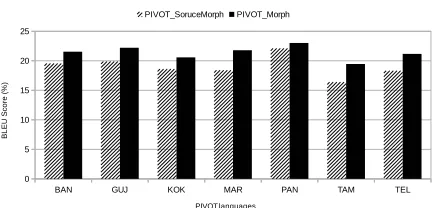
[image:4.612.87.305.336.440.2]We compared the use of word segmentation at source as well as pivot with word segmentation on the source language alone. Figure 2 compares these two system for various pivot languages.
Figure 2: Comparison of PIVOT_Morph and PIVOT_SourceMorph MT systems
The additional use of word segmentation at pivot provides a 4% to 18% increase in the BLEU score.
TheDIR_Morph+All-PIVOT_Morphsystem combines all pivot languages as well as source and pivot segmentation. This is the best perform-ing system which achieves an improvement of 9.4 BLEU (58% improvement) overDIRsystem.
5.1 Examples
Below are few examples comparing baselineDIR
and our final system i.e. DIR_Morph+All-PIVOT_Morph.
• Example 1:
mal input: താമസി ു തിനു
െസൗകര ം സർ ാർ വിശ മ ക ാംപുകൾ
കാർലാ േഹാ ൽ എ ിവയിലു .
tAmasikkunnatinuLLa saukarya.n sarkkAr
vishrama kyA.npukaL kArlA hoTTal .ennivay-iluNT)
Baseline:के ठहरने क व्यवस्था सरकारी िवशर्ाम कैंप
कारला होटल എ ിവയിലു के नाम से जाना जाता है ।
(ke Thaharane kI vyavasthA sarakArI vishrAma kai.npa kAralA hoTala .ennivayiluNT ke nAma se jAnA jAtA hai)
Final system: ठहरने क व्यवस्था सरकारी िवशर्ाम
कैंप कारला होटल भी उपलब्ध हैं ।
(Thaharane kI vyavasthA sarakArI vishrAma kai.npa kAralA hoTala bhI upalabdha hai.n)
Better translations for words are generated, and the number of unknown words is reduced. • Example 2:
mal input: െചവിയിെല കുരു ൾ
ആെരയും ഉറ ാൻ അനുവദി ില.
(c.eviyil.e kurukkaL Ar.eyu.n uRa N NAn anu-vadikkilla)
Baseline:कान क फुंसी को सोने के ।
(kAna kI phu.nsI ko sone ke)
Final system:कान क फुंसी िकसी को भी नींद नहीं
होने िदया ।
(kAna kI phu.nsI kisI ko bhI nI.nda nahI.n hone diyA)
The direct system is not able to translate some words, whereas out final system translates most words correctly.
6 Conclusions
We have shown that pre-processing using word segmentation and augmentation of direct systems with pivot-based systems provides significant ad-vancement in translation quality. This is an at-tempt to integrate word segmentation with pivot-strategies. We achieved compelling results with our approach. The approach is applicable to any resource-scarce language pair with morphologi-cally rich source side. In future, we will focus on applying our approach to other challenging lan-guage pairs. We will also work on MT tasks which involve morphologically rich target language.
Acknowledgements
We would like to thank the Technology Devel-opment for Indian Languages (TDIL) Programme and the Department of Electronics & Information Technology, Govt. of India for providing the ILCI corpus.
References
Raj Dabre, Fabien Cromieres, Sadao Kurohashi, and Pushpak Bhattacharyya. 2014. Leveraging small multilingual corpora for smt using many pivot lan-guages.
Adrià De Gispert and Jose B Marino. 2006. Catalan-english statistical machine translation without
par-allel corpus: bridging through spanish. In Proc.
of 5th International Conference on Language Re-sources and Evaluation (LREC), pages 65–68. Cite-seer.
Sharon Goldwater and David McClosky. 2005. Im-proving statistical mt through morphological
anal-ysis. In Proceedings of the conference on Human
Language Technology and Empirical Methods in Natural Language Processing, pages 676–683. As-sociation for Computational Linguistics.
Girish Nath Jha. 2010. The tdil program and the indian
language corpora initiative (ilci). Proceedings of
the Seventh Conference on International Language Resources and Evaluation (LREC 2010). European Language Resources Association (ELRA).
Philipp Koehn and Hieu Hoang. 2007. Factored
trans-lation models. InEMNLP-CoNLL, pages 868–876.
Philipp Koehn, Franz Josef Och, and Daniel Marcu.
2003. Statistical phrase-based translation. In
Proceedings of the 2003 Conference of the North American Chapter of the Association for Computa-tional Linguistics on Human Language Technology-Volume 1, pages 48–54. Association for Computa-tional Linguistics.
Anoop Kunchukuttan, Ratish Pudupully, Rajen Chat-terjee, Abhijit Mishra, and Pushpak Bhattacharyya. 2014. The iit bombay smt system for icon 2014 tools
contest. InNLP Tools Contest at ICON 2014.
Preslav Nakov and Hwee Tou Ng. 2012.
Improv-ing statistical machine translation for a resource-poor language using related resource-rich lan-guages. Journal of Artificial Intelligence Research, 44(1):179–222.
Kishore Papineni, Salim Roukos, Todd Ward, and Wei-Jing Zhu. 2002. Bleu: a method for automatic
eval-uation of machine translation. In Proceedings of
the 40th annual meeting on association for compu-tational linguistics, pages 311–318. Association for Computational Linguistics.
Michael Paul, Andrew Finch, and Eiichrio Sumita. 2013. How to choose the best pivot language for
au-tomatic translation of low-resource languages.ACM
Transactions on Asian Language Information Pro-cessing (TALIP), 12(4):14.
Masao Utiyama and Hitoshi Isahara. 2007. A compari-son of pivot methods for phrase-based statistical
ma-chine translation. InHLT-NAACL, pages 484–491.
Sami Virpioja, Peter Smit, Stig-Arne Grönroos, Mikko Kurimo, et al. 2013. Morfessor 2.0: Python imple-mentation and extensions for morfessor baseline.
Hua Wu and Haifeng Wang. 2007. Pivot language ap-proach for phrase-based statistical machine transla-tion.Machine Translation, 21(3):165–181.
Hua Wu and Haifeng Wang. 2009. Revisiting pivot
language approach for machine translation. In
Pro-ceedings of the Joint Conference of the 47th Annual Meeting of the ACL and the 4th International Joint Conference on Natural Language Processing of the AFNLP: Volume 1-Volume 1, pages 154–162. Asso-ciation for Computational Linguistics.