BioNLP Shared Task 2013: Supporting Resources
Pontus Stenetorp1 Wiktoria Golik2 Thierry Hamon3
Donald C. Comeau4 Rezarta Islamaj Do˘gan4 Haibin Liu4 W. John Wilbur4 1National Institute of Informatics, Tokyo, Japan
2French National Institute for Agricultural Research (INRA), Jouy-en-Josas, France 3University Paris 13, Paris, France
4National Center for Biotechnology Information, National Library of Medicine,
National Institutes of Health, Bethesda, MD, USA
[email protected] [email protected] [email protected]
{comeau,islamaj,liuh11,wilbur}@ncbi.nlm.nih.gov
Abstract
This paper describes the technical con-tribution of the supporting resources pro-vided for the BioNLP Shared Task 2013. Following the tradition of the previous two BioNLP Shared Task events, the task organisers and several external groups sought to make system development easier for the task participants by providing auto-matically generated analyses using a vari-ety of automated tools. Providing analy-ses created by different tools that address the same task also enables extrinsic evalu-ation of the tools through the evaluevalu-ation of their contributions to the event extraction task. Such evaluation can improve under-standing of the applicability and benefits of specific tools and representations. The supporting resources described in this pa-per will continue to be publicly available from the shared task homepage
http://2013.bionlp-st.org/
1 Introduction
The BioNLP Shared Task (ST), first organised in 2009, is an ongoing series of events focusing on novel challenges in biomedical domain informa-tion extracinforma-tion. In the first BioNLP ST, the or-ganisers provided the participants with automat-ically generated syntactic analyses from a variety of Natural Language Processing (NLP) tools (Kim et al., 2009) and similar syntactic analyses have since then been a key component of the best per-forming systems participating in the shared tasks. This initial work was followed up by a similar ef-fort in the second event in the series (Kim et al., 2011), extended by the inclusion of software tools and contributions from the broader BioNLP
com-munity in addition to task organisers (Stenetorp et al., 2011).
Although no formal study was carried out to es-timate the extent to which the participants utilised the supporting resources in these previous events, we note that six participating groups mention us-ing the supportus-ing resources in published descrip-tions of their methods (Emadzadeh et al., 2011; McClosky et al., 2011; McGrath et al., 2011; Nguyen and Tsuruoka, 2011; Bj¨orne et al., 2012; Vlachos and Craven, 2012). These resources have been available also after the original tasks, and several subsequent studies have also built on the resources. Van Landeghem et al. (2012) applied a visualisation tool that was made available as a part of the supporting resources, Vlachos (2012) em-ployed the syntactic parses in a follow-up study on event extraction, Van Landeghem et al. (2013) used the parsing pipeline created to produce the syntactic analyses, and Stenetorp et al. (2012) pre-sented a study of the compatibility of two different representations for negation and speculation anno-tation included in the data.
These research contributions and the overall positive reception of the supporting resources prompted us to continue to provide supporting re-sources for the BioNLP Shared Task 2013. This paper presents the details of this technical contri-bution.
2 Organisation
Following the practice established in the BioNLP ST 2011, the organisers issued an open call for supporting resources, welcoming contributions relevant to the task from all authors of NLP tools. In the call it was mentioned that points such as availability for research purposes, support for well-established formats and access
Name Annotations Availability BioC Lemmas and syntactic constituents Source BioYaTeA Terms, lemmas, part-of-speech and syntactic constituencies Source
Cocoa Entities Web API
Table 1: Summary of tools/analyses provided by external groups.
to technical documentation would considered favourable (but not required) and each supporting resource provider was asked to write a brief description of their tools and how they could potentially be applied to aid other systems in the event extraction task. This call was answered by three research groups that offered to provide a variety of semantic and syntactic analyses. These analyses were provided to the shared task participants along with additional syntactic analyses created by the organisers.
However, some of the supporting resource providers were also participants in the main event extraction tasks, and giving them advance access to the annotated texts for the purpose of creating the contributed analyses could have given those groups an advantage over others. To address this issue, the texts were made publicly available one week prior to the release of the annotations for each set of texts. During this week, the supporting analysis providers annotated the texts using their automated tools and then handed the analyses to the shared task organisers, who made them avail-able to the task participants via the shared task homepage.
3 Analyses by External Groups
This section describes the tools that were applied to create supporting resources by the three exter-nal groups. These contributions are summarised in Table 1.
BioC Don Comeau, Rezarta Islamaj, Haibin Liu and John Wilbur of the National Center for Biotechnology Information provided the output of the shallow parser MedPost (Smith et al., 2004) and the BioLemmatizer tool (Liu et al., 2012), supplied in the BioC XML format1 for annota-tion interchange (Comeau et al., 2013). The BioC format address the problem of interoperability be-tween different tools and platforms by providing a unified format for use by various tools. Both Med-Post and BioLemmatizer are specifically designed
1http://bioc.sourceforge.net/
for biomedical texts. The former annotates parts-of-speech and performs sentence splitting and to-kenisation, while the latter performs lemmatisa-tion. In order to make it easier for participants to get started with the BioC XML format, the providers also supplied example code for parsing the format in both the Java and C++ programming languages.
BioYaTeA Wiktoria Golik of the French Na-tional Institute for Agricultural Research (INRA) and Thierry Hamon of University Paris 13 pro-vided analyses created by BioYaTeA2 (Golik et al., 2013). BioYaTeA is a modified version of the YaTeA term extraction tool (Aubin and Hamon, 2006) adapted to the biomedical domain. Working on a noun-phrase level, BioYaTeA provides anno-tations such as lemmas, parts-of-speech, and con-stituent analysis. The output formats used were a simple tabular format as well as BioYaTeA-XML, an XML representation specific to the tool.
Cocoa S. V. Ramanan of RelAgent Private Ltd provided the output of the Compact cover anno-tator (Cocoa) for biological noun phrases.3 Co-coa provides noun phrase-level entity annotations for over 20 different semantic categories such as macromolecules, chemicals, proteins and organ-isms. These annotations were made available for the annotated texts for the shared task along with the opportunity for the participants to use the Co-coa web API to annotate any text they may con-sider beneficial for their system. The data format used by Cocoa is a subset of the standoff format used for the shared task entity annotations, and it should thus be easy to integrate into existing event extraction systems.
4 Analyses by Task Organisers
This section describes the syntactic parsers ap-plied by the task organisers and the pre-processing
2
http://search.cpan.org/˜bibliome/ Lingua-BioYaTeA/
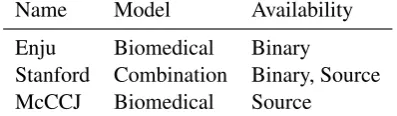
Name Model Availability Enju Biomedical Binary
[image:3.595.82.281.64.122.2]Stanford Combination Binary, Source McCCJ Biomedical Source
Table 2: Parsers used for the syntactic analyses.
and format conversions applied to their output. The applied parsers are listed in Table 2.
4.1 Syntactic Parsers
Enju Enju (Miyao and Tsujii, 2008) is a deep parser based on the Head-Driven Phrase Struc-ture Grammar (HPSG) formalism. Enju analyses its input in terms of phrase structure trees with predicate-argument structure links, represented in a specialised XML-format. To make the analyses of the parser more accessible to participants, we converted its output into the Penn Treebank (PTB) format using tools included with the parser. The use of the PTB format also allow for its output to be exchanged freely for that of the other two syn-tactic parsers and facilitates further conversions into dependency representations.
McCCJ The BLLIP Parser (Charniak and John-son, 2005), also variously known as the Charniak parser, the Charniak-Johnson parser, or the Brown reranking parser, has been applied in numerous biomedical domain NLP efforts, frequently using the self-trained biomedical model of McClosky (2010) (i.e. the McClosky-Charniak-Johnson or McCCJ parser). The BLLIP Parser is a con-stituency (phrase structure) parser and the applied model produces PTB analyses as its native out-put. These analyses were made available to par-ticipants without modification.
Stanford The Stanford Parser (Klein and Man-ning, 2002) is a widely used publicly available syntactic parser. As for the Enju and BLLIP parsers, a model trained on a dataset incorporating biomedical domain annotations is available also for the Stanford parser. Like the BLLIP parser, the Stanford parser is constituency-based and pro-duces PTB analyses, which were provided to task participants. The Stanford tools additionally in-corporate methods for automatic conversion from this format to other representations, discussed fur-ther below.
4.2 Pre-processing and Conversions
To create the syntactic analyses from the Enju, BLLIP and Stanford Parser systems, we first ap-plied a uniform set of pre-processing steps in order to normalise over differences in e.g. tokenisation and thus ensure that the task participants can eas-ily swap the output of one system for another. This pre-processing was identical to that applied in the BioNLP 2011 Shared Task, and included sentence splitting of the annotated texts using the Genia Sentence Splitter,4the application of a set of post-processing heuristics to correct frequently occur-ring sentence splitting errors, and Genia Treebank-like tokenisation (Tateisi et al., 2004) using a to-kenisation script created by the shared task organ-isers.5
Since several studies have indicated that repre-sentations of syntax and aspects of syntactic de-pendency formalism differ in their applicability to support information extraction tasks (Buyko and Hahn, 2010; Miwa et al., 2010; Quirk et al., 2011), we further converted the output of each of the parsers from the PTB representation into three other representations: CoNNL-X, Stanford De-pendencies and Stanford Collapsed DeDe-pendencies. For the CoNLL-X format we employed the con-version tool of Johansson and Nugues (2007), and for the two Stanford Dependency variants we used the converter provided with the Stanford CoreNLP tools (de Marneffe et al., 2006). These analyses were provided to participants in the output for-mats created by the respective tools, i.e. the TAB-separated column-oriented format CoNLL and the custom text-based format of the Stanford Depen-dencies.
5 Results and Discussion
Just like in previous years the supporting resources were well-received by the shared task participants and as many as five participating teams mentioned utilising the supporting resources in their initial submissions (at the time of writing, the camera-ready versions were not yet available). This level of usage of the supporting resources by the partici-pants is thus comparable to what was observed for the 2011 shared task.
Following in the tradition of the 2011
support-4
https://github.com/ninjin/geniass 5https://github.com/ninjin/bionlp_
ing resources, to aim for reproducibility, the pro-cessing pipeline containing pre/post-propro-cessing and conversion scripts for all the syntactic parses has been made publicly available under an open licence.6 The repository containing the pipeline also contains detailed instructions on how to re-produce the output and how it can potentially be applied to other texts.
Given the experience of the organisers in analysing medium-sized corpora with a variety of syntactic parsers, many applied repeatedly over several years, we are also happy to report that the robustness of several publicly available parsers has recently improved noticeably. Random crashes, corrupt outputs and similar failures appear to be transitioning from being expected to rare occur-rences.
In this paper, we have introduced the supporting resources provided for the BioNLP 2013 Shared Task by the task organisers and external groups. These resources included both syntactic and se-mantic annotations and were provided to allow the participants to focus on the various novel chal-lenges of constructing event extraction systems by minimizing the need for each group to separately perform standard processing steps such as syntac-tic analysis.
Acknowledgements
We would like to give special thanks to Richard Johansson for providing and allowing us to dis-tribute an improved and updated version of his for-mat conversion tool.7 We would also like to ex-press our appreciation to the broader NLP com-munity for their continued efforts to improve the availability of both code and data, thus enabling other researchers to stand on the shoulders of gi-ants.
This work was partially supported by the Quaero programme funded by OSEO (the French agency for innovation). The research of Donald C. Comeau, Rezarta Islamaj Do˘gan, Haibin Liu and W. John Wilbur was supported by the Intra-mural Research Program of the National Institutes of Health (NIH), National Library of Medicine (NLM).
6https://github.com/ninjin/bionlp_st_
2013_supporting
7https://github.com/ninjin/
pennconverter
References
Sophie Aubin and Thierry Hamon. 2006. Improving term extraction with terminological resources. In
Advances in Natural Language Processing, pages 380–387. Springer.
Jari Bj¨orne, Filip Ginter, and Tapio Salakoski. 2012. University of Turku in the BioNLP’11 Shared Task.
BMC Bioinformatics, 13(Suppl 11):S4.
Ekaterina Buyko and Udo Hahn. 2010. Evaluating the Impact of Alternative Dependency Graph Encod-ings on Solving Event Extraction Tasks. In Proceed-ings of the 2010 Conference on Empirical Methods in Natural Language Processing, pages 982–992, Cambridge, MA, October.
Eugene Charniak and Mark Johnson. 2005. Coarse-to-fine n-best parsing and MaxEnt discriminative
reranking. InProceedings of the 43rd Annual
Meet-ing on Association for Computational LMeet-inguistics, pages 173–180. Association for Computational Lin-guistics.
Donald C. Comeau, Rezarta Islamaj Do˘gan, Paolo Ci-ccarese, Kevin Bretonnel Cohen, Martin Krallinger, Florian Leitner, Zhiyong Lu, Yifan Peng, Fabio Ri-naldi, Manabu Torii, Alfonso Valencia, Karin Ver-spoor, Thomas C. Wiegers, Cathy H. Wu, and
W. John Wilbur. 2013. BioC: A minimalist
ap-proach to interoperability for biomedical text pro-cessing. submitted.
Marie-Catherine de Marneffe, Bill MacCartney, and Christopher D. Manning. 2006. Generating typed dependency parses from phrase structure parses. In
Proceedings of LREC, volume 6, pages 449–454.
Ehsan Emadzadeh, Azadeh Nikfarjam, and Graciela Gonzalez. 2011. Double layered learning for
bio-logical event extraction from text. InProceedings
of the BioNLP Shared Task 2011 Workshop, pages 153–154. Association for Computational Linguis-tics.
Wiktoria Golik, Robert Bossy, Zorana Ratkovic, and Claire N´edellec. 2013. Improving Term Extraction with Linguistic Analysis in the Biomedical Domain. InSpecial Issue of the journal Research in Comput-ing Science, Samos, Greece, March. 14th Interna-tional Conference on Intelligent Text Processing and Computational Linguistics.
Richard Johansson and Pierre Nugues. 2007.
Ex-tended constituent-to-dependency conversion for
English. In Proc. of the 16th Nordic Conference
on Computational Linguistics (NODALIDA), pages 105–112.
Jin-Dong Kim, Tomoko Ohta, Sampo Pyysalo, Yoshi-nobu Kano, and Jun’ichi Tsujii. 2009. Overview of BioNLP’09 Shared Task on Event Extraction. In
Jin-Dong Kim, Yue Wang, Toshihisa Takagi, and Aki-nori Yonezawa. 2011. Overview of Genia Event
Task in BioNLP Shared Task 2011. InProceedings
of BioNLP Shared Task 2011 Workshop.
Dan Klein and Christopher D Manning. 2002. Fast ex-act inference with a fex-actored model for natural
lan-guage parsing. Advances in neural information
pro-cessing systems, 15(2003):3–10.
Haibin Liu, Tom Christiansen, William Baumgartner,
and Karin Verspoor. 2012. BioLemmatizer: a
lemmatization tool for morphological processing of
biomedical text. Journal of Biomedical Semantics,
3(1):3.
David McClosky, Mihai Surdeanu, and Christopher D Manning. 2011. Event Extraction as Dependency
Parsing for BioNLP 2011. In Proceedings of the
BioNLP Shared Task 2011 Workshop, pages 41–45. Association for Computational Linguistics.
David McClosky. 2010. Any domain parsing:
Auto-matic domain adaptation for natural language pars-ing. Ph.D. thesis, Brown University.
Liam R McGrath, Kelly Domico, Courtney D Cor-ley, and Bobbie-Jo Webb-Robertson. 2011. Com-plex biological event extraction from full text us-ing signatures of lus-inguistic and semantic features. In Proceedings of the BioNLP Shared Task 2011 Workshop, pages 130–137. Association for Compu-tational Linguistics.
Makoto Miwa, Sampo Pyysalo, Tadayoshi Hara, and Jun’ichi Tsujii. 2010. Evaluating Dependency
Rep-resentations for Event Extraction. In Proceedings
of the 23rd International Conference on Computa-tional Linguistics (Coling 2010), pages 779–787, Beijing, China, August.
Yusuke Miyao and Jun’ichi Tsujii. 2008. Feature
for-est models for probabilistic HPSG parsing.
Compu-tational Linguistics, 34(1):35–80.
Nhung TH Nguyen and Yoshimasa Tsuruoka. 2011. Extracting bacteria biotopes with semi-supervised named entity recognition and coreference resolution. In Proceedings of the BioNLP Shared Task 2011 Workshop, pages 94–101. Association for Compu-tational Linguistics.
Chris Quirk, Pallavi Choudhury, Michael Gamon, and
Lucy Vanderwende. 2011. MSR-NLP Entry in
BioNLP Shared Task 2011. In Proceedings of
BioNLP Shared Task 2011 Workshop, pages 155– 163, Portland, Oregon, USA, June.
Larry Smith, Thomas Rindflesch, and W. John Wilbur.
2004. MedPost: a part-of-speech tagger for bio
medical text. Bioinformatics, 20(14):2320–2321.
Pontus Stenetorp, Goran Topi´c, Sampo Pyysalo, Tomoko Ohta, Jin-Dong Kim, and Jun’ichi Tsujii. 2011. BioNLP Shared Task 2011: Supporting
Re-sources. In Proceedings of BioNLP Shared Task
2011 Workshop, pages 112–120, Portland, Oregon, USA, June.
Pontus Stenetorp, Sampo Pyysalo, Tomoko Ohta,
Sophia Ananiadou, and Jun’ichi Tsujii. 2012.
Bridging the gap between scope-based and event-based negation/speculation annotations: a bridge not
too far. InProceedings of the Workshop on
Extra-Propositional Aspects of Meaning in Computational Linguistics, pages 47–56. Association for Computa-tional Linguistics.
Y Tateisi, T Ohta, and J Tsujii. 2004. Annotation of predicate-argument structure on molecular biology
text. Proceedings of the Workshop on the 1st
In-ternational Joint Conference on Natural Language Processing (IJCNLP-04).
Sofie Van Landeghem, Kai Hakala, Samuel R¨onnqvist, Tapio Salakoski, Yves Van de Peer, and Filip Gin-ter. 2012. Exploring biomolecular literature with EVEX: connecting genes through events, homology, and indirect associations. Advances in Bioinformat-ics, 2012.
Sofie Van Landeghem, Jari Bj¨orne, Chih-Hsuan Wei, Kai Hakala, Sampo Pyysalo, Sophia Ananiadou, Hung-Yu Kao, Zhiyong Lu, Tapio Salakoski, Yves Van de Peer, et al. 2013. Large-scale event extrac-tion from literature with multi-level gene normaliza-tion. PloS one, 8(4):e55814.
Andreas Vlachos and Mark Craven. 2012. Biomedical event extraction from abstracts and full papers using
search-based structured prediction. BMC
Bioinfor-matics, 13(Suppl 11):S5.
Andreas Vlachos. 2012. An investigation of imita-tion learning algorithms for structured predicimita-tion. In