Recognizing Spatial Containment Relations between
Event Mentions
Kirk Roberts
Human Language Technology Research Institute University of Texas at Dallas
Michael A. Skinner
University of Texas Southwestern Medical Center Children’s Medical Center
Sanda M. Harabagiu
Human Language Technology Research Institute University of Texas at Dallas
Abstract
In this paper, we present an approach for recognizing spatial containment relations that hold between event mentions. Event mentions refer to real-world events that have spatio-temporal prop-erties. While the temporal aspect of event relations has been well-studied, the spatial aspect has received relatively little attention. The difficulty in this task is the highly implicit nature of event locations in discourse. We present a supervised method that is designed to capture both explicit and implicit spatial relation information. Our approach outperforms the only known previous method by a 14 point increase in F1-measure.
1
Introduction
Understanding the interaction of events expressed in natural language requires the ability to recog-nize spatio-temporal relations between event mentions. While the automatic recognition of temporal relations has received significant attention in the literature (Pustejovsky et al. 2003, Verhagen et al. 2009, UzZaman et al. 2012), the automatic recognition of spatial relations has received comparatively little attention. We believe this is partly due to the difficulty of the task as compared to temporal event relations. The difficulty stems from the fact that (i) spatial relations are multi-dimensional and there-fore have a more complex representation, (ii) narrative structure is largely chronological in nature, and the events are often presented by their relative temporal order instead of their relative spatial arrangement, and (iii) by extension, spatial event relations are typically implicit in nature, relying on an intuitive understanding of the semantic properties of events.
Spatial relations between events that are explicitly expressed are typically indicated through syn-tactic relationships, such as “The [presentation] at the [conference] was excellent”. Here, the prepo-sitionatindicates thepresentationevent is spatially contained within theconferenceevent.
Far more common, however, are implicitly expressed spatial event relations. For example, in the sentence “The [bombing] victim [died] immediately”, it is clear that thediedevent is spatially related to thebombingevent. Specifically, we would say that thebombingevent spatially contains thedied event since the assumed bounds of thebombingis larger.
The goal of this paper is to enable this type of spatial reasoning by connecting events through spatial containment relations.
These spatial relations allow for complex reasoning beyond simply placing an entity on a map. Consider the following sentence taken from a surgeon’s operative note:
A longitudinal [incision] through the umbilicus was [carried] down through to the fascia. Here the nominalizedincisionevent is spatially tied to thecarriedevent. Understanding the spatial relation between these events allows us to recognize that a three-dimensional path exists from the point of theincisiondown to thefascia, a layer of tissue between the skin and muscles. This deep spatial understanding of text motivates new forms of information extraction, machine reading, and question answering.
In this paper, we present a mostly supervised approach to the detection of spatial event relations. Due to the presense of both explicitly and implicitly expressed relations, we rely on two different classes of features. The first class, which targets explicitly expressed relations, utilizes typical in-formation extraction features, such as lexical and syntactic context. The second class, which targets implicitly expressed relations, focuses on identifying semantically related events that are more likely to be spatially related (such aspresentationandconference, orbombinganddie). This allows us to leverage unlabeled data to derive semantic similarity measures.
The remainder of this paper is organized as follows. Section 2 outlines related work in generalized event relations, generalized spatial relations, as well as current work in spatial event relations. Section 3 describes the data we use to train and evaluate our models. Section 4 details our supervised method, including our classifier, features, and feature selection technique. Section 5 contains the results of our experiments. Section 6 discusses the limitations of our approach and proposes future work. Finally, Section 7 concludes by summarizing our work.
2
Related Work
Event relations in general have received significant attention in the literature, but largely in the form of temporal event relations. The TimeML annotation standard (Pustejovsky et al., 2003) for temporal relations as well as the TimeBank corpus (Pustejovsky et al., 2003) have inspired a significant number of automatic systems for this task (Verhagen et al. 2009, Verhagen et al. 2010, UzZaman et al. 2012, Sun et al. 2013). Beyond temporal relations, work in other types of event relations has received less attention. Prominent among the other event relation types is causation (Bethard and Martin 2008, Beamer and Girju 2009, Rink et al. 2010, Do et al. 2011) and co-reference (Chen et al. 2009, Bejan and Harabagiu 2010). Beyond event relations, Chambers and Jurafsky (2008, 2009) and Bejan (2008) both create narrative schemas based on commonly co-occurring event structures, which is a useful tool for determining a prior likelihood of two or more events being related.
Spatial relations between non-events has likewise received much attention. Several such works are spatial annotation schemas. SpatialML (Mani et al., 2008) focuses on recognizing geographic regions and expressions. For example, the following text:
a town some 50 miles south of Salzburg in the central Austrian Alps
SpatialML would recognizetown,Salzburg,Austrian, andAlpsas geographic locations, normalize SalzburgandAustrianto their respective geo-political entities, recognize the direction and distance relation betweentownandSalzburg, and the containment relations betweenSalzburgandAustrian andAlpsandAustrian. SpatialML has no handling, however, for spatial event relations. Likewise, SpRL (Kordjamshidi et al., 2010) represents spatial relations beyond geographic relations, but would have difficulty representing event relations because SpRL requires an indicator (trigger, e.g.,in,on, at, to the left of) that is rarely present in spatial event mentions. SpRL does, however, have an annotated corpus (Kordjamshidi et al., 2012) and several automatic approaches have been proposed (Kordjamshidi et al. 2011, Roberts and Harabagiu 2012). STML (Pustejovsky and Moszkowicz, 2008) focuses on the annotation of spatial relations for events, specifically motion events. But their scheme connects a motion event with its motion-specific arguments, and does not include event-event spatial relations.
information (beyond just spatial language). However, no publicly available corpus is known to exist.1 Prior to this work, we have developed a corpus (Roberts et al., 2012) of spatial event relations, which is discussed in detail in the next section. While its spatial representation is not as rich as ISO-Space, it contains similar relation types and is designed to represent the highly implicit nature of spatial event relations.
3
Data
In order to conceptualize spatial relations between event mentions, the event itself must be spatially conceptualized. In Roberts et al. (2012), we suggest this can be done by approximating the spatial bounds of an event. For instance, an electionevent might assume the spatial bounds of the geo-political entity conducting the election; a sporting event may be bounded by the field or stadium in which it is played; and abattleevent may be bounded by the immediate vicinity of the various battle participants. A spatial relation between events, then, can be determined by comparing the spatial bounds of two events, such as whether they are equal, overlap, or one event subsumes the other.
This corpus consists of 162 newswire documents, a subset of the SpatialML corpus (Mani et al., 2008). The corpus contains 5,029 events and 1,695 spatial relations. Annotators marked each event as “spatial” or not based on whether they had intuitive spatial bounds (e.g., “the gas [attack]” would be spatial while “the stock price [increase]” would not be spatial as it is not clear what the spatial bounds ofincreasemight be). In order for a spatial relation to hold between two events, both events must be marked as spatial. For the purposes of this paper, we only evaluate on event pairs in which both events are manually marked as spatial. The data contains six different spatial relation types:
1. SAME: Two eventsE1 andE2 have indistinguishable spatial bounds. 2. CONTAINS: E1’s spatial bounds containE2’s spatial bounds. 3. R CONTAINS:E2’s spatial bounds containE1’s spatial bounds.
4. OVERLAPS: E1 andE2 share partial spatial bounds but neither is a sub-set of the other. 5. NEAR:E1 andE2 do not share spatial bounds but they are within close proximity of each other. 6. DIFFERENT:E1 andE2 have distinguishably different spatial bounds.
These relation types are based on RCC-8 (Randell et al., 1992). Four of the part-of relations are collapsed into CONTAINSand R CONTAINS. Also, NEARand DIFFERENTreplace the disconnected and externally connected relations, a design decision similar to SpatialML. An example sentence from this corpus exemplifies the CONTAINSrelation:
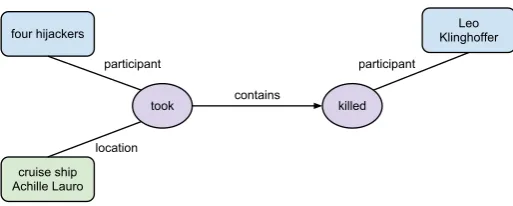
In October of 1985, four hijackers under his command [took] over the Italian cruise ship Achille Lauro and [killed] a wheelchair-bound American tourist, Leo Klinghoffer.
Here, thetookevent is determined to exhibit a CONTAINSrelation with thekilledevent, astook’s spatial bounds are determined to be the entire cruise ship, while the spatial bounds ofkilledare the immediate vicinity of the victim.
In addition to annotating spatial events and spatial relations between events, the corpus contains annotated participants and locations of the events. In this way we can graphically represent the spatial relationships between various entities in the text, such as in Figure 1. This graph allows us to make the inference thatLeo Klinghofferwas located on the Achille Laurowhen he was killed. Without such a relation, we would have to make the (un-principled) assumption that the closest location (in this case a vehicle) is the location of thekilledevent.
4
Method
We utilize a mostly supervised, two-stage machine learning approach for detecting spatial event relations. A binary support vector machine (SVM) classifier is used for recognizing spatial relations and a multi-class SVM is used for determining the relation type. Previous SVM-based approaches to relation extraction have utilized advanced kernels (e.g., Nguyen et al. (2009)). In this work, however,
1
took killed
four hijackers KlinghofferLeo
cruise ship Achille Lauro
participant participant
location
contains
[image:4.595.170.427.116.219.2]In October of 1985, four hijackers under his command took over the Italian cruise ship Achille Lauro and killed a wheelchair-bound American tourist, Leo Klinghoffer.
Figure 1: Example spatial event relation from our corpus.
we focus on the utility of different feature types and perform our experiments with a linear kernel using LibLinear (Fan et al., 2008). We evaluate on 3-sentence and 1-sentence windows for potentially related events (annotators were limited to relations in a 3-sentence window). Since the vast majority of event mentions are not spatially related, we adjust the negative weight to 0.05 (leaving the positive weight at 1.0). For the multi-class relation type classifier, SAMEand CONTAINSmake up the vast majority of relations and therefore get a weight of 0.1. These weights were tuned using a different cross-validation split than that used on our experiments below. Below we detail the features used by the two classifiers. For both classifiers, a large number of partially overlapping features were developed, most of which are described below. We utilize a greedy forward/backward technique known as floating forward feature selection (Pudil et al., 1994) to optimize the best sub-set of features.
4.1
Explicit Relation Features
These features are designed to recognize explicit statements of spatial relatedness based on the con-text of the relation. Sometimes explicit relations are expressed with spatial prepositions such asin, on, orat. In general, however, we consider explicit relations to be those in which the local context indicates a spatial relation is highly likely. For instance:
After today’s air [strikes], 13 Iraqi soldiers [abandoned] their posts and [surrendered] to Kurdish fighters.
Here,abandoned andsurrenderedshare the same subject and are syntactically connected through the conjunctionand. When an actor performs two actions at connected or overlapping time intervals, the actions are necessarily spatially related. While ananddependency doesn’t necessarily guarantee temporal connectivity, it is highly suggestive and therefore acts as a good indicator.
We utilize the following classes of features:
• Words between arguments, which includes features that are ignored entirely when the argu-ments are separated by a certain number of tokens or sentences. These bag-of-word features provide useful lexical context that is not always available from a dependency parse (such as modifiers).
• Token-level and sentence-level distance. Event mentions that are lexically closer are more likely to be spatially related, and mentions in different sentences are much less likely to be spatially related.
• Dependency paths. We use the Stanford Dependency Parser (de Marneffe et al., 2006) with the collapsed representation so that preposition nodes (prep) become edges (e.g., prep at). This also results in more semantic conjunction edges (conj andinstead of simplyconj).
• TimeML relations from TARSQI (Verhagen et al., 2005), including TLinks, SLinks, and ALinks. TLinks are typical temporal links, such as one event occurring before or after another event. SLinks are a subordinate links, such as in “John [promised] to [buy] wine for Mary”. ALinks are aspectual links, such as “John [stopped] [talking]”.
Top 5 Events via TLink PMI
bomb PMI pass PMI drive PMI
strafe 0.298 touchdown 0.288 intoxicate 0.276 nuke 0.281 defense 0.277 floorboarding 0.271
landmark 0.273 exam 0.268 park 0.239
shell 0.242 interception 0.249 impair 0.231 machine-gun 0.242 amendment 0.233 bike 0.208
Top 5 Events via Gigaword Sentence PMI
bomb PMI pass PMI drive PMI
[image:5.595.143.453.71.248.2]strafe 0.295 touchdown 0.354 homer 0.289 plot 0.292 veto 0.237 intoxicate 0.260 nuke 0.291 vote 0.230 floorboarding 0.257 landmark 0.255 squash 0.212 reformat 0.256 scan 0.249 test 0.209 touchdown 0.234
Table 1: Highly associated events for
bomb
,
pass
, and
drive
, as acquired from unlabeled data.
4.2
Implicit Relation Features
These features are designed to recognize spatial relatedness between events based entirely on their semantic properties (i.e., without regard to context). Many times our intuitive understanding of event structures enables the omission of linguistic context clues of spatial relations. For instance:
During a live broadcast, Geraldo [drew] a map in the sand [showing] the location of the unit in relation to Baghdad.
Here, we understand the purpose ofdrewis manifested inshowing, and further that in such a rela-tionship the two events are connected by a common object (in general a drawing, but specifically amapin this example) that forms an integral part of their spatial bounds. This kind of information requires a source of external knowledge, potentially from (i) a manually constructed knowledge base, (ii) knowledge built from training data, or (iii) knowledge built from unlabeled data. While manual knowledge sources such as ConceptNet (Liu and Singh, 2004) or FreeBase (Bollacker et al., 2008) could be utilized, they are quite sparse on event information (rather focusing on entity information). Instead, we focus on learning which individual events are likely to participate in a spatial relation (using the training data), which pairs of events are likely to participate in a spatial relation (also from the training data), and which pairs of events are likely to be related (from unlabeled data).
We utilize the following classes of features:
• Individual arguments (separate features for first and second arguments). Includes features based on event mention’s surface form, caseless form, lemmatized form, part-of-speech from the Stanford Parser (Klein and Manning, 2003), General Inquirer categories (Stone et al., 1966), TimeML event classes from TARSQI (Verhagen et al., 2005), WordNet (Fellbaum, 1998) synsets and hypernyms, and VerbNet (Kipper et al., 1998) classes.
• Concatenation of the above individual argument features for both arguments (e.g., “draw::show” for lemmatized form, “25.2::29.5-2” for VerbNet classes).
• Intersection of feature values for individual argument features. • Statistical association of events based on various resources:
– Gigaword (Parker et al., 2009) sentence co-occurrence
– TimeML relations on Gigaword
– Wikipedia co-occurrence
the narrative in a temporal structure. These relations have the advantage of including related cross-sentence events while excluding un-related within-cross-sentence events. While this is more principled, TimeML is a difficult task, and any automatic technique would contain both noise and bias. Third, Wikipedia’s article structure is more inclined to articles whose events take place in a single location. Thus, we can relax our local constraint to allow for document-wide context. This not only reduces sparsity, but is more likely to capture transitive spatial relations.
While all of these resources should be capable of providing related events, we require a method to increase the likelihood of the event associations being spatial. For this purpose, we use the statistical association metric known as pointwise mutual information (PMI):
P M I(x, y) =logp(x|y) p(y)
Where co-occurrences with less than 10 instances are discarded. PMI is a simple technique that has been shown to be effective at natural language tasks, most appropriately narrative chain construction (Chambers and Jurafsky, 2008). Due to the large amount of data, we require a highly efficient technique, such as PMI, that only requires a limited view of the data.2
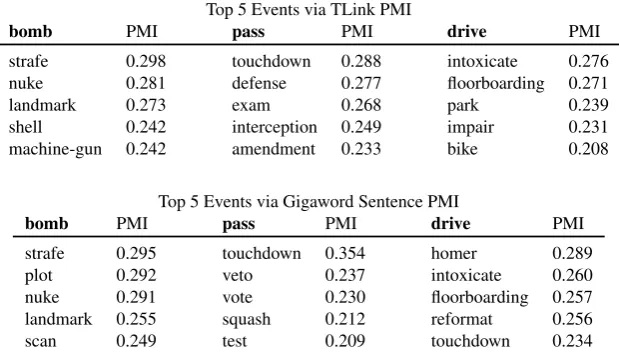
The result of these PMI calculations for three events (bomb,pass, anddrive) are shown in Table 1. As can be seen, PMI across this data is able to capture spatially related events: bombis spatially related to sub-types of bombing events suchnukeandshelland other war activities such asstrafe andmachine-gun. PMI captures spatially related events for multiple senses ofpassanddrive. For instance,touchdown,defense, andinterceptionare spatially related events to the sporting sense of pass, whilevote,vetoandamendmentare spatially related events to the political sense ofpass(as in, “pass a bill into law”). Further, as can be seen in Table 1, while the different data sources assign different weights, there is some degree of overlap between them.
Given the different data sources, and the myriad of potential features that could be written to rep-resent this data (in addition to all the other feature types), we utilize the automated feature selection technique discussed above. This enables us to optimize how we present these partially overlapping features to the classifier, ultimately resulting in increased performance. We next discuss the actual features chosen by this technique.
4.3
Selected Features
The features chosen by the feature selector for relation detection are shown in Table 2. The feature selector chose four explicit relation features and eight implicit relation features. The chosen implicit relation features include the first feature chosen and five of the first six features. The features chosen by the feature selector for relation type classification are shown in Table 3. Here, the feature selec-tor chose only two features, both of which are implicit features, suggesting the context is of little significance for determining specifically how two event mentions may be related. The next section evaluates these two classifiers on held-out data.
5
Experiments
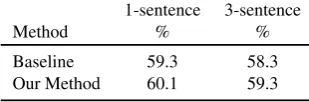
We experiment under two different settings: (1) intra-sentence relations only, and (2) intra-sentence relations up to a 3-sentence window, the maximum relation length for the data. We evaluate both relation recognition (whether two event mentions have a spatial relation between them) and relation type classification (given a related pair of mentions, which is the proper relation type). These are both evaluated on the data described in Section 3. In Roberts et al. (2012), we present a baseline method for both spatial relation recognition and spatial relation type classification based on the event mention words, the words between the mentions, and the mention hypernyms. We consider this our baseline for the task. The results for spatial relation recognition are shown in Table 4, and the results for spatial relation classification are shown in Table 5.
Our method easily outperforms the baseline for spatial relation recognition with a 30% increase in F1-measure. The overall score is still quite low, however, owing to the difficulty of the task. This
is discussed more in the next section. Spatial relation type classification outperforms the baseline,
2
#
Type
Feature Description
1
a
I
Concatenated event mention lemmas. Argument order is ignored by
representing lemmas in orthographic order. E.g.,
kill::take
2
E
Dependency path between the event mentions. E.g.,
↓
conj and
3
I
TLink co-occurrence from Gigaword, adjusted by point-wise mutual
information (PMI). Specifically, we use a symmetric PMI so the feature is
mention-order independent. This is done by taking the minimum of
PMI(
E1,
E2) and PMI(
E2,
E1). (real-valued)
4
I
Concatenated event mentions in their caseless form. Argument order is
preserved. E.g.,
took::killed
5
I
Co-occurrence from Wikipedia, adjusted using PMI. (real-valued)
6
I
Concatenated event mention lemmas. Argument order is preserved unlike
Feature 1. E.g.,
take::kill
7
E
Whether the two event mentions have the same location. This feature uses
the Stanford co-reference resolution system (Raghunathan et al., 2010) to
expand locations so that two events have the same location if their respective
locations belong to the same co-reference chain. (boolean-valued)
8
E
Whether the two event mentions have the same participant. (boolean-valued)
9
E
Token distance between the event mentions. Reduced to scalar between
0 and 1 by computing
1
−
(
|
t
1−
t
2|
+ 1)
−1. (real-valued)
10
I
Intersection of event mention categories from the General Inquirer. E.g.,
kill
’s categories are: A
CTIVE, DAV, H4L
VD, H
OSTILE, N
EGATIV, N
GTV,
N
OUN, PFREQ, S
OCR
EL, S
TRONG, SUPV, and T
RNL
OSS.
take
’s
categories are: A
CTIVE, A
FFIL, B
EGIN, DAV, F
ETCH, H4, H
ANDELS,
IAV, M
ODIF, N
EED, P
OWER, S
OCR
EL, S
TRONG, SUPV, T
RY, V
ARY, and
V
IRTUE. The intersection is thus A
CTIVE(i.e., active orientation), DAV
(descriptive action verb), S
OCR
EL(socially defined inter-personal process),
S
TRONG(strength), and SUPV (support verb).
11
I
Intersection of event mention VerbNet classes. E.g.,
∅
12
I
Concatenated event mention surface form. Argument order is ignored.
E.g.,
killed::took
Table 2: Spatial event relation recognition features, shown in the order chosen by the feature
selector. Type ‘E’ refers to the explicit features (Section 4.1), Type ‘I’ refers to the implicit
features (Section 4.2). Feature values taken from example in Figure 1.
#
Type
Feature Description
1
I
Whether the ALink co-occurrence PMI (from Gigaword) is greater than 0
(i.e., is the aspectual link positively correlated?). This does not use a
symmetric PMI because the relation type order matters. (boolean-valued)
2
I
Co-occurrence from Gigaword sentences, adjusted using PMI. (real-valued)
Table 3: Spatial event relation type features.
a
1-sentence 3-sentence
Method P R F1 P R F1
[image:8.595.176.423.71.121.2]Baseline 35.1 41.3 37.9 29.1 35.5 32.0 Our Method 44.7 69.2 54.3 37.2 60.4 46.0
Table 4: Spatial event relation recognition experiments on our corpus.
1-sentence 3-sentence
Method % %
Baseline 59.3 58.3 Our Method 60.1 59.3
Table 5: Spatial event relation type classification experiments on our corpus.
but only slightly. Here, the issue is largely a matter of data imbalance: the SAMErelation is favored by the classifier in almost all cases.
Reducing the context to a single-sentence window improves the relation recognition score by a further 8.3 points. While this would limit the reasoning power of any downstream system, it is useful to know that performance gains are possible by focusing on an easier sub-set of the data. This improvement in relation recognition does not apply to relation type classification, however. In the next section we place our results in greater context and analyze some typical errors.
6
Discussion
The performance gains seen in the previous section are encouraging: they validate our assumption that spatial information can be obtained from large amounts of unlabeled data in an efficient manner. The overall F1-measure, though, still seems quite low compared to other natural language tasks such
as named entity recognition (NER) and semantic role labeling (SRL). However, those tasks are lim-ited to explicit context, such as contiguous tokens for NER and parse nodes within the syntactic scope for SRL. These tasks also utilize more predictable features, such as surface-level casing features for NER and predictable argument structures for SRL (e.g., the syntactic subject for an active verb is usually the ARG0). Proper comparison requires evaluating our results alongside other implicit tasks. One such work involves implicit SRL. Gerber and Chai (2010) perform nominal SRL and achieve an overall F1-measure of 42.3. While the tasks are not directly comparable in terms of difficulty, this
does suggest that implicit tasks require far more advanced methods to achieve superior performance and that downstream systems will likely need to be highly tolerant to noise. To address this, we dis-cuss future work below, analyzing the types of errors that our system makes to give context to these ideas.
As might be guessed, rare event mentions with long dependency paths are highly likely to result in false negatives, such as the relation betweenelectedanddisillusionmenthere:
Tehran had been governed by reformists since 1989, but a conservative city council was [elected] in the February 28 municipal polls in a result attributed to a meager turnout amid growing public [disillusionment] with electoral politics.
Here the elected anddisillusionment events are judged to cover all of Tehran. The dependency path for this relation has five edges, including the rare dependency relationprep amid. Further, the disillusionmentevent is fairly rare. Such long dependency relations with rare arguments is unlikely to be recognized by a simple machine learning classifier. Instead, this suggests an approach where either intermediate events are able to transitively suggest spatial relations, or the dependency parse is relaxed in certain cases to allow for longer-range relations.
As is common in semantic tasks, word sense presents an issue, resulting in a false negative: It was believed Naotia was a [practicing] sorcerer and through his black magic he had [cast] evil spells on villagers, prompting a group within the village to eliminate them.
[image:8.595.219.374.154.205.2]In terms of false positives, our implicit features can result in errors when very similar events are clearly different based on their context:
The British leader [travelled] to the United States before also [visiting] Japan, South Korea, China on a whistle-stop tour.
Here, the spatial bounds of travelledis interpreted as being the United States and the flight from Britain, while thevisitingevent is interpreted as being several Asian countries. While one might argue these two trips are spatially related since one is a continuation of the other, the annotator in this case chose to use neither the NEARor OVERLAPSrelations. This highlights another issue with such implicit tasks: the annotations rely heavily on the annotator’s intuition. Not unexpectedly, the corpus has fairly low inter-annotator agreement (Roberts et al., 2012).
One final error highlights the difference between events that are related by a narrative, and events that are spatially related:
Police have [arrested] four people in connection with the [killings].
This false positive resulted from the high degree of association betweenarrestedandkillings, but arrests are rarely made at the scene of the crime. One potential solution to this is to automatically ex-tract event narrative structures, then check the locations of the events on that structure for unexpected location changes. This would be quite challenging: automatic narrative structures proposed thus far are quite simplistic, and most events within a narrative structure will not have an explicit location, so a very robust model of structure would be required.
Finally, despite the accuracy score being higher than the F1-measure for relation recognition,
spatial relation type classification may be the more difficult task. Almost all errors were the result of misclassifying a relation as SAMEdue to the class imbalance. While the classifier weights may be tuned to improve F1-measure for recognition, this rarely improves a multi-class task significantly.
Our main direction for future work is to actually classify thesizeof events. For example, we would like to recognize that anelectionhas larger bounds than aprotest. This would allow our classifier to recognize when two events are very different in size, and if so which is larger. Ideally, by constricting the set of classes for a containment relation using the sizes of the arguments, this would allow other semantic features to contribute to relation type classification.
7
Conclusion
We have presented an approach for recognizing spatial containment relations between event men-tions. Using a corpus of event mentions from newswire texts, we have developed a supervised clas-sifiers for (1) recognizing the presense of a spatial relation between two event mentions, and (2) classifying spatially related event pairs into one of five spatial containment relations. Our method combines features that are designed to extract explicit information from the relation context, as well as implicit information about the likelihood of two events being spatially related. We have evaluated our method and shown substantial improvements over the pre-existing baseline, achieving an F1of
46.0 on relation recognition and an accuracy of 59.3% on relation type classification. These gains, though, are largely limited to the task of recognizing whether a spatial relation exists. Finally, we have performed an error analysis to determine paths of future work on this challenging task.
References
Beamer, B. and R. Girju (2009). Using a Bigram Event Model to Predict Causal Potential. In Proceedings of Computational Linguistics and Intelligent Text Processing, pp. 430–441.
Bejan, C. A. (2008). Unsupervised Discovery of Event Scenarios from Texts. InProceedings of the 21st Florida Artificial Intelligence Research Society International Conference (FLAIRS).
Bejan, C. A. and S. Harabagiu (2010). Unsupervised Event Coreference Resolution with Rich Lin-guistic Features. InProceedings of the Association for Computational Linguistics.
Bollacker, K., C. Evans, P. Paritosh, T. Sturge, and J. Taylor (2008). Freebase: A Collaboratively Created Graph Database for Structuring Human Knowledge. InProceedings of ACM SIGMOD International Conference on Management of Data, pp. 1247–1250.
Chambers, N. and D. Jurafsky (2008). Unsupervised Learning of Narrative Schemas and their Par-ticipants. InProceedings of the 46th Annual Meeting of the Association for Computational Lin-guistics: Human Language Technologies.
Chambers, N. and D. Jurafsky (2009). Unsupervised Learning of Narrative Schemas and their Par-ticipants. InProceedings of the Joint Conference of the 47th Annual Meeting of the ACL and the 4th International Joint Conference on Natural Language Processing of the AFNLP.
Chen, Z., H. Ji, and R. Haralick (2009). A pairwise event coreference model, feature impact and evaluation for event coreference resolution. InProceedings of the RANLP Workshop on Events in Emerging Text Types, pp. 17–22.
de Marneffe, M.-C., B. MacCartney, and C. Manning (2006). Generating Typed Dependency Parses from Phrase Structure Parses. InProceedings of the Fifth International Conference on Language Resources and Evaluation.
Do, Q. X., Y. S. Chan, and D. Roth (2011). Minimally Supervised Event Causality Identification. In Proceedings of the 2011 Conference on Empirical Methods in Natural Language Processing, pp. 294–303.
Fan, R.-E., K.-W. Chang, C.-J. Hsieh, X.-R. Wang, and C.-J. Lin (2008). LIBLINEAR: A Library for Large Linear Classification.Journal of Machine Learning Research 9, 1871–1874.
Fellbaum, C. (Ed.) (1998). WordNet: An Electronic Lexical Database. MIT Press.
Gaizauskas, R., E. Barker, C.-L. Chang, L. Derczynski, M. Phiri, and C. Peng (2012). Applying ISO-Space to Healthcare Facility Design Evaluation Reports. InSeventh Workshop on Interop-erable Semantic Annotation (ISA), Eighth International Conference on Language Resources and Evaluation, pp. 13–20.
Gerber, M. and J. Y. Chai (2010). Beyond NomBank: A Study of Implicit Arguments for Nominal Predicates. InProceedings of the Association for Computational Linguistics, pp. 1583–1592. Kipper, K., H. T. Dang, and M. Palmer (1998). Class-based construction of a verb lexicon. In
Proceedings of AAAI/IAAI.
Klein, D. and C. D. Manning (2003). Accurate Unlexicalized Parsing. InProceedings of the 41st Annual Meeting of the Association for Computational Linguistics, pp. 423–430.
Kordjamshidi, P., S. Bethard, and M.-F. Moens (2012). SemEval-2012 Task 3: Spatial Role Labeling. InProceedings of the 6th International Workshop on Semantic Evaluation (SemEval).
Kordjamshidi, P., M. V. Otterlo, and M.-F. Moens (2011). Spatial Role Labeling: Towards Extrac-tion of Spatial RelaExtrac-tions from Natural Language. ACM Transactions on Speech and Language Processing 8(3).
Kordjamshidi, P., M. van Otterlo, and M.-F. Moens (2010). Spatial role labeling: Task definition and annotation scheme. InProceedings of the Seventh International Conference on Language Resources and Evaluation, pp. 413–420.
Lee, K., A. C. Fang, and J. Pustejovsky (2011). Multilingual Verification of the Annotation Scheme ISO-Space. InInternational Conference on Semantic Computing (ICSC), pp. 449–458.
Liu, H. and P. Singh (2004). ConceptNet – a practical commonsense reasoning tool-kit.BT Technol-ogy Journal 22(4), 211–226.
Nguyen, T.-V. T., A. Moschitti, and G. Riccardi (2009). Convolution kernels on constituent, depen-dency and sequential structures for relation extraction. InProceedings of the 2009 Conference on Empirical Methods in Natural Language Processing, pp. 1378–1387.
Parker, R., D. Graff, J. Kong, K. Chen, and K. Maeda (2009). English Gigaword Fourth Edition.The LDC Corpus Catalog. LDC2009T13.
Pudil, P., J. Novoviˇcov´a, and J. Kittler (1994). Floating search methods in feature selection. Pattern Recognition Letters 15, 1119–1125.
Pustejovsky, J., J. Castano, R. Ingria, R. Saur´ı, R. Gaizauskas, A. Setzer, G. Katz, and D. Radev (2003). TimeML: Robust Specification of Event and Temporal Expressions in Text. InIWCS-5 Fifth International Workshop on Computational Semantics.
Pustejovsky, J., P. Hanks, R. Saur´ı, A. See, R. Gaizauskas, A. Setzer, D. Radev, B. Sundheim, D. Day, L. Ferro, and M. Lazo (2003). The TIMEBANK Corpus. InProceedings of Corpus Linguistics. Pustejovsky, J. and J. L. Moszkowicz (2008). Integrating Motion Predicate Classes with Spatial and
Temporal Annotations. InProceedings of COLING 2008, pp. 95–98.
Pustejovsky, J., J. L. Moszkowicz, and M. Verhagen (2011a). Iso-space: The annotation of spa-tial information in language. InProceedings of the Sixth Joint ISO-ACL SIGSEM Workshop on Interoperable Semantic Annotation, pp. 1–9.
Pustejovsky, J., J. L. Moszkowicz, and M. Verhagen (2011b). Using ISO-Space for Annotating Spa-tial Information. InProceedings of the International Conference on Spatial Information Theory. Raghunathan, K., H. Lee, S. Rangarajan, N. Chambers, M. Surdeanu, D. Jurafsky, and C. Manning
(2010). A Multi-Pass Sieve for Coreference Resolution. InProceedings of the 2010 Conference on Empirical Methods in Natural Language Processing.
Randell, D. A., Z. Cui, and A. G. Cohn (1992). A Spatial Logic based on Regions and Connection. InProceedings of the 3rd International Conference on Knowledge Representation and Reasoning, Volume 117.
Rink, B., C. A. Bejan, and S. Harabagiu (2010). Learning Textual Graph Patterns to Detect Causal Event Relations. InProceedings of the 23rd Florida Artificial Intelligence Research Society Inter-national Conference (FLAIRS’10), Applied Natural Language Processing Track, pp. 265–270. Roberts, K., T. Goodwin, and S. M. Harabagiu (2012). Annotating Spatial Containment Relations
Between Events. InProceedings of the Eighth International Conference on Language Resources and Evaluation, pp. 3052–3059.
Roberts, K. and S. M. Harabagiu (2012). UTD-SpRL: A Joint Approach to Spatial Role Labeling. InProceedings of the 6th International Workshop on Semantic Evaluation (SemEval).
Stone, P. J., D. C. Dunphy, and M. S. Smith (1966).The General Inquirer: A Computer Approach to Content Analysis. MIT Press.
Sun, W., A. Rumshisky, and O. Uzuner (2013). Evaluating Temporal Relations in Clinical Text: 2012 i2b2 Challenge Overview.Journal of the American Medical Informatics Association Submitted. UzZaman, N., H. Llorens, J. F. Allen, L. Derczynski, M. Verhagen, and J. Pustejovsky (2012).
TempEval-3: Evaluating Events, Time Expressions, and Temporal Relations.arXiv.1206.5333v1. Verhagen, M., R. Gaizauskas, F. Schilder, M. Hepple, J. Moszkowicz, and J. Pustejovsky (2009). The TempEval challenge: identifying temporal relations in text.Language Resources and Evalu-ation 43, 161–179.
Verhagen, M., I. Mani, R. Saur´ı, R. Knippen, J. Littman, and J. Pustejovsky (2005). Automating Temporal Annotation with TARSQI. InProceedings of the 43rd Annual Meeting of the Association for Computational Linguistics, Demo Session.