USZEGED: Correction Type-sensitive Normalization of English Tweets
Using Efficiently Indexed n-gram Statistics
G´abor Berend University of Szeged Department of Informatics ´Arp´ad t´er 2., 6720 Szeged, Hungary
Ervin Tasn´adi University of Szeged Department of Informatics ´Arp´ad t´er 2., 6720 Szeged, Hungary [email protected]
Abstract
This paper describes the framework ap-plied by team USZEGED at the “Lexical Normalisation for English Tweets” shared task. Our approach first employs a CRF-based sequence labeling framework to de-cide the kind of corrections the individ-ual tokens require, then performs the nec-essary modifications relying on external lexicons and a massive collection of effi-ciently indexed n-gram statistics from En-glish tweets. Our solution is based on the assumption that from the context of the OOV words, it is possible to recon-struct its IV equivalent, as there are users who use the standard English form of the OOV word within the same context. Our approach achieved an F-score of 0.8052, being the second best one among the un-constrained submissions, the category our submission also belongs to.
1 Introduction
Social media is a rich source of information which has been proven to be useful to a variety of ap-plications, such as event extraction (Sakaki et al., 2010; Ritter et al., 2012; Ritter et al., 2015) or trend detection, including the tracking of epi-demics (Lamb et al., 2013). Analyzing tweets in general, however, can pose several difficulties. From an engineering point of view, the streaming nature of tweets requires that special attention is paid to the scalability of the algorithms applied and from an NLP point of view, the often sub-standard characteristics of social media utterances has to be addressed. The fact that tweets are often written on mobile devices and are informal makes the misspelling and abbreviations of words and ex-pressions, as well as the use of creative informal language prevalent, giving rise to a higher number
of out-of-vocabulary (OOV) words than in other genres.
2 Related Work
The informal language of social media, includ-ing Twitter, is extremely heterogeneous, makinclud-ing its grammatical analysis more difficult compared to standard genres such as newswire. It has been shown previously, that the performance of linguis-tic analyzers trained on standard text types de-grade severely once they are applied to texts found in social media, especially tweets (Ritter et al., 2011; Derczynski et al., 2013).
In order to build taggers that perform more re-liable on social media texts, one possible way is to augment the training data by including texts originating from social media (Derczynski et al., 2013). Such approaches, however, require con-siderable human effort, so one possible alternative can be to normalize the social media texts first, then apply standard analyzers on these normalized texts. Recently, a number of approaches have been proposed for the lexical normalization of informal (mostly social media and SMS) texts (Liu et al., 2011; Liu et al., 2012; Han et al., 2013; Yang and Eisenstein, 2013).
Han and Baldwin (2011) rely on the identifica-tion of the words that require correcidentifica-tion, then de-fine a confusion set containing the candidate IV correction forms for such words. Finally, a rank-ing scheme, takrank-ing multiple factors into consid-eration, is applied which selects the most likely correction for an OOV word. In their subsequent work, Han et al. (2012) propose an automated method to construct accurate normalization dictio-naries.
Liu et al. (2011; 2012) propose a character-level sequence model to predict insertions, deletions and substitutions. They first collect a large set of noisy (OOV, IV) training pairs from the Web. These pairs are then aligned at the character level
and provided as training data for a CRF classifier. The authors also released their 3,802-element nor-malization dictionary that our work also relies at.
Yang and Eisenstein (2013) introduce an unsu-pervised log-linear model for the task of text nor-malization. Besides the features that can be de-rived from pairs of words (e.g. edit distance), fea-tures considering the context are also employed in their model. As the number of class labels in that model is equal to the size of the IV words an OOV word could possibly be corrected to (typically on the order of 104-105, which is far beyond the
typ-ical label size of classification tasks), the authors propose the use of Sequential Monte Carlo train-ing approach for learntrain-ing the appropriate feature weights.
3 The Task of Lexical Normalization Formally, given an m-long sequence of words in the ith tweet, Ti = [ti,1, ti,2, . . . , ti,m],
partici-pants of the shared task had to return a sequence of normalized in-vocabulary (IV) words, i.e.Si =
[si,1, si,2, . . . , si,m]. The training set of the shared
task consisted of 2,950 tweets comprising 44,385 tokens, while the test set had 1,967 tweets which included a total of 29,421 tokens. According to the dataset, most of the words did not require any kind of corrections, i.e. the proportion of unmodi-fied words was 91.12% and 90.57% for the train-ing and test set, respectively. Further details with respect the shared task can be found in the paper (Baldwin et al., 2015).
As a consequence, we first built a sequence model to decidewhichtokens need to be corrected andin what way. A typical distinction of the cor-rection types would be based on the number of tokens a noisy token and its corrected form com-prises of. According to this approach, one could distinguish between one-to-one, one-to-many and many-to-one corrections on the per token basis. However, instead of applying the above types of corrections, we identified a more detailed catego-rization of the correction types and trained a linear chain CRF utilizing CRFsuite (Okazaki, 2007). The correction types a token could be classified as were the following:
• MissingApos, standing for tokens that only differ from their corrected version in the ab-sence of an apostrophe (e.g.youll→you’ll),
• MissingW S, standing for tokens that only
Training Test
MissingApos 507 369
MissingW S 126 76
1to1ED≤2 1,979 1,405 1to1ED≥3 413 292
1toMABB 917 634
Subtotal 3,942 2,776
O 40,443 26,645
[image:2.595.332.502.62.188.2]T otal 44,385 29,421
Table 1: Distribution of the correction types in the training and test sets
differ from their corrected version in the ab-sence of one or more whitespace characters (e.g.whataburger→what a burger),
• 1to1ED≤2, standing for corrections where no whitespace characters had to be inserted and the augmented edit distance (introduced in Section 4.2) between the noisy token and its normalized form was at most 2 (e.g.tmrw→tomorrow),
• 1to1ED≥3, standing for corrections where no whitespace characters had to be inserted and the augmented edit distance was at least 3 (e.g.plz→please),
• 1toMABB, standing for corrections where
both whitespace and alphanumeric characters had to be inserted to obtain a tokens corrected variant (e.g.lol→laugh out loud).
For the sake of completeness, we should add that a further class label (O) was employed. This, how-ever, corresponded to the case when there was no correction required to be performed for a token. As mentioned above, more than 90% of the words in both the training and test sets belonged to this category. Table 1 shows the distribution of the cor-rection types on both the training and test sets. 4 Proposed Approach
Our approach consists of a sequence labeling mod-ule and relies on lookups from an efficiently in-dexed n-gram corpus of English tweets. Subse-quently, we describe the details of these modules.
4.1 Sequence Labeling for Determining Correction Types
(Lafferty et al., 2001). Besides the common word surface forms, such as the capitalization pattern, the first letter or character suffixes, we relied on the following dictionary resources upon determin-ing the features for the individual words:
• the SCOWL dictionary being part of the
aspell spell checker project containing canonical English dictionary entries,
• the normalization dictionaries of Han et al. (2012) and Liu et al. (2012),
• the 5,307-element normalization dictionary derived from the portal noslang.com, which map common social media abbrevia-tions to their complete forms.
For each token, word type features were gener-ated along with the word types of its neighboring tokens. The POS tags assigned to each token and its neighboring tokens by the Twitter POS tagger (Gimpel et al., 2011) were also utilized as features in the CRF model. The Twitter POS tag set was useful to us, as it contains a separate tag (G) for multi-word abbreviations (e.g.ilyforI love you), which was expected to be highly indicative for the correction type1toMABB.
In order to be able to discriminate the
MissingW S class, we introduced a feature which indicates for a token t originating from a tweet whether the relation
max
s∈split(t)freq1T(s)≥τ
holds, where τ is a threshold calibrated to 106 based on the training set,freq1T(s)is a function
which returns the frequency value associated with a stringsaccording to the Google 1T 5-gram cor-pus and the functionsplit(t)returns the set of all the possible splits of token t such that its com-ponents are all contained in the SCOWL dictio-nary. For instancesplit(“whataburger00)returns a set of splits including “what a burger”, “what a burg er” and “what ab urger”. As there is a split (i.e. “what a burger”) that is sufficiently fre-quent according to the n-gram corpus, we take it as an indication that the original token omitted some whitespace characters that we need to inserted.
A CRF model with the above feature set was trained using L-BFGS training method and L1 reg-ularization using CRFsuite (Okazaki, 2007). The overall token accuracy this model achieved was
Precision Recall F-score
MissingApos 0.9686 0.9744 0.9715
MissingW S 0.8795 0.5794 0.6986 1to1ED≤2 0.9078 0.8504 0.8782 1to1ED≥3 0.9593 0.6852 0.7994 1toMABB 0.9624 0.8942 0.9271
O 0.9874 0.9959 0.9916
[image:3.595.308.526.63.172.2]macro average 0.9442 0.8299 0.8777 Table 2: Results of predicting the correction types for tokens on the training set
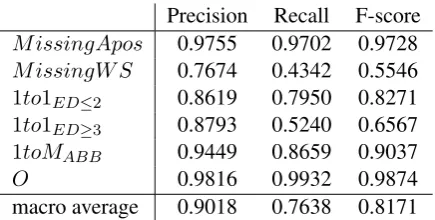
Precision Recall F-score
MissingApos 0.9755 0.9702 0.9728
MissingW S 0.7674 0.4342 0.5546 1to1ED≤2 0.8619 0.7950 0.8271 1to1ED≥3 0.8793 0.5240 0.6567 1toMABB 0.9449 0.8659 0.9037
O 0.9816 0.9932 0.9874
macro average 0.9018 0.7638 0.8171 Table 3: Results of predicting the correction types for tokens on the test set
0.9830 and 0.9746 and the proportion of tweets for which all the tokens were tagged properly was 0.7902 and 0.7143 for the training and test sets, respectively. A more detailed breakdown of the classification performances of the sequence model on the training and test sets are included in Ta-ble 2 and TaTa-ble 3. These taTa-bles reveal that the most difficult error type to identify was the one where a word missed some whitespace characters (rowMissingW S). This class happens to be the least frequent and one of the most heterogeneous class as well, which might be an explanation for the lower results on that class.
4.2 Augmented Edit Distance
When determining a set of candidate IV words that an OOV might be rewritten for, it is a com-mon practice to place an upper bound on the edit distance between the IV candidates and the OOV word. In order to measure edit distance between tokens originating from tweets and their corrected forms, we implemented a modification of the stan-dard edit distance algorithm that is especially tai-lored to measuring the difference of OOV tokens originating from social media to IV ones.
[image:3.595.308.526.218.328.2]to-morrow, the edit distance is regarded as 0 if the former is considered to be the substandard OOV token and the latter one as the standard IV one. Note, however, if the role of the two tokens was changed (i.e iftmrwwas treated as IV and tomor-rowas OOV), their edit distance would become 4. A further relaxation to the standard edit distance is that we assign 0 cost to the following kinds of phonetically motivated transcriptions:
• z → slocated at the end of words (e.g. in
catz→cats),
• a → er located at the end of words (e.g. in
bigga→bigger).
By making the above relaxations to the def-inition of the standard edit distance, we could obtain larger candidate sets for a given edit dis-tance threshold for tokens with higher recall, as we could reduce the edit distance between the OOV words and their appropriate IV equivalent in many cases. Obviously, as the candidate set grows, it might get increasingly difficult to choose the cor-rect normalization from it. However, at this stage of our pipeline, we were more interested in having the correct IV word in the set of candidate normal-ization, rather than reducing its size.
4.3 Making Use of Twitter n-gram Statistics
Our basic assumption was that from the context of an OOV word, it is possible to reconstruct its IV equivalent, as there are users who use the cor-rect IV English form of the OOV word within the same context, e.g. see you tomorrow instead of see u tmrw. The Twitter n-gram frequencies we made use of were the ones that we aggregated over the Twitter n-gram corpus augmented with demo-graphic metadata described in (Herdadelen, 2013). For a given tokentiat positioniin a tweet, we
chose the most probable corrected form according to the formula
arg max
t0∈C(ti,ct(ti))P(t
0|t
i−1)P(ti+1|t0), (1)
where the function C(ti, ct(ti)) returns a set of
IV candidates for the tokenti, according toct(ti),
which is the correction type determined for that token by the sequence model introduced in Sec-tion 4.1. We indexed the Twitter n-gram corpus with the highly effective LIT indexer (Ceylan and Mihalcea, 2011), which made fast queries of the formti−1∗ti+1 possible, the symbol* being a
Correction Precision Recall F-score
MissingApos 0.9972 0.9972 0.9972
[image:4.595.307.527.62.132.2]MissingW S 0.8684 0.4177 0.5641 1to1 0.9191 0.9219 0.9205 1toMABB 0.8861 0.9533 0.9185
Table 4: Detailed performance on the different correction types on the training dataset
Correction Precision Recall F-score
MissingApos 1.0000 0.9841 0.992
MissingW S 0.9737 0.4458 0.6116 1to1 0.9141 0.9127 0.9134 1toMABB 0.8523 0.9699 0.9073
Table 5: Detailed performance on the different correction types on the test dataset
placeholder for any token at the given position. The only case when we did not choose the normal-ization of an OOV word according to (1) was when there was a unique suggestion for an IV word in the normalization dictionaries we listed in Sec-tion 4.1.
The performance of the normalization on the training and test sets, according to the correction types we defined can be found in Table 4 and Ta-ble 5, respectively. From these taTa-bles, one can see that the worst results were obtained for the correc-tion type when spaces were required to be inserted to a OOV word.
This is in accordance with the fact that our se-quence model obtained the lowest scores exactly on this kind of corrections. However, due to the fact that this error category is the least frequent, the lower scores on that category does not harm that much our overall performance as can be seen in Table 6 for both the training and test corpora. The results shown in Table 6 also illustrate that our approach seems to generalize well, as there is a small gap between the performances observed on the training and test sets of the shared task.
Training Test precision 0.8703 0.8606 recall 0.7673 0.7564 F1 0.8156 0.8052
[image:4.595.346.489.673.728.2]5 Conclusion
In this paper, we introduced our approach to the lexical normalization of English tweets that ranked second at the shared task among the unconstrained submissions. Our framework first performs se-quence labeling over the tokens of a tweet to pre-dictwhichtokens need to be corrected and inwhat way. This step is followed by correction type-sensitive candidate set generation, from which set the most likely IV normalization of an OOV word is selected by querying an efficiently indexed large n-gram dataset of English tweets.
References
Timothy Baldwin, Marie Catherine de Marneffe, Bo Han, Young-Bum Kim, Alan Ritter, and Wei Xu. 2015. Shared tasks of the 2015 workshop on noisy user-generated text: Twitter lexical
normal-ization and named entity recognition. In
Proceed-ings of the Workshop on Noisy User-generated Text
(WNUT 2015), Beijing, China.
Hakan Ceylan and Rada Mihalcea. 2011. An efficient indexer for large n-gram corpora. InProceedings of the 49th Annual Meeting of the Association for Com-putational Linguistics: Human Language
Technolo-gies: Systems Demonstrations, HLT ’11, pages 103–
108, Stroudsburg, PA, USA. Association for Com-putational Linguistics.
Leon Derczynski, Alan Ritter, Sam Clark, and Kalina Bontcheva. 2013. Twitter part-of-speech tagging
for all: Overcoming sparse and noisy data. In
Pro-ceedings of the International Conference on Recent
Advances in Natural Language Processing.
Associ-ation for ComputAssoci-ational Linguistics.
Kevin Gimpel, Nathan Schneider, Brendan O’Connor, Dipanjan Das, Daniel Mills, Jacob Eisenstein, Michael Heilman, Dani Yogatama, Jeffrey Flanigan, and Noah A. Smith. 2011. Part-of-speech tagging for twitter: Annotation, features, and experiments.
In Proceedings of the 49th Annual Meeting of the
Association for Computational Linguistics: Human
Language Technologies: Short Papers - Volume 2,
HLT ’11, pages 42–47, Stroudsburg, PA, USA. As-sociation for Computational Linguistics.
Bo Han and Timothy Baldwin. 2011. Lexical normal-isation of short text messages: Makn sens a
#twit-ter. InProceedings of the 49th Annual Meeting of
the Association for Computational Linguistics:
Hu-man Language Technologies - Volume 1, HLT ’11,
pages 368–378, Stroudsburg, PA, USA. Association for Computational Linguistics.
Bo Han, Paul Cook, and Timothy Baldwin. 2012. Au-tomatically constructing a normalisation dictionary
for microblogs. In Proceedings of the 2012 Joint
Conference on Empirical Methods in Natural guage Processing and Computational Natural
Lan-guage Learning (EMNLP-CoNLL 2012), pages 421–
432, Jeju Island, Korea.
Bo Han, Paul Cook, and Timothy Baldwin. 2013. Lex-ical normalization for social media text. ACM Trans.
Intell. Syst. Technol., 4(1):5:1–5:27, February.
Ama Herdadelen. 2013. Twitter n-gram corpus with
demographic metadata. Language Resources and
Evaluation, 47(4):1127–1147.
John D. Lafferty, Andrew McCallum, and Fernando C. N. Pereira. 2001. Conditional random fields: Probabilistic models for segmenting and labeling se-quence data. InProceedings of the Eighteenth
Inter-national Conference on Machine Learning, ICML
’01, pages 282–289, San Francisco, CA, USA. Mor-gan Kaufmann Publishers Inc.
Alex Lamb, Michael J. Paul, and Mark Dredze. 2013. Separating fact from fear: Tracking flu infections on twitter. InIn NAACL.
Fei Liu, Fuliang Weng, Bingqing Wang, and Yang Liu. 2011. Insertion, Deletion, or Substitution? Nor-malizing Text Messages without Pre-categorization nor Supervision. InProceedings of the 49thAnnual
Meeting of the Association for Computational
Lin-guistics: Human Language Technologies, pages 71–
76, Stroudsburg, PA, USA. Association for Compu-tational Linguistics.
Fei Liu, Fuliang Weng, and Xiao Jiang. 2012. A Broad-Coverage Normalization System for Social
Media Language. Proceedings of the 50th Annual
Meeting of the Association for Computational
Lin-guistics: Long Papers-Volume 1, pages 1035–1044.
Naoaki Okazaki. 2007. Crfsuite: a fast implementa-tion of condiimplementa-tional random fields (crfs).
Alan Ritter, Sam Clark, Mausam, and Oren Etzioni. 2011. Named entity recognition in tweets: An
ex-perimental study. InProceedings of the Conference
on Empirical Methods in Natural Language
Pro-cessing, EMNLP ’11, pages 1524–1534,
Strouds-burg, PA, USA. Association for Computational Lin-guistics.
Alan Ritter, Mausam, Oren Etzioni, and Sam Clark. 2012. Open domain event extraction from twitter.
In Proceedings of the 18th ACM SIGKDD
Inter-national Conference on Knowledge Discovery and
Data Mining, KDD ’12, pages 1104–1112, New
York, NY, USA. ACM.
Alan Ritter, Evan Wright, William Casey, and Tom Mitchell. 2015. Weakly supervised extraction of
computer security events from twitter. In
Proceed-ings of the 24th International Conference on World
Wide Web, WWW ’15, pages 896–905, Republic and
Takeshi Sakaki, Makoto Okazaki, and Yutaka Matsuo. 2010. Earthquake shakes twitter users: Real-time
event detection by social sensors. In Proceedings
of the 19th International Conference on World Wide
Web, WWW ’10, pages 851–860, New York, NY,
USA. ACM.
Yi Yang and Jacob Eisenstein. 2013. A Log-Linear
Model for Unsupervised Text Normalization.
Pro-ceedings of the Empirical Methods on Natural