Comparative Analysis of Group Sequential Designs Tests
for Randomized Controlled Clinical Trials: A Model Study
on Two-Sided Tests for Comparing Two Treatments
Mehmet Ali Sungur, Emine Arzu Kanik
Department of Biostatistics and Medical Informatics, Medical Faculty, Mersin University, Mersin, Turkey Email: [email protected]
Received July 13,2011; revised August 18, 2011; accepted August 30, 2011
ABSTRACT
Clinical trials are usually long term studies and it seems impossible to reach all required subjects at the same time. Performing interim analyses and monitoring results may provide early termination of trial after obtaining significant results. The aim of this study is comparing group sequential tests in respect to advantage of sample size reduction and early termination. In this study, 4 test types used in group sequential designs were compared with fixed sample size design test and each other. Comparisons were done according to two-sided tests for comparing two treatments. In this sense, 1080 models were performed. In models, 2 different Type I errors, 2 different powers, 5 different analysis groups, 6 different effect sizes and 9 different variances selections were considered. All test types increased the maximum sample size in different manner, compared with fixed sample size design. Each test had different critical values to reject
H0 hypothesis, at the same type I error rate and number of analyses conditions. Selection of test type used in group
sequential designs depends on a few characteristics, as reducing sample size, early termination and detecting minimal effect size. Test performance is highly related with selected Type I error rate, power and number of analyses. In addition to these statistical characteristics, researchers should decide test type with respect to other trial conditions as the issue of trial, reaching subjects easy or not and importance of early termination.
Keywords: Group Sequential Designs; Group Sequential Test Types; Interim Analysis; Monitoring
1. Introduction
Clinical trials are designed to detect differences between treatments with a certain power and Type I error rate. Investigators should ensure to design clinical trials that contain adequate statistical power and sample size. It takes a long time to reach required subject number at the same time. Data are accumulated periodically course of the trial. Thus, it may take a few years to enroll enough subjects to meet determined sample size at the beginning of the trial. Particularly, in clinical trials which have death risk or any potential harm this may be more diffi- cult and reaching required sample size may cause more increasing of trial time. Therefore, it is an important in- terest of investigators substantially to analyze accumu- lated data in specific intervals and evaluate results. Per- forming interim analyses and monitoring results may provide early termination of trial after obtaining signifi- cant results corresponding superiority, inferiority or equi- valency of new treatment according to standard method.
Clinical trials can be classified in two groups in term of sample size, as fixed sample size designs and sequen- tial designs [1]. In fixed sample designs, sample size is
calculated at the beginning of the trial, and data are ana- lyzed once after all required subjects enrolled. In sequen- tial designs, sample size is calculated at the beginning of the trial similarly, but data are analyzed periodically by interim analyses as the trial going on and a final analysis is done at the finishing of the trial if required. Results of each interim analysis are evaluated to decide stopping or continuing the trial, and thereby the trial is monitoring [2-4].
Sequential designs were initially developed for econo- mical reasons. Early termination for a trial that have positive result means that a new product can be used soo- ner. If the trial have negative results, early termination ensures saving from sources. Sequential designs typically serve to savings in sample size, time and cost of the trial comparing with fixed sample size designs [5-7].
that test treatment is superior, inferior or equivalent to the standard treatment.
Sequential designs are categorized in three groups: fully sequential designs, group sequential designs and flexible sequential designs [1,5]. In group sequential de- signs, interim analyses are done periodically at certain times determined at the beginning of the trial. Group se- quential designs require determination of number and time of interim analyses at the beginning of the trial and remain constant. Interim analyses must be done by equal intervals [1].
Group sequential designs based on the evaluation of results obtained interim analysis of data collected from each patient group with predetermined sample size [1]. There are many statistical criteria that controlled Type I error rate during periodic analyses. At each interim ana- lysis test value calculated and compared with critical va- lue of test. These critical values vary according to num- ber of interim analyses and Type I error rate selected. Commonly used group sequential tests are suggested by Pocock and O’Brien & Fleming [6,7]. They have been improved for common test statistics used to compare means, medians, proportions or survival curves. Group sequential designs required determination of number and time of interim analyses at the beginning of the trial and remain constant. Interim analyses must be done in equal intervals [1].
The aim of this study is to evaluate four types (Pocock, O’Brien & Fleming, Wang & Tsiatis and Haybittle-Peto tests) of group sequential designs’ tests used to compare means of two treatments comparatively. The compari- sons were done in respect to advantage of sample size re- duction, potential of early termination and detecting mi- nimum differences between treatments at the same con- ditions.
2. Material and Methods
2.1. Two-Sided Tests for Comparing Two Treatments
In two sided hypothesis tests, the null hypothesis (H0)
referring “there is no statistically significant difference between two treatments” is controlled against the alter- native hypothesis (H1) referring “there is a statistically
significant difference between two treatments”.
When treatments’ means distributing normally with a known variance, the test statistic calculating is Z. In fixed sample size designs, when the value of Z statistic calcu- lated is equal to or larger than a c value named “critical value” the null hypothesis (H0) is rejected while it is ac-
cepted when the value of Z statistic is less. Determination of critical value based on the Type I error rate selected. Type I error is usually determined as 0.05 while 0.01 or 0.001 values are selected when the study has death risk,
irreversible harms or potential risks. The formula of Z
statistic to compare means of two treatments as A and B distributing normally with a known variance, and in- cluding n subjects is as follow [8,9]:
2 2
A B A B
A B A B X X Z n n (2.1.1)
Required sample size in each treatment group for com- paring two independent groups is calculated as following way [5,8-11]:
2 2 2 2 2 A B f A B Z Z
n
(2.1.2)
2.2. Group Sequential Designs
In group sequential designs, number of analysis (K) and required sample size (m) in each group for each analysis is determined initially while two treatments are compar- ing. Total number of analyses in a group sequential de- sign is K, consisting of K – 1 interim analyses and a final analysis. The maximum subject number enroll to study is 2mK. The formula of Zk statistic to compare two means if
A and B distributing normally with a known variance,
and including 2m subjects is as follow [5,9]:
2 2 , 1, 2, ,
A B A B
k
A B A B X X
Z k K
m m
, (2.2.1)
Maximum sample sizes for each test types are differ- rent and calculated by multiplying nf in Equation (2.1.2)
with a special factor R varying for each test type and
each number of analysis.
In group sequential designs, since the number of sta- tistical analyses is more than one, to protect total Type I error rate (α), Type I error rate (αk) for each analysis
should be determined by allocating the total Type I error rate (α) to each analysis. And the ck critical values are
determined according to these Type I error rates (αk) [1-3,
5,12]. Interim analyses are done after collecting data from each 2m subjects groups periodically and Zk test
statistic is calculated for each analysis. When the value of Zk statistic calculated is equal to or larger than ck criti-
cal value the null hypothesis (H0) is rejected and the trial
is terminated, referring as “positive result”. If the value of Zk statistic calculated is less than ck critical value, the
trial continuing by adding a new 2m subjects group. If
there is no positive result until final analysis and if still Zk
< ck at the final analysis, than trial is terminated accept-
2.2.1. Pocock Test
The value of Z statistic after each interim analyses and final analysis is calculated with the formula given at Equ- ation (2.2.1). The critical values of Pocock test that com-
pared with the value of Z statistics are denoted as
,
PC K . The critical values C KP
,
varying based on total Type I error rate (α) and number of analyses (K), and remain constant for all interim analyses and final analysis [5,9].The maximum sample size for Pocock test is calcu- lated by multiplying nf in Equation (2.1.2) with
, ,
PR K values. The R KP
, ,
values varyingbased on total Type I error rate (α), Type II error rate (β)
and number of analyses (K). Subject number for each
treatment in each interim analysis is calculated as follow [5,9]:
P , , f
m R K n K (2.2.2)
2.2.2. O’Brien & Fleming Test
The value of Z statistic after each interim analyses and final analysis is calculated in the same way with the for- mula given at Equation (2.2.1). The critical values of O’Brien & Fleming test that compared with the value of
Z statistics are denoted as C KB
,
for final analysis. For interim analyses, the critical values are obtained by multiplying C KB
,
with K k . The critical val- ues C KB
,
varying based on total Type I error rate (α) and number of analyses (K), and are different for each interim analyses and final analysis [5,9]:The maximum sample size for O’Brien & Fleming test is calculated by multiplying nf in Equation (2.1.2) with
, ,
BR K values. The R KB
, ,
values varyingbased on total Type I error rate (α), Type II error rate (β)
and number of analyses (K). Subject number for each
treatment in each interim analysis is calculated as follow [5,9]:
B , , f
m R K n K (2.2.3)
2.2.3. Wang & Tsiatis Test
There is a parameter for Wang & Tsiatis test diffe- rently from other tests and certain values of this parameter makes Wang & Tsiatis test the same with Pocock and O’Brien & Fleming tests. Wang & Tsiatis test is same
with Pocock test when 0.50 and with O’Brien &
Fleming test when 0. Values of between 0 - 0.5 gives critical values between Pocock and O’Brien & Fle- ming tests. Also, the value of Z statistic after each in- terim analyses and final analysis is calculated with the formula given at Equation (2.2.1). The critical values of Wang & Tsiatis test that compared with the value of Z statistics are denoted as CWT
K, ,
for final analy- sis. For interim analyses, the critical values are obtained by multiplying CWT
K, ,
with
k K
1 2. Thecritical values CWT
K, ,
varying based on total Type I error rate (α) and number of analyses (K), and are different for each interim analyses and final analysis [5, 9].The maximum sample size for Wang & Tsiatis test is calculated in the same manner by multiplying nf in Equa-
tion (2.1.2) with RWT
K, , ,
values. The
, , ,
WTR K values vary based on total Type I error
rate (α), Type II error rate (β), number of analyses (K)
and value of . Subject number for each treatment in
each interim analysis is calculated as follow [5,9].
WT , , , f
m R K n K (2.2.4)
2.2.4. Haybittle-Peto Test
Calculation of Z statistic after each interim analyses and final analysis is the same with other tests, with the for- mula given at Equation (2.2.1). Haybittle-Peto test sug-
gested that, in kK analyses, namely in all interim
analyses, H0 can be rejected only if Zk 3. So, critical
values of this test denoted as CHP
K,
are constant (c1cK13) for all interim analyses. It is differentonly for final analysis The critical values CHP
K,
for final analysis is varying based on total Type I error rate (α) and number of analyses (K) [5,9].
The maximum sample size for Haybittle-Peto test is
calculated by multiplying nf in Equation (2.1.2) with
, ,
HPR K values. The RHP
K, ,
values varybased on total Type I error rate (α), Type II error rate (β)
and number of analyses (K). Subject number for each
treatment in each interim analysis is calculated as follow [5,9].
HP , , f
m R K n K (2.2.5)
2.3. Models
In this study, four test types (Pocock, O’Brien & Fleming, Wang & Tsiatis and Haybittle-Peto tests) used to test difference between to treatment in group sequential de- signs were compared with fixed sample size design test and each other. In this sense, 10080 models were per- formed. In models, 2 different Type I errors (α), 2 dif- ferent powers (1-β), 14 different number of analyses (K), 15 different effect sizes (d) and 12 different variances (σ2) selections were considered:
0.05 and 0.01
1
0.90 and 0.801; 2; 3; 4; 5; 6; 7 ; 8; 9; 10; 11; 12; 15 and 20 K
0, 5; 1, 0; 1, 5; 2, 0; 2, 5; 3, 0; 3, 5; 4, 0; 4, 5; 5, 0; d
(continue) 6, 0; 7, 0; 8, 0; 9, 0 and 10, 0 d
2
1; 2; 3; 4; 5; 6; 7 ; 8; 9; 10; 15 and 20
Sample size calculations for large effect sizes were too small and critical values according to analysis group numbers can be calculated by iteration [5,13], so 1080 of these 10080 models were used. In these models, 2 dif- ferent Type I errors (α), 2 different powers (1-β), 5 dif- ferent number of analyses (K), 6 different effect sizes (d) and 9 different variances (σ2) selections were considered:
0.05 and 0.01
1
0.90 and 0.80 1; 5; 10; 15 and 20K
0.5; 1.0; 1.5; 2.0; 2.5 and 3.0
d
2
1; 2; 3; 4; 5; 6; 7; 8 and 9
Critical values to reject null hypothesis (H0) and ma-
ximum sample sizes required for all test types were de- termined for each combination. In each combination, these four test types were compared with each other and fixed sample size design test, and advantages and disad- vantages of tests were examined in same conditions. Haybittle-Peto and Wang & Tsiatis tests can only be used
for 0.05 Type I error rate [5,13]. So, these tests
were only compared for 0.05 combinations. In other combinations, only Pocock and O’Brien & Fleming test were compared with each other and fixed sample size design test. In addition, critical values of all test types decreasing from first interim analysis to final analysis. So, critical values for different number of analysis not in- cluded in tables can be calculated by iteration [5,13]. Results are summarized with tables.
3. Results
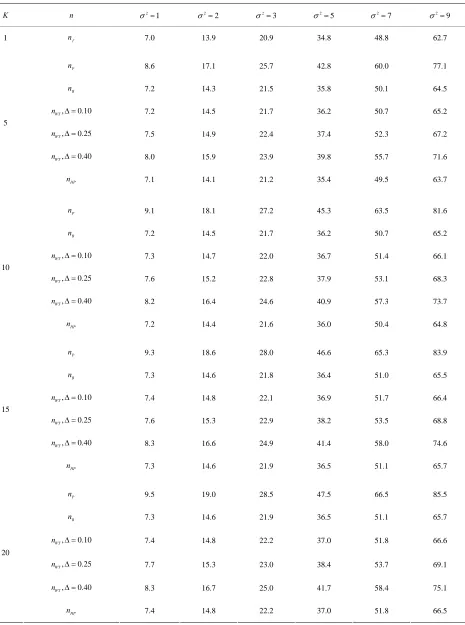
Critical values of each test types to reject null hypothesis (H0) at 0.05 level were shown at Tables 1-4. Also,
sample size calculations for each test types to detect 3 different effect sizes with 6 several variances at 2 diffe- rent 1 – β level and 0.05 level were shown at Ta-bles 5-10. Since Haybittle-Peto and Wang & Tsiatis tests
can only be used at 0.05 level, comparisons at
0.01
level were done only for Pocock and O’Brien
& Fleming tests. Advantages and disadvantage of these
tests according to each other at 0.01 level were
same with the condition at 0.05 level. So, results of
0.01
level combinations were not shown. In addi-
tion, sample sizes calculated for larger effect sizes were very small as 3.9 and some of them not possible in prac- tice. Thereby some of these sample sizes were similar
and not comparable. So, sample sizes for d2.0,
2.5
d and d3.0 were not shown. Sample sizes ca-
lculated according to different variance selections in- creasing as variances increase and can be calculated by iteration. So, sample sizes for 24, 2 6, and
2
8
were not shown.
Critical value of fixed sample size design test to reject null hypothesis (H0) at 0.05 level is cK 1.96.
The nearest critical value of group sequential tests at fi- nal analysis was obtained for Haybittle-Peto test and the furthest one was obtained for Pocock test. And it did not change according to the number of analysis (Tables 1-4).
When K5, Pocock test had the lowest critical val- ues that might detect smaller effect sizes in first three interim analyses while O’Brien & Fleming test had the lowest critical values that might detect smaller effect
sizes at 4th interim analysis and final analysis. This
changing was observed at 7th interim analysis when
10
K , at 10th interim analysis when K 15 and at
13th interim analysis when K20. Wang & Tsiatis test was always placed between these two tests. It was closed
to O’Brien & Fleming test for small values and
started to close up to Pocock with increasing values. Critical values of Wang & Tsiatis test for early interim
analyses were getting closer to Pocock test as the
values increase, and they were decreasing for later in- terim analyses. Similarly, critical values of Wang & Tsi- atis test were getting closer to O’Brien & Fleming test as
the values decrease, and they were decreasing for
later interim analyses in parallel with critical values of O’Brien & Fleming test. When K5, Pocock test had lower critical values that might detect smaller effect sizes than Wang & Tsiatis test for all values in first two or three interim analyses, while Wang & Tsiatis test had lower critical values that might detect smaller effect sizes in last two interim analyses and final analysis. This changing was observed at 5th - 7th interim analysis when
10
K , at 7th - 10th interim analysis when K 15 and at 8th - 11th interim analysis when K20. Number of analysis which this changing was observed, was varying according to value of . Haybittle-Peto test had a dif- ferent way as having a constant critical value for all in- terim analysis. This critical value was placed between critical values of Pocock and O’Brien & Fleming tests for early interim analyses, and became higher from them after a few interim analysis. This changing was observed at 3rd interim analysis when K5, at 5th interim analy- sis when K10, at 8th interim analysis when K15
and at 11th interim analysis when K 20. Only for final analysis Haybittle-Peto test had a different critical value that the nearest one to fixed sample size design test (Ta- bles 1-4).
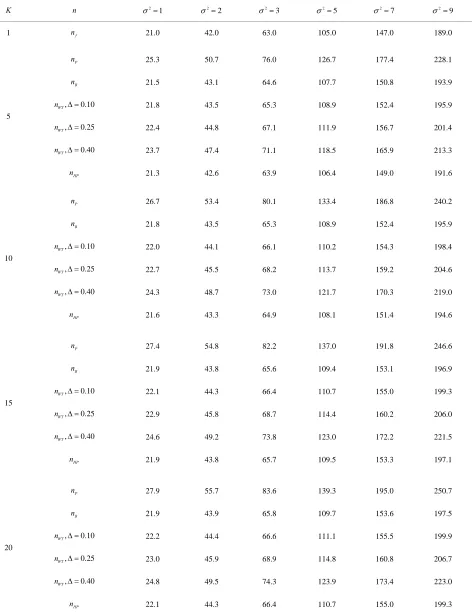
All of the group sequential tests were required more
sample size than the fixed sample size designs (Tables
Table 1. Critical values for α = 0.05 and K = 5.
K CP CB CWT, 0.10 CWT, 0.25 CWT, 0.40 CHP
1 2.413 4.562 3.937 3.194 2.663 3.000
2 2.413 3.226 2.984 2.686 2.485 3.000
3 2.413 2.634 2.357 2.427 2.386 3.000
4 2.413 2.281 2.261 2.259 2.318 3.000
5 2.413 2.040 2.068 2.136 2.267 1.990
[image:5.595.56.541.235.424.2]K: Number of analysis, C: Critical values of tests; CP: Pocock; CB: O’Brien & Fleming; CWT: Wang & Tsiatis; CHP: Haybittle-Peto.
Table 2. Critical values for α = 0.05 and K = 10.
K CP CB CWT, 0.10 CWT, 0.25 CWT, 0.40 CHP
1 2.555 6.600 5.325 3.910 2.965 3.000
2 2.555 4.667 4.036 3.288 2.766 3.000
3 2.555 3.810 3.432 2.971 2.656 3.000
4 2.555 3.300 3.059 2.765 2.581 3.000
5 2.555 2.951 2.797 2.615 2.524 3.000
6 2.555 2.694 2.601 2.499 2.478 3.000
7 2.555 2.494 2.445 2.404 2.441 3.000
8 2.555 2.333 2.318 2.325 2.408 3.000
9 2.555 2.200 2.211 2.258 2.380 3.000
10 2.555 2.087 2.120 2.199 2.355 2.021
K: Number of analysis, C: Critical values of tests; CP: Pocock; CB: O’Brien & Fleming; CWT: Wang & Tsiatis; CHP: Haybittle-Peto.
Table 3. Critical values for α = 0.05 and K = 15.
K CP CB CWT, 0.10 CWT, 0.25 CWT, 0.40 CHP
1 2.626 8.172 6.340 4.387 3.143 3.000
2 2.626 5.778 4.805 3.689 2.932 3.000
3 2.626 4.718 4.085 3.333 2.816 3.000
4 2.626 4.086 3.641 3.102 2.736 3.000
5 2.626 3.655 3.330 2.934 2.675 3.000
6 2.626 3.336 3.096 2.803 2.627 3.000
7 2.626 3.089 2.911 2.697 2.587 3.000
8 2.626 2.889 2.760 2.608 2.553 3.000
9 2.626 2.724 2.633 2.533 2.523 3.000
10 2.626 2.584 2.524 2.467 2.496 3.000
11 2.626 2.464 2.429 2.409 2.473 3.000
12 2.626 2.359 2.346 2.357 2.451 3.000
13 2.626 2.267 2.272 2.310 2.432 3.000
14 2.626 2.184 2.206 2.268 2.414 3.000
15 2.626 2.110 2.146 2.229 2.397 2.046
[image:5.595.55.538.463.724.2]Table 4. Critical values for α = 0.05 and K = 20.
K CP CB CWT, 0.10 CWT, 0.25 CWT, 0.40 CHP
1 2.672 9.508 7.166 4.754 3.269 3.000
2 2.672 6.723 5.431 3.998 3.050 3.000
3 2.672 5.489 4.618 3.612 2.929 3.000
4 2.672 4.754 4.116 3.362 2.846 3.000
5 2.672 4.252 3.764 3.179 2.783 3.000
6 2.672 3.882 3.500 3.038 2.733 3.000
7 2.672 3.594 3.290 2.923 2.691 3.000
8 2.672 3.362 3.119 2.827 2.656 3.000
9 2.672 3.169 2.976 2.745 2.624 3.000
10 2.672 3.007 2.853 2.673 2.597 3.000
11 2.672 2.867 2.746 2.610 2.572 3.000
12 2.672 2.745 2.652 2.554 2.550 3.000
13 2.672 2.637 2.569 2.504 2.530 3.000
14 2.672 2.541 2.494 2.458 2.511 3.000
15 2.672 2.455 2.426 2.416 2.494 3.000
16 2.672 2.377 2.364 2.377 2.478 3.000
17 2.672 2.306 2.307 2.341 2.463 3.000
18 2.672 2.241 2.255 2.308 2.449 3.000
19 2.672 2.181 2.207 2.277 2.435 3.000
20 2.672 2.126 2.162 2.248 2.423 2.068
K: Number of analysis, C: Critical values of tests; CP: Pocock; CB: O’Brien & Fleming; CWT: Wang & Tsiatis; CHP: Haybittle-Peto.
Table 5. Sample sizes for α = 0.05, (1 – β) = 0.90, and d = 0.5.
K n 2
1
2
2
2
3
2
5
2
7
2
9
1 nf 84.0 168.0 251.9 419.9 587.9 755.8
P
n 101.4 202.7 304.1 506.8 709.6 912.3
B
n 86.2 172.3 258.5 430.8 603.2 775.5
, 0.10 WT
n 87.1 174.2 261.3 435.4 609.6 783.8
, 0.25 WT
n 89.5 179.0 268.6 447.6 626.7 805.7
, 0.40 WT
n 94.8 189.6 284.4 474.1 663.7 853.3
5
HP
n 85.2 170.3 255.5 425.8 596.1 766.4
P
n 106.7 213.5 320.2 533.7 747.2 960.7
B
n 87.1 174.2 261.3 435.4 609.6 783.8
, 0.10 WT
n 88.2 176.4 264.5 440.9 617.3 793.6
, 0.25 WT
n 91.0 181.9 272.9 454.8 636.7 818.6
, 0.40 WT
n 97.3 194.7 292.0 486.7 681.3 876.0
10
HP
n 86.5 173.0 259.5 432.5 605.5 778.5
P
n 109.6 219.2 328.8 548.0 767.2 986.4
B
n 87.5 175.0 262.5 437.5 612.6 787.6
, 0.10 WT
n 88.6 177.2 265.8 443.0 620.2 797.4
, 0.25 WT
n 91.5 183.1 274.6 457.7 640.8 823.9
, 0.40 WT
n 98.4 196.9 295.3 492.1 689.0 885.8
15
HP
n 87.6 175.2 262.8 438.0 613.1 788.3
P
n 111.4 222.9 334.3 557.2 780.1 1003.0
B
n 87.8 175.5 263.3 438.8 614.3 789.8
, 0.10 WT
n 88.9 177.7 266.6 444.3 622.0 799.7
, 0.25 WT
n 91.9 183.7 275.6 459.4 643.1 826.9
, 0.40 WT
n 99.1 198.2 297.3 495.5 693.7 891.9
20
HP
n 88.6 177.2 265.8 443.0 620.2 797.4
[image:6.595.66.538.382.727.2]Table 6. Sample sizes for α = 0.05, (1 – β) = 0.90, and d = 1.0.
K n 2
1
2
2
2
3
2
5
2
7
2
9
1 nf 21.0 42.0 63.0 105.0 147.0 189.0
P
n 25.3 50.7 76.0 126.7 177.4 228.1
B
n 21.5 43.1 64.6 107.7 150.8 193.9
, 0.10 WT
n 21.8 43.5 65.3 108.9 152.4 195.9
, 0.25 WT
n 22.4 44.8 67.1 111.9 156.7 201.4
, 0.40 WT
n 23.7 47.4 71.1 118.5 165.9 213.3
5
HP
n 21.3 42.6 63.9 106.4 149.0 191.6
P
n 26.7 53.4 80.1 133.4 186.8 240.2
B
n 21.8 43.5 65.3 108.9 152.4 195.9
, 0.10 WT
n 22.0 44.1 66.1 110.2 154.3 198.4
, 0.25 WT
n 22.7 45.5 68.2 113.7 159.2 204.6
, 0.40 WT
n 24.3 48.7 73.0 121.7 170.3 219.0
10
HP
n 21.6 43.3 64.9 108.1 151.4 194.6
P
n 27.4 54.8 82.2 137.0 191.8 246.6
B
n 21.9 43.8 65.6 109.4 153.1 196.9
, 0.10 WT
n 22.1 44.3 66.4 110.7 155.0 199.3
, 0.25 WT
n 22.9 45.8 68.7 114.4 160.2 206.0
, 0.40 WT
n 24.6 49.2 73.8 123.0 172.2 221.5
15
HP
n 21.9 43.8 65.7 109.5 153.3 197.1
P
n 27.9 55.7 83.6 139.3 195.0 250.7
B
n 21.9 43.9 65.8 109.7 153.6 197.5
, 0.10 WT
n 22.2 44.4 66.6 111.1 155.5 199.9
, 0.25 WT
n 23.0 45.9 68.9 114.8 160.8 206.7
, 0.40 WT
n 24.8 49.5 74.3 123.9 173.4 223.0
20
HP
n 22.1 44.3 66.4 110.7 155.0 199.3
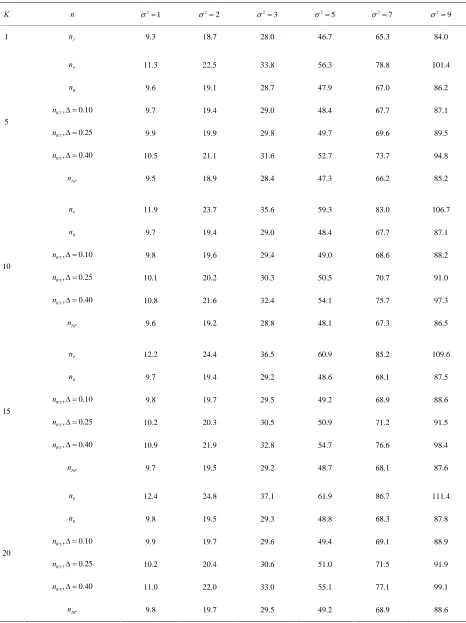
Table 7. Sample sizes for α = 0.05, (1 – β) = 0.90, and d = 1.5.
K n 2
1
2
2
2
3
2
5
2
7
2
9
1 nf 9.3 18.7 28.0 46.7 65.3 84.0
P
n 11.3 22.5 33.8 56.3 78.8 101.4
B
n 9.6 19.1 28.7 47.9 67.0 86.2
, 0.10 WT
n 9.7 19.4 29.0 48.4 67.7 87.1
, 0.25 WT
n 9.9 19.9 29.8 49.7 69.6 89.5
, 0.40 WT
n 10.5 21.1 31.6 52.7 73.7 94.8
5
HP
n 9.5 18.9 28.4 47.3 66.2 85.2
P
n 11.9 23.7 35.6 59.3 83.0 106.7
B
n 9.7 19.4 29.0 48.4 67.7 87.1
, 0.10 WT
n 9.8 19.6 29.4 49.0 68.6 88.2
, 0.25 WT
n 10.1 20.2 30.3 50.5 70.7 91.0
, 0.40 WT
n 10.8 21.6 32.4 54.1 75.7 97.3
10
HP
n 9.6 19.2 28.8 48.1 67.3 86.5
P
n 12.2 24.4 36.5 60.9 85.2 109.6
B
n 9.7 19.4 29.2 48.6 68.1 87.5
, 0.10 WT
n 9.8 19.7 29.5 49.2 68.9 88.6
, 0.25 WT
n 10.2 20.3 30.5 50.9 71.2 91.5
, 0.40 WT
n 10.9 21.9 32.8 54.7 76.6 98.4
15
HP
n 9.7 19.5 29.2 48.7 68.1 87.6
P
n 12.4 24.8 37.1 61.9 86.7 111.4
B
n 9.8 19.5 29.3 48.8 68.3 87.8
, 0.10 WT
n 9.9 19.7 29.6 49.4 69.1 88.9
, 0.25 WT
n 10.2 20.4 30.6 51.0 71.5 91.9
, 0.40 WT
n 11.0 22.0 33.0 55.1 77.1 99.1
20
HP
n 9.8 19.7 29.5 49.2 68.9 88.6
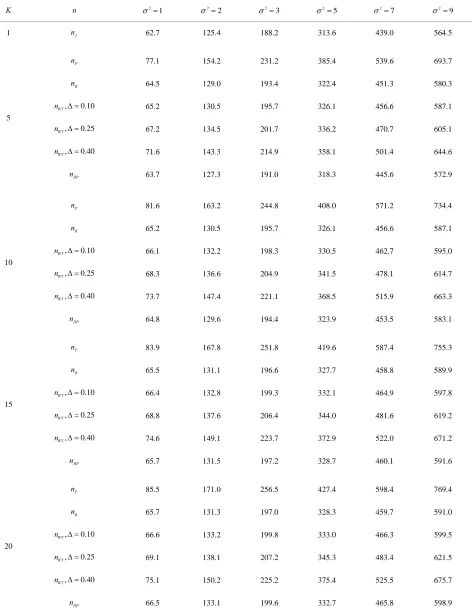
Table 8. Sample sizes for α = 0.05, (1 – β) = 0.80, and d = 0.5.
K n 2
1
2
2
2
3
2
5
2
7
2
9
1 nf 62.7 125.4 188.2 313.6 439.0 564.5
P
n 77.1 154.2 231.2 385.4 539.6 693.7
B
n 64.5 129.0 193.4 322.4 451.3 580.3
, 0.10 WT
n 65.2 130.5 195.7 326.1 456.6 587.1
, 0.25 WT
n 67.2 134.5 201.7 336.2 470.7 605.1
, 0.40 WT
n 71.6 143.3 214.9 358.1 501.4 644.6
5
HP
n 63.7 127.3 191.0 318.3 445.6 572.9
P
n 81.6 163.2 244.8 408.0 571.2 734.4
B
n 65.2 130.5 195.7 326.1 456.6 587.1
, 0.10 WT
n 66.1 132.2 198.3 330.5 462.7 595.0
, 0.25 WT
n 68.3 136.6 204.9 341.5 478.1 614.7
, 0.40 WT
n 73.7 147.4 221.1 368.5 515.9 663.3
10
HP
n 64.8 129.6 194.4 323.9 453.5 583.1
P
n 83.9 167.8 251.8 419.6 587.4 755.3
B
n 65.5 131.1 196.6 327.7 458.8 589.9
, 0.10 WT
n 66.4 132.8 199.3 332.1 464.9 597.8
, 0.25 WT
n 68.8 137.6 206.4 344.0 481.6 619.2
, 0.40 WT
n 74.6 149.1 223.7 372.9 522.0 671.2
15
HP
n 65.7 131.5 197.2 328.7 460.1 591.6
P
n 85.5 171.0 256.5 427.4 598.4 769.4
B
n 65.7 131.3 197.0 328.3 459.7 591.0
, 0.10 WT
n 66.6 133.2 199.8 333.0 466.3 599.5
, 0.25 WT
n 69.1 138.1 207.2 345.3 483.4 621.5
, 0.40 WT
n 75.1 150.2 225.2 375.4 525.5 675.7
20
HP
n 66.5 133.1 199.6 332.7 465.8 598.9
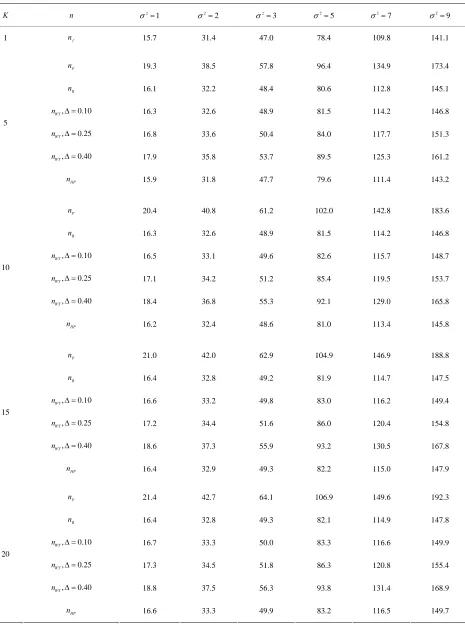
Table 9. Sample sizes for α = 0.05, (1 – β) = 0.80, and d = 1.0.
K n 2
1
2
2
2
3
2
5
2
7
2
9
1 nf 15.7 31.4 47.0 78.4 109.8 141.1
P
n 19.3 38.5 57.8 96.4 134.9 173.4
B
n 16.1 32.2 48.4 80.6 112.8 145.1
, 0.10 WT
n 16.3 32.6 48.9 81.5 114.2 146.8
, 0.25 WT
n 16.8 33.6 50.4 84.0 117.7 151.3
, 0.40 WT
n 17.9 35.8 53.7 89.5 125.3 161.2
5
HP
n 15.9 31.8 47.7 79.6 111.4 143.2
P
n 20.4 40.8 61.2 102.0 142.8 183.6
B
n 16.3 32.6 48.9 81.5 114.2 146.8
, 0.10 WT
n 16.5 33.1 49.6 82.6 115.7 148.7
, 0.25 WT
n 17.1 34.2 51.2 85.4 119.5 153.7
, 0.40 WT
n 18.4 36.8 55.3 92.1 129.0 165.8
10
HP
n 16.2 32.4 48.6 81.0 113.4 145.8
P
n 21.0 42.0 62.9 104.9 146.9 188.8
B
n 16.4 32.8 49.2 81.9 114.7 147.5
, 0.10 WT
n 16.6 33.2 49.8 83.0 116.2 149.4
, 0.25 WT
n 17.2 34.4 51.6 86.0 120.4 154.8
, 0.40 WT
n 18.6 37.3 55.9 93.2 130.5 167.8
15
HP
n 16.4 32.9 49.3 82.2 115.0 147.9
P
n 21.4 42.7 64.1 106.9 149.6 192.3
B
n 16.4 32.8 49.3 82.1 114.9 147.8
, 0.10 WT
n 16.7 33.3 50.0 83.3 116.6 149.9
, 0.25 WT
n 17.3 34.5 51.8 86.3 120.8 155.4
, 0.40 WT
n 18.8 37.5 56.3 93.8 131.4 168.9
20
HP
n 16.6 33.3 49.9 83.2 116.5 149.7
Table 10. Sample sizes for α = 0.05, (1 – β) = 0.80, and d = 1.5.
K n 2
1
2
2
2
3
2
5
2
7
2
9
1 nf 7.0 13.9 20.9 34.8 48.8 62.7
P
n 8.6 17.1 25.7 42.8 60.0 77.1
B
n 7.2 14.3 21.5 35.8 50.1 64.5
, 0.10 WT
n 7.2 14.5 21.7 36.2 50.7 65.2
, 0.25 WT
n 7.5 14.9 22.4 37.4 52.3 67.2
, 0.40 WT
n 8.0 15.9 23.9 39.8 55.7 71.6
5
HP
n 7.1 14.1 21.2 35.4 49.5 63.7
P
n 9.1 18.1 27.2 45.3 63.5 81.6
B
n 7.2 14.5 21.7 36.2 50.7 65.2
, 0.10 WT
n 7.3 14.7 22.0 36.7 51.4 66.1
, 0.25 WT
n 7.6 15.2 22.8 37.9 53.1 68.3
, 0.40 WT
n 8.2 16.4 24.6 40.9 57.3 73.7
10
HP
n 7.2 14.4 21.6 36.0 50.4 64.8
P
n 9.3 18.6 28.0 46.6 65.3 83.9
B
n 7.3 14.6 21.8 36.4 51.0 65.5
, 0.10 WT
n 7.4 14.8 22.1 36.9 51.7 66.4
, 0.25 WT
n 7.6 15.3 22.9 38.2 53.5 68.8
, 0.40 WT
n 8.3 16.6 24.9 41.4 58.0 74.6
15
HP
n 7.3 14.6 21.9 36.5 51.1 65.7
P
n 9.5 19.0 28.5 47.5 66.5 85.5
B
n 7.3 14.6 21.9 36.5 51.1 65.7
, 0.10 WT
n 7.4 14.8 22.2 37.0 51.8 66.6
, 0.25 WT
n 7.7 15.3 23.0 38.4 53.7 69.1
, 0.40 WT
n 8.3 16.7 25.0 41.7 58.4 75.1
20
HP
n 7.4 14.8 22.2 37.0 51.8 66.5
Pocock test required the largest sample size among the group sequential test types. O’Brien & Fleming and Haybittle-Peto tests had nearest sample sizes to fixed sample size design and order of these two tests changed
with number of analyses. For example, when K15
Haybittle-Peto test had the smallest sample size while O’Brien & Fleming test required the smallest sample size
when K15. But Pocock test had always the largest
sample size for all combinations. Wang & Tsiatis test was always placed between these two tests as for critical values. It had the same sample size with Pocock test when 0.50 and with O’Brien & Fleming test when
0
. The sample size was close to O’Brien & Fleming test for small values and started close to Pocock test with increasing values. This condition was not vary- ing according to number of interim analysis and other parameters related to calculation of sample size, as power, Type I error rate, effect size and variance. Sample sizes were almost similar for increasing effect sizes, and be-
came same at d2.0 and more effect sizes. It was
mainly caused by the smallness of sample sizes such as 3.9. Because of the smallness of sample sizes, the differ- rences between sample sizes for each test can not be ob- served and they were seen similar. So, advantage and disadvantage of each test in term of sample size can be compared for low effect sizes.
4. Discussion
Results obtained about sample size in all combinations almost same. Haybittle-Peto and O’Brien & Fleming tests have been required much smaller sample sizes comparing to other test types. Pocock test has been re- quired the largest sample size for all combinations. Wang & Tsiatis test has been always required sample size that placed between O’Brien & Fleming and Pocock tests.
The reason for requiring small sample size of O’Brien & Fleming test comparing to Pocock test, can be under- stood from the formula for calculating the Z statistic, Equality (2.2.1). It can be seen that, effect of effect size on expected value of test statistic E Z
k increases withnumber of analysis. So, the power of test achieves mainly later analyses [4,5].
Maximum sample size requiring in group sequential designs increases as the number of analyses increase. But, basic goal of group sequential designs is evaluating the advantage of early stopping through interim analysis [6,7, 13]. It takes into consideration that, maximum sample size is only required when there is no positive result in all interim analyses and the trial goes on to the final ana- lyses.
Critical values of group sequential tests in interim ana- lyses were ordered in a different manner, changing for each interim analysis. In addition, order of tests in term
of critical values changing according to number of analy- sis (K). Pocock test had the lowest critical values for early interim analyses while O’Brien & Fleming test had the lowest critical values for latter analyses. Number of interim analysis in which this changing occurred varied according to number of analysis (K).
,
BC K K k values increase because of
in-crease in
K k
values, and so the difference in criti-cal values according to other tests in initial interim analyses increase as planned total number of analyses (K)increase.
K k
values start to decrease from firstanalysis to final analyses and therefore
,
BC K K k values start to decrease, so the
critical values according to other tests are lower in latter analyses. Similarly, Wang & Tsiatis test shows same
manner for critical values. CWT
K, ,
K k
1 2values increase because of increase in
k K
1 2 values in initial interim analyses as planned total number of analyses (K) increase, and there is a big difference in terms of critical values according to other tests. It starts to decrease as the analyses goes on, and lower than other tests in latter analysis.The number of analyses performed is important as the test type used. In some conditions, 1 or 2 interim analy- ses may be effective for decreasing sample size, and generally 4 or 5 interim analyses are sufficient. Accord- ingly, for a group sequential design using O’Brien Flem-
ing test, K 10 interim analyses have been the opti-
mum. In addition, for a group sequential design using
Pocock test, K5 interim analysis seems unreason-
able.
As a result, these four test types have several advan- tages and disadvantages. In a group sequential trial, deci- sion of test type using to analysis the trial data, based on a few criteria: 1) whether early termination is important or not; 2) reducing sample size; 3) the issue of trial; 4) whether reaching the subject easy or not; 5) detecting minimal effect sizes. In the conditions that, reaching sub- jects is hard or studying smaller sample size because of high risk, the test which provides that detect smaller treatment differences at the first interim analyses can be preferred.
REFERENCES
[1] D. L. DeMets, “Sequential Designs in Clinical Trials,”
Cardiac Electrophysiology Review, 1998, Vol. 2, No. 1,
pp. 57-60.
Hoboken, 2004.
[3] P. C. O’Brien, “Data and Safety Monitoring,” In: P. Ar-mitage and T. Colton, Eds., Encyclopedia of Biostatistics, Vol. 2, 2005, pp. 1362-1371.
[4] R. Aplenc, H. Zhao, T. R. Rebbeck and K. J. Propert,
“Group Sequential Methods and Sample Size Savings in Biomarker-Disease Association Studies,” Genetics, Vol. 163, 2003, pp. 1215-1219.
[5] C. Jennison and B. W. Turnbull, “Group Sequential
Methods with Applications to Clinical Trials,” Chapman & Hall/CRC, Boca Raton, 2000.
[6] M. Mazumdar and A. Liu, “Group Sequential Design for
Comparative Diagnostic Accuracy Studies,” Statistics in
Medicine, Vol. 22, No. 5, 2003, pp. 727-739.
[7] M. Mazumdar, “Group Sequential Design for
Compara-tive Diagnostic Accuracy Studies: Implications and Guide-lines for Practitioners,” Medical Decision Making, Vol. 24, No. 5, 2004, pp. 525-533.
[8] B. Tasdelen and E. A. Kanik, “The Formulae and Tables to Determine Sample Sizes for Classical Hypothesis Tests,”
University of Mersin School of Medicine Medical Journal, Vol. 4, 2004, pp. 438-446.
[9] S. C. Chow, J. Shao and H. Wang, “Sample Size Calcula-tions in Clinical Research,” Marcel Dekker, Inc., New York, 2003.
[10] J. M. Lachin, “Sample Size Determination,” In: P. Ar-mitage and T. Colton, Eds., Encyclopedia of Biostatistics, Vol. 7, 2005, pp. 4693-4704.
[11] E. Lakatos, “Sample Size Determination for Clinical
Trials,” In: P. Armitage and T. Colton, Eds.,
Encyclope-dia of Biostatistics, Vol. 7, 2005, pp. 4704-4711.
[12] H. H. Muller and H. Schafer, “Adaptive Group
Sequen-tial Designs for Clinical Trials: Combining the Advan-tages of Adaptive and of Classical Group Sequential Ap-proaches,” Biometrics, Vol. 57, No. 3, 2001, pp. 886-891.
[13] T. G. Karrison, D. Huo and R. Chappell, “A Group
Se-quential, Response-Adaptive Design for Randomized Cli- nical Trials,” Controlled Clinical Trials, Vol. 24, No. 5, 2003, pp. 506-522.