RESEARCH ARTICLE
PARAMETRIC PRECONDITIONED GAUSS – SEIDEL ITERATIVE METHOD
*
Kumar, V. B., Vatti and Shouri Dominic
Department of Engineering Mathematics, Andhra University College of Engineering (A),
Andhra University, Visakhapatnam – 530003, Andhra Pradesh, India
ARTICLE INFO ABSTRACT
In this paper, the Parametric Preconditioned Gauss-Seidel Iterative Method is developed by using the Preconditioned Gauss-Seidel Iterative Method and the spectral radius of these two methods are compared. A numerical example is given to illustrate the superiority of the new result.
Copyright©2016, Kumar et al. This is an open access article distributed under the Creative Commons Attribution License, which permits unrestricted use, distribution, and reproduction in any medium, provided the original work is properly cited.
INTRODUCTION
We consider the system
AX
b
(1.1)Where
A X b
,
,
R
n n
are known non-singular co-efficient matrix, unknown vector and known vector of the linear system(1.1) respectively. Without loss of generality, if we let
A
I
L U
where I is the identity matrix and–L and–U are the strictly lower triangular and upper triangular parts of A respectively. Then the well known AOR method iterative matrix is1
,
(I
) [(1
) I (
)
]
r
T
rL
r L
U
(1.2)where
0
r
1
with
0
and the Gauss-Seidel iterative matrix is
1 .
( - )
G S
T
I L
U
(1.3)*Corresponding author: Kumar, V.B.,
Department of Engineering Mathematics, Andhra University College of Engineering (A), Andhra University, Visakhapatnam–530003, Andhra Pradesh, India.
ISSN: 0975-833X
International Journal of Current Research
Vol. 8, Issue, 09, pp.37905-37910, September, 2016
INTERNATIONAL JOURNAL OF CURRENT RESEARCH
Article History: Received 23rdJune, 2016
Received in revised form 24thJuly, 2016
Accepted 08thAugust, 2016
Published online 20thSeptember, 2016
Citation: Kumar, V.B., Vatti and Shouri Dominic, 2016. “Parametric preconditioned gauss–Seidel iterative method”International Journal of Current Research, 8, (09), 37905-37910.
Key words: M-matrix, Preconditioner, Gauss-Seidel Splitting, Convergence, Iterative Methods.
RESEARCH ARTICLE
PARAMETRIC PRECONDITIONED GAUSS – SEIDEL ITERATIVE METHOD
*
Kumar, V. B., Vatti and Shouri Dominic
Department of Engineering Mathematics, Andhra University College of Engineering (A),
Andhra University, Visakhapatnam – 530003, Andhra Pradesh, India
ARTICLE INFO ABSTRACT
In this paper, the Parametric Preconditioned Gauss-Seidel Iterative Method is developed by using the Preconditioned Gauss-Seidel Iterative Method and the spectral radius of these two methods are compared. A numerical example is given to illustrate the superiority of the new result.
Copyright©2016, Kumar et al. This is an open access article distributed under the Creative Commons Attribution License, which permits unrestricted use, distribution, and reproduction in any medium, provided the original work is properly cited.
INTRODUCTION
We consider the system
AX
b
(1.1)Where
A X b
,
,
R
n n
are known non-singular co-efficient matrix, unknown vector and known vector of the linear system(1.1) respectively. Without loss of generality, if we let
A
I
L U
where I is the identity matrix and–L and–U are the strictly lower triangular and upper triangular parts of A respectively. Then the well known AOR method iterative matrix is1
,
(I
) [(1
) I (
)
]
r
T
rL
r L
U
(1.2)where
0
r
1
with
0
and the Gauss-Seidel iterative matrix is
1 .
( - )
G S
T
I L
U
(1.3)*Corresponding author: Kumar, V.B.,
Department of Engineering Mathematics, Andhra University College of Engineering (A), Andhra University, Visakhapatnam–530003, Andhra Pradesh, India.
ISSN: 0975-833X
International Journal of Current Research
Vol. 8, Issue, 09, pp.37905-37910, September, 2016
INTERNATIONAL JOURNAL OF CURRENT RESEARCH
Article History: Received 23rdJune, 2016
Received in revised form 24thJuly, 2016
Accepted 08thAugust, 2016
Published online 20thSeptember, 2016
Citation: Kumar, V.B., Vatti and Shouri Dominic, 2016. “Parametric preconditioned gauss–Seidel iterative method”International Journal of Current Research, 8, (09), 37905-37910.
Key words: M-matrix, Preconditioner, Gauss-Seidel Splitting, Convergence, Iterative Methods.
RESEARCH ARTICLE
PARAMETRIC PRECONDITIONED GAUSS – SEIDEL ITERATIVE METHOD
*
Kumar, V. B., Vatti and Shouri Dominic
Department of Engineering Mathematics, Andhra University College of Engineering (A),
Andhra University, Visakhapatnam – 530003, Andhra Pradesh, India
ARTICLE INFO ABSTRACT
In this paper, the Parametric Preconditioned Gauss-Seidel Iterative Method is developed by using the Preconditioned Gauss-Seidel Iterative Method and the spectral radius of these two methods are compared. A numerical example is given to illustrate the superiority of the new result.
Copyright©2016, Kumar et al. This is an open access article distributed under the Creative Commons Attribution License, which permits unrestricted use, distribution, and reproduction in any medium, provided the original work is properly cited.
INTRODUCTION
We consider the system
AX
b
(1.1)Where
A X b
,
,
R
n n
are known non-singular co-efficient matrix, unknown vector and known vector of the linear system(1.1) respectively. Without loss of generality, if we let
A
I
L U
where I is the identity matrix and–L and–U are the strictly lower triangular and upper triangular parts of A respectively. Then the well known AOR method iterative matrix is1
,
(I
) [(1
) I (
)
]
r
T
rL
r L
U
(1.2)where
0
r
1
with
0
and the Gauss-Seidel iterative matrix is
1 .
( - )
G S
T
I L
U
(1.3)*Corresponding author: Kumar, V.B.,
Department of Engineering Mathematics, Andhra University College of Engineering (A), Andhra University, Visakhapatnam–530003, Andhra Pradesh, India.
ISSN: 0975-833X
International Journal of Current Research
Vol. 8, Issue, 09, pp.37905-37910, September, 2016
INTERNATIONAL JOURNAL OF CURRENT RESEARCH
Article History: Received 23rdJune, 2016
Received in revised form 24thJuly, 2016
Accepted 08thAugust, 2016
Published online 20thSeptember, 2016
Citation: Kumar, V.B., Vatti and Shouri Dominic, 2016. “Parametric preconditioned gauss–Seidel iterative method”International Journal of Current Research, 8, (09), 37905-37910.
By considering
,
1, 2,...,
1,
(s )
0
for others
in ij n n
a
i
n
j
n
S
the preconditioned linear system as given by He Honghao et al. [2009] is
(
I
S AX
)
(
I
S b
)
(1.4)where,
1 1 1
(
I
S A
)
(
I
D
L
L
U U )
(1.5)
Here
D L
1,
1and U
1 are the diagonal, strictly lower and strictly upper triangular parts ofS
SL
respectively. And it can be easily seen that SU is always a null matrix.If
a a
in.
ni
1 (
i
1, 2,...,
n
1),
then(
I
D
1
L
L
1)
1exists and hence the Preconditioned Gauss-Seidel Iterative Method (PGSM) iterative matrix exists.And, the PGSM iterative matrix is
(1.6)
Where
. 1 1
G S
M
I
D
L L
(1.7). 1
G S
N
U
U
(1.8) we below mention some of the preliminaries, lemmas and theorems as given in He Honghao et al.[2009].
A matrix
A
(a )
ij
R
n n is called nonnegative ifa
ij
0, ,
i j
1, 2,..., .
n
A matrix
A
(a )
ij
R
n n is called Z-matrix ifa
ij
0,
i
j
, and it is called an M-matrix if A is a Z-matrix and,
0,
( ),
A
sI
B
B
s
B
where
(B)
denotes the spectral radius of B.A splitting
B
M
N
is called regular ifM
1
0 and
N
0,
weak regular ifM
1
0 and
M
1N
0.
A matrix
A
(a )
ij
R
n n is called an M-matrix if A is a Z-matrix andA
1
0.
A matrix A is irreducible if the direct graph associated to A is strongly connected.Lemma 1.1: Let
A
0
be an irreducible matrix. Then A has a positive real eigen value equal to its spectral radius;
To
( )
A
there corresponds an eigen vectorX
0
;
( )
A
is a simple eigen value of A.Lemma 1.2: Let
A
0,
a
0,
thena
( )
A
ifaX
AX
and
X
0;
moreover,a
( )
A
ifaX
AX
andX
0.
Lemma 1.4: Let
A
(a )
ij
R
n n be a non-singular and irreducible M-matrix, then
(
T
r,)
1,
0
r
1, (
0),
where
T
r, be the iterative matrix of AOR method given by (1.2).Lemma 1.5: Let
A
(a )
ij
R
n n be a non-singular and irreducible M-matrix with0
a a
in ni
1,
i
1, 2,...,
n
1.
then,
, 0
1(
0)
r
T
r
is nonnegative and irreducible matrix, whereT
r,is defined by (1.2).Lemma 1.6: Let
A
(a )
ij
R
n n be an M-matrix with0
a a
in ni
1,
i
1, 2,...,
n
1,
X
R
n
is n-dimensionalvector, then
M
G S1.SX
0.
Theorem 1.1: Let
A
(a )
ij
R
n n is non-singular and irreducible M-matrix with0
a a
in ni
1,
i
1, 2,...,
n
1,
then. . .
. .
. . .
(1)
(
)
(
)
if
(
) 1.
(2)
(
)
1
if
(
)
1.
(3)
(
)
(
)
if
(
)
1.
G S G S G S
G S G S
G S G S G S
T
T
T
T
T
T
T
T
Theorem 1.2: Let
A
(a )
ij
R
n n is non-singular and irreducible M-matrix with0
a a
in ni
1,
1, 2,...,
1,
ni
n
X
R
then
(
T
G S.)
(
T
r,)
1,
0
r
1(
0)
where
T
G S. andT
r, are defined by (1.6) and (1.2) respectively.In the section 2, we introduce Parametric Preconditioned Gauss-seidel Iterative Method (PPGSM) and compare the spectral radius of the iterative matrices of PPGSM and PGSM. Whereas in the concluding section, we present a numerical example.
Parametric Preconditioned Gauss–Seidel Iterative Method (PPGSM)
We consider the preconditioned linear system
AX
b
i.e.;
(
I
S AX
)
(
I
S b
)
(2.1)where
0
being a relaxation parameterHere,
1 1 1
(
I
S A
)
(
I
D
L
L
U
U
)
(2.2)where
D L
1,
1andU
1are the diagonal, strictly lower and strictly upper triangular parts ofS
SL
respectively.The inverse of
(
I
D
1
L
L
1)
exists ifa a
in ni
1
(
i
1, 2,..., ),
n
0
and hence PPGSM iteration matrixT
G S.which is defined by
1
. .
.
.G S G S G S
T
M
N
(2.3)
Where
M
1G S.(
I
D
1L
L
1)
and
.
(
1)
G S
N
U
U
(2.5) We now, prove the following theorem by using the lemmas stated in section 1.
Theorem 2.1: Let
A
(a )
ij
R
n n is irreducible M-matrix and non-singular with0
a a
in ni
1,
i
1, 2,...,
n
1,
x
R
n.Then
(
T
G S.)
(
T
G S.) if
(
T
G S.) 1
(
T
G S.)
(
T
G S.) if
(
T
G S.) 1
.Proof: There exists a positive vector
X
such that 1(
I
L
)
UX
X
(2.6)since A being an irreducible M-matrix. Here
' '
being the spectral radius of the Gauss-Seidel iterative matrix i.e;
(
T
G S.)
. From (2.6), we have(
I
L X
)
UX
(2.7)(2.8)
Let
y
[(
I
D
1) (
L
L
1)] (
1L
1
D X
1)
andy
(
L
1
D X
1)
. By the assumption0
a a
in ni
1,
1, 2,...,
1,
i
n
we have(
L
1
D X
1)
a a X
in ni i
0,
fori
1, 2,...,
n
1 .
From which one can deduce that the first n-1 entries ofy
are positive.1 1 1
1 1 1 1 1
[(
I
D
) (
L
L
)]
[
I
(
I
D
) (
L
L
)](
I
D
)
1 1
1 1
[
I
(
I
D
) (
L
L
)] (
I
L
)
2
(
I
L
L
...)
I
L
,
(
)
y
I
L y
y
Ly
is obtained. Because ofa
n1n nna
1
0, ( )
L
nn1
0
is obtained. Hence the nthentry ofLy
is positive. So, we can deduce that y is positive.If
0
1
and
0
then from (2.8) we have.
(
1)
0
G S
T
X
y
(2.9)by Lemma (1.2) and hence
. .
(
T
G S)
(
T
G S)
If
1, then
T
G S.
X
(
1)
y
0
(2.10)Therefore,
(
T
G S.)
(
T
G S.)
If
1and
0, then
T
G S.
X
(
1)
y
0
(2.11)Therefore,
(
T
G S.)
(
T
G S.)
provided1
1
(2.12) Finally, as long as
'
'
be fixed as in (2.12) we have for any' '
in the ranges0
1
and
1
,Hence the proof of the theorem is complete.
Numerical Examples
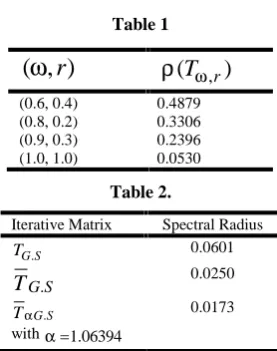
We considered the example given in He Honghao et.al. [2009] and tabulated the spectral radii of iterative matrices of AOR, PGSM and PPGSM in this paper. One can denote the following matrix ‘A’ as non-singular and irreducible M-matrix.
1 0.0709 0.0250 0.0240
0.0718 1 0.0472 0.0597 0.0735 0.0856 1 0.0783 0.1261 0.0107 0.0746 1
A
[image:5.595.227.366.584.760.2]
Table 1
( , )
r
(
T
,r)
(0.6, 0.4) 0.4879 (0.8, 0.2) 0.3306 (0.9, 0.3) 0.2396 (1.0, 1.0) 0.0530Table 2.
Iterative Matrix Spectral Radius
. G S
T 0.0601
.
G S
T
0.0250. G S T
with1.06394
It can be seen from the above tabulated results that PPGSM with preconditioner
P
(
I
S
) where ' '
is as given in (2.12), better than all the methods considered in this paper.REFERENCES
Axelession, O. 1994. Iterative Solution Method [M]. Cambridge University Press, Cambridge.
Berban, R.J. 1994. Plemmons. Nonnegative Matrices in the Mathematical Sciences [J]. SIAM, Philadelphia, PA.
Elsner, L. 1989. Comparisons of Weak Regular Splitting and Multisplitting Methods [J]. Numer. Math., 56: 283-289, 1989. Evans, D.J., Martins, M.M., Trigo, M.E. 2001. The AOR method for preconditioned liner [J], Journal of Computational and
Applied Mathematics, 132: 461-466.
He Honghao, Yuan Dongjin, Hou Yi, Xu Jinqiu, 2009. Preconditioned Gauss-Seidel Iterative Method for Linear Systems. International Forum on Information Technology and Applications, 382-385, 2009.
Jiagan Hu., Iterative method for solving linear [M]. Science Press, Beijing, 1991.
Li–Ying Sun, 2005. Comparison theorem for the SOR iterative method [J]. Journal of Computational and Applied Mathematics, 181:336-341).
Varga, R.S. 1981. Matrix iterative Analysis [M], Prentice Hall, Eaglewood Cliff NJ, 1981.
Wen Li, W.W. Sun, 2000. Modified Gauss– Seidel methods and Jacobi type methods for Z– matrix [J]. Linear Algebra Appl., 317: 223-240.