doi:10.4236/ajcm.2011.14029 Published Online December 2011 (http://www.SciRP.org/journal/ajcm)
Chebyshev Approximate Solution to Allocation Problem in
Multiple Objective Surveys with Random Costs
Mohammed Faisal Khan1*, Irfan Ali2, Qazi Shoeb Ahmad1 1
Department of Mathematics, Integral University, Lucknow, India
2
Department of Statistics & Operations Research, Aligarh Muslim University, Aligarh, India E-mail:*faisalkhan004@yahoo.com
Received July 23, 2011; revised August 29,2011; accepted September 8, 2011
Abstract
In this paper, we consider an allocation problem in multivariate surveys as a convex programming problem with non-linear objective functions and a single stochastic cost constraint. The stochastic constraint is con-verted into an equivalent deterministic one by using chance constrained programming. The resulting multi- objective convex programming problem is then solved by Chebyshev approximation technique. A numerical example is presented to illustrate the computational procedure.
Keywords:Chance Constrained Programming, Multivariate Stratified Sampling, Optimum Allocation, Chebyshev Approximation
1. Introduction
Optimum allocation of sample sizes to various strata in univariate stratified random sampling is well defined in the literature. But usually in real life problems more than one population characteristics are to be estimated, which may be of conflicting nature. There are situations where the cost of measurement varies from stratum to stratum. Also the cost of enumerating various characters is gener-ally much different. Further the strata variances for the various characters may not be distributed in the same way. Allocation based on one character may not be optimum for the others. One way to resolve this problem is to search for a compromise allocation, which is in some sense optimum for all the characters.
Kokan and Khan [1], Chatterjee [2], Huddleston [3], Bethel [4], Chromy [5] all discussed the use of convex programming in relation to multivariate optimal allocation problem. The above convex programming approaches give the optimal solution to the problem with given tol- erance limits on variances but the resulting cost may not be acceptable so that a further search is usually required for an optimal solution which falls within the budgetary constraint limit.
The case when sampling variances are random in the constraints has been dealt with by Diaz-Garcia [6]. Javaid and Bakhshi [7] applied modified E-model for solving the multivariate allocation problem when the costs are
con-sidered random in the objective function. Bakhshi [8] find the optimal Sample Numbers with a Probabilistic Cost Constraint.
In this paper, we consider the problem of allocating the sample to various strata when several characters are under study and the budget is fixed. We minimize the variances of various characters subject to the condition of given budget. The problem is transformed to a convex pro-gramming problem (CPP) with several linear objective functions and single convex constraint. The resulting CPP is then solved by Chebyshev approximation approach.
2. Formulation of the Problem
We consider a multivariate population consisting of units which is divided into disjoint strata of sizes
N L
1, 2, , L
N N N such that
1
L i i
N
N. Suppose that p cha-racteristics
j1,,
th i
p are measured on each unit of the population. We assume that the strata boundaries are fixed in advance. Let ni units be drawn without
re-placement from the stratum For character, an unbiased estimate of the population mean
1, , .
i L jth
1, ,p
Yj j . denoted by yjst, has its sampling vari-ance
2 2 11 1
, 1, ,
L
jst i ij
i i i
V y W S j p
n N
where i i
N W
N
is the stratum weight and
2 2 1 1 1 i
Nij ijh ij
h i
S y
N
Y is the variance for the thj
character in the th stratum. i
Let ij be the cost of enumerating the character in
the stratum and let the overhead cost 0 be constant.
Let
c jth
c
th
i
C be the upper limit on the total cost of the survey. Then assuming linear cost function one should have
0 1 1 p L ij i i j
c n c C
or , (2.2)1
L
i i i
c n C
where is the cost of enumeration of all the
1 p i j c
cij pcharacter in the ith stratum and C C c0.
The restrictions on the sample size from various strata are
2 ni Ni, i1,,L (2.3) Let us assume that the survey is to be conducted in such a way that the variances for all the p characters are mini-mized for a fixed budget i.e., we have to minimize all the variances together given by (2.1).
Ignoring the constant terms in (2.1), the NLP problems to be solved are
2 2
1
1
min , 1, ...,
Subject to
and 2 , 1, , ,
L i ij n i i L i i i
i i i
W S
V j p
n
c n C
n N i L n N
(2.4)By making the transformation i 1, 1, ,
i
n i
x
p and
putting the problems (2.4) are transformed into
2 2
,
ij i ij
a W S
1
min , 1, ..., , (1) Subject to
(2)
1 1
and , 1, , (3) 2 L ij i i i i i
a x j p
c C x
x i L
N
(2.5)In many practical situations the costs i in the various
strata are not fixed and vary from one unit to the other. Let us assume that i, are independently
nor-mally distributed random variables. So, we write the above problem in the following chance constrained
pro-c
c i1,,
1
0
min , 1, , (1) Subject to
(2)
2 , 1, ..., , (3)
L a xij j i
i i
i i i
j p
c
P C p
x
n N i L n N
(2.6) where
0p , 0 p01 is a specified probability.
3. Deterministic Equivalent Using Chance
We have assumed that the cost , in the
Constrained Programming
sci
en
1, , i L
ntly and no constraint function 2.6 (2) are indep de rmally
distributed random variables. Then function
1
L i
c
i xi
, will also be normally distributed with mean as
1 1
1
,
L L
i i L
i i i
i
i i i
c E c
E
x x x
(3.1)wher
ei E c
i , i1,,L, and variance as
L 22 2 1 1 i i i i
i i i
c
V V c
x x L gramming form: x
(3.2)where 2
i V ci
.
Now let
1 L i i i c f c x
, where then{2.6 (2)} is given by
1, , n
,c c c
f c C
p0,P or
0,f c E f c C E f c
P p
V f c V f c
f c E f c
V f c
where is a standard normal variable
with mean zero and variance one. Thus the probability of realizing
f c
less than or equal to C can be written as
C E f c
P f c C
V f c
, (3.3)
where
zstand
represents the cumulative density function of the ard normal variable evaluated at z. If K
represents the value of the standard normal variable which
at
K p0defined by q inequalitie ten as
.C E f c
K
V f c
(3.4)
The inequality (3.4) will be satisfied only if
,C E f c
K
V f c
or equivalently,
.E f c K V f c C (3.5)
Substituting from (3.1) and (3.2) in (3.5), we get
2
L L
2
1 1
.
i i
i i i i
K C
x x
(3.6)If the constants
i
and i
d
in (3.6) are unknown then we use their estima s ˆ an ˆ2.
i i
tor Thus
1
ˆ
ˆ i i L i
i
i i
E c
c c
E
i
x x x
, say,2 2 1
ˆ i
L c i
i
i i
c V
x x
, say,where ciand
2 i
c
are the estimated means and variances le.
lent deterministic constraint to the sto-ch
from the samp Thus, an equiva
astic constraint 2.6 (2) is given by
2
0 2
1 1
.
i
L L
c i
i i i i
c
c K C
x x
The equivalent deterministic non-linear programming problem to the chance constrained programming problem (2.6) is obtained as
1
2 2
1 1
min , 1, , (1) Subject to
(2)
1 1
, 1, ..., (3). 2
i L
j ij j
i
L L
c i
i i i i
i i
V a x j p
c
K C
x x
x i L
N
(3.7)
4. Convex Chebyshev Approximation
Consider p convex smooth functions
Problem
, ,
, 1,j j i n ,
g x g x x j p (4.1)
and a region s
1, ,
0, 1, ,i x i x xn i q
(4.2)
where i are also convex smooth functions.
The Convex Chebyshev Approximation Problem (CCAP) aints (4.2) co
for minimizing the system (4.1) under Constr nsists in finding x* for which
max min max .
x
j gj x j fj
Since
x
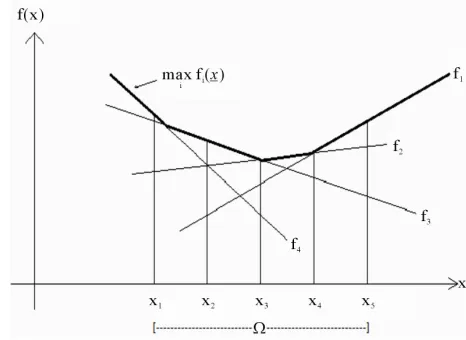
(4.3)
max j
[image:3.595.52.290.81.438.2] [image:3.595.304.537.531.701.2]i g x is convex as can be Figure 1 below, th
seen from the
e convex Chebyshev approximation problem is convex.
Corresponding to the points
x1,,x5
, we have
2 2 3
3 3 1 4 2 4 1 5
, ,
, ,
x f x
4 1 3
max i k ,
i f x f x f
f x f x f x f x
In the general (CCAP) (4.1) & (4.2) we introduce an auxiliary variable xn1 and the auxiliary constraints
1jgj x xn
a , where aj are some constants. The pro-
blem (4.3) then is equi ent to
1
minZxn
val
1 1
1
subject to
( , , ) 0, 1, , and ( , , ) 0, 1, ,
j j n n
i n
a g x x x j p
x x i q
(4.4)
5. Solutions Using Chebyshev Approximation
Th functions in 3.7 (1)are linear. The
sin-Technique
e p objective
gle co aint 3.7 (2)is convex (see Kokan and Khan [1]). So (3.7) represents p convex programming problems. Let us denote the feasible region defined by 3.7 (2) and (3) introduce an auxiliary variable L1, 1, ,
nstr
x j p.From
.i
max
i f x
by s not void. Let us tion procedure. The data used in this example is from a stratified random sample survey conducted in Varanasi district of Uttar Pradesh (U.P), India to study the distri-bution of manurial resources among different crops and cultural practices (see Sukhatme[9]). Relevant data with respect to the two characteristics “area under rice” and “total cultivated area” are given in Table 1. The total num- ber of villages in the district was 4190.
) to
. Suppose that the feasible region i
(4.1 (4.3) it follows that the problem (3.7) is equivalent to the convex Chabyshev’s approximation problem of finding x* such that
max in max j j
j j a V x , (5.1)
where
m
j j
x
a V x
j
a are the weights assigned to the p variances according to their importance. The problem .1) is then equivalent to the following problem with a linear objec-tive function:
(5
In order to demonstrate the procedure the following are also assumed. The per unit travel costs ci ,
i1,, 4
of measurement in various strata are inde-pendently normally distributed with the following means and variances E c
1 3 , E c
2 4 , E c
3 5 ,
4 7E c and V c
1 0.6, V c
2 0.5, V c
3 0.7,
4 0.8V c
1
L
Zx
1 1
1 2 2
1 1
(1) subject to
( ) or 0, 1, , (2)
(3)
1 1
and , 1, , (4)
2
i L
j j L j ij i L
i
L L
c i
i i i i
i i
a V x x a a x x j p
c
K C
x x
x i L
N
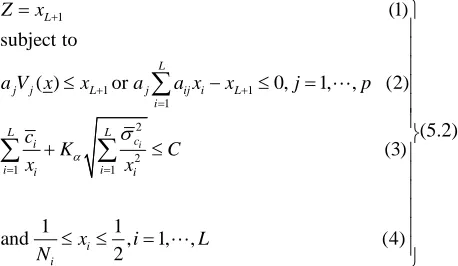
(5.2)
The non-linear programming problem in (5.2) is con-ve
Let us assign the weights to the variances of the two characters in proportion to the inverse of the sums
4 4 1 1 1
and
i
i i
S
i2
S
which turn out to be a10.75 and2 0.25
a .
The total amount available for the survey is as-sumed as 600 units including an expected overhead cost
= 100 units.
C
0
t
Let the chance constraint 2.6 (2) be required to be sat-isfied with 99% probability. Then k is such that
k 0.99 . The value of standard normal variable K
corresponding to 99% confidence limits is 2.33. Thus, the problem (5.2) is obtained as:
x as the objective functions in 5.2 (1) and the constraint 5.2 (2) are linear. Further the left hand side in 5.2 (2) is convex. So it is possible to solve the convex programming problem (5.2) by using any standard convex programming algorithm. The optimal sample numbers thus obtained may turn out to be fractional. However, it is known that the variance functions are flat at the optimum solution. So for large or even moderate sample size it is enough to round the fractional values to the nearest integers. How-ever, for small ni1 xi the branch and bound method should be applied for finding the optimal integer solution.
[image:4.595.58.287.210.343.2]6. Numerical Illustration
Table 1. Data for four strata and two characteristics.
Stratumi Ni Wi
2 1
i
S 2
2
i S
1 1419 0.3387 4817.72 130121.15
2 619 0.1477 6251.26 7613.52
3 1253 0.2990 3066.16 1456.40
4 899 0.2146 56207.25 66977.72
The following numerical example demonstrates the solu-
5
1 2 3 4 5
1 2 3 4 5
2 2 2 2
1 2 3 4 1 2 3 4
1 2
min X Subject to
0.75 552.640 136.277 274.114 2588.343 0
0.25 14926.197 165.9747 130.202 3084.324 0
3 4 5 7 0.6 0.5 0.7 0.8
2.33 500
1 1 1 1 1
, ,
1419 2 619 2 12
X X X X X
X X X X X
X X X X X X X X
X X
3 1, 1 4 1.
53 X 2 899 X 2
(6.1)
The Chebyshev point by solving the convex programming problem (6.1) is
*
0.02159, 0.12169, 0.10866, 0.03882 with
The values of sample sizes rounded to nearest integers ar = 46, = 8, = 9 and = 26, with a to
lu e n1
ar
2
n n3
c
4
n
e
tal of 89. Corresponding to this allocation the values of the v iances for the two haracters ar obtained as V1
= 159.05, V2 = 478.32
Remark: We may compare these results with the com- promise so tion (Cochran [10]) which is obtained by solving the following NLP problem:
1 2 3 4
1 2 3 4
1 2 3 4
2 2 2 2 1 2 3 4
1 2 3
min
552.640 136.277 274.11
n V
4 2588.343
0.75
14926.197 165.39747 130.202 3084.324 0.25
Subject to
3 4 5 7
2.33 0.6 0.5 0.7 0.8 500 2 1419, 2 619, 2 1253
n n n n
n n n n
n n n n
n n n n
n n n
, 2n4899
The integer solution is obtained as = 44, = 9, = 10 and = 29 with a total o . The
s
n problem in multivariate random costs has been formulat
8. References
nd S. Khan, “Optimum Allocation in Mul-ys: An Analytical Solution,” Journal of the
tio
1
n
f 92
2
n
valu oc
Ame
3
n
th are
4
n es of Computational Statistics and Data Analysis6, 2007, pp. 3016-3026. , Vol. 51, No.
e individual variances, corresponding to this all ation obtained as V1 = 144.36 and V2 = 476.90.
7. Conclusion
The optimum allocatio
fied sampling with ed as
a problem in multiple linear objectives under the single probabilistic constraint. An equivalent deterministic mo- del of the stochastic programming problem is established by using Chance Constrained programming method. The problem is then solved by using the Chebyshev appro- ximation technique. A comparative study of the increases in the variance using Chebyshev approximation as com- pared to the compromise allocation is also presented.
[1] A. R. Kokan a tivariate Surve
Royal Statistical Society. Series B, Vol. 29, No. 1, 1967, pp. 115-125.
[2] S. Chatterjee, “Multivariate Stratified Surveys,” Journal of the American Statistical Association, Vol. 63, No. 322, 1968, pp. 530-534.
[3] H. F. Huddlesto, et al., “Optimal Sample Allocation to Strata Using Convex Programming,” Journal of the Royal Statistical Society. Series C, Vol. 19, No. 3, 1970, pp. 273-278.
[4] J. Bethel, “An Optimum Allocation Algorithm for Multi-variate Survey,” Proceeding of the Survey Research Sec-n, American Statistical Association, 1985, pp. 204- 212.
[5] J. R. Chromy, “Design Optimization with Multiple Ob- jectives,” Proceeding of the Survey Research Section,
rican Statistical Association, 1987, pp. 194-199. [6] J. A. Diaz-Garcia and M. M. Garay-Tapia, “Optimum al-
location in Stratified surveys: Stochastic Programming,”
doi:10.1016/j.csda.2006.01.016
[7] S. Javed, Z. H. Bakhshi and M. M. Khalid, “Optimum allocation in Stratified Sampling with Random Costs,” International Review of Pure and Applied Mathematics, Vol. 5, No. 2, 2009, pp. 363-370.
[8] Z. H. Bakhshi, M. F. Khan and Q. S. Ahmad, “Optimal Sample Numbers in Multivariate Stratified Sampling with a Probabilistic Cost Constraint,” International Journal of Mathematics and Applied Statistics, Vol. 1, No. 2, 2010, pp. 111-120.
[9] P. V. Sukhatme, B. V. Sukhatme, S. Sukhatme and C. Asok, “Sampling Theory of Surveys with Applications,” 3rd Edi- tion, Iowa State University Press,Ames, 1984.