doi:10.4236/ti.2011.24024 Published Online November 2011 (http://www.SciRP.org/journal/ti)
An Efficient and Concise Algorithm for Convex
Quadratic Programming and Its Application to
Markowitz’s Portfolio Selection Model
Zhongzhen Zhang1, Huayu Zhang2
1School of Management, Wuhan University of Technology, Wuhan, China
2Institute of Applied Informatics and Formal Description Methods (AIFB), Karlsruhe Institute of Technology (KIT), Karlsruhe, Germany
E-mail: [email protected], [email protected]
Received May 16, 2011; revised September 9, 2011; accepted September 16, 2011
Abstract
This paper presents a pivoting-based method for solving convex quadratic programming and then shows how to use it together with a parameter technique to solve mean-variance portfolio selection problems.
Keywords: Convex Quadratic Programming, Mean-Variance Portfolio Selection Model, Pivoting Algorithm
1. Introduction
There are a variety of algorithms for solving convex quadratic programming (QP). The most well-known one is active set method [1,2]. However this method is diffi-cult to learn for many people due to its operational man-ner. In this paper we present a pivoting-based method for solving convex QP which is efficient for calculating and concise for understanding.
The Karush-Kuhn-Tucker conditions (KKT conditions) of QP is a system of (in) equalities where all the expres-sions are linear equalities or inequalities except for com-plementarity conditions. Like Wolfe’s method [3] we solve the linear part by a kind of pivoting operation while maintaining the complementarity conditions in the computational process. However the system computed by our method has a much smaller size because many variables are deleted from the KKT conditions.
In 1952 Harry Markowitz published the milestone pa-per “Portfolio Selection” in which the portfolio selection problem is formulated as a convex quadratic program with nonnegative variables [4,5]. It is nearly 60 years. However most people still think the model is difficult to solve and few people conduct their investment activities by calculating efficient portfolios for references. We see that every investments textbooks have a figure to show portfolios which are formed by two assets with different correlation coefficients. But we can hardly see a book which has an example to show portfolios formed by three
or more assets in the case of no short sale. We will pre-sent a pivoting-based algorithm together with a parame-ter technique to solve Markowitz’s portfolio selection model in a very simple form. The most important advan-tage of our parameter technique is that it can continu-ously obtain minimal risk portfolios at different levels of return in linear time after a portfolio is established by the pivoting algorithm.
The rest sections of this paper are organized as follows. In Section 2, we introduce a pivoting-based algorithm for solving the system of linear inequalities and the parame-ter technique for generating new basic solutions which are associated with different right-hand side terms. In Section 3, we introduce basic concepts and operations for solving the convex QP. In Section 4, we discuss how to solve Markowitz’s mean-variance portfolio selection model. For brevity, relative theorems and proofs as well as tedious reasoning processes are omitted. For details, the reader refers to [6-8].
2. The System of Linear Inequalities
Consider a system of linear inequalities in the form: = , 1, 2, , ,
, +1, + 2, ,
i i
i i
a x b i l
a x b i l l m
. (2.1)
where = ( , , , )1 2
T n
x x x x
1, 2, ,
i m
, and bi is
a scalar, 1 2
= ( , , , )
i i i in
a a a a
.
em-ployed.
A set of maximum linearly independent vectors of a1, a2, , am is called a basis of (2.1). Vectors in the basis are called basic otherwise called nonbasic. The equalities and inequalities associated with basic vectors are called basic otherwise called nonbasic. The system of basic (in) equalities is called a basic system and whose solution set is called a basic cone. The solution to the system of equations that are corresponding to basic (in) equalities, i.e., the vertex of the basic cone, is called basic solution.
Geometrically, our algorithm begins with a basic cone whose vertex is denoted by x. If x lies on the hy-per-planes determined by every equalities and lies in the half-spaces determined by every inequalities of (2.1), it is a solution to the entire system. Otherwise there exists an inequality (or equality) such as a xr r so that
r which is called a violating inequality against
b
r
a x b
x. If the intersection of the half-space
r rand the basic cone is empty, there is no solution for (2.1). Oth-erwise
a x b
x is projected onto the boundary
r of the half-space where r r replaces a basic inequal-ity to constitute a new basic cone. Then the same process is repeated.
= r a x b a xb
Algebraically, a nonbasic (in) equality replacing a ba-sic inequality is accomplished by the following pivoting operation.
Given a basis of (2.1), let I0, I1, I2 and I3 be the index sets for basic equalities, basic inequalities, nonbasic ine-qualities and nonbasic eine-qualities respectively. Let x be the basic solution, i.e., (1)
j j
a x b , .
Sup-pose that 0
j I I1
2 I
0 1
3 ,
i ij j
j I I
a w a i I
. (2.2)If wrs 0 for an r I3I2 and an s I1, from the rth expression of (2.2) we have
0 1\{ }
1
s rs r rj rs j
j I I s
a w a w w
a . (2.3)Substitute it into the other expressions of (2.2) to yield
0 1\{ }3 2
,
\
i is rs r ij is rs rj j
j I I s
a w w a w w w w a
i I I r
(2.4)
Now, we have a new basic cone whose index set is 0 1 and the associated basic solution is denoted by
\
r I I s
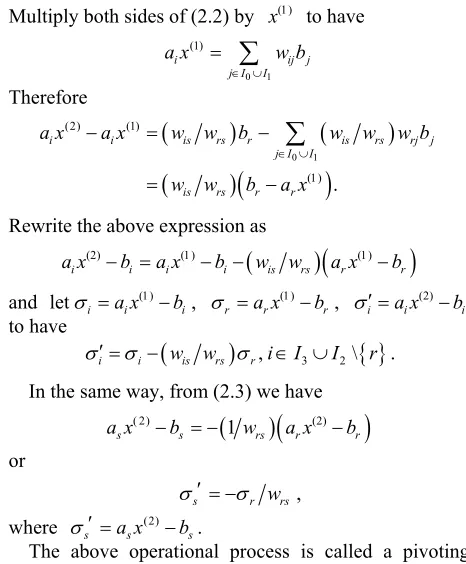
x. Multiply both sides of (2.4) by x on the right to have
0 1
0 1
(2) (2)
(2)
\{ }
.
i is rs r
ij is rs rj j j I I s
is rs r ij is rs rj j
j I I
a x w w a x
w w w w a x
w w b w w w w b
Multiply both sides of (2.2) by x to have
0 1
(1)
i i
j I I
a x w b
j jTherefore
0 1
(2) (1)
.
i i is rs r is rs rj
j I I
is rs r r
a x a x w w b w w w b
w w b a x
jRewrite the above expression as
i i i i is rs r
a x b a x b w w a xb r
i
and leti a xi b , r a xr br , i a xi bi
to have
, 3 2\
i i w wis rs r i I I r
.
In the same way, from (2.3) we have
2 1
s s rs r
a x b w a xb
r or
s r wrs , where (2)
s a xs bs .
The above operational process is called a pivoting (operation) and wrs is called pivot (element). The row of wrs is called pivot row and the column of wrs is called pivot column. We say ar enters and as leaves the basis and the exchange of these two vectors is denoted by ar ↔ as. The process is simply shown by Tables 1 and 2. Where
3 2 0 1
3 2
, \ \
= , \ .
ij ij is rs rj
i i is rs r
w w w w w i I I r j I I s w w i I I r
;
For Table 1, i a xi bi is called the deviation of
ai or the associated (in-) equality with respect to x. If
(1)
3 0,
i a xi bi i I
;
(1)
2 0,
i a xi bi i I
,
then x
(1
a x
is a solution to system (2.1). If
) 0
r r br
[image:2.595.304.537.77.359.2] for some r I2, a x br ris called
Table 1. Initial table.
as aj
ar wrs
wrj σr
ai wis wij σi
Table 2. The result of pivoting.
ar aj
as 1/wrs wrj/wrs σr/wrs
[image:2.595.310.538.574.721.2]231
violating inequality against x and
r r
a x b a
r
is called the distance from x to .
r r
The computational steps for the system of linear ine-qualities are as follows.
a x b
Algorithm 2.1. Pivoting algorithm for system (2.1). Step 1. Construct initial table.
If (2.1) has an inequality in the form of xili, i i
x l is an initial basic inequality; otherwise introduce i
x M into (2.1) and let xi M be the initial ba-sic inequality, i = 1, 2, , n. Where M is a number large enough, i
x M is called artificial inequality and whose coefficient vector is called artificial vector. The initial basic solution is (0)
(0) (0)
1 , ,
T n
x x x where
i i
x l or M, i = 1, 2, , n. The initial basic vector is ei which is the ith row of the identity matrix of order n, i = 1, 2, , n. Other (in) equalities of (2.1) and their coefficient vectors are nonbasic whose deviation with respect to x is . Thus we have an ini-tial table as shown by Table 1.
(0)
i a xi bi
Step 2. Preprocessing.
Let I3 be the index set of equalities, i.e., I3 = 1, , l. 1) If I3 = , go to step 3. Otherwise, for an rI3 if the deviation σr of ar is negative, positive or zero, go to 2), 3) and 4) respectively.
2) If there is no positive element in the row of ar that is corresponding to the basic inequality, (2.1) has no so-lution; otherwise carry out a pivoting on one of the posi-tive elements, let I3I3\ r and return to 1).
3) If there is no negative element in the row of ar that is corresponding to the basic inequality, (2.1) has no so-lution, otherwise carry out a pivoting on one of the nega-tive elements, let I3I3\ r and return to 1).
4) If all of the elements in the row of ar that are corre-sponding to basic inequalities are zeros, let I3I3\ r and return to 1); otherwise carry out a pivoting on one of the non-zero elements, let I3I3\ r and return to 1).
Step 3. Main iterations.
1) If all of the deviations of non-basic vectors are nonnegative, the current basic solution is a solution to (2.1). Otherwise
2) select a non-basic vector with negative deviation to enter the basis. If there is no positive element in the row of entering vector that is corresponding to the basic ine-quality, (2.1) has no solution, otherwise carry out a piv-oting on one of the positive elements and return to 1).
Note that step 1 of Algorithm 2.1 is just a simplified statement for constructing the initial table. In fact, if (2.1) has no inequality xili but has xiui for a finite ui,
i i
x u
can serve as an initial basic inequality and no need to introduce the artificial xi M.
From steps 2 and 3 of Algorithm 2.1 we see that basic equalities never leave the basic system. Because if (2.1) has a solution, it must satisfy all the equalities. Therefore,
once a non-basic equality enters the basic system, the corresponding column can be eliminated.
Sometimes, a system of inequalities has inequalities in the form of bi a x bi i, especially , which are formally written as i iand i i
i i u x l
a x bi
a x b in our method. Let x be the basic solution, then deviations of ai and ai are a x bi iand i i respectively and with a sum of i i
a x b
b b . Since ai and ai are linearly de-pendent, they cannot be basic simultaneously. If one of them is basic, the deviation of the other one is
> 0 i i
b b , hence can be ignored. If both of ai and ai are non-basic, they can share one row in the table since the coefficients in the expressions of ai and ai in terms of basic vectors have reversed signs.
It should be noted that even though the basic solution is not explicitly presented in the table, it can be easily obtained from the table. Let x= ( , , )x1 xn Tbe the basic
solution which is obtained as follows. If xi li or M is basic, xili or M; otherwise xi equals to the devia-tion of this inequality plus li or M. Or if xi ui is basic, xiui; otherwise xi equals to ui minus the de-viation of xi ui.
There are many rules for selecting a vector to enter or leave the basis. We will give several ones which are used in the main iterations stage.
For a given basis of (2.1) let I0, I1 and I2 be index sets for basic equalities, basic inequalities and non-basic ine-qualities respectively. Let x(1) be the current basic so-lution and
0 1
(1)
2
, = ,
i ij j i i i
j I I
a w a a x b i
I
.Rule 1. (The smallest deviation rule). Among all the non-basic vectors with negative deviations, select a vec-tor ar having the smallest deviation to enter the basis. That is if r= min{ : i i< 0,i I 2}, then ar enters the basis.
Rule 2. (The largest distance rule). Among all the non-basic vectors with negative deviations, select a vec-tor ar whose associated inequality is farthest away from the current basic solution to enter the basis. That is if
2
|| || = min || || : < 0,
r ar i ai i
i I , then ar enters the basis.
Rule 3. (Rule of the farthest distance along an edge). Among all the non-basic vectors with negative deviations, select a vector ar whose associated inequality is farthest away from the current basic solution along an edge of the basic cone to enter the basis. That is if r wrs =
2
min i wis:i < 0 andwis > 0,iI for an sI1, then
ar enters the basis.
having the smallest index to leave the basis. That is if , then ar enters the basis; and if
2min : i < 0 r i I
min : > 0
s j I w 1 rj , then as leaves the basis. Like Bland’s anti-cycling rule [9], it can be proved that when the smallest index rule is used to solve system (2.1), cycling doesn’t occur.
[image:4.595.56.289.236.441.2]Now let us consider the parameter technique by which a new basic solution can be obtained from the current table by changing the right-hand side terms of some ba-sic (in) equalities.
For a basis of (2.1), let IB and IN denote the index sets of basic and nonbasic vectors respectively and x be the basic solution. Suppose
,
B
i ij j
j I
a w a i
IN.Multiply both sides by x, since ajx = bj, j IB, to have
B
i i
j I
a x w b
j j .Therefore the deviation of the nonbasic ai is ,
B
i i i ij j i N
j I
a x b w b b i I
.If bj is changed to bj + j, j IB, the deviation of ai becomes
,B B
i ij j j i i ij j
j I j I
w b b w i I
N. (2.5)The above operation is denoted by + j
j
a , j IB. Usually we just change the right-hand side of one ba-sic (in) equality such as changing bs to bs + for an s IB. Then the deviation of ai becomes
, i i wis i IN
. (2.6) It indicates that when the right-hand side of a basic (in) equality is increased by , deviations of nonbasic vectors with respect to the new basic solution can be obtained by multiplying the column of this basic (in) equality by , and then add it to the last column (the deviation column). We will use as
to denote such an operation which
gives the result (2.6).
3. Convex Quadratic Programming
3.1. Fundamental Concepts and Algorithm Consider quadratic programming in this form:
1 min ( )
2
s.t. , 1, 2, , , , 1, 2, , , 1, 2, , .
T
i i
i i
i i
f x x Hx cx
a x b i l
a x b i l l m
x l i n
where
1, 2 ,
T n
x x x x , H
hij n n is positive semi- definite, c
c c1, , ,2 cn
, , bi and liare real numbers.
1 2
, , ,i i i i
a a a an
Let λi be the Lagrange multiplier associated with
i i
a x b or , i be the Lagrange multiplier as-sociated with i i
i
a x b i
x l , and ei be the ith row of the identity matrix of order n. The KKT conditions for (3.1) are as follows.
1 1
m n
T T
i i i i
i i
T
Hx c a e
,0, ( ) 0, 1, 2, , i i a x bi i i l l m
,
0, 0, 1, 2, ,
i i xi li i
n
,
, , 1, 2, ,
i i
a x b i l
, 1, 2, ,
i i
a x b i l l m, , 1, 2, ,
i i .
x l i n
Since
1 2
1 1
, , , 0
m n T
T T T
i i i i n
i i
Hx a c e
,eliminate all the i from above KKT conditions to have
1 1 1 1
1 1
1 1
1 1 1 1
1 1
, 1, 2, , ,
, 1, 2, ,
, 1, 2, ,
, 1, 2, , ,
0, 1, 2, , ,
0 1, 2, , , 0
i in n i mi i i
i in n i
i in n i
i i
i
i in n i mi i i i i
i in n i i
h x h x a a c i n a x a x b i l
a x a x b i l l m x l i n
i l l m
h x h x a a c x l
i n
a x a x b
,i l 1,l2, , . m
(3.2) We will solve the linear part of (3.2) by Algorithm 2.1 while maintaining all of the complementarity conditions.
(3.2) has n + m variables where λ1, λ2, , λl are free. In order to initiate the computation, we introduce artifi-cial inequalities
1 M, 2 M, , l M
into (3.2). The coefficient vectors of first n + m (in) equalities of (3.2) are
1, , , 1
, 1, 2, ,i i in i mi
h h h a a i n,
1, , ,0, ,0 ,
1, 2, ,i i in
a a a i m,
and the coefficient vectors of last n + m inequalities are denoted by ei which is the ith row of the identity matrix of order n + m, i = 1, 2, , n + m.
,
(3.1)
233
i
1 1 1 1
i in n i mi i
h x h x a a c and xili,
0
i
and a xi1 1 a xin nbi
are called complementary inequalities, and their coeffi-cient vectors are called complementary vectors in which
1, , , ,2 n n1, n2, , n m
h h h e e e
are called Lagrange vectors and 1, , , , , , ,2 n 1 2 m
e e e a a a
are called constraint vectors, and the associated inequali-ties are called Lagrange inequaliinequali-ties and constraint (in) equalities respectively.
According to the definition of basic solution of the system of linear inequalities, if one of the tary inequalities is basic, the corresponding complemen-tarity condition is satisfied. Hence we will keep one of them basic and the other one nonbasic in the computa-tional process.
The initial basic system for solving (3.2) is
1 1, , n n
x l x l ,
1 M, , l M, l 1 0, , m 0
, i.e., e1, , en, en+1, , en+m are initial basic vectors, and
(0)
1, , , , , ,0, ,0
T n
y l l M M
i is initial basic solution; hi and ai are initial nonbasic vectors with deviations
(0)
1 1 1
i h yi ci h li h lin n ai a M cli
,
1, 2, , i n, and
(0)
1 1
n i a yi bi a li a lin n bi
,
1, 2, , i m.
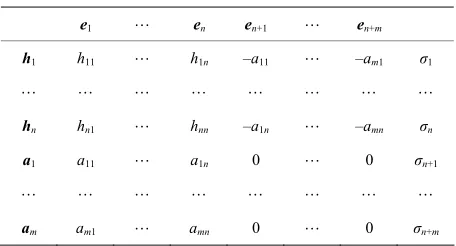
The representation of nonbasic vectors in terms of ba-sic ones and their deviations are given in Table 3.
Since a1, , al are coefficient vectors of equalities, we first put them into the basis as many as possible. Without loss of generality, suppose that a1, , al are
[image:5.595.58.286.596.719.2]
Table 3. Initial table for (3.2).
e1 en en+1 en+m
h1 h11 h1n –a11 –am1 σ1
hn hn1 hnn –a1n –amn σn
a1 a11 a1n 0 0 σn+1
am am1 amn 0 0 σn+m
linearly independent and suppose l pivoting operations can be carried out along the diagonal of the sub-matrix
11 1
1
l
l l
a a
a a
l
l
.
In order to maintain the complementarity conditions, another l pivoting operations are carried out along the diagonal of
11 1
1
l
l l
a a
a a
which translate the l basic artificial vectors out of the basis. The above 2l pivoting operations are called pre-processing. Since the basic solution must satisfy every equality constraints, once an equality enters the basic system, it is never selected to leave the basic system. For this reason, the columns of basic equalities and the asso-ciated rows of artificial inequalities can be deleted from the table. It implies that the upper bound M of the artifi-cial variable may be any number. For convenience of computation, we always take M = 0.
The computational process following the preprocess-ing is called main iterations where each table is called general (pivoting) table, as shown by Table 4.
Where hN and hB are a partition of the Lagrange vec-tors h1 hn , en+N and en+B are a partition of the La-grange vectors en1, , enm, eN and eB as well as aN and aB are partitions of the constraint vectors e1, , en and a1, , am respectively, and h, λ, e, a in the last column are vectors formed by deviations of the cor-responding nonbasic vectors.
We say the principal sub-matrix associated with non-basic Lagrange vectors and non-basic constraint vectors to be Lagrange matrix and denote it by L, and say the principal sub-matrix associated with nonbasic constraint vectors and basic Lagrange vectors to be constraint matrix and denote it by . For the initial table, L = H and = O; for Table 4,
11 12 T 12 22
L L
L
L L
and .
11 12
12T 22
D D
D D
Table 4. The general table.
eB aB hB en+B
hN L11 L12 11 T
E
21
T
E
h
en+N 12 T
L L22 12 T
E
22
T
E
λ
eN E11 E12 D11 D12 e
It can be proved that both Lagrange matrix and con-straint matrix are positive semi-definite when the Hes-sian matrix H of (3.1) is positive semi-definite. A posi-tive semi-definite matrix has the property that if the ith diagonal entry is zero, then all the entries in the ith row and in the ith column are zeros.
Main iterations involve two kinds of operations. One is called principal pivoting which is carried out on a pos-itive diagonal element of the table. The other one is called double pivoting which is carried out on a pair of symmetric off-diagonal elements successively while the diagonal element is zero. The 2l pivoting operations in the preprocessing stage are l double pivoting operations.
The basic solution associated with Table 4 is
, , 0,
B B N e N B N
x l x l .
Besides, we have B 0 and N h. Where lB and lN are vectors formed by the right-hand side terms of basic and nonbasic xili, λB and λN are vectors formed by basic and nonbasic multipliers of λ1, λ2, , λm, B and N are vectors formed by basic and nonbasic multipliers of μ1, μ2, , μn respectively.
Computational steps for the convex QP are as follows. Algorithm 3.1. Computational steps for (3.2).
Step 1. Initial step. Let
1 1, , n n, 1 0, , m 0 x l x l
be the initial basic system and construct initial table given by Table 3.
Step 2. Preprocessing.
For i = 1, 2, , l, when the deviation of ai is less than, greater than, or equal to 0, go to 1), 2) and 3) respec-tively.
1) If there is no positive elements in the row of ai that are corresponding to basic inequalities, there is no feasi-ble solution, stop; otherwise carry out a pivoting on one of the positive elements and then carry out a pivoting on the symmetric element.
2) If there is no negative elements in the row of ai that are corresponding to basic inequalities, there is no feasi-ble solution, stop; otherwise carry out a pivoting on one of the negative elements and then carry out a pivoting on the symmetric element.
3) If all the elements in the row of ai that are corre-sponding to basic inequalities are zero, delete the row of ai and then delete the column of en+i; otherwise carry out a pivoting on one of the nonzero elements and then carry out a pivoting on the symmetric element.
Step 3. Main iterations.
1) If all the deviations of nonbasic vectors (except for nonbasic Lagrange vectors en+1, , en+l that are corre-sponding to equality constraints) are non-negative, the
current basic solution is the solution to (3.2), stop; oth-erwise select a nonbasic vector with negative deviation to enter the basis.
2) If there is no positive element in the row of the en-tering vector that is corresponding to the basic inequality, (3.2) has no solution, stop. Otherwise
3) if the diagonal element in the row of the entering vector is positive, carry out a pivoting on that diagonal element, return to 1); otherwise carry out a pivoting on the largest off-diagonal element in the row of the enter-ing vector, and then carry out a pivotenter-ing on the symmet-ric element, and return to 1).
We will prove that the smallest index rule can prevent cycling even though it may involve more pivoting opera-tions than the smallest deviation rule does. Here each pair of complementary vectors has the same index. For example, hi and ei have index i for i = 1, 2, , n, and ai and en+i have index n + i for i = 1, 2, , m.
If cycling occurs, some vectors would enter and leave the basis repeatedly. Let s be the largest index of such vectors and consider two tables in the computational process. In one table the sth Lagrange vector enters and the sth constraint vector leaves the basis, and in the other table just reverse. Let P and Q be the principal sub-ma- trices associated with complementary nonbasic vectors of these two tables, and P and Q be deviations associ-ated with P and Q respectively. Then Q P ,
Q P
Q and
0
T T
P Q PQ P
where Q can be partitioned into a 2 2 matrix as shown in Table 4 or positive definite. It contradicts the assump-tion that the components of P and Q with index s are negative and other components are nonnegative.
3.2. Convex QP with Upper Bounded Variables Now let us consider the quadratic programming where variables are bounded from above:
1min
2
s.t. , 1, 2, , , , 1, 2, ,
, 1, 2, , . T
i i
i i
i i i
f x x Hx cx
a x b i l
a x b i l l m
u x l i n
,
(3.3)
Let
,
1 1 1 1 ,1, ,
i i in n i mi i
h x h x h x a a c
i n
i
and let I1 and I2 be a partition of 1, , n, i.e., I1 I2 =
235
1
2
, 0, , , 0, ,
, 0, , , 0,
, 0, 0, 1, , ,
, 1, 2, , ,
i i i i i i
i i i i i i
i i i i i i
i i
h x x l h x x l i I
h x x u h x x u i I
a x b a x b i l m
a x b i l
,
(3.4) and every components of x satisfy xi ui
i I 1
and xili
i I 2
, then x is the optimal solution for(3.3).
The solution of (3.4) is as follows.
Firstly, let I1 = 1, 2, , n and I2 = , i.e., ignoring all the upper bounds ui, to solve (3.4) where the first two steps of Algorithm 3.1 are applied. In the following computational process we will make the basic solution satisfy not only xili but also xi ui. That is we should make deviations of both ei and ei non-negative. In other words, if the deviation of ei or ei is negative, then it is a candidate to enter the basis.
If ei is entering the basis but it does not appear in the table, we change the table as follows. Replace the devia-tion σi of ei with ui liσi, reverse signs of other entries in the row of ei, and then substitute ei for ei; reverse signs of entries in the column of hi and then substitute hi for hi. The above operation is called a vector substi-tution for ei. It amounts to replacing the nonbasic xili with xi ui and replacing the basic h xi , 0 with h xi , 0. Similarly, if ei is entering the basis but it does not appear in the table, we update the table by conducting a vector substitution for ei.
Another problem in solving (3.4) is that when a La-grange vector hi, hi or en+i is entering the basis, all the entries in this row are non-positive. In this situation, the change of the table is stated in the following 1) and 2).
1) Suppose that the Lagrange vector hi is entering the basis but all the entries in this row are non-positive. In this case we conduct a vector substitution for hi, i.e., re-verse signs of all the entries in the row of hi and then substitute hi for hi; reverse signs of entries in the col-umn of ei and then substitute ei for ei. It amounts to re-placing the nonbasic h xi , 0 with h xi , 0 and replacing the basic xili with xi ui. The associ-ated equalities of the last two inequalities are xili and
i i
x u , therefore the change of the right-hand side of i i
x l is ui li. Considering signs of all the entries in the column of ei had been reversed, by (2.6) we multiply the column of ei by li ui, and then add it to the devia-tion column. Similarly, if hi is entering the basis but all the entries in this row are non-positive, we conduct a vector substitution for hi
2) Suppose that the Lagrange vector en+ii = l + 1, , m is entering the basis but all the entries in this row are non-positive. We see that en+i is a n + m dimensional unit
vector with 1 at the (n + i) th position, hi and hi are n + m dimensional vector whose last m components are not all zeros, and the last m components of constraint vectors are zeros. It implies that the expression of en+i in terms of basic vectors must contain hj or hj. Suppose that wij is a negative off-diagonal entry in the row of en+i and in the column of hj= hj or hj. We conduct a vector substi-tution for en+i in this way: reverse signs of entries in the column of hj and then substitute hj for hj; replace the deviation j of ej= ej or ej with uj lj j, re-verse signs of other entries in the row of ej, and then substitute ej for ej. This substitution transforms wij into a positive number so that a regular pivoting en+i↔
j
h can be carried out.
Now let us give the algorithm for solving (3.3). In this algorithm, the non-basic vectors include not only those listed in the table but also those that are not listed in the table where ei = eior ei and i = hi or hi.
Algorithm 3.2. Computational steps for (3.4).
h
Step 1. Initial step, see step 1 of Algorithm.3.1. Step 2. Preprocessing, see step 2 of Algorithm 3.1. Step 3. Main iterations.
1) If all the deviations of non-basic vectors except for en+1, , en+l are non-negative, the current basic solution is optimal for (3.3), stop. Otherwise
2) select a non-basic vector with negative deviation to enter the basis. If the entering vector is ai, , ei hi or en+i, go to a), b), c), d) respectively.
a) If all the entries in the row of ai that are corre-sponding to basic inequalities are non-positive, (3.3) has no feasible solution, stop. If the diagonal entry in the row of ai is positive, carry out a pivoting on that entry, return to 1); otherwise carry out a pivoting on the largest entry in the row of ai and then carry out a pivoting on the symmetric entry, return to 1).
b) If ei is not listed in the table, conduct a vector sub-stitution for ei. In the row of the entering vector ei, if all the entries that are corresponding to basic inequalities are non-positive, (3.3) has no feasible solution, stop; otherwise if the diagonal entry is positive, carry out a pivoting on that entry, return to 1); otherwise carry out a pivoting on the largest entry and then carry out a pivot-ing on the symmetric entry, return to 1).
c) If the diagonal entry in the row of i is positive, carry out a pivoting on that entry, return to 1); otherwise if there is a positive entry in the row of i, carry out a pivoting on the largest entry and then carry out a pivot-ing on the symmetric entry, return to 1); otherwise con-duct a vector substitution for , return to 1).
h
h
i
d) If the diagonal entry in the row of en+i is positive, carry out a pivoting on that entry, return to 1); otherwise if there is a positive entry in the row of en+i, carry out a pivoting on the largest entry and then carry out a
ing on the symmetric entry, return to 1); otherwise con-duct a vector substitution for en+i, return to 1).
4. Mean-Variance Portfolio Optimization
4.1. Markowitz’s Portfolio Selection Model Suppose that there are n assets for selection. The rates of return of these n assets are R1, , Rn (random variables) whose means are r1, , rn respectively and the covari-ance matrix is ij n n
H where ij COV R R i, j. Let x1, x2, , xn be fractions of n assets. The problem is to determine the portfolio (x1, x2, , xn) so that it has a minimal variance risk at a certain level of expected re-turn rate. It is formulated as follows.
1 1
1
1 1 min
2
s.t. ,
1, , , 0,
T
n n p
n
n x Hx
r x r x r
x x
x x
(4.1)
where x= ( ,x x1 2, )xn T and rp is the expected return rate of the investor. Obviously, rp should satisfy
1
1min r, , rn rp max r, , rn
to ensure the feasibility.
The KKT conditions of model (4.1) are
1 1 1 2
1
1 1
1
1 1 1 2
0, 1, ,
1, ,
, , 0,
0, 1, , .
i in n i
n
n n p
n
i in n i i
x x r i n
x x r x r x r x x
x x r x i
n
. (4.2)
Add up the n complementarity conditions to have , thus
1 2 0
T
p
x Hx r
1 2
T
p
x Hx r .
This is another way to compute the variance risk of the portfolio.
(4.1) is a special case of (3.1) mainly in that (4.1) has no general inequality constraints and has feasible solu-tions. It makes the computation of (4.1) much easy.
Algorithm 4.1. Pivoting algorithm for (4.2). Step 1. Initial step.
Let
1 0, , n 0, 1 0, 0
x x 2
be the initial basic system to construct initial table as shown by Table 5.
Where e1, , en, en+1, en+2 are coefficient vectors of the initial basic system which are the n + 2 rows of the
[image:8.595.344.498.525.583.2]
Table 5. Initial table.
e1 ... en en+1 en+2
h1 σ11 ... σ1n 1 r1 0
... ... ... ... ... ... ...
hn σn1 ... σnn 1 rn 0
e 1 ... 1 0 0 1
r r1 ... rn 0 0 rp
identity matrix of order n + 2, hi(i1, ,in, 1, ri),
1, 1,0,0
e and r( , , ,0,0)r1 rn . Step 2. Preprocessing.
Suppose that r1 min
r1, , rn
, r2 max
r1, , rn
2
and r1r . Carry out four pivoting operations as fol-lows:
e ↔ e1, h1↔ en+1, r ↔ e2, h2↔ en+2. Step 3. Main iterations.
1) If all the deviations of nonbasic vectors except for en+1 and en+2 are nonnegative, the current basic solution is the solution of (4.2), stop. Otherwise
2) select a nonbasic vector except for en+1 and en+2 with the most negative deviation to enter the basis. If the diagonal entry in the row of entering vector is positive, carry out a pivoting on that entry, return to 1); otherwise carry out two pivoting operations first on the largest en-try in the entering vector row and then carry out a pivot-ing on the symmetric entry, return to 1).
Denote rank (H) by the rank of H. It can be proved that among n basic vectors e1, , en at most rank (H) + 2 ones may be pivoted out of the basis. It implies that at most rank (H) + 2 components of
1
( , , )x xn may be nonzeros.
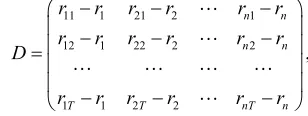
Let ri1, , riT be the realization of Ri in T periods, then ri
Tt1r Titn
. Let
11 1 21 2 1
12 1 22 2 2
1 1 2 2
n n
n n
T T nT
r r r r r r r r r r r r D
r r r r r r
,
then the covariance matrix HD D TT 1 . Since D
is an T n matrix, rank (H) is no more than T. Therefore each portfolio obtained by Algorithm 4.1 contains no more than T + 2 assets no matter how larger n is.
237
minimal mean to the maximal mean of the 1072 stocks. Each pivoting requires about 1074 1075 multiplica-tions and addimultiplica-tions. Therefore the total amounts of com-putation are 80 1074 1075 and 314 1074 1075 multiplications and additions respectively. We know that it requires about 10723/3 multiplications and additions to solve a system of 1072 linear equations in 1072 variables by Gaussian elimination.
Now let us give a small example to show how to solve the portfolio problem by using Algorithm 4.1 and the parameter technique introduced in section 2.
Example 1. An investor is interested in three assets. The means of these three assets are 0.05, 0.11 and 0.08,
and the covariance matrix is . Solve
0.54 0.11 0.09 0.11 0.32 0.02 0.09 0.02 0.21
a portfolio with the minimal variance risk at expected return rate rp =0.07, 0.08, 0.09 or 0.1.
Solution. The model of this problem is
1 2 3
1 2 3
1 2 3
1 min
2
s.t. 1,
0.05 0.11 0.08 ,
, , 0,
T
p
x Hx x x x
x x x
x x x
r
where 1, ,2 3
T
x x x x , H is the covariance matrix and rp = 0.07, 0.08, 0.09 or 0.1.
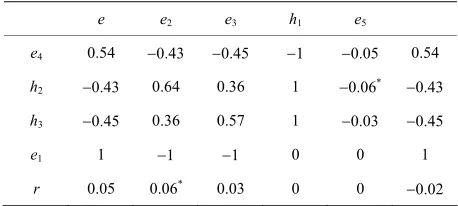
The initial table for rp = 0.07 is given by Table 6. Since the minimal mean is in the first column, we car-ry out a double pivoting to have Ta-ble 7.
1, 1 4
e e h e
Since the maximal mean is in the second column of the initial table, we carry out a double pivoting (re2,
to have Table 8. 2
h e5
In Table 8, ignoring the deviations of e4 and e5 since they are associated with equalities, there is only one negative deviation 0.2217 taken by h3. Therefore h3 enters the basis. Since the diagonal entry 0.37 in the row of h3 is positive, carry out a principal pivoting on 0.37 to yield Table 9 ignoring the last three columns.
From the column rp = 0.07 we see that all the devia-tions of nonbasic vectors except for e4 and e5 are positive, therefore the minimal risk portfolio for rp = 0.07 is
1 2 3
( , , )x x x = (0.3671, 0.0338, 0.5991), and 1 = 0.4165 and 2 = 3.2117. The variance risk of this portfolio is
1 + 2rp = 0.4165 3.2117 0.07 = 0.1916. Now consider the portfolio with rp = 0.08. since = 0.08 – 0.07 = 0.01, by (2.6), we multiply the column of r by 0.01 and then add it and the column of rp = 0.07 to get the column of rp = 0.08. We see that the last three numbers of the column of rp = 0.08 are still positive. Therefore the
minimal risk portfolio for rp = 0.08 is ( , , )x x x1 2 3 = (0.2095, 0.2095, 0.5811), and 1 = 0.2607 and 2 =
1.4459. The variance risk of this portfolio is 1 + 2rp = 0.2607 1.4459 0.08 = 0.1451. For rp = 0.09, since = 0.09 – 0.08 = 0.01, we multi-ply the column of r by 0.01 and then add it and the col-umn of rp = 0.08 to get the column of rp = 0.09. We see that the last three numbers of the column of rp = 0.09 are positive also. Therefore the minimal risk portfolio for rp = 0.09 is ( , , )x x x1 2 3 = (0.0518, 0.3851, 0.5631), and
1 = 0.1050 and 2 = 0.3198. The variance risk is
1 + 2rp = 0.1050 + 0.3198 0.09 = 0.1338. In the same way, we can get the column of rp = 0.1. We see that the deviation of e1 is negative and the di-agonal entry is positive. Carry out a pivoting e1↔ h1 to have Table 10.
From Table 10 we see that the last three deviations are positive. Therefore the minimal risk portfolio for rp = 0.1 is ( , , )x x x1 2 3 = (0, 0.6667, 0.3333), and 1 = 0.2811 and 2 = 4.5556. The variance risk of this portfolio is
1 + 2rp = 0.2811 + 4.5556 0.1 = 0.1744.
4.2. Portfolio of Upper Bounded Assets
For institutional investors some asset such as a stock is not allowed greater than a limited ratio of the total capi-tal. In this situation the model with upper bounded vari-ables is required. Let ui be the upper bound for asset xi that satisfies u1 un1 and for i = 1,
, n. This problem is formulated as
0 <ui1
[image:9.595.308.537.485.588.2]
Table 6. Initial table for rp= 0.07.
e1 e2 e3 e4 e5
h1 0.54 0.11 0.09 1* 0.05 0
h2 0.11 0.32 0.02 1 0.11 0
h3 0.09 0.02 0.21 1 0.08 0
e 1* 1 1 0 0 1
r 0.05 0.11 0.08 0 0 0.07
Table 7. Result of first double pivoting.
e e2 e3 h1 e5
e4 0.54 0.43 0.45 1 0.05 0.54
h2 0.43 0.64 0.36 1 0.06* 0.43
h3 0.45 0.36 0.57 1 0.03 0.45
e1 1 1 1 0 0 1
r 0.05 0.06* 0.03 0 0 0.02
[image:9.595.308.537.616.719.2]
Table 8. Result of second double pivoting.
e r e3 h1 h2
e4 1.7011 –16.0556 –0.2683 –1.8333 0.8333 0.5722
e5 –16.0556 177.7778 0.6667 16.6667 –16.6667 –3.6111
h3 –0.2683 0.6667 0.37* 0.5 0.5 –0.2217
e1 1.8333 –16.6667 –0.5 0 0 0.6667
[image:10.595.56.539.95.199.2]e2 –0.8333 16.6667 –0.5 0 0 0.3333
Table 9. Result of first principal pivoting.
e r h3 h1 h2 rp= 0.07 rp= 0.08 rp= 0.09 rp= 0.1
e4 1.5065 –15.5721 –0.7252 –1.4707 1.1959 0.4165 0.2607 0.1050 –0.0507
e5 –15.5721 176.5766 1.8018 15.7658 –17.5676 –3.2117 –1.4459 0.3198 2.0856
e3 0.7252 –1.8018 2.7027 –1.3514 –1.3514 0.5991 0.5811 0.5631 0.5450
e1 1.4707 –15.7658 –1.3514 0.6757* 0.6757 0.3671 0.2095 0.0518 –0.1059
[image:10.595.53.539.367.469.2]e2 –1.1959 17.5676 –1.3514 0.6757 0.6757 0.0338 0.2095 0.3851 0.5608
Table 10. Result of principal pivoting for rp = 0.1.
e r h3 e1 h2
e4 4.7078 –49.8889 –3.6667 –2.1767 2.6667 –0.2811
e5 –49.8889 544.4445 33.3333 23.3333 –33.3333 4.5556
e3 3.6667 –33.3333 0 –2 0 0.3333
h1 –2.1767 23.3333 2 1.48 –1 0.1567
e2 –2.6667 33.3333 0 1 0 0.6667
1 1
1 1 min
2
s.t. ,
1,
0 , 1,
T
n n p
n
i i
x Hx
r x r x r x x
, .
x u i n
(4.3)
where min p max to ensure the feasibility. The minimal value of rp is obtained as follows. Suppose that
1 2 . Distribute 1 to x1, x2, , xn sequentially such that
r r r
n
r
1 1
r r
x u, x2u2,, xk1uk1, xk v where and 0 . Then
1 2
u u uk1 v 1 v uk
min 1 1 2 2 k 1 k 1 k
r r u r u r u rv.
Similarly, we can obtain the maximal value rmax of rp. The algorithm for (4.3) is as follows.
Algorithm 4.2. Computational steps for (4.3). Step 1. Initial step, see step 1 of Algorithm 4.1. Step 2. Preprocessing, see step 2 of Algorithm 4.1. Step 3. Main iterations.
1) If all the deviations of non-basic vectors except for
en+1 and en+2 are non-negative, the current basic solution is optimal for (4.3), stop. Otherwise
2) select a non-basic vector with negative deviation to enter the basis. If this vector is not listed in the table, conduct a vector substitution. If the diagonal entry in that row is positive, carry out a pivoting on that entry, return to 1); otherwise carry out a pivoting on the most positive entry in that row and then carry out a pivoting on the symmetric entry, return to 1).
Example 2. In Example 1, each asset is not allowed to exceed 50%. Solve a minimal risk portfolio with rp = 0.09.
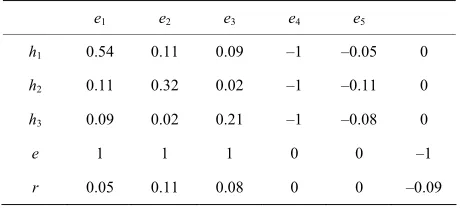
Solution. The initial form is given by Table 11. As done for Example 1, carrying out 4 pivoting opera-tions e ↔ e1, h1↔ e4, r ↔ e2, h2↔ e5, and then carrying out a principal pivoting h3 ↔ e3, we have Table 12 where the columns of e and r and the rows of e4 and e5 are deleted.
239
Table 11. Initial table for rp= 0.09.
e1 e2 e3 e4 e5
h1 0.54 0.11 0.09 –1 –0.05 0
h2 0.11 0.32 0.02 –1 –0.11 0
h3 0.09 0.02 0.21 –1 –0.08 0
e 1 1 1 0 0 –1
r 0.05 0.11 0.08 0 0 –0.09
Table 12. Result of 5 pivoting operations.
h3 h1 h2
e3 2.7027 –1.3514 –1.3514 0.5631
e1 –1.3514 0.6757 0.6757 0.0518
e2 –1.3514 0.6757 0.6757 0.3851
Table 13. Result of vector substitution for e3.
h3 h1 h2
e3 2.7027* 1.3514 1.3514 0.0631
e1 1.3514 0.6757 0.6757 0.0518
e2 1.3514 0.6757 0.6757 0.3851
Table 14. Final table.
e3 h1 h2
h3 0.37 –0.5 –0.5 0.0233
e1 0.5 0 0 0.0833
e2 0.5 0 0 0.4167
in the current table. For this we conduct a vector substi-tution for e3: replace the deviation 0.5631 of e3 with 0.5
0.5631 = 0.0631, reverse signs of other entries in the row of e3, and then substitute e3 for e3; reverse signs of entries in the column of h3 and then substitute h3 for h3. It results in Table 13.
In Table 13 we carry out a pivoting on the diagonal entry 2.7027 to yield Table 14.
Now all the deviations are positive and no assets are greater than 0.5. Hence we get the required portfolio. Since e3 is basic, x3 = u3 = 0.5, and x1 = 0.0833, x2 = 0.4167. The variance risk xTHx = 0.1353.
An experiment was conducted by using the same data
with n = 1072 and T = 69. For ui = 0.1, i = 1, 2, , n, it experiences about 95 pivoting operations to obtain one efficient portfolio and 347 pivoting operations to obtain 20 minimal variance portfolios with different values of rp. Each pivoting requires about 1074 1075 multiplica-tions and addimultiplica-tions. Therefore the total amounts of com-putation are 95 1074 1075 and 347 1074 1075 multiplications and additions respectively.
5. Conclusions
In this paper we proposed a series of pivoting-based al-gorithms for solving the following problems:
the system of linear inequalities; convex quadratic programming;
mean-variance portfolio selection problems.
These algorithms are concise for understanding and efficient for computing as shown by the numerical ex-amples and computer experiments for 1072 stocks. We also proved the convergence of the smallest index rule for convex QP therefore for mean-variance portfolio op-timization for the first time.
6. References
[1] R. Fletcher, “Practical Method of Optimization: Constrained Optimization,” John Wiley & Sons, New York, 1981. [2] J. Nocedal and S. J. Wright, “Numerical Optimization,”
Science Press of China, Beijing, 2006.
[3] P. Wolfe, “The Simplex Method for Quadratic Program-ming,” Econometrica, Vol. 27, No. 10, 1959, pp. 382-398.
doi:10.2307/1909468
[4] H. Markowitz, “Portfolio Selection,” The Journal of Fi-nance, Vol. 7, No. 1, 1952, pp. 77-91.
doi:10.2307/2975974
[5] H. M. Markowitz and G. P. Todd, “Mean-Variance Analy-sis in Portfolio Choice and Capital Markets,” Frank J. Fabozzi Associates, Pennsylvania, 2000.
[6] Z. Z. Zhang, “Convex Programming: Pivoting Algorithms for Portfolio Selection and Network Optimization,” Wuhan University Press, Wuhan, 2004.
[7] Z. Z. Zhang, “Quadratic Programming: Algorithms for Nonlinear Programming and Portfolio Selection,” Wuhan University Press, Wuhan, 2006.
[8] Z. Z. Zhang, “An Efficient Method for Solving the Local Minimum of Indefinite Quadratic Programming,” 2007. http://www.numerical.rl.uk/qp/qp.html