doi:10.4236/sgre.2011.24037 Published Online November 2011 (http://www.SciRP.org/journal/sgre)
Study and Implementation on Batteries Charging
Method of Micro-Grid Photovoltaic Systems
Tiezhou Wu*, Qing Xiao, Linzhang Wu, Jie Zhang, Mingyue Wang
School of Electrical & Electronic Engineering, Hubei University of Technology, Wuhan, China. Email: *[email protected]
Received September 5th, 2011; revised September 26th, 2011; accepted October 3rd, 2011.
ABSTRACT
In the micro-grid photovoltaic systems, the random changes of solar radiation enable lead-acid batteries to experience
low SOC (State of Charge) or overcharged for periods of time if directly charged with such traditional methods as de-
creased charging current, which will reduce lifetime of batteries. What’s more, it’s difficult to find a proper reduction
coefficient in decreasing charging current. To adapt to the random changes of circumstance and avoid selecting the
reduction coefficient, a new fast charging method named decreased charging current based on SOC is proposed to ap-
ply into micro-grid photovoltaic systems. It combines batteries’ SOC with the maximum charging voltage to determine
the charging rate without strictly selecting reduction coefficient. By close-loop current control strategy and related
scheme, the experiment proves the new method is feasible and verifies that, comparing with decreased charging current,
the improved method make batteries’ SOC reach 100% in shorter time as well as the temperature of batteries raise
more slowly.
Keywords: Micro-Grid Photovoltaic System, Decreased Charging Current Based on SOC, Charging Rate, Reduction
Coefficient
1. Introduction
Micro-grid photovoltaic system is capable of operating normally under the condition of connected grid or off- grid, featuring with small scale, low voltage class and easy management. More, energy storage device plays a significant role in maintaining the dynamic power bal- ance in entire system [1]. Lead-acid batteries generally act as the main energy storage in micro-grid photovoltaic system due to its low cost and easy of availability. The whole structure of micro-grid photovoltaic system is shown in Figure 1. Unidirectional arrow and bidirec- tional arrow respectively respect energy flow one direc- tion and both directions. Contact point 1 in the composite switch works if the system connects grid, otherwise, contact point 2 works. Given the public grid is out of work, the system will continually power the significant load for a few hours. Batteries, PV arrays and inverter compose a power generation system for the significant load.
Random changes of solar radiation make batteries ex- perience a low SOC for periods of time, which may lead to acid stratification or produce sulphate. Therefore, the life of batteries in photovoltaic system is shorter than any
other application area. It is essential to search a charging method that keeps the batteries in higher SOC within shorter time when the output energy of PV array is suffi- cient [2,3]. The paper firstly analyzes the advantages and disadvantages among the traditional charging methods for lead-acid batteries in photovoltaic system. Secondly it proposes the decreased charging current based on SOC evaluated by modified dynamic voltage model. At last, it proves the new method is feasible by close-loop current control strategy and related scheme in 10 KW micro-grid photovoltaic inverter prototype.
2. Traditional Charging Method in
Photovoltaic System
2.1. Three-Stage Charging
Boost circuit (MPPT)
Boost/Buck circuit
Batteries
Inverter Circuit breaker Grid
Important load 1
2
Composit switch BUS
[image:2.595.60.285.88.167.2]PV array
Figure 1. Structure of micro-grid photovoltaic system.
like over-charging and high rising temperature for bat-teries still exist in this method.
2.2. Pulse Charging
Pulse charging eliminates polarization to avoid generat- ing gas by intermittent time and reverse current, and the temperature of batteries rise slowly. However, the charg- ing time will be extended because no energy transfers to batteries during intermittent time. That is to say, in the same solar radiation, pulse charging method enables the batteries to maintain lower SOC and influences the life of batteries.
2.3. Trickle Charging
Trickle charging charges the batteries with small constant current, which is below or equal to C 100 of lead-acid batteries (C 100 is the charging rate or charging current with times of battery’s nominal capacity. If the nominal capacity of battery equals to 100 Ah, charging rate is
100 100 100 1
C , or charging current equals to 1 A.) The method is used to compensate batteries’ self-dis- charge or recharge the batteries after state of deep dis- charge. Trickle charging can protect lead-acid batteries and extend its life.
2.4. Decreased Charging Current
The principle of decreased charging current is to make the real charging current as close as maximum acceptable current [5,6], as shown in Figure 2. The maximum charging voltage set to V0. The concrete process of
charging is as follows: first charge the batteries with the maximum charging rate 1 and change into 2 when
the batteries’ voltage reaches to 0. Then charging rate
becomes 3 n in turn. It indicates batteries’ SOC
reach to 100% once the charging current decreases to the given value. The method comparatively makes the bat- teries reach full capacity in shot time without accurately gauging batteries’ current; also it reduces the current sensor accuracy required and the cost for circuitry. Nonetheless, to avoid overcharging, the reduction coeffi- cient
C C
V C C
1
n n
C C
is difficult to select, because the change of SOC is required below 1% of nominal capacity
V0
VB
0 100%
[image:2.595.347.499.89.186.2]C1 C2 C3 Cn
Figure 2. Principle of decreased charging current.
(Cn: the charging rate at time ; n1: the charging rate
at the time
n C
1
n ). The main disadvantage of this method is reduction coefficient selected too high or low may lead to batteries overcharge or insufficiently charge, which will influence the batteries’ life.
3. Principle of Decreased Charging Current
Based on SOC
3.1. Estimation of Batteries’ SOC
To solve the problem caused by reduction coefficient , a scheme is proposed to solve the problem: Combine the charging maximum voltage with SOC estimated by a suitable model to determine the charging rate of each stage. Up to now, lots of manpower and material re- sources are put into measuring the parameter related to SOC such as temperature, current, voltage and internal resistance. Estimation of batteries’ SOC entails mass experimental data to assure the accuracy and reliability, for the relationship between battery parameter and SOC is complex. The common models for widely used are ideal model, modified ideal model, Thevenin battery model and dynamic battery voltage model. The paper adopts modified dynamic battery voltage model, using resistance and capacitors to express the dynamic charac- teristic during the process of charging [7]. The equivalent electric circuit is given in Figure 3 Voltage of battery
is expressed as:
b
U
b cb cp
U n U t U t (1)
d 1
d
cb
b b U
i t
t C t (2)
d 1
) d
cp cp
b p
U U
i t
t C R t (3)
20.16
cb
U t
SOC t (4)
0.6 1.2
10
1 6 0.48
1 b 1
R t
C i t soc t
Cp
R
Cb Ub
Ucb
[image:3.595.327.516.88.199.2]Ucp
Figure 3. Equivalent circuit for voltage model.
100.9
10
1.67 1
0.16 1 0.67
b
b
C C t
n i t
I
,
b: battery current (A), : battery voltage (V),
i Ub n240:
number of serial cells, Ucp: polarization voltage (V), cb: electromotive force (V), p= 2000 F: polarization
capacitor (F), : nominal capacity after 10hours charging (Ah) , 10
U C
10 C
I : 10 related or charging current is
equal to nominal capacity/10 (A) .
C
Discrete equations (5) and (6) are given as:
cb 1
b k
k cb k
b k
i t
U t U t t
C t
(5)
11
2 0.16
cb k
k k
U t
SOC t SOC t
(6)
Conclusions can be deduced from equations (5) and (6): SOC is evaluated by measuring batteries’ current in the process of charging.
Once the output energy of PV array is low, batteries have to stop charging anyhow. Charging rate is deter- mined through current SOC before the next charging process starts. Open circuit voltage method is used to get the current SOC, and Table 1 lists the link between OCV and SOC for lead-acid battery CB121000B12V [8].
3.2. Decreased Charging Current Based on SOC
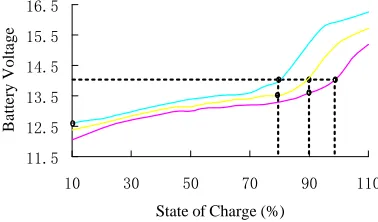
[image:3.595.104.249.89.174.2]The relation between 12V batteries’ SOC and voltage of lead-acid batteries under different charging rate is shown as Figure 4 [9]. Set the maximum charging voltage as 14.2 V. The concrete process of charging is: step1, charge batteries with the rate of C 5 or 20 A current from point A to point B. If the battery voltage reaches to
Table 1. Link between OCV and SOC for CB121000B12 V 100 AH.
OCV (V)
11.76 11.97 12.18 12.27 12.39 12.45 12.54 12.63
SOC (%) Dd1 25 50 60 75 80 90 100
1. Deep discharge.
11.5 12.5 13.5 14.5 15.5 16.5
10 30 50 70 90 110
State of Charge (%)
B
a
tt
e
ry V
o
lt
a
g
[image:3.595.105.243.208.252.2]e
Figure 4. Principle of decreased charging current for 12V batteries.
maximum value and the SOC is 80% through estimation, turn to step2 automatically. Step2 is from point C to point D in which batteries are charged with the rate of
10
C or 10 A current. When the battery voltage again reaches to maximum value and SOC is 90% through es- timation, turn to step3. The charging rage is C 20 be- tween point E and point F in this step. Stop charging if batteries’ voltage reaches to 14.2 V next time and SOC is 100%.
Suppose batteries need to charge again after interrupt- tion, the charging rate can be determined by Figure 4 and Table 1: Charging rate is C 5, if SOC lower than 80%; charging rate is C 10 if SOC ranges from 80% to 90%; charging rate is C 20 if SOC ranges from 90% to 100%.
4. Implementation on Decreased Charging
Current Based on SOC
4.1. Main Circuit for Batteries Charging
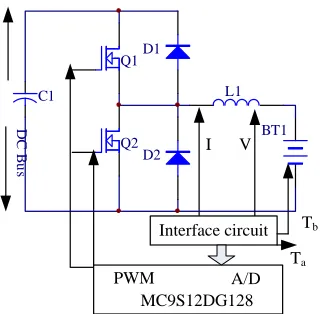
Bi-directional half bridge DC-DC converter has the trait of easy controlling unit, small endured current for device, low cost of conduction and so on. It can be used for variable systems, for instance, electric vehicle, UPS and photovoltaic or wind power [10]. The main diagram of charging and discharging for batteries in 10 KW mi- cro-grid photovoltaic system is given as Figure 5. a
represents the ambient temperature and b represents
batteries’ temperature. To prevent filter capacitor from explosion or avoid batteries short-circuit due to opposite polarity cross in circuit, the filter capacitor is ignored [11]. Concrete analysis for batteries charging process: capacitor 1, MOSFET 1, inductor and batteries
1
T comprise a loop if MOSFET 1 turns on the
free-wheel diode will be cut off and inductor storages energy; if 1 cuts off, free-wheel diode 2
turns on and loop is composed by inductor and bat- teries .
T
1 L D T
L
C Q L1
Q B
2 D
Q
1
1 T
Twenty lead-acid batteries are in series to comprise the battery stack. Patterns for main device in charging and
[image:3.595.57.288.656.712.2]I V
Interface circuit Tb
A/D MC9S12DG128 PWM
Ta
D1
D2
BT1 Q1
Q2
C1 L1
DC
B
u
[image:4.595.88.248.83.240.2]s
Figure 5. Main charging and discharging circuit.
discharging circuit are introduced: MC9S12DG128 pro- duced by Freescale firm is chosen as main controlling chip, IPM module is PM75DSA120, free-wheel diode is ultra-fast soft recovery diode module DWM2F60N120, the value of inductor is 2.5 mH, capacitor is used for DC bus is 2200 uF. Take current sensor LT308-SP8 and voltage sensor LV25-P produced by LEM to sample bat- teries’ current and voltage, DS18B20 as temperature sensor to sample batteries’ temperature and ambient tem- perature.
4.2. Controlling Strategy for Charging
To avoid lead-acid batteries generating gas during proc- ess of charging, work mode of inductor should be set in non-continuous mode and Figure 6 shows the wave of charging current. Average current is required to follow the change of reference current according to controlling strategy, therefore, Pulse Width Modulation (PWM) con- trolling method is chosen [12,13]. Common controlling method of PWM includes hysteresis comparison and triangular comparison. The frequency of switch varies in hysteresis comparison, however, frequency for MOSFET in triangular is fixed and equal to the carrier’s. If the duty rate of MOSFET is set a given value, the charging time will postpone as the frequency rises [14]. Principle of triangular wave comparison is shown in Figure 7 and the carrier’s frequency sets as 6KHz. IL* represents refer- ence current, which compares with real current to get an error. Presetting parameter method is used to get PI (Proportional-integral) value through PI controller. By comparing the output of PI controller with triangular carrier, PWM signal is acquired and used for controlling the turn on or off of MOSFET.
trickle I
Vbat,max: Trickle current;
V : Maximum batteries’ voltage at 25 ;
℃
1
bus : Minimum DC bus voltage when the output
en-ergy of PV array is enough;
C/5 C/10 C/20
[image:4.595.330.513.181.246.2]t I
Figure 6. Current wave in charging process.
PI
-IL IL* +
+
- PWM
Figure 7. Principle of triangular wave comparison.
2
bus : Minimum DC bus voltage when the output
en-ergy of PV array is lacking.
V
The maximum batteries’ voltage set as 284 V at 25℃. Formula calculating maximum charging voltage bat,max
is given as equation (7). C, the number of cells in bat-
teries stack, equals to 120, α = –3.5 mV/˚C/cell is the compensating coefficient for temperature.
V N
,max 284 25
bat a C
V T N (7)
Control algorithm flowchart about charging is ex- pressed as follows, and Table 2 shows the initial value for program variable.
Step1: Initiate MCU system and sampling chip system; Step2: Measure batteries’ voltage and evaluate the SOC based on OCV-SOC curve. If SOC > 100%, turn to Step15;
Step3: Determine the initial charging rate according to the range of SOC and set reference charging current
*
L
I ;
Step4: Sampling bus voltage, if , turn to Step11;
1
bus bus
V V
Step5: Measure ambient temperature and calculate ;
,max
Step6: Enable MCU output PWM to control turn- on and close off;
bat V
1 Q 2
Q
Step7: Control the charging current with closed- loop; Step8: Measure batteries’ voltage and current and evaluate SOC based on dynamic battery model;
Step9: If SOC > 100%, turn to Step15;
Step10: If VbatVbat,max or SOC not reach to the
Table 2. Initial value for program variable.
Variable
trickle
I Vbat,max Vbus1 Vbus2
given value, then turn to Step4;
Step11: Correct the charging rate and turn to Step4; Step12: If bus bus2, turn to Step15;
Step13: Set the reference current as , turn to Step6, Step7, Step8 and Step9;
V V
trickle
I
Step14: Turn to Step4; Step15: Stop charging.
The feature of control algorithm is: 1) Judge the output energy of PV array is enough or not by sampling the DC bus voltage in real-time, then using different charging methods. Decreased charging current based on batteries’ SOC is selected to charge batteries when the energy is sufficient, otherwise, trickle current charging method is selected. 2) Attenuate the requirement of reduction coef- ficient by combining the setting maximum batteries’ voltage with SOC to determine charging rate in each stage. 3) The setting maximum batteries’ voltage varies as the ambient temperature changes, which avoids over- charging or insufficient charging.
5. Experimental Result and Analysis
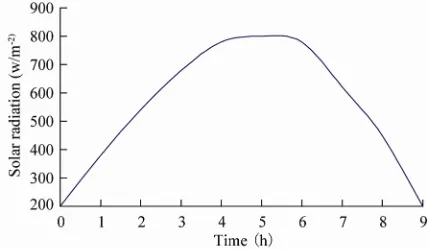
[image:5.595.319.529.86.211.2]A solar simulator management system replaced the PV array in real-time is selected for experiment in 10 KW micro-grid photovoltaic inverter prototype [15]. A sta- tionary DC halogen lamp whose brightness is adjustable and programmed acts as sun to illuminate the PV array in the solar simulator. Figure8 shows the solar simulator measurements over the course of a simulated day. Initial batteries’ SOC is set to 65%, reduction coefficient for both methods is 1/2, and maximum charging voltage and current in each stage for both methods are also equal. Batteries’ charging time and temperature are recorded respectively under the same solar simulator. With regard to decreased charging current, it denotes batteries’ SOC reach to 100% when the current drops to the minimal given value 5A. Figure 9 indicates that decreased charg- ing current based on SOC enable batteries to reach full capacity earlier than decreased charging current.In Fig- ure 10, under the same reduction coefficient , com- paring with decreased charging current, temperature of
Figure 8. Solar radiation against time in solar simulator.
3 Decreased
charging current
1 2
65 70 75 80 85 90 95 100 105
Time(h)
SOC
(%
)
0 5 10 15 20 25
B
att
e
ri
e
s'
c
urre
n
t(A
)
[image:5.595.315.531.248.364.2]Decreased charging current based on SOC
Figure 9. Batteries’ charging time of two methods.
21 22 23 24 25 26 27
0 1 2 3 4 5
Time(h)
T
emper
atur
e
(
℃)
Decreased charging current based on SOC
Decreased charging current
Figure 10. Batteries’ temperature of two methods.
batteries charged by decreased charging current based on SOC raises slowly and the peak value only appears at the full capacity.
Experimental result proves that decreased charging current based on SOC to be feasible and indicates that this method can maintain batteries with high state of charge in relatively shot time and decrease acid stratify- cation. Moreover, the inductor of hardware circuit works with non-continuous mode, this greatly reduce the po- larization and lengthen batteries’ life.
6. Conclusions
Decreased charging current based on SOC is able to ad- just the charging rate according to batteries’ SOC with- out accurate reduction coefficient, as well as reduces charging time and adapts to the random changes of solar radiation. Once the batteries need to be charged again, the charging rate is determined by the relation between OCV and SOC, batteries will automatically transfer into related charging stage. To some extend, the method plays an important impact on how to distribute power among parts of micro-grid photovoltaic system.
7. Acknowledgements
[image:5.595.65.280.577.702.2]tion of Hubei province (research on soc estimation me- thod and equalizing charging of lithium-ion battery for HEV. No. ZRY1530) and Hubei provincial education board (batteries modeling and study on soc estimation method in photovoltaic system. No. B20091403).
REFERENCES
[1] G. J. Zhang, X. Tang and Z. P. Qi, “Application of Hy- brid Energy Storage System of Super-Capacitors and Bat- teries in a Micro-Grid,” Automation of Electric Power
Systems, Vol. 34, No. 12, 2010, pp.85-87.
[2] J. H. Xue, Z. D .Yin and B. B. Wu, “Technology Re- search of Novel Energy Storage Control for the PV Gen- eration System,” Proceedings of APPEEC 2009, Asia-
Pacific, Wuhan, 27-31 March 2009, pp.1-4.
[3] Z. Q. Wang, X. Li and G. Y. Li, “Energy Storage Control for the Photovoltaic Generation System in a Micro-Grid,”
Proceedings of the 5th International Conference, Beijing, 20-22 September 2010, pp.1-5.
[4] S. Armstrong, M. E. Glavin and W. G. Hurley, “Com- parison of Battery Charging Algorithms for stand Alone Photovoltaic Systems,” Proceedings of Power Electronics
Specialists Conference of PESC 2008 IEEE, Rhodes, 15-19 June 2008, pp. 1469-1475.
[5] E. Koutroulis and K. Kalaitzakis, “Novel Battery Charg-ing Regulation System for Photovoltaic Applications,”
IEE Proceedings Electric Power Applications, Vol. 151, No. 2, 2004, pp. 191-197. doi:10.1049/ip-epa:20040219
[6] W. K. Zhang, “Fast Charging Method for Lead-Acid Batteries in Automobile,” Hunan Institute of Science and
Technology, Vol. 18, No. 3, 2005, pp. 70-72.
[7] H. Fakham, D. Lu and B. Francois, “Power Control De- sign of a Battery Charger in a Hybrid Active PV Genera-tor for Load-Following Applications,” IEEE Transaction
on Industrial Electronics, Vol. 58, No. 1, 2011, pp. 85-94. [8] T. D. Herder. “Design and Simulation of Photovoltaic
Super System Using Simulink,” Senior Project, Electrical Engineering Department, California Polytechnic State University, San Luis Obispo, 2006.
[9] R. Perez, “Lead-acid Battery State of Charge vs. Volt- age,” Home Power, Vol. 36, 1993, p. 67.
[10] J. Chen, “Research on House-Hold Photovoltaic Power Generation System Based on Bi-Directional DC/DC Con- verter,” Power Electronics and Drives Transmission, Ji-angnan University, Wuxi, 2009.
[11] J. Xu, “Design and Development of Power Battery Charg- er,” Control Theory and Control Engineering, Tianjing University, Tianjing, 2008.
[12] X. Q. Wang and D. Zhang, “Carrier-Reversed Current Tracking PWM Control,” Science and Technology of
West China, Vol. 8, No. 12, 2009, pp. 5-7.
[13] L. Xu and Y. X. Xie, “Summarization of Methods to Re-alize PWM Technology,” Power Supply Technologies
and Applications, Vol. 8, No. 2, 2005, pp. 51-53. [14] A. C. Hua and B. Z. Wei, “Charge and Discharge
Char-acteristics of Lead-Acid Battery and LiFePO4 Battery,”
Proceedings of International power Electronics Confer-ence, Sapporo, 21-24 June 2010, p. 1481.