POWER QUALITY IMPROVEMENT BY USING INTERPHASE POWER CONTROLLER
*Pratiksha Vitthalrao Padmane and Pritee R. Rane
P. R. Pote College of Engineering, SGBAU University, India
ARTICLE INFO ABSTRACT
Many approaches have been proposed for solving the stability problems found in power system operation. Interphase Power Controller (IPC) is new concept of controlling power flow Within AC network. Interphase Power Controller provide a solution for high sho
based on the series connection of impedances between different phases of the two (synchronous) sub networks to be interconnected. Interphase Power Controller provides passive solutions for normal and contingency conditions
Interphase Power Controller is equipped with the Phase Shifting Transformer (PST) which Control the output power. The Interphase Power Controller can provide reactive power supp
adjustment of voltages. The purpose of this technology is to facilitate the supply of loads in flexible and rapid fashion, while providing optimal management of Electrical networks. Here, the basic theory and operating characteristics of the In
controller system is modeled and simulation is done in MATLAB.
Copyright © 2015 Pratiksha Vitthalrao Padmane and Pritee R. Rane
which permits unrestricted use, distribution, and reproduction in any medium, provided the original work is properly cited.
INTRODUCTION
The Interphase Power Controller (IPC) is an emerging technology developed for the management of power flows within ac networks. Power flow control is becoming most important issue in planning and operation of power system transmission network. In flexible AC transmissio
phase shifting transformer, limiting reactor and series compensation may not be satisfactory (Satyanarayana
IPC is one of the products of an emerging technology developed by CITEQ for the management of power flows within AC networks. It is a series connected controller consisting of two impedances per phase, one inductive and one capacitive, subjected to separately phase-shifted voltage .The values of these impedances are high so that the IPC limits its own contribution into a short circuit. In the particular case where the impedances have the same magnitude and form a conjugated pair, each side of the IPC behaves as a voltage dependent current source. This makes the IPC a very robust and predictable controller. The operating set
IPC can be modified by open-loop controls, to adapt its characteristics to the steady state and post contingency necessities of a given system (Chitra Selvi, 2008
*Corresponding author: Pratiksha Vitthalrao Padmane, P. R. Pote College of Engineering, SGBAU University, India
ISSN: 0975-833X
Vol.
Article History:
Received 21st September, 2015
Received in revised form 22nd October, 2015
Accepted 19th November, 2015 Published online 30th December,2015
Key words:
MATLAB,
Phase Shifting Transformer (PST), Thyristor-Controlled-IPC(TC-IPC), Interphase Power Controller (IPC).
Citation: Pratiksha Vitthalrao Padmane and Pritee R. Rane
International Journal of Current Research, 7, (12),
RESEARCH ARTICLE
POWER QUALITY IMPROVEMENT BY USING INTERPHASE POWER CONTROLLER
Pratiksha Vitthalrao Padmane and Pritee R. Rane
College of Engineering, SGBAU University, India
ABSTRACT
Many approaches have been proposed for solving the stability problems found in power system operation. Interphase Power Controller (IPC) is new concept of controlling power flow Within AC network. Interphase Power Controller provide a solution for high sho
based on the series connection of impedances between different phases of the two (synchronous) sub networks to be interconnected. Interphase Power Controller provides passive solutions for normal and contingency conditions. Interphase power controller control the power flow and act as fault limiter. Interphase Power Controller is equipped with the Phase Shifting Transformer (PST) which Control the output power. The Interphase Power Controller can provide reactive power supp
adjustment of voltages. The purpose of this technology is to facilitate the supply of loads in flexible and rapid fashion, while providing optimal management of Electrical networks. Here, the basic theory and operating characteristics of the Interphase Power Controller are discussed. The Interphase power controller system is modeled and simulation is done in MATLAB.
Pratiksha Vitthalrao Padmane and Pritee R. Rane. This is an open access article distributed under the Creative Co use, distribution, and reproduction in any medium, provided the original work is properly cited.
Power Controller (IPC) is an emerging technology developed for the management of power flows within ac networks. Power flow control is becoming most important issue in planning and operation of power system transmission network. In flexible AC transmission system phase shifting transformer, limiting reactor and series Satyanarayana, 2013). IPC is one of the products of an emerging technology developed by CITEQ for the management of power flows a series connected controller consisting of two impedances per phase, one inductive and one shifted voltage .The values of these impedances are high so that the IPC limits its . In the particular case where the impedances have the same magnitude and form a conjugated pair, each side of the IPC behaves as a voltage dependent current source. This makes the IPC a very robust and predictable controller. The operating set-point of the basic loop controls, to adapt its characteristics to the steady state and post contingency
, 2008).
*Corresponding author: Pratiksha Vitthalrao Padmane, neering, SGBAU University, India
The IPC promises reliable and expectable operation under normal as well as incident conditions. In addition, it is shown that in the case of contingencies, the IPC can provide reactive power support for the modification
with the fast control of voltage and power at different points in the network in order to conserve stability .Also with the da and seasonal load variation (Brochu
IPC Description
The IPC is not a new technology but
power engineers. Its working mechanisms, flexibility and speed of response put this technology in the category of the FACTS devices. It is a series connected device, which the major components in each of the phases are a reactor and a capacitor subjected to individual phase shifted voltages provided by two phase shifting transformers (PST). There are many IPC formations, depending on specific application requirements and on the method used to implement the internal phase shifts. IPC can consist of only passive elements including inductors, capacitors and PST
An IPC with electronically switched phase shifting devices add dynamic regulation capabilities to the power system. As a consequence, not only the steady
also the transient stability performance of the power system is enhanced, remarkably. After disturbances such as line outages, electronically based IPC can quickly redistribute the power
Available online at http://www.journalcra.com
International Journal of Current Research
Vol. 7, Issue, 12, pp.24123-24127, December, 2015
INTERNATIONAL
Pratiksha Vitthalrao Padmane and Pritee R. Rane,2015. “Power quality improvement by using ), 24123-24127.
z
POWER QUALITY IMPROVEMENT BY USING INTERPHASE POWER CONTROLLER
Pratiksha Vitthalrao Padmane and Pritee R. Rane
College of Engineering, SGBAU University, India
Many approaches have been proposed for solving the stability problems found in power system operation. Interphase Power Controller (IPC) is new concept of controlling power flow Within AC network. Interphase Power Controller provide a solution for high short situations .The application is based on the series connection of impedances between different phases of the two (synchronous) sub networks to be interconnected. Interphase Power Controller provides passive solutions for normal and . Interphase power controller control the power flow and act as fault limiter. Interphase Power Controller is equipped with the Phase Shifting Transformer (PST) which Control the output power. The Interphase Power Controller can provide reactive power support for the adjustment of voltages. The purpose of this technology is to facilitate the supply of loads in flexible and rapid fashion, while providing optimal management of Electrical networks. Here, the basic theory terphase Power Controller are discussed. The Interphase power controller system is modeled and simulation is done in MATLAB.
is an open access article distributed under the Creative Commons Attribution License, use, distribution, and reproduction in any medium, provided the original work is properly cited.
The IPC promises reliable and expectable operation under normal as well as incident conditions. In addition, it is shown that in the case of contingencies, the IPC can provide reactive power support for the modification of voltages. IPC compacts with the fast control of voltage and power at different points in the network in order to conserve stability .Also with the daily
Brochu, 1994)
The IPC is not a new technology but almost unknown among power engineers. Its working mechanisms, flexibility and speed of response put this technology in the category of the FACTS devices. It is a series connected device, which the major components in each of the phases are a reactor and a capacitor subjected to individual phase shifted voltages provided by two phase shifting transformers (PST). There are many IPC formations, depending on specific application requirements and on the method used to implement the internal consist of only passive elements including inductors, capacitors and PST (Chitra Selvi, 2008). An IPC with electronically switched phase shifting devices add dynamic regulation capabilities to the power system. As a consequence, not only the steady state stability properties but also the transient stability performance of the power system is enhanced, remarkably. After disturbances such as line outages, electronically based IPC can quickly redistribute the power
INTERNATIONAL JOURNAL OF CURRENT RESEARCH
flow to a predefined state and therefore increase the system security. Overloaded transmission corridors, which could occur in subsequent operational problems and further outages, are thus escaped. The IPC with electronically switched phase shifting devices is therefore an option for power system control, having fast response as the key planning factor. Another advantage of electronically switched phase shifting components is their maintenance free operation (Farmad, 2006).
Operating Principle of IPC
[image:2.595.44.282.275.374.2]As shown in Fig 1.the IPC uses a group of three-phase reactors and capacitor examine installed in series between two networks or sub networks. The way in which the series components are connected to the networks differentiates this new class of equipment from other series compensation equipment.
Figure 1. Operating Principle of IPC
For instance, the phase A reactor and capacitor of the first network could be connected to phases B and C of the second network.
Thus, whatever the angle δ at the IPC terminals, some of the components are always subjected to a certain voltage. By adjusting the value of these components, it is always possible to force a current in each of the networks even if the angle at the terminals is nil. When all components are strengthened, the amplitude and phase angle of the current are set in one of the two buses to which the IPC is connected.
This current control thus enables the power carried by the IPC to be set, as well as the reactive power absorbed or generated at one of the buses. the transformation is done by replacing phase shifting transformer with static phase shifters and resulting device is TC-IPC(Thyristor-Controlled IPC) (Brochu, 1994).
Thyristor Controlled-Interphase Power Controller
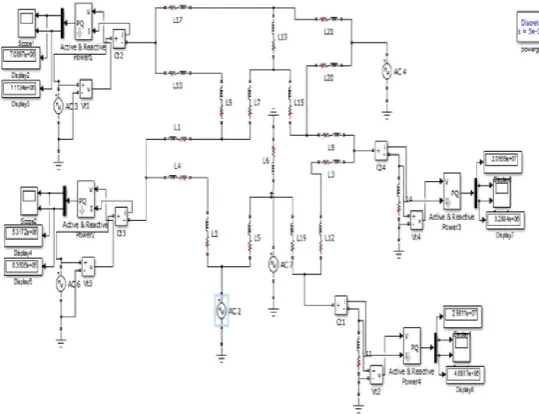
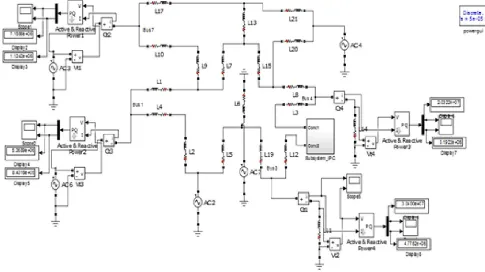
[image:2.595.323.537.321.491.2]In this paper a 8 bus system is implemented with a thyristor controlled interphase controller. Based on this model it can be explained that the TC-IPC can be very infective to damp power oscillations. It can improve the dynamic performance of the system and system security. The TC-IPC can maintain the transmitted real power almost constant without any control action or delays, because of the control characteristic is inherent to the IPC. TC-IPC acts as a Voltage-dependent current source. Therefore, this IPC characteristic can cause connection of two networks without increase in short circuit level. For short circuit current mitigation application, reactance of the inductor and capacitor are selected to be equal, so as to apply infinite impedance to the short circuit current (Farmad, 2006).
Figure 3. IPC as a Current Source
Fig. 1. Single line diagram of principle IPC
[image:2.595.162.432.555.762.2]The IPC controls the power flow in a link connecting two synchronous networks in a passive manner while providing short circuit isolation and voltage decoupling between them.
Figure 4. 8 Bus System Without TC-IPC
Figure 4(b)
24125 International Journal of Current Research,
Figure 4(a) :Active and Reactive Power at bus 4
Figure 4(b). Active And Reactive Power at bus 7.
Figure 5. Eight Bus System with TC-IPC
[image:3.595.122.472.65.297.2] [image:3.595.53.538.464.736.2]Figure 5(a)
Figure 5 (
Figure 5(c).
Figure 5(d)
24126 Pratiksha Vitthalrao Padmane and Pritee R. Rane
Figure 5(a). Active And Reactive Power at bus 1
Figure 5 (b). Active and Reactive Power at Bus 3
Figure 5(c). Active and Reactive power at bus 4
Figure 5(d). Active And Reactive Power at bus.1
[image:4.595.128.473.42.639.2] [image:4.595.131.469.49.211.2] [image:4.595.129.470.536.769.2]The basic IPC is a series-connected device comprising two susceptances, one inductive and the other capacitive, subjected to properly phase-shifted voltages, as shown in Fig. 1. (Satyanarayana, 2013).
The controllable parameters are phase shift angles. The phase shifting device may be conventional or electronically switched static phase shifting Transformer (SPST).An IPC with electronically switched phase shifting device add dynamic regulation capabilities in the power system. It can be used not only for steady state stability but also to improve the transient stability performance. After disturbances such as outage, electronically based IPC can quickly redistribute the power flow to predefine state and system security increase. Unturned IPC can be used for power flow control especially for increasing transfer capabilities with transmission facilities. Concerning with this matter it is necessary to replace conventional Phase Shifting Transformer (PST) with Static Phase Shifting Transformer (SPST), (Chitra Selvi, 2008).
Eight bus system without TC-IPC is as shown in Fig 4, Real and Reactive Power are as shown in Fig 4(a) (b) at bus4 and 7 respectively. Eight bus system with TC-IPC is as shown in Fig 5. Real and Reactive Power are as shown in Fig 5 (a),(b) at bus4 and 7 respectively. The values at different buses are given in Table – 1 of the reactive power with and without IPC.
No. Reactive power without
TC-IPC
Reactive power with TC-IPC
BUS - 4 0.3219 0.3192
BUS -7 0.1223 0.1321
DISCUSSION
TC-IPC can improve the system stability. It is observed that the real and reactive power flowing through the line can be increase by using TC-IPC. The dynamic power regulations are done by using IPC. Simulation result indicates that TC-IPC can increase real and reactive power.
Acknowledgment
It is a matter of great pleasure by getting the opportunity of highlighting a fraction of knowledge, I acquired during our technical education through this project. This project would not have been successful without enlightened ideas timely suggestion and keen interest of my respected Guide Prof.
Pritee R. Rane without her best guidance this would have been
an impossible task to complete. Last but not the least; I would like to express my thankfulness to teaching and non-teaching staff, my friends and all our well-wishers.
REFERENCES
Brochu, J., Pelletier, P., Beauregard, F. and Morin, G., 1994. "The Interphase Power Controller, A New Concept for Managing Power How Within ACNetworks,",IEEE Tran. PWRD Vol. 9, No. 2, April,pp 833-841.
Chitra Selvi, S. and Kumudini Devi, R.P. 2008. “ Stability Analysis of Thyristor Controlled Interphase power controller in deregulated power System “ Power System Technology and IEEE Power India Conference,. POWERCON 2008
Farmad, M., Farhangi, S., Afsharnia, S., and Gharehpetian, G.B. “An efficient algorithm for determining the values of elements of interphase power controller as a fault limiter”, Power Systems Conference and Exposition, PSCE 2006. pp. 1493 – 1497
Hingorani, N. G., 1990. “Flexible AC Transmission Systems (FACTS) - Overview”, Panel Session on FACTS, IEEE Winter Power Meeting, Atlanta.
Hurley, J. D. and Baldwin, M. S. 1982. "High-ResponseExcitation Systems on Turbine-Generator: A Stability Assessment", IEEE Transactions on Power
Apparatus and Systems, Vol. PAS-101, NO.11,
November, pp. 4211-4221System Technology.
Khorrami, M., Mohammad, S,. Naderi, N. Khalil nejad1,” Using Interphase Power Controller to Control the Short Circuit Level in Transmission Power Network,”2010
International Conference on Power system technology.
Lemay, J., Brochu, J. Pelletier, P. and Beauregard, F. 2000. “Inter-phase Power Controllers: Complementing the family of FACTS controllers,”J. IEEE Can. Rev., vol. 34, pp. 9–12, Spring.
Schnurr, N., U. Bachmann, F. Berger, R. Reinisch, I. Erlich,M. Häusler,and M. Lösing, “Possibilities of multifunctional facts application inthe european electric power system under changing conditions of theliberalized electricity market,” in 39th CIGRE Session, Paris, France,Aug. 25–30, 2002, Paper 14-112.
Sybille, G., Haj-Maharsi, Y., Morin, G., Beauregard, E., Brochu, J., Lemay, J. and P. Pelletier, "Simulator demonstration of the interphase power controller technology", IEEEIPES I996 Winter Meeting, 96 WM 119-8 PW1RD.
Satyanarayana Rao, V.V. R., S.Rama Reddy ,”Digital Simulation of Thyristor Controlled Interphase Power Control Technology (TCIPC) to limit the fault currents,”
International Journal of Engineering and Technology
(IJET),Vol 5 No 3 Jun-Jul 2013
Wirth, E. and Kara, A. 2000. "Innovative power flow management and voltage control technologies", Power
Engineering Journal, vol. 14, No. 3,pp. 129-140, June
2000.