CLASSIFICATION OF RESULT ANALYSIS FOR RECOGNITION IMAGE USING PRECEPTRON MODEL &
TEXT USING ADAPTIVE RESONANCE THEORY 1
1,*
Anbazhagan,
1
Guest Lecturer, Department of Computer
2
Associate Professor and Head, Department of Computer Science, GAC, Coimbatore, India
ARTICLE INFO ABSTRACT
In this paper works focuses of an application that performs handwritten English character recognition in hand and an image visible by the human eye. The objective of this type of character
a process which is used to recognition the pattern to handwritten English character and image
technique which is based on the recognition with the help of Adaptive Resonance Theory.
Copyright © 2015 Anbazhagan and Ponmuthuramalingam
permits unrestricted use, distribution, and reproduction in any medium, provided the original work is properly cited.
INTRODUCTION
Now a Days Computer plays an important role in various small and large scale industries for automation, Most of the Department Sectors they can use Computerization instead of Manual works (Aman Puri and Kamlesh Lakhwani
Text Based Character Recognition is developed to identify either printed characters or handwritten characters
Nirav Tushar and Saurabh Upadhyay, 2012
pattern recognition that usually deals with the realization of the written scripts or printed material into human Brain. The main advantages compare between Image and the Text Data which storing these written texts into human brain, it requires less space for storage and can be maintained for further references without referring to the actual script again and again Nirav Tushar and Saurabh Upadhyay, 2012
which requires such greater spaces for storage and can be maintained for further references with referring to the actual script again and again (Parikh Nirav Tushar
Upadhyay, 2012). Image acquisition stage where the image data/ Text Data under consideration is taken. In this method, the data have been acquired through either a printed characters or handwritten characters.
*Corresponding author: Anbazhagan,R.,
Guest Lecturer, Department of Computer Science, GAC, Coimbatore, India.
ISSN: 0975-833X
Vol.
Article History:
Received 15th September, 2015
Received in revised form
27th October, 2015
Accepted 19th November, 2015
Published online 21st December,2015
Key words:
Adaptive Resonance Theory, Character recognition, Image recognition, Neural Network, Training and Testing Data set, Tool Box, Mat Lab.
Citation: Anbazhagan,R. and Dr. Ponmuthuramalingam, P.
model & text using adaptive resonance theory 1 algorithmic approaches
RESEARCH ARTICLE
RESULT ANALYSIS FOR RECOGNITION IMAGE USING PRECEPTRON MODEL &
TEXT USING ADAPTIVE RESONANCE THEORY 1 ALGORITHMIC APPROACHES
Anbazhagan,
R. and
2Dr. Ponmuthuramalingam, P.
Guest Lecturer, Department of Computer Science, GAC, Coimbatore, India
Head, Department of Computer Science, GAC, Coimbatore, India
ABSTRACT
his paper works focuses of an application that performs handwritten English character recognition in hand and an image visible by the human eye. The objective of this type of character
a process which is used to recognition the pattern to make the use of visual capabilities to extract handwritten English character and image recognition is taken to further process by preprocessing technique which is based on the recognition with the help of Adaptive Resonance Theory.
Anbazhagan and Ponmuthuramalingam. This is an open access article distributed under the Creative Commons Att use, distribution, and reproduction in any medium, provided the original work is properly cited.
Now a Days Computer plays an important role in various small and large scale industries for automation, Most of the Department Sectors they can use Computerization instead of Kamlesh Lakhwani, 2013). aracter Recognition is developed to identify either printed characters or handwritten characters (Parikh 2012). It is a part of pattern recognition that usually deals with the realization of the ted material into human Brain. The main advantages compare between Image and the Text Data which storing these written texts into human brain, it requires less space for storage and can be maintained for further references cript again and again (Parikh 2012). But Images which requires such greater spaces for storage and can be maintained for further references with referring to the actual Parikh Nirav Tushar and Saurabh stage where the image data/ Text Data under consideration is taken. In this method, the data have been acquired through either a printed characters
Guest Lecturer, Department of Computer Science, GAC, Coimbatore,
One of the important roles in the handwritten character recognition process is preprocessing. Which is used to converts the acquired image into a more usable text form for the next stages to store and Maintained into the Human Brain (Rajasekaran and VijayalakshmiPai
objectives of these preprocessing stages are to reduce the amount of noise data’s presented into the Neurons and also used to Increase the amount of Text data to be Stored into the Neurons(Rajasekaran and VijayalakshmiPai
preprocessing stage includes a number of techniques in order to achieve these objectives (Sara Izadi
Naeem Ayyaz et al., 2012) (Rajkumar
image is segmented into individual character
character is resized into m*n pixels towards the extracting the features.
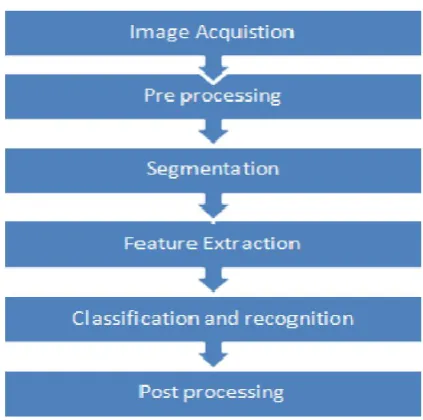
The two essential sub-stages of recognition phase are feature extraction and classification. The feature extraction stage analyzes a text segment and selects a set of features that can be used to uniquely identify the text segment. The derived features are then used as input to the character classifier
and Kamlesh Lakhwani, 2013)
main decision making stage of character recognition system and uses the extracted feature as input to identify the text segment. Performance of the system largely depends upon the type of the classifier used (Rajasekaran
2003).
Available online at http://www.journalcra.com
International Journal of Current Research
Vol. 7, Issue, 12, pp.23618-23628, December, 2015
INTERNATIONAL
R. and Dr. Ponmuthuramalingam, P.,2015. “Classification of result analysis for recognition image using preceptron model & text using adaptive resonance theory 1 algorithmic approaches”, International Journal of Current Research,
z
RESULT ANALYSIS FOR RECOGNITION IMAGE USING PRECEPTRON MODEL &
ALGORITHMIC APPROACHES
Dr. Ponmuthuramalingam, P.
Science, GAC, Coimbatore, India
Head, Department of Computer Science, GAC, Coimbatore, India
his paper works focuses of an application that performs handwritten English character recognition in hand and an image visible by the human eye. The objective of this type of character recognition is make the use of visual capabilities to extract is taken to further process by preprocessing technique which is based on the recognition with the help of Adaptive Resonance Theory.
Creative Commons Attribution License, which
One of the important roles in the handwritten character recognition process is preprocessing. Which is used to converts the acquired image into a more usable text form for the next stages to store and Maintained into the Human Brain lakshmiPai, 2003). The major objectives of these preprocessing stages are to reduce the amount of noise data’s presented into the Neurons and also used to Increase the amount of Text data to be Stored into the VijayalakshmiPai, 2003). The preprocessing stage includes a number of techniques in order to Sara Izadi, 2010) (Muhammad Rajkumar et al., 2010). The input image is segmented into individual character and then each is resized into m*n pixels towards the extracting the
stages of recognition phase are feature extraction and classification. The feature extraction stage analyzes a text segment and selects a set of features that can be d to uniquely identify the text segment. The derived features are then used as input to the character classifier (Aman Puri ). The classification stage is the main decision making stage of character recognition system extracted feature as input to identify the text segment. Performance of the system largely depends upon the Rajasekaran and VijayalakshmiPai,
INTERNATIONAL JOURNAL OF CURRENT RESEARCH
result analysis for recognition image using preceptron
23619 Anbazhagan and Ponmuthuramalingam, Classification of result analysis for recognition image using Preceptron model & text using adaptive resonance theory 1 algorithmic approaches
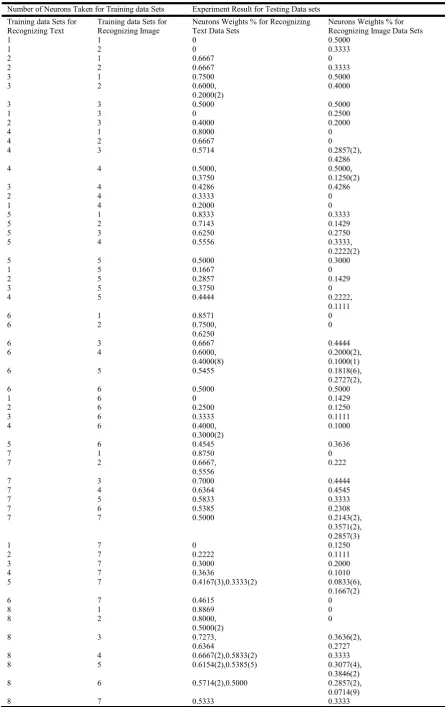
Table 1. Number of Neurons Taken for Training & Testing data Sets
Number of Neurons Taken for Training data Sets Experiment Result for Testing Data sets
Training data Sets for Recognizing Text
Training data Sets for Recognizing Image
Neurons Weights % for Recognizing Text Data Sets
Neurons Weights % for Recognizing Image Data Sets
1 1 0 0.5000
1 2 0 0.3333
2 1 0.6667 0
2 2 0.6667 0.3333
3 1 0.7500 0.5000
3 2 0.6000,
0.2000(2)
0.4000
3 3 0.5000 0.5000
1 3 0 0.2500
2 3 0.4000 0.2000
4 1 0.8000 0
4 2 0.6667 0
4 3 0.5714 0.2857(2),
0.4286
4 4 0.5000,
0.3750
0.5000, 0.1250(2)
3 4 0.4286 0.4286
2 4 0.3333 0
1 4 0.2000 0
5 1 0.8333 0.3333
5 2 0.7143 0.1429
5 3 0.6250 0.2750
5 4 0.5556 0.3333,
0.2222(2)
5 5 0.5000 0.3000
1 5 0.1667 0
2 5 0.2857 0.1429
3 5 0.3750 0
4 5 0.4444 0.2222,
0.1111
6 1 0.8571 0
6 2 0.7500,
0.6250
0
6 3 0.6667 0.4444
6 4 0.6000,
0.4000(8)
0.2000(2), 0.1000(1)
6 5 0.5455 0.1818(6),
0.2727(2),
6 6 0.5000 0.5000
1 6 0 0.1429
2 6 0.2500 0.1250
3 6 0.3333 0.1111
4 6 0.4000,
0.3000(2)
0.1000
5 6 0.4545 0.3636
7 1 0.8750 0
7 2 0.6667,
0.5556
0.222
7 3 0.7000 0.4444
7 4 0.6364 0.4545
7 5 0.5833 0.3333
7 6 0.5385 0.2308
7 7 0.5000 0.2143(2),
0.3571(2), 0.2857(3)
1 7 0 0.1250
2 7 0.2222 0.1111
3 7 0.3000 0.2000
4 7 0.3636 0.1010
5 7 0.4167(3),0.3333(2) 0.0833(6),
0.1667(2)
6 7 0.4615 0
8 1 0.8869 0
8 2 0.8000,
0.5000(2)
0
8 3 0.7273,
0.6364
0.3636(2), 0.2727
8 4 0.6667(2),0.5833(2) 0.3333
8 5 0.6154(2),0.5385(5) 0.3077(4),
0.3846(2)
8 6 0.5714(2),0.5000 0.2857(2),
0.0714(9)
8 7 0.5333 0.3333
Classification is usually accomplished by comparing the feature vectors corresponding to the input text/image/character with the representatives of each character class, using a distance metric.
Multilayer Feed Forward Network
This network, as its name indicates is made up of multiple layers. Input layer and an output layer also have one or more intermediary layers that are called Hidden layers (Rajasekaran and VijayalakshmiPai, 2003).
The Computational units of the hidden layer are known as the hidden neurons or hidden units. Hidden layer performing useful intermediary computations before directing the input to the output layer. The input layer neurons are linked to the hidden layer neurons and the weights on these links are referred to as input-hidden layer weights.
Again the hidden layer neurons are linked to the output layer neurons and the weights on these links are referred to as hidden-output layer weights.
23620 International Journal of Current Research, Vol. 7, Issue, 12, pp.23618-23628, December, 2015
8 8 0.5000 0.4375, 0.1875
1 8 0 0.1111
2 8 0 0.1000
3 8 0.2727 0.1818
4 8 0.3333 0.0833
5 8 0.3846 0.2308
6 8 0.4286 0.3571
7 8 0.4667 0.0667
9 1 0.9000 0
9 2 0.8182 0
9 3 0.7500 0.2500
9 4 0.6923 0.3077,
0.1538(2)
9 5 0.6429 0.2857
9 6 0.6000,
0.5333(3)
0.2000, 0.1333
9 7 0.5625 0.1875(8),
0.0625(2)
9 8 0.5294 0.3529,
0.2941, 0.1765
9 9 0.5000 0.4444
1 9 0 0.1000
2 9 0 0.1818
3 9 0.2500 0.0833
4 9 0.3077 0.2308
5 9 0.3571 0
6 9 0.4000 0
7 9 0.4375 0.1250
8 9 0.4706,
0.4118
0.2941, 0.1765(2)
10 1 0.9091,
0.5455, 0.4545
0
10 2 0.8333 0.3333
10 3 0.7692 0.2308,
0.1538, 0.0769
10 4 0.7143 0.2857
10 5 0.6667 0.0444
10 6 0.6250 0.0625
10 7 0.5882 0.2941
10 8 0.5556 0.2778,
0.3333
10 9 0.5263 0.3684
10 10 0.5000 0.3500,
0.1500(2), 0.2500
1 10 0 0.0909
2 10 0 0.1667(6),
0.0833(1)
3 10 0.2308 0.1538
4 10 0.2857 0.1010
5 10 0.3333 0.0667
6 10 0.3750,
0.3125(2)
0.1250(5), 0.1875(3)
7 10 0.4118 0.1176
8 10 0.4444 0.3333,
0.2222, 0.1111(2)
9 10 0.4737 0.1579(8),
Figure 1. Stages for optical character recognition
[image:4.595.55.273.358.434.2]A Multilayer feed forward network with l input neurons and m1 neurons in the first hidden layer, m2 neurons in the second hidden layer and n output neurons in the output layer is written as l-m1-m2-n (Rajasekaran and VijayalakshmiPai, 2003).
Figure 2. Multilayer Feed Forward Networks
Image Pre-Processing
Image Pre-Processing is one of the important modules in our concept compare to Text data. Image pre-processing relates to the preparation of an Image for that an image keeps to store into the Neurons and use whenever need. Neurons captured an image through a human eye (Ankit Sharma et al., 2013). One of the important steps in the preprocessing block is to transform the color image into a gray scale image and this result to noisy gray scale image. After that Conversion a gray scale image have been converted into Black and White images (Rajasekaran and Vijayalakshmi Pai, 2003). That Black and White images are represented as a binary manner into the neuron. Assign the value of 1 and 0 as black and white respectively. A value may be 1 that means an image fully in black. A value may be 0 that means an image fully in white. An image contained a value of 0 to1. The mid value is 0.5.The range of value 0.5 to 1 black occupied mostly when they increased about the value. The range of value 0 to 0.5 white occupied mostly when they increased about the value (Aman Puri and Kamlesh Lakhwani, 2013).
RESULTS AND DISCUSSION
The testing phases was performing to confirm the effectiveness of the recognition of the individual neural network. The neurons can be trained with several training neuron data sets and gathered experimental results. Experimental Results will be analyzed and Tested with 100 Testing Data sets. After compute the Accuracy rate for Neurons Recognize Text Data and Image. After the Successful Computation 89.333% of Accuracy rate for Neurons Recognize Text Data and the Accuracy rate for Neurons Recognize an Image is 10.666% only.
The following (Figure 3) Experiment result will display the Accuracy for recognition of Image, which is occupied some of
few neurons compare to text data training and testing sets, and the Accuracy rate for Neurons Recognize an Image is 10.666% only.
Figure 4. Linear Vector Classifier Parameters
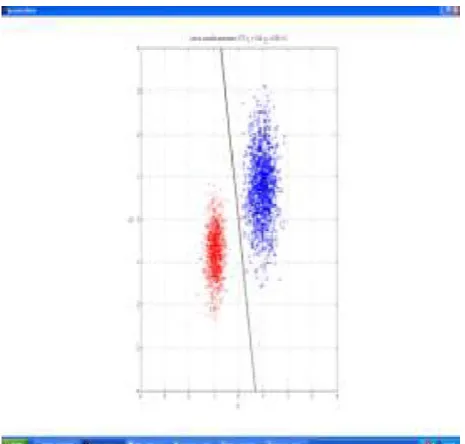
Figure 5. Clustering
Figure 6. Actual Image
[image:10.595.310.558.280.483.2]Figure 7. Actual Image is recognized in Gray Scale manner
[image:10.595.49.278.323.512.2]Figure 8. Gray Scale Image Converted into Black & white
Figure 9. Character Recognition
[image:10.595.308.561.511.726.2]Conclusion
Pattern Recognition approaches heavily depended on behalf of the nature of data to be recognized. The main objective of this paper use Neural Network for Recognition of handwritten English character and Image recognition is taken to further process by preprocessing technique which is based on the recognition with the help of Adaptive Resonance Theory Algorithmic Approach. Most of the Neurons Recognize Text data Sets Compare between Images. Although some of the Neurons recognize Image. The Recognition of Text data sets gives good Result into the Neurons to keep the Text Information to be stored and maintained whenever need to use Compare between Images. Neural Network has been trained with several numbers of Training datasets for recognition of handwritten English character and an Image. The accuracy of recognition of characters will increase definitely.
REFERENCES
Aman Puri, Kamlesh Lakhwani 2013. “Enhanced Approach For Handwritten Text Recognition Using Neural Network” International Journal of Communication and Computer Technologies, Volume 01 – No.58 Issue: 06 Aug 2013, ISSN NUMBER: 2278-9723.
Ankit Sharma, Dipti R Chaudhary ” Characterer Recognition
Using Neural Network” International Journal of
Engineering Trends and Technology (IJETT) – Volume 4 Issue 4- April, 2013.
Muhammad Naeem Ayyaz, Imran Javed and Waqar Mahmood,“Handwritten Character Recognition Using Multiclass SVM Classification with Hybrid Feature Extraction” Pak. J. Engg. & Appl. Sci., Vol. 10, Jan., 2012 (p. 57-67)
Parikh Nirav Tushar, Dr. Saurabh Upadhyay, 2012. “Chain Code Based Handwritten Cursive Character Recognition System with Better Segmentation Using Neural Network”, International Journal of Computational Engineering Research, ||Vol, 03||Issue,5||
Rajkumar, J., Mariraja, K., Kanakapriya, K., Nishanthini, S., Chakravarthy, V.S. 2010. Two Schemas for Online Character Recognition of Telugu script based on Support Vector
S.Rajasekaran, G.A. 2003. VijayalakshmiPai “Neural
Networks, Fuzzy logic, and Genetic Algorithms Synthesis and Applications, PHI.
Sara Izadi, Mehdi Haji, Ching Y. Suen, 2010. “A New Segmentation Algorithm for Online Handwritten Word Recognition in Persian Script”, Centre for Pattern Recognition and Machine Intelligence.