When Are Tree Structures Necessary for Deep Learning of
Representations?
Jiwei Li1, Minh-Thang Luong1, Dan Jurafsky1and Eduard Hovy2 1Computer Science Department, Stanford University, Stanford, CA 94305 2Language Technology Institute, Carnegie Mellon University, Pittsburgh, PA 15213
jiweil,lmthang,[email protected] [email protected]
Abstract
Recursive neural models, which use syn-tactic parse trees to recursively generate representations bottom-up, are a popular architecture. However there have not been rigorous evaluations showing for exactly which tasks this syntax-based method is appropriate. In this paper, we benchmark recursiveneural models against sequential recurrentneural models, enforcing apples-to-apples comparison as much as possible. We investigate 4 tasks: (1) sentiment clas-sification at the sentence level and phrase level; (2) matching questions to answer-phrases; (3) discourse parsing; (4) seman-tic relation extraction.
Our goal is to understand better when, and why, recursive models can outperform simpler models. We find that recursive models help mainly on tasks (like seman-tic relation extraction) that require long-distance connection modeling, particularly on very long sequences. We then intro-duce a method for allowing recurrent mod-els to achieve similar performance: break-ing long sentences into clause-like units at punctuation and processing them sepa-rately before combining. Our results thus help understand the limitations of both classes of models, and suggest directions for improving recurrent models.
1 Introduction
Deep learning based methods learn low-dimensional, real-valued vectors for word tokens, mostly from large-scale data corpus (e.g., (Mikolov et al., 2013; Le and Mikolov, 2014; Collobert et al., 2011)), successfully capturing syntactic and semantic aspects of text.
For tasks where the inputs are larger text units (e.g., phrases, sentences or documents), a compo-sitional model is first needed to aggregate tokens into a vector with fixed dimensionality that can be used as a feature for other NLP tasks. Models for achieving this usually fall into two categories: re-currentmodels andrecursivemodels:
Recurrentmodels (also referred to assequence models) deal successfully with time-series data (Pearlmutter, 1989; Dorffner, 1996) like speech (Robinson et al., 1996; Lippmann, 1989; Graves et al., 2013) or handwriting recognition (Graves and Schmidhuber, 2009; Graves, 2012). They were ap-plied early on to NLP (Elman, 1990), by modeling a sentence as tokens processed sequentially and at each step combining the current token with pre-viously built embeddings. Recurrent models can be extended to bidirectional ones from both left-to-right and right-to-left. These models generally consider no linguistic structure aside from word order.
Recursiveneural models (also referred to astree models), by contrast, are structured by syntactic parse trees. Instead of considering tokens sequen-tially, recursive models combine neighbors based on the recursive structure of parse trees, starting from the leaves and proceeding recursively in a bottom-up fashion until the root of the parse tree is reached. For example, for the phrase the food is delicious, following the operation sequence ( (the food) (is delicious) ) rather than the sequen-tial order(((the food) is) delicious). Many recur-sive models have been proposed (e.g., (Paulus et al., 2014; Irsoy and Cardie, 2014)), and applied to various NLP tasks, among them entailment (Bow-man, 2013; Bowman et al., 2014), sentiment anal-ysis (Socher et al., 2013; Irsoy and Cardie, 2013; Dong et al., 2014), question-answering (Iyyer et al., 2014), relation classification (Socher et al., 2012; Hashimoto et al., 2013), and discourse (Li and Hovy, 2014).
One possible advantage of recursive models is their potential for capturing long-distance depen-dencies: two tokens may be structurally close to each other, even though they are far away in word sequence. For example, a verb and its correspond-ing direct object can be far away in terms of to-kens if many adjectives lies in between, but they are adjacent in the parse tree (Irsoy and Cardie, 2013). However we do not know if this advan-tage is truly important, and if so for which tasks, or whether other issues are at play. Indeed, the reliance of recursive models on parsing is also a potential disadvantage, given that parsing is rela-tively slow, domain-dependent, and can be error-ful.
On the other hand, recent progress in multi-ple subfields of neural NLP has suggested that re-current nets may be sufficient to deal with many of the tasks for which recursive models have been proposed. Recurrent models without parse structures have shown good results in sequence-to-sequence generation (Sutskever et al., 2014) for machine translation (e.g., (Kalchbrenner and Blunsom, 2013; 3; Luong et al., 2014)), pars-ing (Vinyals et al., 2014), and sentiment, where for example recurrent-based paragraph vectors (Le and Mikolov, 2014) outperform recursive models (Socher et al., 2013) on the Stanford sentiment-bank dataset.
Our goal in this paper is thus to investigate a number of tasks with the goal of understanding for which kinds of problems recurrent models may be sufficient, and for which kinds recursive mod-els offer specific advantages. We investigate four tasks with different properties.
• Binary sentiment classification at the sen-tence level (Pang et al., 2002) and phrase level (Socher et al., 2013) that focus on understanding the role of recursive models in dealing with semantic compositionally in various scenarios such as different lengths of inputs and whether or not supervision is com-prehensive.
• Phrase Matching on the UMD-QA dataset (Iyyer et al., 2014) can help see the difference between outputs from intermediate compo-nents from different models, i.e., representa-tions for intermediate parse tree nodes and outputs from recurrent models at different time steps. It also helps see whether
pars-ing is useful for findpars-ing similarities between question sentences and target phrases.
• Semantic Relation Classification on the SemEval-2010 (Hendrickx et al., 2009) data can help understand whether parsing is help-ful in dealing with long-term dependencies, such as relations between two words that are far apart in the sequence.
• Discourse parsing (RST dataset) is useful for measuring the extent to which parsing im-proves discourse tasks that need to combine meanings of larger text units. Discourse pars-ing treats elementary discourse units (EDUs) as basic units to operate on, which are usually short clauses. The task also sheds light on the extent to which syntactic structures help acquire shot text representations.
The principal motivation for this paper is to un-derstand better when, and why, recursive models are needed to outperform simpler models by en-forcing apples-to-apples comparison as much as possible. This paper applies existing models to existing tasks, barely offering novel algorithms or tasks. Our goal is rather an analytic one, to inves-tigate different versions of recursive and recurrent models. This work helps understand the limita-tions of both classes of models, and suggest direc-tions for improving recurrent models.
The rest of this paper organized as follows: We detail versions of recursive/recurrent models in Section 2, present the tasks and results in Section 3, and conclude with discussions in Section 4. 2 Recursive and Recurrent Models
2.1 Notations
We assume that the text unit S, which could be a phrase, a sentence or a document, is com-prised of a sequence of tokens/words: S =
{w1, w2, ..., wNS}, where Ns denotes the
num-ber of tokens in S. Each word w is associated with a K-dimensional vector embedding ew =
{e1
w, e2w, ..., eKw}. The goal of recursive and re-current models is to map the sequence to a K-dimensionaleS, based on its tokens and their cor-respondent embeddings.
re-sulting current embeddinght, and passes it to the next step. The embeddinghtfor the current timet is thus:
ht=f(W ·ht−1+V ·et) (1)
whereW andV denote compositional matrices. If
Nsdenotes the length of the sequence,hNs
repre-sents the whole sequenceS.
Standard recursive/Tree models work in a similar way, but processing neighboring words by parse tree order rather than sequence order. It computes a representation for each parent node based on its immediate children recursively in a bottom-up fashion until reaching the root of the tree. For a given nodeηin the tree and its left child
ηleft(with representationeleft) and right childηright
(with representationeright), the standard recursive
network calculateseηas follows:
eη =f(W ·eηleft+V ·eηright) (2)
Bidirectional Models (Schuster and Paliwal, 1997) add bidirectionality to the recurrent frame-work where embeddings for each time are calcu-lated both forwardly and backwardly:
h→
t =f(W→·ht→−1+V→·et)
h←
t =f(W←·ht+1← +V←·et) (3)
Normally, final representations for sentences can be achieved either by concatenating vectors calcu-lated from both directions[e←
1 , e→NS]or using
fur-ther compositional operation to preserve vector di-mensionality
ht=f(WL·[h←t , h→t ]) (4)
whereWLdenotes aK×2Kdimensional matrix.
Long Short Term Memory (LSTM) LSTM models (Hochreiter and Schmidhuber, 1997) are defined as follows: given a sequence of inputs
X ={x1, x2, ..., xnX}, an LSTM associates each
timestep with an input, memory and output gate, respectively denoted asit,ftandot. We notation-ally disambiguate eandh: et denotes the vector for individual text units (e.g., word or sentence) at time step t, whilehtdenotes the vector computed by the LSTM model at time t by combiningetand
ht−1. σ denotes the sigmoid function. The vector
representationhtfor each time-steptis given by:
it
ft
ot
lt =
σ σ σ
tanh W ·
ht−1
et
(5)
ct=ft·ct−1+it·lt (6)
hs
t =ot·ct (7) where W ∈ R4K×2K. Labels at the phrase/sentence level are predicted representations outputted from the last time step.
Tree LSTMs Recent research has extended the LSTM idea to tree-based structures (Zhu et al., 2015; Tai et al., 2015) that associate memory and forget gates to nodes of the parse trees.
Bi-directional LSTMs These combine bi-directional models and LSTMs.
3 Experiments
In this section, we detail our experimental settings and results. We consider the following tasks, each representative of a different class of NLP tasks.
• Binary sentiment classificationon the Pang et al. (2002) dataset. This addresses the is-sues where supervision only appears globally after a long sequence of operations.
• Sentiment Classification on the Stanford Sentiment Treebank (Socher et al., 2013): comprehensive labels are found for words and phrases where local compositionally (such as from negation, mood, or others cued by phrase-structure) is to be learned.
• Sentence-Target Matching on the UMD-QA dataset (Iyyer et al., 2014): Learns matches between target and components in the source sentences, which are parse tree nodes for recursive models and different time-steps for recurrent models.
• Semantic Relation Classification on the SemEval-2010 task (Hendrickx et al., 2009). Learns long-distance relationships between two words that may be far apart sequentially.
In each case we followed the protocols de-scribed in the original papers. We first group the algorithm variants into two groups as follows:
• Standard tree models vs standard sequence models vs standard bi-directional sequence models
• LSTM tree models, LSTM sequence models vs LSTM bi-directional sequence models. We employed standard training frameworks for neural models: for each task, we used stochas-tic gradient decent using AdaGrad (Duchi et al., 2011) with minibatches (Cotter et al., 2011). Pa-rameters are tuned using the development dataset if available in the original datasets or from cross-validation if not. Derivatives are calculated from standard back-propagation (Goller and Kuchler, 1996). Parameters to tune include size of mini batches, learning rate, and parameters for L2 pe-nalizations. The number of running iterations is treated as a parameter to tune and the model achieving best performance on the development set is used as the final model to be evaluated.
For settings where no repeated experiments are performed, the bootstrap test is adopted for sta-tistical significance testing (Efron and Tibshirani, 1994). Test scores that achieve significance level of 0.05 are marked by an asterisk (*).
3.1 Stanford Sentiment TreeBank
Task Description We start with the Stanford Sentiment TreeBank (Socher et al., 2013). This dataset contains gold-standard labels for every parse tree constituent, from the sentence to phrases to individual words.
Of course, any conclusions drawn from imple-menting sequence models on a dataset that was based on parse trees may have to be weakened, since sequence models may still benefit from the way that the dataset was collected. Nevertheless we add an evaluation on this dataset because it has been a widely used benchmark dataset for neural model evaluations.
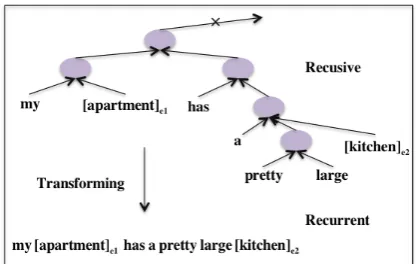
For recursive models, we followed the proto-cols in Socher et al. (2013) where node embed-dings in the parse trees are obtained from recur-sive models and then fed to a softmax classifier. We transformed the dataset for recurrent model use as illustrated in Figure 1. Each phrase is recon-structed from parse tree nodes and treated as a sep-arate data point. As the treebank contains 11,855
sentences with 215,154 phrases, the reconstructed dataset for recurrent models comprises 215,154 examples. Models are evaluated at both the phrase level (82,600 instances) and the sentence root level (2,210 instances).
Fine-Grained Binary
Tree 0.433 0.815
Sequence 0.420 (-0.013) 0.807 (-0.007)
P-value 0.042* 0.098
Bi-Sequence 0.435 (+0.08) 0.816 (+0.002)
[image:4.595.320.511.140.208.2]P-value 0.078 0.210
Table 1: Test set accuracies on the Stanford Senti-ment Treebank at root level.
Fine-Grained Binary
Tree 0.820 0.860
Sequence 0.818 (-0.002) 0.864 (+0.004)
P-value 0.486 0.305
Bi-Sequence 0.826 (+0.06) 0.862 (+0.002)
P-value 0.148 0.450
Table 2: Test set accuracies on the Stanford Senti-ment Treebank at phrase level.
Results are shown in Table 1 and 21. When
comparing the standard version of tree models to sequence models, we find it helps a bit at root level identification (for sequences but not bi-sequences), but yields no significant improvement at the phrase level.
LSTM Tai et al. (2015) discovered that LSTM tree models generate better performances in terms of sentence root level evaluation than sequence models. We explore this task a bit more by training deeper and more sophisticated models. We exam-ine the following three models:
1. Tree-structured LSTM models (Tai et al., 2015)2.
2. Deep Bi-LSTM sequence models (denoted as
Sequence) that treat the whole sentence as just one sequence.
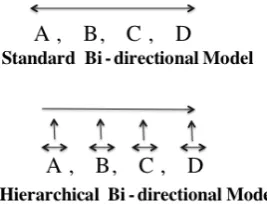
3. Deep Bi-LSTM hierarchical sequence mod-els (denoted asHierarchical Sequence) that first slice the sentence into a sequence of sub-sentences by using a look-up table of punc-tuations (i.e., comma, period, question mark
1The performance of our implementations of recursive
models is not exactly identical to that reported in Socher et al. (2013), but the relative difference is around1%to2%.
2Tai et al.. achieved 0.510 accuracy in terms of
[image:4.595.319.511.258.326.2]Figure 1: Transforming Stanford Sentiment Treebank to Sequences for Sequence Models.
Figure 2: Illustration of two sequence models. A, B, C, D denote clauses or sub sentences separated by punctuation.
and exclamation mark). The representation for each sub-sentence is first computed sep-arately, and another level of sequence LSTM (one-directional) is then used to join the sub-sentences. Illustrations are shown in Figure2.
We consider the third model because the dataset used in Tai et al. (2015) contains long sentences and the evaluation is performed only at the sen-tence root level. Since a parsing algorithm will naturally break long sentences into sub-sentences, we would like to know whether any performance boost is introduced by the intra-clause parse tree structure or just by this broader segmentation of a sentence into clause-like units; this latter advan-tage could be approximated by using punctuation-based approximations to clause boundaries.
We run 15 iterations for each algorithm. Pa-rameters are harvested at the end of each itera-tion; those performing best on the development set are used on the test set. The whole process takes roughly 15-20 minutes on a single GPU ma-chine3. For a more convincing comparison, we
did not use the bootstrap test where parallel ex-amples are generated from one same dataset. In-stead, we repeated the aforementioned procedure for each algorithm 20 times and report accuracies
3Tesla K40m, 2880 Cuda cores.
with standard deviation in Table 3.
Model all-fine root-fine root-coarse Tree LSTM 83.4(0.3) 50.4 (0.9) 86.7 (0.5) Bi-Sequence 83.3 (0.4) 49.8 (0.9) 86.7 (0.5) Hier-Sequence 82.9 (0.3) 50.7(0.8) 86.9(0.6) Table 3: Test set accuracies on the Stanford Sen-timent Treebank with deviations. For our exper-iments, we report accuracies over 20 runs with standard deviation.
Tree LSTMs are equivalent or marginally bet-ter than standard bi-directional sequence model (two-tailed p-value equals 0.041*, and only at the root level, with p-value for the phrase level at 0.376). The hierarchical sequence model achieves the same performance with a p-value of 0.198.
Discussion The results above suggest that clausal segmentation of long sentences offers a slight performance boost, a result also supported by the fact that very little difference exists between the three models for phrase-level sentiment eval-uation. Clausal segmentation of long sentences thus provides a simple approximation to parse-tree based models.
We suggest a few reasons for this slightly better performances introduced by clausal segmentation:
1. Treating clauses as basic units (to the extent that punctuation approximates clauses) pre-serves the semantic structure of text.
2. Semantic compositions such as negations or conjunctions usually appear at the clause level. Working on clauses individually and then combining them model inter-clause compositions.
[image:5.595.113.247.227.329.2]Figure 3: Sentiment prediction using a one-directional (left to right) LSTM. Decisions at each time step are made by feeding embeddings calcu-lated from the LSTM into a softmax classifier.
review “simple as the plot was , i still like it a lot”. With standard recurrent models it takes 12 steps before the prediction error gets back to the first token “simple”:
error→lot→a→it→like→still→i→,→was
→plot→the→as→simple
In a hierarchical model, the second clause is compacted into one component, and the error propagation is thus given by:
error→ second-clause → first-clause →
was→plot→the→as→simple.
Propagation with clause segmentation con-sists of only 8 operations. Such a procedure thus tends to attenuate the gradient vanish-ing problem, potentially yieldvanish-ing better per-formance.
3.2 Binary Sentiment Classification (Pang) Task Description: The sentiment dataset of Pang et al. (2002) consists of sentences with a sentiment label for each sentence. We divide the original dataset into train-ing(8101)/dev(500)/testing(2000). No pre-training procedure as described in Socher et al. (2011b) is employed. Word embeddings are initialized using skip-grams and kept fixed in the learning procedure. We trained skip-gram embeddings on the Wikipedia+Gigaword dataset using the word2vec package4. Sentence level
embeddings are fed into a sigmoid classifier. Performances for 50 dimensional vectors are given in the table below:
Discussion Why don’t parse trees help on this task? One possible explanation is the distance
4https://code.google.com/p/word2vec/
Standard LSTM
Tree 0.745 0.774
Sequence 0.733 (-0.012) 0.783 (+0.008)
P-value 0.060 0.136
Bi-Sequence 0.754 (+0.09) 0.790 (+0.016)
[image:6.595.317.512.61.130.2]P-value 0.058 0.024*
Table 4: Test set accuracies on the Pang’s senti-ment dataset using Standard model settings. of the supervision signal from the local composi-tional structure. The Pang et al. dataset has an av-erage sentence length of 22.5 words, which means it takes multiple steps before sentiment related ev-idence comes up to the surface. It is therefore un-clear whether local compositional operators (such as negation) can be learned; there is only a small amount of training data (around 8,000 examples) and the sentiment supervision only at the level of the sentence may not be easy to propagate down to deeply buried local phrases.
3.3 Question-Answer Matching
Task Description: In the question-answering dataset QANTA5, each answer is a token or short
phrase. The task is different from standard gener-ation focused QA task but formalized as a multi-class multi-classification task that matches a source question with a candidates phrase from a prede-fined pool of candidate phrases We give an illus-trative example here:
Question:He left unfinished a novel whose title character forges his father’s signature to get out of school and avoids the draft by feigning desire to join. Name this German author of The Magic Mountain and Death in Venice.
Answer: Thomas Mann from the pool of phrases. Other candidates might include George Washington, Charlie Chaplin, etc.
The model of Iyyer et al. (2014) minimizes the distances between answer embeddings and node embeddings along the parse tree of the question. Concretely, letcdenote the correct answer to ques-tionS, with embedding~c, andzdenoting any ran-dom wrong answer. The objective function sums over the dot product between representation for every node η along the question parse trees and the answer representations:
L= X
η∈[parse tree]
X
z
max(0,1−~c·eη+~z·eη) (8)
5http://cs.umd.edu/˜miyyer/qblearn/.
[image:6.595.84.282.65.184.2]where eη denotes the embedding for parse tree node calculated from the recursive neural model. Here the parse trees are dependency parses follow-ing (Iyyer et al., 2014).
By adjusting the framework to recurrent mod-els, we minimize the distance between the answer embedding and the embeddings calculated from each timesteptof the sequence:
L= X
t∈[1,Ns]
X
z
max(0,1−~c·et+~z·et) (9)
[image:7.595.310.520.253.385.2]At test time, the model chooses the answer (from the set of candidates) that gives the lowest loss score. As can be seen from results presented in Table 5, the difference is only significant for the LSTM setting between the tree model and the sequence model; no significant difference is ob-served for other settings.
Standard LSTM
Tree 0.523 0.558
Sequence 0.525 (+0.002) 0.546 (-0.012)
P-value 0.490 0.046*
Bi-Sequence 0.530 (+0.007) 0.564 (+0.006)
[image:7.595.82.280.324.392.2]P-value 0.075 0.120
Table 5: Test set accuracies for UMD-QA dataset.
Discussion The UMD-QA task represents a group of situations where because we have in-sufficient supervision about matching (it’s hard to know which node in the parse tree or which timestep provides the most direct evidence for the answer), decisions have to be made by looking at and iterating over all subunits (all nodes in parse trees or timesteps). Similar ideas can be found in pooling structures (e.g. Socher et al. (2011a)).
The results above illustrate that for tasks where we try to align the target with different source components (i.e., parse tree nodes for tree mod-els and different time steps for sequence modmod-els), components from sequence models are able to em-bed important information, despite the fact that se-quence model components are just sentence frag-ments and hence usually not linguistically mean-ingful components in the way that parse tree con-stituents are.
3.4 Semantic Relationship Classification Task Description: SemEval-2010 Task 8 (Hen-drickx et al., 2009) is to find semantic rela-tionships between pairs of nominals, e.g., in “My [apartment]e1 has a pretty large [kitchen]e2”
classifying the relation between [apartment] and [kitchen] ascomponent-whole. The dataset con-tains 9 ordered relationships, so the task is formal-ized as a 19-class classification problem, with di-rected relations treated as separate labels; see Hen-drickx et al. (2009; Socher et al. (2012) for details. For the recursive implementations, we follow the neural framework defined in Socher et al. (2012). The path in the parse tree between the two nominals is retrieved, and the embedding is calcu-lated based on recursive models and fed to a soft-max classifier6. Retrieved paths are transformed
for the recurrent models as shown in Figure 5.
Figure 4: Illustration of Models for Semantic Re-lationship Classification.
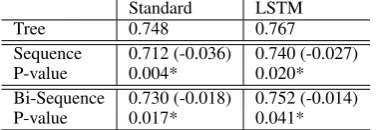
Discussion Unlike for earlier tasks, here recur-sive models yield much better performance than the corresponding recurrent versions for all ver-sions (e.g., standard tree vs. standard sequence,
p = 0.004). These results suggest that it is the need to integrate structures far apart in the sen-tence that characterizes the tasks where recursive models surpass recurrent models. In parse-based models, the two target words are drawn together much earlier in the decision process than in recur-rent models, which must remember one target un-til the other one appears.
3.5 Discourse Parsing
Task Description: Our final task, discourse parsing based on the RST-DT corpus (Carlson et
6(Socher et al., 2012) achieve state-of-art performance
Standard LSTM
Tree 0.748 0.767
Sequence 0.712 (-0.036) 0.740 (-0.027)
P-value 0.004* 0.020*
Bi-Sequence 0.730 (-0.018) 0.752 (-0.014)
[image:8.595.88.277.63.128.2]P-value 0.017* 0.041*
Table 6: Test set accuracies on the SemEval-2010 Semantic Relationship Classification task.
Figure 5: An illustration of discourse parsing. [e1, e2, ...] denote EDUs (elementary discourse units), each consisting of a sequence of tokens. [r12, r34, r56]denote relationships to be classified. A binary classification model is first used to decide whether two EDUs should be merged and a multi-class multi-classifier is then used to decide the relation type.
al., 2003), is to build a discourse tree for a doc-ument, based on assigning Rhetorical Structure Theory (RST) relations between elementary dis-course units (EDUs). Because disdis-course relations express the coherence structure of discourse, they presumably express different aspects of compo-sitional meaning than sentiment or nominal rela-tions. See Hernault et al. (2010) for more details on discourse parsing and the RST-DT corpus.
Representations for adjacent EDUs are fed into binary classification (whether two EDUs are re-lated) and multi-class relation classification mod-els, as defined in Li et al. (2014). Related EDUs are then merged into a new EDU, the representa-tion of which is obtained through an operarepresenta-tion of neural composition based on the previous two re-lated EDUs. This step is repeated until all units are merged.
Discourse parsing takes EDUs as the basic units to operate on; EDUs are short clauses, not full sen-tences, with an average length of 7.2 words. Re-cursive and recurrent models are applied on EDUs to create embeddings to be used as inputs for dis-course parsing. We use this task for two rea-sons: (1) to illustrate whether syntactic parse trees are useful for acquiring representations for short clauses. (2) to measure the extent to which
pars-ing improves discourse tasks that need to combine the meanings of larger text units.
Models are traditionally evaluated in terms of three metrics, i.e., spans7, nuclearity8, and
identi-fying the rhetorical relation between two clauses. Due to space limits, we only focus the last one, rhetorical relation identification, because (1) rela-tion labels are treated as correct only if spans and nuclearity are correctly labeled (2) relation identi-fication between clauses offer more insights about model’s abilities to represent sentence semantics. In order to perform a plain comparison, no addi-tional human-developed features are added.
Standard LSTM
Tree 0.568 0.564
Sequence 0.572 (+0.004) 0.563 (-0.002)
P-value 0.160 0.422
Bi-Sequence 0.578 (+0.01) 0.575 (+0.012)
P-value 0.054 0.040*
Table 7: Test set accuracies for relation identifica-tion on RST discourse parsing data set.
Discussion We see no large differences between equivalent recurrent and recursive models. We suggest two possible explanations. (1) EDUs tend to be short; thus for some clauses, parsing might not change the order of operations on words. Even for those whose orders are changed by parse trees, the influence of short phrases on the final represen-tation may not be great enough. (2) Unlike earlier tasks, where text representations are immediately used as inputs into classifiers, the algorithm pre-sented here adopts additional levels of neural com-position during the process of EDU merging. We suspect that neural layers may act as information filters, separating the informational chaff from the wheat, which in turn makes the model a bit more immune to the initial inputs.
4 Discussions and Conclusions
We compared recursive and recurrent neural mod-els for representation learning on 5 distinct NLP tasks in 4 areas for which recursive neural models are known to achieve good performance (Socher et al., 2012; Socher et al., 2013; Li et al., 2014; Iyyer et al., 2014).
As with any comparison between models, our results come with some caveats: First, we ex-plore the most general or basic forms of
recur-7on blank tree structures.
[image:8.595.318.510.248.317.2]sive/recurrent models rather than various sophis-ticated algorithm variants. This is because fair comparison becomes more and more difficult as models get complex (e.g., the number of lay-ers, number of hidden units within each layer, etc.). Thus most neural models employed in this work are comprised of only one layer of neural compositions—despite the fact that deep neural models with multiple layers give better results. Our conclusions might thus be limited to the al-gorithms employed in this paper, and it is unclear whether they can be extended to other variants or to the latest state-of-the-art. Second, in order to compare models “fairly”, we force every model to be trained exactly in the same way: AdaGrad with minibatches, same set of initializations, etc. How-ever, this may not necessarily be the optimal way to train every model; different training strategies tailored for specific models may improve their per-formances. In that sense, our attempts to be “fair” in this paper may nevertheless be unfair.
Pace these caveats, our conclusions can be sum-marized as follows:
• In tasks like semantic relation extraction, in which single headwords need to be associ-ated across a long distance, recursive models shine. This suggests that for the many other kinds of tasks in which long-distance seman-tic dependencies play a role (e.g., translation between languages with significant reorder-ing like Chinese-English translation), syntac-tic structures from recursive models may of-fer useful power.
• Tree models tend to help more on long se-quences than shorter ones with sufficient su-pervision: tree models slightly help root level identification on the Stanford Sentiment Treebank, but do not help much at the phrase level. Adopting bi-directional versions of re-current models seem to largely bridge this gap, producing equivalent or sometimes bet-ter results.
• On long sequences where supervision is not sufficient, e.g., in Pang at al.,’s dataset (super-vision only exists on top of long sequences), no significant difference is observed between tree based and sequence based models.
• In cases where tree-based models do well, a simple approximation to tree-based models
seems to improve recurrent models to equiv-alent or almost equivequiv-alent performance: (1) break long sentences (on punctuation) into a series of clause-like units, (2) work on these clauses separately, and (3) join them together. This model sometimes works as well as tree models for the sentiment task, suggesting that one of the reasons tree models help is by breaking down long sentences into more manageable units.
• Despite that the fact that components (out-puts from different time steps) in recur-rent models are not linguistically meaningful, they may do as well as linguistically mean-ingful phrases (represented by parse tree nodes) in embedding informative evidence, as demonstrated in UMD-QA task. Indeed, recent work in parallel with ours (Bowman et al., 2015) has shown that recurrent models like LSTMs can discover implicit recursive compositional structure.
5 Acknowledgments
We would especially like to thank Richard Socher and Kai-Sheng Tai for insightful comments, ad-vice, and suggestions. We would also like to thank Sam Bowman, Ignacio Cases, Jon Gauthier, Kevin Gu, Gabor Angeli, Sida Wang, Percy Liang and other members of the Stanford NLP group, as well as the anonymous reviewers for their helpful ad-vice on various aspects of this work. We acknowl-edge the support of NVIDIA Corporation with the donation of Tesla K40 GPUs We gratefully ac-knowledge support from an Enlight Foundation Graduate Fellowship, a gift from Bloomberg L.P., the Defense Advanced Research Projects Agency (DARPA) Deep Exploration and Filtering of Text (DEFT) Program under Air Force Research Lab-oratory (AFRL) contract no. FA8750-13-2-0040, and the NSF via award IIS-1514268. Any opin-ions, findings, and conclusions or recommenda-tions expressed in this material are those of the authors and do not necessarily reflect the views of Bloomberg L.P., DARPA, AFRL, NSF, or the US government.
References
learning to align and translate. arXiv preprint arXiv:1409.0473.
Samuel R Bowman, Christopher Potts, and Christo-pher D Manning. 2014. Recursive neural net-works for learning logical semantics. arXiv preprint arXiv:1406.1827.
Samuel R Bowman, Christopher D Manning, and Christopher Potts. 2015. Tree-structured compo-sition in neural networks without tree-structured ar-chitectures. arXiv preprint arXiv:1506.04834. Samuel R Bowman. 2013. Can recursive neural tensor
networks learn logical reasoning? arXiv preprint arXiv:1312.6192.
Lynn Carlson, Daniel Marcu, and Mary Ellen Okurowski. 2003. Building a discourse-tagged cor-pus in the framework of rhetorical structure theory. InCurrent and New Directions in Discourse and Di-alogue Text, Speech and Language Technology. vol-ume 22. Springer.
Ronan Collobert, Jason Weston, L´eon Bottou, Michael Karlen, Koray Kavukcuoglu, and Pavel Kuksa. 2011. Natural language processing (almost) from scratch. The Journal of Machine Learning Re-search, 12:2493–2537.
Andrew Cotter, Ohad Shamir, Nati Srebro, and Karthik Sridharan. 2011. Better mini-batch algorithms via accelerated gradient methods. InAdvances in Neu-ral Information Processing Systems, pages 1647– 1655.
Li Dong, Furu Wei, Chuanqi Tan, Duyu Tang, Ming Zhou, and Ke Xu. 2014. Adaptive recursive neural network for target-dependent twitter sentiment clas-sification. InProceedings of the 52nd Annual Meet-ing of the Association for Computational LMeet-inguis- Linguis-tics, pages 49–54.
Georg Dorffner. 1996. Neural networks for time series processing. InNeural Network World.
John Duchi, Elad Hazan, and Yoram Singer. 2011. Adaptive subgradient methods for online learning and stochastic optimization. The Journal of Ma-chine Learning Research, 12:2121–2159.
Bradley Efron and Robert J Tibshirani. 1994. An in-troduction to the bootstrap. CRC press.
Jeffrey L Elman. 1990. Finding structure in time.
Cognitive science, 14(2):179–211.
Christoph Goller and Andreas Kuchler. 1996. Learn-ing task-dependent distributed representations by backpropagation through structure. InNeural Net-works, 1996., IEEE International Conference on, volume 1, pages 347–352. IEEE.
Alex Graves and Juergen Schmidhuber. 2009. Offline handwriting recognition with multidimensional re-current neural networks. InAdvances in Neural In-formation Processing Systems, pages 545–552.
Alex Graves, Abdel-rahman Mohamed, and Geoffrey Hinton. 2013. Speech recognition with deep recur-rent neural networks. InAcoustics, Speech and Sig-nal Processing (ICASSP), 2013 IEEE InternatioSig-nal Conference on, pages 6645–6649. IEEE.
Alex Graves. 2012. Supervised sequence labeling with recurrent neural networks, InStudies in Com-putational Intelligence.volume 385. Springer. Kazuma Hashimoto, Makoto Miwa, Yoshimasa
Tsu-ruoka, and Takashi Chikayama. 2013. Simple cus-tomization of recursive neural networks for seman-tic relation classification. InEMNLP, pages 1372– 1376.
Iris Hendrickx, Su Nam Kim, Zornitsa Kozareva, Preslav Nakov, Diarmuid ´O S´eaghdha, Sebastian Pad´o, Marco Pennacchiotti, Lorenza Romano, and Stan Szpakowicz. 2009. Semeval-2010 task 8: Multi-way classification of semantic relations between pairs of nominals. In Proceedings of the Workshop on Semantic Evaluations: Recent Achievements and Future Directions, pages 94–99. Association for Computational Linguistics.
Hugo Hernault, Helmut Prendinger, Mitsuru Ishizuka. 2010. Hilda: a discourse parser using support vector machine classification.Dialogue & Discourse, 1(3). Sepp Hochreiter and J¨urgen Schmidhuber. 1997. Long short-term memory. Neural computation, 9(8):1735–1780.
Ozan Irsoy and Claire Cardie. 2013. Bidirectional re-cursive neural networks for token-level labeling with structure. arXiv preprint arXiv:1312.0493.
Ozan Irsoy and Claire Cardie. 2014. Deep recursive neural networks for compositionality in language. InAdvances in Neural Information Processing Sys-tems, pages 2096–2104.
Mohit Iyyer, Jordan Boyd-Graber, Leonardo Claudino, Richard Socher, and Hal Daum´e III. 2014. A neural network for factoid question answering over para-graphs. InProceedings of the 2014 Conference on Empirical Methods in Natural Language Processing (EMNLP), pages 633–644.
Nal Kalchbrenner and Phil Blunsom. 2013. Recurrent continuous translation models. In EMNLP, pages 1700–1709.
Quoc V Le and Tomas Mikolov. 2014. Distributed representations of sentences and documents. arXiv preprint arXiv:1405.4053.
Jiwei Li and Eduard Hovy. 2014. A model of coher-ence based on distributed sentcoher-ence representation. InProceedings of the 2014 Conference on Empirical Methods in Natural Language Processing (EMNLP)
in Natural Language Processing (EMNLP), pages 2061–2069.
Richard P Lippmann. 1989. Review of neural net-works for speech recognition. Neural computation, 1(1):1–38.
Thang Luong, Ilya Sutskever, Quoc V Le, Oriol Vinyals, and Wojciech Zaremba. 2014. Addressing the rare word problem in neural machine translation.
Proceedings of ACL. 2015.
Tomas Mikolov, Wen-tau Yih, and Geoffrey Zweig. 2013. Linguistic regularities in continuous space word representations. InHLT-NAACL, pages 746– 751.
Bo Pang, Lillian Lee, and Shivakumar Vaithyanathan. 2002. Thumbs up?: sentiment classification using machine learning techniques. InProceedings of the ACL-02 conference on Empirical methods in natural language processing-Volume 10, pages 79–86. As-sociation for Computational Linguistics.
Romain Paulus, Richard Socher, and Christopher D Manning. 2014. Global belief recursive neural net-works. InAdvances in Neural Information Process-ing Systems, pages 2888–2896.
Barak A Pearlmutter. 1989. Learning state space tra-jectories in recurrent neural networks. Neural Com-putation, 1(2):263–269.
Tony Robinson, Mike Hochberg, and Steve Renals. 1996. The use of recurrent neural networks in con-tinuous speech recognition. In Automatic speech and speaker recognition, pages 233–258. Springer.
Mike Schuster and Kuldip K Paliwal. 1997. Bidirec-tional recurrent neural networks.Signal Processing, IEEE Transactions on, 45(11):2673–2681.
Richard Socher, Eric H Huang, Jeffrey Pennin, Christo-pher D Manning, and Andrew Y Ng. 2011a. Dy-namic pooling and unfolding recursive autoencoders for paraphrase detection. InAdvances in Neural In-formation Processing Systems, pages 801–809.
Richard Socher, Jeffrey Pennington, Eric H Huang, Andrew Y Ng, and Christopher D Manning. 2011b. Semi-supervised recursive autoencoders for predict-ing sentiment distributions. In Proceedings of the Conference on Empirical Methods in Natural Lan-guage Processing, pages 151–161. Association for Computational Linguistics.
Richard Socher, Brody Huval, Christopher D Manning, and Andrew Y Ng. 2012. Semantic compositional-ity through recursive matrix-vector spaces. In Pro-ceedings of the 2012 Joint Conference on Empiri-cal Methods in Natural Language Processing and Computational Natural Language Learning, pages 1201–1211. Association for Computational Linguis-tics.
Richard Socher, Alex Perelygin, Jean Y Wu, Jason Chuang, Christopher D Manning, Andrew Y Ng, and Christopher Potts. 2013. Recursive deep mod-els for semantic compositionality over a sentiment treebank. InProceedings of the Conference on Em-pirical Methods in Natural Language Processing (EMNLP), pages 1631–1642.
Ilya Sutskever, Oriol Vinyals, and Quoc VV Le. 2014. Sequence to sequence learning with neural net-works. InAdvances in Neural Information Process-ing Systems, pages 3104–3112.
Kai Sheng Tai, Richard Socher, and Christopher D Manning. Improved semantic representations from tree-structured long short-term memory networks.
ACL. 2015.
Oriol Vinyals, Lukasz Kaiser, Terry Koo, Slav Petrov, Ilya Sutskever, and Geoffrey Hinton. 2014. Grammar as a foreign language. arXiv preprint arXiv:1412.7449.