Proceedings of the 2019 Conference on Empirical Methods in Natural Language Processing 3591
Using Pairwise Occurrence Information to Improve Knowledge Graph
Completion on Large-Scale Datasets
Esma Balkır1,2*,Masha Naslidnyk2,Dave Palfrey2andArpit Mittal2 1University of Edinburgh, Scotland, UK
2Amazon Research, Cambridge, UK 1[email protected]
2{naslidny, dpalfrey, mitarpit}@amazon.co.uk
Abstract
Bilinear models such as DistMult and ComplEx are effective methods for knowl-edge graph (KG) completion. However, they require large batch sizes, which becomes a performance bottleneck when training on large scale datasets due to memory con-straints. In this paper we use occurrences of entity-relation pairs in the dataset to construct a joint learning model and to increase the quality of sampled negatives during training. We show on three standard datasets that when these two techniques are combined, they give a significant improvement in performance, especially when the batch size and the number of generated negative examples are low relative to the size of the dataset. We then apply our techniques to a dataset containing 2 million entities and demonstrate that our model outperforms the baseline by 2.8% absolute on hits@1.
1 Introduction
A Knowledge Graph (KG) is a collection of facts which are stored as triples, e.g.Berlin is-capital-of Germany. Even though knowledge graphs are es-sential for various NLP tasks, open domain knowl-edge graphs have missing facts. To tackle this is-sue, there has recently been considerable interest in KG completion methods, where the goal is to rank correct triples above incorrect ones.
Embedding methods such as DistMult (Yang et al.,2014) and ComplEx (Trouillon et al.,2016) are simple and effective methods for this task, but are known to be sensitive to hyperparameter and loss function choices (Kadlec et al.,2017;Lacroix et al.,2018). When paired with the right loss func-tion, these methods need large minibatches and a large number of corrupted triples per each positive triple during training to reach peak performance.
*Work done while the author was an intern
1 This causes memory issues for KGs in the wild,
which are several magnitudes bigger than the com-mon benchmarking datasets.
To address the issue of scalability, we develop a framework that could be used with any bilin-ear KG embedding model. We name our model JoBi (Joint model with Biased negative sam-pling). Our framework uses occurrences of entity-relation pairs to overcome data sparsity, and to bias the model to score plausible triples higher. The framework trains a base model jointly with an auxiliary model that uses occurrences of pairs within a given triple in the data as labels. For ex-ample, the auxiliary model would receive the la-bel 1 for the triple (Berlin is-capital-of France) if the pairs (Berlin is-capital-of) and (is-capital-of France) are present in the training data, while the base model would receive the label 0.
The intuition for using bigram occurrences is to capture some information about restrictions on the set of entities that could appear as the object or subject of a given relation; that information should implicitly correspond to some underlying type constraints. For example, even if(Berlin is-capital-of France)is not a correct triple,Berlinis the right type for the subject ofis-capital-of.
Our framework also utilizes entity-relation pair occurrences to improve the distribution of negative examples for contrastive training, by sampling a false triple e.g. (Berlin is-capital-of France) with higher probability if the pairs (Berlin is-capital-of) and (is-capital-of France) both occur in the dataset. This tunes the noise distribution for the task so that it is more challenging, and hence the model needs a fraction of the negative examples compared to a uniform distribution.
We show empirically that joint training is es-pecially beneficial when the batch size is small,
1The choice of loss function has a very strong effect on
and biased negative sampling helps model learn higher quality embeddings with much fewer neg-ative samples. We show that the two techniques are complementary and perform significantly bet-ter when combined. We then test JoBi on a large-scale dataset, and demonstrate that JoBi learns bet-ter embeddings in very large KGs.
2 Background
Formally, given a set of entitiesE ={e0, . . . , en} and a set of relationsR={r0, . . . , rm}, a Knowl-edge Graph (KG) is a set triples in the form G = {(h, r, t)} ✓ E ⇥R⇥E, where if a triple (h, r, t) 2 G, then relation r holds between
en-titiesh andt. Given such a KG, the aim of KG
completion is score each triple inE⇥R⇥E, so that correct triples are assigned higher scores than the false ones. KG embedding methods achieve this by learning dense vector representations for entities and relations through optimizing a cho-sen scoring function. A class of KG completion models such as RESCAL (Nickel et al., 2012), DistMult (Yang et al.,2014), ComplEx (Trouillon et al., 2016), SimplE (Kazemi and Poole, 2018) and TUCKER (Balaˇzevi´c et al.,2019) define their scoring function to be a bilinear interaction of the embeddings of entities and relations in the triple. For this work we consider DistMult, ComplEx and SimplE as our baseline models due to their sim-plicity.
DistMult. (Yang et al., 2014) is a knowledge graph completion model that defines the scoring function for a triple as a simple bilinear interac-tion, where the entity has the same representation regardless of whether it appears as the head or the tail entity. For entitiesh, t, relationr, and the
em-beddingsh,t,r2 Rd, the scoring function is de-fined as:
s(h, r, t) =hTdiag(r)t (1)
where diag(r) is a diagonal matrix with r on the diagonal.
ComplEx. (Trouillon et al., 2016) is a bilin-ear model similar to DistMult. Because of its symmetric structure, DistMult cannot model anti-symmetric relations. ComplEx overcomes this shortcoming by learning embeddings in a complex vector space, and defining the embedding of an en-tity in tail position as the complex conjugate of the embedding in the head position.
Leth,r,t 2 Cdbe the embeddings forh, r, t. The score for ComplEx is defined as follows:
s(h, r, t) =Re hTdiag(r)t (2)
Where adenotes the complex conjugate of a, and Re(a) denotes the real part of the complex vectora.
SimplE. (Kazemi and Poole,2018) is also a bi-linear model similar to DistMult. Each entity has two associated embeddings e1,e2 2 Rd, where
one is the representation ofeas the head, and the
other as the tail entity of the triple. Each relation also has two associated embeddings: r andr 1, wherer 1 is the representation for the reverse of
r. The score function is defined as:
s(h, r, t) = 1/2 (h1)T diag(r)t1
+1/2 (t2)T diag(r 1)h2
(3)
3 Joint framework
JoBi contains two copies of a bilinear model, where one is trained on labels of triples, and the other on occurrences of entity-relation pairs within the triples. For the pair module, we label a triple
(h, r, t) correct if there are triples (h, r, t0) and (h0, r, t)in the training set for somet0andh0.
The scoring functions for the two models are
sbiandstri, for the pair and the triple modules re-spectively. We tie the weights of the entity embed-dings, but let the embeddings for the relations be optimized separately. The equations using Com-plEx as the base model are as follows:
stri(h, r, t) =Re hTdiag(rtri)t (4)
sbi(h, r, t) =Re hTdiag(rbi)t (5)
We define the framework for DistMult and Sim-plE analogously. During training, we optimize the two jointly, but use only stri during test time. Hence, the addition of the auxiliary module has no effect on the number of final parameters of the trained model. Note that even during training, this doesn’t increase model complexity in any signifi-cant way since the number of relations in KGs are often a fraction of the number of entities.
For each triple in the minibatch, we generate
nnegnegative examples per positive triple by ran-domly corrupting the head or the tail entity. For
Dataset #entities #relations #train
FB15K 14,951 1,345 483,142 FB15K-237 14,541 237 272,115 YAGO3-10 123,182 37 1,079,040
[image:3.595.82.285.63.115.2]FB1.9M 1,892,241 3,247 19,323,513
Table 1: Statistics of datasets used in experiments.
entropy loss. We combine the two losses via a sim-ple weighted addition with a tunable hyperparam-eter↵:
Ltotal =Ltri+↵Lbi (6) Biased negative sampling. We also examine the effect of using the pair cooccurrence information for making the contrastive training more challeng-ing for the model. For this, we keep the model as is, but with probabilityp, instead of corrupting the head or the tail of the triple with an entity chosen uniformly at random, we corrupt it with an entity that is picked with uniform probability from the set of entities that occur as the head or tail entity of the relation in the given triple. To illustrate, when sampling a negative tail entity for the tupleBerlin is-capital-of, this method causes the model to pick
France with higher probability than George Or-well if France but not George Orwell occurs as the head entity for the relationis-capital-of in the training data.
4 Experiments
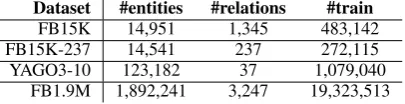
We perform our experiments on standard datasets FB15K (Bordes et al., 2013), FB15K-237 (Toutanova et al., 2015), YAGO3-10 (Dettmers et al., 2018), and on a new large-scale dataset FB1.9M which we construced from FB3M (Xu and Barbosa, 2018). 2 We focus on YAGO3-10
since it is 10 times larger than the other two and better reflects how the performance of the models scale. We present the comparison of the sizes of these datasets in Table1, and further details could be found in AppendixA.
For evaluation, we rank each triple (h, r, t) in
the test set against(h0, r, t)for all entitiesh0, and
similarly against(h, r, t0)for all entitiest0. We
fil-ter out the candidates that have occurred in train-ing, validation or test set as described in Bordes et al.(2013), and we report average hits@1, 3, 10 and mean reciprocal rank (MRR).
2We do not perform experiments on WordNet derived
datasets WN18 or WN18RR because bigram modelling would not provide any information – all entities are synsets and almost all can occur as an object or subject to all the pos-sible relations.
We re-implement all our baselines and obtain very competitive results. In our preliminary ex-periments on baselines, we found that the choice of loss function had a large effect on performance, with negative log-likelihood (NLL) of softmax consistently outperforming both max-margin and logistic losses. Larger batch sizes lead to bet-ter performance. With NLL of sampled soft-max, we found that increasing the number of gen-erated negatives steadily increases performance3,
and state-of-the-art results could be reached by us-ing the full softmax as used inJoulin et al.(2017) andLacroix et al.(2018). This technique is pos-sible for standard benchmarks but not for large KGs, and we report results in AppendixDfor all datasets small enough to allow for full contrastive training. However, our main experiments use NLL of sampled softmax since our focus is on scala-bility. Note that results with full softmax (Ap-pendix D) demonstrate that our implementation of baselines is very competitive.Our implementa-tion of ComplEx performs significantly better than ConvE (Dettmers et al., 2018) on two out of the three datasets, and come close to results ofLacroix et al.(2018) who use extremely large embeddings as well as full softmax, thus cannot be scaled. Our code is publicly available.4
For most of our experiments, we choose to use ComplEx as the base for our model (JoBi Com-plEx), since this configuration consistently out-performed others in preliminary experiments. To test the effect of our techniques on different bilin-ear models, we report results with DistMult (JoBi DistMult) and SimplE (JoBi SimplE) on FB15K-237.
Discussion. It could be seen in Table2that JoBi ComplEx outperforms both ComplEx and Dist-Mult on all three standard datasets, on all the met-rics we consider. For Hits@1, JoBi Complex out-performs baseline ComplEx by 4% on FB15K-237, 6.4% on FB15K and 5.6% on YAGO3-10.
Moreover, results in Table 2 demonstrate that JoBi improves performance on DistMult and Sim-plE. It should be noted that on FB15K-237, all JoBi models outperform all the baseline models, regardless of the base model used.
Lastly, results on FB1.9M (Table 3) demon-strate that JoBi improves performance on this very
3This effect is not observed when using logistic-loss or
max-margin loss
FB15K-237 h@1 h@3 h@10 MRR
SimplE 0.160 0.268 0.430 0.248 DistMult 0.158 0.271 0.432 0.247 ComplEx 0.159 0.275 0.441 0.25 JoBi SimplE 0.188 0.301 0.461 0.277 JoBi DistMult 0.205 0.316 0.466 0.29 JoBi ComplEx 0.199 0.319 0.479 0.29
FB15K h@1 h@3 h@10 MRR
DistMult 0.587 0.785 0.867 0.697 ComplEx 0.617 0.803 0.874 0.72 JoBi ComplEx 0.681 0.824 0.883 0.761
YAGO3-10 h@1 h@3 h@10 MRR
DistMult 0.252 0.407 0.568 0.357 ComplEx 0.277 0.44 0.589 0.383 JoBi ComplEx 0.333 0.477 0.617 0.428
Table 2: Performance on different datasets against baselines, where h@k denotes hits at k. Results are
reported on test sets with the best parameters found in grid search for each model.
ComplEx h@1 h@3 h@10 MRR
Baseline 0.424 0.598 0.721 0.530
JoBi 0.452 0.615 0.726 0.550
Table 3: Performance on the large-scale FB1.9M dataset, measured against the best performing baseline.
# epochs training time
ComplEx 70 5 days 5 hours 8 minutes JoBi ComplEx 30 4 days 19 minutes
Table 4: Runtimes of ComplEx and JoBi Complex on FB1.9M.
large dataset, where it is not possible to perform softmax over the entire set of entities, or have very large embedding sizes due to memory constraints. Although one epoch for JoBi takes slightly longer than the baseline, JoBi converges in fewer epochs, resulting in shorter running time overall. We report running times on FB1.9M in Table4.
Comparison with TypeComplex For results of TypeComplex, Jain et al. (2018) use a wider set of negative ratios in their grid search than we do. To isolate the effects of the different models from hyperparameter choices, we set the negative ratio for our model to be 400 to match the setting on their best performing models. We keep the other hyperparameters the same as the best performing models for the previous experiments.
Jain et al.(2018) use a modified version of the ranking evaluation procedure to report their re-sults, where they only rank the tail entity against all other entities. To be able to compare our model to theirs, we also report the performance of our framework on this modified metric. The results
FB15K-237 h@1 h@3 h@10 MRR
ComplEx 0.209 0.347 0.535 0.314 TypeComplex 0.296 - 0.575 0.389
JoBi ComplEx 0.276 0.416 0.587 0.377
FB15K h@1 h@3 h@10 MRR
ComplEx 0.630 0.818 0.895 0.734 TypeComplex 0.663 - 0.885 0.754 JoBi ComplEx 0.702 0.847 0.906 0.782
YAGO3-10 h@1 h@3 h@10 MRR
[image:4.595.82.283.61.221.2]ComplEx 0.412 0.587 0.701 0.516 TypeComplex 0.516 - 0.702 0.587 JoBi ComplEx 0.507 0.647 0.742 0.591
Table 5: Comparison with TypeComplex where the scores are calculated ranking only the tail entities. Re-sults for TypeComplex are taken fromJain et al.(2018). h@kdenotes hits atk.
.
for these experiments can be found in Table5. Our model generally outperforms TypeCom-plex by a large margin on hits@10. It also outper-forms TypeComplex on MRR by a moderate mar-gin except on FB15K-237, the smallest dataset. On the other hand, TypeComplex outperforms our model on hits@1 in two out of the three datasets. In fact for FB15K, TypeComplex does worse on hits@10 compared to the baseline model. This suggests that TypeComplex may be compromising on hits@k where k is larger to improve the hits@1 metric, which might be undesirable depending on the application.
Qualitative analysis. We analyzed correct pre-dictions made by JoBi ComplEx but not regular ComplEx. Among relations in YAGO3-10, major gains can be observed forhasGender (Appendix
C). The improvement comes solely from tail-entity predictions, with hits@1 increasing from 0.22 to 0.86. Furthermore, we found that the er-rors made by ComplEx are exactly of the kind that can be mitigated by enforcing plausibility: Com-plEx predicts an object that is not a gender (e.g. a sports team or a person) 65% of the time; JoBi makes such an obvious mistake only 2% of the time.
[image:4.595.318.516.62.187.2]h@1 h@3 h@10 MRR
Baseline 0.277 0.44 0.589 0.383 BiasedNeg 0.276 0.427 0.568 0.375 Joint 0.287 0.447 0.601 0.392
[image:5.595.91.274.62.113.2]JoBi 0.333 0.477 0.617 0.428
Table 6: Results of ablation study on ComplEx model.
0 200 400 600 800 1,000 0.45
0.5 0.55 0.6
Batch size
Hits@10 BiasedNegBaseline
[image:5.595.74.284.148.254.2]Joint JoBi
Figure 1: Performances on YAGO3-10 with different batch sizes
0 50 100 150 200 0.45
0.5 0.55 0.6
Negatives ratio
Hits@10 BiasedNegBaseline
Joint JoBi
Figure 2: Performances on YAGO3-10 with different negative ratios
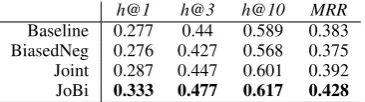
In Table 6 it can be seen that Joint on its own gives a slight performance boost over the base-line, and BiasedNeg performs slightly under the baseline on all measures. However, combining our two techniques in JoBi gives 5.6% points improve-ment on hits@1. This suggests that biased nega-tive sampling increases the efficacy of joint train-ing greatly, but is not very effective on its own.
Figure 1 and 2 shows that JoBi not only con-sistently performs the best over the entire range of parameters, but also delivers a performance im-provement that is especially large when the batch size or the negative ratio is small. This setting was designed to reflect the training conditions on very large datasets. It can be seen that Biased-Neg is more robust to low values of negative ra-tios, and both BiasedNeg and Joint alone show less deterioration in performance as the batch size de-creases. When these two methods are combined in JoBi, the training becomes more robust to differ-ent choices on both these parameters.
The reason behind BiasedNeg performing
worse on its own but better with Joint could be the choice of binary cross entropy loss for the pair module. We speculate that as the negative ratio in-creases, the ratio of negative to positive examples for this module becomes more skewed. Biasing the negative triples in the training alleviates this problem by making the classes more balanced, and allows the joint training to be more effective.
4.1 Related work
Utilizing pair occurrences for embedding mod-els have been considered before, both as explicit model choices and as negative sampling strategies.
Chang et al.(2014) andKrompaß et al.(2015) use pair occurrences to constrain the set of triples to be used in the optimization procedure. For meth-ods that rely on SGD with contrastive training, this translates to a special case of our biased sampling method wherep = 1. Garcia-Dur´an et al. (2016)
presentTATEC, a model that combines bigram and trigram interactions. The trigram model uses a full matrix representation for relations, and hence has many more parameters compared to our model.
Jain et al.(2018) presentJointDMand JointCom-plex, which could be viewed as a simplification of
TATEC. Unlike our model, both of these methods use the bigram terms both in training and evalua-tion, do not share any of the embeddings between two models, and do not provide supervision based on pair occurrences in the data. Other methods that have been considered for improving the nega-tive sampling procedure includes adversarial (Cai and Wang,2018) and self-adversarial (Sun et al.,
2019) training. None of these methods focus on improving the models to scale to large KGs.
5 Conclusion
[image:5.595.74.283.303.407.2]References
Ivana Balaˇzevi´c, Carl Allen, and Timothy M Hospedales. 2019. Tucker: Tensor factorization for knowledge graph completion. arXiv preprint arXiv:1901.09590.
Antoine Bordes, Nicolas Usunier, Alberto Garcia-Dur´an, Jason Weston, and Oksana Yakhnenko. 2013. Translating embeddings for modeling multi-relational data. InProceedings of the 26th Interna-tional Conference on Neural Information Processing Systems, pages 2787–2795. Curran Associates Inc. Liwei Cai and William Yang Wang. 2018. Kbgan:
Ad-versarial learning for knowledge graph embeddings. InProceedings of the 2018 Conference of the North American Chapter of the Association for Computa-tional Linguistics: Human Language Technologies, Volume 1 (Long Papers), pages 1470–1480. Kai-Wei Chang, Scott Wen-tau Yih, Bishan Yang, and
Chris Meek. 2014. Typed tensor decomposition of knowledge bases for relation extraction. In Proceed-ings of the 2014 Conference on Empirical Methods in Natural Language Processing.
Tim Dettmers, Minervini Pasquale, Stenetorp Pon-tus, and Sebastian Riedel. 2018. Convolutional 2D Knowledge Graph Embeddings. InProceedings of the 32th AAAI Conference on Artificial Intelligence, pages 1811–1818.
Alberto Garcia-Dur´an, Antoine Bordes, Nicolas Usunier, and Yves Grandvalet. 2016. Combining two and three-way embedding models for link pre-diction in knowledge bases. Journal of Artificial In-telligence Research, 55:715–742.
Prachi Jain, Pankaj Kumar, Soumen Chakrabarti, and others. 2018. Type-Sensitive Knowledge Base In-ference Without Explicit Type Supervision. In Pro-ceedings of the 56th Annual Meeting of the Associa-tion for ComputaAssocia-tional Linguistics (Volume 2: Short Papers), volume 2, pages 75–80.
Armand Joulin, Edouard Grave, Piotr Bojanowski, Maximilian Nickel, and Tomas Mikolov. 2017. Fast Linear Model for Knowledge Graph Embeddings.
arXiv preprint arXiv:1710.10881.
Rudolf Kadlec, Ondrej Bajgar, and Jan Kleindienst. 2017. Knowledge Base Completion: Baselines Strike Back.arXiv preprint arXiv:1705.10744. Seyed Mehran Kazemi and David Poole. 2018.
Sim-plE Embedding for Link Prediction in Knowledge Graphs. arXiv preprint arXiv:1802.04868.
Diederik P Kingma and Jimmy Ba. 2014. Adam: A method for stochastic optimization. arXiv preprint arXiv:1412.6980.
Denis Krompaß, Stephan Baier, and Volker Tresp. 2015. Type-constrained representation learning in knowledge graphs. InInternational Semantic Web Conference, pages 640–655.
Timothe Lacroix, Nicolas Usunier, and Guillaume Obozinski. 2018. Canonical Tensor Decomposition for Knowledge Base Completion. In Proceedings of the 35th International Conference on Machine Learning.
Maximilian Nickel, Volker Tresp, and Hans-Peter Kriegel. 2012. Factorizing YAGO: scalable machine learning for linked data. InProceedings of the 21st International Conference on World Wide Web, pages 271–280, New York, New York, USA. ACM.
Fabian M. Suchanek, Gjergji Kasneci, and Gerhard Weikum. 2007. YAGO. In Proceedings of the 16th International Conference on World Wide Web - WWW ’07, page 697, New York, New York, USA. ACM Press.
Zhiqing Sun, Zhi-Hong Deng, Jian-Yun Nie, and Jian Tang. 2019. Rotate: Knowledge graph embedding by relational rotation in complex space. In Interna-tional Conference on Learning Representations.
Kristina Toutanova, Danqi Chen, Patrick Pantel, Hoi-fung Poon, Pallavi Choudhury, and Michael Gamon. 2015. Representing Text for Joint Embedding of Text and Knowledge Bases. InProceedings of the Conference on Empirical Methods in Natural Lan-guage Processing (EMNLP), pages 1499–1509, Lis-bon. ACM.
Tho Trouillon, Johannes Welbl, Sebastian Riedel, Eric Gaussier, and Guillaume Bouchard. 2016. Complex Embeddings for Simple Link Prediction. In Pro-ceedings of The 33rd International Conference on Machine Learning, pages 2071 – 2080.
Peng Xu and Denilson Barbosa. 2018. Investiga-tions on Knowledge Base Embedding for Rela-tion PredicRela-tion and ExtracRela-tion. arXiv preprint arXiv:1802.02114.