Proceedings of the 2019 Conference on Empirical Methods in Natural Language Processing and the 9th International Joint Conference on Natural Language Processing, pages 4058–4068,
4058
Sampling Bias in Deep Active Classification: An Empirical Study
Ameya Prabhu1∗†, Charles Dognin2∗, Maneesh Singh2
University of Oxford1 Verisk|AI, Verisk Analytics2
[email protected],{charles.dognin, maneesh.singh}@verisk.com
Abstract
The exploding cost and time needed for data labeling and model training are bottlenecks for training DNN models on large datasets. Identi-fying smaller representative data samples with strategies like active learning can help mit-igate such bottlenecks. Previous works on active learning in NLP identify the problem of sampling bias in the samples acquired by uncertainty-based querying and develop costly approaches to address it. Using a large em-pirical study, we demonstrate that active set selection using the posterior entropy of deep models like FastText.zip (FTZ) is robust to sampling biases and to various algorithmic choices (query size and strategies) unlike that suggested by traditional literature. We also show that FTZ based query strategy pro-duces sample sets similar to those from more sophisticated approaches (e.g ensemble net-works). Finally, we show the effectiveness of the selected samples by creating tiny high-quality datasets, and utilizing them for fast and cheap training of large models. Based on the above, we propose a simple baseline for deep active text classification that outper-forms the state-of-the-art. We expect the pre-sented work to be useful and informative for dataset compression and for problems involv-ing active, semi-supervised or online learn-ing scenarios. Code and models are available at: https://github.com/drimpossible/Sampling-Bias-Active-Learning
1 Introduction
Deep neural networks (DNNs) trained on large datasets provide state-of-the-art results on various NLP problems (Devlin et al.,2019) including text classification (Howard and Ruder, 2018). How-ever, the cost and time needed to get labeled data and to train models is a serious impediment to creating new and/or better models. This problem can be mitigated by creating smaller representative datasets with active learning which can be used for training DNNs to achieve similar test accuracy as
∗
indicates equal contribution
†
Work done at Verisk|AI
that using the full training dataset . In other words, the smaller sample can be considered a surrogate for the full data.
However, there is lack of clarity in the active learning literature regarding sampling bias in such surrogate datasets created using active learning (Settles, 2009): its dependence on models, func-tions and parameters used to acquire the sample. Indeed, what constitutes a good sample? In this paper, we perform an empirical investigation us-ing active text classification as the application.
Early work in active text classification (Lewis and Gale, 1994) suggests that greedy query gen-eration using label uncertainty may lead to ef-ficient representative samples (Nonetheless, the same test accuracy). Subsequent concerns regard-ing samplregard-ing bias has lead to explicit use of expen-sive diversity measures (Brinker,2003;Hoi et al.,
2006) in acquisition functions or using ensemble approaches (Liere and Tadepalli,1997;McCallum and Nigam,1998) to improve diversity implicitly. Deep active learning approaches adapt the dis-cussed framework above to train DNNs on large data. However, it is not clear if the properties of deep approaches mirror those of their shallow counterparts and if the theory and the empirical evidence regarding sampling efficiency and bias translates from shallow to deep models. For exam-ple, (Sener and Savarese,2018) and (Ducoffe and Precioso,2018) find that uncertainty based strate-gies perform no better than random sampling even if ensembles are used and using diversity mea-sures outperform both. On the other hand, (Beluch et al.,2018;Gissin and Shalev-Shwartz,2019) find that uncertainty measures computed with ensem-bles outperform diversity based approaches while (Gal et al., 2017; Beluch et al., 2018; Siddhant and Lipton, 2018) find them to outperform un-certainty measures computed using single models. A recent empirical study (Siddhant and Lipton,
rel-atively small datasets.
1.1 Sampling Bias in Active Classification
In this paper, we investigate the issues of sampling bias and sample efficiency, the stability of the ac-tively collected query and train sets and the impact of algorithmic factors - i.e. the setup chosen while training the algorithm, in the context of deep active text classification on large datasets. In particular, we consider two sampling biases: label and distri-butional bias, three algorithmic factors: initial set selection, query size and query strategy along with two trained models and four acquisition functions on eight large datasets.
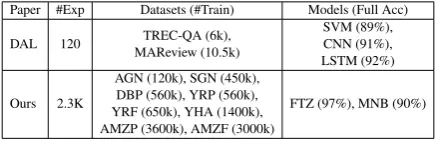
To isolate and evaluate the impact of the above (combinatorial) factors, a large experimental study was necessary. Consequently, we conducted over 2.3K experiments on 8 popular, large, datasets of sizes ranging from 120K-3.6M. Note that the current trend in deep learning is to train large models on very large datasets. However, the aforementioned issues have not yet been investi-gated in the literature in such a setup. As shown in Table1, the datasets used in latest such analysis on active text classification by (Siddhant and Lipton,
2018) are quite small in comparison. The datasets used by us are two orders of magnitude larger, our query samples often being the size of the entire datasets used, and the presented empirical study is more extensive (20x experiments).
Our findings are as follows:
(i) We find that utilizing the uncertainty query strategy using a deep model like FastText.zip (FTZ)1to actively construct a representative sam-ple provides query and train sets with remarkably good sampling properties.
(ii) We finds that a single deep model (FTZ) used for querying provides a sample set similar to more expensive approaches using ensemble of models. Additionally, the sample set has a large overlap with support vectors of an SVM trained on the entire dataset largely invariant to a variety of algorithmic factors, thus indicating the robust-ness of the acquired sample set.
(iii) We demonstrate that the actively acquired training datasets can be utilized as small, surro-gate training sets with a 5x-40x compression for training large, deep text classification models. In
1We use FastText.zip (FTZ) to optimize the time and re-sources needed for this study.
particular, we can train the ULMFiT (Howard and Ruder,2018) model to state of the art accuracy at 25x-200x speedups.
(iv) Finally, we create a novel, state-of-the-art baseline for active text classification which outper-forms recent work (Siddhant and Lipton, 2018), using Bayesian dropout, utilizing 4x less training data. We also outperform (Sener and Savarese,
2018) at all training data sizes. The latter uses an expensive diversity based query strategy (coreset sampling).
The rest of the paper is organized as follows: in Section 2, the experimental methodology and setup are described. Section3presents the exper-imental study on sampling biases as well as the impact of various algorithmic factors. In Section
4, we compare with prior literature in active text classification. Section 5 presents a downstream use case - fast bootstrapping of the training of very large models like ULMFiT. Finally, we discuss the current literature in light of our work in Section6
and summarize the conclusions in Section7.
2 Methodology
This section describes the experimental approach and the setup used to empirically investigate the issues of (i) sampling bias and (ii) sampling ef-ficiency in creating small samples to train deep models.
2.1 Approach
A labelled training set is incrementally built from a pool of unlabeled data by selecting & acquiring labels from an oracle in sequential increments. In this, we follow the standard approach found in the active learning literature. We use the following terminology:
Queries & Query Strategy: We refer to the (incremental) set of points selected to be labeled and added to the training as the query and the (ac-quisition) function used to select the samples as the query strategy.
Pool & Train Sets: The pool is the unlabeled data from which queries are iteratively selected, labeled and added to the (labeled) train set.
LetDS = (xi, yi)denote a dataset consisting of
to acquire new samples from the pool, get them labeled by an oracle and add them to the train set. Thus, a sequence of training sets: [S1,S2. . . ,Sb]
is created by sampling b queries from the pool set, each of size K. The b queries are given by [S1 − S0,S2− S1. . . ,Sb − Sb−1]. Note that |Si|= (|S0|+i×K)andS1⊂ S2. . .⊂ Sb ⊂ S. In this paper, we investigate the efficiency and bias of sample setsS1
b,Sb2, . . . ,Sbtobtained by
dif-ferent query strategiesQ1, Q2, . . . Qt. We exclude the randomly acquired initial set and perform com-parisons on the actively acquired sample sets de-fined asSˆi
j = (Sji− S0i).
2.2 Experimental Setup
In this section, we share details of the experimen-tal setup, and present and explain the choice of the datasets, models and query strategies used.
Datasets: We used eight, large, representative datasets widely used for text classification: AG-News (AGN), DBPedia (DBP), Amazon Review Polarity (AMZP), Amazon Review Full (AMZF), Yelp Review Polarity (YRP), Yelp Review Full (YRF), Yahoo Answers (YHA) and Sogou News (SGN). Please refer to Section 4 of (Zhang et al.,
2015) for details regarding the collection and char-acteristics of these datasets. Table 1 provides a comparison regarding the choice of datasets, mod-els and number of experiments between our study and (Siddhant and Lipton, 2018) which investi-gates a variety of NLP tasks including text clas-sification while we focus only on the latter.
Models: We reported two text classification
models as representatives of classical and deep learning approaches respectively which were fast to train and also had good performance on text classification: Multinomial Naive Bayes (MNB) with TF-IDF (Wang and Manning,2012) and Fast-Text.zip (FTZ) (Joulin et al., 2016). The FTZ model provides results competitive with VDC-NNs (a 29 layer CNN) (Conneau et al.,2017) but with over 15,000×speedup (Joulin et al., 2017). This allowed us to conduct a thorough empiri-cal study on large datasets. Multinomial Naive Bayes (MNB) with TF-IDF features is a popularly claimed baseline for text classification (Wang and Manning,2012).
Query Strategies: Uncertainty based query
strategies are widely used and well studied in the active learning literature. Those strategies typi-cally use a scoring function on the (softmax)
out-Paper #Exp Datasets (#Train) Models (Full Acc)
DAL 120 TREC-QA (6k), MAReview (10.5k)
SVM (89%), CNN (91%), LSTM (92%)
Ours 2.3K
AGN (120k), SGN (450k), DBP (560k), YRP (560k), YRF (650k), YHA (1400k), AMZP (3600k), AMZF (3000k)
[image:3.595.308.526.62.133.2]FTZ (97%), MNB (90%)
Table 1: Comparison of active text classification datasets and models (Acc on Trec-QA) used in (Sid-dhant and Lipton,2018) and our work. We use signif-icantly larger datasets (two orders larger), perform 20x more experiments, and use more efficient and accurate models.
put of a single model. We evaluate the follow-ing ones: Least Confidence (LC) and Entropy (Ent). Independently training ensembles of mod-els (Lakshminarayanan et al., 2017) is another principled approach to obtain uncertainties associ-ated with the output estimate.Then, we tried four query strategies - LC and Ent computed using single and ensemble models and evaluated them against random sampling (chance) as a baseline. For ensembles, we used five FTZ ensembles ( Lak-shminarayanan et al.,2017). In contrast, (Siddhant and Lipton,2018) used Bayesian ensembles using Dropout, proposed in (Gal et al.,2017). Please re-fer to Section4for a comparison.
Implementation Details: We performed 2304
active learning experiments. We obtained our re-sults on three random initial sets and three runs per seed (to account for stochasticity in FTZ) for each of the eight datasets. The query sizes were 0.5% of the dataset for AGN, AMZF, YRF and YHA and0.25%for SGN, DBP, YRP and AMZP respectively forb = 39sequential, active queries. We also experimented with different query sizes keeping the size of the final training data b×K constant. The default query strategy uses a single model with output Entropy (Ent) unless explicitly stated otherwise. Results in the chance column are obtained using random query strategy.
We used Scikit-Learn (Pedregosa et al., 2011) implementation for MNB and original implemen-tation for FastText.zip (FTZ) 2. We required 3 weeks of running time for all FTZ experiments on a x1.16xlarge AWS instance with Intel Xeon E7-8880 v3 processors and 1TB RAM to obtain re-sults presented in this work. The experiments are deterministic beyond the stochasticity involved in training the FTZ model, random initialization and
2https://github.com/facebookresearch/
Dsets Limit FTZ (∩Q) MNB (∩Q) FTZ (∩S) MNB (∩S) SGN 1.61 1.56±0.03 1.15±0.32 1.59±0.01 1.57±0.01 DBP 2.64 2.50±0.02 2.27±0.11 2.51±0.0 2.58±0.01 YHA 2.30 2.25±0.01 2.22±0.02 2.25±0.0 2.28±0.0 YRP 0.69 0.69±0.0 0.56±0.13 0.69±0.0 0.69±0.01 YRF 1.61 1.56±0.02 1.42±0.21 1.56±0.0 1.57±0.01 AGN 1.39 1.33±0.04 1.13±0.17 1.33±0.0 1.35±0.01 AMZP 0.69 0.69±0.0 0.69±0.0 0.69±0.0 0.69±0.0 AMZF 1.61 1.58±0.02 1.6±0.01 1.59±0.0 1.61±0.0
Table 2: Label entropy with a large query size (b = 9 queries).∩Qdenotes averaging across queries of a sin-gle run,∩S denotes the label entropy of the final col-lected samples, averaged across seeds. Naive Bayes (∩Q) has biased (inefficient) queries while FastText (∩Q) shows stable, high label entropy showing a rich diversity in classes despite the large query size. Over-all, the resultant sample (∩S) becomes balanced in both cases.
SGD updates. The entire list of hyperparameters and metrics affecting uncertainty such as calibra-tion error (Guo et al., 2017) is given in the sup-plementary material. The experimental logs and models are available on our github link3.
3 Results
In this section, we study several aspects of sam-pling bias (class bias, feature bias) and the impact of relevant algorithmic factors (initial set selec-tion, query size and query strategy.
We evaluated the actively acquired queries and sample set for sampling bias, and for the stabil-ity as measured by %intersection of collected sets across a critical influencing factor. Higher sample intersections indicate more stability increase to the chosen influencing factor.
3.1 Aspects of Sampling Bias
We study two types of sampling biases: (a) Class Bias and (b) Feature Bias.
3.1.1 Class Bias
Greedy uncertainty based query strategies are said to pick disproportionately from a subset of classes per query (Sener and Savarese,2018;Ebert et al.,
2012), developing a lopsided representation in each query. However, its effect on the resulting sample set is not clear. We test this by measur-ing the Kullback-Leibler (KL) divergence between the ground-truth label distribution and the distribu-tion obtained per query as one experiment (∩Q),
3 https://github.com/drimpossible/Sampling-Bias-Active-Learning
and over the resulting sample (∩S) as the sec-ond. Let us denote P as the true distribution of labels, Pˆ the sample distribution and C the to-tal number of classes. Since P follows a uni-form distribution, we can use Label entropy in-stead (L = −KL(P||Pˆ) +log(C)). Label en-tropyLis an intuitive measure. The maximum la-bel entropy is reached when sampling is uniform,
ˆ
P(x) =P(x), i.e. L=log(C).
We present our results in Table 2. We ob-serve that across queries (∩Q), FTZ with entropy strategy has a balanced representation from all classes (high mean) with a high probability (low std) while Multinomial Naive Bayes (MNB) re-sults in more biased queries (lower mean) with high probability (high std) as studied previously. However, we did not find evidence of class bias in the resulting sample (∩S) in both models: Fast-Text and Naive Bayes (column 5 and 6 from Table
2).
We conclude that entropy as a query strategy can be robust to class bias even with large query sizes.
3.1.2 Feature Bias
Uncertainty sampling can lead to undesirable sam-pling bias in feature space (Settles, 2009) by re-peating redundant samples and picking outliers (Zhu et al., 2008). Diversity-based query strate-gies (Sener and Savarese, 2018) are used to ad-dress this issue, by selecting a representative sub-set of the data. In the context of active classifica-tion, it is good to pick the most informative sam-ples to be the ones closer to class boundaries4.
Indeed, recent work suggests that the learning in deep classification networks may focus on small part of the data closer to class boundaries, thus re-sembling support vectors (Xu et al.,2018;Toneva et al., 2019). To investigate whether uncertainty sampling also exhibits this behavior, we perform below a direct comparison with support vectors from a SVM. For this, we train a FTZ model on the full training data and train a SVM on the resulting features (sentence embeddings) to obtain the port vectors and compute the intersection of sup-port vectors with each selected set. The percent-age intersections are shown in Table3. The high percentage overlap is a surprising result which shows that the sampling is indeed biased but in
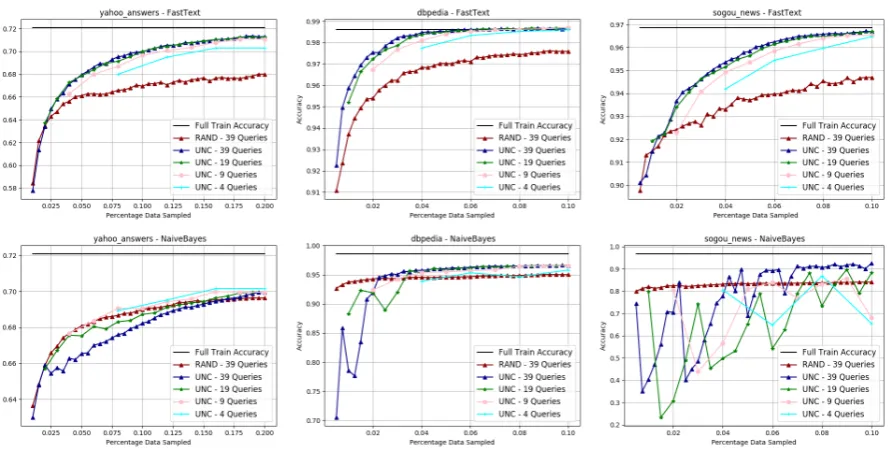
Figure 1: Accuracy across different number of queries bfor FastText and Naive Bayes, with b×K constant. FastText is robust to increase in query size and significantly outperforms random in all cases. Naive Bayes: (Left) All includingb=39 perform worse than random, (Center) All including b=9eventually perform better than random (Right) b = 39 performs better than random but larger query sizes perform worse than random. Uncertainty sampling with Naive Bayes suffers from sampling size bias.
Dsets Common% Chance% #SV
[image:5.595.325.508.376.471.2]SGN 71.3±0.5 9.3±0.5 13184 DBP 86.3±0.5 9.7±0.5 1479 YRP 57.3±0.5 9.7±0.5 31750 AGN 45.0±0.8 21.0±1.6 1032
Table 3: Proportion of Support Vectors intersecting
with our actively selected set calculated by |SSV∩Sˆb|
|SSV| . Actively selected sets share large overlap with supports of an SVM (critical for classification).
a desirable way. Since the support vectors rep-resent the class boundaries, a large percentage of selected data consists of samples around the class boundaries. This overlap indicates that the ac-tively acquired training sample covers the support vectors well which are important for good classifi-cation performance. The overlap with the support vectors of an SVM (a fixed algorithm) also sug-gests that uncertainty sampling using deep models might generalize beyond FastText, to other learn-ing algorithms.
Experimental Details:We used a fast GPU
im-plementation for training an SVM with a linear kernel (Wen et al.,2018) with default hyperparam-eters. Please refer to supplementary material for additional details. We ensured the SVM achieves similar accuracies as original FTZ model.
Dsets Chance FTZD FTZS MNBD MNBS SGN 0.8 77.8 81.0 55.5 100.0 DBP 0.9 79.7 81.3 79.7 100.0 YHA 3.7 69.0 73.6 89.5 100.0 YRP 0.9 42.9 43.7 16.0 100.0 YRF 3.6 67.7 71.6 13.6 100.0 AGN 3.7 68.7 70.1 79.8 100.0 AMZP 0.9 48.4 48.8 15.0 100.0 AMZF 3.6 56.8 63.1 57.8 100.0
Table 4: % Intersection of samples obtained with dif-ferent seeds (ModelD) compared to same seeds (Mod-elS) and chance intersection forb = 39 queries. We see that FastText is initialization independent (FTZD ≈ FTZS Chance). NaiveBayes shows significant dependency on the initial set sometimes, while other times performs comparable to FastText.
3.2 Algorithmic Factors
We analyze three algorithmic factors of relevance to sampling bias: (a) Initial set selection (b) Query size, and, (c) Query strategy.
3.2.1 Initial Set Selection
Dsets Chance FTZ9∩19∩39 FTZ39∩39∩39 MNB9∩19∩39 MNB39∩39∩39 SGN 0.83±0.0 77.0±0.5 77.9±0.2 31.9±0.0 55.5±0.0 DBP 0.9±0.0 80.0±0.1 79.6±0.2 82.3±0.0 79.7±0.0 YHA 3.7±0.0 68.3±0.1 69.0±0.0 92.1±0.0 89.5±0.0 YRP 0.9±0.0 46.0±0.9 42.7±1.0 10.8±0.0 16.0±0.0 YRF 3.6±0.0 68.4±0.2 67.6±0.1 14.2±0.0 13.6±0.0 AGN 3.7±0.0 70.3±0.2 68.7±0.1 81.6±0.0 79.8±0.0 AMZP 0.9±0.0 45.8±0.1 48.2±0.2 11.5±0.0 15.0±0.0 AMZF 3.6±0.0 55.2±0.4 57.0±0.2 28.4±0.0 57.8±0.0
Table 5: Intersection of samples obtained with different values ofb. We see the intersection of samples selected with different number of intersections comparable to highest possible (different seeds) in FastText, far higher compared to chance intersection. This indicates similar samples are selected regardless of sample size. NaiveBayes does not show clear trends but occasionally the queried percentage drops significantly when increasing iterations, occasionally it remains unaffected.
Dsets Chance FTZ Ent-Ent FTZ Ent-LC FTZ Ent-DelEnt FTZ DelEnt-DelLC FTZ DelEnt-DelEnt SGN 9.4±0.0 84.6±0.2 83.1±0.3 81.7±0.1 82.6±0.1 84.2±0.1 DBP 9.3±0.0 85.7±0.2 85.5±0.3 83.3±0.1 83.0±0.4 83.2±0.2 YHA 19.0±0.0 79.0±0.0 71.6±0.2 76.3±0.1 69.6±0.7 75.6±3.9 YRP 9.3±0.0 58.4±0.6 59.0±0.3 59.0±0.6 61.6±0.7 62.1±0.1 YRF 19.0±0.0 77.8±0.2 66.6±0.3 75.8±0.1 65.4±0.3 80.1±0.2 AGN 19.1±0.0 78.3±0.1 77.3±0.1 77.1±0.3 78.2±0.4 79.0±0.3 AMZP 9.5±0.0 63.5±0.2 63.5±0.3 66.1±0.4 70.0±0.1 70.0±0.1 AMZF 19.0±0.0 70.3±0.1 64.3±0.2 69.6±0.1 65.6±0.2 72.6±0.2
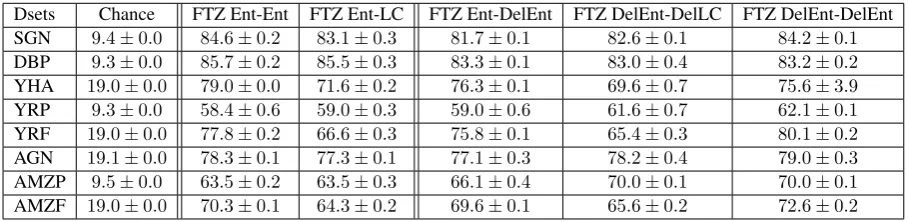
Table 6: Intersection of query strategies across acquisition functions. We observe that the % intersection among samples in the Ent-LC is comparable to those Ent-Ent. Similarly, the Ent-DelEnt (entropy with deletion) is compa-rable to both DelEnt-DelLC and DelEnt-DelEnt showing robustness of FastText to query functions (beyond minor variation). DelEnt-DelEnt obtains similar intersections as compared to Ent-Ent, showing the robustness of the acquired samples to deletion.
3 and 5 present overlaps from different initial sets while 4 and 6 from same initial sets. We note from column 4 and 6 that due to the stochasticity of training in FTZ, we expect non-identical final sets even with same initial samples as well. The results demonstrate that samples obtained using FastText are largely initialization independent (low varia-tion between columns 3 and 4) consistently across datasets while the samples obtained with Naive Bayes can be vastly different showing relatively heavy dependence on the initial seed. This indi-cates the relative stability of train set obtained with the posterior uncertainty of the actively trained FTZ as an acquisition function.
3.2.2 Query size
Since the sampled data is sequentially constructed by training models on previously sampled data, large query sizes were expected to impact sam-ples collected by uncertainty sampling and the per-formance thereof (Hoi et al., 2006). We exper-iment with various query sizes - (0.25%, 0.5%, 1%) for DBP, SGN, YRP and AMZP and (0.5%, 1%, 2%) for the rest corresponding to 9, 19 and 39 iterations. Figure 1 shows that FastText (top
row) has very stable performance across sample sizes while MNB (bottom row) show more erratic performance. Table5 presents the intersection of samples obtained with different query sizes across multiple runs. We observe a high overlap of the acquired samples across different query sizes indi-cating that the performance is independent of the query size (compare column 3 to column 4 where the size is held constant) while MNB results in lower overlap with more erratic behavior due to change in the query size (compare column 5 com-pared to column 6).
3.2.3 Query strategy
We now investigate the impact of various query strategies using FastText by evaluating and com-paring the correlation between the respective ac-tively selected sample sets.
Acquisition Functions: We compare four
[image:6.595.73.528.231.342.2]Dsets Chance FTZ-FTZ Ent
FTZ-5F TZ Ent
5FTZ-5FTZ Ent-LC
5FTZ-5FTZ Ent-Ent SGN 9.4±0.0 84.6±0.2 86.3±0.2 85.4±0.4 85.8±0.0
DBP 9.3±0.0 85.7±0.2 86.6±0.3 86.78±0.1 87.8±0.2
YRP 9.3±0.0 58.4±0.6 58.1±0.7 58.3±0.3 58.2±0.2
YRF 19.0±0.0 77.8±0.2 79.0±0.3 68.5±1.1 77.6±0.3
[image:7.595.73.304.61.129.2]AGN 19.1±0.0 78.3±0.1 79.0±0.2 79.1±0.2 77.9±0.2
Table 7: Intersection of query strategies across single and ensemble of 5FTZ models. We observe that the % intersection of samples selected by ensembles and single models is comparable to intersection among ei-ther. The 5-model committee does not seem to add any additional value over selection by a single model.
the ten possible combinations and again observe the high degree of overlap in the collected sam-ples. It can be concluded that the approach is fairly robust to these variations in the query strategy.
Ensembles versus Single Models: A similar
experiment was conducted to investigate the over-lap between a single FTZ model and a probabilis-tic committee of models (5-model ensemble with FTZ (Lakshminarayanan et al.,2017)) to identify comparative advantages of using ensemble meth-ods. The results are presented in Table7showing little to no difference in sample overlaps. 5 We conclude that more expensive sampling strategies commonly used, like ensembling, may offer lit-tle benefit compared to using a single FTZ model with posterior uncertainty as a query function.
The experiments in this section demonstrate that uncertainty based sampling using deep mod-els like FTZ show no class bias or an undesirable feature bias (and favorable bias to class bound-aries). There is also a high degree of robustness to algorithmic factors, especially query size, a sur-prisingly high degree of overlap in the resulting training samples and stable performances (classi-fication accuracy). Additionally, all uncertainty query strategies perform well, and expensive sam-pling strategies like ensembling offer little benefit. We conclude that sampling biases demonstrated in active learning literature do hold well with tradi-tional models, however, they do not seem to trans-late to deep models like FTZ using (posterior) un-certainty.
4 Application: Active Text Classification
Experimental results from the previous sections suggest that entropy function with a single FTZ
5The ensembles were too costly to run on larger datasets, so the results for YHA, AMZP and AMZF could not be ob-tained.
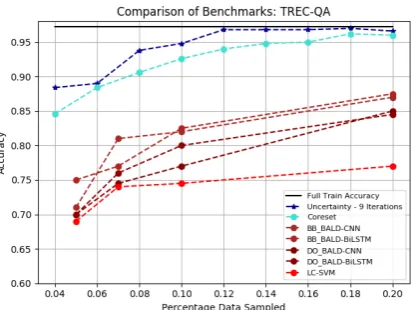
Figure 2: Active text classification: Comparison with K-Center Coreset, BALD and SVM algorithms. Ac-curacy is plotted against percentage data sampled. We reach full-train accuracy using 12% of the data, com-pared to BALD which requires 50% data and perform significantly worse in terms of accuracy. We also out-perform K-center greedy Coreset at all sampling per-centages without utilizing additional diversity-based augmentation.
model would be a good baseline for active text classification. We compare our baseline with the latest work in deep active learning for text clas-sification - BALD (Siddhant and Lipton, 2018) and with the recent diversity based Coreset query function (Sener and Savarese, 2018) which uses a costly K-center algorithm to build the query. Experiments are performed on TREC-QA for a fair comparison (used by (Siddhant and Lipton,
2018)). Table8shows that the results of our study generalize to small datasets like TREC-QA.
The results are shown in Figure 2 using the baseline with the query size of 2% of the full dataset (b=9 queries). Note that uncertainty sampling converges to full accuracy using just 12% of the data, whereas (Siddhant and Lipton,
2018) required 50% of the data. There is also a remarkable accuracy improvement over ( Sid-dhant and Lipton,2018) which can be largely at-tributed to the models used (FastText versus 1-layer CNN/BiLSTM). Also, uncertainty sampling outperforms diversity-based augmentations like Coreset Sampling (Sener and Savarese,2018) be-fore convergence. Thus, we establish a new state-of-the-art baseline for further research in deep ac-tive text classification.
5 Application: Training of Large Models
[image:7.595.314.520.65.220.2]Dsets Chance FTZ-Ent-Ent FTZ Ent-LC SV Chce% SV Com% TQA 15.1±0.0 59.7±0.5 56.3±1.4 18.7±6.1 79.0±3.6
Table 8: Results of sample selection from previous investigations on small datasets (Trec-QA).
Model AGN DBP SGN YRF YRP YHA AMZP AMZF VDCNN (Conneau et al.,2017) 91.3 98.7 96.8 64.7 95.7 73.4 95.7 63.0 DPCNN (Johnson and Zhang,2017) 93.1 99.1 98.1 69.4 97.3 76.1 96.7 65.2
WC-Reg (Qiao et al.,2018) 92.8 98.9 97.6 64.9 96.4 73.7 95.1 60.9 DC+MFA (Wang et al.,2018) 93.6 99.2 - 66.0 96.5 - - 63.0 DRNN (Wang,2018) 94.5 99.2 - 69.1 97.3 70.3 96.5 64.4
ULMFiT (Howard and Ruder,2018) 95.0 99.2 - 70.0 97.8 - - -EXAM (Du et al.,2019) 93.0 99.0 - - - 74.8 95.5 61.9 Ours: ULMFiT (Small data) 93.7 (20) 99.2 (10) 97.0 (10) 67.6 (20) 97.1 (10) 74.3 (20) 96.1 (10) 64.1 (20)
Ours: ULMFiT (Tiny data) 91.7 (8) 98.6 (2.3) 97.4 (6.3) 66.3 (8) 96.7 (4) 73.3 (8) 95.8 (4) 62.9 (8)
Table 9: Comparison of accuracies with state-of-the-art approaches (earliest-latest) for text classification (%dataset in brackets). We are competitive with state-of-the-art models while using 5x-40x compressed datasets.
ULMFiT AGN DBP YRP YRF Full 95.0 99.2 97.8 70.0
Ours-Small 93.7 (20) 99.2 (10) 97.1 (10) 67.6 (20) Ours-Tiny 91.7 (8) 98.6 (2.3) 96.7 (4) 66.3(8)
Table 10: ULMFiT: Resulting sample Sˆb compared
to reported accuracies in (Howard and Ruder, 2018) (%dataset in brackets). We observe that using our cheaply obtained compressed datasets, we can achieve similar accuracies with 25x-200x speedup (5x less epochs, 5x-40x less data). Transferability to other mod-els is evidence of the generalizability of the subset col-lected using FTZ to other deep models.
impediment to creating new and/or better models. Our study suggests that the training samples col-lected with uncertainty sampling (entropy) on a single model FTZ may provide a good represen-tation (surrogate) for the entire dataset. Buoyed by this, we investigate if we can speedup training of ULMFiT (Howard and Ruder,2018) using the surrogate dataset. We show these results in Ta-ble10. We achieve 25x-200x speedup6(5x fewer epochs, 5x-40x smaller training size). We also benchmark the performance against the state-of-the-art on text classification as shown in Table9. We conclude that we can significantly compress the training datasets and speedup classifier train-ing time with little tradeoff in accuracy.
Implementation Details: We use the official
github repository for ULMFiT7, use default hyper-parameters and train on one NVIDIA Tesla V100 16GB GPU. Further details are provided in
sup-6The cost of acquiring the training data using FTZ-Ent is negligible in comparison.
7https://github.com/fastai/fastai/
tree/master/courses/dl2/imdb_scripts
plementary material.
6 Related Work
We now expand on the brief literature review in Section1to better contextualize our work. We di-vide the past works into (i) Traditional Models and (ii) Deep Models.
Sampling Bias in Classical AL in NLP:
Ac-tive learning (AL) in text classification started with greedy uncertainty query strategy from a pool us-ing decision trees (Lewis and Gale,1994), which was shown to be effective and led to widespread adoption with classifiers like SVMs (Tong and Koller,2001), Naive Bayes (Roy and McCallum,
2001) and KNN (Fujii et al.,1998). This strategy was also applied to other NLP tasks like parse se-lection (Baldridge and Osborne,2004), sequence labeling (Settles and Craven, 2008) and informa-tion extracinforma-tion (Thompson and Mooney, 1999). These early papers popularized two greedy uncer-tainty query methods: Least Confident and En-tropy.
Issues of lack of diversity (large reduduncy in sampling) (Zhang and Oles,2000) and lack of ro-bustness (high variance in sample quality)(Krogh and Vedelsby, 1994) guided subsequent efforts. The two most popular directions were: (i) aug-menting uncertainty with diversity measures (Hoi et al., 2006; Brinker, 2003; Tang et al., 2002) and (ii) using query-by-committee (McCallum and Nigam, 1998; Liere and Tadepalli, 1997). For a comprehensive survey of classical AL methods for NLP, please refer to (Settles,2009).
Sampling Bias in Deep AL:Deep active
training of DNNs on large data. Two main query strategies are used: (i) ensemble based greedy un-certainty, which represents a probabilistic query-by-committee paradigm (Gal et al.,2017;Beluch et al., 2018), and (ii) diversity based measures (Sener and Savarese, 2018; Ducoffe and Pre-cioso,2018). Papers proposing diversity based ap-proaches find that greedy uncertainty based sam-pling (using ensemble and single model) perform significantly worse than random (See Figures 4 and 2 respectively in (Sener and Savarese, 2018;
Ducoffe and Precioso,2018)). They attribute the poor performance to redundant, highly correlated sampling selected using uncertainty based meth-ods and justify the need for prohibitively expen-sive diversity-based approaches (Refer section 2 of (Sener and Savarese, 2018) for details on the expensiveness of various diversity sampling meth-ods). However, K-center greedy coreset sampling scales poorly: we were only able to use it on TREC-QA (a small dataset). On the other hand, ensemble-based greedy uncertainty methods find that probabilistic averaging from a committee (Gal et al., 2017;Beluch et al.,2018) performs better than single model as with on diversity based meth-ods like coreset(Gissin and Shalev-Shwartz,2019;
Beluch et al., 2018). Current approaches in text classification literature mostly adopt the ensem-ble based greedy uncertainty framework (Siddhant and Lipton,2018;Lowell et al.,2018;Zhang et al.,
2017).
However, our work demonstrates the problems of sampling bias and efficiency may not translate from shallow to deep approaches. Recent evidence from image domain (Gissin and Shalev-Shwartz,
2019) demonstrates atleast a subset of our findings generalize to other DNNs (class bias and query functions). Uncertainty sampling using a deep model like FTZ demonstrates surprisingly good sampling properties without using ensembles or bayesian methods. Ensembles do not seem to sig-nificantly affect sampling. Whether this behavior generalizes to other deep models and tasks is yet to be seen.
Other Related Works: An interesting set of
papers (Soudry et al.,2018;Xu et al.,2018) show that deep neural networks trained with SGD con-verge to the maximum margin solution in the lin-early separable case. Several works investigate the possibility that deep networks give high im-portance to a subset of the training dataset (Toneva
et al.,2019;Vodrahalli et al.,2018;Birodkar et al.,
2019), resembling supports in support vector ma-chines. In our experiments, we find that ac-tive learning with uncertainty sampling with deep models like FTZ has a (surprisingly) large over-lap with the support vectors of an SVM. Thus, it seems to have a inductive bias for class bound-aries, similar to the above works. Whether this property generalizes to other deep models is yet to be seen.
7 Conclusion
We conducted a large empirical study of sam-pling bias and efficiency, along with algorithmic factors which impacting active text classification. We conclude that uncertainty sampling with deep models like FastText.zip exhibits negligible class bias, seems to be favorably biased to sampling data points near class boundaries, is robust to various algorithmic factors and expensive sam-pling strategies like ensembling offer little bene-fit. Also, we find a surprisingly large overlap of actively acquired points with supports of a SVM. We additionally show that uncertainty sampling can be effectively used to bootstrap the training of large DNN models by generating compact surro-gate datasets (5x-40x compression). Finally, FTZ-Ent provides a strong baseline for deep active text classification, outperforming previous results by a margin of 4x less data.
The current work opens up several directions for future investigations. To list a few: (a) a deeper look into the nature of sampled data - their distribution in the feature space, as well as their importance for the task at hand; (b) the creation of surrogate datasets for a variety of applications, including hyperparameter and architecture search, etc; (c) an extension to other deep models (beyond FTZ) and beyond classification models; and, (d) an extension to semi-supervised, online and continual learning.
Acknowledgements: We thank Prof. Vineeth
References
Jason Baldridge and Miles Osborne. 2004. Active learning and the total cost of annotation. InEMNLP.
William H. Beluch, Tim Genewein, Andreas Nurn-berger, and Jan M. Kohler. 2018. The power of en-sembles for active learning in image classification. InCVPR.
Vighnesh Birodkar, Hossein Mobahi, and Samy Ben-gio. 2019. Semantic redundancies in image-classification datasets: The 10% you don’t need. arXiv preprint arXiv:1901.11409.
Klaus Brinker. 2003. Incorporating diversity in active learning with support vector machines. InICML.
Alexis Conneau, Holger Schwenk, Lo¨ıc Barrault, and Yann Lecun. 2017. Very deep convolutional net-works for text classification. InEACL.
Jacob Devlin, Ming-Wei Chang, Kenton Lee, and Kristina Toutanova. 2019. Bert: Pre-training of deep bidirectional transformers for language understand-ing. InNAACL.
Cunxiao Du, Zhaozheng Chin, Fuli Feng, Lei Zhu, Tian Gan, and Liqiang Nie. 2019. Explicit interac-tion model towards text classificainterac-tion. InAAAI.
Melanie Ducoffe and Frederic Precioso. 2018. Adver-sarial active learning for deep networks: a margin based approach. InICML.
Sandra Ebert, Mario Fritz, and Bernt Schiele. 2012. Ralf: A reinforced active learning formulation for object class recognition. InCVPR.
Atsushi Fujii, Takenobu Tokunaga, Kentaro Inui, and Hozumi Tanaka. 1998. Selective sampling for example-based word sense disambiguation. In Com-putational Linguistics.
Yarin Gal, Riashat Islam, and Zoubin Ghahramani. 2017. Deep bayesian active learning with image data. InICML.
Daniel Gissin and Shai Shalev-Shwartz. 2019. Dis-criminative active learning. ArXiv preprint arxiv:1907.06347v1.
Chuan Guo, Geoff Pleiss, Yu Sun, and Kilian Q Wein-berger. 2017. On calibration of modern neural net-works. InICML.
Steven C. H. Hoi, Rong Jin, and Michael R. Lyu. 2006. Large-scale text categorization by batch mode active learning. InWWW.
Jeremy Howard and Sebastian Ruder. 2018. Universal language model fine-tuning for text classification. In ACL.
Rie Johnson and Tong Zhang. 2017. Deep pyramid convolutional neural networks for text categoriza-tion. InACL.
Armand Joulin, Edouard Grave, Piotr Bojanowski, Matthijs Douze, H´erve J´egou, and Tomas Mikolov. 2016. Fasttext. zip: Compressing text classification models. arXiv preprint arXiv:1612.03651.
Armand Joulin, Edouard Grave, Piotr Bojanowski, and Tomas Mikolov. 2017. Bag of tricks for efficient text classification. InEACL.
Anders Krogh and Jesper Vedelsby. 1994. Neural net-work ensembles, cross validation and active learn-ing. InNeurIPS.
Balaji Lakshminarayanan, Alexander Pritzel, and Charles Blundell. 2017. Simple and scalable predic-tive uncertainty estimation using deep ensembles. In NeurIPS.
David D. Lewis and William A. Gale. 1994. A sequen-tial algorithm for training text classifiers. InSIGIR.
Ray Liere and Prasad Tadepalli. 1997. Active learning with committees for text categorization. InAAAI.
David Lowell, Zachary C Lipton, and Byron C Wal-lace. 2018. How transferable are the datasets collected by active learners? arXiv preprint arXiv:1807.04801.
Andrew McCallum and Kamal Nigam. 1998. Employ-ing em and pool-based active learnEmploy-ing for text clas-sification. InICML.
F. Pedregosa, G. Varoquaux, A. Gramfort, V. Michel, B. Thirion, O. Grisel, M. Blondel, P. Pretten-hofer, R. Weiss, V. Dubourg, J. Vanderplas, A. Pas-sos, D. Cournapeau, M. Brucher, M. Perrot, and E. Duchesnay. 2011. Scikit-learn: Machine learn-ing in Python. InJMLR.
Chao Qiao, Bo Huang, Guocheng Niu, Daren Li, Dax-iang Dong, Wei He, Dianhai Yu, and Hua Wu. 2018. A new method of region embedding for text classifi-cation. InICLR.
Nicholas Roy and Andrew McCallum. 2001. Toward optimal active learning through sampling estimation of error reduction. InICML.
Ozan Sener and Silvio Savarese. 2018. Active learn-ing for convolutional neural networks: A core-set approach. InICLR.
Burr Settles. 2009. Active learning literature survey. Technical report, University of Wisconsin-Madison.
Burr Settles and Mark Craven. 2008. An analysis of ac-tive learning strategies for sequence labeling tasks. InEMNLP.
Daniel Soudry, Elad Hoffer, Mor Shpigel Nacson, Suriya Gunasekar, and Nathan Srebro. 2018. The implicit bias of gradient descent on separable data. JMLR.
Min Tang, Xiaoqiang Luo, and Salim Roukos. 2002. Active learning for statistical natural language pars-ing. InACL.
Cynthia A Thompson and Raymond J Mooney. 1999. Active learning for natural language parsing and in-formation extraction. InICML.
Mariya Toneva, Alessandro Sordoni, Remi Tachet des Combes, Adam Trischler, Yoshua Bengio, and Geof-frey J. Gordon. 2019. An empirical study of exam-ple forgetting during deep neural network learning. InICLR.
Simon Tong and Daphne Koller. 2001. Support vec-tor machine active learning with applications to text classification. JMLR.
Kailas Vodrahalli, Ke Li, and Jitendra Malik. 2018. Are all training examples created equal? an empiri-cal study. arXiv preprint arXiv:1811.12569.
Baoxin Wang. 2018. Disconnected recurrent neural networks for text categorization. InACL.
Shiyao Wang, Minlie Huang, and Zhidong Deng. 2018. Densely connected CNN with multi-scale feature at-tention for text classification. InIJCAI.
Sida Wang and Christopher D Manning. 2012. Base-lines and bigrams: Simple, good sentiment and topic classification. InACL.
Zeyi Wen, Jiashuai Shi, Qinbin Li, Bingsheng He, and Jian Chen. 2018. ThunderSVM: A fast SVM library on GPUs and CPUs. InJMLR.
Tengyu Xu, Yi Zhou, Kaiyi Ji, and Yingbin Liang. 2018. Convergence of SGD in learning ReLU models with separable data. arXiv preprint arXiv:1806.04339.
Tong Zhang and F Oles. 2000. The value of unlabeled data for classification problems. InICML.
Xiang Zhang, Junbo Zhao, and Yann LeCun. 2015. Character-level convolutional networks for text clas-sification. InNeurIPS.
Ye Zhang, Matthew Lease, and Byron C Wallace. 2017. Active discriminative text representation learning. InAAAI.