3325
Evaluating and Enhancing the Robustness of Dialogue Systems: A Case
Study on a Negotiation Agent
Minhao Cheng
University of California Los Angeles
Wei Wei
Google Cloud AI
Cho-Jui Hsieh
University of California Los Angeles
Abstract
Recent research has demonstrated that goal-oriented dialogue agents trained on large datasets can achieve striking performance when interacting with human users. In real world applications, however, it is important to ensure that the agent performs smoothly in-teracting with not only regular users but also those malicious ones who would attack the system through interactions in order to achieve goals for their own advantage. In this paper, we develop algorithms to evaluate the robust-ness of a dialogue agent by carefully designed attacks using adversarial agents. Those attacks are performed in both black-box and white-box settings. Furthermore, we demonstrate that adversarial training using our attacks can significantly improve the robustness of a goal-oriented dialogue system. On a case-study of the negotiation agent developed by (Lewis et al., 2017), our attacks reduced the average ad-vantage of rewards between the attacker and the trained RL-based agent from2.68to−5.76 on a scale from −10 to 10 for randomized goals. Moreover, with the proposed adversar-ial training, we are able to improve the robust-ness of negotiation agents by 1.5 points on av-erage against all our attacks.
1 Introduction
Crafting an intelligent agent to communicate in the dialogue system using natural languages has been a long-standing problem in AI. It requires designing an agent to understand, plan and gen-erate natural language to achieve different goals such as question-answering, cooperation, negotia-tion etc (Vinyals and Le,2015;Li et al.,2017; Ser-ban et al.,2016;Dhingra et al.,2016;Serban et al.,
2016). Inspired by recent successes in deep neural networks, (Lewis et al.,2017) has recently devel-oped an end-to-end learning framework to train a recurrent neural network (RNN)-based negotiation
agent in goal-oriented dialogue systems. This NN-based technique has been identified as one of the state-of-the-arts and has been applied to several other tasks (Bahdanau et al., 2014;Luong et al.,
2015;Rush et al.,2015;Chan et al.,2016). Although NN-based dialogue agents have shown convincing performance on several tasks, it is not clear whether they also work well when facing malicious users or agents. To answer this question, we study how to evaluate the robustness of a goal-oriented dialogue system. For simplicity, we consider a goal-oriented agentA that aims to maximize some score, and define the “robustness” ofAas the worst-case performance under any fea-sible agent A0. We also call A0 an adversarial agentthat tries to “attack”Asince it aims to mini-mizeA’s score. The problem of evaluating the ro-bustness ofAcan then be solved by designing an adversarial agent to attack A. For instance, con-sidering a negotiation agent that can decide when to make a deal, we say the agent is not robust if an adversarial agent can fool the target agent to make a deal with significant lower scores. Ideally, be-fore deploying an agent into real systems, we need to ensure it performs smoothly under strong adver-sarial attacks.
The concept of adversarial agent is related to recent studies on adversarial examples for im-age classifiers—it has been shown that a care-fully designed small perturbation can easily make neural networks mis-classify (Goodfellow et al.,
2014; Szegedy et al., 2013; Moosavi Dezfooli et al., 2016; Carlini and Wagner, 2017; Cheng et al., 2019), and several recent works has ex-tended these attacks to natural language process-ing models such as sentiment analysis (Gao et al.,
im-age/sentence there is no interaction between the attacker and the target model. Instead, we inves-tigate a much more challenging problem, where there can be many turns of interactions between adversarial and target agents. This leads to sev-eral difficulties including 1) How to lead the target agent to a bad state and 2) how to force the target agent to make a wrong decision. Therefore, previ-ous methods for attacking static models cannot be directly applied.
In this paper, we tackle the aforementioned challenges by proposing several novel ways to de-sign an adversarial agent to evaluate the robustness of goal-oriented dialogue systems. We highlight our major contributions as follows:
• We propose a framework to generate adver-sarial agents in both black-box and white-box settings. To the best of our knowledge, this is the first work on crafting adversarial agents instead of adversarial examples in an interac-tive dialogue system.
• We conduct a series of studies on the negoti-ation agent proposed in (Lewis et al.,2017). We demonstrate that the proposed strategies can successfully attack existing negotiation agents to significantly reduce their average score. For instance, our attacks can reduce the average advantage of the RL-based nego-tiation agent from2.68to−5.76on random problems with the total value of10.
• We also show that through the proposed it-erative adversarial training procedure, we could significantly improve the robustness of a goal-oriented agent against various attacks.
2 Related work
2.1 Goal-oriented dialogue agent
Goal-oriented dialogue systems aim at building a conversation model that is capable of accomplish-ing tasks through the interactions with human us-ing natural language (Li et al., 2017; Eric and Manning,2017;Wen et al.,2016;Wei et al.,2018;
Bordes et al., 2016). Traditional approaches to learn a goal-oriented intelligent agent relies heav-ily on dialogue states annotated in the training data (Wen et al., 2016;Henderson et al., 2014). The use of state annotations allows a cleaner separa-tion of the reasoning and natural language aspects
of dialogues. However, it is very expensive to an-notate every state in a large amount of training data. (Bordes et al., 2016) explores end-to-end goal orientated dialogue with a supervised model. And (He et al., 2017) uses task-specific rules to combine the task input and dialogue history into a more structured state representation. Recently, reinforcement learning has been widely used in dialogue systems to increase the agent versatil-ity (Mordatch and Abbeel,2017) and improve the agent’s performance in goal-oriented tasks such as cooperative bot-bot dialogues (Das et al., 2017) and negotiation tasks (Lewis et al.,2017).
2.2 Adversarial examples in NLP applications
Algorithms have been proposed to craft adversar-ial sentences in NLP applications. (Papernot et al.,
2016) uses Fast Gradient Sign method to gen-erate adversarial example on RNN/LSTM based model. (Li et al., 2016) learns the importance of words by deleting them in sentiment analysis task and then use reinforcement learning to lo-cate such words. (Samanta and Mehta,2017) and (Liang et al.,2017) generate adversarial sequences by inserting or replacing existing words with ty-pos and synonyms. (Gao et al., 2018) aims to attack sentiment classification models in a black-box setting. It develops some scoring functions to find the most important words to modify. (Jia and Liang, 2017) aims to fool the SQuAD read-ing comprehension system by addread-ing crafted sen-tences. (Yang et al.,2018) proposes a greedy algo-rithm to swap the word/character and uses a Gum-bel softmax function to reduce the computation. (Ebrahimi et al., 2018) aims to generate adver-sarial examples on character CNN model in chine translation problem by using Jacobian ma-trix to determine which word/character should be replaced or deleted. (Zhao et al.,2017) generated natural adversarial example using Generative Ad-versarial Networks (GANs). (Cheng et al.,2018) proposed a framework to conduct non-overlapping and targeted keyword attack on seq2seq model.
sys-tems. Instead, for the first time, we propose novel ways to construct a adversarial agent, which can bait the target agent to step to a wrong state and make a bad decision.
2.3 Defense against adversarial examples
Many defense algorithms have been proposed re-cently to enhance the robustness of classification models. Among them, adversarial training (Madry et al.,2018;Goodfellow et al.,2014) has become one of the most successful methods, which uses both clean and adversarial examples to train a ro-bust model. (Wong and Kolter, 2018) proposed another kind of adversarial training to improve the verification lower bound of neural networks; (Liu and Hsieh,2019) combines the idea of gen-erative adversarial network (GAN) and adversarial training to further boost the robustness on test im-ages. Another promising way to enhance robust-ness is by adding randomrobust-ness to the model. (Liu et al.,2018) shows adding randomness to both in-put and intermediate layers of neural networks can improve robustness; (Liu et al.,2019;Ye and Zhu,
2018) show that combining Bayesian neural net-work (with randomized weights) and adversarial training can achieve state-of-the-art adversarial er-ror under attacks. However, all the existing de-fense methods only work for static models (usu-ally for classification tasks). In this paper, we pro-pose an adversarial training algorithm for an agent using RL with an “adversarial agent”. This is to our knowledge the first algorithm for improving the robustness of an agent.
3 Competitive Negotiation Dialogues
We use the negotiation agent developed in (Lewis et al.,2017) as the running example in this paper. Note that our algorithm can be generalized to other goal-oriented dialogue systems by designing a dif-ferent scoring function according to the task.
In a competitive negotiation dialogue setting, two agents are negotiating with each other over a set of items. We adopt the same setting as (Lewis et al., 2017), in which case items can be catego-rized into either a ball, a hat or a book. Each agent is given the goal of the conversation (denoted by
g), which contains the initial values and the quan-tities of each of the three items. Agents then ne-gotiate to maximize the total value of their pos-sessed items. Agents are allowed to negotiate up to a maximum of 10 turns. Scores will be granted
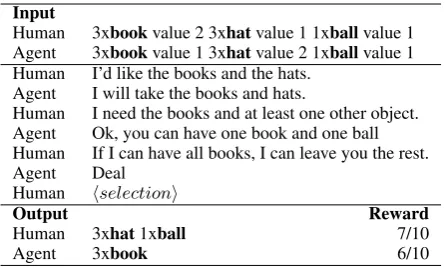
Input
Human 3xbookvalue 2 3xhatvalue 1 1xballvalue 1 Agent 3xbookvalue 1 3xhatvalue 2 1xballvalue 1 Human I’d like the books and the hats.
Agent I will take the books and hats.
Human I need the books and at least one other object. Agent Ok, you can have one book and one ball Human If I can have all books, I can leave you the rest. Agent Deal
Human hselectioni
Output Reward
Human 3xhat1xball 7/10
[image:3.595.307.530.61.195.2]Agent 3xbook 6/10
Table 1: Competitive negotiation dialogue generated between agent and human.
to agents based on the total value of the items if they reach an agreement. If they choose not to agree, 0 score will be granted to both agents. A competitive negotiation dialogue example played by human and agent could be found in Table1.
We assess the robustness of a trained end-to-end negotiation agent used in (Lewis et al.,2017). In the negotiation chatbot setting, agents first chat using natural language and then make a selection based on what they have chatted with. We refer to the first phase as negotiation phaseand the sec-ond phase asdecision phase.
In the negotiation phase, conversation response at timet,xt is generated word by word based on chat historyx0..t−1 and the goal of the
conversa-tiong. The conversation model is controlled by a speaking moduleθand tokens are randomly sam-pled from probability distributionpθ. This process continues recursively until an end-of-sentence to-ken hEOSi or selection tokenhselectioni token is generated. When hEOSi is encountered, the turn terminates and the conversation is handled to another agent. Whenhselectioniis encountered, the negotiation phase terminates and the negotia-tion will reach the decision phase.
xt∼pθ(xt|x0...t−1, g) (1)
In the decision phase, both agents will output a decisionobased on a decision module probability distributionp0θ. Agents’ decisions will be based on conversation historyx0...T up to the current time step T and the goal of the conversation g. Here
is possible to enumerate all the possibilities to get the setO.
o∗ = arg max
o∈O Y
i
p0θ(oi|x0...T, g) (2)
Agents will then collect rewards (i.e. scores) from the environment (which will be 0 if they output conflicted decisions, e.g. the total num-ber of items are different from the initial amount). It is important to keep the agent producing sen-tences that are correct both grammatically and se-mantically and keeping them competitive at the same time. Therefore, a common strategy is to train agents using supervised learning to learn nat-ural language and to use reinforcement learning to optimize models’ performance using on goal-oriented learning. We measure two statisticsscore and agreement. score is the average score for each agent (0-10). agreement is the percentage of dialogues where both agents agreed on the same decision. To measure the extent of success of our adversarial agent, we useadvantagewhich is easy to compute directly from adversarial agent score minus target agent score, i.e.Sadv−Sori.
4 Proposed Black-box Attack Algorithms
We first build our adversarial agent in black-box setting. Black-box setting in goal-oriented dia-logue system is defined where the target agent is unknown to the attacker, but it is possible to make queries to obtain the final decision made by the target agent. To be noted, our aim is to test the ro-bustness of the target agent. Therefore, in the de-cision phase we let adversarial agent chooses the complementary of target agent’s choice, so those two agents will always reach agreement. The ad-versarial agent thus only has the speaking module and there is no decision network needed. In this section we proposed two adversarial agents in the black-box setting.
4.1 Reinforcement learning attack
Inspired by the procedure of goal-based reinforce-ment learning, we modified the reward function of our adversarial agent with the advantage instead of the score he got:
radv =Sadv−Sori (3)
where Sadv and Sori are adversarial agent score and target agent score respectively. After a com-plete dialogue has been generated, we update
ad-versarial agent’s parameters based on the outcome of the negotiation.
To learn the adversarial agent’s speaking net-work by reinforcement learning, we denote the subset of tokens generated by the adversarial agent asXadv. In the completed dialogue,γ is the dis-count factor that rewards actions at the end of the dialogue more strongly, andµis a running average of completed dialogue rewards so far. We define the future reward R for an actionxt ∈ Xadv as follows:
R(xt) = X
xt∈Xadv
γT−t(radv −µ). (4)
Then by a standard policy gradient algorithm, we could train our adversarial agent. Note that this attack doesn’t require the knowledge on the target agent’s structure/weights, and the experimental re-sults demonstrate significant attack performance over regular agents.
4.2 Transfer attack
Transfer attack is a popular idea for attacking black-box models (Papernot et al.,2017). In dia-logue systems, we can also consider the following transfer process: a sentence that leads to lowradv
in one dialogue might also lead to similar results in another dialogue. To implement this idea, we first collect a list of last sentences spoken by the adver-sarial agent from dialogues with high reward, de-noted byL. In the conversations, we let our adver-sarial agent and the target agent negotiatenturns using the regular speaking module, and then plug in one sentence inL at the(n+ 1)-th turn. Our experimental results show that this transfer attack does not work well in practice.
5 Proposed White-box Attack Algorithms
5.1 Force target agent to select at a fixed turn
To begin with, we consider a simplified strategy where we first let our adversarial agent and the tar-get agent negotiatenturns using regular speaking module. For the(n+ 1)-th turn, we propose the following two ways to modify the output of reg-ular speaking module to maximize the rewards of adversarial agent.
5.1.1 Reactive attack
The first strategy is that the adversarial agent pro-duces a sentence that forces the target agent to say
hselectioni. The conversation will then enter the decision phase. At the same time, the sentence produced by the adversarial agent should guide the target agent to make a bad selection that would be in favor of the adversarial agent. We call this methodreactive attack.
We formulate this strategy as an optimization problem. Let xˆ = xtn...T−1 be the output
sen-tence generated by adversarial agent in the speak-ing model aftern-th turn. Specifically, we define
x0...T−1 as all the tokens in the dialogue history
before hselectioni. Zr(x0...T−1) indicates the
logit layer outputs for predictingxT based on chat historyx0...T−1in the speaking model.Zo(x0...T) indicates the logit layer outputs on conversation history x0...T in the decision model. Because we have a constraint to force the target agent to say the end-of-dialog tokenhselectioni, we could format this constraint as
[Zr(x0...T−1)]ksel−max
i6=ksel
[Zr(x0...T−1)]i ≥0 (5)
where ksel is the corresponding index of end-of-dialog tokenhselectioni.
At the same time, the score of output oshould be in favor of our adversarial agent. Assume the original decision output iso0,
L(ˆx) = max{[Zo(x0...T)]o0−max
o∈O¯[Zo(x0...T)]o,−κ}
(6) whereO¯ is the set of outputs that score of adver-sarial agent is greater than target agent i.e. O¯ = {o ∈ O¯|Sadv(o) > Sori(o)}, andκ ≥ 0denotes the confidence margin parameter. Note that xˆ is a sub-sequence inx0...T, so the right hand side of (6) is a function ofxˆ.
Combining these two equations together, we
can get our final objective function:
min
ˆ
x L(ˆx) (7)
s.t.[Zr(x0...T−1)]ksel−max
i6=ksel
[Zr(x0...T−1)]i ≥0
Eq (7) is a discrete optimization problem sincexˆ
is the sentence produced by adversarial agent. In this paper, we use a modified version of the greedy algorithm to optimize (7). Although the original algorithm proposed in (Yang et al.,2018) only considered the unconstrained discrete prob-lem, we show that the following slightly modified version performs well for solving (7). At each it-eration, we try to replace each word in xˆ by the special tokenhP ADi. A word that achieves min-imal loss after swapping withhP ADi is then se-lected as the word to be replaced. Then we try to replace the selected word with each word in the vocabulary. For all the trials that satisfy the con-straint, we choose the one with minimal loss and conduct the actual change. We run this procedure iteratively to minimize (7). In the experiments, we only replace two words inxˆto ensure the fluency and correctness of the adversarial sentences.
5.1.2 Preemptive attack
The other attack strategy is to produce a sentence to guide the target agent to lower its demand in the reply instead of making target agent say end-of-dialog token. And after the reply from tar-get agent, the adversarial agent speaks the end-of-dialogue token to enter the decision phase. Simi-lar to the reactive attack, adversarial agent’s score should be greater than target agent’s score in the decision phase. Clearly, this strategy is more chal-lenging than the previous one because there is an intermediate sentence spoken by the target agent before end-of-dialogue. We call this preemptive attack.
Let xˆ = xtn...tnT be the output sentence
gen-erated by adversarial agent in the speaking model after turnn, wheretn is the first word andtnT is
the last word of the sentence. Similarly, we could formally turn the intuition into optimization prob-lem as follows:
L(ˆx) = max{[Zo(x0...T)]o0−max
o∈O¯[Zo(x0...T)]o,−κ}
Algorithm 1Arbitrary turn attack algorithm
Input:Target agent B, Input goalg
Output: Dialoguex0...T, Agent scoreSadv and
Sori
whilehselectioniis not generateddo Set the lossL(·)to be (7)
Optimize the LossL(·)
if L(·)<0then
Add the output into the dialogue else
Set the lossL(·)in to be (8) Optimize the LossL(·)
if L(·)<0then
Add the output into the dialogue else
if Transfer Attackthen
Randomly add a sentence inL (mali-cious sentences) into the dialogue. else
Add the sentence generated by regu-lar speaking model into the dialogue (delayed attack).
end if end if end if end while
Generateousing dialoguex0...T CalculateSadv andSori
Return: x0...T,Sadv,Sori
directly apply the unconstrained version of greedy algorithm (Yang et al.,2018) to solve it.
5.2 Force target agent to select at arbitrary turn
While we could let our adversarial agent and the target agent negotiaten turns, it is still unknown whichn should be chosen to get the best perfor-mance. In other words, we aim to not only know what to say but also when to say to fool the target agent.
We propose two strategies to force target agent to make bad decisions at arbitrary turn. The de-tails are presented in Algorithm1. When it is the turn for adversarial agent to speak, we first try to apply reactive and preemptive attacks. If both at-tacks couldn’t make the lossL(·)less than 0, there are two strategies: 1) just output the sentence gen-erated by the regular speaking module (delayed at-tack), and 2) conduct transfer attack. The compar-isons can be found in the experiments.
6 Adversarial Training
Adversarial training is a popular method to im-prove the robustness of machine learning mod-els (Miyato et al., 2016; Madry et al.,2018). In this section, we use the agents designed in the pre-vious sections to improve the robustness of the tar-get agent.
In standard adversarial training for neural net-work models (Goodfellow et al., 2014; Jia and Liang, 2017), adversarial examples (images or sentences) generated by an attack are added to the training procedure to refine the model. Since our setting is interactive and there is no fixed data used in selfplay, we should conduct training with ad-versarial agents instead of adversarial examples. Moreover, as pointed out by (Jia and Liang,2017), training on the examples generated by a single at-tack will lead to over-fitting to a particular atat-tack, so we should do adversarial training iteratively.
Taking the black-box RL agent as an example, we consider the following min-max formulation:
min
θori{maxθadv Sadv−Sori}, (9)
whereθoriis the weights for the target agent and
θadv is the weights for the adversarial black-box agent. We solve (9) by the following alternating minimization procedure. At each iteration, we first update the target agent (θori) using the standard policy gradient algorithm, and then use our RL al-gorithm in Section4.1to update adversarial agent to counter the target model. We iteratively conduct these updates until convergence. The experiments show that the adversarial training procedure can improve the robustness not only under RL attack but also under other white-box attacks.
7 Experimental Results
We perform extensive experiments on evaluating the robustness of the negotiation agents developed in (Lewis et al.,2017). Furthermore, we show that the robustness of negotiation agents can be signif-icantly improved using the proposed adversarial training procedure. Our codes are publicly avail-able at https://github.com/cmhcbb/ Robustness-of-Dialogue-systems.
7.1 Experimental Setup
specifically, we first train the model on 5808 di-alogues, based on 2236 unique scenarios in super-vised way to imitate the actions of human users. We call this model supervised model (SV agent). Then we use reinforcement learning to conduct goal-oriented training in order to maximize the agent’ reward. The second model is called the inforcement learning model (RL agent). As a re-sult, when doing selfplay between RL agent and SV agent, we could get RL agent with 5.86 per-plexity, 89.57% agreement and 7.23 average score, while SV agent achieves 5.47 perplexity and 4.55 average score. These numbers are similar to the numbers reported in (Lewis et al.,2017).
To evaluate the robustness of these agents, we conduct all the proposed attacks on both super-vised model (SV agent) and reinforcement learn-ing model (RL agent). The successfulness of an attack is measured by average score advantage and positive advantage rate (PAR). Average score ad-vantage is defined by averaged adversarial agent’s score minus average target agent’s score. The value is in the region of [−10,10] since the to-tal values are controlled to be 10 for both sides, and a larger advantage indicates a more success-ful attack. Also, we define positive advantage rate (PAR) as the ratio of dialogues that the adversar-ial agent gets a higher score than the target agent. We will see that most attacks developed in this pa-per will improve both average score advantage and PAR. Note that this is the first work on attacking a goal-oriented dialogue agent so there is no previ-ous method that could be included in the compar-isons.
7.2 Results on Black-box Attacks
As introduced in Section 4, we have two black-box attacks: reinforcement learning attack (RL attack) and Transfer attack.
RL Attack. In the reinforcement learning at-tack, we use a learning rate of 0.1, clip gradients above 1.0, and set the discount factor γ = 0.95
in (4). We train the adversarial agent for 4 epochs on all scenarios. From Table 2, we observe that with 100% agreement rate, our adversarial agent could gain 2.32 score advantage against the RL agent and 4.25 advantage against the SV agent. Also, our agent achieves a relatively high positive advantage rate at 84.45% and 69.35% respectively. We show some adversarial dialogues played by adversarial agent and target agent in Table 3. It
shows that RL agent is able to identify the weak point of target agent by saying ”take book you get rest”, which could easily let the agent accept the deal and make a bad selection that is inconsistent with the context of dialogue.
Transfer attack. In transfer attack, we first let our adversarial agent speak the sentence gener-ated by the speaking model with target agent for 3 turns. If the end-of-dialog token has never been mentioned, in the 4th turn, the adversar-ial agent speaks the sentence generated by our RL agent. The detailed results are shown in Ta-ble 2. We observe that the transfer attack is not successful—only -0.13 and -1.189 score advan-tage are achieved. We found that transferring sentences between dialogues is not successful be-cause the item values and conversation histories are quite different between dialogues.
7.3 Results on White-box Attacks
We conduct the white-box attacks introduced in Section5.
Force target agent to select at a fixed turn. There are two types of algorithms (reactive attack and preemptive attack) introduced in Section5.1. The detailed results are shown in Table 2. We observe that the reactive attack could achieve bet-ter results than black-box method with 5.40 score advantage against SV agent and 4.98 score ad-vantage against RL agent. On the other hand, preemptive attack is not that successful—it gets 2.81 advantage against SV agent and 0.77 score advantage against RL agent. Furthermore, we have included some adversarial dialogues played by white-box adversarial agent and target agent in Table 4. From these examples, we could see that white-box adversarial agent could generate the adversarial sentences, slightly unnatural how-ever still readable, that could fool the target agent to make terrible decisions.
vs SV agent vs RL agent
Model PAR% Score(advantage) Agreement% PAR% Score(advantage) Agreement%
[image:8.595.74.532.62.154.2]RL model(w/o attack) 75.79 7.23 vs 4.55 (2.68) 89.57 44.70 5.05 vs 5.00 (0.05) 76.36 Transfer attack 44.43 6.41 vs 6.54 (-0.13) 100 36.10 5.65 vs 6.84 (-1.19) 100 RL attack 84.45 8.28 vs 4.03 (4.25) 100 69.35 7.11 vs 4.79 (2.32) 100 Reactive attack 87.00 8.83 vs 3.43 (5.40) 100 90.23 8.72 vs 3.77 (4.95) 100 Preemptive attack 71.86 7.76 vs 4.95 (2.81) 100 69.23 6.78 vs 6.01 (0.77) 100 RA+PA+DA 84.33 8.79 vs 2.96 (5.83) 100 86.93 8.73 vs 2.95 (5.78) 100 RA+PA+TA 83.12 8.67 vs 3.05 (5.62) 100 89.74 8.62 vs 2.92 (5.70) 100
Table 2: Negotiation task evaluation with different adversarial agent on 2000 randomly generated scenarios, against the supervised model and reinforcement learning model. The maximum socre is 10. When agents failed to agree, all agents get 0 score. PAR stands for positive advantage rate. RA+PA+DA stands for the combination of re-active attack, preemptive attacka and delayed attack. RA+PA+TA stands for the combination of rere-active attack, preemptive attacka and transfer attack.
Input
Adv agent 1xbookvalue 1 4xhatvalue 1 1xballvalue 5 RL agent 1xbookvalue 2 4xhatvalue 1 1xballvalue 4 Adv agent i want the hats and 2 balls
RL agent i need the balls and the hat Adv agent take book you get rest RL agent deal
Adv agent hselectioni
Output Reward
Adv agent 4xhat1xball 9/10
[image:8.595.71.291.252.363.2]RL agent 1xbook 2/10
Table 3: Dialogue example generated by black-box RL attack agent against RL agent.
Input
Adv agent 1xbookvalue 0 1xhatvalue 1 3xballvalue 3 RL agent 1xbookvalue 1 1xhatvalue 0 3xballvalue 3 Adv agent i would like the balls and the hat
RL agent i need the balls and the book Adv agent i need the balls and fine book RL agent hselectioni
Output Reward
Adv agent 1xhat1xbook3xball 10/10
RL agent 0/10
Table 4: Dialogue example generated by reactive attack agent against RL agent.
Input
Adv agent 1xbookvalue 4 2xhatvalue 1 2xballvalue 2 RL agent 1xbookvalue 8 2xhatvalue 0 2xballvalue 1 RL agent i would like the book and the hat.
Adv agent i want reasonable balls and book RL agent hselectioni
Output Reward
Adv agent 1xbook2xball 8/10
RL agent 2xhat 0/10
Table 5: Dialogue example generated by RA+PA+DA attack agent against RL agent.
(RA+PA+DA), which gets 5.83 advantage against SV agent and 5.78 score advantage against RL agent, with very high positive advantage rates at 84.33% and 86.93% respectively. We have in-cluded some adversarial dialogues played by this adversarial agent and the target agent in Table5. We observe that with the delayed attack, the ad-versarial agent can decide when to attack, thus achieves much better performance than attacking at a fixed turn.
7.4 Adversarial Training
Using the algorithm proposed in Section 6, we conduct adversarial training using the black-box RL attack model. The results are shown in Table
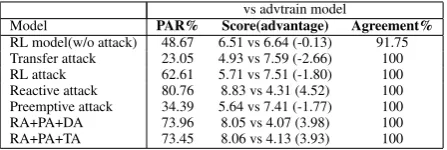
6. First, we observe that the adversarial trained model achieves much better performance against black-box RL attack; the advantage of RL attack drops from 2.32 to −1.8. Moreover, the model achieves consistently better performance against other white-box attacks. For instance, the advan-tage of the strongest RA+PA+DA attack is reduced from 5.78 to 3.98.
vs advtrain model
Model PAR% Score(advantage) Agreement%
RL model(w/o attack) 48.67 6.51 vs 6.64 (-0.13) 91.75 Transfer attack 23.05 4.93 vs 7.59 (-2.66) 100 RL attack 62.61 5.71 vs 7.51 (-1.80) 100 Reactive attack 80.76 8.83 vs 4.31 (4.52) 100 Preemptive attack 34.39 5.64 vs 7.41 (-1.77) 100 RA+PA+DA 73.96 8.05 vs 4.07 (3.98) 100 RA+PA+TA 73.45 8.06 vs 4.13 (3.93) 100
Table 6: Negotiation task evaluation with different ad-versarial agent on 2000 randomly generated scenarios, against adversarial trained model.
7.5 Analysis and Discussions
[image:8.595.309.533.552.627.2] [image:8.595.74.295.616.713.2]learn to mimic human’s action and are trained only on human data. Therefore, it is reasonable that RL agents are more robust than SV agents.
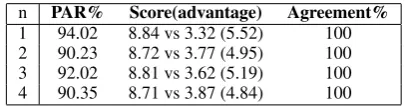
The importance of arbitrary turns. In reactive attack and preemptive attack, we begin our attack at the n-th turn and we setn = 2 in the experi-ments. Here we show the results with differentn
in Table 7. We observe that the performance of white-box attacks are quite consistent with differ-ent choices ofn. This probably indicates that there the bestnvaries for different cases. Therefore, if we could change the n from case to case adap-tively, which is done by delayed attack, we could see a performance boost.
n PAR% Score(advantage) Agreement%
1 94.02 8.84 vs 3.32 (5.52) 100 2 90.23 8.72 vs 3.77 (4.95) 100 3 92.02 8.81 vs 3.62 (5.19) 100 4 90.35 8.71 vs 3.87 (4.84) 100
Table 7: Negotiation task evaluation with different choices ofnagainst RL model.
Adversarial training helps to improve the ro-bustness. We then try to investigate the robust-ness of the adversarial trained model. We found that in the original model, it is easy for an at-tacker to find a sentence to quickly end the di-alogue. However, after adversarial training, it becomes much harder to find such sentences. Moreover, although we only conduct adversarial training on black-box RL model, the adversar-ial trained model still achieves better performance against other white-box attacks. This indicates that the adversarial trained model could probably detect the slight unnaturalness of those sentences and thus have a better reading comprehension abil-ity.
8 Conclusion
In this paper, we develop adversarial agents to evaluate the robustness of a goal-oriented dialogue system. Our experimental results show that the current NN-based models are not robust against our adversarial agents. Furthermore, by iterative adversarial training using our black-box RL agent, we can significantly improve the robustness of the dialogue system.
Acknowledgments
We acknowledge the support by NSF IIS1719097, Intel faculty award, Google Cloud and AITRICS.
References
Dzmitry Bahdanau, Kyunghyun Cho, and Yoshua Ben-gio. 2014. Neural machine translation by jointly learning to align and translate. arXiv preprint arXiv:1409.0473.
Antoine Bordes, Y-Lan Boureau, and Jason Weston. 2016. Learning end-to-end goal-oriented dialog.
arXiv preprint arXiv:1605.07683.
Nicholas Carlini and David Wagner. 2017. Towards evaluating the robustness of neural networks. In Se-curity and Privacy (SP), 2017 IEEE Symposium on, pages 39–57. IEEE.
William Chan, Navdeep Jaitly, Quoc Le, and Oriol Vinyals. 2016. Listen, attend and spell: A neural network for large vocabulary conversational speech recognition. In Acoustics, Speech and Signal Pro-cessing (ICASSP), 2016 IEEE International Confer-ence on, pages 4960–4964. IEEE.
Minhao Cheng, Thong Le, Pin-Yu Chen, Jin-feng Yi, Huan Zhang, and Cho-Jui Hsieh. 2019. Query-efficient hard-label black-box attack: An optimization-based approach. InICLR.
Minhao Cheng, Jinfeng Yi, Huan Zhang, Pin-Yu Chen, and Cho-Jui Hsieh. 2018. Seq2sick: Evaluat-ing the robustness of sequence-to-sequence mod-els with adversarial examples. arXiv preprint arXiv:1803.01128.
Abhishek Das, Satwik Kottur, Jos´e MF Moura, Stefan Lee, and Dhruv Batra. 2017. Learning cooperative visual dialog agents with deep reinforcement learn-ing.arXiv preprint arXiv:1703.06585.
Bhuwan Dhingra, Lihong Li, Xiujun Li, Jianfeng Gao, Yun-Nung Chen, Faisal Ahmed, and Li Deng. 2016. Towards end-to-end reinforcement learning of dia-logue agents for information access. arXiv preprint arXiv:1609.00777.
Javid Ebrahimi, Anyi Rao, Daniel Lowd, and Dejing Dou. 2018. Hotflip: White-box adversarial exam-ples for text classification. In Proceedings of the 56th Annual Meeting of the Association for Compu-tational Linguistics (Volume 2: Short Papers), vol-ume 2, pages 31–36.
Mihail Eric and Christopher D Manning. 2017. Key-value retrieval networks for task-oriented dialogue.
arXiv preprint arXiv:1705.05414.
Ji Gao, Jack Lanchantin, Mary Lou Soffa, and Yanjun Qi. 2018. Black-box generation of adversarial text sequences to evade deep learning classifiers. arXiv preprint arXiv:1801.04354.
[image:9.595.79.282.268.321.2]He He, Anusha Balakrishnan, Mihail Eric, and Percy Liang. 2017. Learning symmetric collaborative di-alogue agents with dynamic knowledge graph em-beddings.arXiv preprint arXiv:1704.07130.
Matthew Henderson, Blaise Thomson, and Jason D Williams. 2014. The second dialog state tracking challenge. InProceedings of the 15th Annual Meet-ing of the Special Interest Group on Discourse and Dialogue (SIGDIAL), pages 263–272.
Robin Jia and Percy Liang. 2017. Adversarial exam-ples for evaluating reading comprehension systems.
arXiv preprint arXiv:1707.07328.
Mike Lewis, Denis Yarats, Yann Dauphin, Devi Parikh, and Dhruv Batra. 2017. Deal or no deal? end-to-end learning of negotiation dialogues. InProceedings of the 2017 Conference on Empirical Methods in Nat-ural Language Processing, EMNLP 2017, Copen-hagen, Denmark, September 9-11, 2017, pages 2443–2453.
Jiwei Li, Will Monroe, and Dan Jurafsky. 2016. Un-derstanding neural networks through representation erasure. arXiv preprint arXiv:1612.08220.
Xiujun Li, Yun-Nung Chen, Lihong Li, Jianfeng Gao, and Asli Celikyilmaz. 2017. End-to-end task-completion neural dialogue systems. arXiv preprint arXiv:1703.01008.
Bin Liang, Hongcheng Li, Miaoqiang Su, Pan Bian, Xirong Li, and Wenchang Shi. 2017. Deep text classification can be fooled. arXiv preprint arXiv:1704.08006.
Xuanqing Liu, Minhao Cheng, Huan Zhang, and Cho-Jui Hsieh. 2018. Towards robust neural networks via random self-ensemble. In Proceedings of the European Conference on Computer Vision (ECCV), pages 369–385.
Xuanqing Liu and Cho-Jui Hsieh. 2019. Adv-gan: Generator, discriminator, and adversarial attacker. InCVPR.
Xuanqing Liu, Yao Li, Chongruo Wu, and Cho-Jui Hsieh. 2019. Ad v-bnn: Improved adversarial de-fense through robust bayesian neural network. In
ICLR.
Minh-Thang Luong, Hieu Pham, and Christopher D Manning. 2015. Effective approaches to attention-based neural machine translation. arXiv preprint arXiv:1508.04025.
Aleksander Madry, Aleksandar Makelov, Ludwig Schmidt, Dimitris Tsipras, and Adrian Vladu. 2018. Towards deep learning models resistant to adversar-ial attacks. InICLR.
Takeru Miyato, Andrew M Dai, and Ian Good-fellow. 2016. Adversarial training methods for semi-supervised text classification. arXiv preprint arXiv:1605.07725.
Seyed Mohsen Moosavi Dezfooli, Alhussein Fawzi, and Pascal Frossard. 2016. Deepfool: a sim-ple and accurate method to fool deep neural net-works. InProceedings of 2016 IEEE Conference on Computer Vision and Pattern Recognition (CVPR), EPFL-CONF-218057.
Igor Mordatch and Pieter Abbeel. 2017. Emergence of grounded compositional language in multi-agent populations. arXiv preprint arXiv:1703.04908.
Nicolas Papernot, Patrick McDaniel, Ian Goodfel-low, Somesh Jha, Z Berkay Celik, and Ananthram Swami. 2017. Practical black-box attacks against machine learning. InProceedings of the 2017 ACM on Asia Conference on Computer and Communica-tions Security, pages 506–519. ACM.
Nicolas Papernot, Patrick McDaniel, Ananthram Swami, and Richard Harang. 2016. Crafting adver-sarial input sequences for recurrent neural networks. InMilitary Communications Conference, MILCOM 2016-2016 IEEE, pages 49–54. IEEE.
Alexander M Rush, Sumit Chopra, and Jason We-ston. 2015. A neural attention model for ab-stractive sentence summarization. arXiv preprint arXiv:1509.00685.
Suranjana Samanta and Sameep Mehta. 2017. Towards crafting text adversarial samples. arXiv preprint arXiv:1707.02812.
Iulian Vlad Serban, Alessandro Sordoni, Yoshua Ben-gio, Aaron C Courville, and Joelle Pineau. 2016. Building end-to-end dialogue systems using gener-ative hierarchical neural network models. InAAAI, volume 16, pages 3776–3784.
Christian Szegedy, Wojciech Zaremba, Ilya Sutskever, Joan Bruna, Dumitru Erhan, Ian Goodfellow, and Rob Fergus. 2013. Intriguing properties of neural networks. arXiv preprint arXiv:1312.6199.
Oriol Vinyals and Quoc Le. 2015. A neural conversa-tional model. arXiv preprint arXiv:1506.05869.
Wei Wei, Quoc Le, Andrew Dai, and Jia Li. 2018. Airdialogue: An environment for goal-oriented di-alogue research. In Proceedings of the 2018 Con-ference on Empirical Methods in Natural Language Processing, pages 3844–3854.
Tsung-Hsien Wen, David Vandyke, Nikola Mrksic, Milica Gasic, Lina M Rojas-Barahona, Pei-Hao Su, Stefan Ultes, and Steve Young. 2016. A network-based end-to-end trainable task-oriented dialogue system. arXiv preprint arXiv:1604.04562.
Eric Wong and J Zico Kolter. 2018. Provable defenses against adversarial examples via the convex outer adversarial polytope. InICML.
Nanyang Ye and Zhanxing Zhu. 2018. Bayesian adver-sarial learning. InNIPS.