Proceedings of the 9th Workshop on Computational Approaches to Subjectivity, Sentiment and Social Media Analysis, pages 217–223 217
NL-FIIT at IEST-2018: Emotion Recognition utilizing Neural Networks
and Multi-level Preprocessing
Samuel Pecar, Michal Farkas, Marian Simko, Peter Lacko, Maria Bielikova Slovak University of Technology in Bratislava
Faculty of Informatics and Information Technologies lkoviˇcova 2, 842 16 Bratislava, Slovakia
{samuel.pecar, michal.farkas, marian.simko, peter.lacko maria.bielikova}@stuba.sk
Abstract
In this paper, we present neural models sub-mitted to Shared Task on Implicit Emotion Recognition, organized as part of WASSA 2018. We propose a Bi-LSTM architecture with regularization through dropout and Gaus-sian noise. Our models use three different embedding layers: GloVe word embeddings trained on Twitter dataset, ELMo embeddings and also sentence embeddings. We see pre-processing as one of the most important parts of the task. We focused on handling emojis, emoticons, hashtags, and also various short-ened word forms. In some cases, we pro-posed to remove some parts of the text, as they do not affect emotion of the original sen-tence. We also experimented with other modi-fications like category weights for learning and stacking multiple layers. Our model achieved a macro average F1 score of 65.55 %, signif-icantly outperforming the baseline model pro-duced by a simple logistic regression.
1 Introduction
Both text reconstruction and sentiment analysis are well studied and highly practical areas of re-search in the field of natural language processing. Recently, there have been significant advances and improvements (Buechel and Hahn,2017), at least partly due to the wider adoption of neural net-works (Köper et al.,2017).
As it is, Implicit Emotion Recognition, as pro-posed by organizers of WASSA 2018 workshop (Klinger et al., 2018), can be seen both as a text reconstruction and as a sentiment analysis task. This is possible because, in this task, sentiment of a sentence should be equal to the missing word. In practice, the difference is marginal, neverthe-less for both these tasks bi-directional LSTMs are widely used.
In recent years, there have been several com-petitions, papers and shared tasks dealing with
emotion recognition and classification ( Moham-mad et al.,2018;Mohammad and Bravo-Marquez,
2017). Dealing with noisy and ungrammatical user-generated text can be also challenging in other high-level NLP tasks like summarization (Pecar,2018).
In this paper, we present a neural network ar-chitecture with special focus on the preprocessing phase. We believe preprocessing can have signif-icant impact on accuracy of each system in nat-ural language processing. We explored many se-tups and also different types of regularization as dropout, Gaussian noise, kernel and activity regu-larization – L1 and L2, and also recurrent dropout within LSTM cells. We also experimented with three different types of embedding layers – GloVe, ELMo and various sentence representations. Fi-nally, we explored impact of different setups on model accuracy. In this paper, we report on results of these experiments.
2 Preprocessing
We are aware that preprocessing of input is one of the most important phases in natural language pro-cessing. This need is also highlighted when using user generated content which is more difficult to process. We can distinguish our preprocessing in a few stages displayed in Figure1. We also eval-uate different setups of our preprocessing in the results section.
Word-level Cleaning
Character-level Cleaning
Emoji and Emoticon Processing
[image:2.595.122.241.58.246.2]Hashtag Processing
Figure 1: Preprocessing pipeline
omit some of the words which do not affect clas-sification (e.g. @username, http://url.removed). The [NEWLINE] sign was replaced by sentence endings followed by space.
Character-level Cleaning Similarly to word-level cleaning, this phase consists of several rules operating on character-level preprocessing. We can describe this preprocessing in several cate-gories, such as: currency handling, character es-caping, replacing, and removing. In currency han-dling, we replaced signs for pounds, dollars, euros and yens with its word form. Other currency signs were replaced with the word ’currency’. Character replacing consists of unification of different forms used for apostrophe and as quotation marks. In character escaping, we surrounded characters like apostrophe, quotation mark, colon, dash, and caret with white-spaces to separate them from words and make tokenization easier. Finally, we decided to remove other unmentioned punctuation marks. We also considered removing all numbers as they often do not determine any sentiment.
Emoji and Emoticons Processing Handling
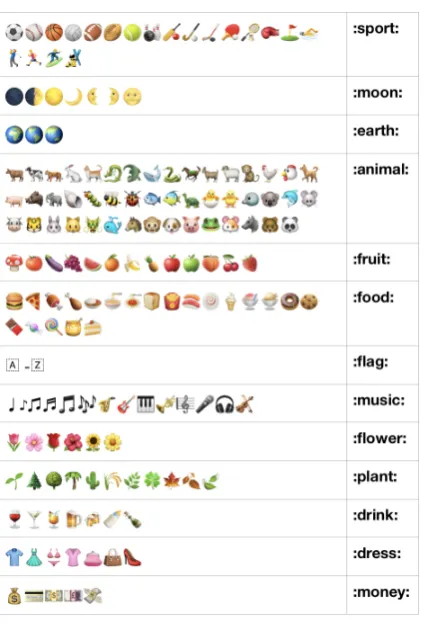
emoticons and emojis is a more extensive part in our preprocessing phase. The first step consists of replacing emoticons (punctuation, numbers and characters used to create pictorial icons) with their emoji equivalent (only one unicode character). In phase of handling emojis, we removed all char-acters which modify original emoji with gender or skin color. We also tried to categorize emoji into categories (Figure 2). This step helped us to reduce amount of emojis used in text. We
re-placed emojis symbolizing sport, moon, earth, an-imal, fruit, food, lag, music, flower, plant, drink, dress, money with their category word surrounded by colon (Figure2). Another categories were pro-duced by unification of different emojis with sim-ilar sense.
Figure 2: Emoji categorization
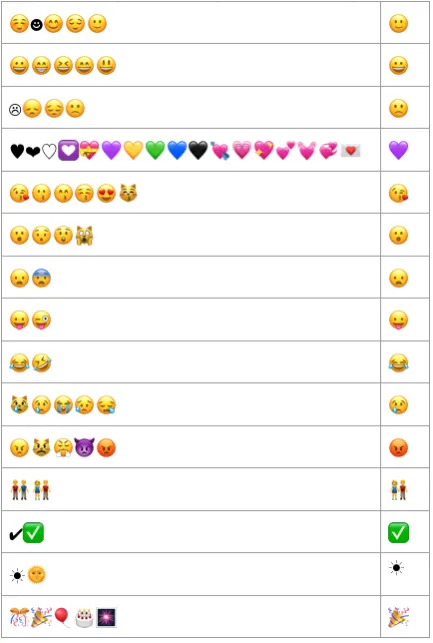
Finally, we surround all emojis with white-spaces. This step can significantly help in tok-enization, as emojis were sometimes recognized as part of words and also group of emojis were recognized as one token.
[image:2.595.308.525.158.480.2]Figure 3: Emoji replacing
Examples of preprocessed texts are displayed in Figure4. We can see examples of each preprocess-ing step described in this chapter.
3 Model
In this shared task, we experimented with many different setups, based on a different embedding layer and also different neural layers on top of an embedding layer.
3.1 Embedding Layer
We experimented some of the commonly used embedding layers like Word2Vec (Mikolov et al.,
2013), GloVe (Pennington et al.,2014) or ELMo (Peters et al.,2018) but also sentence embeddings like Universal Sentence Encoder (Cer et al.,2018) and InferSent (Conneau et al., 2017). For en-coding input words, we used various pre-trained word embeddings available online like GloVe em-beddings1. With GloVe embeddings, we experi-mented with domain specific embeddings trained on Twitter data but also with embeddings trained on data extracted by CommonCrawl. We have also experimented with recent ELMo embeddings,
1https://nlp.stanford.edu/projects/glove/
however these experiments were done addition-ally, after submission deadline. We used pre-trained model of ELMo available online2.
Both GloVe and ELMo embeddings were in-cluded in model in such way that they can be fur-ther fine-tuned. However, available implementa-tion of InferSent is done in Torch and integrating that model into Keras model proved to be prob-lematic, this is mainly due to their use of custom layer. Hence, we encoded sentences into their vec-tors outside of the model and stored it in a separate file. We are considering a whole tweet as a single sentence and have a file that has a label and an embedding of the entire tweet. On the other hand, both variants of USE are available as a Tensorflow module3 4. This enables us to use them as an em-bedding layer, although without any fine tuning.
3.2 Hidden Layers
Embedding layer is followed by several Bi-LSTM layers, when sentence embeddings were not used. We have experimented with up to two stacked lay-ers. In case of sentence embedding models, we have experimented with several architectures with varying number of layers, however in the end we have settled on simple feed-forward network with one hidden layer, which uses parametric rectified linear unit.
We experimented with a different size of each layer and also a different number of stacked layers. While using 1024 units in each of hidden layers was the best option, we also tested a much bigger model with sentence embeddings containing more units within each layer and also more stacked lay-ers.
3.3 Activation
We experimented with several different activation functions, but their impact was either insignifi-cant or obvious. Hence, all our results use the same configuration as far as activation functions are concerned.
In LSTM cells, we use typical activation func-tions – hard sigmoid and hyperbolic tangent. In case of models that utilize sentence embeddings, we use parametric rectified linear activation, al-though its contribution is uncertain.
2
https://tfhub.dev/google/elmo/2
3
https://tfhub.dev/google/universal-sentence-encoder/2
4
Original @USERNAME i'm [#TRIGGERWORD#] that he wasn't alone 💕 since its his first solo..
Processed i am #TRIGGERWORD# that he was not alone 💜 since its his first solo
Original @USERNAME This picture says it all. Thank you again for being so kind & sweet. He's SO [#TRIGGERWORD#] that you liked his gift 🐟 💞 🌳 http://url.removed
Processed This picture says it all Thank you again for being so kind sweet He is SO #TRIGGERWORD# that you liked his gift :animal: 💜 :plant:
Figure 4: Examples of preprocessed sentences
Since we use categorical crossentropy as our loss function, choice of softmax activation func-tion for the last layer is natural.
3.4 Regularization
In training stage, we discovered a problem with over-fitting on training dataset and some regular-ization was needed. We experimented with differ-ent types of regularization like dropout, Gaussian noise and also applying L1 and L2 norm to differ-ent types of regularization, such as: bias, kernel, recurrent or activation. We found out that using combined L1 and L2 regularization often causes learning to stop. Although we fine-tuned L1 and L2 weight parameters, it failed to achieve better results than a model without this kind of regular-ization.
Unsurprisingly, we have utilized early stopping technique to halt training when validation accu-racy has not improved at least by 0.001% two times in a row. Although we experimented with different configurations, such as monitoring vali-dation loss and tweaking patience, we did not ob-serve any improvement and in most cases we even observed detrimental effect.
While L1 and L2 regularization had no posi-tive effect on accuracy of our model, application of dropout and Gaussian noise significantly im-proved accuracy of tested models. We experi-mented with different setups and the most accu-rate combination was with the use of dropout with rate of 0.3 after each layer or replacing dropout after embedding layer with dropout with rate 0.2 and Gaussian noise on the embeddings with stan-dard deviation 0.2. That being said, we have found out that applying these regularizations on sentence embeddings proved to be more challenging and
the same settings often were too much for the neu-ral network to handle.
4 Evaluation
In this section, we briefly summarize evaluation metrics for this task and also basic information about used dataset and embeddings. Later, we de-scribe different setups of our model.
For evaluation, standard measures like preci-sion, recall and f-score were used. Then micro and macro measures were computed. As final official result, macro F1 was taken.
4.1 Dataset
The dataset for emotion recognition shared task consists of tweets where emotion word was re-moved. The dataset contains six different cate-gories: anger, disgust, fear, joy, sadness, and sur-prise. The train dataset contains approximately 150 thousands of tweets and test contains more than 30 thousands of tweets. Detailed information can be found in the main paper of the shared task (Klinger et al.,2018).
4.2 Results
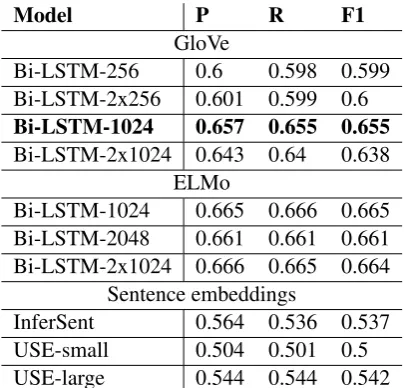
Our experiments show that the effect of LSTM size is apparent up to 1024 units. After that, it has negligible or even detrimental effect. Sim-ilarly, our experiments with two-layer Bi-LSTM achieved worse or same results as single-layer only. Our results are shown in Table1. Setup for Glove and also ELMo was set as follows5:
• batch size: 64
• gaussian noise after embedding layer: 0.2
5default attributes from keras were used if not specified
• dropout after embedding layer: 0.2
• dropout after recurrent layer: 0.3
• loss function: categorical cross entropy
• optimizer: adam
• early stopping value: 0.01
• early stop patience: 1
• embeddings dimension: 200
The same setup, except for regularization, was used also for sentence embedding approach. Reg-ularization did not seem to improve generalization and results, hence we did not include it in our model. It is highly probable that regularization was not needed, because, as we reported earlier, sentence embedding methods are applied in such way that they cannot be fine-tuned.
Model P R F1
GloVe
Bi-LSTM-256 0.6 0.598 0.599
Bi-LSTM-2x256 0.601 0.599 0.6
Bi-LSTM-1024 0.657 0.655 0.655
Bi-LSTM-2x1024 0.643 0.64 0.638
ELMo
Bi-LSTM-1024 0.665 0.666 0.665
Bi-LSTM-2048 0.661 0.661 0.661
Bi-LSTM-2x1024 0.666 0.665 0.664 Sentence embeddings
InferSent 0.564 0.536 0.537
USE-small 0.504 0.501 0.5
USE-large 0.544 0.544 0.542
Table 1: Comparison between different models.
Various variants of GloVe, even those trained on Twitter data, did not show much variance. On the other hand, ELMo embeddings did slightly im-prove our results as was expected.
There are several possible reasons why sentence embedding methods failed. First, the provided dataset is actually quite substantial and does not need such methods. Secondly, these methods can-not work well on Twitter data. Finally, the way we have included both InferSent and USE into our models does not enable fine tuning. Of course we cannot rule out a bug in our code as well.
Preprocessing had far greater impact on results than fine tuning our model. Details shown in Table
2clearly demonstrate that text cleaning with emoji processing can improve classification of emotion. In the setup Text cleaning, only word-level and character-level cleaning were used. In theEmoji processingsetup, we used previous features along with emoji processing and inHashtag processing
we used only text cleaning with hashtag process-ing. Finally, in the last setup, all previous setups were combined.
Setup P R F1
No preprocessing 0.630 0.626 0.626
Text cleaning 0.645 0.639 0.641
Emoji processing 0.657 0.655 0.655 Hashtags processing 0.648 0.647 0.647
[image:5.595.80.283.342.536.2]Combined 0.657 0.655 0.655
Table 2: Comparison of different preprocessing se-tups.
To see how our best model performed on differ-ent classes, we can take a look at Table3. It is ap-parent that we have achieved best results on ’joy’ class and worst results on ’anger’ class. Precision metric of class ’surprise’ is particularly notewor-thy, due to it being considerably lower than other classes. This suggests that our model often classi-fied other labels as ’surprise’ class.
Confusion matrix, shown in Table4, depicts ac-curacy of our official results (columns represent predicted classes while rows represent true labels). Quite surprisingly, false positives are more or less balanced across all categories. Nevertheless, we can see that our model rarely misclassified ’joy’ as ’disgust’, ’fear’, and vice versa. We can glean more findings from this confusion matrix, but they may be just a noise.
5 Conclusion
In this paper, we discussed different neural models for emotion recognition based on word and sen-tence embeddings followed by stacked Bi-LSTM layers and dense layers, respectively. We also dis-cussed need of preprocessing that can significantly improve accuracy.
We observed that false negative and also false positive examples were equally distributed be-tween classes. We tried also set sample weights for classes with the best and worst F1, but no com-bination brought any overall improvement.
Label TP FP FN P R F
anger 2717 1713 2077 0.613 0.567 0.589
disgust 3013 1368 1781 0.688 0.628 0.657
sad 2793 1722 1546 0.619 0.644 0.631
joy 3893 1193 1353 0.765 0.742 0.754
surprise 3124 2297 1668 0.576 0.652 0.612
fear 3345 1578 1446 0.679 0.698 0.689
MicAvg 18885 9871 9871 0.657 0.657 0.657
MacAvg 0.657 0.655 0.655
Table 3: Official results over classes.
Class anger disgust fear joy sadness surprise
anger 2717 345 437 310 397 588
disgust 352 3013 196 146 457 630
fear 314 169 3345 223 275 465
joy 303 119 266 3893 337 328
sadness 388 364 234 274 2793 286
[image:6.595.162.435.60.189.2]surprise 356 371 445 240 256 3124
Table 4: Confusion matrix of official results.
this preprocessing some of the sentences can be recognized as the same. An interesting point of re-search can be deduplication of these examples and examination of overall impact of these duplicated examples.
We made our code publicly available at GitHub6.
Acknowledgments
This work was partially supported by the Slovak Research and Development Agency under the con-tract No. APVV-17-0267 - Automated Recogni-tion of Antisocial Behaviour in Online Commu-nities, the Scientific Grant Agency of the Slo-vak Republic, grant No. VG 1/0667/18 and VG 1/0646/15 and the Cultural and Educational Grant Agency of the Slovak Republic, grant No. KEGA 028STU-4/2017
References
Sven Buechel and Udo Hahn. 2017. Emobank: Study-ing the impact of annotation perspective and repre-sentation format on dimensional emotion analysis. InProceedings of the 15th Conference of the Euro-pean Chapter of the Association for Computational Linguistics: Volume 2, Short Papers, pages 578– 585. Association for Computational Linguistics.
6https://github.com/SamuelPecar/nl-fiit-wassa-emotion
Daniel Cer, Yinfei Yang, Sheng-yi Kong, Nan Hua, Nicole Limtiaco, Rhomni St John, Noah Constant, Mario Guajardo-Cespedes, Steve Yuan, Chris Tar, et al. 2018. Universal sentence encoder. arXiv preprint arXiv:1803.11175.
Alexis Conneau, Douwe Kiela, Holger Schwenk, Loïc Barrault, and Antoine Bordes. 2017. Supervised learning of universal sentence representations from natural language inference data. InProceedings of the 2017 Conference on Empirical Methods in Nat-ural Language Processing, pages 670–680, Copen-hagen, Denmark. Association for Computational Linguistics.
Roman Klinger, Orphée de Clercq, Saif M. Moham-mad, and Alexandra Balahur. 2018. Iest: Wassa-2018 implicit emotions shared task. InProceedings of the 9th Workshop on Computational Approaches to Subjectivity, Sentiment and Social Media Anal-ysis, Brussels, Belgium. Association for Computa-tional Linguistics.
Maximilian Köper, Evgeny Kim, and Roman Klinger. 2017. IMS at EmoInt-2017: Emotion intensity pre-diction with affective norms, automatically extended resources and deep learning. In Proceedings of the 8th Workshop on Computational Approaches to Subjectivity, Sentiment and Social Media Analysis, Copenhagen, Denmark. Workshop at Conference on Empirical Methods in Natural Language Processing, Association for Computational Linguistics.
compositional-ity. InAdvances in neural information processing systems, pages 3111–3119.
Saif Mohammad and Felipe Bravo-Marquez. 2017. Wassa-2017 shared task on emotion intensity. In Proceedings of the 8th Workshop on Computational Approaches to Subjectivity, Sentiment and Social Media Analysis, pages 34–49. Association for Com-putational Linguistics.
Saif M. Mohammad, Felipe Bravo-Marquez, Mo-hammad Salameh, and Svetlana Kiritchenko. 2018. Semeval-2018 Task 1: Affect in tweets. In Proceed-ings of International Workshop on Semantic Evalu-ation (SemEval-2018), New Orleans, LA, USA.
Samuel Pecar. 2018. Towards opinion summarization of customer reviews. InProceedings of ACL 2018, Student Research Workshop, pages 1–8. Association for Computational Linguistics.
Jeffrey Pennington, Richard Socher, and Christo-pher D. Manning. 2014. Glove: Global vectors for word representation. InEmpirical Methods in Nat-ural Language Processing (EMNLP), pages 1532– 1543.