Proceedings of the Second Workshop on Universal Dependencies (UDW 2018), pages 173–182 173
Extended and Enhanced Polish Dependency Bank
in Universal Dependencies Format
Alina Wróblewska
Institute of Computer Science Polish Academy of Sciences
ul. Jana Kazimierza 5 01-248 Warsaw, Poland
Abstract
The paper presents the largest Polish Depen-dency Bank in Universal Dependencies for-mat – PDBUD – with 22K trees and 352K tokens. PDBUD builds on its previous ver-sion, i.e. the Polish UD treebank (PL-SZ), and contains all 8K SZ trees. The PL-SZ trees are checked and possibly corrected in the current edition of PDBUD. Further 14K trees are automatically converted from a new version of Polish Dependency Bank. The PDBUD trees are expanded with the en-hanced edges encoding the shared dependents and the shared governors of the coordinated conjuncts and with the semantic roles of some dependents. The conducted evaluation exper-iments show that PDBUD is large enough for training a high-quality graph-based depen-dency parser for Polish.
1 Introduction
Natural language processing (NLP) is nowadays dominated by machine learning methods, espe-cially deep learning methods. Data-driven NLP tools not only perform more accurately than rule-based tools, but are also easier to develop. The shift towards machine learning methods is also visible in syntactic parsing, especially depen-dency parsing. The vast majority of the contempo-rary dependency parsing systems (e.g.Nivre et al.,
2006;Bohnet,2010;Dozat et al.,2017;Straka and Straková,2017) take advantage of machine learn-ing methods. Based on trainlearn-ing data, parsers learn to analyse sentences and to predict the most appro-priate dependency structures of these sentences. Even if various learning methods were applied to data-driven dependency parsing (e.g.Jiang et al.,
2016), the best results so far are given by the su-pervised methods (cf. Zeman et al., 2017). Su-pervised dependency parsers trained on correctly annotated data achieve high parsing performance
even for languages with rich morphology and rel-atively free word order, such as Polish.
The supervised learning methods require gold-standard training data, whose creation is a time-consuming and expensive process. Nevertheless, dependency treebanks have been created for many languages, in particular within the Universal De-pendencies initiative (UD, Nivre et al., 2016). The UD leaders aim at developing a cross-linguistically consistent tree annotation schema and at building a large multilingual collection of dependency treebanks annotated according to this schema.
Polish is also represented in the Universal Dependencies collection. There are two Polish treebanks in UD: the Polish UD treebank (PL-SZ) converted fromSkładnica zale˙zno´sciowa1and the LFG enhanced UD treebank (PL-LFG) con-verted from a corpus of the Polish LFG struc-tures.2 PL-SZ contains more than 8K sentences with 10.1 tokens per sentence on average. PL-LFG is larger and contains more than 17K sentences, but the average number of tokens per sentence is only 7.6.3
This paper presents the largest Polish Depen-dency Bank in Universal Dependencies format – PDBUD4 – with 22K trees and 352K to-kens (hence 15.8 toto-kens per sentence on aver-age). PDBUD builds on its previous version, i.e. the Polish UD treebank (PL-SZ), and contains all 8K PL-SZ trees. The PL-SZ trees are checked and possibly corrected in the current edition of
1
Składnica zale˙zno´sciowawas converted to the UD for-mat byZeman et al.(2014).
2
LFG structures were converted by A. Przepiórkowski and A. Patejuk.
3A detailed comparison of PL-SZ and PL-LFG is
pre-sented on http://universaldependencies.org/ treebanks/pl-comparison.html.
PDBUD. Further 14K trees are automatically con-verted from a new version of Polish Dependency Bank (PDB, see Section 2). Polish sentences un-derlying the additional PDB trees contain prob-lematic linguistic phenomena whose conversion requires some modifications of the UD annotation schema (see Section3). Furthermore, the PDBUD trees are expanded with the enhanced edges en-coding the shared dependents and the shared gov-ernors of the coordinated conjuncts (see Section
4) and with the semantic roles of some dependents (see Section 5). Finally, we conduct some eval-uation experiments. The evaleval-uation results show that PDBUD is large enough for training a high-quality graph-based dependency parser for Polish (see Section6).
2 Polish Dependency Bank
2.1 PDB
The first Polish dependency treebank –Składnica zale˙zno´sciowa (Wróblewska, 2012) – was a col-lection of about 8K trees which were automati-cally converted from Polish constituent trees of Składnica frazowa (Woli´nski et al., 2011). All sentences of Składnica were derived from Pol-ish National Corpus (Przepiórkowski et al.,2012). The annotated sentences are rather short with 10.2 tokens per sentence on average and corresponding trees are relatively simple (there is only 289 non-projective trees,5i.e. 3.5% of all trees).
This first version of Polish dependency treebank was enlarged with 4K trees (Wróblewska,2014). The additional trees resulted from the projection of English dependency structures on Polish paral-lel sentences fromEuroparl(Koehn,2005), DGT-Translation Memory (Steinberger et al., 2012), OPUS (Tiedemann, 2012) and Pelcra Parallel Corpus (P˛ezik et al., 2011). The additional sen-tences with the average length of 15.9 tokens per sentence were longer than the sentences from
5
Non-projective trees contain long distance dependencies resulting in crossing edges. See the topicalisation example Czerwon ˛a kupiłam sukienk˛e‘I bought a red dress’ (lit. ‘Red I bought a dress’) with the following non-projective depen-dency tree:
ROOT Czerwon ˛a kupiłam sukienk˛e
red I bought dress root
obj amod
Składnica. The projection-based trees were also more complex and 235 of them are non-projective (i.e. 5.9% of all added trees). The entire set of Składnica trees and the projection-based trees is called Polish Dependency Bank (PDB).
PDB is still being developed at the Institute of Computer Science PAS. The current version of PDB is enlarged with a suite of 10K sentences an-notated with the dependency trees. The additional sentences are relatively complex (20.5 tokens per sentence on average) and come from Polish Na-tional Corpus (Przepiórkowski et al., 2012), Pol-ish CDSCorpus6 (Wróblewska and Krasnowska-Kiera´s,2017), and literature. There are 1388 non-projective trees in this set (i.e. 13.9% of 10K trees). Besides enlarging PDB, the development consists in correcting the previous PDB trees. TheSkładnicatrees and the projection-based trees are manually checked and corrected if necessary.
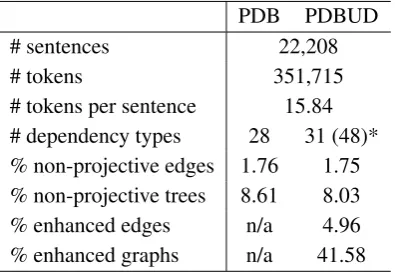
The current version of PDB consists of more than 22K trees with 15.8 tokens per sentence on average (see Table 1). There are 1912 non-projective trees in PDB (i.e. 8.61% of all trees).
PDB PDBUD
# sentences 22,208
# tokens 351,715
# tokens per sentence 15.84 # dependency types 28 31 (48)* % non-projective edges 1.76 1.75 % non-projective trees 8.61 8.03
% enhanced edges n/a 4.96
[image:2.595.319.517.397.534.2]% enhanced graphs n/a 41.58
Table 1: Statistics of Polish Dependency Bank (PDB) and its UD conversion (PDBUD). *There are 31 uni-versal dependency types in PDBUD and 48 uniuni-versal types with the Polish-specific subtypes.
2.2 PDBUD
The PDB trees are automatically converted to the UD trees according to the guidelines of Uni-versal Dependencies v27 and the resulting set is called PDBUD (i.e. Polish Dependency Bank in Universal Dependencies format). PDBUD con-tains all trees of the Polish UD treebank
(PL-6http://zil.ipipan.waw.pl/Scwad/
CDSCorpus
7http://universaldependencies.org/
SZ), which are possibly corrected. The size of PDBUD is exactly the same as the size of PDB, i.e. 22K trees and 351K tokens (see Table1). 1783 of the PDBUD trees are non-projective, i.e. 8.03% of all trees. There are 17K enhanced edges (4.96% of all edges) in PDBUD and 41.6% of the PDBUD graphs have at least one enhanced edge.
The converted PDBUD trees are largely con-sistent with the PL-SZ trees. While converting, we try to preserve the universality principle of UD, but some necessary modifications are es-sential. The PL-SZ trees are rather simple and the sentences underlying this data set do not con-tain some linguistic phenomena, e.g. ellipsis, com-parative constructions, directed speech, interpo-lations and comments, nominative noun phrases used in the vocative function, and many others. Therefore, the repertoire of the UD relation sub-types and language-specific features is slightly ex-tended in PDBUD to cover these phenomena (see Section3). Furthermore, in contrast to the PL-SZ trees, the PDBUD graphs contain enhanced edges encoding shared dependents or shared governors of coordinated elements (see Section 4). Finally, some semantic labels are added that goes beyond the standard annotation scheme of Universal De-pendencies (see Section5).
3 Corrections and extensions
Plenty of errors are corrected in the original Skład-nicatrees (and the projection-based trees) and thus they are not transferred to these PDBUD trees, which correspond to the PL-SZ trees. The errors in theSkładnicatrees were predominantly caused by the inadequate automatic conversion of the phrase-structure trees into the dependency trees, particu-larly by the erroneous labelling. Defective part-of-speech tags, morphological features, lemmas, de-pendency relations and their labels are manually corrected by highly qualified linguists. The cor-rection issues do not fall within the scope of this paper. The conversion issues and extension sug-gestions are described in the following sections.
3.1 Comparative constructions
Comparative constructions are distinguished in the PDB trees and thus they are also marked in PDBUD. According toBondaruk(1998), there are two types of comparative constructions in Polish: comparatives of equality marked with e.g.tak ... jak(‘as ... as’), taki ... jaki(‘just like’), and
com-paratives of inequalitymarked withNI ˙Z(‘than’).8 All markers introducing comparative construc-tions, e.g. JAK, NI ˙Z, JAKBY, NICZYM, are con-verted as the subordinate conjunctions SCONJ with the feature ConjType=Cmpr.9 Comparative constructions are annotated with the following de-pendencies (see Figure1): the comparative marker is labelled mark and it depends on the main el-ement of the comparative construction labelled obl:cmpr(a new UD subtype).
znali ceny lepiej ni˙z kelnerzy
they know prices better than waiters obj
advmod obl:cmpr
[image:3.595.318.519.218.279.2]mark
Figure 1: The PDBUD tree of [...]znali ceny potraw lepiej ni˙z kelnerzy(‘they know the prices of dishes bet-ter than the waibet-ters’) with the comparative construc-tion.
3.2 Constructions withJAKO
The lexeme JAKO is one of the uninflectable Polish parts of speech. It causes considerable difficulties and is heterogeneously analysed as a preposition, a coordinating conjunction, a sub-ordinating conjunction, or an adverb in the tra-ditional Polish linguistics. According to the con-cept of the bi-functional subordinating conjunc-tion JAKO (Wróblewska and Wieczorek, 2018),
we convert all examples of JAKO as SCONJ with the feature ConjType=Pred (i.e. a predica-tive conjunction – a new Polish-specific feature). The subordinating conjunctionJAKO, which is la-belled mark, can be governed by the head of any constituent phrase (e.g. a nominal, preposi-tional, or verbal phrase) which is, in turn, gov-erned by the sentence predicate subcategorising another phrase of the same type (see Figure 2). There is an identification relation between the
sub-8
Comparatives of inequality are sometimes introduced by the comparative forms of adjectives or adverbs (marked in PDBUD with the feature Degree=Cmp). However, compara-tives of inequality can also be introduced by non-comparative adjectives (e.g.inny‘other’), adverbs (e.g.inaczej‘in another way’,przeciwnie‘on the contrary’), or even the verbwole´c ‘to prefer’.
9Cmp
categorised argument and the phrase introduced by JAKO (hence the bi-functional subordinating conjunction) which could be marked with an en-hanced edge.
o zgod˛e wyst ˛apił jako o ´srodek
for permission he applied as for measure case
obl:arg
[image:4.595.79.298.137.203.2]case mark obl
Figure 2: The PDBUD tree of the sentence O zgod˛e tak ˛a wyst ˛apił jako o ´srodek zapobiegawczy (‘He ap-plied for such permission as a precautionary measure’) withJAKO.
3.3 Mobile inflection
The mobile inflections (marked asagltin the Pol-ish tagset, e.g. -eminodwołałem‘IMask recalled’ or -´sinzrobiłaby´s‘youFemwould do’) are the en-clitics which substitute auxiliary verbs in the past perfect constructions. We convert them as AUX with Aspect, Number, and Person features, sim-ilar to PL-SZ. The repertoire of the morphological features of the mobile inflections is enriched with Clitic=Yesand itsVariant– eitherLong(e.g.-em in odwołałem ‘IMask recalled’) or Short (e.g. -m inodwołałam‘IFemrecalled’). The mobile inflec-tions are marked with the further features Verb-Form=FinandMood=Indin the PL-SZ trees, but as they are not the proper finite verbs, these fea-tures seem to be incorrect and are not included in PDBUD. A mobile inflection is the special case of an auxiliary verb. Therefore, the relation between the mobile inflection and its governing participle is labelled with a special subtypeaux:clitic(a new UD subtype).
3.4 Conditional particle
The conditional particle BY, e.g. -by- in zro-biłaby´s (‘youFem would do’), is annotated in PL-SZ as an auxiliary AUX with the features As-pect=Imp, Mood=Cnd andVerbForm=Fin, and with the lemmaBY ´C(‘to be’). It is a particle which
doesn’t bear any grammatical features in Polish (cf. Przepiórkowski et al., 2012). Since it is not any verb form, it cannot be annotated withAspect, MoodandVerbFormfeatures which are reserved for verbs. Furthermore, its lemma form isBYand notBY ´C. The conditional particleBYis converted
as PART in PDBUD. The relation between this particle and its governor is labelled withaux:cnd (a new UD subtype).
3.5 Other morphosyntactic extensions
We propose some morphosyntactic extensions of the schema which was used to annotate the PL-SZ trees. Some of these extensions are already defined in the UD guidelines, but they were not applied in PL-SZ. Other extensions are newly defined.
ADP There is only one postposition in Polish – TEMU (‘ago’), which is converted in PDBUD
as the adposition ADP with the feature Adp-Type=Post. In PL-SZ, the postposition TEMU
was wrongly assigned the featureAdpType=Prep, which is reserved for prepositions.
CCONJ We convert the conjunctionsPLUS and
MINUS as the coordinating conjunction CCONJ with the featureConjType=Oper(a mathematical operator). There was not any conjunction of this kind in PL-SZ.
Digits Digits (NumForm=Digit) and roman numbers (NumForm=Roman), which are distin-guished in PDB, are converted as follows:
• ordinal numbers: the adjectives ADJ with the feature NumType=Ord and other stan-dard features of the adjectives,
• cardinal numbers: the numerals NUM with the feature NumType=Card and other stan-dard features of the numerals,
• other numbers: the tagX.
PUNCT Some features of the punctuation marks are specified:
• PunctSidewith the valuesInitial orFinal,
• PunctType with one of the following val-ues: Brck (bracket), Colo (colon), Comm (comma), Dash, Elip (elipsis), Slsh (slash), Blsh(backslash), etc.
Note thatElip,SlshandBlshare the newly defined PunctTypevalues.
VERB The impersonal verb forms10 are con-verted as the adjectives ADJ with the fea-ture Case in PL-SZ. In the Polish linguistics however, the impersonals are considered verb forms which cannot be conjugated by the gram-matical case. Therefore, we convert them as the verbs VERB with the following features: Aspect (Perfective or Imperfective), Mood=Ind, Person=0, Tense=Past, VerbForm=Fin, and Voice=Act.
X The foreign words are converted as X tags with the feature Foreign=Yes. Abbreviations are also annotated as X tags with the features Abbr=Yes and Pun=Yes if the abbreviation re-quires a full stop (e.g.art. ‘article’), or Pun=No if it doesn’t (e.g.cm‘centimetre’).
3.6 Additional relation subtypes
We also propose to extend the inventory of the UD relation subtypes with some additional subtypes listed in the alphabetical order below.11
acl:attrib A Polish clause can modify a noun phrase, even if it is not a proper relative clause, e.g. [...] jest jedynie przejawem[...] prawa przy-ci ˛agania seksualnego: owad nieomylnie trafia do pragn ˛acej zapylenia ro´sliny. (‘[it] is just a sign of the law of sexual attraction: an insect infalli-bly goes to a plant that wants to be pollinated.’) – the clause owad nieomylnie trafia [...] modi-fies the noun prawa (‘of the law’). The relation subtype acl:attrib (adverbial clause modifier of a noun)12 is therefore introduced to cover con-structions of this type.
10
Impersonal verb forms are annotated with the tagimps in PDB.
11
The list of all dependency labels used in PDBUD is as follows (the new dependency labels are under-lined): acl:attrib, acl:relcl, advcl, advmod, advmod:arg, advmod:neg, amod, appos, aux, aux:clitic (see Sec-tion 3.3), aux:cnd (see Section 3.4), aux:imp, aux:pass, case, cc, cc:preconj, ccomp, ccomp:obj, conj, cop, csubj,det,discourse:emo(see Section3.5),discourse:intj, expl:impers,fixed, flat,iobj, list,mark, nmod, nmod:arg, nmod:subj,nsubj,nsubj:pass,nummod,obj,obl,obl:agent, obl:arg, obl:cmpr (see Section 3.1), orphan, parataxis, parataxis:insert, parataxis:obj, punct, root, vocative, xcomp.
12
We considered labelling this relation with the function advcl. However, “an adverbial clause modifier is a clause which modifies a verb or other predicate” (see the UD guidelines http://universaldependencies.org/ u/dep/advcl.html). Therefore, we decided not to use the labeladvclfor an adverbial clause modifier of a noun. Alternatively, this relation could be labelled withparataxis.
advmod:arg It is possible in Polish that an ad-verbial is subcategorised by the verb, e.g. lepiej (‘better’) is subcategorised by the infinitivemie´c (‘to have’) in Wiem, ˙ze mo˙zemy mie´c lepiej (‘I know that our situation/conditions will improve’, lit. ‘I know that we can have better’). The rela-tions between adverbials with the argument status and governing verbs are labelled with the subtype advmod:arg(an adverbial with the argument sta-tus) in PDBUD.
advmod:neg The relation between the negation particle NIE (‘not’) and its governor is labelled
withadvmod:neg.
aux:imp The relation between the imperative particleNIECH(‘let’s’) and its governor is labelled withaux:imp.
ccomp:obj The PDB direct objects are these verb arguments which are shifted into the grammatical subjects in the passive sentences. Not only noun objects but also clausal objects undergo this shift, e.g. Przewidział, ˙ze inflacja b˛edzie spada´c(‘He predicted that inflation would go down’) and its passive version Ze inflacja˙ b˛edzie spada´c zostało przewidziane (‘It was foreseen that inflation would go down’, lit. ‘That inflation would go down was foreseen’). In order to convert the clausal objects, the subtype ccomp:obj is proposed. It is worth considering whether it is not a better solution to introduce a new UD typecobjin analogy tocsubj.
discourse:intj Interjections, e.g.cze´s´c(‘hello’), Och (‘Oh’),Okay, are labelled with the function discourse:intj.
nmod:arg Noun complements of various parts of speech, except for verbs, are labelled with the function nmod:arg (noun complement), e.g. ´srodowiska in ochronaNOUN ´srodowiskaNOUN13 (‘environmental protection’), dzieci in korytarz pełenADJ dzieciNOUN (‘a corridor full of chil-dren’).
nmod:subj Polish allows the grammatical sub-ject realised as a prepositional phrase, e.g.doADP 2 lat wi˛ezienia in Grozi mu do 2 lat wi˛ezienia (‘He faces up to two years in prison’, lit. ‘Up to two years in prison threatens him’) or an adver-bial phrase, e.g.RzadkoADV inRzadko nie znaczy
13
wcale (‘It’s rare, nevertheless still occurs’, lit. ‘Rarely does not mean at all’). The relation be-tween a prepositional or adverbial subject and its governing verb is labelled with the subtype nmod:subj. We realise that this subtype is not the best solution. Alternatively, an adverbial sub-ject could be labelledadvmod:argand a preposi-tional subject could be labelled obl:arg, but then we lose information about their subject function. We also consider introducing two additional sub-types –advmod:subjandobl:subj, but they are ex-tremely confusing.14
4 Enhanced graphs
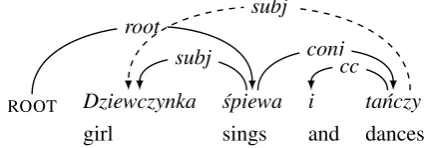
The PDBUD graphs contain the enhanced edges encoding the dependents shared by the con-juncts in coordinate structures (see Figure3) and the shared governors of the coordinated elements (see Figure4).
ROOT Dziewczynka ´spiewa i ta´nczy
girl sings and dances
root
subj conjcc
subj
Figure 3: The PDBUD graph of the sentence Dziewczynka ´spiewa i ta´nczy(‘A girl sings and dances’) with the shared subject. The enhanced edge is marked with the dashed arrow.
ROOT Dziewczynki i chłopcy ´spiewaj ˛a
girl and boy sing
conj cc root
subj
[image:6.595.76.291.349.423.2]subj
Figure 4: The PDBUD graph ofDziewczynki i chłopcy ´spiewaj ˛a(‘Girls and boys are singing’) with the shared governor of the coordinated subject. The enhanced edge is marked with the dashed arrow.
In the PDB trees, all coordinated elements de-pend on a conjunction and the relations between
14One of the reviewers of the paper suggests to use the
la-belsubj. It would be an ideal solution. However, the function subjdoes not belong to the repertoire of the UD functions.
the conjunction and these elements are labelled with a technical dependency type – conjunct. A dependent shared by all conjuncts also depends on the conjunction, but this relation is labelled with the grammatical function of the shared de-pendent, e.g.subj,obj. The conversion of the PDB trees into the enhanced PDBUD graphs is thus a straightforward process. There are only en-hanced edges involved in the coordination con-structions in PDBUD, but they are numerous, i.e. more than 41% of all PDBUD trees contain at least one enhanced edge (see Table1).
5 Semantic labels
The UD format is extended by adding some se-mantic labels in the 11th column. There are 28 semantic labels corresponding to some selected frame elementsof FrameNet (Fillmore and Baker,
2009; Ruppenhofer et al., 2010). In addition to the common semantic roles: THEME, RECIPI
-ENT/BENEFICIARY, RESULT, there are roles re-lated to
• place: SOURCE, GOAL, PLACE, PATH,
• time: TIME, DURATION, STARTING_POINT, END_POINT, FREQUENCY/ITERATION,
• some other roles: ATTITUDE,
CAUSE/EXPLANATION/REASON, CIR -CUMSTANCES/OTHER, CONCESSIVE, CONDITION, CO-PARTICIPANT, DEGREE, EVENT_DESCRIPTION, INSTRUMENT,
MANNER, PURPOSE, REPLACEE, ROLE, STIMULUS, SUPERSET, and TITLE.
The additional semantic labels extend the se-mantic meaning of indirect objects (iobj), oblique nominals (obl)15, adverbial clause modifiers ( ad-vcl), some adverbial modifiers (advmod), some noun modifiers (nmod), etc.
6 Evaluation
6.1 Dependency parsing systems
Various contemporary dependency parsing sys-tems are tested in our evaluation experiments. All of the tested systems allow dependency parsing, but only some of them allow part-of-speech tag-ging, morphological analysis and lemmatisation. We test transition-based parsers (i.e. MaltParser, UDPipe, and the transition-based version of BIST
system architecture classifier parsing tagging lemmatisation
MaltParser(Nivre et al.,2006) trans LR yes no no
MATE parser(Bohnet,2010) graph perceptron yes no no
BIST parser(Kiperwasser and Goldberg,2016) trans/graph biLSTM yes no no
Stanford parser(Dozat et al.,2017) graph biLSTM yes yes no
UDPipe(Straka and Straková,2017) trans 1-layer NN yes yes yes
Table 2: Properties of the dependency parsing systems tested in our experiments. Explanation: trans – a transition-based parser, graph – a graph-transition-based parser, LR – a linear classifier transition-based on logistic regression, 1-layer NN – a non-linear classifier based on 1-layer neural network, biLSTM – Bidirectional Long-Short Term Memory network.
parser) as well as graph-based parsers (i.e. MATE parser, Stanford parser, and the graph-based ver-sion of BIST parser). The properties of the tested dependency parsing systems are summarised in Table2.
6.2 Data split
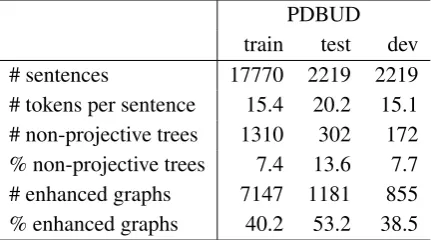
PDBUD is divided into three parts – training, test and development data sets. The procedure of assigning dependency trees to particular data sets is generally random, but there is one con-straint on the dividing procedure – the Składnica trees, and thus also the PL-SZ trees, are not in-cluded in the test set.16 Since sentences underly-ing theSkładnicatrees are generally shorter than the remaining sentences, the average number of to-kens per sentence is significantly higher in the test set than in two other sets. The statistics of the par-ticular data sets is given in Table3.
PDBUD train test dev
# sentences 17770 2219 2219
# tokens per sentence 15.4 20.2 15.1 # non-projective trees 1310 302 172 % non-projective trees 7.4 13.6 7.7
# enhanced graphs 7147 1181 855
[image:7.595.74.290.513.633.2]% enhanced graphs 40.2 53.2 38.5
Table 3: Statistics of the training (train), test (test), and development (dev) data sets of PDBUD.
16
PDBUD is used in the shared task on dependency parsing of Polish – PolEval 2018 (http://poleval.pl). The or-ganisers of this shared task decided not to use the PL-SZ trees, which have been publicly available for some time, for validation of the participating systems. Therefore, the PL-SZ trees are not part of the PDBUD test set.
6.3 Evaluation methodology
We apply the evaluation measures defined for the purpose of CoNLL 2018 shared task on Multi-lingual Parsing from Raw Text to Universal De-pendencies.17 The proposed metrics, i.e. LAS, UAS, CLAS, MLAS, BLEX, evaluate the differ-ent prediction aspects.
Two evaluation scenarios are proposed: 1) test-ing the quality of dependency parstest-ing of Polish, and 2) testing the quality of morphosyntactic pre-diction of dependency trees, i.e. part-of-speech tagging, lemmatisation, and dependency parsing of Polish. For the purpose of our evaluation, we use the script18of CoNLL 2018 shared task.
6.4 Results
6.4.1 Evaluation of dependency parsing
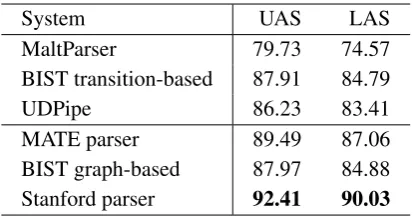
Stanford parser is the best performing parser on Polish data (see Table4). The second best parser – MATE parser – performs surprisingly well. Even if it doesn’t have any neural component, it outper-forms not only the graph-based neural parser BIST (87.06 LAS vs. 84.88 LAS), but also all transition-based parsers. It is also worth mentioning that the worst graph-based parser – BIST parser – performs slightly better than its transition-based version, which achieves LAS of 84.79% and is the best of all transition-based parsers. It follows that the graph-based parsers are generally better suited for parsing Polish than the transition-based parsers.
17http://universaldependencies.org/
conll18/evaluation.html
18http://universaldependencies.org/
conll18/conll18_ud_eval.py
System UAS LAS
MaltParser 79.73 74.57
BIST transition-based 87.91 84.79
UDPipe 86.23 83.41
MATE parser 89.49 87.06
BIST graph-based 87.97 84.88
Stanford parser 92.41 90.03
Table 4: Parsers are tested on the sentences with the gold-standard tokens, lemmas, and part-of-speech tags.
6.4.2 Evaluation of morphosyntactic prediction of dependency trees
Two systems – Stanford system and UDPipe – are tested in the task of morphosyntactic prediction of dependency trees. These systems predict universal part-of-speech tags (UPOS) as well as language-specific tags (XPOS). Stanford system outper-forms UDPipe in part-of-speech tagging (see Ta-ble5). Only UDPipe predicts morphological fea-tures (UFEATS) and lemmas (LEMMA).
System UPOS XPOS UFEATS LEMMA
Stanford 97.87 92.45 n/a n/a
UDPipe 96.81 86.05 88.02 95.61
Table 5: The quality (F1 scores) of predicting uni-versal part-of-speech tags (UPOS), Polish-specific tags (XPOS), morphological features (UFEATS), and lem-mas (LEMMA).
Stanford parser significantly outperforms UD-Pipe in predicting labelled dependency trees (LAS) and in predicting governors and depen-dency relation types of content words (CLAS), see Table 6. Since Stanford system doesn’t pre-dict morphological features and lemmas, we can-not compare MLAS and BLEX scores.
6.4.3 Summary
We carried out two evaluation experiments on PDBUD data. The results of these experi-ments show that the graph-based parsers, even the parsers without any neural component, are bet-ter suited for parsing Polish than the transition-based parsing systems. The best results in pars-ing Polish data without precedpars-ing morphosyntac-tic analysis are achieved with Stanford parser, i.e. 88.04 LAS. These results are slightly lower than those reported in Dozat et al. (2017), i.e.
System UAS LAS CLAS MLAS BLEX
[image:8.595.78.285.61.170.2]Stanford 91.33 88.04 85.48 n/a n/a UDPipe 83.32 78.93 75.22 64.33 71.17
Table 6: The quality (F1 scores) of predicting unla-belled dependency trees (UAS), launla-belled dependency trees (LAS), governors and dependency relation types of content words (CLAS), governors, dependency re-lation types, universal part-of-speech tags and mor-phological features of content words (MLAS), gover-nors, dependency relation types and lemmas of content words (BLEX).
90.32 LAS. The possible reason for this is that our test data contains the dependency trees of the longer sentences and thus there is more room for making mistakes. If Stanford parser operates on the PDBUD sentences with the gold-standard part-of-speech tags, it performs better, i.e. 90.03 LAS.
7 Conclusions and future work
We presented PDBUD – the largest Polish de-pendency bank with 22K dede-pendency trees in Universal Dependencies format. PDBUD con-tains the corrected trees of the Polish UD tree-bank (PL-SZ) and 14K dependency trees automat-ically converted from Polish Dependency Bank. The PDBUD trees are expanded with the en-hanced edges encoding the shared dependents and the shared governors of the coordinated conjuncts and with the semantic roles of some dependents. Our evaluation experiments showed that PDBUD is large enough for training a high-quality graph-based dependency parser for Polish.
We did our best to maintain consistency with the UD guidelines while building PDBUD. How-ever, some of our annotation decisions could be ar-guable and should be discussed again in the con-text of the universality assumptions of Universal Dependencies.
There is plenty of elliptical constructions in Pol-ish. Some of them are labelled with the function orphanin PDBUD. In our future works, we plan to add empty nodes representing the elided elements to the PDBUD trees. Furthermore, we are going to create a Polish version of Parallel Universal De-pendency treebank.
multi-word expressions (LAW-MWE-CxG-2018)19 and are currently used in the shared task on depen-dency parsing of Polish (PolEval 2018).20 This is a confirmation of the fact that PDBUD is of very high quality. Therefore, in the future we would like to replace the Polish UD treebank PL-SZ with its corrected, extended and enhanced version – PDBUD.
Acknowledgments
We would like to thank the anonymous review-ers for their valuable comments that we will un-doubtedly take into consideration before publish-ing the final version of our data set.
The research presented in this paper was founded by SONATA 8 grant no 2014/15/D/HS2/03486 from the National Science Centre Poland and by the Polish Ministry of Science and Higher Educa-tion as part of the investment in the CLARIN-PL research infrastructure.
References
Bernd Bohnet. 2010. Very High Accuracy and Fast De-pendency Parsing is not a Contradiction. In Pro-ceedings of the 23rd International Conference on Computational Linguistics, COLING 2010, pages 89–97.
Anna Bondaruk. 1998. Comparison in English and Polish Adjectives: A Syntactic Study, volume 6 of PASE Studies and Monographs. Folium, Lublin.
Timothy Dozat, Peng Qi, and Christopher D. Manning. 2017. Stanford’s Graph-based Neural Dependency Parser at the CoNLL 2017 Shared Task. In Proceed-ings of the CoNLL 2017 Shared Task: Multilingual Parsing from Raw Text to Universal Dependencies, pages 20–30. Association for Computational Lin-guistics.
Charles J. Fillmore and Collin Baker. 2009. A Frames Approach to Semantic Analysis. In Bernd Heine and Heiko Narrog, editors,The Oxford Handbook of Lin-guistic Analysis, pages 313–340. Oxford University Press.
Yong Jiang, Wenjuan Han, and Kewei Tu. 2016. Un-supervised neural dependency parsing. In Proceed-ings of the 2016 Conference on Empirical Methods in Natural Language Processing, pages 763–771, Austin, Texas. Association for Computational Lin-guistics.
19http://multiword.sourceforge.net/
PHITE.php?sitesig=CONF&page=CONF_04_ LAW-MWE-CxG_2018___lb__COLING__rb__& subpage=CONF_40_Shared_Task
20http://poleval.pl
Eliyahu Kiperwasser and Yoav Goldberg. 2016. Sim-ple and Accurate Dependency Parsing Using Bidi-rectional LSTM Feature Representations. Transac-tions of the Association for Computational Linguis-tics, 4:313–327.
Philipp Koehn. 2005. Europarl: A Parallel Corpus for Statistical Machine Translation. In Proceedings of the 10th Machine Translation Summit Conference, pages 79–86.
Joakim Nivre, Johan Hall, and Jens Nilsson. 2006. MaltParser: A Data-Driven Parser-Generator for De-pendency Parsing. In Proceedings of the Fifth In-ternational Conference on Language Resources and Evaluation, LREC’06, pages 2216–2219.
Joakim Nivre, Marie-Catherine de Marneffe, Filip Ginter, Yoav Goldberg, Jan Hajiˇc, Christopher D. Manning, Ryan T. McDonald, Slav Petrov, Sampo Pyysalo, Natalia Silveira, Reut Tsarfaty, and Daniel Zeman. 2016. Universal Dependencies v1: A Mul-tilingual Treebank Collection. In Proceedings of the Tenth International Conference on Language Re-sources and Evaluation LREC 2016, pages 1659– 1666.
Piotr P˛ezik, Maciej Ogrodniczuk, and Adam Przepiórkowski. 2011. Parallel and spoken corpora in an open repository of Polish language resources. In Proceedings of the 5th Language & Technology Conference: Human Language Technologies as a Challenge for Computer Science and Linguistics, pages 511–515.
Adam Przepiórkowski, Mirosław Ba´nko, Rafał L. Górski, and Barbara Lewandowska-Tomaszczyk, editors. 2012. Narodowy Korpus J˛ezyka Polskiego. Wydawnictwo Naukowe PWN, Warsaw.
Josef Ruppenhofer, Michael Ellsworth, Miriam R. L. Petruck, Christopher R. Johnson, and Jan Schef-fczyk. 2010. FrameNet II: Extended Theory and Practice. International Computer Science Institute, Berkeley, California.
Ralf Steinberger, Andreas Eisele, Szymon Klocek, Spyridon Pilos, and Patrick Schlüter. 2012. DGT-TM: A freely Available Translation Memory in 22 Languages. InProceedings of the 8th International Conference on Language Resources and Evaluation, pages 454–459.
Milan Straka and Jana Straková. 2017. Tokenizing, POS Tagging, Lemmatizing and Parsing UD 2.0 with UDPipe. InProceedings of the CoNLL 2017 Shared Task: Multilingual Parsing from Raw Text to Universal Dependencies, pages 88–99, Vancouver, Canada. Association for Computational Linguistics.
Marcin Woli´nski, Katarzyna Głowi´nska, and Marek ´Swidzi´nski. 2011. A preliminary version of Skład-nica treebank of Polish. InProceedings of the 5th Language & Technology Conference: Human Lan-guage Technologies as a Challenge for Computer Science and Linguistics, pages 299–303, Pozna´n, Poland.
Alina Wróblewska. 2012. Polish Dependency Bank. Linguistic Issues in Language Technology, 7(1):1– 15.
Alina Wróblewska. 2014. Polish Dependency Parser Trained on an Automatically Induced Dependency Bank. Ph.D. dissertation, Institute of Computer Sci-ence, Polish Academy of Sciences, Warsaw. Alina Wróblewska and Katarzyna Krasnowska-Kiera´s.
2017. Polish evaluation dataset for compositional distributional semantics models. InProceedings of the 55th Annual Meeting of the Association for Com-putational Linguistics (Volume 1: Long Papers), pages 784–792, Vancouver, Canada. Association for Computational Linguistics.
Alina Wróblewska and Aleksandra Wieczorek. 2018. Status składniowy jako we współczesnej pol-szczy´znie. J˛ezyk Polski, to appear.
Daniel Zeman, Ondˇrej Dušek, David Mareˇcek, Mar-tin Popel, Loganathan Ramasamy, Jan Štˇepánek, Zdenˇek Žabokrtský, and Jan Hajiˇc. 2014. Ham-leDT: Harmonized Multi-Language Dependency Treebank. Language Resources and Evaluation, 48(4):601–637.
![Figure 1: The PDBUD tree of [...] znali ceny potrawlepiej ni˙z kelnerzy (‘they know the prices of dishes bet-ter than the waiters’) with the comparative construc-tion.](https://thumb-us.123doks.com/thumbv2/123dok_us/1349623.667047/3.595.318.519.218.279/figure-pdbud-potrawlepiej-kelnerzy-dishes-waiters-comparative-construc.webp)