A Novel Discriminative Framework for Sentence-Level Discourse Analysis
Shafiq Joty and Giuseppe Carenini and Raymond T. Ng {rjoty, carenini, rng}@cs.ubc.ca
Department of Computer Science University of British Columbia Vancouver, BC, V6T 1Z4, Canada
Abstract
We propose a complete probabilistic discrim-inative framework for performing sentence-level discourse analysis. Our framework com-prises a discourse segmenter, based on a bi-nary classifier, and a discourse parser, which applies an optimal CKY-like parsing algo-rithm to probabilities inferred from a Dynamic Conditional Random Field. We show on two corpora that our approach outperforms the state-of-the-art, often by a wide margin.
1 Introduction
Automatic discourse analysis has been shown to be critical in several fundamental Natural Lan-guage Processing (NLP) tasks including text gener-ation (Prasad et al., 2005), summarizgener-ation (Marcu, 2000b), sentence compression (Sporleder and Lap-ata, 2005) and question answering (Verberne et al., 2007). Rhetorical Structure Theory (RST) (Mann and Thompson, 1988), one of the most influential theories of discourse, posits a tree representation of a discourse, known as a Discourse Tree (DT), as exemplified by the sample DT shown in Figure 1. The leaves of a DT correspond to contiguous atomic text spans, also called Elementary Discourse Units (EDUs) (three in the example). The adjacent EDUs are connected by a rhetorical relation (e.g., ELAB-ORATION), and the resulting larger text spans are recursively also subject to this relation linking. A span linked by a rhetorical relation can be either a NUCLEUS or a SATELLITE depending on how central the message is to the author. Discourse anal-ysis in RST involves two subtasks: (i) breaking the
[image:1.612.320.542.292.332.2]text into EDUs (known as discourse segmentation) and (ii) linking the EDUs into a labeled hierarchical tree structure (known as discourse parsing).
Figure 1: Discourse structure of a sentence in RST-DT.
Previous studies on discourse analysis have been quite successful in identifying what machine learn-ing approaches and what features are more useful for automatic discourse segmentation and parsing (Sori-cut and Marcu, 2003; Subba and Eugenio, 2009; du-Verle and Prendinger, 2009). However, all the pro-posed solutions suffer from at least one of the fol-lowing two key limitations: first, they make strong independence assumptions on the structure and the labels of the resulting DT, and typically model the construction of the DT and the labeling of the rela-tions separately; second, they apply a greedy, sub-optimal algorithm to build the structure of the DT.
In this paper, we propose a new sentence-level discourse parser that addresses both limitations. The crucial component is a probabilistic discriminative parsing model, expressed as a Dynamic Conditional Random Field (DCRF) (Sutton et al., 2007). By representing the structure and the relation of each discourse tree constituent jointly and by explicitly capturing the sequential and hierarchical dependen-cies between constituents of a discourse tree, our DCRF model does not make any independence as-sumption among these properties. Furthermore, our
parsing model supports a bottom-up parsing algo-rithm which is non-greedy and provably optimal.
The discourse parser assumes that the input text has been already segmented into EDUs. As an addi-tional contribution of this paper, we propose a novel discriminative approach to discourse segmentation that not only achieves state-of-the-art performance, but also reduces the time and space complexities by using fewer features. Notice that the combination of our segmenter with our parser forms a complete probabilistic discriminative framework for perform-ing sentence-level discourse analysis.
Our framework was tested in a series of experi-ments. The empirical evaluation indicates that our approach to discourse parsing outperforms the state-of-the-art by a wide margin. Moreover, we show this to be the case on two very different genres: news ar-ticles and instructional how-to-do manuals.
In the rest of the paper, after discussing related work, we present our discourse parser. Then, we describe our segmenter. The experiments and the corpora we used are described next, followed by a discussion of the key results and some error analysis.
2 Related work
Automatic discourse analysis has a long history; see (Stede, 2011) for a detailed overview. Sori-cut and Marcu (2003) present the publicly available SPADE1system that comes with probabilistic mod-els for sentence-level discourse segmentation and parsing based on lexical and syntactic features de-rived from the lexicalized syntactic tree of a sen-tence. Their parsing algorithm finds the most proba-ble DT for a sentence, where the probabilities of the constituents are estimated by their parsing model. A constituent (e.g., ATTRIBUTION-NS[(1,2),3] in Figure 1) in a DT has two components, first, the la-bel denoting the relation and second, the structure indicating which spans are being linked by the rela-tion. The nuclearity statuses of the spans are built into the relation labels (e.g., NS[(1,2),3] means that span (1,2) is the NUCLEUS and it comes before span 3 which is the SATELLITE). SPADE is limited in several ways. It makes an independence assump-tion between the label and the structure while mod-eling a constituent, and it ignores the sequential and
1
http://www.isi.edu/licensed-sw/spade/
hierarchical dependencies between the constituents in the parsing model. Furthermore, SPADE relies only on lexico-syntactic features, and it follows a generative approach to estimate the model param-eters for the segmentation and the parsing models. SPADE was trained and tested on the RST-DT cor-pus (Carlson et al., 2002), which contains human-annotated discourse trees for news articles.
Subsequent research addresses the question of how much syntax one really needs in discourse analysis. Sporleder and Lapata (2005) focus on discourse chunking, comprising the two subtasks of segmentation and non-hierarchical nuclearity as-signment. More specifically, they examine whether features derived via part of speech (POS) and chunk taggers would be sufficient for these purposes. Their results on RST-DT turn out to be comparable to SPADE without using any features from the syntac-tic tree. Later, Fisher and Roark (2007) demonstrate over 4% absolute “performance gain” in segmenta-tion, by combining the features extracted from the syntactic tree with the ones derived via taggers. Us-ing quite a large number of features in a binary log-linear model they achieve the state-of-the-art seg-mentation performance on the RST-DT test set.
On the different genre of instructional manuals, Subba and Eugenio (2009) propose a shift-reduce parser that relies on a classifier to find the appro-priate relation between two text segments. Their classifier is based on Inductive Logic Programming (ILP), which learns first-order logic rules from a large set of features including the linguistically rich compositional semantics coming from a semantic parser. They show that the compositional seman-tics improves the classification performance. How-ever, their discourse parser implements a greedy ap-proach (hence not optimal) and their classifier disre-gards the sequence and hierarchical dependencies.
se-lected spans with the appropriate relation. They use a very large set of features in their parser. How-ever, taking a radically-greedy approach, they model structure and relations separately, and ignore the se-quence dependencies in their models.
Recently, there has been an explosion of interest in Conditional Random Fields (CRFs) (Lafferty et al., 2001) for solving structured output classification problems, with many successful applications in NLP including syntactic parsing (Finkel et al., 2008), syn-tactic chunking (Sha and Pereira, 2003) and dis-course chunking (Ghosh et al., 2011) in Penn Dis-course Treebank (Prasad et al., 2008). CRFs being a discriminative approach to sequence modeling (i.e., directly models the conditionalp(y|x,Θ)), have sev-eral advantages over its generative counterparts such as Hidden Markov Models (HMMs) and Markov Random Fields (MRFs), which first model the joint p(y,x|Θ), then infer the conditionalp(y|x,Θ)). Key advantages include the ability to incorporate arbi-trary overlapping local and global features, and the ability to relax strong independence assumptions. It has been advocated that CRFs are generally more accurate since they do not “waste effort” modeling complex distributions (i.e., p(x)) that are not rele-vant for the target task (Murphy, 2012).
3 The Discourse Parser
Assuming that a sentence is already segmented into a sequence of EDUse1, e2, . . . enmanually or by an automatic segmenter (see Section 4), the discourse parsing problem is to decide which spans to con-nect (i.e., structure of the DT) and which relations (i.e., labels of the internal nodes) to use in the pro-cess of building the hierarchical DT. To build the DTs effectively, a common assumption is that they are binary trees (Soricut and Marcu, 2003; duVerle and Prendinger, 2009). That is, multi-nuclear re-lations (e.g., LIST, JOINT, SEQUENCE) involving more than two EDUs are mapped to a hierarchi-cal right-branching binary tree. For example, a flat LIST(e1, e2, e3, e4)is mapped to a right-branching
binary treeLIST(e1, LIST(e2, LIST(e3, e4))).
Our discourse parser has two components. The first component, the parsing model, assigns a proba-bility to every possible DT. The second component, the parsing algorithm, finds the most probable DT
among the candidate discourse trees.
3.1 Parsing Model
A DT can be represented as a set of constituents of the form R[i, m, j], which denotes a rhetorical relation R that holds between the span containing EDUsithroughm, and the span containing EDUs m+1 throughj. For example, the DT in Figure 1 can be written as {ELABORATION-NS[1,1,2], ATTRIBUTION-NS[1,2,3]}. Notice that a rela-tion R also indicates the nuclearity assignments of the spans being connected, which can be one of NUCLEUS-SATELLITE (NS), SATELLITE-NUCLEUS (SN) and SATELLITE-NUCLEUS-SATELLITE-NUCLEUS (NN). Given the model parameters Θ and a candi-date DT T, for all the constituents c in T, our parsing model estimates the conditional probabil-ity P(c|C,Θ), which specifies the joint probabil-ity of the relation R and the structure [i, m, j]
associated with the constituent c, given that c has a set of sub-constituents C. For instance,
for the DT shown in Figure 1, our model
would estimate P(R′[1,1,2]|Θ), P(R′[2,2,3]|Θ), P(R′[1,2,3]|R′′[1,1,2],Θ) etc. for allR′ andR′′
ranging on the set of relations. In what follows we describe our probabilistic parsing model to compute all these conditional probabilities P(c|C,Θ). We will demonstrate how our approach not only models the structure and the relation jointly, but it also cap-tures linear sequence dependencies and hierarchical dependencies between constituents of a DT.
Figure 2: A Dynamic CRF as a discourse parsing model.
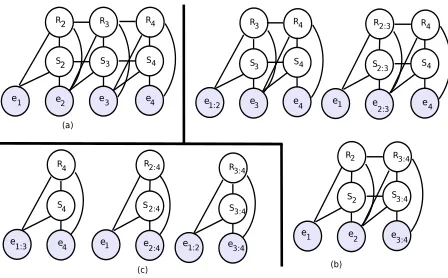
We can obtain the conditional probabilities of the constituents (i.e., P(c|C,Θ)) of all candidate DTs for a sentence by applying the DCRF pars-ing model recursively at different levels, and by computing the posterior marginals of the relation-structure pairs. To illustrate, consider the example sentence in Figure 1 where we have three EDUs e1, e2 and e3. The DCRF model for the first
level is shown in Figure 3(a), where the (observed) EDUs are the spans in the span sequence. Given this model, we obtain the probabilities of the con-stituentsR[1,1,2] andR[2,2,3]by computing the posterior marginals P(R2, S2=1|e1, e2, e3,Θ) and
P(R3, S3=1|e1, e2, e3,Θ), respectively. At the
sec-ond level (see Figure 3(b)), there are two possi-ble span sequences(e1:2, e3) and (e1, e2:3). In the
first sequence, EDUs e1 and e2 are linked into
a larger span, and in the second one, EDUs e2
and e3 are connected into a larger span. We
ap-ply our DCRF model to the two possible span se-quences and obtain the probabilities of the con-stituents R[1,2,3] and R[1,1,3] by computing the posterior marginalsP(R3, S3=1|e1:2, e3,Θ)and
P(R2:3, S2:3=1|e1, e2:3,Θ), respectively.
Figure 3: DCRF model applied to the sequences at differ-ent levels in the example in Fig. 1. (a) A sequence at the first level (b) Two possible sequences at the second level.
To further clarify the process, let us as-sume that the sentence contains four EDUs e1, e2, e3 and e4. At the first level
(Fig-ure 4(a)), there is only one possible span
se-quence to which we apply our DCRF model. We obtain the probabilities of the constituents R[1,1,2],R[2,2,3]andR[3,3,4]by computing the posterior marginals P(R2, S2=1|e1, e2, e3, e4,Θ),
P(R3, S3=1|e1, e2, e3, e4,Θ) and P(R4, S4=1|e1,
e2, e3, e4,Θ), respectively. At the second level
(Figure 4(b)), there are three possible sequences
(e1:2, e3, e4), (e1, e2:3, e4) and(e1, e2, e3:4). When
the DCRF model is applied to the sequence
(e1:2, e3, e4), we obtain the probabilities of the
constituent R[1,2,3] by computing the posterior marginalP(R3, S3=1|e1:2, e3, e4,Θ). Likewise, the
posterior marginals P(R2:3, S2:3=1|e1, e2:3, e4,Θ)
andP(R4, S4=1|e1, e2:3, e4,Θ)in the DCRF model
applied to the sequence (e1, e2:3, e4) represents
the probabilities of the constituents R[1,1,3]
and R[2,3,4], respectively. Similarly, we at-tain the probabilities of the constituent R[2,2,4]
from the DCRF model applied to the sequence
(e1, e2, e3:4) by computing the posterior marginal
P(R3:4, S3:4=1|e1, e2, e3:4,Θ). At the third level
(Figure 4(c)), there are three possible sequences
(e1:3, e4),(e1, e2:4)and(e1:2, e3:4), to which we
[image:4.612.314.538.419.558.2]ap-ply our model and acquire the probabilities of the constituents R[1,3,4], R[1,1,4] and R[1,2,4] by computing their respective posterior marginals.
Figure 4: DCRF model applied to the sequences at differ-ent levels of a discourse tree. (a) A sequence at the first level, (b) Three possible sequences at the second level, (c) Two possible sequences at the third level.
Our DCRF model is designed using MALLET (McCallum, 2002). In order to avoid overfitting we regularize the DCRF model with l2 regularization
[image:4.612.83.289.525.595.2]we perform approximate inference (to compute the posterior marginals) using tree-based reparameteri-zation (Wainwright et al., 2002).
3.1.1 Features Used in the Parsing Model
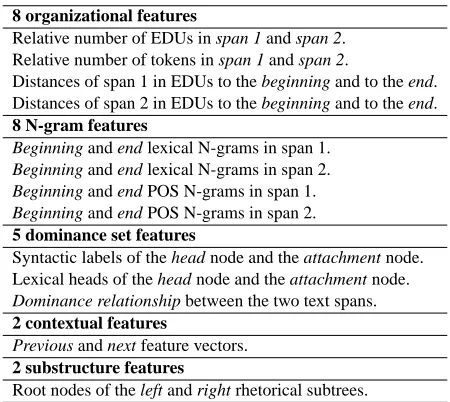
Crucial to parsing performance is the set of fea-tures used, as summarized in Table 1. Note that these features are defined on two consecutive spans Wj−1 andWj of a span sequence. Most of the fea-tures have been explored in previous studies. How-ever, we improve some of these as explained below. Organizational features encode useful informa-tion about the surface structure of a sentence as shown by (duVerle and Prendinger, 2009). We mea-sure the length of the spans in terms of the number of EDUs and tokens in it. However, in order to better adjust to the length variations, rather than comput-ing their absolute numbers in a span, we choose to measure their relative numbers with respect to their total numbers in the sentence. For example, in a sen-tence containing three EDUs, a span containing two of these EDUs will have a relative EDU number of
0.67. We also measure the distances of the spans from the beginning and to the end of the sentence in terms of the number of EDUs.
8 organizational features
Relative number of EDUs in span 1 and span 2. Relative number of tokens in span 1 and span 2.
Distances of span 1 in EDUs to the beginning and to the end. Distances of span 2 in EDUs to the beginning and to the end.
8 N-gram features
Beginning and end lexical N-grams in span 1. Beginning and end lexical N-grams in span 2. Beginning and end POS N-grams in span 1. Beginning and end POS N-grams in span 2.
5 dominance set features
Syntactic labels of the head node and the attachment node. Lexical heads of the head node and the attachment node. Dominance relationship between the two text spans.
2 contextual features
Previous and next feature vectors.
2 substructure features
[image:5.612.316.546.258.427.2]Root nodes of the left and right rhetorical subtrees.
Table 1: Features used in the DCRF parsing model.
Discourse connectives (e.g., because, but), when present, signal rhetorical relations between two text segments (Knott and Dale, 1994; Marcu, 2000a). However, previous studies (e.g., Hernault et al. (2010), Biran and Rambow (2011)) suggest that an
empirically acquired lexical N-gram dictionary is more effective than a fixed list of connectives, since this approach is domain independent and capable of capturing non-lexical cues such as punctuations. To build the lexical N-gram dictionary empirically from the training corpus we consider the first and last N tokens (N∈{1,2}) of each span and rank them according to their mutual information2 with the two labels, Structure and Relation. Intuitively, the most informative cues are not only the most fre-quent, but also the ones that are indicative of the la-bels in the training data (Blitzer, 2008). In addition to the lexical N-grams we also encode POS tags of the first and lastN tokens (N∈{1,2}) as features.
Figure 5: A discourse segmented lexicalized syntactic tree. Boxed nodes form the dominance setD.
Dominance set extracted from the Discourse Seg-mented Lexicalized Syntactic Tree (DS-LST) (Sori-cut and Marcu, 2003) has been shown to be a very effective feature in SPADE. Figure 5 shows the DS-LST for our running example (see Figure 1 and 3). In a DS-LST, each EDU except the one with the root node must have a head nodeNH that is attached to an attachment nodeNAresiding in a separate EDU. A dominance setD(shown at the bottom of Figure 5 for our example) contains these attachment points of the EDUs in a DS-LST. In addition to the syntactic and lexical information of the head and attachment nodes, each element in D also represents a domi-nance relationship between the EDUs involved. The EDU withNAdominates the EDU withNH. In
or-2
[image:5.612.74.299.404.605.2]der to extract dominance set features for two consec-utive spansei:jandej+1:k, we first computeDfrom the DS-LST of the sentence. We then extract the element from Dthat holds across the EDUs j and j+ 1. In our running example, for the spanse1 and
e2(Figure 3(a)), the relevant dominance set element
is (1, efforts/NP)>(2, to/S). We encode the syntac-tic labels and lexical heads of NH andNAand the dominance relationship (i.e., which of the two spans is dominating) as features in our model.
We also incorporate more contextual information by including the above features computed for the neighboring span pairs in the current feature vector. We incorporate hierarchical dependencies be-tween constituents in a DT by means of the sub-structure features. For the two adjacent spansei:j and ej+1:k, we extract the roots of the rhetorical subtrees spanning overei:j (left) andej+1:k(right). In our example (see Figure 1 and Figure 3 (b)), the root of the rhetorical subtree spanning overe1:2
is ELABORATION-NS. However, this assumes the presence of a labeled DT which is not the case when we apply the parser to a new sentence. This problem can be easily solved by looping twice through build-ing the model and the parsbuild-ing algorithm (described below). We first build the model without considering the substructure features. Then we find the optimal DT employing our parsing algorithm. This interme-diate DT will now provide labels for the substruc-tures. Next we can build a new, more accurate model by including the substructure features, and run again the parsing algorithm to find the final optimal DT.
3.2 Parsing Algorithm
Our parsing model above assigns a conditional prob-ability to every possible DT constituent for a sen-tence, the job of the parsing algorithm is to find the most probable DT. Formally, this can be written as,
DT∗ =argmax
DTP(DT|Θ)
Our discourse parser implements a probabilistic CKY-like bottom-up algorithm for computing the most likely parse of a sentence using dynamic pro-gramming; see (Jurafsky and Martin, 2008) for a description. Specifically, with n number of EDUs in a sentence, we use the upper-triangular por-tion of the n × n Dynamic Programming Table (DPT). The cell [i, j] in the DPT represents the span containing EDUs i through j and stores the
probability of a constituentR[i, m, j], where m =
argmaxi≤k≤jP(R[i, k, j]).
In contrast to HILDA which implements a greedy algorithm, our approach finds a DT that is glob-ally optimal. Our approach is also different from SPADE’s implementation. SPADE first finds the tree structure that is globally optimal, then it assigns the most probable relations to the internal nodes. More specifically, the cell [i, j] in SPADE’s DPT stores the probability of a constituent R[i, m, j], wherem = argmaxi≤k≤jP([i, k, j]). Disregard-ing the relation labelRwhile building the DPT, this approach may find a tree that is not globally optimal.
4 The Discourse Segmenter
Our discourse parser above assumes that the input sentences have been already segmented into EDUs. Since it has been shown that discourse segmentation is a primary source of inaccuracy for discourse pars-ing (Soricut and Marcu, 2003), we have developed our own segmenter, that not only achieves state-of-the-art performance as shown later, but also reduces the time complexity by using fewer features.
Our segmenter implements a binary classifier to decide for each word (except the last word) in a sen-tence, whether to put an EDU boundary after that word. We use a Logistic Regression (LR) (i.e., dis-criminative) model withl2 regularization and learn
the model parameters using the L-BFGS algorithm, which gives quadratic convergence rate. To avoid overfitting, we use 5-fold cross validation to learn the regularization strength parameter from the train-ing data. We also use a simple baggtrain-ing technique (Breiman, 1996) to deal with the sparsity of bound-ary tags. Note that, our first attempt at this task im-plemented a linear-chain CRF model to capture the sequence dependencies between the tags in a dis-criminative way. However, the binary LR classifier, using the same features, not only outperforms the CRF model, but also reduces the space complexity.
4.1 Features Used in the Segmentation Model
Our set of features for discourse segmentation are mostly inspired from previous studies but used in a novel way as we describe below.
ex-tracted from the lexicalized syntactic tree for the given sentence. These features replicates the fea-tures used in SPADE, but used in a discriminative way. To decide on an EDU boundary after a token wk, we find the lowest constituent in the lexicalized syntactic tree that spans over tokenswi. . . wj such thati≤k<j. The production that expands this con-stituent in the tree and its different variations, form the feature set. For example in Figure 5, the produc-tion NP(efforts)→PRP$(its)NNS(efforts)↑S(to) and its different variations depending on whether they include the lexical heads and how many non-terminals (up to two) to consider before and after the potential EDU boundary (↑), are used to de-termine the existence of a boundary after the word efforts (see (Fisher and Roark, 2007) for details). SPADE uses these features in a generative way, meaning that, it inserts an EDU boundary if the rela-tive frequency (i.e., Maximum Likelihood Estimate (MLE)) of a potential boundary given the production in the training corpus is greater than0.5. If the pro-duction has not been observed frequently enough, it uses its other variations to perform further smooth-ing. In contrast, we compute the MLE estimates for a production and its other variations, and use those as features with/without binarizing the values.
Shallow syntactic parse (or Chunk) and POS tags have been shown to possess valuable cues for dis-course segmentation (Fisher and Roark, 2007). For example, it is less likely that an EDU boundary oc-curs within a chunk. We, therefore, annotate the to-kens of a sentence with chunk and POS tags by a state-of-the-art tagger3and encode these as features. EDUs are normally multi-word strings. Thus, a token near the beginning or end of a sentence is un-likely to be the end of a segment. Therefore, for each token we include its relative position in the sentence and distances to the beginning and end as features.
It is unlikely that two consecutive tokens are tagged with EDU boundaries. We incorporate con-textual information for a token by including the above features computed for its neighboring tokens. We also experimented with different N-gram (N∈{1,2,3}) features extracted from the token se-quence, POS sequence and chunk sequence. How-ever, since such features did not improve the
seg-3
http://cogcomp.cs.illinois.edu/page/software
mentation accuracy on the development set, they were excluded from our final set of features.
5 Experiments
5.1 Corpora
To demonstrate the generality of our model, we ex-periment with two different genres. First, we use the standard RST-DT corpus (Carlson et al., 2002) that contains discourse annotations for 385Wall Street Journal news articles from the Penn Treebank (Mar-cus et al., 1994). Second, we use the Instructional corpus developed by Subba and Eugenio (2009) that contains discourse annotations for176instructional how-to-do manuals on home-repair.
The RST-DT corpus is partitioned into a training set of347documents (7673sentences) and a test set of38documents (991sentences), and53documents (1208 sentences) have been (doubly) annotated by two human annotators, based on which we compute the human agreement. We use the human-annotated syntactic trees from Penn Treebank to train SPADE in our experiments using RST-DT as done in (Sori-cut and Marcu, 2003). We extracted a sentence-level DT from a document-level DT by finding the subtree that exactly spans over the sentence. By our count,
7321 sentences in the training set, 951 sentences in the test set and 1114 sentences in the doubly-annotated set have a well-formed DT in RST-DT. The Instructional corpus contains3430sentences in total, out of which 3032 have a well-formed DT. This forms our sentence-level corpora for discourse parsing. However, the existence of a well-formed DT in not a necessity for discourse segmentation, therefore, we do not exclude any sentence in our dis-course segmentation experiments.
5.2 Experimental Setup
We perform our experiments on discourse pars-ing in RST-DT with the 18 coarser relations (see Figure 6) defined in (Carlson and Marcu, 2001) and also used in SPADE and HILDA. By attach-ing the nuclearity statuses (i.e., NS, SN, NN) to these relations we get 39 distinct relations4. Our experiments on the Instructional corpus consider the same 26 primary relations (e.g., GOAL:ACT, CAUSE:EFFECT, GENERAL-SPECIFIC) used in
4
(Subba and Eugenio, 2009) and also treat the versals of non-commutative relations as separate re-lations. That is, PREPARATION-ACT and ACT-PREPARATION are two different relations. Attach-ing the nuclearity statuses to these relations gives70
distinct relations in the Instructional corpus.
We use SPADE as our baseline model and apply the same modifications to its default setting as de-scribed in (Fisher and Roark, 2007), which delivers improved performance. Specifically, in testing, we replace the Charniak parser (Charniak, 2000) with a more accurate reranking parser (Charniak and John-son, 2005). We use the reranking parser in all our models to generate the syntactic trees. This parser was trained on the sections of the Penn Treebank not included in the test set. For a fair comparison, we ap-ply the same canonical lexical head projection rules (Magerman, 1995; Collins, 2003) to lexicalize the syntactic trees as done in SPADE and HILDA. Note that, all the previous works described in Section 2, report their models’ performance on a particular test set of a specific corpus. To compare our results with the previous studies, we test our models on those specific test sets. In addition, we show more general performance based on10-fold cross validation.
5.3 Parsing based on Manual Segmentation
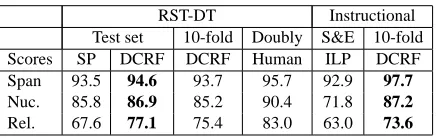
First, we present the results of our discourse parser based on manual segmentation. The parsing perfor-mance is assessed using the unlabeled (i.e., span) and labeled (i.e., nuclearity, relation) precision, re-call and F-score as described in (Marcu, 2000b, page 143). For brevity, we report only the F-scores in Ta-ble 2. Notice that, our parser (DCRF) consistently outperforms SPADE (SP) on the RST-DT test set5. Especially, on relation labeling, which is the hardest among the three tasks, we get an absolute F-score improvement of 9.5%, which represents a relative error rate reduction of29.3%. Our F-score of77.1
in relation labeling is also close to the human agree-ment (i.e., F-score of83.0) on the doubly-annotated data. Our results on the RST-DT test set are con-sistent with the mean scores over 10-folds, when we perform 10-fold cross validation on RST-DT.
The improvement is even larger on the Instruc-tional corpus, where we compare our mean results
5
The improvements are statistically significant (p <0.01).
over 10-folds with the results reported in Subba and Eugenio (S&E) (2009) on a test set6, giving ab-solute F-score improvements of 4.8%, 15.5% and
10.6%in span, nuclearity and relations, respectively. Our parser reduces the errors by67.6%,54.6%and
28.6%in span, nuclearity and relations, respectively.
RST-DT Instructional Test set 10-fold Doubly S&E 10-fold Scores SP DCRF DCRF Human ILP DCRF Span 93.5 94.6 93.7 95.7 92.9 97.7
Nuc. 85.8 86.9 85.2 90.4 71.8 87.2
[image:8.612.320.539.148.217.2]Rel. 67.6 77.1 75.4 83.0 63.0 73.6
Table 2: Parsing results using manual segmentation.
If we compare the performance of our model on the two corpora, we see that our model is more accu-rate in finding the right tree structure (see Span) on the Instructional corpus. This may be due to the fact that sentences in the Instructional domain are rela-tively short and contain fewer EDUs than sentences in the News domain, thus making it easier to find the right tree structure. However, when we compare the performance on the relation labeling task, we ob-serve a decrease on the Instructional corpus. This may be due to the small amount of data available for training and the imbalanced distribution of a large number of discourse relations in this corpus.
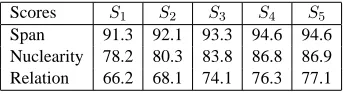
To analyze the features, Table 3 presents the pars-ing results on the RST-DT test set uspars-ing different subsets of features. Every new subset of features appears to improve the accuracy. More specifically, when we add the organizational features with the dominance set features (see S2), we get about 2%
absolute improvement in nuclearity and relations. With N-gram features (S3), the gain is even higher; 6%in relations and3.5%in nuclearity, demonstrat-ing the utility of the N-gram features. This is con-sistent with the findings of (duVerle and Prendinger, 2009; Schilder, 2002). Including the Contextual fea-tures (S4), we get further 3% and 2.2%
improve-ments in nuclearity and relations, respectively. No-tice that, adding the substructure features (S5) does
not help much in sentence-level parsing, giving only
6
an improvement of0.8%in relations. Therefore, one may choose to avoid using this computationally ex-pensive feature in time-constrained scenarios. How-ever, in the future, it will be interesting to see its im-portance in document-level parsing with large trees.
Scores S1 S2 S3 S4 S5
[image:9.612.101.273.138.185.2]Span 91.3 92.1 93.3 94.6 94.6 Nuclearity 78.2 80.3 83.8 86.8 86.9 Relation 66.2 68.1 74.1 76.3 77.1
Table 3: Parsing results based on manual segmentation using different subsets of features on RST-DT test set. Feature subsetsS1={Dominance set},S2={Dominance
set, Organizational}, S3 = {Dominance set,
Organiza-tional, N-gram},S4 = {Dominance set, Organizational,
N-gram, Contextual},S5(all) ={Dominance set,
Orga-nizational, N-gram, Contextual, Substructure}.
5.4 Evaluation of the Discourse Segmenter
We evaluate the segmentation accuracy with respect to the intra-sentential segment boundaries following (Fisher and Roark, 2007). Specifically, if a sen-tence containsnEDUs, which corresponds ton−1
intra-sentence segment boundaries, we measure the model’s ability to correctly identify these n − 1
boundaries. Human agreement for this task is quite high (F-score of98.3) on RST-DT.
Table 4 shows the results of different models in (P)recision, (R)ecall, and (F)-score on the two cor-pora. We compare our model’s (LR) results with HILDA (HIL), SPADE (SP) and the results reported in Fisher and Roark (F&R) (2007) on the RST-DT test set. HILDA gives the weakest performance7. Our results are also much better than SPADE8, with an absolute F-score improvement of4.9%, and com-parable to the results of F&R, even though we use fewer features. Furthermore, we perform 10-fold cross validation on both corpora and compare with SPADE. However, SPADE does not come with a training module for its segmenter. We reimple-mented this module and verified it on the RST-DT test set. Due to the lack of human-annotated syntac-tic trees in the Instructional corpus, we train SPADE in this corpus using the syntactic trees produced
7Note that, the high segmentation accuracy reported in
(Her-nault et al., 2010) is due to a less stringent evaluation metric. 8
The improvements are statistically significant (p<2.4e-06)
by the reranking parser. Our model delivers abso-lute F-score improvements of3.8%and8.1%on the RST-DT and the Instructional corpora, respectively, which is statistically significant in both cases (p< 3.0e-06). However, when we compare our results on the two corpora, we observe a substantial decrease in performance on the Instructional corpus. This could be due to a smaller amount of data in this corpus and the inaccuracies in the syntactic parser and taggers, which are trained on news articles.
RST-DT Instructional Test Set 10-fold 10-fold 10-fold HIL SP F&R LR SP LR SP LR P 77.9 83.8 91.3 88.0 83.7 87.5 65.1 73.9
R 70.6 86.8 89.7 92.3 86.2 89.9 82.8 89.7
F 74.1 85.2 90.5 90.1 84.9 88.7 72.8 80.9
Table 4: Segmentation results of different models.
5.5 Parsing based on Automatic Segmentation
In order to evaluate our full system, we feed our discourse parser the output of our discourse seg-menter. Table 5 shows the F-score results. We com-pare our results with SPADE on the RST-DT test set. We achieve absolute F-score improvements of3.6%,
3.4%and7.4%in span, nuclearity and relation, re-spectively. These improvements are statistically sig-nificant (p<0.001). Our system, therefore, reduces the errors by15.5%,11.4%, and17.6%in span, nu-clearity and relations, respectively. These results are also consistent with the mean results over 10-folds.
[image:9.612.316.540.201.265.2]RST-DT Instructional Test set 10-fold 10-fold Scores SPADE DCRF DCRF DCRF Span 76.7 80.3 78.7 71.9 Nuclearity 70.2 73.6 72.2 64.3 Relation 58.0 65.4 64.2 54.8
Table 5: Parsing results using automatic segmentation.
[image:9.612.326.529.482.549.2]not surprising because previous studies (Soricut and Marcu, 2003) have already shown that automatic segmentation is the primary impediment to high ac-curacy discourse parsing. This demonstrates the need for a more accurate segmentation model in the Instructional genre. A promising future direction would be to apply effective domain adaptation meth-ods (e.g.,easyadapt(Daume, 2007)) to improve the segmentation performance in the Instructional domain by leveraging the rich data in RST-DT.
5.6 Error Analysis and Discussion
The results in Table 2 suggest that given a manually segmented discourse, our sentence-level discourse parser finds the unlabeled (i.e., span) discourse tree and assigns the nuclearity statuses to the spans at a performance level close to human annotators. We, therefore, look more closely into the performance of our parser on the hardest task of relation labeling.
Figure 6 shows the confusion matrix for the rela-tion labeling task using manual segmentarela-tion on the RST-DT test set. The relation labels are ordered ac-cording to their frequency in the RST-DT training set and represented by their initial letters. For exam-ple, EL represents ELABORATION and CA repre-sents CAUSE. In general, errors can be explained by two different phenomena acting together: (i) the fre-quency of the relations in the training data, and (ii) the semantic (or pragmatic) similarity between the relations. The most frequent relations (e.g., ELAB-ORATION) tend to confuse the less frequent ones (e.g., SUMMARY), and the relations which are se-mantically similar (e.g., CAUSE, EXPLANATION) confuse each other, making it hard to distinguish for the computational models. Notice that, the confu-sions caused by JOINT appears to be high consid-ering its frequency. The confusion between JOINT and TEMPORAL may be due to the fact that both of these coarser relations9 contain finer relations (i.e., list in JOINT and sequence in TEMPORAL), which are semantically similar, as pointed out by Carlson and Marcu (2001). The confusion between JOINT and BACKGROUND may be explained by their dif-ferent (semantic vs. pragmatic) interpretation in the RST theory (Stede, 2011, page 85).
9
[image:10.612.314.540.56.193.2]JOINT is actually not a relation, but is characterized by juxtaposition of two EDUs without a relation.
Figure 6: Confusion matrix for the relation labels on the RST-DT test set. Y-axis represents true and X-axis represents predicted labels. The relation labels are TOPIC-COMMENT, EVALUATION, SUMMARY, MANNER-MEANS, COMPARISON, EXPLANATION, CONDITION, TEMPORAL, CAUSE, ENABLEMENT, BACKGROUND, CONTRAST, JOINT, SAME-UNIT, ATTRIBUTION, ELABORATION.
Based on these observations we will pursue two ways to improve our discourse parser. We need a more robust (e.g., bagging) method to deal with the imbalanced distribution of relations, along with a better representation of semantic knowledge. For example, compositional semantics (Subba and Eu-genio, 2009) and subjectivity (Somasundaran, 2010) can be quite relevant for identifying relations.
6 Conclusion
In this paper, we have described a complete prob-abilistic discriminative framework for performing sentence-level discourse analysis. Experiments indi-cate that our approach outperforms the state-of-the-art on two corpora, often by a wide margin.
In ongoing work, we plan to generalize our DCRF-based parser to multi-sentential text and also verify to what extent parsing and segmentation can be jointly performed. A longer term goal is to extend our framework to also work with graph structures of discourse, as recommended by several recent dis-course theories (Wolf and Gibson, 2005). Once we achieve similar performance on graph structures, we will perform extrinsic evaluation to determine their relative utility for various NLP tasks.
Acknowledgments
We are grateful to G. Murray, J. CK Cheung, the3
References
Or Biran and Owen Rambow. 2011. Identifying Justifi-cations in Written Dialogs by Classifying Text as Ar-gumentative. Int. J. Semantic Computing, 5(4):363– 381.
J. Blitzer, 2008. Domain Adaptation of Natural Lan-guage Processing Systems. PhD thesis, University of Pennsylvania.
L. Breiman. 1996. Bagging predictors. Machine Learn-ing, 24(2):123–140, August.
L. Carlson and D. Marcu. 2001. Discourse Tagging Ref-erence Manual. Technical Report ISI-TR-545, Univer-sity of Southern California Information Sciences Insti-tute.
L. Carlson, D. Marcu, and M. Okurowski. 2002. RST Discourse Treebank (RST-DT) LDC2002T07. Lin-guistic Data Consortium, Philadelphia.
E. Charniak and M. Johnson. 2005. Coarse-to-Fine n-Best Parsing and MaxEnt Discriminative Reranking. In Proceedings of the 43rd Annual Meeting of the As-sociation for Computational Linguistics, pages 173– 180, NJ, USA. ACL.
E. Charniak. 2000. A Maximum-Entropy-Inspired Parser. In Proceedings of the 1st North American Chapter of the Association for Computational Linguis-tics Conference, pages 132–139, Seattle, Washington. ACL.
M. Collins. 2003. Head-Driven Statistical Models for Natural Language Parsing. Computational Linguis-tics, 29(4):589–637, December.
H. Daume. 2007. Frustratingly Easy Domain Adapta-tion. In Proceedings of the 45th Annual Meeting of the Association for Computational Linguistics, pages 256–263, Prague, Czech Republic. ACL.
D. duVerle and H. Prendinger. 2009. A Novel Discourse Parser based on Support Vector Machine Classifica-tion. In Proceedings of the Joint Conference of the 47th Annual Meeting of the ACL and the 4th Interna-tional Joint Conference on Natural Language Process-ing of the AFNLP, pages 665–673, Suntec, SProcess-ingapore. ACL.
J. Finkel, A. Kleeman, and C. Manning. 2008. Efficient, Feature-based, Conditional Random Field Parsing. In Proceedings of the 46th Annual Meeting of the Associ-ation for ComputAssoci-ational Linguistics, pages 959–967, Columbus, Ohio, USA. ACL.
S. Fisher and B. Roark. 2007. The Utility of Parse-derived Features for Automatic Discourse Segmenta-tion. In Proceedings of the 45th Annual Meeting of the Association for Computational Linguistics, pages 488–495, Prague, Czech Republic. ACL.
S. Ghosh, R. Johansson, G. Riccardi, and S. Tonelli. 2011. Shallow Discourse Parsing with Conditional
Random Fields. In Proceedings of the 5th Interna-tional Joint Conference on Natural Language Process-ing, pages 1071–1079, Chiang Mai, Thailand. AFNLP. H. Hernault, H. Prendinger, D. duVerle, and M. Ishizuka. 2010. HILDA: A Discourse Parser Using Support Vector Machine Classification. Dialogue and Dis-course, 1(3):1–33.
D. Jurafsky and J. Martin, 2008. Speech and Language Processing, chapter 14. Prentice Hall.
A. Knott and R. Dale. 1994. Using Linguistic Phenom-ena to Motivate a Set of Coherence Relations. Dis-course Processes, 18(1):35–62.
J. Lafferty, A. McCallum, and F. Pereira. 2001. Condi-tional Random Fields: Probabilistic Models for Seg-menting and Labeling Sequence Data. In Proceedings of the Eighteenth International Conference on Ma-chine Learning, pages 282–289, San Francisco, CA, USA. Morgan Kaufmann Publishers Inc.
D. Magerman. 1995. Statistical Decision-tree Mod-els for Parsing. In Proceedings of the 33rd annual meeting on Association for Computational Linguistics, pages 276–283, Cambridge, Massachusetts. ACL. W. Mann and S. Thompson. 1988. Rhetorical Structure
Theory: Toward a Functional Theory of Text Organi-zation. Text, 8(3):243–281.
D. Marcu. 2000a. The Rhetorical Parsing of Unrestricted Texts: A Surface-based Approach. Computational Linguistics, 26:395–448.
D. Marcu. 2000b. The Theory and Practice of Discourse Parsing and Summarization. MIT Press, Cambridge, MA, USA.
M. Marcus, B. Santorini, and M. Marcinkiewicz. 1994. Building a Large Annotated Corpus of English: The Penn Treebank. Computational Linguistics, 19(2):313–330.
A. McCallum. 2002. MALLET: A Machine Learning for Language Toolkit. http://mallet.cs.umass.edu. K. Murphy. 2012. Machine Learning A Probabilistic
Perspective (Forthcoming, August 2012). MIT Press, Cambridge, MA, USA.
R. Prasad, A. Joshi, N. Dinesh, A. Lee, E. Miltsakaki, and B. Webber. 2005. The Penn Discourse TreeBank as a Resource for Natural Language Generation. In Pro-ceedings of the Corpus Linguistics Workshop on Us-ing Corpora for Natural Language Generation, pages 25–32, Birmingham, U.K.
F. Schilder. 2002. Robust Discourse Parsing via Dis-course Markers, Topicality and Position. Natural Lan-guage Engineering, 8(3):235–255, June.
F. Sha and F. Pereira. 2003. Shallow Parsing with Conditional Random Fields. In Proceedings of the 2003 Conference of the North American Chapter of the Association for Computational Linguistics on Human Language Technology - Volume 1, pages 134–141, Ed-monton, Canada. ACL.
S. Somasundaran, 2010. Discourse-Level Relations for Opinion Analysis. PhD thesis, University of Pitts-burgh.
R. Soricut and D. Marcu. 2003. Sentence Level Dis-course Parsing Using Syntactic and Lexical Informa-tion. In Proceedings of the 2003 Conference of the North American Chapter of the Association for Com-putational Linguistics on Human Language Technol-ogy - Volume 1, pages 149–156, Edmonton, Canada. ACL.
C. Sporleder and M. Lapata. 2005. Discourse Chunk-ing and its Application to Sentence Compression. In Proceedings of the conference on Human Language Technology and Empirical Methods in Natural Lan-guage Processing, pages 257–264, Vancouver, British Columbia, Canada. ACL.
M. Stede. 2011. Discourse Processing. Synthesis Lec-tures on Human Language Technologies. Morgan And Claypool Publishers, November.
R. Subba and B. Di Eugenio. 2009. An Effective Discourse Parser that Uses Rich Linguistic Informa-tion. In Proceedings of Human Language Technolo-gies: The 2009 Annual Conference of the North Ameri-can Chapter of the Association for Computational Lin-guistics, pages 566–574, Boulder, Colorado. ACL. C. Sutton, A. McCallum, and K. Rohanimanesh. 2007.
Dynamic Conditional Random Fields: Factorized Probabilistic Models for Labeling and Segmenting Se-quence Data. Journal of Machine Learning Research (JMLR), 8:693–723.
S. Verberne, L. Boves, N. Oostdijk, and P. Coppen. 2007. Evaluating Discourse-based Answer Extrac-tion for Why-quesExtrac-tion Answering. In Proceedings of the 30th annual international ACM SIGIR conference on Research and development in information retrieval, pages 735–736, Amsterdam, The Netherlands. ACM. M. Wainwright, T. Jaakkola, and A. Willsky. 2002.