1808
Modeling Document-level Causal Structures for Event Causal Relation
Identification
Lei Gao, Prafulla Kumar Choubey, Ruihong Huang Department of Computer Science and Engineering
Texas A&M University
(sjtuprog, prafulla.choubey, huangrh)@tamu.edu
Abstract
We aim to comprehensively identify all the event causal relations in a document, both within a sentence and across sentences, which is important for reconstructing pivotal event structures. The challenges we identified are two: 1) event causal relations are sparse among all possible event pairs in a docu-ment, in addition, 2) few causal relations are explicitly stated. Both challenges are espe-cially true for identifying causal relations be-tween events across sentences. To address these challenges, we model rich aspects of document-level causal structures for achiev-ing comprehensive causal relation identifica-tion. The causal structures include heavy in-volvements of document-level main events in causal relations as well as several types of fine-grained constraints that capture implications from certain sentential syntactic relations and discourse relations as well as interactions be-tween event causal relations and event corefer-ence relations. Our experimental results show that modeling the global and fine-grained as-pects of causal structures using Integer Lin-ear Programming (ILP) greatly improves the performance of causal relation identification, especially in identifying cross-sentence causal relations.
1 Introduction
Understanding causal relations between events in a document is an important step in text under-standing and is beneficial to various NLP appli-cations, such as information extraction, question answering and text summarization. Causal rela-tions can occur between any two events in a doc-ument, both between events within a sentence and between events across sentences. In this paper, we aim to identify all the event causal relations in a document.
[image:1.595.309.527.226.383.2]The main challenges for achieving comprehen-sive causal relation identification are that event
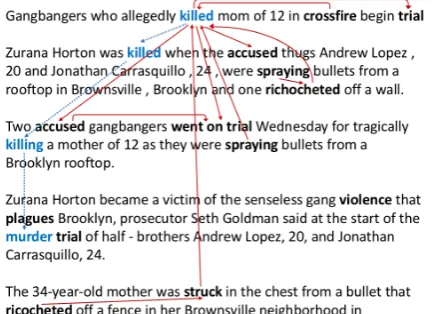
Figure 1: An Example of Main Event Causal Structure
causal relations are sparse among all the event pairs in a document and few event causal relations are explicitly stated. The challenges are especially true for identifying cross-sentence event causal re-lations and most of them have no clear causal indi-cators. To address these challenges, we model rich aspects of document-level causal structures, i.e., structural distributions of causal relations within a document, for achieving comprehensive causal re-lation identification in news articles.
relations are related to the main event.
In addition to the global causal structures re-lated to main events of a document, we model three types of fine-grained causal structures in or-der to accurately identify each individual causal relation. First, specific sentential syntactic rela-tions may evoke causal relarela-tions between event pairs. For instance, adverbial clause modifier of a verb phrase explains its consequence, condition or purpose. Second, we model implications of a discourse relation between two text units (e.g., the
contingencydiscourse relation) towards causal re-lations between events in the two text units. Third, we model interactions between event causal re-lations and event coreference rere-lations. For ex-ample, coreferent event mentions should have the same causal relations; a causal relation and an identity relation should not co-exist between any two events.
We use Integer Linear Programming (ILP) to model these rich causal structures within a docu-ment by designing constraints and modifying the objective function to encourage causal relations akin to the observed causal structures and discour-age the opposite. Our experimental results on the dataset EventStoryLine (Caselli and Vossen,2017) show that modeling the global and fine-grained aspects of causal structures within a document greatly improves the performance of causal rela-tion identificarela-tion, especially in identifying cross-sentence causal relations.
2 Related Work
In the last decade or so, both unsupervised and su-pervised causal relation identification approaches have been proposed including linguistic patterns, statistical measures and supervised classifiers, pri-marily with the goal of acquiring event causal-ity knowledge from a text corpus. The pro-posed approaches mainly rely on explicit con-textual patterns (Girju; Hashimoto et al., 2014) or other causality cues (Riaz and Girju, 2010;
Do et al., 2011), statistical associations between events (Beamer and Girju,2009;Hu et al.,2017;
Hu and Walker,2017;Do et al.,2011;Hashimoto et al.,2014), and lexical semantics of events (Riaz and Girju,2013,2014b,a;Hashimoto et al.,2014). An increasing amount of recent works focused on recognizing event causal relations within a doc-ument, but mostly limited to identifying intra-sentence causal relations with explicit causal
indi-cators. Mirza et al.(2014) annotated event causal relations in the TempEval-3 corpus and created CausalTimeBank.Mirza and Tonelli(2014) stated that incorporating temporal information improved the performance of a causal relation classifier.
Mirza and Tonelli (2016) built both a rule-based multi-sieve approach and a feature based classi-fier to recognize causal relations in Bank. However, causal relations in CausalTime-Bank are few and only explicitly stated intra-sentence causal relations were annotated. In ad-dition,Mostafazadeh et al.(2016) annotated both temporal and causal relations in 320 short stories (five sentences in each story) taken from the ROC-Stories Corpus and indicated strong correlations between causal relations and temporal relations.
Lately,Caselli and Vossen(2017) created a cor-pus called EventStoryLine, which contains 258 documents and more than 5,000 causal relations. The EventStoryLine corpus is the largest dataset for causal relation identification till now with com-prehensive event causal relations annotated, both intra-sentence and cross-sentence, which presents unique challenges for causal relation identifica-tion. Caselli and Vossen(2017) showed that only 117 annotated causal relations in this dataset are indicated by explicit causal cue phrases while the others are implicit. We conduct experiments on the EventStoryLine dataset. Distinguished from most of the previous approaches that identify one causal relation each time, we model coarse-grained and fine-coarse-grained document-level event causal structures and infer all the causal relations in a document.
3 The EventStoryLine Corpus
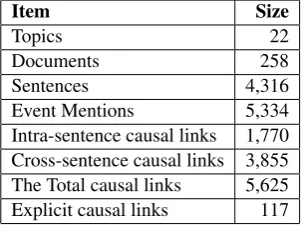
Table 1 shows the statistics of the corpus EventStoryLine v0.91(Caselli and Vossen,2017).
Item Size
Topics 22
Documents 258
Sentences 4,316
Event Mentions 5,334
Intra-sentence causal links 1,770 Cross-sentence causal links 3,855 The Total causal links 5,625
Explicit causal links 117
Table 1: EventStoryLine v0.9
Causal relations annotated in EventStoryLine are between two event mentions. Different causal relations are annotated in EventStoryLine, called “rising action” and “falling action”, which indi-cate the directions of causal relations and intu-itively correspond to “precondition” and “conse-quence” relations. Note that in this paper, we fo-cus on identifying all the pairs of events in a doc-ument that are causally related, but not on clas-sifying the direction of a causal relation though; specifically, we aim to recognize if there exists a causal relation between any two eventsAandBin a document, but we do not further distinguish ifA
causesBvs.BcausesA.
On average, there is 1.2 event mentions in each sentence. There are 7,805 intra-sentence and 46,521 cross-sentence event mention pairs in total in the corpus, around 22% (1,770) and 8% (3,855) of them were annotated with a causal relation re-spectively. Out of the annotated causal links, only 117Caselli and Vossen(2017) causal relations are indicated by explicit causal cue phrases while the others are implicit. In our experiments, we use the gold event mentions in EventStoryLine and ex-clude aspectual, causative, perception and report-ing event mentions2, most of which were not anno-tated with any causal relation according toCaselli and Vossen(2017).
4 The Feature Based Local Pairwise Classifiers
Intra- and cross-sentence causal relations are dif-ferent by nature. For instance, dependency
rela-1
Statistics are calculated based on latest release https://github.com/tommasoc80/EventStoryLine
2639 event mentions were excluded in this way.
tions between words in a sentence may be more useful for detecting intra-sentence causal rela-tions, than when used for detecting cross-sentence causal relations. Therefore, we train two sepa-rate logistic regression classifiers, one for intra-sentence causal link detection and the other for cross-sentence causal link detection.
We consider all event mention pairs within a sentence as training instances for the intra-sentence causal relation classifier. Then we pair event mentions from two sentences with one event mention from each sentence, which are used as training instances for the cross-sentence fier. Note that training instances for both classi-fiers are unbalanced, with a POS:NEG ration of around 1:3 and 1:10 for intra- and cross-sentence cases respectively. We applied the “balanced” class weight option3 in logistic regression classi-fiers to deal with the class imbalance problem.
We use the same set of features for training both classifiers, but we expect the two classifiers to as-sign different weights to features.
4.1 The Common Feature Set
Lexical Features: We implement rich lexical fea-tures to capture event word forms and similarities between two events, event modifiers and event ar-guments. First, we encode word and lemma for each token in two event phrases as features. Then we created various similarity features between two events.
• Similarities Based on Event Word Form Match. Three binary features indicating whether the lowercases of two event head words, two event head lemmas and two com-plete event phrases are exactly the same.
• Similarities Based on Wordnet. We first identify synsets for each event head word in Wordnet. Then for each pair of synsets, with one synset for each event head word, we cal-culate the Wup similarity (Wu and Palmer,
1994). We create numerical features using the average, minimal and maximal Wup sim-ilarities.
• Similarities Based on Word Embeddings. We apply l2 normalization on event head word embeddings, and then we calculate the Eu-clidean distance and Cosine distance between
[image:3.595.107.259.124.238.2]two word embeddings and use them as fea-tures. We use Glove Vectors (Pennington et al.,2014) for word embeddings.
• Similarities Based on Event Modifiers. We run the dependency parsing tool from the Stanford CoreNLP (Manning et al., 2014) and identify event modifiers as words that have a certain dependency relation4 with an event head word. We measure the similarity between two events using the number of com-mon modifiers and the number of comcom-mon dependency relations that connect a modifier with an event head word.
• Similarities Based on Event Arguments. We consider entities that have a direct depen-dency relation with an event head word as its event arguments. We use the Stan-ford CoreNLP to identify entities and their types. We measure the similarity between two events using the number of common event arguments and the number of common entity types.
Causal Potential Features: As inspired by the causal potential metric proposed by (Beamer and Girju, 2009), we encode features based on the point-wise mutual information (PMI) score and the relative textual order between two events. We calculate the PMI score of two event words in EventStoryLine by using co-occurrences of two events in one sentence, and we use the score as a numerical feature.
Syntactic Features: We use dependency relations on the dependency path between two events. We use the basic dependencies extracted from Stan-fordCoreNLP (Manning et al., 2014). For cross-sentence event pairs, we consider the dependency path from each event to the root node in its own sentence in extracting dependency relations, fol-lowingCheng and Miyao(2017). In addition, we use Part Of Speech tags of two event head words as features.
4.2 Score Replacement
We observed that the cross-sentence causal rela-tion classifier is usually not as capable as the intra-sentence classifier, probably due to less contex-tual evidence to rely on. Therefore, for cross-sentence event mention pairs that can be converted
4Specifically, we consider ’nmod’, ’amod’, ’advmod’, ’mark’, ’aux’, ’auxpass’, ’expl’, ’cc’, ’cop’, ’punct’ to be modifiers.
to intra-sentence cases through event coreference links, we use a heuristic method to improve causal relation prediction performance and replace the predictions from the cross-sentence classifier with the predictions from the intra-sentence classifier5, by using system predicted event coreference links. Note that two events may have more than one pair of mentions, one mention for each event, co-occur within one sentence, we will use the highest score produced by the intra-sentence classifier over all the event mention pairs.
In addition, the score replacement procedure may change prediction scores of some intra-sentence event mention pairs as well. For in-stance, if one event mention has a coreferent men-tion within the same sentence that is closer to and is more clearly in a causal relation with the other event mention according to the intra-sentence clas-sifier, and when paired up, the new event pair has received a higher score, then we will replace the score of the original event pair with the higher score. We implemented the within-document neu-ral network based event coreference classifier as described in (Choubey and Huang, 2017a) and used the system to obtain event coreference links.
5 Modeling Causal Structures Using ILP
Our Integer Linear Programming (ILP) system performs document level global inference for re-solving all the intra-sentence and inter-sentence event causal relations in a document. Letpij
de-notes confidence score from the corresponding lo-cal pairwise classifier for assigning a causal rela-tion to the event pair(i, j). Letµrefer to the set of event mentions in a document, we formulate our basic ILP objective function with equation1.
ΘBasic= max X
i∈µ X
j∈µ
pijxij+¬xij(1−pij)
(1)
We then augment the objective function with new objectives (equation2) and add constraints to induce causal structures, including heavy involve-ments of main events (ΘM andΘF) in causal
re-lations throughout the document, as well as fine-grained interactions of event causal relations with discourse relations (ΘD), and event coreference
relations(ΘC) as well as syntactic structure
con-straints (ΘS) for identifying causal relations.
Θ = ΘBasic+ ΘM+ ΘF+ ΘD+ ΘC+ ΘS (2)
5.1 Document Level Main Event Based Constraints
Main Event: Main events are central to the story in a document and tend to participate in multiple causal links. Similar to Choubey et al. (2018), we recognize main events based on characteristics of event coreference chains within a document. Specifically, we rank events based on the number of event mentions referring to an event, and choose the top two events as main events6. Then we add a new objective function (equation3) and additional constraints to encourage causal links in event men-tion pairs containing a main event (equamen-tion4) and discourage causal links in the remaining mention pairs (equation5).
ΘM = max h X
i∈Λ
[km1m1(i) +km2m2(i)]
− X
i∈µ−Λ
[kn1n1(i) +kn2n2(i)]
i (3)
∀i∈Λ, X j∈µ,di=dj
xij≥m1(i)
∀i∈Λ, X j∈µ,di6=dj
xij≥m2(i)
(4)
∀i∈µ−Λ, X j∈µ−Λ,di=dj
xij≤n1(i)
∀i∈µ−Λ, X j∈µ−Λ,di6=dj
xij≤n2(i)
(5)
In the above equations, Λ denotes the set of main event mentions, anddi denotes the sentence
number for event i. The independent variables
m1(i) and m2(i) indicate the minimum num-ber of intra- and cross-sentence causal relations that main events participate in. By maximizing
m1(i) and m2(i) in the objective function ΘM,
our model favors main events to have more causal relations. Similarly, variables n1(i) and n2(i) in equation 5 are separately defined to set up-per thresholds on the maximum number of
intra-6
If there is a tie between two event clusters with the same number of coreferential event mentions, we use the sum of confidence scores for pairs of coreferential event mentions in a cluster to break the tie. The confidence scores were as-signed by the local pairwise coreference relation classifier.
and cross-sentence causal relations without a main event. Unlikem1(i) andm2(i), we aim to mini-mize the variablesn1(i)andn2(i)to restrict non-main events from participating in causal relations. Notice that we apply the constraints separately to intra- and cross-sentence mention pairs. This is primarily because main events are likely to par-ticipate in many more cross-sentence causal rela-tions compared to intra-sentence cases. Further-more, we observe that a main event may trigger several consequent events which themselves are causally related. However, causal relations involv-ing only non-main events are less likely to show transitivity. Therefore, we add the constraint 6
to ensure non-transitivity among causal relations with no main event.
xij+xjk+xik≤2 + 1i∈Λ+ 1j∈Λ+ 1k∈Λ (6)
Locality Constraints: Main events may not al-ways have the largest coreference chain size, and the position of an event mention provides another strong heuristics for identifying the main event (Upadhyay and Roth,2016). In addition, the first sentence often summarizes the central context of story and are likely to describe foreground events (Grimes,1975) that have causal relation with mul-tiple other events. Therefore, we add an objective function (equation 7) and additional constraints (equation 8) to encourage causal relations that contain an event from the first sentence.
ΘS= max X
i∈S
kfb1(i)−
X
i∈µ X
j∈µ
kflij· |di−dj| (7)
∀i∈F,X j∈µ
xij≥b1(i) (8a)
∀< i, j >∈M, xij≤lij+ 1i /∈{F}∧1j /∈{F} (8b)
where, F represents all the events in first sen-tence, independent variable b1(i) indicates the minimum number of causal relations that an event inF participates in,M represents the set of event mention pairs that can be mapped to the same sen-tence andlij is a leakage variable that allows
dis-tant event mentions in F receiving a very high confidence valuepij to have a causal relation.
be mapped to the same sentence using corefer-ence links7. By maximizing the variables b1(i) and minimizing the termlij· |di−dj|, we
encour-age event mentions in F complying with certain constraints to have more causal relations.
5.2 Fine-grained Causal Structure Constraints
Syntactic Relations: Specific sentential syntac-tic relations may evoke causal relations between event pairs. First, adverbial clause modifier of a verb phrase explains its consequence, condition or purpose; Second, nominal events mentioned as subject in the main clause presents an assertional structure that delivers foreground (Grimes,1975) information which may have causal associations with other events; Third, non-finite verb events that share arguments and complement the main event of a sentence are likely to have causal as-sociations with the main event.
Therefore, we add an objective function (equa-tion9) and additional constraints (equation10) to encourage causal relations that contain a nomi-nal event as subject or verb event that modifies its parent with advcl or xcomp dependency rela-tions. Here,S represents event mentions that pos-sess one of the above syntactic structures, indepen-dent variableb2(i)indicates the minimum number of causal relations that an event in S participates in. Note that equation 10(b) was modified from 8(b) and allows discounted optimization (withlij)
for events in S that are mappable to the same or nearby sentences.
ΘS= max X
i∈S
ksb2(i) (9)
∀i∈S,X j∈µ
xij≥b2(i) (10a)
∀< i, j >∈M, xij≤lij+ 1i /∈{F,S}∧1j /∈{F,S} (10b)
Discourse Relations: Note that the implications of discourse relations between two text units to-wards causal relations between events in the two text units have been discussed in the previous work (Do et al., 2011). In this work, we con-sider three types of discourse relations8. First,
7
Two event mentions are mappable if their respective co-referential event mentions co-occur in at least one sentence.
8We use PDTB parser (Lin et al.,2014) to identify three discourse relations.
two subtypes of the contingency discourse rela-tion, namely cause and condition, strongly sug-gest that causal links exist between events in the two discourse units. On the contrary, the com-parisondiscourse relation highlights semantic dependence between two discourse units, thus in-hibits causal relations between events described in them. Third, all causal relations are inher-ently temporal. An event that causes another event must necessarily occur before or temporally over-lap with the latter. Thus, clauses having one of these temporal discourse relations may also fa-vor causal relations between events in them. We model the above three dependencies between dis-course relations and causation through constraints
11and the objective function12.
∀r=Contingency, X i∈arg1
X
j∈arg2
xij≥1
∀r=Comparison, X i∈arg1
X
j∈arg2
xij≤0
∀r=T emporal, X i∈arg1
X
j∈arg2
xij ≥T(r)
(11)
ΘD= max X
r=T emporal
ktT(r) (12)
Specifically, we enforce events in clauses with the contingency discourse relation to have at least one event pair with causal relation. Similarly, we inhibit a causal relation between any event pair in clauses with the comparison discourse relation. For events in clauses with a temporal discourse re-lation, we aim to maximize the number of causal relations without grounding it to any hard lower bound. Here,r denotes the discourse relation be-tween two discourse arguments, arg1 and arg2, and Temporal refers to the set of temporal dis-course relations. We use the pre-trained PDTB discourse parser (Lin et al., 2014) to obtain dis-course relations in a document.
Event Coreference Relations: We model inter-actions between event causal relations and event coreference relations by adding constraints13and
14and an objective function15.
∀i≡j, xij≤c3(i, j) (13)
∀i≡j, xik+¬xjk≤1 +c1(i, j, k)
∀i≡j,¬xik+xjk≤1 +c2(i, j, k)
ΘC= max X
i∈µ X
j∈µ X
k∈µ
−kc(c1(i, j, k)
+c2(i, j, k))
−(1−kc)(c3(i, j))
(15)
Here≡represents the identity (coreference) re-lation. The constraint13ensures that causal rela-tion and coreference relarela-tion are mutually exclu-sive, allowing some violations whenpi,j is high.
The constraints14 along with the objective func-tion 15 encourage coreferent event mentions to have a causal relation with the same other event. While this relation between causal and corefer-ence relations is strictly true for gold standard data, we observed that these constraints make the system very sensitive to noise when using system predicted coreference links. Therefore, we added binary leakage variablesc1(i, j, k),c2(i, j, k)and
c3(i, j) to relax these constraints.By maximizing the negative of leakage variables, we allow our model to overcome this instability.
6 Evaluation
6.1 Experimental settings
There are 22 topics in the EventStoryLine corpus. We put them in order based on their topic IDs and use documents in the last two topics as the devel-opment set. We trained the ILP system using the rest 20 topics and tuned parameters based on the system performance on the development set. We report experimental results by conducting 5-fold cross validation on the rest 20 topics. For event causal relation identification, we report precision, recall, and F1-score.
The weighting parameters for constraints, in-cludingkm1, km2, kn1, kn2, kf, kt, kcandks, were
first pre-set to be a small number0.1. We then con-ducted grid search and searched for the best value for each parameter over the range from0.1to0.5
with a step size of0.1. The best values for the pa-rameters are0.2,0.1,0.1,0.5,0.2,0.1,0.1,0.2 re-spectively.
6.2 Baseline Systems
We consider six baseline systems:
OP:a dummy model used in (Caselli and Vossen,
2017) that assigns a causal relation to every event mention pair.
Cheng and Miyao (2017): a dependency path based sequential neural network model that ex-tensively models compositional meanings of the
context between two event mentions for causal re-lation identification. This model was first used for identifying event temporal relations and has been shown effective in identifying both intra- and cross-sentence temporal relations.
Choubey and Huang (2017b): another depen-dency path based sequential neural network model that was first developed for identifying temporal relations between event mentions within a sen-tence. We make this model also work for cross sentence cases by merging the root nodes of two dependency trees associated with two separate sentences and extracting a dependency path con-necting events across sentences.
So far, there is no well recognized effective approach for causal relation identification within a document. We applied the above two models for causal relation identification considering that causal relations are closely related with certain temporal relations and a causal event must occur before or overlap with the consequence event.
LR (Lexical): the same logistic regression clas-sifier as our local pairwise clasclas-sifier but using the lexical features only.
LR (Causal Potential): the same logistic regres-sion classifier as our local pairwise classifier but using the causal potential features only.
LR (Full): our local pairwise classifier using the full set of features.
+ Score Replacement: our local pairwise classi-fier using the full set of features, with the heuristic score replacement procedure applied.
6.3 Experimental Results
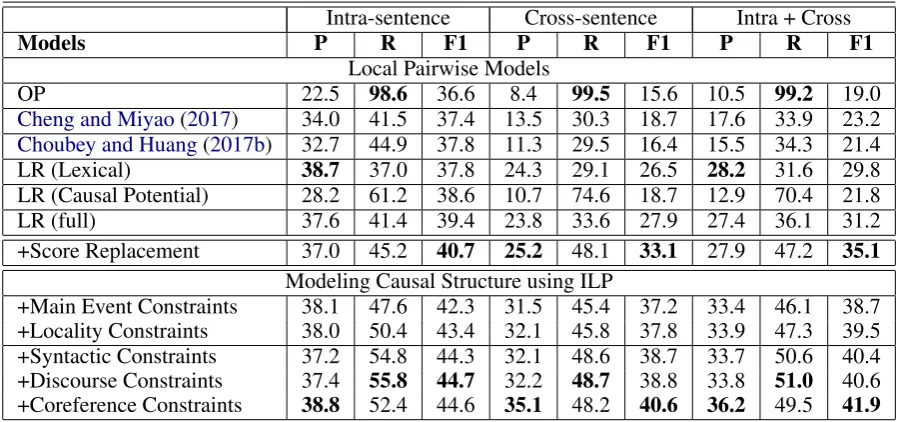
The first section of table2shows the performance of baseline models on intra- and cross-sentence causal relation identification. The modelOP la-bels each event mention pair as causal and suffers from low precisions9, especially on identifying cross-sentence causal relations. The two depen-dency path based neural network model (Cheng and Miyao,2017;Choubey and Huang,2017b) do not perform effectively on identifying causal relations. The performance is especially poor on cross-sentence cases.
The model LR (Lexical) improved the pre-cision of causal relation identification but
Intra-sentence Cross-sentence Intra + Cross
Models P R F1 P R F1 P R F1
Local Pairwise Models
OP 22.5 98.6 36.6 8.4 99.5 15.6 10.5 99.2 19.0
Cheng and Miyao(2017) 34.0 41.5 37.4 13.5 30.3 18.7 17.6 33.9 23.2
Choubey and Huang(2017b) 32.7 44.9 37.8 11.3 29.5 16.4 15.5 34.3 21.4
LR (Lexical) 38.7 37.0 37.8 24.3 29.1 26.5 28.2 31.6 29.8
LR (Causal Potential) 28.2 61.2 38.6 10.7 74.6 18.7 12.9 70.4 21.8
LR (full) 37.6 41.4 39.4 23.8 33.6 27.9 27.4 36.1 31.2
+Score Replacement 37.0 45.2 40.7 25.2 48.1 33.1 27.9 47.2 35.1 Modeling Causal Structure using ILP
[image:8.595.75.524.62.273.2]+Main Event Constraints 38.1 47.6 42.3 31.5 45.4 37.2 33.4 46.1 38.7 +Locality Constraints 38.0 50.4 43.4 32.1 45.8 37.8 33.9 47.3 39.5 +Syntactic Constraints 37.2 54.8 44.3 32.1 48.6 38.7 33.7 50.6 40.4 +Discourse Constraints 37.4 55.8 44.7 32.2 48.7 38.8 33.8 51.0 40.6 +Coreference Constraints 38.8 52.4 44.6 35.1 48.2 40.6 36.2 49.5 41.9
Table 2: Performance of different models on causal relation identification
fers from low recall. In contrast, the model LR (Causal Potential)improved the recall but suffers from low precision. The modelLR (full)with rich lexical, semantic and syntactic features achieved the best trade-off between precision and recall. + Score Replacementsignificantly improves the recall and F1-score on identifying cross-sentence causal relations, which also slightly improves the recall of intra-sentence cases. But the precision of causal relation identification remains low, espe-cially on cross-sentence cases.
The second section of table2shows the perfor-mance of our ILP model after gradually adding each type of constraints. +Main Event Con-straints shows the performance of the ILP sys-tem with constraints encouraging causal relations involving a main event. By modeling this as-pect of document-level causal structures, the pre-cision of cross-sentence causal relation identifica-tion was clearly improved by around 6.3%. With a small loss on recall, the F1-score was improved by 4.1%. Modeling this document-level causal structure also improves both precision and recall on identifying intra-sentence causal relations, but with a relatively small margin. Compared to the local pairwise model + Score Replacement, the overall F1-score improvement from using global main event constraints is statistically significant with p<0.05 (Dietterich, 1998). +Locality Con-straintsstrengthens the effects of modeling main events and further improved the performance of both cross- and intra-sentence causal relation
iden-tification.
Next, adding sentential syntactic structure based constraints (+Syntactic Constraints) re-covered additional intra-sentence causal relations and cross-sentence causal relations as well due to score replacement, and improved their recall by 4.4% and 2.8% respectively with little or no drop on precision. Then, after adding discourse con-straints (+Discourse Concon-straints), both precision and recall on intra-sentence causal relation identi-fication were slightly improved while the perfor-mance on cross-sentence causal relation identifi-cation remains roughly the same, this is mainly due to the fact that few cross-sentence discourse relations were identified by the discourse parser we used. Finally, after adding conference con-straints (+Coreference Concon-straints), the preci-sion of cross-sentence causal relation identifica-tion was increased by 2.9%, with a small loss on recall, the F1-score was improved by 1.8%. Unsurprisingly, the overall performance on intra-sentence causal relation identification was not af-fected much by coreference constraints since event coreference relations often involve events across sentences. Compared to the model considering global constraints only (the line+ Locality Con-straints), the overall F1-score improvement from using fine-grained causal structure constraints is statistically significant with p<0.01.
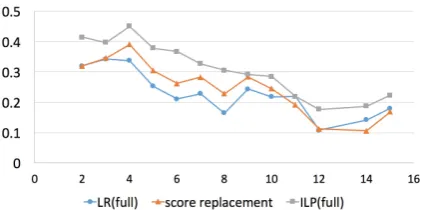
re-Figure 2: F1-scores on documents with different lengths. The x-axis indicates the number of sentences a document has. The y-axis indicates the macro average F1-score of causal relation identification.
lation identification was greatly improved by 3.9% and 7.5% in F1-score respectively. Compared to the local pairwise model + Score Replace-ment, the overall F1-score improvement from us-ing both global main event constraints and fine-grained causal structure constraints is statistically significant with p<0.002.
Impact of Document Lengths Figure 2 shows performance comparisons of three models on doc-uments with different lengths. The first impres-sion is that causal relation identification becomes harder when documents are longer. If we look into the figure, the score replacement heuristic im-proves the performance of causal relation iden-tification on medium-sized documents, but not on short (< 4 sentences) or long (> 10 sen-tences) documents. This may either due to lit-tle event coreference information for use in short documents or event coreference information be-coming too noisy in long documents. Compared to the mixed effects of the score replacement heuristic, the ILP system improved the perfor-mance of causal relation identification consistently in documents of any length, through modeling rich document-level causal structures.
7 Conclusions
We have presented an ILP system that collectively identifies all the causal relations within a docu-ment, both intra- and cross-sentence causal rela-tions, by modeling the global and fine-grained as-pects of causal structures. In the future, we will continue to enrich document-level causal struc-tures, e.g., by considering segment-wise topic lay-outs and rhetorical discourse structures.
Acknowledgments
This work was partially supported by the National Science Foundation via NSF Award IIS-1755943. Disclaimer: the views and conclusions contained herein are those of the authors and should not be interpreted as necessarily representing the official policies or endorsements, either expressed or im-plied, of NSF or the U.S. Government.
References
Brandon Beamer and Roxana Girju. 2009. Using a bi-gram event model to predict causal potential. In In-ternational Conference on Intelligent Text Process-ing and Computational LProcess-inguistics, pages 430–441. Springer.
Tommaso Caselli and Piek Vossen. 2017. The event storyline corpus: A new benchmark for causal and temporal relation extraction. InProceedings of the Events and Stories in the News Workshop, pages 77– 86.
Fei Cheng and Yusuke Miyao. 2017. Classifying tem-poral relations by bidirectional lstm over depen-dency paths. In Proceedings of the 55th Annual Meeting of the Association for Computational Lin-guistics (Volume 2: Short Papers), volume 2, pages 1–6.
Prafulla Kumar Choubey and Ruihong Huang. 2017a. Event coreference resolution by iteratively un-folding inter-dependencies among events. arXiv preprint arXiv:1707.07344.
Prafulla Kumar Choubey and Ruihong Huang. 2017b. A sequential model for classifying temporal rela-tions between intra-sentence events. arXiv preprint arXiv:1707.07343.
Prafulla Kumar Choubey, Kaushik Raju, and Ruihong Huang. 2018. Identifying the most dominant event in a news article by mining event coreference re-lations. In Proceedings of the 2018 Conference of the North American Chapter of the Association for Computational Linguistics: Human Language Tech-nologies, Volume 2 (Short Papers), volume 2, pages 340–345.
Thomas G Dietterich. 1998. Approximate statistical tests for comparing supervised classification learn-ing algorithms. Neural computation, 10(7):1895– 1923.
[image:9.595.75.287.61.166.2]Quang Xuan Do, Wei Lu, and Dan Roth. 2012. Joint inference for event timeline construction. In Pro-ceedings of the 2012 Joint Conference on Empirical Methods in Natural Language Processing and Com-putational Natural Language Learning, pages 677– 687. Association for Computational Linguistics.
Roxana Girju. Automatic detection of causal relations for question answering. InProceedings of the ACL 2003 workshop on Multilingual summarization and question answering-Volume 12, pages 76–83.
Joseph Evans Grimes. 1975. The thread of discourse, volume 207. Walter de Gruyter.
Chikara Hashimoto, Kentaro Torisawa, Julien Kloetzer, Motoki Sano, Istv´an Varga, Jong-Hoon Oh, and Yu-taka Kidawara. 2014. Toward future scenario gener-ation: Extracting event causality exploiting semantic relation, context, and association features. In Pro-ceedings of the 52nd Annual Meeting of the Associa-tion for ComputaAssocia-tional Linguistics (Volume 1: Long Papers), volume 1, pages 987–997.
Zhichao Hu, Elahe Rahimtoroghi, and Marilyn A Walker. 2017. Inference of fine-grained event causality from blogs and films. arXiv preprint arXiv:1708.09453.
Zhichao Hu and Marilyn A Walker. 2017. Infer-ring narrative causality between event pairs in films.
arXiv preprint arXiv:1708.09496.
Ziheng Lin, Hwee Tou Ng, and Min-Yen Kan. 2014. A pdtb-styled end-to-end discourse parser. Natural Language Engineering, 20(2):151–184.
Christopher D Manning, Mihai Surdeanu, John Bauer, Jenny Rose Finkel, Steven Bethard, and David Mc-Closky. 2014. The stanford corenlp natural lan-guage processing toolkit. In ACL (System Demon-strations), pages 55–60.
Paramita Mirza, Rachele Sprugnoli, Sara Tonelli, and Manuela Speranza. 2014. Annotating causality in the tempeval-3 corpus. InProceedings of the EACL 2014 Workshop on Computational Approaches to Causality in Language (CAtoCL), pages 10–19.
Paramita Mirza and Sara Tonelli. 2014. An analysis of causality between events and its relation to tempo-ral information. InProceedings of COLING 2014, the 25th International Conference on Computational Linguistics: Technical Papers, pages 2097–2106.
Paramita Mirza and Sara Tonelli. 2016. Catena: Causal and temporal relation extraction from natural lan-guage texts. InThe 26th International Conference on Computational Linguistics, pages 64–75. ACL.
Nasrin Mostafazadeh, Alyson Grealish, Nathanael Chambers, James Allen, and Lucy Vanderwende. 2016. Caters: Causal and temporal relation scheme for semantic annotation of event structures. In Pro-ceedings of the 4th Workshop on Events: Definition, Detection, Coreference, and Representation, pages 51–61.
Qiang Ning, Zhili Feng, and Dan Roth. 2017. A struc-tured learning approach to temporal relation extrac-tion. InProceedings of the 2017 Conference on Em-pirical Methods in Natural Language Processing, pages 1027–1037.
Jeffrey Pennington, Richard Socher, and Christopher Manning. 2014. Glove: Global vectors for word representation. InProceedings of the 2014 confer-ence on empirical methods in natural language pro-cessing (EMNLP), pages 1532–1543.
Mehwish Riaz and Roxana Girju. 2010. Another look at causality: Discovering scenario-specific contin-gency relationships with no supervision. In Seman-tic Computing (ICSC), 2010 IEEE Fourth Interna-tional Conference on, pages 361–368. IEEE.
Mehwish Riaz and Roxana Girju. 2013. Toward a better understanding of causality between verbal events: Extraction and analysis of the causal power of verb-verb associations. InSIGDIAL Conference, pages 21–30.
Mehwish Riaz and Roxana Girju. 2014a. In-depth ex-ploitation of noun and verb semantics to identify causation in verb-noun pairs. InProceedings of the 15th Annual Meeting of the Special Interest Group on Discourse and Dialogue (SIGDIAL), pages 161– 170.
Mehwish Riaz and Roxana Girju. 2014b. Recogniz-ing causality in verb-noun pairs via noun and verb semantics. InProceedings of the EACL 2014 Work-shop on Computational Approaches to Causality in Language (CAtoCL), pages 48–57.
Jiayue Teng, Peifeng Li, Qiaoming Zhu, and Weiyi Ge. 2016. Joint event co-reference resolution and tem-poral relation identification. InWorkshop on Chi-nese Lexical Semantics, pages 426–433. Springer.
Christos Upadhyay, Shyam
@articlediet-terich1998approximate, title=Approximate sta-tistical tests for comparing supervised classification learning algorithms, author=Dietterich, Thomas G, journal=Neural computation, volume=10, number=7, pages=1895–1923, year=1998, pub-lisher=MIT Press and Christodoulopoulos and Dan Roth. 2016. ”making the news”: Identifying noteworthy events in news articles. InProceedings of the Fourth Workshop on Events, pages 1–7.