In:
Proceedings of CoNLL-2000 and LLL-2000,
pages 31-36, Lisbon, Portugal, 2000.A Comparison between Supervised Learning Algorithms for Word
Sense Disambiguation*
G e r a r d E s c u d e r o and L l u i s M h r q u e z and G e r m a n R i g a u
T A L P Research Center. LSI D e p a r t m e n t . Universitat Polit~cnica de C a t a l u n y a (UPC) Jordi G i r o n a Salgado 1-3. E-08034 Barcelona. C a t a l o n i a
{escudero, lluism, g.rigau}@Isi.upc.es
A b s t r a c t
This paper describes a set of comparative exper- iments, including cross-corpus evaluation, be- tween five alternative algorithms for supervised Word Sense Disambiguation (WSD), namely Naive Bayes, Exemplar-based learning,
SNOW,
Decision Lists, and Boosting. Two main conclu- sions can be drawn: 1) The LazyBoosting algo- rithm outperforms the other four state-of-the- art algorithms in terms of accuracy and ability to tune to new domains; 2) The domain depen- dence of WSD systems seems very strong and suggests that some kind of adaptation or tun- ing is required for cross-corpus application. 1 I n t r o d u c t i o nWord Sense Disambiguation (WSD) is the prob- lem of assigning the appropriate meaning (or sense) to a given word in a text or discourse. Resolving the ambiguity of words is a central problem for large scale language understanding applications and their associate tasks (Ide and V4ronis, 1998). Besides, WSD is one of the most important open problems in NLP. Despite the wide range of approaches investigated (Kilgar- rift and Rosenzweig, 2000) and the large effort devoted to tackling this problem, to date, no large-scale broad-coverage and highly accurate WSD system has been built.
One of the most successful current lines of research is the corpus-based approach, in which statistical or Machine Learning (M L) algorithms have been applied to learn statistical models or classifiers from corpora in order to per- * This research has been partially funded by the Spanish Research Department (CICYT's project TIC98-0423- C06), by the EU Commission (NAMIC I8T-1999-12392), and by the Catalan Research Department (CIRIT's consolidated research group 1999SGR-150 and CIRIT's grant 1999FI 00773).
form WSD. Generally, supervised approaches (those that learn from previously semantically annotated corpora) have obtained better results than unsupervised methods on small sets of se- lected ambiguous words, or artificial pseudo- words. Many standard M L algorithms for su- pervised learning have been applied, such as: Decision Lists (Yarowsky, 1994; Agirre and Martinez, 2000), Neural Networks (Towell and Voorhees, 1998), Bayesian learning (Bruce and Wiebe, 1999), Exemplar-based learning (Ng, 1997), Boosting (Escudero et al., 2000a), etc. Further, in (Mooney, 1996) some of the previ- ous methods are compared jointly with Decision Trees and Rule Induction algorithms, on a very restricted domain.
Although some published works include the comparison between some alternative algo- rithms (Mooney, 1996; Ng, 1997; Escudero et al., 2000a; Escudero et al., 2000b), none of them addresses the issue of the portability of supervised ML algorithms for WSD, i.e., testing whether the accuracy of a system trained on a certain corpus can be extrapolated to other corpora or not. We think that the study of the domain dependence of WSD - - i n the style of other studies devoted to parsing (Sekine, 1997; Ratnaparkhi, 1999)-- is needed to assure the validity of the supervised approach, and to de- termine to which extent a tuning pre-process is necessary to make real WSD systems portable. In this direction, this work compares five differ- ent M L algorithms and explores their portability and tuning ability by training and testing them on different corpora.
2 L e a r n i n g A l g o r i t h m s T e s t e d
cal setting (Duda and Hart, 1973). T h a t is, assuming the independence of features, it clas- sifies a new example by assigning the class that maximizes the conditional probability of the class given the observed sequence of features of that example. Model probabilities are esti- mated during the training process using relative frequencies. To avoid the effect of zero counts, a very simple smoothing technique has been used, which was proposed in (Ng, 1997).
Despite its simplicity, Naive Bayes is claimed to obtain s t a t e - o f - t h e - a r t accuracy on super- vised WSD in many papers (Mooney, 1996; Ng, 1997; Leacock et al., 1998).
E x e m p l a r - b a s e d C l a s s i f i e r (EB). In exem- plar, instance, or m e m o r y - b a s e d learning (Aha et al., 1991) no generalization of training ex- amples is performed. Instead, the examples are simply stored in m e m o r y and the classification of new examples is based on the most similar stored exemplars. In our implementation, all examples are kept in memory and the classifica- tion is based on a k-NN (Nearest-Neighbours) algorithm using H a m m i n g distance to measure closeness. For k's greater t h a n 1, the resulting sense is the weighted majority sense of the k nearest neighbours - - w h e r e each example votes its sense with a strength proportional to its closeness to the test example.
Exemplar-based learning is said to be the
best option for WSD (Ng, 1997). Other au-
thors (Daelemans et al., 1999) point out that exemplar-based m e t h o d s tend to be superior in language learning problems because they do not forget exceptions.
T h e S N o W A r c h i t e c t u r e
(SN).
S N o W i s aSparse Network of linear separators which uti- lizes the Winnow learning algorithm 1. In the
SNo W architecture there is a winnow node for each class, which learns to separate that class from all the rest. During training, which is per- formed in an on-line fashion, each example is considered a positive example for the winnow node associated to its class and a negative ex- ample for all the others. A key point that allows a fast learning is that the winnow nodes are not connected to all features but only to those that
1The Winnow algorithm (Littlestone, 1988) consists of a linear threshold algorithm with multiplicative weight updating for 2-class problems.
are "relevant" for their class. W h e n classify-
ing a new example, SNo W is similar to a neural
network which takes the input features and out- puts the class with the highest activation. Our
implementation of SNo W for WSD is explained
in (Escudero et al., 2000c).
S N o W is proven to perform very well in high dimensional NLP problems, where both the training examples and the target function reside very sparsely in the feature space (Roth, 1998), e.g: context-sensitive spelling correction, POS tagging, P P - a t t a c h m e n t disambiguation, etc.
D e c i s i o n L i s t s (DL). In this setting, a Deci-
sion List is a list of features extracted from the training examples and sorted by a log-likelihood measure. This measure estimates how strong a particular feature is as an indicator of a specific sense (Yarowsky, 1994). W h e n testing, the deci- sion list is checked in order and the feature with the highest weight that matches the test exam- ple is used to select the winning word sense. Thus, only the single most reliable piece of ev- idence is used to perform disambiguation. Re- garding the details of implementation (smooth- ing, pruning of the decision list, etc.) we have followed (Agirre and Martinez, 2000).
Decision Lists were one of the most success- ful systems on the 1st Senseval competition for WSD (Kilgarriff and Rosenzweig, 2000).
L a z y B o o s t i n g
(LB).
T h e main idea of boost-ing algorithms is to combine many simple and
moderately accurate hypotheses (weak classi-
fiers) into a single, highly accurate classifier. T h e weak classifiers are trained sequentially and, conceptually, each of t h e m is trained on the examples which were most difficult to classify by the preceding weak classifiers. These weak hy- potheses are t h e n linearly combined into a single
rule called the combined hypothesis.
the learning process with no loss in accuracy.
3 S e t t i n g
A number of comparative experiments has been carried out on a subset of 21 highly ambiguous words of the DSO corpus, which is a semanti- cally annotated English corpus collected by Ng and colleagues (Ng and Lee, 1996). Each word is treated as a different classification problem. The 21 words comprise 13 nouns (age, art, body,
car, child, cost, head, interest, line, point, state,
thing, work) and 8 verbs (become, fall, grow, lose,
set, speak, strike, tell), which frequently appear
in the
WSD
literature. The average number ofsenses per word is close to 10 and the number of training examples is around 1,000.
The DSO corpus contains sentences from two different corpora, namely Wall Street Journal (WSJ) and Brown Corpus (BC). Therefore, it is easy to perform experiments about the porta- bility of systems by training t h e m on the WSJ part (A part, hereinafter) and testing t h e m on the BC part (B part, hereinafter), or vice-versa. Two kinds of information are used to train
classifiers: local and topical context. Let
... " be
~ W - 3 W--2 W--1 W W-i_ 1 W+2 W + 3 . . .
the context of consecutive words around the word w to be disambiguated, and P±i ( - 3 < i < 3) be the part-of-speech tag of word
w±i. Attributes referring to local context
are the following 15: P-3, P-2, P - l , P+I,
P+2, P+3, w - l , W-t-1 , (W-2, W-1), (W-i,W+I),
( W + I , W + 2 ) , ( W - 3 , W--2, W--1), ( W - 2 , W - i , W + I ) , (W--l, W+i , W+2), and (W+l, w+2, w+3), where the last seven correspond to collocations of two and three consecutive words. The topical con-
text is formed by c l , . . . , Cm, which stand for the
unordered set of open class words appearing in the sentence 2. Details about how the different algorithms translate this information into fea- tures can be found in (Escudero et al., 2000c).
4 C o m p a r i n g t h e f i v e a p p r o a c h e s
The five algorithms, jointly with a naive Most- Frequent-sense Classifier (MFC), have been tested, by 10-fold cross validation, on 7 different combinations of training-test sets 3. Accuracy
2This set of a t t r i b u t e s corresponds to t h a t used in (Ng and Lee, 1996), with the exception of the morphology of the target word and the v e r b - o b j e c t syntactic relation.
3The combinations of t r a i n i n g - t e s t sets are called:
A+B-A+B, A-I-B-A, A+B-B, A-A, B-B, A-B, and B-A,
figures, micro-averaged over the 21 words and over the ten folds, are reported in table 1. The comparison leads to the following conclusions:
As expected, the five algorithms significantly outperform the baseline M FC classifier. Among them, three groups can be observed: Ni3, DL, and SN perform similarly; LB outperforms all the other algorithms in all experiments; and EB is somewhere in between. T h e difference be- tween [B and the rest is statistically significant in all cases except when comparing [B to the EB approach in the case marked with an asterisk 4. Extremely poor results are observed when testing the portability of the systems. Restrict- ing to LB results, it can be observed that the accuracy obtained in A-B is 47.1%, while the accuracy in B-B (which can be considered an upper b o u n d for LB in B corpus) is 59.0%, that is, that there is a difference of 12 points. Fur- thermore, 47.1% is only slightly better than the most frequent sense in corpus B, 45.5%.
Apart from accuracy figures, the comparison between the predictions made by the five meth- ods on the test sets provides interesting infor- mation about the relative behaviour of the algo- rithms. Table 2 shows the agreement rates and the Kappa statistics 5 between all pairs of meth- ods in the A + B - A + B experiment. Note that 'DSO' stands for the annotation of DSO corpus, which is taken as the correct one.
It can be observed that N B obtains the most similar results with regard to M FC in agreement and Kappa values. T h e agreement ratio is 74%, that is, almost 3 out of 4 times it predicts the most frequent sense. On the other extreme, LB obtains the most similar results with regard to DSO in agreement and K a p p a values, and it has the least similar with regard to M FC, suggesting
respectively. In this notation, the training set is placed on the left h a n d side of symbol "-", while the test set is on the right h a n d side. For instance, A-B means t h a t the training set is corpus A and the test set is corpus B. The symbol "+" stands for set union.
4Statistical tests of significance applied: McNemar's test and 10-fold cross-validation paired Student's t-test at a confidence value of 95% (Dietterich, 1998).
Accuracy (%)
LazyBoosting
A + B - A + B A+B-A A+B-B A-A B-B
MFC 46.55±o.71 53.90±2.ol 39.21±i.9o 55.94±Mo 45.52±1.27
Naive Bayes 61.55±1.o4 67.25±1.o7 55.85±1.81 65.86±1.11 56.80±1.12
Decision Lists 61.58±o.98 67.64±0.94 55.53±1.85 67.57±1.44 56.56±1.59
SNoW 60.92±1.o9 65.57±1.33 56.28±1.1o 67.12±1.16 56.13±1.23
E x e m p l a r - b a s e d 63.01±o.93 69.08±1.66 56.97±1.22 68.98±1.o6 57.36±1.68
66.32±1.34 71.79±1.51 60.85~L81 71,26±1.i5 58.96±1.86
A-B B-A
36.40 38.71
41.38 47.66
43.01 48.83
44.07 49.76
45.32 51.13
47.10 51.99"
Table 1: A c c u r a c y results (=h s t a n d a r d deviation) of the m e t h o d s on all t r a i n i n g - t e s t combinations
A + B - A + B
DSO MFC NB EB SN DL LB DSO -- 4 6 . 6 61.6 63.0 60.9 61.6 66.3
MFC -0.19 - - 73.9 60.0 55.9 64.9 54.9
NB 0.24 -0.09 - - 76.3 74.5 76.8 71.4
EB 0.36 -0.15 0.44 - - 69.6 70.7 72.5
SN 0.36 -0.17 0.44 0.44 - - 67.5 69.0
DL 0.32 -0.13 0.40 0.41 0.38 - - 69.9
LB 0 . 4 4 -0.17 0.37 0.50 0.46 0.42 - -
Table 2: K a p p a statistic (below diagonal) and
% of agreement (above diagonal) between all
m e t h o d s in the A + B - A + B experiment
t h a t LB is the algorithm t h a t b e t t e r learns the behaviour of the DSO examples.
In absolute terms, the K a p p a values are very low. But, as it is suggested in (Vdronis, 1998), evaluation measures should be c o m p u t e d rela- tive to the agreement between the h u m a n an- notators of the corpus and not to a theoreti- cal 100%. It seems pointless to expect more agreement between the system and the refer- ence corpus t h a n between the annotators them- selves. C o n t r a r y to t h e intuition t h a t the agree- ment between h u m a n annotators should be very high in the WSD task, some papers report sur- prisingly low figures. For instance, (Ng et al., 1999) reports an accuracy rate of 56.7% and a K a p p a value of 0.317 when comparing the anno- tation of a subset of the DSO corpus performed by two i n d e p e n d e n t research groups. From this perspective, the K a p p a value of 0.44 achieved by LB in A + B - A + B could be considered an ex- cellent result. Unfortunately, the subset of the [:)SO corpus studied by (Ng et al., 1999) and t h a t used in this report are not the same and, thus, a direct comparison is not possible.
4.1 A b o u t t h e t u n i n g t o n e w d o m a i n s
This experiment explores the effect of a sim- ple t u n i n g process consisting in adding to the
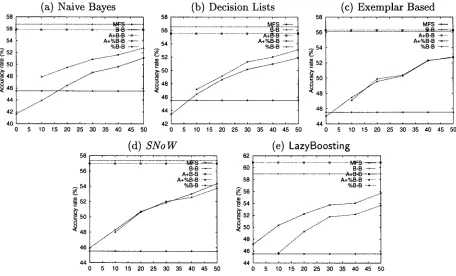
original training set A a relatively small sample of m a n u a l l y s e n s e - t a g g e d examples of the new d o m a i n B. T h e size of this supervised portion varies from 10% to 50% of the available corpus in steps of 10% (the r e m a i n i n g 50% is kept for testing) 6. This e x p e r i m e n t will be referred to as A + % B - B T. In order to d e t e r m i n e to which extent t h e original training set contributes to accurately disambiguating in t h e new domain, we also calculate t h e results for %B-B, t h a t is, using only t h e t u n i n g corpus for training.
Figure 1 graphically presents the results ob- tained by all m e t h o d s . E a c h plot contains the
A + % B - B and % B - B curves, and the straight lines corresponding to t h e lower b o u n d MFC, a n d to the u p p e r b o u n d s B-B and A+B-B.
As expected, t h e accuracy of all m e t h o d s grows (towards the u p p e r b o u n d ) as more tun- ing corpus is a d d e d to t h e training set. How- ever, t h e relation b e t w e e n A + % B - B and %B-B reveals some interesting facts. In plots (c) and (d), the contribution of t h e original training cor- pus is null, while in plots (a) and (b), a degrada- tion o n t h e accuracy is observed. Summarizing, these results suggest t h a t for NB, DL, SN, and EB m e t h o d s it is not w o r t h keeping the original training examples. Instead, a b e t t e r (but dis- appointing) s t r a t e g y would be simply using the t u n i n g corpus. However, this is not the situa- tion of LB - - p l o t ( d ) - - for which a moderate, but consistent, improvement of accuracy is ob- served w h e n retaining t h e original training set.
6Tuning examples can be weighted more highly than the training examples to force the learning algorithm to adapt more quickly to the new corpus. Some experi- ments in this direction revealed that slightly better re- sults can be obtained, though the improvement was not statistically significant.
[image:4.596.71.537.82.188.2]58
56
54
g 52
al ~ 5 0
~ 46
4 4
4 2
4 0
(a) Naive Bayes
[image:5.596.60.516.76.352.2]. . . M ~ S o
... ~ ... B...B . . .
A+B-B ... A+%B-B ~ -
%B-B . . . ..
5 6
~ 5 4
o
52
~ 48
4 6
4 4
5 8
56
54
1 6
4 4
4 2
(b) Decision Lists
. . . G . . . o . . . ~ . . . A Y S : B : : i : : : ....
A+%B-B
%B-B . . . '
, , , , ,
5 10 15 20 25 30 35 40 45 50 5 10 15
( d ) S N o W
5 8
E::E::E.~:E.~:E.~:EZ::Z~:E.~:Z.Z..~YE::LL:::Y.:~.'S::47724:L:;
B - B . . .
Zoi~:~ '°~
5 10 15 20 25 30 35 40 45 50
0 20 25 30 35 40 45 50
62
60 58
~ 56
~ 52
4 8
4 6
4 4
(c) Exemplar Based
5 8
MFS 56 =::=:==::=Q:~=:::=:==:::a=:====::==~=::=:::=:=:Q-~,~=--~---~ A+B-B ...
A+%B-B
54 %B-B ...
52
5 0 ... ~
4 6 / o , , ,
' ' ' 4 4 ' ' ' ' ' ' ' ' ' 5 10 15 20 25 30 35 40 45 50
(e) Lazygoosting
... o ... ~ ... ~ ... M F $ - - ~ - -
B-B ... ... A~'B-B .. . . A+%B-B ~ - -
%B-B . . .
/ / i /
5 10 15 20 25 30 35 40 45 50
Figure 1: Results of the tuning experiment
We observed that part of the poor results
obtained is explained by: 1) corpus A and
B have a very different distribution of senses, and, therefore, different a-priori biases; further- more, 2) examples of corpus A and B contain different information and, therefore, the learn- ing algorithms acquire different (and non inter- changeable) classification clues from both cor- pora. The study of the rules acquired by Lazy- Boosting from WSJ and BC helped understand- ing the differences between corpora. On the one hand, the type of features used in the rules was significantly different between corpora and, ad- ditionally, there were very few rules that applied to both sets. On the other hand, the sign of the prediction of many of these common rules was somewhat contradictory between corpora. See (Escudero et al., 2000c) for details.
4.2 A b o u t t h e t r a i n i n g d a t a q u a l i t y
The observation of the rules acquired by Lazy- Boosting could also help improving data quality in a semi-supervised fashion. It is known that mislabelled examples resulting from annotation errors tend to be hard examples to classify cor- rectly and, therefore, tend to have large weights in the final distribution. This observation al-
lows both to identify the noisy examples and use LazyBoosting as a way to improve the train- ing corpus.
A preliminary experiment has been carried out in this direction by studying the rules ac- quired by LazyBoosting from the training ex-
amples of the word state. The manual revi-
sion, by four different people, of the 50 high- est scored rules, allowed us to identify 28 noisy training examples. 11 of them were clear tag- ging errors, and the remaining 17 were not co- herently tagged and very difficult to judge, since the four annotators achieved systematic dis- agreement (probably due to the extremely fine grained sense definitions involved in these ex- amples).
5 C o n c l u s i o n s
This work reports a comparative study of five ML algorithms for WSD, and provides some re- sults on cross corpora evaluation and domain re-tuning.
Regarding portability, it seems that the per- formance of supervised sense taggers is not guaranteed when moving from one domain to
another (e.g. from a balanced corpus, such
These results imply t h a t some kind of adap- tation is required for cross-corpus application. Consequently, it is our belief t h a t a n u m b e r of issues regarding portability, tuning, knowledge acquisition, etc., should be thoroughly studied before stating t h a t the supervised M k p a r a d i g m is able to resolve a realistic WSD problem.
Regarding the ML algorithms tested, kazy- Boosting emerges as the best option, since it outperforms the other four state-of-the-art m e t h o d s in all experiments. Furthermore, this algorithm shows b e t t e r properties w h e n t u n e d to new domains. F u t u r e work is planned for an extensive evaluation of kazyBoosting on the WSD task. This would include taking into ac- count a d d i t i o n a l / a l t e r n a t i v e attributes, learn- ing curves, testing t h e algorithm on other cor- pora, etc.
R e f e r e n c e s
E. Agirre and D. Martinez. 2000. Decision Lists and
Automatic Word Sense Disambiguation. In Pro-
ceedings of the COLING Workshop on Semantic Annotation and Intelligent Content.
D. Aha, D. Kibler, and M. Albert. 1991. Instance-
based Learning Algorithms. Machine Learning,
7:37-66.
R. F. Bruce and J. M. Wiebe. 1999. Decomposable
Modeling in Natural Language Processing. Com-
putational Linguistics, 25(2):195-207.
J. Cohen. 1960. A Coefficient of Agreement for
Nominal Scales. Journal of Educational and Psy-
chological Measurement, 20:37-46.
W. Daelemans, A. van den Bosch, and J. Zavrel. 1999. Forgetting Exceptions is Harmful in Lan-
guage Learning. Machine Learning, 34:11-41.
T. G. Dietterich. 1998. Approximate Statistical Tests for Comparing Supervised Classification
Learning Algorithms. Neural Computation, 10(7).
R. O. Duda and P. E. Hart. 1973. Pattern Classifi-
cation and Scene Analysis. Wiley ~: Sons. G. Escudero, L. M~rquez, and G. Rigau. 2000a.
Boosting Applied to Word Sense Disambiguation. In Proceedings of the 12th European Conference on Machine Learning, ECML.
G. Escudero, L. M~rquez, and G. Rigau. 2000b. Naive Bayes and Exemplar-Based Approaches to
Word Sense Disambiguation Revisited. In Pro-
ceedings of the 14th European Conference on Ar- tificial Intelligence, ECAL
G. Escudero, L. M~rquez, and G. Rigau. 2000c. On the Portability and Tuning of Supervised Word Sense Disambiguation Systems. Research Report LSI-00-30-R, Software Department (LSI). Techni- cal University of Catalonia (UPC).
N. Ide and J. V@ronis. 1998. Introduction to the Special Issue on Word Sense Disambiguation:
The State of the Art. Computational Linguistics,
24(1):1-40.
A. Kilgarriff and J. Rosenzweig. 2000. English SEN-
SEVAL: Report and Results. In Proceedings of the
2nd International Conference on Language Re- sources and Evaluation, LREC.
C. Leacock, M. Chodorow, and G. A. Miller. 1998. Using Corpus Statistics and WordNet Relations
for Sense Identification. Computational Linguis-
tics, 24(1):147-166.
N. Littlestone. 1988. Learning Quickly when Ir-
relevant Attributes Abound. Machine Learning,
2:285-318.
R. J. Mooney. 1996. Comparative Experiments on Disambiguating Word Senses: An Illustration of
the Role of Bias in Machine Learning. In Proceed-
ings of the 1st Conference on Empirical Methods in Natural Language Processing, EMNLP.
H. T. Ng and H. B. Lee. 1996. Integrating Multiple Knowledge Sources to Disambiguate Word Senses:
An Exemplar-based Approach. In Proceedings of
the 3~th Annual Meeting of the ACL.
H. T. Ng, C. Lim, and S. Foo. 1999. A Case Study on Inter-Annotator Agreement for Word Sense
Disambiguation. In Procs. of the ACL SIGLEX
Workshop: Standardizing Lexical Resources.
H. T. Ng. 1997. Exemplar-Base Word Sense Disam-
biguation: Some Recent Improvements. In Procs.
of the 2nd Conference on Empirical Methods in Natural Language Processing, EMNLP.
A. Ratnaparkhi. 1999. Learning to Parse Natural
Language with Maximum Entropy Models. Ma-
chine Learning, 34:151-175.
D. Roth. 1998. Learning to Resolve Natural Lan-
guage Ambiguities: A Unified Approach. In Pro-
ceedings of the National Conference on Artificial Intelligence, A A A I '98.
R. E. Schapire and Y. Singer. 1999. Improved Boosting Algorithms Using Confidence-rated Pre-
dictions. Machine Learning, 37(3):297-336.
S. Sekine. 1997. The Domain Dependence of Pars-
ing. In Proceedings of the 5th Conference on Ap-
plied Natural Language Processing, ANLP.
G. Towell and E. M. Voorhees. 1998. Disambiguat-
ing Highly Ambiguous Words. Computational
Linguistics, 24(1):125-146.
J. V@ronis. 1998. A study of polysemy judgements
and inter-annotator agreement. In Programme
and advanced papers of the Senseval workshop,
Herstmonceux Castle, England.
D. Yarowsky. 1994. Decision Lists for Lexical Ambi- guity Resolution: Application to Accent Restora-
tion in Spanish and French. In Proceedings of the