Automatic classification of citation function
Simone Teufel Advaith Siddharthan Dan Tidhar
Natural Language and Information Processing Group Computer Laboratory
Cambridge University, CB3 0FD, UK
{Simone.Teufel,Advaith.Siddharthan,Dan.Tidhar}@cl.cam.ac.uk
Abstract
Citation function is defined as the author’s reason for citing a given paper (e.g. ac-knowledgement of the use of the cited method). The automatic recognition of the rhetorical function of citations in scientific text has many applications, from improve-ment of impact factor calculations to text summarisation and more informative ci-tation indexers. We show that our anno-tation scheme for cianno-tation function is re-liable, and present a supervised machine learning framework to automatically clas-sify citation function, using both shallow and linguistically-inspired features. We find, amongst other things, a strong re-lationship between citation function and sentiment classification.
1 Introduction
Why do researchers cite a particular paper? This is a question that has interested researchers in discourse analysis, sociology of science, and in-formation sciences (library sciences) for decades (Garfield, 1979; Small, 1982; White, 2004). Many annotation schemes for citation motivation have been created over the years, and the question has been studied in detail, even to the level of in-depth interviews with writers about each individual cita-tion (Hodges, 1972).
Part of this sustained interest in citations can be explained by the fact that bibliometric met-rics are commonly used to measure the impact of a researcher’s work by how often they are cited (Borgman, 1990; Luukkonen, 1992). However, re-searchers from the field of discourse studies have long criticised purely quantitative citation analy-sis, pointing out that many citations are done out of “politeness, policy or piety” (Ziman, 1968), and that criticising citations or citations in
pass-ing should not “count” as much as central cita-tions in a paper, or as those citacita-tions where a re-searcher’s work is used as the starting point of somebody else’s work (Bonzi, 1982). A plethora of manual annotation schemes for citation motiva-tion have been invented over the years (Garfield, 1979; Hodges, 1972; Chubin and Moitra, 1975). Other schemes concentrate on citation function (Spiegel-R¨using, 1977; O’Connor, 1982; Wein-stock, 1971; Swales, 1990; Small, 1982)). One of the best-known of these studies (Moravcsik and Murugesan, 1975) divides citations in running text into four dimensions: conceptual or opera-tional use (i.e., use of theory vs. use of technical method); evolutionary or juxtapositional (i.e., own work is based on the cited work vs. own work is an alternative to it); organic or perfunctory (i.e., work is crucially needed for understanding of citing ar-ticle or just a general acknowledgement); and fi-nally confirmative vs. negational (i.e., is the cor-rectness of the findings disputed?). They found, for example, that 40% of the citations were per-functory, which casts further doubt on the citation-counting approach.
Based on such annotation schemes and hand-analyzed data, different influences on citation be-haviour can be determined. Nevertheless, re-searchers in the field of citation content analysis do not normally cross-validate their schemes with independent annotation studies with other human annotators, and usually only annotate a small num-ber of citations (in the range of hundreds or thou-sands). Also, automated application of the annota-tion is not something that is generally considered in the field, though White (2004) sees the future of discourse-analytic citation analysis in automation. Apart from raw material for bibliometric stud-ies, citations can also be used for search purposes in document retrieval applications. In the library world, printed or electronic citation indexes such as ISI (Garfield, 1979) serve as an orthogonal
Nitta and Niwa 94 Resnik 95
Brown et al. 90a
Rose et al. 90
Church and Gale 91
Dagan et al. 94 Li and Abe 96
Hindle 93
Hindle 90
Dagan et al 93
Pereira et al. 93
Following Pereira et al, we measure word similarity by the relative entropy or Kulbach−Leibler (KL) distance, bet− ween the corresponding conditional distributions.
[image:2.595.72.292.62.240.2]His notion of similarity seems to agree with our intuitions in many cases, but it is not clear how it can be used directly to construct word classes and corresponding models of association.
Figure 1: A rhetorical citation map
search tool to find relevant papers, starting from a source paper of interest. With the increased avail-ability of documents in electronic form in recent years, citation-based search and automatic citation indexing have become highly popular, cf. the suc-cessful search tools Google Scholar and CiteSeer (Giles et al., 1998).1
But not all search needs are fulfilled by current citation indexers. Experienced researchers are of-ten interested inrelationsbetween articles (Shum, 1998). They want to know if a certain article crit-icises another and what the criticism is, or if the current work is based on that prior work. This type of information is hard to come by with current search technology. Neither the author’s abstract, nor raw citation counts help users in assessing the relation between articles.
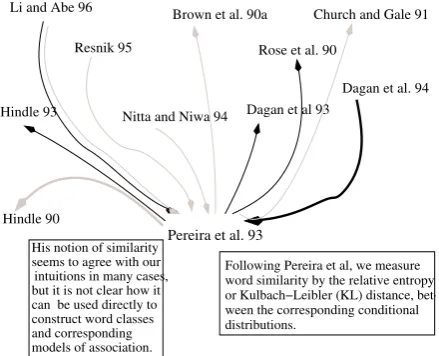
Fig. 1 shows a hypothetical search tool which displays differences and similarities between a tar-get paper (here: Pereira et al., 1993) and the pa-pers that it cites and that cite it. Contrastivelinks are shown in grey – links to rival papers and pa-pers the current paper contrasts itself to. Continu-ativelinks are shown in black – links to papers that usethe methodology of the current paper. Fig. 1 also displays the most characteristic textual sen-tence about each citation. For instance, we can see which aspect ofHindle (1990)our example paper criticises, and in which way the example paper’s work was used byDagan et al. (1994).
Note that not even the CiteSeer text snippet
1These tools automatically citation-index all scientific
ar-ticles reached by a web-crawler, making them available to searchers via authors or keywords in the title, and displaying the citation in context of a text snippet.
can fulfil the relation search need: it is always centered around the physical location of the ci-tations, but the context is often not informative enough for the searcher to infer the relation. In fact, studies from our annotated corpus (Teufel, 1999) show that 69% of the 600 sentences stat-ing contrast with other work and 21% of the 246 sentences stating research continuation with other work do not contain the corresponding cita-tion; the citation is found in preceding sentences (which means that the sentence expressing the contrast or continuation is outside the CiteSeer snippet). A more sophisticated, discourse-aware citation indexer which finds these sentences and associates them with the citation would add con-siderable value to the researcher’s bibliographic search (Ritchie et al., 2006b).
Our annotation scheme for citations is based on empirical work in content citation analysis. It is designed for information retrieval applications such as improved citation indexing and better bib-liometric measures (Teufel et al., 2006). Its 12 cat-egories mark relationships with other works. Each citation is labelled with exactly one category. The following top-level four-way distinction applies:
• Explicit statement of weakness
• Contrast or comparison with other work (4 categories)
• Agreement/usage/compatibility with other work (6 categories), and
• A neutral category.
In this paper, we show that the scheme can be reliably annotated by independent coders. We also report results of a supervised machine learning ex-periment which replicates the human annotation.
2 An annotation scheme for citations
Category Description
Weak Weakness of cited approach
CoCoGM Contrast/Comparison in Goals or Meth-ods(neutral)
CoCo- Author’s work is stated to be superior to cited work
CoCoR0 Contrast/Comparison in Results (neutral) CoCoXY Contrast between 2 cited methods PBas Author uses cited work as basis or starting
point
PUse Author uses
tools/algorithms/data/definitions
PModi Author adapts or modifies tools/algorithms/data
PMot This citation is positive about approach used or problem addressed (used to mo-tivate work in current paper)
PSim Author’s work and cited work are similar PSup Author’s work and cited work are
compat-ible/provide support for each other Neut Neutral description of cited work, or not
[image:3.595.72.283.60.294.2]enough textual evidence for above cate-gories, or unlisted citation function
Figure 2: Annotation scheme for citation function.
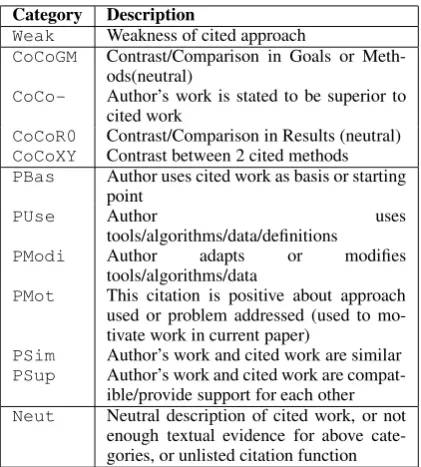
Our categories are as follows: One category (Weak) is reserved for weakness of previous re-search, if it is addressed by the authors. The next four categories describe comparisons or contrasts between own and other work. The difference tween them concerns whether the contrast is be-tween methods employed or goals (CoCoGM), or results, and in the case of results, a difference is made between the cited results being worse than the current work (CoCo-), or comparable or bet-ter results (CoCoR0). As well as considering dif-ferences between the current work and other work, we also mark citations if they are explicitly com-pared and contrasted with other work (i.e. not the work in the current paper). This is expressed in category CoCoXY. While this is not typically annotated in the literature, we expect a potential practical benefit of this category for our applica-tion, particularly in searches for differences and rival approaches.
The next set of categories we propose concerns positive sentiment expressed towards a citation, or a statement that the other work is actively used in the current work (which we consider the ulti-mate praise). We mark statements of use of data and methods of the cited work, differentiating un-changed use (PUse) from use with adaptations
(PModi). Work which is stated as the explicit
starting point or intellectual ancestry is marked with our category PBas. If a claim in the liter-ature is used to strengthen the authors’ argument,
or vice versa, we assign the category PSup. We also mark similarity of (an aspect of) the approach to the cited work (PSim), and motivation of ap-proach used or problem addressed (PMot).
Our twelfth category,Neut, bundles truly neu-tral descriptions of cited work with those cases where the textual evidence for a citation function was not enough to warrant annotation of that cate-gory, and all other functions for which our scheme did not provide a specific category.
Citation function is hard to annotate because it in principle requires interpretation of author inten-tions (what could the author’s intention have been in choosing a certain citation?). One of our most fundamental principles is thus to only mark explic-itly signalled citation functions. Our guidelines explicitly state that a general linguistic phrase such as “better” or “used by us” must be present; this increases the objectivity of defining citation func-tion. Annotators must be able to point to textual evidence for assigning a particular function (and are asked to type the source of this evidence into the annotation tool for each citation). Categories are defined in terms of certain objective types of statements (e.g., there are 7 cases forPMot, e.g. “Citation claims that or gives reasons for why problem Y is hard”). Annotators can use general text interpretation principles when assigning the categories (such as anaphora resolution and par-allel constructions), but are not allowed to use in-depth knowledge of the field or of the authors.
that they are using somebody else’s method. An-other difficult distinction concerns the judgement of whether the authors continue somebody’s re-search (i.e., consider their rere-search as intellectual ancestry, i.e. PBas), or whether they simply use the work (PUse).
The unit of annotation is a) the full citation (as recognised by our automatic citation processor on our corpus), and b) names of authors of cited pa-pers anywhere in running text outside of a for-mal citation context (i.e., without date). These latter are marked up, slightly unusually in com-parison to other citation indexers, because we be-lieve they function as important referents compa-rable in importance to formal citations.2 In
prin-ciple, there are many other linguistic expressions by which the authors could refer to other people’s work: pronouns, abbreviations such as “Mueller and Sag (1990), henceforth M & S”, and names of approaches or theories which are associated with particular authors. The fact that in these contexts citation function cannot be annotated (because it is not technically feasible to recognise them well enough) sometimes causes problems with context dependencies.
While there are unambiguous example cases where the citation function can be decided on the basis of the sentence alone, this is not always the case. Most approaches are not criticised in the same sentence where they are also cited: it is more likely that there are several descriptive sentences about a cited approach between its formal cita-tion and the evaluative statement, which is often at the end of the textual segment about this citation. Nevertheless, the annotator must mark the func-tion on the nearest appropriate annotafunc-tion unit (ci-tation or author name). Our rules decree that con-text is in most cases constrained to the paragraph boundary. In rare cases, paper-wide information is required (e.g., forPMot, we need to know that a praised approach is used by the authors, infor-mation which may not be local in the paragraph). Annotators are thus asked to skim-read the paper before annotation.
One possible view on this annotation scheme could consider the first two sets of categories as “negative” and the third set of categories “posi-tive”, in the sense of Pang et al. (2002) and Turney (2002). Authors need to make a point (namely,
2Our citation processor can recognise these after parsing
the citation list.
that they have contributed something which is bet-ter or at least new (Myers, 1992)), and they thus have a stance towards their citations. But although there is a sentiment aspect to the interpretation of citations, this is not the whole story. Many of our “positive” categories are more concerned with dif-ferent ways in which the cited work is useful to the current work (which aspect of it is used, e.g., just a definition or the entire solution?), and many of the contrastive statements have no negative connota-tion at all and simply state a (value-free) differ-ence between approaches. However, if one looks at the distribution of positive and negative adjec-tives around citations, it is clear that there is a non-trivial connection between our task and sentiment classification.
The data we use comes from our corpus of 360 conference articles in computational linguis-tics, drawn from the Computation and Language E-Print Archive (http://xxx.lanl.gov/cmp-lg). The articles are transformed into XML format; head-lines, titles, authors and reference list items are au-tomatically marked up. Reference lists are parsed using regular patterns, and cited authors’ names are identified. Our citation parser then finds cita-tions and author names in running text and marks them up. Ritchie et al. (2006a) report high ac-curacy for this task (94% of citations recognised, provided the reference list was error-free). On av-erage, our papers contain 26.8 citation instances in running text3. For human annotation, we use our
own annotation tool based on XML/XSLT tech-nology, which allows us to use a web browser to interactively assign one of the 12 tags (presented as a pull-down list) to each citation.
We measure inter-annotator agreement between three annotators (the three authors), who indepen-dently annotated 26 articles with the scheme (con-taining a total of 120,000 running words and 548 citations), using the written guidelines. The guide-lines were developed on a different set of articles from the ones used for annotation.
Inter-annotator agreement was Kappa=.72 (n=12;N=548;k=3)4. This is quite high,
consider-ing the number of categories and the difficulties
3As opposed to reference list items, which are fewer. 4Following Carletta (1996), we measure agreement in
(e.g., non-local dependencies) of the task. The relative frequency of each category observed in the annotation is listed in Fig. 3. As expected, the distribution is very skewed, with more than 60% of the citations of category Neut.5 What
is interesting is the relatively high frequency of usage categories (PUse, PModi, PBas) with a total of 18.9%. There is a relatively low frequency of clearly negative citations (Weak,
CoCo-, total of 4.1%), whereas the neutral–
contrastive categories (CoCoR0, CoCoXY,
CoCoGM) are slightly more frequent at 7.6%.
This is in concordance with earlier annotation experiments (Moravcsik and Murugesan, 1975; Spiegel-R¨using, 1977).
3 Features for automatic recognition of citation function
This section summarises the features we use for machine learning citation function. Some of these features were previously found useful for a dif-ferent application, namely Argumentative Zoning (Teufel, 1999; Teufel and Moens, 2002), some are specific to citation classification.
3.1 Cue phrases
Myers (1992) calls meta-discourse the set of ex-pressions that talkabout the act of presenting re-search in a paper, rather than the rere-search itself (which is called object-level discourse). For in-stance, Swales (1990) names phrases such as “to our knowledge, no. . .” or “As far as we aware” as meta-discourse associated with a gap in the cur-rent literature. Strings such as these have been used in extractive summarisation successfully ever since Paice’s (1981) work.
We model meta-discourse (cue phrases) and treat it differently from object-level discourse. There are two different mechanisms: A finite grammar over strings with a placeholder mecha-nism for POS and for sets of similar words which can be substituted into a string-based cue phrase (Teufel, 1999). The grammar corresponds to 1762 cue phrases. It was developed on 80 papers which are different to the papers used for our experiments here.
The other mechanism is a POS-based recog-niser of agents and a recogrecog-niser for specific actions these agents perform. Two main agent types (the
5Spiegel-R¨using found that out of 2309 citations she
ex-amined, 80% substantiated statements.
authors of the paper, and everybody else) are mod-elled by 185 patterns. For instance, in a paragraph describing related work, we expect to find refer-ences to other people in subject position more of-ten than in the section detailing the authors’ own methods, whereas in the background section, we often find general subjects such as “researchers in computational linguistics” or “in the literature”. For each sentence to be classified, its grammatical subject is determined by POS patterns and, if pos-sible, classified as one of these agent types. We also use the observation that in sentences without meta-discourse, one can assume that agenthood has not changed.
20 different action types model the main verbs involved in meta-discourse. For instance, there is a set of verbs that is often used when the over-all scientific goal of a paper is defined. These are the verbs of presentation, such as “propose, present, report” and “suggest”; in the corpus we found other verbs in this function, but with a lower frequency, namely “describe, discuss, give, intro-duce, put forward, show, sketch, state” and “talk about”. There are also specialised verb clusters which co-occur with PBas sentences, e.g., the cluster of continuation of ideas (eg.“adopt, agree with, base, be based on, be derived from, be orig-inated in, be inspired by, borrow, build on,. . . ”). On the other hand, the semantics of verbs inWeak
sentences is often concerned with failing (of other researchers’ approaches), and often contain verbs such as“abound, aggravate, arise, be cursed, be incapable of, be forced to, be limited to, . . . ”.
We use 20 manually acquired verb clusters. Negation is recognised, but too rare to define its own clusters: out of the20×2 = 40theoretically possible verb clusters, only 27 were observed in our development corpus. We have recently auto-mated the process of verb–object pair acquisition from corpora for two types of cue phrases (Abdalla and Teufel, 2006) and are planning on expanding this work to other cue phrases.
3.2 Cues Identified by annotators
Neut PUse CoCoGM PSim Weak PMot CoCoR0 PBas CoCoXY CoCo- PModi PSup 62.7% 15.8% 3.9% 3.8% 3.1% 2.2% 0.8% 1.5% 2.9% 1.0% 1.6% 1.1%
Figure 3: Distribution of citation categories
Weak CoCoGM CoCoR0 CoCo- CoCoXY PBas PUse PModi PMot PSim PSup Neut
P .78 .81 .77 .56 .72 .76 .66 .60 .75 .68 .83 .80
R .49 .52 .46 .19 .54 .46 .61 .27 .64 .38 .32 .92
F .60 .64 .57 .28 .62 .58 .63 .37 .69 .48 .47 .86
Percentage Accuracy 0.77 Kappa (n=12; N=2829; k=2) 0.57
[image:6.595.321.513.239.310.2]Macro-F 0.57
Figure 4: Summary of Citation Analysis results (10-fold cross-validation; IBk algorithm; k=3).
that recorded the presence of cues that our annota-tors associated with a particular class.
3.3 Other features
There are other features which we use for this task. We know from Teufel and Moens (2002) that verb tense and voice should be useful for recogniz-ing statements of previous work, future work and work performed in the paper. We also recognise modality (whether or not a main verb is modified by an auxiliary, and which auxiliary it is).
The overall location of a sentence containing a reference should be relevant. We observe that more PMotcategories appear towards the begin-ning of the paper, as do Weakcitations, whereas comparative results (CoCoR0, CoCoR-) appear towards the end of articles. More fine-grained lo-cation features, such as the lolo-cation within the paragraph and the section, have also been imple-mented.
The fact that a citation points to own previous work can be recognised, as we know who the pa-per authors are. As we have access to the infor-mation in the reference list, we also know the last names ofallcited authors (even in the case where an et al. statement in running text obscures the later-occurring authors). With self-citations, one might assume that the probability of re-use of ma-terial from previous own work should be higher, and the tendency to criticise lower.
4 Results
Our evaluation corpus for citation analysis con-sists of 116 articles (randomly drawn from the part of our corpus which was not used for guideline development or cue phrase acquisition). The 116 articles contain 2829 citation instances. Each citation instance was manually tagged as one
Weakness Positive Contrast Neutral
P .80 .75 .77 .81
R .49 .65 .52 .90
F .61 .70 .62 .86
Percentage Accuracy 0.79 Kappa (n=12; N=2829; k=2) 0.59
Macro-F 0.68
Figure 5: Summary of results (10-fold cross-validation; IBk algorithm; k=3): Top level classes.
Weakness Positive Neutral
P .77 .75 .85
R .42 .65 .92
F .54 .70 .89
Percentage Accuracy 0.83 Kappa (n=12; N=2829; k=2) 0.58
Macro-F 0.71
Figure 6: Summary of results (10-fold cross-validation; IBk algorithm; k=3): Sentiment Anal-ysis.
of {Weak, CoCoGM, CoCo-, CoCoR0, CoCoXY, PBas, PUse, PModi, PMot, PSim, PSup, Neut}. The papers are then further processed (e.g. to-kenised and POS-tagged). All other features are automatically determined (e.g. self-citations are detected by overlap of citing and cited authors); then, machine learning is applied to the feature vectors.
[image:6.595.342.491.360.436.2]heavily skewed distributions like ours6.
In the case of Macro-F, each category is treated as one unit, independent of the number of items contained in it. Therefore, the classification suc-cess of the individual items in rare categories is given more importance than classification suc-cess of frequent category items. However, one should keep in mind that numerical values in macro-averaging are generally lower (Yang and Liu, 1999), due to fewer training cases for the rare categories. Kappa has the additional advantage over Macro-F that it filters out random agreement (random use, but following the observed distribu-tion of categories).
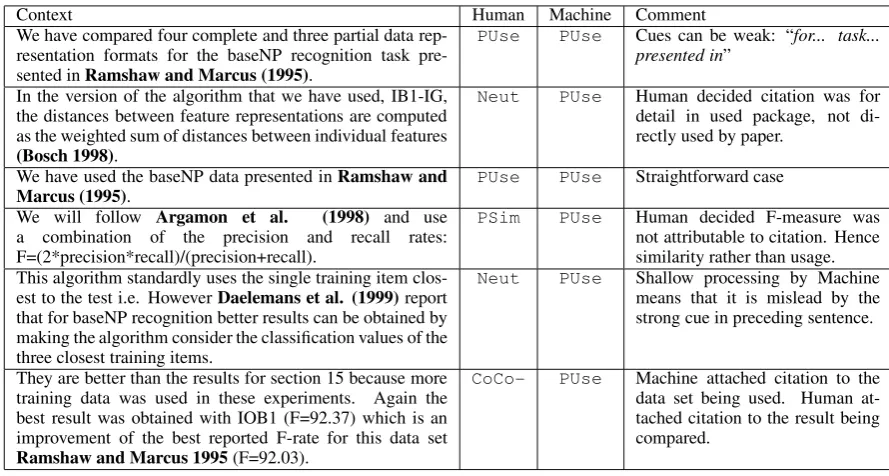
For our task, memory-based learning outper-formed other models. The reported results use the IBk algorithm withk = 3(we used the Weka ma-chine learning toolkit (Witten and Frank, 2005) for our experiments). Fig. 7 provides a few ex-amples from one file in the corpus, along with the gold standard citation class, the machine predic-tion, and a comment.
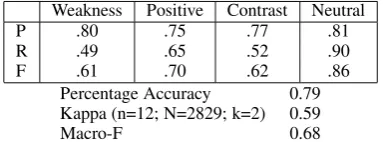
Kappa is even higher for the top level distinc-tion. We collapsed the obvious similar categories (allPcategories into one category, and all CoCo
categories into another) to give four top level categories (Weak, Positive, Contrast, Neutral; results in Fig. 5). Precision for all the categories is above 0.75, and K=0.59. For con-trast, the human agreement for this situation was K=0.76 (n=3,N=548,k=3).
In a different experiment, we grouped the cate-gories as follows, in an attempt to perform senti-ment analysis over the classifications:
Old Categories New Category Weak, CoCo- Negative PMot, PUse, PBas, PModi, PSim, PSup Positive
CoCoGM, CoCoR0, CoCoXY, Neut Neutral
Thus negative contrasts and weaknesses are grouped intoNegative, while neutral contrasts are grouped into Neutral. All positive classes are conflated intoPositive.
Results show that this grouping raises results to a smaller degree than the top-level distinction did (to K=.58). For contrast, the human agree-ment for these collapsed categories was K=.75 (n=3,N=548,k=3).
6This situation has parallels in information retrieval,
where precision and recall are used because accuracy over-estimates the performance on irrelevant items.
5 Conclusion
We have presented a new task: annotation of ci-tation function in scientific text, a phenomenon which we believe to be closely related to the over-all discourse structure of scientific articles. Our annotation scheme concentrates on weaknesses of other work, and on similarities and contrast be-tween work and usage of other work. In this paper, we present machine learning experiments for replicating the human annotation (which is re-liable at K=.72). The automatic result reached K=.57 (acc=.77) for the full annotation scheme; rising to Kappa=.58 (acc=.83) for a three-way classification (Weak, Positive, Neutral).
We are currently performing an experiment to see if citation processing can increase perfor-mance in a large-scale, real-world information retrieval task, by creating a test collection of researchers’ queries and relevant documents for these (Ritchie et al., 2006a).
6 Acknowledgements
This work was funded by the EPSRC projects CIT-RAZ (GR/S27832/01, “Rhetorical Citation Maps and Domain-independent Argumentative Zon-ing”) and SCIBORG (EP/C010035/1, “Extracting the Science from Scientific Publications”).
References
Rashid M. Abdalla and Simone Teufel. 2006. A bootstrap-ping approach to unsupervised detection of cue phrase variants. InProc. of ACL/COLING-06.
Susan Bonzi. 1982. Characteristics of a literature as predic-tors of relatedness between cited and citing works.JASIS, 33(4):208–216.
Christine L. Borgman, editor. 1990. Scholarly Communica-tion and Bibliometrics. Sage Publications, CA.
Jean Carletta. 1996. Assessing agreement on classification tasks: The kappa statistic. Computational Linguistics, 22(2):249–254.
Daryl E. Chubin and S. D. Moitra. 1975. Content analysis of references: Adjunct or alternative to citation counting?
Social Studies of Science, 5(4):423–441.
Eugene Garfield. 1979. Citation Indexing: Its Theory and Application in Science, Technology and Humanities. J. Wiley, New York, NY.
C. Lee Giles, Kurt D. Bollacker, and Steve Lawrence. 1998. Citeseer: An automatic citation indexing system. InProc. of the Third ACM Conference on Digital Libraries, pages 89–98.
T.L. Hodges. 1972. Citation Indexing: Its Potential for Bibli-ographical Control. Ph.D. thesis, University of California at Berkeley.
David D. Lewis. 1991. Evaluating text categorisation. In
Context Human Machine Comment We have compared four complete and three partial data
rep-resentation formats for the baseNP recognition task pre-sented inRamshaw and Marcus (1995).
PUse PUse Cues can be weak: “for... task... presented in”
In the version of the algorithm that we have used, IB1-IG, the distances between feature representations are computed as the weighted sum of distances between individual features (Bosch 1998).
Neut PUse Human decided citation was for detail in used package, not di-rectly used by paper.
We have used the baseNP data presented inRamshaw and
Marcus (1995). PUse PUse Straightforward case
We will follow Argamon et al. (1998) and use a combination of the precision and recall rates: F=(2*precision*recall)/(precision+recall).
PSim PUse Human decided F-measure was not attributable to citation. Hence similarity rather than usage. This algorithm standardly uses the single training item
clos-est to the tclos-est i.e. HoweverDaelemans et al. (1999)report that for baseNP recognition better results can be obtained by making the algorithm consider the classification values of the three closest training items.
Neut PUse Shallow processing by Machine means that it is mislead by the strong cue in preceding sentence.
They are better than the results for section 15 because more training data was used in these experiments. Again the best result was obtained with IOB1 (F=92.37) which is an improvement of the best reported F-rate for this data set Ramshaw and Marcus 1995(F=92.03).
[image:8.595.70.515.60.298.2]CoCo- PUse Machine attached citation to the data set being used. Human at-tached citation to the result being compared.
Figure 7: Examples of classifications by the machine learner.
Terttu Luukkonen. 1992. Is scientists’ publishing behaviour reward-seeking?Scientometrics, 24:297–319.
Michael H. MacRoberts and Barbara R. MacRoberts. 1984. The negational reference: Or the art of dissembling. So-cial Studies of Science, 14:91–94.
Michael J. Moravcsik and Poovanalingan Murugesan. 1975. Some results on the function and quality of citations. So-cial Studies of Science, 5:88–91.
Greg Myers. 1992. In this paper we report...—speech acts and scientific facts.Journal of Pragmatics, 17(4). John O’Connor. 1982. Citing statements: Computer
recogni-tion and use to improve retrieval.Information Processing and Management, 18(3):125–131.
Chris D. Paice. 1981. The automatic generation of literary abstracts: an approach based on the identification of self-indicating phrases. In R. Oddy, S. Robertson, C. van Rijs-bergen, and P. W. Williams, editors,Information Retrieval Research. Butterworth, London, UK.
Bo Pang, Lillian Lee, and Shivakumar Vaithyanathan. 2002. Thumbs up? Sentiment classification using machine learning techniques. InProc. of EMNLP-02.
Anna Ritchie, Simone Teufel, and Stephen Robertson. 2006a. Creating a test collection for citation-based IR ex-periments. InProc. of HLT/NAACL 2006, New York, US. Anna Ritchie, Simone Teufel, and Stephen Robertson. 2006b. How to find better index terms through citations. InProc. of ACL/COLING workshop “Can Computational Linguistics improve IR”.
Simon Buckingham Shum. 1998. Evolving the web for sci-entific knowledge: First steps towards an “HCI knowledge web”.Interfaces, British HCI Group Magazine, 39. Henry Small. 1982. Citation context analysis. In P. Dervin
and M. J. Voigt, editors,Progress in Communication Sci-ences 3, pages 287–310. Ablex, Norwood, N.J.
Ina Spiegel-R¨using. 1977. Bibliometric and content analy-sis.Social Studies of Science, 7:97–113.
John Swales. 1986. Citation analysis and discourse analysis.
Applied Linguistics, 7(1):39–56.
John Swales, 1990. Genre Analysis: English in Academic and Research Settings. Chapter 7: Research articles in English, pages 110–176. Cambridge University Press, Cambridge, UK.
Simone Teufel and Marc Moens. 2002. Summarising scien-tific articles — experiments with relevance and rhetorical status.Computational Linguistics, 28(4):409–446. Simone Teufel, Advaith Siddharthan, and Dan Tidhar. 2006.
An annotation scheme for citation function. InProc. of SIGDial-06.
Simone Teufel. 1999. Argumentative Zoning: Information Extraction from Scientific Text. Ph.D. thesis, School of Cognitive Science, University of Edinburgh, UK. Peter D. Turney. 2002. Thumbs up or thumbs down?
se-mantic orientation applied to unsupervised classification of reviews. InProc. of ACL-02.
Melvin Weinstock. 1971. Citation indexes. In Encyclope-dia of Library and Information Science, volume 5. Dekker, New York, NY.
Howard D. White. 2004. Citation analysis and discourse analysis revisited.Applied Linguistics, 25(1):89–116. Ian H. Witten and Eibe Frank. 2005. Data Mining:
Practi-cal machine learning tools and techniques. Morgan Kauf-mann, San Francisco.
Yiming Yang and Xin Liu. 1999. A re-examination of text categorization methods. InProc. of SIGIR-99.