Style & Topic Language Model Adaptation Using HMM-LDA
Bo-June (Paul) Hsu, James Glass
MIT Computer Science and Artificial Intelligence Laboratory
32 Vassar Street, Cambridge, MA 02139, USA
{bohsu,glass}@mit.edu
Abstract
Adapting language models across styles and topics, such as for lecture transcrip-tion, involves combining generic style models with topic-specific content rele-vant to the target document. In this work, we investigate the use of the Hid-den Markov Model with Latent Dirichlet Allocation (HMM-LDA) to obtain syn-tactic state and semantic topic assign-ments to word instances in the training corpus. From these context-dependent labels, we construct style and topic mod-els that better model the target document, and extend the traditional bag-of-words topic models to n-grams. Experiments with static model interpolation yielded a perplexity and relative word error rate (WER) reduction of 7.1% and 2.1%, re-spectively, over an adapted trigram base-line. Adaptive interpolation of mixture components further reduced perplexity by 9.5% and WER by a modest 0.3%.
1
Introduction
With the rapid growth of audio-visual materials available over the web, effective language mod-eling of the diverse content, both in style and topic, becomes essential for efficient access and management of this information. As a prime example, successful language modeling for aca-demic lectures not only enables the initial tran-scription via automatic speech recognition, but also assists educators and students in the creation and navigation of these materials through annota-tion, retrieval, summarizaannota-tion, and even transla-tion of the embedded content.
Compared with other types of audio content, lecture speech often exhibits a high degree of spontaneity and focuses on narrow topics with specific terminology (Furui, 2003; Glass et al, 2004). Unfortunately, training corpora available for language modeling rarely match the target lecture in both style and topic. While transcripts from other lectures better match the style of the target lecture than written text, it is often difficult to find transcripts on the target topic. On the other hand, although topic-specific vocabulary can be gleaned from related text materials, such as the textbook and lecture slides, written lan-guage is a poor predictor of how words are actu-ally spoken. Furthermore, given that the precise topic of a target lecture is often unknown a priori and may even shift over time, it is generally dif-ficult to identify topically related documents. Thus, an effective language model (LM) need to not only account for the casual speaking style of lectures, but also accommodate the topic-specific vocabulary of the subject matter. Moreover, the ability of the language model to dynamically adapt over the course of the lecture could prove extremely useful for both increasing transcription accuracy, as well as providing evidence for lec-ture segmentation and information retrieval.
In this paper, we investigate the application of the syntactic state and semantic topic assign-ments from the Hidden Markov Model with La-tent Dirichlet Allocation model to the problem of language modeling. We explore the use of these context-dependent labels to identify style and learn topics from both a large number of spoken lectures as well as written text. By dynamically interpolating lecture style models with topic-specific models, we obtain language models that better describe the subtopic structure within a lecture. Initial experiments demonstrate a 16.1% perplexity reduction and a 2.4% WER reduction over an adapted trigram baseline.
In the following sections, we first summarize related research on adaptive and topic-mixture language models, and describe previous work on the HMM-LDA model. We then examine the ability of the model to learn syntactic classes as well as topics from textbook materials and lec-ture transcripts. Next, we describe a variety of language model experiments we performed to combine style and topic models constructed from the state and topic labels with conventional tri-gram models trained from both spoken and writ-ten materials. We also demonstrate the use of the combined model in an on-line adaptive mode. Finally, we summarize the results of this research and suggest future opportunities for related mod-eling techniques in spoken lecture and other con-tent processing research.
2
Adaptive and Topic-Mixture LMs
The concept of adaptive and topic-mixture lan-guage models has been previously explored by many researchers. Adaptive language modeling exploits the property that words appearing earlier in a document are likely to appear again. Cache language models (Kuhn and De Mori, 1990; Clarkson and Robinson, 1997) leverage this ob-servation and increase the probability of previ-ously observed words in a document when pre-dicting the next word. By interpolating with a conditional trigram cache model, Goodman (2001) demonstrated up to 34% decrease in per-plexity over a trigram baseline for small training sets.
The cache intuition has been extended by at-tempting to increase the probability of unob-served but topically related words. Specifically, given a mixture model with topic-specific com-ponents, we can increase the mixture weights of the topics corresponding to previously observed words to better predict the next word. Some of the early work in this area used a maximum en-tropy language model framework to trigger in-creases in likelihood of related words (Lau et al., 1993; Rosenfeld, 1996).
A variety of methods has been used to explore topic-mixture models. To model a mixture of topics within a document, the sentence mixture model (Iyer and Ostendorf, 1999) builds multiple topic models from clusters of training sentences and defines the probability of a target sentence as a weighted combination of its probability under each topic model. Latent Semantic Analysis (LSA) has been used to cluster topically related words and has demonstrated significant
reduc-tion in perplexity and word error rate (Belle-garda, 2000). Probabilistic LSA (PLSA) has been used to decompose documents into compo-nent word distributions and create unigram topic models from these distributions. Gildea and Hofmann (1999) demonstrated noticeable per-plexity reduction via dynamic combination of these unigram topic models with a generic tri-gram model.
To identify topics from an unlabeled corpus, (Blei et al., 2003) extends PLSA with the Latent Dirichlet Allocation (LDA) model that describes each document in a corpus as generated from a mixture of topics, each characterized by a word unigram distribution. Hidden Markov Model with LDA (HMM-LDA) (Griffiths et al., 2004) further extends this topic mixture model to sepa-rate syntactic words from content words whose distributions depend primarily on local context and document topic, respectively.
In the specific area of lecture processing, pre-vious work in language model adaptation has primarily focused on customizing a fixed n-gram language model for each lecture by combining n-gram statistics from general conversational speech, other lectures, textbooks, and other re-sources related to the target lecture (Nanjo and Kawahara, 2002, 2004; Leeuwis et al., 2003; Park et al., 2005).
Most of the previous work on topic-mixture models focuses on in-domain adaptation using large amounts of matched training data. How-ever, most, if not all, of the data available to train a lecture language model are either cross-domain or cross-style. Furthermore, although adaptive models have been shown to yield significant per-plexity reduction on clean transcripts, the im-provements tend to diminish when working with speech recognizer hypotheses with high WER.
3
HMM-LDA
3.1 Latent Dirichlet Allocation
Discrete Principal Component Analysis describes a family of models that decompose a set of fea-ture vectors into its principal components (Bun-tine and Jakulin, 2005). Describing feature vec-tors via their components reduces the number of parameters required to model the data, hence im-proving the quality of the estimated parameters when given limited training data. LSA, PLSA, and LDA are all examples from this family.
Given a predefined number of desired compo-nents, LSA models feature vectors by finding a set of orthonormal components that maximize the variance using singular value decomposition (Deerwester et al., 1990). Unfortunately, the component vectors may contain non-interpret-able negative values when working with word occurrence counts as feature vectors. PLSA eliminates this problem by using non-negative matrix factorization to model each document as a weighted combination of a set of non-negative feature vectors (Hofmann, 1999). However, be-cause the number of parameters grows linearly with the number of documents, the model is prone to overfitting. Furthermore, because each training document has its own set of topic weight parameters, PLSA does not provide a generative framework for describing the probability of an unseen document (Blei et al., 2003).
To address the shortcomings of PLSA, Blei et al. (2003) introduced the LDA model, which fur-ther imposes a Dirichlet distribution on the topic mixture weights corresponding to the documents in the corpus. With the number of model pa-rameters dependent only on the number of topic mixtures and vocabulary size, LDA is less prone to overfitting and is capable of estimating the probability of unobserved test documents.
Empirically, LDA has been shown to outper-form PLSA in corpus perplexity, collaborative filtering, and text classification experiments (Blei et al., 2003). Various extensions to the basic LDA model have since been proposed. The Au-thor Topic model adds an additional dependency on the author(s) to the topic mixture weights of each document (Rosen-Zvi et al., 2005). The Hierarchical Dirichlet Process is a nonparametric model that generalizes distribution parameter modeling to multiple levels. Without having to estimate the number of mixture components, this model has been shown to match the best result from LDA on a document modeling task (Teh et al., 2004).
3.2 Hidden Markov Model with LDA
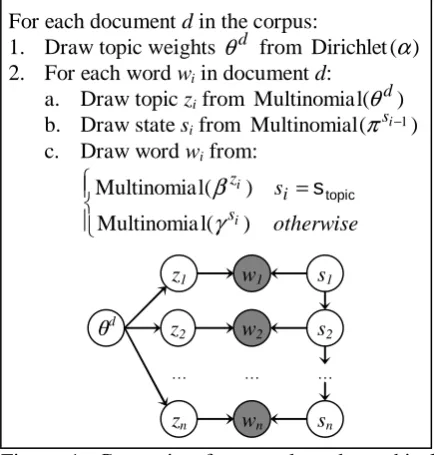
HMM-LDA model proposed by Griffiths et al. (2004) combines the HMM and LDA models to separate syntactic words with local dependencies from topic-dependent content words without re-quiring any labeled data. Similar to HMM-based part-of-speech taggers, HMM-LDA maps each word in the document to a hidden syntactic state. Each state generates words according to a uni-gram distribution except the special topic state, where words are modeled by document-specific mixtures of topic distributions, as in LDA. Figure 1 describes this generative process in more detail.
Figure 1: Generative framework and graphical model representation of HMM-LDA. The num-ber of states and topics are pre-specified. The topic mixture for each document is modeled with a Dirichlet distribution. Each word wi in the n-word document is generated from its hidden state
si or hidden topic zi if si is the special topic state.
Unlike vocabulary selection techniques that separate domain-independent words from topic-specific keywords using word collocation statis-tics, HMM-LDA classifies each word instance according to its context. Thus, an instance of the word “return” may be assigned to a syntactic state in “to return a”, but classified as a topic keyword in “expected return for”. By labeling each word in the training set with its syntactic state and mixture topic, HMM-LDA not only separates stylistic words from content words in a context-dependent manner, but also decomposes the corpus into a set of topic word distributions. This form of soft, context-dependent
classifica-For each document d in the corpus:
1. Draw topic weights θd from Dirichlet(α)
2. For each word wi in document d:
a. Draw topic zi from Multinomial(θd) b. Draw state si from Multinomial(πsi−1)
c. Draw word wi from:
=
otherwise s
i i
s i z
) ( l Multinomia
) ( l Multinomia
γ
β stopic
D
d
z1 w1
z2 w2
zn wn
s1
s2
sn
[image:3.595.306.524.267.495.2]tion has many potential uses for language model-ing, topic segmentation, and indexing.
3.3 Training
To train an HMM-LDA model, we employ the MATLAB Topic Modeling Toolbox 1.3 (Grif-fiths and Steyvers, 2004; Grif(Grif-fiths et al., 2004). This particular implementation performs Gibbs sampling, a form of Markov chain Monte Carlo (MCMC), to estimate the optimal model parame-ters fitted to the training data. Specifically, the algorithm creates a Markov chain whose station-ary distribution matches the expected distribution of the state and topic labels for each word in the training corpus. Starting from random labels, Gibbs sampling sequentially samples the label for each hidden variable conditioned on the cur-rent value of all other variables. After a suffi-cient number of iterations, the Markov chain converges to the stationary distribution. We can easily compute the posterior word distribution for each state and topic from a single sample by averaging over the label counts and prior pa-rameters. With a sufficiently large training set, we will have enough words assigned to each state and topic to yield a reasonable approxima-tion to the underlying distribuapproxima-tion.
In the following sections, we examine the ap-plication of models derived from the HMM-LDA labels to the task of spoken lecture transcription and explore techniques on adaptive topic model-ing to construct a better lecture language model.
4
HMM-LDA Analysis
Our language modeling experiments have been conducted on high-fidelity transcripts of ap-proximately 168 hours of lectures from three un-dergraduate subjects in math, physics, and com-puter science (CS), as well as 79 seminars cover-ing a wide range of topics (Glass et al., 2004). For evaluation, we withheld the set of 20 CS lec-tures and used the first 10 leclec-tures as a develop-ment set and the last 10 lectures for the test set. The remainder of these data was used for training
and will be referred to as the Lectures dataset. To supplement the out-of-domain lecture tran-scripts with topic-specific textual resources, we added the CS course textbook (Textbook) as ad-ditional training data for learning the target top-ics. To create topic-cohesive documents, the textbook is divided at every section heading to form 271 documents. Next, the text is heuristi-cally segmented at sentence-like boundaries and normalized into the words corresponding to the spoken form of the text. Table 1 summarizes the data used in this evaluation.
[image:4.595.66.530.644.750.2]Dataset Documents Sentences Vocabulary Words Lectures 150 58,626 25,654 1,390,039 Textbook 271 6,762 4,686 131,280 CS Dev 10 4,102 3,285 93,348 CS Test 10 3,595 3,357 87,518
Table 1: Summary of evaluation datasets.
In the following analysis, we ran the Gibbs sampler against the Lectures dataset for a total of 2800 iterations, computing a model every 10 it-erations, and took the model with the lowest per-plexity as the final model. We built the model with 20 states and 100 topics based on prelimi-nary experiments. We also trained an HMM-LDA model on the Textbook dataset using the same model parameters. We ran the sampler for a total of 2000 iterations, computing the perplex-ity every 100 iterations. Again, we selected the lowest perplexity model as the final model.
4.1 Semantic Topics
HMM-LDA extracts words whose distributions vary across documents and clusters them into a set of components. In Figure 2, we list the top 10 words from a random selection of 10 topics computed from the Lectures dataset. As shown, the words assigned to the LDA topic state are representative of content words and are grouped into broad semantic topics. For example, topic 4, 8, and 9 correspond to machine learning, linear algebra, and magnetism, respectively.
Since the Lectures dataset consists of speech transcripts with disfluencies, it is interesting to
1 2 3 4 5 6 7 8 9 10
center world and ideas
new technology innovation community place building
work research
right people computing
network system information
software computers
rights human
U. S. government international countries president world support
system things robot systems
work example
person robots learning machine
<laugh> her children
book Cambridge
books street city library brother
<partial> memory
ah brain animal
okay eye synaptic receptors
mouse
class people
tax wealth
social American
power world <unintelligible>
society
basis v <eh> vector matrix transformation
linear eight output
t
magnetic current
field loop surface direction
e law flux m
light red water colors white angle blue here rainbow
sun
observe that “<laugh>” is the top word in a topic corresponding to childhood memories. Cursory examination of the data suggests that the speakers talking about children tend to laugh more during the lecture. Although it may not be desirable to capture speaker idiosyncrasies in the topic mixtures, HMM-LDA has clearly demon-strated its ability to capture distinctive semantic topics in a corpus. By leveraging all documents in the corpus, the model yields smoother topic word distributions that are less vulnerable to overfitting.
Since HMM-LDA labels the state and topic of each word in the training corpus, we can also visualize the results by color-coding the words by their topic assignments. Figure 3 shows a color-coded excerpt from a topically coherent paragraph in the Textbook dataset. Notice how most of the content words (uppercase) are as-signed to the same topic/color. Furthermore, of the 7 instances of the words “and” and “or” (underlined), 6 are correctly classified as syntac-tic or topic words, demonstrating the context-dependent labeling capabilities of the HMM-LDA model. Moreover, from these labels, we can identify multi-word topic key phrases (e.g.
[image:5.595.68.540.659.751.2]output signals, input signal, “and” gate) in addi-tion to standalone keywords, an observaaddi-tion we will leverage later on with n-gram topic models.
Figure 3: Color-coded excerpt from the Textbook dataset showing the context-dependent topic la-bels. Syntactic words appear black in lowercase. Topic words are shown in uppercase with their respective topic colors. All instances of the words “and” and “or” are underlined.
4.2 Syntactic States
Since the syntactic states are shared across all documents, we expect words associated with the syntactic states when applying HMM-LDA to the
Lectures dataset to reflect the lecture style vo-cabulary.
In Figure 4, we list the top 10 words from each of the 19 syntactic states (state 20 is the topic state). Note that each state plays a clear syntactic role. For example, state 2 contains prepositions while state 7 contains verbs. Since the model is trained on transcriptions of spontaneous speech, hesitation disfluencies (<uh>, <um>, <partial>) are all grouped in state 3 along with other words (so, if, okay) that frequently indicate hesitation. While many of these hesitation words are con-junctions, the words in state 6 show that most conjunctions are actually assigned to a different state representing different syntactic behavior from hesitations. As demonstrated with sponta-neous speech, HMM-LDA yields syntactic states that have a good correspondence to part-of-speech labels, without requiring any labeled training data.
4.3 Discussions
Although MCMC techniques converge to the global stationary distribution, we cannot guaran-tee convergence from observation of the perplex-ity alone. Unlike EM algorithms, random sam-pling may actually temporarily decrease the model likelihood. Thus, in the above analysis, the number of iterations was chosen to be at least double the point at which the perplexity first ap-peared to converge.
In addition to the number of iterations, the choice of the number of states and topics, as well as the values of the hyper-parameters on the Dirichlet prior, also impact the quality and effec-tiveness of the resulting model. Ideally, we run the algorithm with different combinations of the parameter values and perform model selection to choose the model with the best complexity-penalized likelihood. However, given finite computing resources, this approach is often
im-We draw an INVERTER SYMBOLICALLY as in Figure 3.24. An AND GATE, also shown in Figure 3.24, is a PRIMITIVE FUNCTION box with two INPUTS and ONE OUTPUT. It drives its OUTPUT SIGNAL to a value that is the LOGICAL AND of the INPUTS. That is, if both of its INPUT SIGNALS BECOME 1. Then ONE and GATE DELAY time later the AND GATE will force its OUTPUT SIGNAL TO be 1; otherwise the
OUTPUT will be 0. An OR GATE is a SIMILAR two INPUT PRIMITIVE FUNCTION box that drives its OUTPUT SIGNAL
to a value that is the LOGICAL ORof the INPUTS. That is, the
OUTPUT will BECOME 1 if at least ONE of the INPUT SIGNALS is 1; otherwise the OUTPUT will BECOME 0.
1 2 3 4 5 6 7 8 9 10 11 12 13 14 15 16 17 18 19
practical. As an alternative for future work, we would like to perform Gibbs sampling on the hyper-parameters (Griffiths et al., 2004) and ap-ply the Dirichlet process to estimate the number of states and topics (Teh et al., 2004).
Despite the suboptimal choice of parameters and potential lack of convergence, the labels de-rived from HMM-LDA are still effective for lan-guage modeling applications, as described next.
5
Language Modeling Experiments
To evaluate the effectiveness of models derived from the separation of syntax from content, we performed experiments that compare the per-plexities and WERs of various model combina-tions. For a baseline, we used an adapted model (L+T) that linearly interpolates trigram models trained on the Lectures (L) and Textbook (T) datasets. In all models, all interpolation weights and additional parameters are tuned on a devel-opment set consisting of the first half of the CS lectures and tested on the second half. Unless otherwise noted, modified Kneser-Ney discount-ing (Chen and Goodman, 1998) is applied with the respective training set vocabulary using the SRILM Toolkit (Stolcke, 2002).
To compute the word error rates associated with a specific language model, we used a speaker-independent speech recognizer (Glass, 2003). The lectures were pre-segmented into utterances by forced alignment of the reference transcription.
5.1 Lecture Style
In general, an n-gram model trained on a limited set of topic-specific documents tends to overem-phasize words from the observed topics instead of evenly distributing weights over all potential topics. Specifically, given the list of words fol-lowing an n-gram context, we would like to deemphasize the observed occurrences of topic words and ideally redistribute these counts to all potential topic words. As an approximation, we can build such a topic-deemphasized style tri-gram model (S) by using counts of only n-gram sequences that do not end on a topic word, smoothed over the Lectures vocabulary. Figure 5 shows the n-grams corresponding to an utter-ance used to build the style trigram model. Note that the counts of topic to style word transitions are not altered as these probabilities are mostly independent of the observed topic distribution.
By interpolating the style model (S) from above with the smoothed trigram model based on
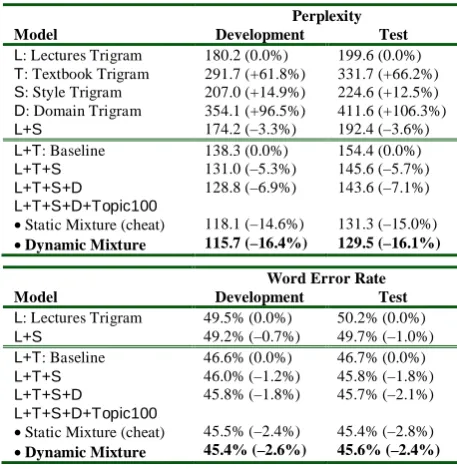
the Lectures dataset (L), the combined model (L+S) achieves a 3.6% perplexity reduction and
1.0% WER reduction over (L), as shown in Table
2. Without introducing topic-specific training data, we can already improve the generic lecture LM performance using the HMM-LDA labels.
<s> for the SPATIAL MEMORY </s>
unigrams: for, the, spatial, memory, </s>
bigrams: <s> for, for the, the spatial, spatial memory, memory </s> trigrams: <s> <s> for, <s> for the, for the spatial,
the spatial memory, spatial memory </s>
Figure 5: Style model n-grams. Topic words in the utterance are in uppercase.
5.2 Topic Domain
Unlike Lectures, the Textbook dataset contains content words relevant to the target lectures, but in a mismatched style. Commonly, the Textbook trigram model is interpolated with the generic model to improve the probability estimates of the transitions involving topic words. The interpola-tion weight is chosen to best fit the probabilities of these n-gram sequences while minimizing the mismatch in style. However, with only one pa-rameter, all n-gram contexts must share the same mixture weight. Because transitions from con-texts containing topic words are rarely observed in the off-topic Lectures, the Textbook model (T) should ideally have higher weight in these con-texts than concon-texts that are more equally ob-served in both datasets.
One heuristic approach for adjusting the weight in these contexts is to build a topic-domain trigram model (D) from the Textbook
n-gram counts with Witten-Bell smoothing (Chen
and Goodman, 1998) where we emphasize the sequences containing a topic word in the context by doubling their counts. In effect, this reduces the smoothing on words following topic contexts with respect to lower-order models without sig-nificantly affecting the transitions from non-topic words. Figure 6 shows the adjusted counts for an utterance used to build the domain trigram model.
<s> HUFFMAN CODE can be represented as a BINARY TREE …
unigrams: huffman, code, can, be, represented, as, binary, tree, … bigrams: <s> huffman, huffman code (2×), code can (2×),
can be, be represented, represented as, a binary, binary tree (2×), …
trigrams: <s> <s> hufmann, <s> hufmann code (2×), hufmann code can (2×), code can be (2×), can be represented, be represented as,
represented as a, as a binary, a binary tree (2×), ...
Empirically, interpolating the lectures, text-book, and style models with the domain model (L+T+S+D) further decreases the perplexity by
1.4% and WER by 0.3% over (L+T+S),
validat-ing our intuition. Overall, the addition of the style and domain models reduces perplexity and WER by a noticeable 7.1% and 2.1%, respec-tively, as shown in Table 2.
Perplexity
Model Development Test
L: Lectures Trigram 180.2 (0.0%) 199.6 (0.0%)
T: Textbook Trigram 291.7 (+61.8%) 331.7 (+66.2%)
S: Style Trigram 207.0 (+14.9%) 224.6 (+12.5%)
D: Domain Trigram 354.1 (+96.5%) 411.6 (+106.3%)
L+S 174.2 (–3.3%) 192.4 (–3.6%)
L+T: Baseline 138.3 (0.0%) 154.4 (0.0%)
L+T+S 131.0 (–5.3%) 145.6 (–5.7%)
L+T+S+D 128.8 (–6.9%) 143.6 (–7.1%)
L+T+S+D+Topic100
• Static Mixture (cheat)
• Dynamic Mixture
118.1 (–14.6%)
115.7 (–16.4%)
131.3 (–15.0%)
129.5 (–16.1%)
Word Error Rate
Model Development Test
L: Lectures Trigram 49.5% (0.0%) 50.2% (0.0%)
L+S 49.2% (–0.7%) 49.7% (–1.0%)
L+T: Baseline 46.6% (0.0%) 46.7% (0.0%)
L+T+S 46.0% (–1.2%) 45.8% (–1.8%)
L+T+S+D 45.8% (–1.8%) 45.7% (–2.1%)
L+T+S+D+Topic100
• Static Mixture (cheat)
• Dynamic Mixture
45.5% (–2.4%)
45.4% (–2.6%)
45.4% (–2.8%)
[image:7.595.64.293.183.418.2]45.6% (–2.4%)
Table 2: Perplexity (top) and WER (bottom) per-formance of various model combinations. Rela-tive reduction is shown in parentheses.
5.3 Textbook Topics
In addition to identifying content words, HMM-LDA also assigns words to a topic based on their distribution across documents. Thus, we can apply HMM-LDA with 100 topics to the
Text-book dataset to identify representative words and their associated contexts for each topic. From these labels, we can build unsmoothed trigram
language models (Topic100) for each topic from
the counts of observed n-gram sequences that end in a word assigned to the respective topic.
Figure 7 shows a sample of the word n-grams identified via this approach for a few topics. Note that some of the n-grams are key phrases for the topic while others contain a mixture of syntactic and topic words. Unlike bag-of-words models that only identify the unigram distribu-tion for each topic, the use of context-dependent labels enables the construction of n-gram topic models that not only characterize the frequencies of topic words, but also describe the transition contexts leading up to these words.
Huffman tree relative frequency relative frequencies
the tree one hundred
Monte Carlo rand update random numbers
trials remaining trials passed
time segment the agenda segment time
current time first agenda
assoc key the table local table
a table of records
Figure 7: Sample of n-grams from select topics.
5.4 Topic Mixtures
Since each target lecture generally only covers a subset of the available topics, it will be ideal to identify the specific topics corresponding to a target lecture and assign those topic models more weight in a linearly interpolated mixture model. As an ideal case, we performed a cheating ex-periment to measure the best performance of a statically interpolated topic mixture model (L+T+S+D+Topic100) where we tuned the mixture weights of all mixture components, in-cluding the lectures, textbook, style, domain, and the 100 individual topic trigram models on indi-vidual target lectures.
Table 2 shows that by weighting the compo-nent models appropriately, we can reduce the perplexity and WER by an additional 7.9% and 0.7%, respectively, over the (L+T+S+D) model even with simple linear interpolation for model combination.
To gain further insight into the topic mixture model, we examine the breakdown of the nor-malized topic weights for a specific lecture. As shown in Figure 8, of the 100 topic models, 15 of them account for over 90% of the total weight. Thus, lectures tend to show a significant topic skew which topic adaptation approaches can model effectively.
0 0.1 0.2 0.3 0.4 0.5 0.6 0.7 0.8 0.9 1
Figure 8: Topic mixture weight breakdown.
5.5 Topic Adaptation
( )
( ) ( )
( ) ( )
′ ′ ′=
t Pwt Pt
t P t w P w t P
| |
|
To achieve the exponential decay, we update the topic distribution after each word according to
Pi+1(t) = (1 – ) Pi(t) + P(t | wi), where is the adaptation rate.
We evaluated this approach of dynamic
mix-ture weight adaptation on the (L+T+S+D+Topic
100) model, with the same set of components as the cheating experiment with static weights. As shown in Table 2, the dynamic model actually outperforms the static model by more than 1% in perplexity, by better modeling the dynamic topic substructure within the lecture.
To run the recognizer with a dynamic LM, we rescored the top 100 hypotheses generated with
the (L+T+S+D) model using the dynamic LM.
The WER obtained through such n-best rescoring yielded noticeable improvements over the (L+T+S+D) model without a priori knowledge of the topic distribution, but did not beat the op-timal static model on the test set.
To further gain an intuition for mixture weight adaptation, we plotted the normalized adapted weights of the topic models across the first lec-ture of the test set in Figure 9. Note that the topic mixture varies greatly across the lecture. In this particular lecture, the lecturer starts out with a review of the previous lecture. Subsequently, he shows an example of computation using ac-cumulators. Finally, he focuses the lecture on stream as a data structure, with an intervening example that finds pairs of i and j that sum up to a prime. By comparing the topic labels in Figure 9 with the top words from the corresponding top-ics in Figure 10, we observe that the topic weights obtained via dynamic adaptation match the subject matter of the lecture fairly closely.
Finally, to assess the effect that word error rate has on adaptation performance, we applied the adaptation algorithm to the corresponding tran-script from the automatic speech recognizer (ASR). Traditional cache language models tend to be vulnerable to recognition errors since incor-rect words in the history negatively bias the pre-diction of the current word. However, by adapt-ing at a topic level, which reduces the number of dynamic parameters, the dynamic topic model is less sensitive to recognition errors. As seen in Figure 9, even with a word error rate around 40%, the normalized topic mixture weights from the ASR transcript still show a strong resem-blance to the original weights from the manual reference transcript.
Figure 9: Adaptation of topic model weights on manual and ASR transcription of a single lecture.
T12 T35 T98 T99
stream s streams integers series prime filter delayed interleave
infinite
pairs i j k pair
s integers
sum queens
t
sequence enumerate accumulate
map interval
filter sequences operations
odd nil
of see and in for vs register
[image:8.595.306.525.67.217.2]data as make
Figure 10: Top 10 words from select Textbook topics appearing in Figure 9.
6
Summary and Conclusions
In this paper, we have shown how to leverage context-dependent state and topic labels, such as the ones generated by the HMM-LDA model, to construct better language models for lecture tran-scription and extend topic models beyond tradi-tional unigrams. Although the WER of the top recognizer hypotheses exceeds 45%, by dynami-cally updating the mixture weights to model the topic substructure within individual lectures, we are able to reduce the test set perplexity and WER by over 16% and 2.4%, respectively, rela-tive to the combined Lectures and Textbook (L+T) baseline.
Although we primarily focused on lecture transcription in this work, the techniques extend to language modeling scenarios where exactly matched training data are often limited or non-existent. Instead, we have to rely on appropriate combination of models derived from partially matched data. HMM-LDA and related tech-niques show great promise for finding structure in unlabeled data, from which we can build more sophisticated models.
[image:8.595.331.498.260.363.2]labels may yield significant improvement for both perplexity and WER. Thus, in future work, we would like to study algorithms for automati-cally learning appropriate context-dependent in-terpolation weights. Furthermore, we hope to improve the convergence properties of the dy-namic adaptation scheme at the start of lectures and across topic transitions. Lastly, we would like to extend the LDA framework to support speaker-specific adaptation and apply the result-ing topic distributions to lecture segmentation.
Acknowledgements
We would like to thank the anonymous review-ers for their useful comments and feedback. Support for this research was provided in part by the National Science Foundation under grant #IIS-0415865. Any opinions, findings, and con-clusions, or recommendations expressed in this material are those of the authors and do not nec-essarily reflect the views of the NSF.
Reference
Y. Akita and T. Kawahara. 2004. Language Model Adaptation Based on PLSA of Topics and Speak-ers. In Proc. ICSLP.
J. Bellegarda. 2000. Exploiting Latent Semantic In-formation in Statistical Language Modeling. In
Proc. IEEE, 88(8):1279-1296.
D. Blei, A. Ng, and M. Jordan. 1993. Latent Dirichlet Allocation. Journal of Machine Learning
Research, 3:993-1022.
W. Buntine and A. Jakulin. 2005. Discrete Principal Component Analysis. Technical Report, Helsinki Institute for Information Technology.
S. Chen and J. Goodman. 1996. An Empirical Study of Smoothing Techniques for Language Modeling. In Proc. ACL, 310-318.
P. Clarkson and A. Robinson. 1997. Language Model Adaptation Using Mixtures and an Expo-nentially Decaying Cache. In Proc. ICASSP.
S. Deerwester, S. Dumais, G. Furnas, T. Landauer, R. Harshman. 1990. Indexing by Latent Semantic Analysis. Journal of the American Society for
In-formation Science, 41(6):391-407.
S. Furui. 2003. Recent Advances in Spontaneous Speech Recognition and Understanding. In Proc.
IEEE Workshop on Spontaneous Speech Proc. and Rec, 1-6.
D. Gildea and T. Hofmann. 1999. Topic-Based Lan-guage Models Using EM. In Proc. Eurospeech.
J. Glass. 2003. A Probabilistic Framework for
Seg-ment-based Speech Recognition. Computer, Speech
and Language, 17:137-152.
J. Glass, T.J. Hazen, L. Hetherington, and C. Wang. 2004. Analysis and Processing of Lecture Audio Data: Preliminary Investigations. In Proc.
HLT-NAACL Workshop on Interdisciplinary Approaches to Speech Indexing and Retrieval, 9-12.
J. Goodman. 2001. A Bit of Progress in Language Modeling (Extended Version). Technical Report, Microsoft Research.
T. Griffiths and M. Steyvers. 2004. Finding Scien-tific Topics. In Proc. National Academy of
Sci-ence, 101(Suppl. 1):5228-5235.
T. Griffiths, M. Steyvers, D. Blei, and J. Tenenbaum. 2004. Integrating Topics and Syntax. Adv. in
Neu-ral Information Processing Systems, 17:537-544.
R. Iyer and M. Ostendorf. 1999. Modeling Long Distance Dependence in Language: Topic Mixtures Versus Dynamic Cache. In IEEE Transactions on
Speech and Audio Processing, 7:30-39.
R. Kuhn and R. De Mori. 1990. A Cache-Based Natural Language Model for Speech Recognition. In IEEE Transactions on Pattern Analysis and
Ma-chine Intelligence, 12:570-583.
R. Lau, R. Rosenfeld, S. Roukos. 1993. Trigger-Based Language Models: a Maximum Entropy Approach. In Proc. ICASSP.
E. Leeuwis, M. Federico, and M. Cettolo. 2003. Lan-guage Modeling and Transcription of the TED Corpus Lectures. In Proc. ICASSP.
H. Nanjo and T. Kawahara. 2002. Unsupervised Language Model Adaptation for Lecture Speech Recognition. In Proc. ICSLP.
H. Nanjo and T. Kawahara. 2004. Language Model and Speaking Rate Adaptation for Spontaneous Presentation Speech Recognition. In IEEE Trans.
SAP, 12(4):391-400.
A. Park, T. Hazen, and J. Glass. 2005. Automatic Processing of Audio Lectures for Information Re-trieval: Vocabulary Selection and Language Mod-eling. In Proc. ICASSP.
M. Rosen-Zvi, T. Griffiths, M. Steyvers, and P. Smyth. 2004. The Author-Topic Model for Au-thors and Documents. 20th Conference on
Uncer-tainty in Artificial Intelligence.
R. Rosenfeld. 1996. A Maximum Entropy Approach to Adaptive Statistical Language Modeling.
Com-puter, Speech and Language, 10:187-228.
A. Stolcke. 2002. SRILM – An Extensible Language Modeling Toolkit. In Proc. ICSLP.
Y. Teh, M. Jordan, M. Beal, and D. Blei. 2006. Hi-erarchical Dirichlet Processes. To appear in