Enhancing Authorship Attribution By Utilizing Syntax Tree Profiles
Michael Tschuggnall and G¨unther Specht Institute of Computer Science, University of Innsbruck
Technikerstraße 21a, 6020 Innsbruck, Austria
{michael.tschuggnall, guenther.specht}@uibk.ac.at
Abstract
The aim of modern authorship attribution approaches is to analyze known authors and to assign authorships to previously un-seen and unlabeled text documents based on various features. In this paper we present a novel feature to enhance cur-rent attribution methods by analyzing the grammar of authors. To extract the fea-ture, a syntax tree of each sentence of a document is calculated, which is then split up into length-independent patterns using pq-grams. The mostly used pq-grams are then used to compose sample profiles of authors that are compared with the pro-file of the unlabeled document by utiliz-ing various distance metrics and similarity scores. An evaluation using three different and independent data sets reveals promis-ing results and indicate that the grammar of authors is a significant feature to en-hance modern authorship attribution meth-ods.
1 Introduction
The increasing amount of documents available from sources like publicly available literary databases often raises the question of verifying disputed authorships or assigning authors to un-labeled text fragments. The original problem was initiated already in the midst of the twenti-eth century by Mosteller and Wallace, who tried to find the correct authorships of The Federalist Papers (Mosteller and Wallace, 1964), nonethe-less authorship attribution is still a major research topic. Especially with latest events in politics and academia, the verification of authorships becomes increasingly important and is used frequently in areas like juridical applications (Forensic Linguis-tics) or cybercrime detection (Nirkhi and Dha-raskar, 2013). Similarily to works in the field
of plagiarism detection (e.g. (Stamatatos, 2009; Tschuggnall and Specht, 2013b)) which aim to find text fragments not written but claimed to be written by an author, the problem of traditional authorship attribution is defined as follows: Given several authors with text samples for each of them, the question is to label an unknown document with the correct author. In contrast to this so-called closed-class problem, an even harder task is addressed in the open-class problem, where additionally a ”none-of-them”-answer is allowed (Juola, 2006).
In this paper we present a novel feature for the tra-ditional, closed-class authorship attribution task, following the assumption that different authors have different writing styles in terms of the gram-mar structure that is used mostly unconsciously. Due to the fact that an author has many differ-ent choices of how to formulate a sdiffer-entence us-ing the existus-ing grammar rules of a natural lan-guage, the assumption is that the way of construct-ing sentences is significantly different for individ-ual authors. For example, the famous Shakespeare quote ”To be, or not to be: that is the question.”
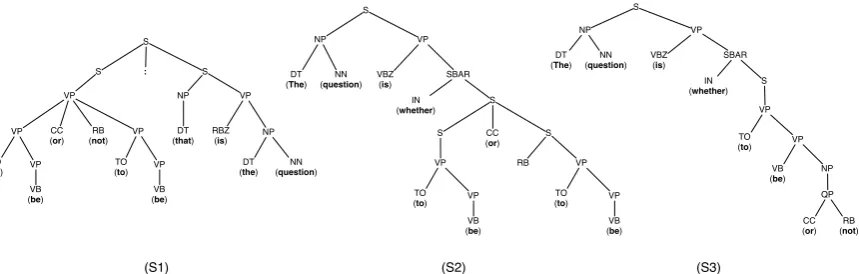
(S1) could also be formulated as”The question is whether to be or not to be.” (S2) or even ”The question is whether to be or not.”(S3) which is se-mantically equivalent but differs significantly ac-cording to the syntax (see Figure 1). The main idea of this approach is to quantify those differences by calculating grammar profiles for each candidate author as well as for the unlabeled document, and to assign one of the candidates as the author of the unseen document by comparing the profiles. To quantify the differences between profiles multiple metrics have been implemented and evaluated. The rest of this paper is organized as follows: Sec-tion 2 sketches the main idea of the algorithm which incorporates the distance metrics explained in detail in Section 3. An extensive evaluation
S
: S
VB (be)
S VP
VP CC (or)
RB (not) VP VP
TO (To)
VB (be) VP TO (to)
NP VP
DT (that)
RBZ (is) NP
DT (the) (questionNN )
S
NP VP
DT (The)
NN (question)
VBZ (is)
SBAR IN (whether)
S
S CC (or) S
VB (be) VP
VP TO (to)
VB (be) VP
VP TO (to) RB
(S1) (S2)
S
NP VP
DT (The)
NN (question)
VBZ (is)
SBAR IN (whether) S
VP
VP TO (to)
VB (be) NP
QP CC (or) (RBnot)
[image:2.595.87.517.62.199.2](S3)
Figure 1: Syntax Trees Resulting From Parsing Sentence (S1), (S2) and (S3).
ing three different test sets is shown in Section 4, while finally Section 5 and Section 6 summarize related work and discuss future work, respectively.
2 Syntax Tree Profiles
The basic idea of the approach is to utilize the syn-tax that is used by authors to distinguish author-ships of text documents. Based on our previous work in the field of intrinsic plagiarism detection (Tschuggnall and Specht, 2013c; Tschuggnall and Specht, 2013a) we modify and enhance the algo-rithms and apply them to be used in closed-class authorship attribution.
The number of choices an author has to for-mulate a sentence in terms of grammar is rather high, and the assumption in this approach is that the concrete choice is made mostly intuitively and unconsciously. Evaluations shown in Section 4 re-inforce that solely parse tree structures represent a significant feature that can be used to distinguish between authors.
From a global view the approach comprises the following three steps:(A)Creating a grammar pro-file for each author,(B)creating a grammar profile for the unlabeled document, and (C) calculating the distance between each author profile and the document profile and assigning the author having the lowest distance (or the highest similarity, de-pending on the distance metric chosen). As this approach is based on profiles a key criterion is the creation of distinguishable author profiles. In or-der to calculate a grammar profile for an author or a document, the following procedure is applied:
(1)Concatenate all text samples for the author into a single, large sample document, (2)split the re-sulting document into single sentences and calcu-late a syntax tree for each sentence, (3)calculate the pq-gram index for each tree, and(4)compose
the final grammar profile from the normalized fre-quencies of pq-grams.
At first the concatenated document is cleaned to contain alphanumeric characters and punctuation marks only, and then split into single sentences1.
Each sentence is then parsed2. For example,
Fig-ure 1 depicts the syntax trees resulting from sen-tences (S1), (S2) and (S3). The labels of each tree correspond to a Penn Treebank tag (Marcus et al., 1993), where e.gNPcorresponds to a noun phrase orJJSto a superlative adjective. In order to exam-ine solely the structure of sentences, the terminal nodes (words) are ignored.
Having computed a syntax tree for every sentence, the pq-gram index (Augsten et al., 2010) of each tree is calculated in the next step. Pq-grams con-sist of a stem (p) and a base (q) and may be re-lated to as ”n-grams for trees”. Therebypdefines how much nodes are included vertically, andq de-fines the number of nodes to be considered hor-izontally. For example, a pq-gram using p = 2
and q = 3 starting from level two of tree (S1) would be [S-VP-VP-CC-RB]. In order to ob-tain all pq-grams of a tree, the base is addition-ally shifted left and right: If then less than p
nodes exist horizontally, the corresponding place in the pq-gram is filled with*, indicating a miss-ing node. Applymiss-ing this idea to the previous exam-ple, also the pq-grams [S-VP-*-*-VP] (base shifted left by two), [S-VP-*-VP-CC] (base shifted left by one), [S-VP-RB-VP-*] (base shifted right by one) and[S-VP-VP-*-*](base shifted right by two) have to be considered. Fi-nally, the pq-gram index contains all pq-grams of
1using OpenNLP, http://incubator.apache.org/opennlp,
visited October 2013
a syntax tree, whereby multiple occurences of the same pq-grams are also present multiple times in the index.
The remaining part for creating the author profile is to compute the pq-gram index of the whole document by combining all pq-gram indexes of all sentences. In this step the number of occurences is counted for each pq-gram and then normalized by the total number of all appearing pq-grams. As an example, the three mostly used pq-grams of a selected document together with their normal-ized frequencies are {[NP-NN-*-*-*], 2.7%}, {[PP-IN-*-*-*], 2.3%}, and
{[S-VP-*-*-VBD], 1.1%}. The final pq-gram profile then consists of the complete table of pq-grams and their occurences in the given document.
3 Distance and Similarity Metrics
With the use of the syntax tree profiles calculated for each candidate author as well as for the unla-beled document, the last part is to calculate a dis-tance or similarity, respectively, for every author profile. Finally, the unseen document is simply la-beled with the author of the best matching profile. To investigate on the best distance or simi-larity metric to be used for this approach, sev-eral metrics for this problem have been adapted and evaluated3: 1. CNG (Keˇselj et al., 2003),
2. Stamatatos-CNG (Stamatatos, 2009), 3. Stamatatos-CNG with Corpus Norm (Stamatatos, 2007), 4. Sentence-SPI.
For the latter, we modified the original SPI score (Frantzeskou et al., 2006) so that each sentence is traversed separately: Let SD be the set of
sen-tences of the document,I(s)the pq-gram-index of sentencesandPxthe profile of authorX, then the
Sentence-SPI score is calculated as follows:
sPx,PD =
X
s∈SD
X
p∈I(s)
1 ifp∈Px
0 else
4 Evaluation
The approach described in this paper has been ex-tensively evaluated using three different English data sets, whereby all sets are completely unre-lated and of different types: (1.) CC04: the train-ing set used for the Ad-hoc-Authorship Attribution
3The algorithm names are only used as a reference for
this paper, but were not originally proposed like that
Competition workshop held in 20044- type:
nov-els, authors: 4, documents: 8, samples per author: 1; (2.) FED: the (undisputed) federalist papers written by Hamilton, Madison and Jay in the 18th century - type: political essays, authors: 3, doc-uments: 61, samples per author: 3; (3.) PAN12: from the state-of-the-art corpus, especially created for the use in authorship identification for the PAN 2012 workshop5 (Juola, 2012), all closed-classed
problems have been chosen - type: misc, authors: 3-16, documents: 6-16, samples per author: 2. For the evaluation, each of the sets has been used to optimize parameters while the remaining sets have been used for testing. Besides examining the discussed metrics and values forpandq (e.g. by choosingp= 1andq= 0the pq-grams of a gram-mar profile are equal to pure POS tags), two addi-tional optimization variables have been integrated for the similarity metric Sentence-SPI:
• topPQGramCounttc: by assigning a value
to this parameter, only the corresponding amount of mostly used pq-grams of a gram-mar profile are used.
• topPQGramOffsetto:based on the idea that
all authors might have a frequently used and common set of syntax rules that are prede-fined by a specific language, this parameter allows to ignore the given amount of mostly used pq-grams. For example ifto = 3in
Ta-ble 1, the first pq-gram to be used would be [NP-NNP-*-*-*].
The evaluation results are depicted in Table 1. It shows the rate of correct author attributions based on the grammar feature presented in this paper.
Generally, the algorithm worked best using the
Sentence-SPIscore, which led to a rate of 72% by using the PAN12 data set for optimization. The optimal configuration uses p = 3 and q = 2, which is the same configuration that was used in (Augsten et al., 2010) to produce the best results. The highest scores are gained by using a limit of top pq-grams (tc ∼ 65) and by ignoring the first
three pq-grams (to = 3), which indicates that it is
sufficient to limit the number of syntax structures
4http://www.mathcs.duq.edu/∼juola/authorship contest.html,
visited Oct. 2013
5PAN is a well-known workshop on Uncovering
metric p q Optimized With CC04 FED PAN12 Overall
Sentence-SPI (tc= 65, to = 3) 3 2 PAN12 57.14 86.89 (76.04) 72.02
CNG 0 2 PAN12 14.29 80.33 (57.29) 47.31
Stamatatos-CNG 2 2 PAN12 14.29 78.69 (60.42) 46.49
Stamatatos-CNG-CN 0 2 CC04 (42.86) 52.46 18.75 35.61
Table 1: Evaluation Results.
and that there exists a certain number (3) of gen-eral grammar rules for English which are used by
allauthors. I.e. those rules cannot by used to infer information about individual authors (e.g. every sentence starts with[S-...]).
All other metrics led to worse results, which may also be a result of the fact that only the Sentence-SPI metric makes use of the additional parameterstcandto. Future work should also
in-vestigate on integrating these parameters also in other metrics. Moreover, results are better using the PAN12 data set for optimization, which may be because this set is the most hetergeneous one: The Federalist Papers contain only political essays written some time ago, and the CC04 set only uses literary texts written by four authors.
5 Related Work
Successful current approaches often are based on or include character n-grams (e.g. (Hirst and Feiguina, 2007; Stamatatos, 2009)). Several stud-ies have shown that n-grams represent a significant feature to identify authors, whereby the major ben-efits are the language independency as well as the easy computation. As a variation, word n-grams are used in (Balaguer, 2009) to detect plagiarism in text documents.
Using individual features, machine learning al-gorithms are often applied to learn from au-thor profiles and to predict unlabeled documents. Among methods that are utilized in authorship at-tribution as well as the related problem classes like text categorization or intrinsic plagiarism detec-tion are support vector machines (e.g. (Sanderson and Guenter, 2006; Diederich et al., 2000)), neural networks (e.g. (Tweedie et al., 1996)), naive bayes classifiers (e.g. (McCallum and Nigam, 1998)) or decision trees (e.g. ( ¨O. Uzuner et. al, 2005)).
Another interesting approach used in authorship attribution that tries to detect the writing style of authors by analyzing the occurences and varia-tions of spelling errors is proposed in (Koppel and
Schler, 2003). It is based on the assumption that authors tend to make similar spelling and/or gram-mar errors and therefore uses this information to attribute authors to unseen text documents.
Approaches in the field of genre categorization also use NLP tools to analyze documents based on syntactic annotations (Stamatatos et al., 2000). Lexicalized tree-adjoining-grammars (LTAG) are poposed in (Joshi and Schabes, 1997) as a ruleset to construct and analyze grammar syntax by using partial subtrees.
6 Conclusion and Future Work
In this paper we propose a new feature to enhance modern authorship attribution algorithms by uti-lizing the grammar syntax of authors. To distin-guish between authors, syntax trees of sentences are calculated which are split into parts by using pq-grams. The set of pq-grams is then stored in an author profile that is used to assign unseen docu-ments to known authors.
References
Nikolaus Augsten, Michael B¨ohlen, and Johann Gam-per. 2010. The pq-Gram Distance between Ordered Labeled Trees. ACM Transactions on Database Sys-tems (TODS).
Enrique Vall´es Balaguer. 2009. Putting Ourselves in SME’s Shoes: Automatic Detection of Plagiarism by the WCopyFind tool. InProceedings of the SE-PLN’09 Workshop on Uncovering Plagiarism, Au-thorship and Social Software Misuse, pages 34–35.
Joachim Diederich, J¨org Kindermann, Edda Leopold, and Gerhard Paass. 2000. Authorship attribution with support vector machines. APPLIED INTELLI-GENCE, 19:2003.
Georgia Frantzeskou, Efstathios Stamatatos, Stefanos Gritzalis, and Sokratis Katsikas. 2006. Effective identification of source code authors using byte-level information. InProceedings of the 28th inter-national conference on Software engineering, pages 893–896. ACM.
Graeme Hirst and Ol’ga Feiguina. 2007. Bigrams of syntactic labels for authorship discrimination of short texts. Literary and Linguistic Computing, 22(4):405–417.
Aravind K. Joshi and Yves Schabes. 1997. Tree-adjoining grammars. In Handbook of formal lan-guages, pages 69–123. Springer.
Patrick Juola. 2006. Authorship attribution. Founda-tions and Trends in Information Retrieval, 1(3):233– 334.
Patrick Juola. 2012. An overview of the traditional au-thorship attribution subtask. InCLEF (Online Work-ing Notes/Labs/Workshop).
Vlado Keˇselj, Fuchun Peng, Nick Cercone, and Calvin Thomas. 2003. N-gram-based author profiles for authorship attribution. InProceedings of the confer-ence pacific association for computational linguis-tics, PACLING, volume 3, pages 255–264.
Dan Klein and Christopher D. Manning. 2003. Ac-curate unlexicalized parsing. InProceedings of the 41st Annual Meeting on Association for Computa-tional Linguistics - Volume 1, ACL ’03, pages 423– 430, Stroudsburg, PA, USA.
Moshe Koppel and Jonathan Schler. 2003. Exploit-ing Stylistic Idiosyncrasies for Authorship Attribu-tion. InIJCAI’03 Workshop On Computational Ap-proaches To Style Analysis And Synthesis, pages 69– 72.
Mitchell P. Marcus, Mary Ann Marcinkiewicz, and Beatrice Santorini. 1993. Building a large anno-tated corpus of English: The Penn Treebank. Com-putational Linguistics, 19:313–330, June.
Andrew McCallum and Kamal Nigam. 1998. A com-parison of event models for naive bayes text classifi-cation.
F. Mosteller and D. Wallace. 1964. Inference and Dis-puted Authorship: The Federalist. Addison-Wesley. Smita Nirkhi and RV Dharaskar. 2013. Comparative study of authorship identification techniques for cy-ber forensics analysis. International Journal. ¨O. Uzuner et. al. 2005. Using Syntactic Information
to Identify Plagiarism. InProc. 2nd Workshop on Building Educational Applications using NLP. Conrad Sanderson and Simon Guenter. 2006. Short
text authorship attribution via sequence kernels, markov chains and author unmasking: an investiga-tion. InProc. of the 2006 Conference on Empiri-cal Methods in Natural Language Processing, pages 482–491, Stroudsburg, PA, USA.
Efstathios Stamatatos, George Kokkinakis, and Nikos Fakotakis. 2000. Automatic text categorization in terms of genre and author. Comput. Linguist., 26:471–495, December.
Efstathios Stamatatos. 2007. Author identification using imbalanced and limited training texts. In Database and Expert Systems Applications, 2007. DEXA’07. 18th International Workshop on, pages 237–241. IEEE.
Efstathios Stamatatos. 2009. Intrinsic Plagiarism De-tection Using Character n-gram Profiles. In CLEF (Notebook Papers/Labs/Workshop).
Michael Tschuggnall and G¨unther Specht. 2013a. Countering Plagiarism by Exposing Irregularities in Authors Grammars. In EISIC, European Intelli-gence and Security Informatics Conference, Upp-sala, Sweden, pages 15–22.
Michael Tschuggnall and G¨unther Specht. 2013b. Detecting Plagiarism in Text Documents through
Grammar-Analysis of Authors. In 15.
GI-Fachtagung Datenbanksysteme f¨ur Business, Tech-nologie und Web, Magdeburg, Germany.
Michael Tschuggnall and G¨unther Specht. 2013c. Us-ing grammar-profiles to intrinsically expose plagia-rism in text documents. InNLDB, pages 297–302. Fiona J. Tweedie, S. Singh, and David I. Holmes.