Proceedings of the 10th International Workshop on Health Text Mining and Information Analysis (LOUHI 2019), pages 157–167 157
Extracting UMLS Concepts from Medical Text Using General and
Domain-Specific Deep Learning Models
Kathleen C. Fraser1∗, Isar Nejadgholi1∗, Berry De Bruijn1, Muqun Li2, Astha LaPlante2, Khaldoun Zine El Abidine2
1National Research Council Canada
2Privacy Analytics Inc., Ottawa, Canada
{kathleen.fraser, isar.nejadgholi, berry.debruijn}@nrc-cnrc.gc.ca
{rachel.li, astha.agarwal, khaldoun.zineelabidine}@privacy-analytics.com
Abstract
Entity recognition is a critical first step to a number of clinical NLP applications, such as entity linking and relation extraction. We present the first attempt to apply state-of-the-art entity recognition approaches on a newly released dataset, MedMentions. This dataset contains over 4000 biomedical abstracts, an-notated for UMLS semantic types. In compar-ison to existing datasets, MedMentions con-tains a far greater number of entity types, and thus represents a more challenging but realistic scenario in a real-world setting. We explore a number of relevant dimensions, including the use of contextual versus non-contextual word embeddings, general versus domain-specific unsupervised pre-training, and different deep learning architectures. We contrast our re-sults against the well-known i2b2 2010 entity recognition dataset, and propose a new method to combine general and domain-specific infor-mation. While producing a state-of-the-art sult for the i2b2 2010 task (F1 = 0.90), our re-sults on MedMentions are significantly lower (F1 = 0.63), suggesting there is still plenty of opportunity for improvement on this new data.
1 Introduction
Entity recognition is a widely-studied task in clin-ical NLP, and has been the focus of a number of shared tasks, including the i2b2 2010 Shared Task (Uzuner et al.,2011), SemEval 2014 Task 7 ( Prad-han et al.,2014), and SemEval 2015 Task 14 ( El-hadad et al., 2015). Most previous work has fo-cused on identifying only a few broad types of en-tities, such as ‘problems’, ‘tests’, and ‘treatments’ in the i2b2 task, and ‘diseases’ in the SemEval tasks. Even when corpora have been annotated for more entity types, as in the GENIA corpus of biological annotations (Ohta et al., 2002), entity
∗
These authors contributed equally.
recognition tasks typically focus on only a small subset of those (Kim et al.,2004).
However, in some downstream applications it would be useful to identify all terms in a docu-ment which exist as concepts in the Unified Med-ical Language System (UMLS) Metathesaurus (Bodenreider, 2004). This resource comprises a much wider range of biomedical entity types than has previously been considered in clinical entity recognition. Additionally, the UMLS Metathe-saurus defines important relationships between en-tity types (and the lower-level concepts associ-ated with them) via its Semantic Network. There-fore, extracting and labelling entities with respect to their UMLS semantic type, rather than more generic types such as ‘problem’ or ‘test’, can be an important first step in many practical clinical NLP applications.
In this work, we present the first attempt to ap-ply existing clinical entity recognition approaches to a new dataset called MedMentions, which is annotated for all UMLS semantic types (Mohan and Li, 2019). We compare the effectiveness of these approaches with reference to a well-known baseline dataset (i2b2 2010) and analyze the errors that occur when applying such techniques to new problems. On the basis of this error analysis, we propose an adaptation to the BERT architecture to better combine the general and clinical knowledge learned in the pre-training phase, and show that this improves over the more basic approaches.
2 Background
such approaches have been surpassed in perfor-mance by deep learning models (Habibi et al., 2017). However, there is a wide range of variation possible within this set of techniques. We briefly discuss some of the parameters of interest in the following sections.
2.1 General vs. Domain-Specific Word Embeddings
Since words may have one dominant meaning in common use, and a different meaning in the medi-cal domain, some work has explored whether word embeddings trained on medical text (e.g. clinical notes, medical journal articles) are more effective in medical entity recognition than those trained on general text sources (e.g. news, Wikipedia).
Roberts (2016) examined the effect of train-ing word embeddtrain-ings on different corpora for the task of entity extraction on the i2b2 2010 dataset. He compared six corpora: the i2b2 dataset it-self, the clinical notes available in the MIMIC database (Johnson et al., 2016), MEDLINE arti-cle abstracts, WebMD forum posts, and generic text corpora from Wikipedia and Gigaword. It was found that the best F1 score was obtained by train-ing on the MIMIC corpus, and that combintrain-ing cor-pora also led to strong results.Si et al.(2019) also compared training embeddings on MIMIC data versus general domain data, and similarly found that pre-training on the MIMIC data led to better performance on both the i2b2 2010 and SemEval tasks. Alsentzer et al.(2019) trained embeddings only on the discharge summaries from MIMIC, and reported a marginal improvement on the i2b2 2010 task over using the entire MIMIC corpus. Peng et al.(2019) found that pre-training a BERT model on PubMed abstracts led to better perfor-mance for biomedical entity extraction, while pre-training on a combination of PubMed abstracts and MIMIC notes led to better performance when extracting entities from patient records.
2.2 Contextual vs. Non-Contextual Word Embeddings
For many years, word embeddings were non-contextual; that is, a word would have the same embedding regardless of the context in which it occurred. Popular word embeddings of this type include GloVe (Pennington et al., 2014), word2vec (Mikolov et al., 2013), and FastText (Bojanowski et al., 2017). Peters et al. (2018) popularized the idea of contextualized word
em-beddings, which allowed the same word to have a different representation, depending on the con-text. The character-based ELMo word embed-dings introduced by Peters et al. (2018) can be used just as the non-contextual word embeddings were. Sheikhshabbafghi et al. (2018) trained ELMo word embeddings on a dataset of biomed-ical papers and achieved a new state of the art in gene mention detection on the BioCreative II gene mention shared task. This work showed that domain-specific contextual embeddings improve various types of biomedical named entities recog-nition. Later in 2018, BERT embeddings were also introduced (Devlin et al.,2019). The BERT architecture improved over ELMo by using a dif-ferent training objective to better take into account both left and right contexts of a word, and made it possible to make use of the entire pre-trained net-work in the downstream task, rather than simply extracting the embedding vectors.
Si et al. (2019) compared word2vec, GloVe, FastText, ELMo, and BERT embeddings on the i2b2 2010 dataset. When using the pre-trained vectors (trained on general-domain corpora), BERT-large performed the best and word2vec per-formed the worst, but there was no clear advantage to the contextualized embeddings (e.g. GloVe per-formed better than ELMo). When the embeddings were pre-trained on MIMIC data, the contextual-ized embeddings did perform appreciably better than the non-contextualized embeddings.
2.3 Classifier Architecture
In contrast, the BERT model makes use of the Transformer architecture, an attention-based method for sequence-to-sequence mod-elling (Vaswani et al.,2017). Once the model has been pre-trained, in the entity extraction stage it is only necessary to add a simple classification layer on the output. However, others have also ex-perimented with feeding the output of the BERT model to a bi-LSTM (Si et al.,2019).
3 Methods
3.1 Data
We consider three datasets in this study: the i2b2 2010 dataset, the ‘full’ MedMentions dataset, and the ‘st21pv’ MedMentions dataset. Details are shown in Table1.
The i2b2 2010 corpus1consists of de-identified clinical notes (discharge summaries), annotated for three entity types: problems, tests, and treat-ments (Uzuner et al.,2011). The original shared task also included subtasks on assertion classifica-tion and relaclassifica-tion extracclassifica-tion, but we focus here on entity extraction. In the original data release for the shared task, the training set contained 394 doc-uments; however, the current release of the dataset contains only 170 training documents. Therefore, it is unfortunately not possible to directly com-pare results across the two versions of the dataset. However, a majority of the recent works are using the current release of the dataset (Zhu et al.,2018; Bhatia et al.,2019;Chalapathy et al.,2016b).
The MedMentions corpus was released ear-lier this year2, and contains 4,392 abstracts from PubMed, annotated for concepts and semantic types from UMLS (2017AA release). UMLS concepts are fine-grained biomedical terms, with approximately 3.2 million unique concepts con-tained in the metathesaurus (Mohan and Li,2019). Each concept is linked to a higher-level seman-tic type, such as ‘Disease or syndrome’, ‘Cell component’, or ‘Clinical attribute’. In this work we focus on identifying the semantic type for each extracted text span, leaving the concept link-ing/normalization for future work. The creators of the dataset have defined an official 60%-20%-20% partitioning of the corpus into training, develop-ment, and test sets.
There are 127 semantic types in UMLS. Of these, there is only one (‘Carbohydrate sequence’)
1
www.i2b2.org/NLP/DataSets
2github.com/chanzuckerberg/MedMentions
which never appears in the full MedMentions dataset. Approximately 8% of the concepts in UMLS can be linked to more than one seman-tic type (Mohan and Li, 2019); in such cases the dataset contains a comma-separated list of all these type IDs corresponding to alphabetical order of semantic types. Where a text span has been la-belled with more than one label, we select only the first one. As a result of this, there is one other type (‘Enzyme’) which appears in MedMentions, but only doubly-labelled with ‘Amino acid, peptide, or protein’, and thus does not occur in our singly-labelled training or test data. Finally, there is an extra class (‘UnknownType’), for a total of 126 se-mantic types or classes in the ‘full’ training data. Of these, there are three (‘Amphibian’, ‘Drug de-livery device’, and ‘Vitamin’) which never occur in the test data.
The full MedMentions dataset suffers from high class imbalance (e.g. there are 31,485 mentions for the semantic type ‘Qualitative concept’ and only two mentions for ‘Fully formed anatomical struc-ture’). Furthermore, many of the semantic types are not particularly useful in downstream clinical NLP tasks, either due to being too broad or too specialized. As a result, the creators of the Med-Mentions dataset also released an alternate ver-sion called ‘st21pv’, which stands for ‘21 seman-tic types from preferred vocabularies’. The details of how this subset was constructed are given by Mohan and Li (2019), but essentially it contains only 21 semantic types, from specific vocabular-ies most relevant to biomedical researchers. The raw abstracts, and partitions into training, devel-opment, and test sets are the same as in the full dataset – only the set of annotations differs.
i2b2 2010 MedMentions (full) MedMentions (st21pv)
Train Test Train Test Train Test
# entity types 3 3 126 123 21 21
# documents 170 256 3513 879 3513 879
# tokens 149,743 267,837 936,247 234,910 936,247 234,910
[image:4.595.104.495.63.127.2]# entities 16,520 31,161 281,719 70,305 162,908 40,101
Table 1: Properties of the datasets. For MedMentions, we combine the training and validation sets into ‘Train’.
the results of a scientific study, covering a wide range of biomedical topics. Finally, there are clearly far more entity types in MedMentions than in i2b2, and greater imbalance between the differ-ent classes. Therefore, there is no guarantee that methods which perform well on the i2b2 data will also be effective on the MedMentions dataset.
3.2 Entity Recognition
Based on our review of the literature (Section 2) we experimented with two basic architectures: bi-LSTM+CRF (with pre-trained contextual and non-contextual word embeddings as input), and BERT (with a simple linear classification layer and a bi-LSTM classification layer). The details of these classifiers and their training are described below.
3.2.1 Text pre-processing
For the bi-LSTM+CRF models, input text retained casing information, but all numerical tokens were normalized to a single NUM token.
BERT uses WordPiece tokenization (Wu et al., 2016), which breaks longer words into frequently occurring sub-word units to improve handling of rare words and morphological variation. This re-quires additional pre- and post-processing for the entity recognition task, since the data is labelled at the word level. Following the recommendation ofDevlin et al.(2019), we first re-tokenize the text using the WordPiece tokenizer, assign the given la-bel to the first piece of each word, and assign any subsequent pieces a padding label.
In all cases, we convert the text and labels to CoNLL IOB format for input to the classifiers.
3.2.2 bi-LSTM+CRF
We use a standard bi-LSTM+CRF architecture (e.g., see (Huang et al., 2015b)), implemented in PyTorch. The LSTM component has 2 bi-directional layers with hidden size of 1536 nodes. The 100-dimensional character embeddings are learned through the training process and concate-nated with pre-trained GloVe embeddings ( Pen-nington et al., 2014) as proposed by Chalapathy
et al. (2016a). We compare the performance of general GloVe embeddings, trained on Wikipedia and Gigaword, and clinical GloVe embeddings, trained on the MIMIC-III corpus (Johnson et al., 2016). In both cases the GloVe embeddings have 300 dimensions. For pre-training on MIMIC, we used a minimum frequency cut-off of 5, and a win-dow size of 15.
We also experimented with contextual ELMo embeddings (Peters et al., 2018) and the bi-LSTM+CRF architecture, comparing general ELMo embeddings3 with clinical ELMo embed-dings.4 The clinical ELMo embeddings were released by Zhu et al. (2018) and trained on Wikipedia pages whose titles are medical con-cepts in the SNOMED-CT vocabulary, as well as MIMIC-III.
The bi-LSTM+CRF models were trained using the Adam optimizer with a learning rate of 0.001 and a batch size of 32 for 10 epochs.
3.2.3 BERT
The BERT (Bidirectional Encoder Representa-tions from Transformers) model is described by Devlin et al.(2019) and proposes to address some of the limitations observed in LSTM models. In our experiments, we use the BERT-base architec-ture, which has 12-layers, hidden size 768, and 12 self-attention heads. To perform the entity recog-nition, we added a linear layer and a softmax layer on top of the last BERT layer to determine the most probable label for each token. While this is the approach taken by Alsentzer et al. (2019), others suggest using a more complex classification model in conjunction with BERT (Si et al.,2019), and so we also experiment with a bi-LSTM layer with input and output size of4×768on top of the concatenation of the last four layers of BERT.
We consider four pre-trained BERT models:
• BERT-base5 General domain BERT model
3
github.com/allenai/allennlp/blob/master/tutorials/how to/elmo.md
4
github.com/noc-lab/clinical concept extraction
released by Google, pre-trained on Wikipedia and BookCorpus (Devlin et al.,2019).
• bioBERT (v1.1)6 The bioBERT model is initialized with BERT-base, and then fur-ther pre-trained on biomedical abstracts from PubMed (Lee et al.,2019).
• clinicalBERT7 The clinicalBERT model is initialized with bioBERT, and then further pre-trained on clinical notes from the MIMIC corpus (Alsentzer et al.,2019).
• NCBI BERT8 The NCBI BERT model is
initialized with BERT-base, and then further pre-trained on PubMed abstracts and MIMIC notes (Peng et al.,2019).
In the fine-tuning stage, we generally follow the recommendations inDevlin et al.(2019), and use an Adam optimizer with β1 = 0.9, β2 = 0.999, L2 weight decay of 0.01, and a dropout probability of 0.1 on all layers. We use a learn-ing rate warmup over the first 10% of steps, and linear decay of the learning rate thereafter. Before training the final models, we conducted a series of hyper-parameter optimization experi-ments using 10-fold cross-validation on the train-ing set. In this optimization stage we considered combinations of batch sizes in{16,32}, learning rates in{0.00002,0.00003,0.00005,0.0001}, and number of training epochs in {1...10}. We also determined that the uncased BERT-base model led to marginally better results, and so we use that in our final evaluation (bioBERT and clinicalBERT are cased, while NCBI BERT is uncased). For the BERT+bi-LSTM model, we also experimented with training only the bi-LSTM component and not fine-tuning the pre-trained layers, but found that fine-tuning led to better results in develop-ment.
3.3 Evaluation
To evaluate the systems, we use micro-averaged strict precision, recall, and F-score. This means that for any given recognized entity, it is only counted as a true positive ifboththe span and the label match exactly with the gold standard anno-tation. Note also that these metrics are computed on the entity-level, not the token level. For exam-ple, given the following gold and predicted label sequences:
6
github.com/dmis-lab/biobert
7
github.com/EmilyAlsentzer/clinicalBERT
8github.com/ncbi-nlp/NCBI BERT
GOLD: O O B-prob I-prob I-prob PRED: O O B-prob I-prob O
A token-level evaluation would identify two true positives, but a strict entity-level evaluation iden-tifies zero true positives.
4 Results
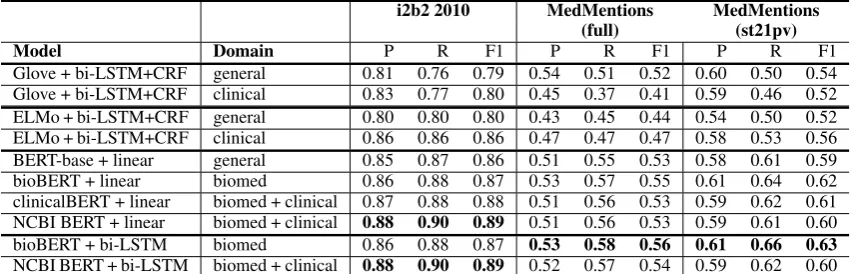
Table2shows the results of the entity recognition experiments for each model and dataset.
4.1 Effect of Contextual vs. Non-Contextual Word Embeddings
If we first consider the bi-LSTM+CRF results for the i2b2 dataset, we observe that the con-textual ELMo embeddings lead to better results than the non-contextual GloVe embeddings, and in both cases, better results are obtained by pre-training the embeddings on domain-specific text. For MedMentions, however, for both versions of the dataset we observe that the general-domain GloVe embeddings outperform the clinical GloVe embeddings, but the clinical ELMo embeddings outperform the general ELMo embeddings. Si et al.(2019) also observed a greater benefit to us-ing contextual embeddus-ings when pre-trainus-ing on domain-specific corpora. Here, this may be due in part to differences between the training corpora; for example, clinical GloVe was trained only on MIMIC notes, while clinical ELMo was trained on a combination of MIMIC notes and Wikipedia ar-ticles about medical concepts, which may be more similar to the biomedical abstracts contained in MedMentions.
The BERT models offer a substantial improve-ment in F1 over the models based on Glove or ELMo embeddings for each of the three datasets. For the i2b2 dataset, the best results are obtained using clinicalBERT (F1 = 0.88) and NCBI BERT (F1 = 0.89), each of which involved pre-training on clinical notes from MIMIC. This demon-strates the importance of pre-training on docu-ments which are similar in nature to those seen in the labelled dataset. Consistent with this, the bioBERT model (pre-trained on biomedical ab-stracts) leads to the best result on both MedMen-tions datasets.
4.2 Effect of Classifier Structure
i2b2 2010 MedMentions MedMentions
(full) (st21pv)
Model Domain P R F1 P R F1 P R F1
Glove + bi-LSTM+CRF general 0.81 0.76 0.79 0.54 0.51 0.52 0.60 0.50 0.54 Glove + bi-LSTM+CRF clinical 0.83 0.77 0.80 0.45 0.37 0.41 0.59 0.46 0.52 ELMo + bi-LSTM+CRF general 0.80 0.80 0.80 0.43 0.45 0.44 0.54 0.50 0.52 ELMo + bi-LSTM+CRF clinical 0.86 0.86 0.86 0.47 0.47 0.47 0.58 0.53 0.56 BERT-base + linear general 0.85 0.87 0.86 0.51 0.55 0.53 0.58 0.61 0.59
bioBERT + linear biomed 0.86 0.88 0.87 0.53 0.57 0.55 0.61 0.64 0.62
clinicalBERT + linear biomed + clinical 0.87 0.88 0.88 0.51 0.56 0.53 0.59 0.62 0.61 NCBI BERT + linear biomed + clinical 0.88 0.90 0.89 0.51 0.56 0.53 0.59 0.61 0.60
bioBERT + bi-LSTM biomed 0.86 0.88 0.87 0.53 0.58 0.56 0.61 0.66 0.63
[image:6.595.86.513.63.200.2]NCBI BERT + bi-LSTM biomed + clinical 0.88 0.90 0.89 0.52 0.57 0.54 0.59 0.62 0.60
Table 2: Results of entity recognition for each dataset and model.
no difference on the i2b2 dataset, but leads to the best result for both versions of MedMentions. It may be that the much larger training set in Med-Mentions is better able to effectively train the more complex classifier, and respectively that the greater complexity is necessary to properly model the large number of classes in MedMentions.
4.3 MedMentions vs i2b2 dataset
Comparing across datasets, it is clear that perfor-mance is worse on the MedMentions data than the i2b2 data. One obvious reason for this is that the MedMentions datasets have many more entity types, or classes, than the i2b2 dataset. This means that the number of examples per class seen in the training data is much lower (in some cases, only a handful), and also that the classes tend to be more easily confused. The ambiguity between classes arises at the level of the training data where, de-pending on context, the same text span will be as-sociated with different labels (e.g. neurocognitive functionis sometimes labelled as a ‘biologic func-tion’ and sometimes as a ‘mental process’; PSA levelsis labelled as both a ‘laboratory procedure’ and a ‘laboratory or test result’; and an even more highly-ambiguous term such asprobeis variously labelled as a ‘medical device’, ‘indicator reagent or diagnostic aid’, ‘nucleic acid nucleoside or nu-cleotide’, ‘functional concept’, ‘diagnostic proce-dure’, ‘research activity’, and ‘chemical viewed functionally’). Thus in MedMentions, the context becomes extremely important, and fine-grained distinctions between entity types must be learned.
5 Error Analysis
In the following section, we examine the errors made by the entity recognition systems from two different perspectives: first, we compare generally
the types of errors made on the two datasets; then, we consider the role of general versus domain-specific pre-training and examine some of the spe-cific errors that occur in each case.
5.1 Types of Errors by Dataset
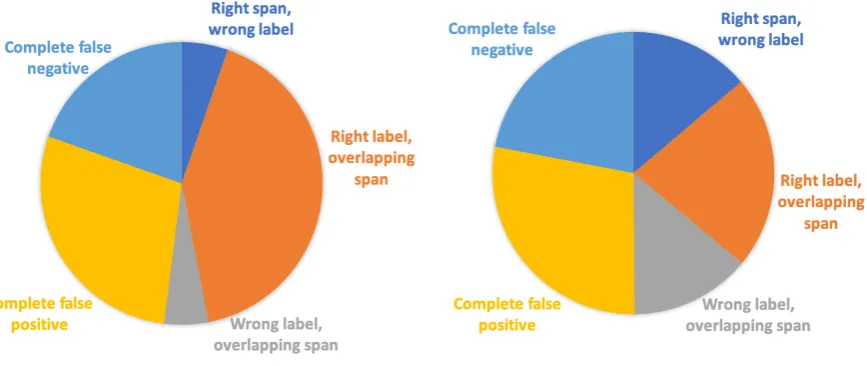
Depending on the downstream application of en-tity recognition, different types of errors may be associated with different costs. For example, if a company is using this model in practice, the cost associated with having human annotators ad-just label boundaries may be different from the cost associated with having them search for enti-ties which have been missed altogether. Our eval-uation metrics, however, do not reflect the differ-ences among various types of errors. To further investigate the nature of the errors being made by the system, we investigated three specific types of ‘partial errors’. These cases are counted asfalsein calculating the evaluation metrics, but the model actually gets at least part of the information cor-rect:
• Right span, wrong label: the text span as-sociated with an entity is correctly identified, but assigned the wrong label.
• Right label, overlapping span:the entity is correctly labelled, but the text span associ-ated with the entity is not exactly the same as that indicated in the gold transcripts.
• Wrong label, overlapping span: the entity overlaps with one of the gold entities, but is assigned the wrong label.
(a) i2b2 2010 (NCBI BERT + linear) (b) MedMentions-st21pv (bioBERT + linear)
Figure 1: Types of errors made on the i2b2 and MedMentions-st21pv datasets.
In the i2b2 dataset, over half of the errors belong to one of the ‘partial’ error types (Figure1a), with the biggest error category overall beingright la-bel, overlapping span. In many cases, the model identifies the main noun phrase associated with the entity, but not adjectives or prepositional phrases that further describe the entity: e.g.,patient feeling weaker than usual, where the model labelsweaker as the problem but the gold entity isweaker than usual, or her glucose remained somewhat low, where the model labelslowas the problem, but the gold entity is somewhat low. One of the reasons that might lead to this kind of error is the incon-sistency that exists in the human annotations. The task of identifying the span of entities can be very subjective and there is always some level of dis-agreement among human annotators. Also, some-times annotation guidelines are interpreted differ-ently by various annotators. As a result of this in-consistency, in the training stage, the model sees examples that the spans of the same entities has been labeled differently. This type of error may occur more frequently in the i2b2 dataset, due to the difficulty in annotating hurriedly written notes compared to academically written abstracts.
For MedMentions-st21pv, we again observe that roughly half the errors are ‘partial’ errors, but with a sizable increase in errors that involve the wrong label, with either a correct or overlapping span (Figure1b). As discussed previously, the in-crease inright span, wrong labelis likely due to the higher ambiguity between entity types in this
dataset. In many cases, errors of the typewrong label, overlapping span appear to be due to the inability of the annotation scheme to handle over-lapping entities. For example, in co-expression analysis, where the model labelsco-expressionas a ‘biologic function’, rather than extracting the en-tire phrase as a ‘research activity’, or inthis region of the brain, where the model simply labelsbrain as an ‘anatomical structure’ rather than region of the brainas a ‘spatial concept’.
5.2 General vs Domain Knowledge
We then performed an exploratory error analysis to identify and compare the type of errors made by models usinggeneralanddomain-specific em-beddings. For this analysis, we considered BERT-base and NCBI BERT. BERT-BERT-base is pre-trained on Wikipedia and the Google Books database, so it transfers the general knowledge of language to the model. NCBI BERT starts its training from BERT-base, and then continues training on PubMed (biomedical abstracts) and MIMIC (clin-ical notes). Generally, embeddings like NCBI BERT are assumed to be more effective since they transfer both general and domain-specific knowl-edge. We analyze the errors of the two models to test this assumption. For simplicity, we concen-trate our analysis on the i2b2 dataset, although we observe similar patterns in MedMentions.
BERT-base. However, there are also 1209 entities that arecorrectlyrecognized by BERT-base but incor-rectlyrecognized by NCBI BERT. Therefore, it is not the case that NCBI BERT encodes the same knowledge as BERT-base, plus more that it has learned from PubMed and MIMIC; rather, the two systems have different strengths and weaknesses.
Qualitatively, we observed that some entities correctly recognized by NCBI BERT and missed by BERT-base involve common words that have a specialized meaning in medicine, for example in the sentence: Suck , root , gag , grasp , and mor-row were normal .The BERT-base model does not extract any entities, while the NCBI BERT model recognizessuck,root,gag, andgraspas standard tests of infant reflexes. NCBI BERT also appears to be better at recognizing specialized acronyms and abbreviations, particularly when there is very little context, as in Brother died 64 / MI, where only NCBI BERT recognizes MI as a problem (myocardial infarction) in this brief family history, or No CPR / No defib, where NCBI BERT cor-rectly labels CPR anddefib as treatments, while BERT-base mis-labels them as problems.
In cases where BERT-base does better than NCBI BERT, it may be partially due to a better knowledge of well-formed text. We observed sev-eral examples where BERT-base appeared to be better at identifying the appropriate qualifiers to attach to a given entity: e.g., inno interval devel-opment of effusion, BERT-base correctly extracts the entire phraseinternal development of effusion, while NCBI BERT only extracts effusion. Simi-larly, in Right ventricular chamber size and free wall motion are normal, BERT-base extractsRight ventricular chamber sizeas a single entity of the type ‘test’, while NCBI BERT splits it intoRight ventricularandsize.
Of course, these observations are purely anec-dotal at this point, and will require future work and annotation to fully quantify the nature of the dif-ferences between the models. However, given the fact that the two models make different errors, it is at least reasonable to assume that predictions from the two models can be combined in a complemen-tary fashion to improve the overall performance. We explore one possible architecture for doing so in the following section.
6 Concatenated Model
As a result of our error analysis, we propose a concatenated BERT model, to better combine the general knowledge from BERT-base and the clin-ical knowledge from the more specialized BERT models. To build such a model we concatenate the last encoding layer of a domain-specific BERT model with the last encoding layer of the gen-eral BERT model and feed this concatenation to a linear or bi-LSTM classification layer. During training we jointly fine-tune both BERT models and the classification layer. We implemented this model with both NCBI BERT and bioBERT mod-els, since they previously led to the optimal results for i2b2 and MedMentions, respectively. NCBI BERT is concatenated with the uncased BERT-base model and bioBERT is concatenated with the cased BERT-base model.
Results for the concatenated models are given in Table 3. For all three datasets, we observe a small improvement over the best performing mod-els in Table2. The best result for i2b2 is achieved by concatenating the NCBI BERT and BERT-base models, with either a linear or bi-LSTM classi-fier on top. The resulting F1 score of 0.90 beats the previously reported state-of-the-art of 0.89 on the current release of the dataset with 170 training documents (Zhu et al.,2018). For MedMentions, concatenating bioBERT and BERT-base leads to the best results, with MedMentions-full attain-ing the best result usattain-ing a linear classifier and MedMentions-st21pv attaining the best result with the bi-LSTM. To our knowledge, there are no prior results reported on entity (i.e. semantic type) ex-traction on this dataset.
Regarding the classifier layer, we observe that replacing a linear classifier layer with a bi-LSTM does not improve the results on i2b2 dataset. This is consistent with the results shown in Ta-ble 2 and indicates that a simple linear classi-fier isenough to learn the entity recognition task for i2b2 dataset. In the case of the MedMen-tions dataset, a bi-LSTM classifier improves the F1 score on MedMentions-st21pv but worsens it on MedMentions-full. These results show that there is room for more rigorous investigation about the classifier layer for extracting entities in Med-Mentions dataset. More complex neural structures with optimized hyperparameters may be needed to improve these results.
con-i2b2 2010 MedMentions MedMentions
(full) (st21pv)
Model P R F1 P R F1 P R F1
[image:9.595.73.524.63.138.2]NCBI BERT concat BERT-base +linear 0.89* 0.90 0.90* 0.52 0.57 0.54 0.59 0.62 0.61 bioBERT concat BERT-base +linear 0.85 0.88 0.86 0.54* 0.59* 0.56* 0.60 0.65 0.62 NCBI BERT concat BERT-base +bi-LSTM 0.89* 0.90 0.90* 0.50 0.55 0.53 0.59 0.62 0.61 bioBERT concat BERT-base +bi-LSTM 0.86 0.87 0.87 0.53 0.58 0.55 0.63* 0.65 0.64*
Table 3: Results of entity recognition using concatenated BERT models. An asterisk indicates an improvement over the best result from Table2.
catenating the models are relatively small, they are consistent across the three datasets. This sug-gests that explicitly inputting both general and domain-specific information to the entity recog-nizer, rather than sequentially pre-training on dif-ferent domains and hoping that the model ‘re-members’ information from each domain, can be a promising direction for future research.
7 Conclusion
We have presented the results of a set of medical entity recognition experiments on a new dataset, MedMentions. We contrasted these results with those obtained on the well-studied i2b2 2010 dataset. We explored a number of relevant di-mensions, including the use of various embed-ding models (contextual versus non-contextual, general versus domain-specific, and LSTM versus attention-based) as well as linear versus bi-LSTM classifier layers. We also proposed a new modi-fication to the previous BERT-based named entity recognition architectures, which allows the classi-fier to incorporate information from both general and domain-specific BERT embeddings. Our re-sults on i2b2 are state-of-the-art, and our rere-sults on MedMentions set a benchmark for future work on this new dataset.
As popular public datasets become more and more studied over time, there is a chance that even if individual researchers follow good train-validate-test protocols, we eventually overfit to the datasets as a community, since there is so much published information available about what works well to improve performance on the test set. One goal of this work was to explore the gap in per-formance between a well-known clinical entity recognition dataset and a new, unstudied dataset. The same models and training procedures lead to significantly lower performance on the MedMen-tions dataset, for a variety of reasons: greater num-ber of entity types, more class ambiguity, higher class imbalance, etc. Ultimately, we find that the
model which performs best on i2b2 2010 isnotthe model that performs best on MedMentions, and that results on MedMentions can be improved by pre-training on more similar documents (biomed-ical abstracts), and by using more complex mod-els (BERT + bi-LSTM rather than BERT + linear). We hope that other researchers will continue to ad-vance the state-of-the-art on this new dataset.
Acknowledgement
We would like to thank Dr. Khaled Emam for his support and insightful feedback. We also thank Ms Lynn Wei for her technical support and her assis-tance in data collection, cleaning and preparation.
References
Emily Alsentzer, John R Murphy, Willie Boag, Wei-Hung Weng, Di Jin, Tristan Naumann, and Matthew McDermott. 2019. Publicly available clinical BERT embeddings. arXiv preprint arXiv:1904.03323.
Parminder Bhatia, Busra Celikkaya, and Mohammed Khalilia. 2019. Joint entity extraction and asser-tion detecasser-tion for clinical text. InProceedings of the 57th Annual Meeting of the Association for Compu-tational Linguistics, pages 954–959.
William Boag, Kevin Wacome, Tristan Naumann, and Anna Rumshisky. 2015. CliNER: a lightweight tool for clinical named entity recognition. AMIA Joint Summits on Clinical Research Informatics (poster).
Olivier Bodenreider. 2004. The Unified Med-ical Language System (UMLS): Integrating biomedical terminology. Nucleic acids research, 32(suppl 1):D267–D270.
Piotr Bojanowski, Edouard Grave, Armand Joulin, and Tomas Mikolov. 2017. Enriching word vectors with subword information. Transactions of the Associa-tion for ComputaAssocia-tional Linguistics, 5:135–146.
Raghavendra Chalapathy, Ehsan Zare Borzeshi, and Massimo Piccardi. 2016b. Bidirectional lstm-crf for clinical concept extraction. In Proceedings of the Clinical Natural Language Processing Work-shop (ClinicalNLP), pages 7–12.
Berry De Bruijn, Colin Cherry, Svetlana Kiritchenko, Joel Martin, and Xiaodan Zhu. 2011. Machine-learned solutions for three stages of clinical infor-mation extraction: the state of the art at i2b2 2010. Journal of the American Medical Informatics Asso-ciation, 18(5):557–562.
Jacob Devlin, Ming-Wei Chang, Kenton Lee, and Kristina Toutanova. 2019. BERT: Pre-training of deep bidirectional transformers for language under-standing. In Proceedings of NAACL-HLT, pages 4171–4186.
No´emie Elhadad, Sameer Pradhan, Sharon Gorman, Suresh Manandhar, Wendy Chapman, and Guergana Savova. 2015. SemEval-2015 task 14: Analysis of clinical text. InProceedings of the 9th International Workshop on Semantic Evaluation (SemEval 2015), pages 303–310.
Xiao Fu and Sophia Ananiadou. 2014. Improving the extraction of clinical concepts from clinical records. Proceedings of BioTxtM14, pages 47–53.
Maryam Habibi, Leon Weber, Mariana Neves, David Luis Wiegandt, and Ulf Leser. 2017. Deep learning with word embeddings improves biomed-ical named entity recognition. Bioinformatics, 33(14):i37–i48.
Sepp Hochreiter and J¨urgen Schmidhuber. 1997. Long short-term memory. Neural Computation, 9(8):1735–1780.
Zhiheng Huang, Wei Xu, and Kai Yu. 2015a. Bidi-rectional LSTM-CRF models for sequence tagging. arXiv preprint arXiv:1508.01991.
Zhiheng Huang, Wei Xu, and Kai Yu. 2015b. Bidirec-tional lstm-crf models for sequence tagging. arXiv preprint arXiv:1508.01991.
Alistair EW Johnson, Tom J Pollard, Lu Shen, H Lehman Li-wei, Mengling Feng, Moham-mad Ghassemi, Benjamin Moody, Peter Szolovits, Leo Anthony Celi, and Roger G Mark. 2016. MIMIC-III, a freely accessible critical care database. Scientific Data, 3:160035.
Siddhartha Jonnalagadda, Trevor Cohen, Stephen Wu, and Graciela Gonzalez. 2012. Enhancing clini-cal concept extraction with distributional semantics. Journal of biomedical informatics, 45(1):129–140.
Jin-Dong Kim, Tomoko Ohta, Yoshimasa Tsuruoka, Yuka Tateisi, and Nigel Collier. 2004. Introduction to the bio-entity recognition task at JNLPBA. In Proceedings of the International Joint Workshop on Natural Language Processing in Biomedicine and its Applications (NLPBA/BioNLP), pages 70–75.
Guillaume Lample, Miguel Ballesteros, Sandeep Sub-ramanian, Kazuya Kawakami, and Chris Dyer. 2016. Neural architectures for named entity recognition. InProceedings of the 2016 Conference of the North American Chapter of the Association for Computa-tional Linguistics: Human Language Technologies, pages 260–270.
Jinhyuk Lee, Wonjin Yoon, Sungdong Kim, Donghyeon Kim, Sunkyu Kim, Chan Ho So, and Jaewoo Kang. 2019. BioBERT: pre-trained biomed-ical language representation model for biomedbiomed-ical text mining. arXiv preprint arXiv:1901.08746.
Tomas Mikolov, Ilya Sutskever, Kai Chen, Greg S Cor-rado, and Jeff Dean. 2013. Distributed representa-tions of words and phrases and their compositional-ity. InAdvances in neural information processing systems, pages 3111–3119.
Sunil Mohan and Donghui Li. 2019. MedMentions: A large biomedical corpus annotated with UMLS con-cepts. arXiv preprint arXiv:1902.09476.
Tomoko Ohta, Yuka Tateisi, and Jin-Dong Kim. 2002. The GENIA corpus: An annotated research abstract corpus in molecular biology domain. In Proceed-ings of the second international conference on Hu-man Language Technology Research, pages 82–86. Morgan Kaufmann Publishers Inc.
Yifan Peng, Shankai Yan, and Zhiyong Lu. 2019. Transfer learning in biomedical natural language processing: An evaluation of BERT and ELMo on ten benchmarking datasets. arXiv preprint arXiv:1906.05474.
Jeffrey Pennington, Richard Socher, and Christopher Manning. 2014. GloVe: Global vectors for word representation. In Proceedings of the 2014 Con-ference on Empirical Methods in Natural Language Processing (EMNLP), pages 1532–1543.
Matthew E Peters, Mark Neumann, Mohit Iyyer, Matt Gardner, Christopher Clark, Kenton Lee, and Luke Zettlemoyer. 2018. Deep contextualized word rep-resentations. arXiv preprint arXiv:1802.05365.
Sameer Pradhan, No´emie Elhadad, Wendy Chapman, Suresh Manandhar, and Guergana Savova. 2014. SemEval-2014 task 7: Analysis of clinical text. In Proceedings of the 8th International Workshop on Semantic Evaluation (SemEval 2014), pages 54–62.
Kirk Roberts. 2016. Assessing the corpus size vs. similarity trade-off for word embeddings in clinical NLP. InProceedings of the Clinical Natural Lan-guage Processing Workshop (ClinicalNLP), pages 54–63.
Yuqi Si, Jingqi Wang, Hua Xu, and Kirk Roberts. 2019. Enhancing clinical concept extraction with contex-tual embedding. arXiv preprint arXiv:1902.08691.
Julien Tourille, Matthieu Doutreligne, Olivier Ferret, Aur´elie N´ev´eol, Nicolas Paris, and Xavier Tannier. 2018. Evaluation of a sequence tagging tool for biomedical texts. InProceedings of the Ninth Inter-national Workshop on Health Text Mining and Infor-mation Analysis, pages 193–203.
Inigo Jauregi Unanue, Ehsan Zare Borzeshi, and Massimo Piccardi. 2017. Recurrent neural net-works with specialized word embeddings for health-domain named-entity recognition. Journal of biomedical informatics, 76:102–109.
¨
Ozlem Uzuner, Brett R South, Shuying Shen, and Scott L DuVall. 2011. 2010 i2b2/VA challenge on concepts, assertions, and relations in clinical text. Journal of the American Medical Informatics Asso-ciation, 18(5):552–556.
Ashish Vaswani, Noam Shazeer, Niki Parmar, Jakob Uszkoreit, Llion Jones, Aidan N Gomez, Łukasz Kaiser, and Illia Polosukhin. 2017. Attention is all you need. InAdvances in Neural Information Pro-cessing Systems (NeurIPS), pages 5998–6008.
Yonghui Wu, Mike Schuster, Zhifeng Chen, Quoc V Le, Mohammad Norouzi, Wolfgang Macherey, Maxim Krikun, Yuan Cao, Qin Gao, Klaus Macherey, et al. 2016. Google’s neural ma-chine translation system: Bridging the gap between human and machine translation. arXiv preprint arXiv:1609.08144.