1
Extracting Complex Relations from Banking Documents
Berke Oral1,2, Erdem Emekligil1, Sec¸il Arslan1, and G¨uls¸en Eryi˘git2
1R&D and Special Projects, Yapı Kredi Technology
2Department of Computer Engineering, Istanbul Technical University
{erdem.emekligil, secil.arslan}@ykteknoloji.com.tr
{oralbe, gulsen.cebiroglu}@itu.edu.tr
Abstract
In order to automate banking processes (e.g. payments, money transfers, foreign trade), we need to extract banking transactions from dif-ferent types of mediums such as faxes, e-mails, and scanners. Banking orders may be consid-ered as complex documents since they con-tain quite complex relations compared to tra-ditional datasets used in relation extraction re-search. In this paper, we present our method to extract intersentential, nested and complex relations from banking orders, and introduce a relation extraction method based on maximal clique factorization technique. We demon-strate 11% error reduction over previous meth-ods.
1 Introduction
Despite recent efforts for digitalization in banking domain, formal letters (such as orders, petitions, demands or complaints) still remain as one of the main communication media in corporate banking. A mid-to-large scale bank receives millions of or-ders in a year, most of which are money transfer requests. Reading and manually processing those documents require significant amount of human labour. Moreover, since these documents require specialized knowledge to be interpreted, employ-ment and education of trustable personnel is often difficult. This situation makes the automatization of the process crucial.
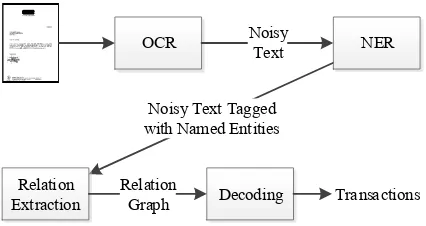
Automatic processing of banking documents is an Information Extraction (IE) task, where one seeks to extract structured information from semi-structured or unsemi-structured texts. This is usually conducted with pipelined processes. The one used in this study depicted in Figure1. The first step is to extract entities of interest from raw text, in our case is extracted via Optical Character Recogni-tion (OCR) system. This can be done with Named Entity Recognition (NER) algorithms or pattern
OCR
Noisy Text Tagged with Named Entities
NER
Relation
Extraction Decoding
Noisy Text
Relation
[image:1.595.309.522.224.337.2]Graph Transactions
Figure 1: Information extraction pipeline.
based methods. Secondly, semantic relations be-tween extracted entities are predicted with Rela-tion ExtracRela-tion (RE) algorithms. Finally, semantic structures are constructed on top of the relations as higher order structures such as templates or events. NER is an important step for many Natural Lan-guage Processing (NLP) tasks. It is a widely re-searched area, and current state-of-the-art algo-rithms (Lample et al.,2016) give satisfactory re-sults in most situations. RE is considered as a linguistically higher order task compared to NER, and proposed algorithms are often tailored to prob-lems in hand. Majority of research in this area is focused on extracting binary relations. Although there are some research dealing with complex re-lations (McDonald et al.,2005;Peng et al.,2017), work on nested complex relations as in the case of banking transactions is scarce.
In this paper, we focus on money transfer re-quests as the major process type in banking or-ders. Within these documents, we seek to extract
pro-cess details should be clearly defined. Thus, in our system, we abstract these real-world entities as three maindivisionsof a transaction: sender, re-ceiver, and process details. Each of these divisions contains required (emphasized with bold font in Figure2) or optionalslots. Sender and Receiver divisions must either include an Account Number or IBAN (having either one of these is enough to address the account). Process Details must contain transfer Amount and its Currency.
Account No IBAN Name Bank Name Branch Name
Sender
Account No IBAN Name Bank Name Branch Name
Branch Code SWIFT Code Receiver
Amount Currency
Expense Import Type
[image:2.595.309.524.61.291.2]Invoice Trx Date Value Date ProcessDetails Transaction
Figure 2: Divisions of a transaction and their slots.
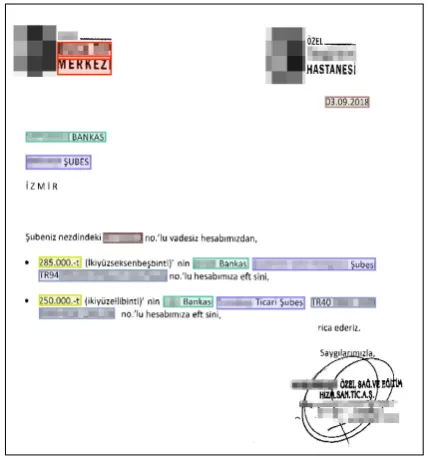
Slots of the divisions should be filled with named entities extracted from a document. Named entities related to the same slot might have been stated multiple times by the author in different places of the document. For example, the name of the account holder may occur within both the body text and the signature part. Additionally, a single named entity may carry information for multiple slots belonging to different transactions. For ex-ample, multiple money transfer orders might have been given from a single sender account, hence an entity holding the sender IBAN should be linked to different transaction slots. Figure3provides such a sample document with two transactions. Private information were masked on the figure, and ex-tracted entities were specified with colored boxes. In this paper, we focus on the relation extrac-tion and the decoding stages of the pipeline intro-duced in Figure 1.1 We propose a method that can automatically extract transaction information from banking documents by forming nested com-plex relations using a relation graph. Our algo-rithm first predicts binary relations between enti-ties. This forms an undirected graph, where nodes are entities, and edges are predictions. On this graph, the algorithm performs series of maximal
1 For the OCR stage of the pipeline, we use Abbyy
Finereader v12 system. For the NER stage, we use an adap-tation ofLample et al.(2016) for banking documents.
Figure 3: A sample money transfer order document with two different transactions provided in separate lines starting with bullets. Best viewed in color.
clique factorization operations to form transac-tions.
In Section 2, we discuss the previous work on intersentential complex relations. In Section 3, we describe a transaction extraction method that uses maximal cliques in a predicted relation graph to extract complex relations. Lastly, we discuss comparable approaches to our method in Section
4, and give our remarks in Section5.
2 Related Work
In early IE systems (Chinchor, 1998), extract-ing complex relations (i.e database entries, tem-plates) was mostly accomplished with rule based approaches. To the best of our knowledgeChieu and Ng (2002) was first to extract complex rela-tions from binary relarela-tions using maximal clique approach. In biomedical domain,McDonald et al.
(2005) extended this approach by adding pre-dicted probabilities from a trained classifier. Us-ing geometric mean of the relation probabilities in cliques, they selected highest scoring cliques as complex relations. Rather than using maximal cliques,Wick et al.(2006) used a clustering algo-rithm to construct complex relations. They trained a classifier that computes similarity score between two clusters. Starting from singletons, their clus-tering algorithm built relation tuples.
[image:2.595.75.291.213.335.2]Ankara Ulus şubesi TR04 0000 2289 19 iban numaralı
BiLSTM Layer
Word Representations Token Representations
[image:3.595.93.509.61.245.2]IBAN BRANCHNAME
Figure 4: Entity representations
word for an event, then using the trigger word and its relations, arguments of an event are filled. Our approach to transaction extraction is analogous to event extraction. In our case, the trigger is a group of amount entities. An interesting approach in this area is the use of dependency parsing algo-rithms as means of complex relation extraction (McClosky et al., 2011; Sprugnoli and Tonelli,
2017; Wang et al., 2018). In literature, closest work to ours is byS¸ahin et al.(2018), which uses a non-projective transition based parser to extract transactions from banking documents.
Although most of the research in relation ex-traction literature focused on binary relations from single sentences, n-ary and document level rela-tion extracrela-tion has become increasingly popular in recent years. Notably, Peng et al.(2017) pro-poses a graph LSTM architecture, which runs on two directed acyclic graphs constructed from syn-tactic dependency trees of sentences. In these graphs, syntactic roots of consequent sentences are linked together. This allows the algorithm to cap-ture syntactic feacap-tures between entities in prox-imate sentences. Later, their model predicts n-ary relations among fixed number of entities. Jia et al.(2019) create entity representations from dif-ferent discourse sizes (document, paragraph, sen-tence) and predicts relations for each entity tuple in a document. In this approach, as the number of entities in document increases, possible n-ary relations will explode (2n), which makes this ap-proach for n-ary relation extraction computation-ally not feasible. However, they merge multiple mentions of a same entity (e.g same gene men-tioned in different paragraphs or sentences) into
one representation, which reduces the number of entities in the relation extraction step. They ar-gue that this step makes n-ary relation extraction computationally affordable. In our case, the num-ber of required slots, the complexity of relation types, and the existence of multiple mentions re-ferring to the same transaction slots (occurring un-der very distinct surface forms also due to OCR errors) make the task even more challenging.
3 Method
We propose a method to extract transactions from banking documents, given a sequence of words and their named entity types.2 It first creates a representation for each entity within the text, then predicts an undirected relation for each entity pair. This creates a fully-connected graph that our de-coding algorithm uses to construct transactions.
3.1 Relation Extraction
In this section, we describe the architecture and the training details of our relation extraction model. Each banking document is provided as a single sequence to our model, which predicts a relation type for each entity pair. We use a BiLSTM to cre-ate contextual representations for our entities and two entity representations are concatenated then fed into a multilayer perceptron (MLP) with three hidden layers to predict relations. This creates an undirected graph which is represented by ma-trixRN×N
where N is the number of entities in a graph. We calculate the cross entropy loss for
2Our named entity types are named as the same with slot
T R 0 4 Word Embedding (FastText / ELMo)
Named Entity Type Embedding Word
Representation
[image:4.595.82.280.60.248.2]Character Embeddings BiLSTM Layer
Figure 5: Word representations
each element of the matrix and take their sum as document loss.
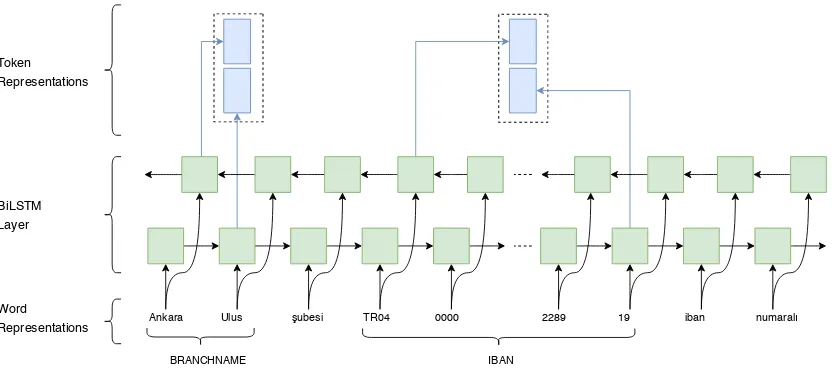
In banking documents, entities are often formed of multiple words (e.g., branch name, IBAN en-tities in Figure 4). Therefore, we need to de-rive the entity representations from multiple word representations. As the overall entity representa-tions, we use the concatenation of forward and backward LSTM outputs at the entity boundaries (right boundary token for the forward pass and left boundary token for the backward pass). Figure4
visualizes our entity representation. Two dotted rectangles on the top represent the embeddings for the two entities branch name and IBAN composed of 2 and more than 4 tokens respectively. The ar-rows coming to the dotted rectangles depict the representations extracted from the entity bound-aries.
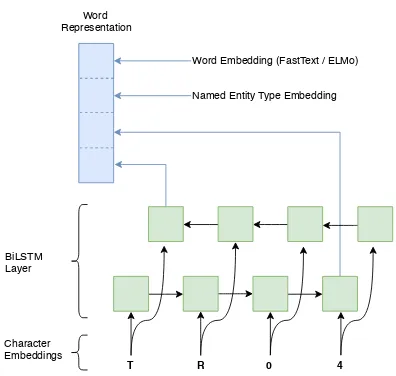
Each word in our model is reprensented as the concatenation of three vectors: pretrained word embeddings, character level word representations, and named entity type embeddings (Figure5). We pre-trained our word-embeddings via both Fast-Text (Bojanowski et al.,2016) and ELMo (Peters et al., 2018) by using a corpus of 626M words collected from banking domain. Using the stan-dard parameters, both models were trained for 10 epochs. FastText embeddings were loaded into a lookup table. To represent out of vocabulary (OOV) words in FastText embeddings we used zero vector with same of the embedding dimen-sion. Our documents contain plenty of numerical values crucial for our task such as account num-bers, amounts, dates etc. Those appear diverse surface forms, yielding to rare occurrence counts.
We used a word transformation algorithm in order to represent them with FastText. The algorithm is used if the number of letters in a word is less than or equal to the half of the word length. It replaces the word with a token specifying the count of let-ters (L), digits (D) and punctuation characlet-ters (O) it contains (see Table 1 for examples). Because ELMo creates word embeddings from characters, we did not need to apply this transformation for ELMo representations. Character level represen-tation of words are also created again by a BiL-STM layer similar to Lample et al.(2016). Both character embeddings and named entity type em-beddings are initialized randomly and learned dur-ing traindur-ing.
Word Token
22/05/2019 <L0D8O2> TR04 <L2D2O0> 10,000 <L0D5O1>
Table 1: Examples of word transformation algorithm
We implemented our models using Tensorflow framework. Number of words in documents and number of characters in words vary for each in-stance. We used mini-batching during training. Each word and character padded to longest ele-ment in the mini-batch with padding tokens so that each instance has the same sized vector. Sim-ilarly, since the number of entities in the docu-ments also varies, we padded the relation matri-ces in the mini-batches with padding entities and
NONE relations. During training, we did not use the padded cells in loss calculation. For optimiza-tion we used Adam (Kingma and Ba,2015) algo-rithm with learnin rate of 1e-3. We used annealing of 0.9 after every epoch. For regularization, we used dropout (0.5) at the BiLSTM inputs and be-fore each hidden layer in MLP.
3.2 Relation Structure
RECEIVER_OF
PROCESS
DETAILS Amount Amount
Currency Currency Expense
SAME DIVISION
SAME DIVISION
SAME DIVISION
Currency
SAME DIVISION
PROCESS DETAILS
SAME DIVISION
SENDER
SENDER_OF
RECEIVER
[image:5.595.85.520.65.215.2]OTHER_DIVISION
Figure 6: An example relational graph containing a transaction.
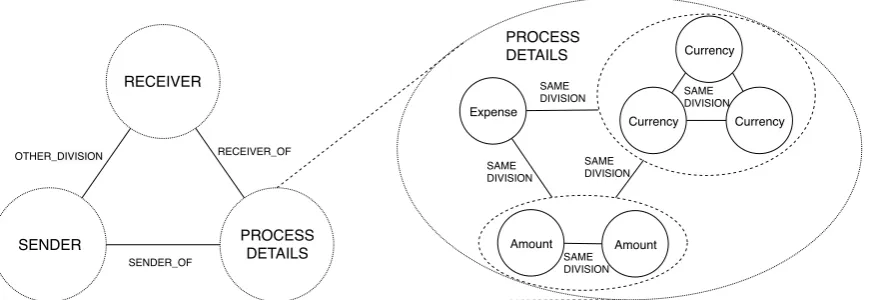
different relation labels (detailed in Table2) in or-der to distinguish the divisions to which the ties belong within a transaction. For instance, enti-ties that are connected withRECEIVER OFrelation are either in receiver or process details divisions. Since possible entity types that reside in sender and process details divisions do not intersect (Fig-ure2), we can distinguish entities of these two di-visions although the relations are undirected. Be-low, we describe our algorithm to decode multi-ple transactions within an order. In Figure6, we provide a visualization for the relations within a single transaction. For simplicity, we provide only the abstract divisions on the left side of the figure and the relations between them meaning that en-tities belonging to these divisions will be related to the entities of the other division with the men-tioned relation types. On the right side of the fig-ure, we zoom into one of the divisions (process de-tails) where entities belonging to a same division are connected to each other withSAME DIVISION
relation type. As explained in the previous sec-tions, named entities occurring within the
docu-Relation Type Description
NONE Entities are not in the same transaction
SAME DIVISION Entities are in the same division OTHER DIVISION One entity is in Sender while other is in the Receiver division RECEIVER OF One entity is in Receiver while other is in the Process Details division
SENDER OF One entity is in Sender while other is in the Process Details division
Table 2: Possible relation types and their description
ments might have been stated multiple times by the author in different places of the document. The figure depicts (with dashed ellipses) a scenario where the same currency is repeated (maybe with slight surface form differences) 3 times within the order and the amount is repeated 2 times. One should keep in mind that this is just a visualization and we actually keep this fully-connected undi-rected graph as a binary relation matrixRN×N
.
3.3 Extracting Transactions
The first step of our decoding algorithm is to de-termine the number of possible transactions. In order to achieve this, the decoding algorithm cre-ates a sub-graph from amount entities. Since the entities of different transactions are expected to be connected withNONErelation type, each maximal clique of this sub-graph can be said to belong to different transactions.3 However mistakes in rela-tion extracrela-tion process complicate this. Missing or extra edges between nodes (i.e., entities in our case) can result in extra cliques, where many of their nodes are shared. Algorithm uses cardinal-ity of maximal cliques to discard possibly wrong ones. It compares cliques to each other and elimi-nates the smaller clique if it has a node that inter-sects with larger clique. If two cliques has same the cardinality while sharing a node, it randomly eliminates one of the cliques. The result of this process is an unconnected set of cliques which are treated as the roots of separate transactions.
Once the transaction root nodes are discovered, i.e the amount slots (the process details division) for each transactions are determined, it becomes
3Although some slots may be shared between
possible to fill the other slots by using the relation graph. In a perfect world, where all relations are extracted correctly, this slot filling is very trivial: each entity value will be written to a slot regard-ing to the relation type of that entity to the root node. Due to the errors propagating from the re-lation extraction stage, we need a decoding algo-rithm to fill out the missing parts of the transac-tions. To fill each slot, our algorithm first looks up all the entities that has matching named entity types and creates a sub-graph from these if they are connected to the amount. For example, if we aim to fill the sender division’s bank name slot for a transaction, we will extract all bank name en-tities connected with SENDER OF relation to the amount entities of that transaction. This time, we select a maximum clique of the entities connected with a SAME DIVISION relation and fill the slots with their values.
Only transactions that contains required slots (sender and receiver division’s account number or IBAN slots, process details division’s amount, and currency slots) are considered as valid transac-tions. In the last step of our decoding algorithm, we pruned the outputs transactions that is not con-taining those required slots.
With the above decoding algorithm, it is possi-ble that re-occuring entities (with exact or different surface forms) are assigned to a single slot. One may use a post-processing stage to select the best entity value for a slot.4
4 Experimental Results
4.1 Dataset
Our dataset contains 3500 Turkish banking docu-ments with a total of 4102 transactions. In order to represent different types of layouts, the dataset is collected such that each document is from a dif-ferent customer.5 The dataset contains 51,396 en-tities and 1.17 transactions per document, 6.7% percent of them contains multiple transactions. On average, there are between 1.18 to 2.23 entities per slot depending on the slot type.
The documents are in image format since they are received via fax, scanner or email channels. They contain misrecognized characters, extra or
4
The post-processing is crucial for our task since the input source of our data is OCR and the data is noisy. For example, we use an IBAN validator at this stage.
5Customers would usually prefer to use their own
docu-ment layout (templates) for their consecutive transaction or-ders yielding documents with similar layouts.
missing characters or spaces, incorrect token se-quences and so on due to noisy images and OCR errors. In our experiments, we randomly selected 600 of these documents (containing 730 transac-tions in total) as our test set and 400 of them as the validation set.
4.2 Experiments and Discussions
Our algorithm predicts a relation type for each en-tity pair in a document. This creates a relation graph which is represented as an N ×N matrix where N is the number of entities. To evaluate relation extraction performance, we used F1 mea-sure. Since the relations are undirected, we used only the upper triangles of relation matrices in our evaluations. Since the cells on the diagonal line of the relation matrix are always expected to contain
SAME DIVISIONrelations, they are excluded from
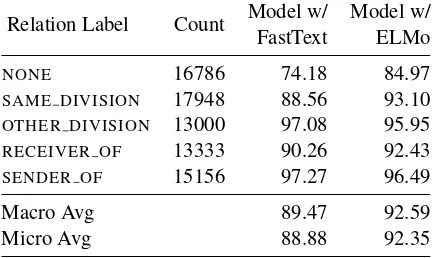
the evaluations. Table 3gives relation extraction scores of our model both with FastText and ELMo embeddings. The dataset contains many rarely oc-curring words due to noisy OCR outputs, espe-cially in numerical tokens and proper nouns. We observe that such rare words are handled better by ELMo.
Relation Label Count Model w/ FastText
Model w/ ELMo
NONE 16786 74.18 84.97
SAME DIVISION 17948 88.56 93.10
OTHER DIVISION 13000 97.08 95.95
RECEIVER OF 13333 90.26 92.43 SENDER OF 15156 97.27 96.49
Macro Avg 89.47 92.59
[image:6.595.309.526.420.549.2]Micro Avg 88.88 92.35
Table 3: F1 scores of binary relation extraction step
similar-Rule Based
Trans. Based
Model w/ FastText
Model w/ ELMo
Sender
P 80.32 87.21 94.61 96.05
R 60.19 72.42 81.13 82.65
F1 68.60 79.10 87.34 88.79
Recei
v
er P 78.49 87.07 91.99 92.45
R 56.33 69.00 81.74 83.39
F1 65.29 76.91 86.47 87.58
Details
P 87.56 91.39 94.63 95.33
R 56.14 69.21 85.35 87.25
F1 68.00 78.56 89.70 91.04
Ov
erall
P 82.86 89.21 93.86 94.59
R 57.32 70.18 83.35 85.10
F1 67.35 78.41 88.22 89.50
Table 4: Slot level entity matching macro average scores grouped by divisions.
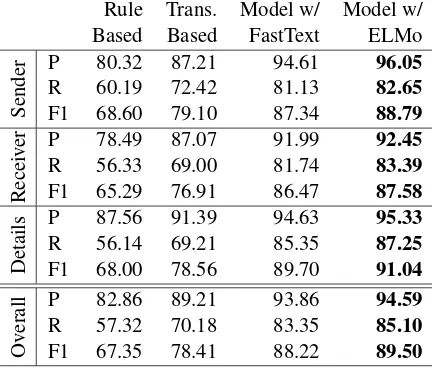
ity score was geometric mean of entity matching scores (F1) between required slots (sender’s and receiver’s account numbers and IBAN, amount, and currency of transaction). We set a rule where predicted transactions could not match with gold transactions if the similarity score was 0, or they were already matched with other predicted trans-actions. Unmatched predicted transactions were counted as wrong, and all of their entities were counted as false positives during slot level evalua-tion. Similarly unmatched gold transactions were counted asmissed, and their entities were counted as false negatives. Table4provides slot level en-tity matching scores grouped by divisions and as overall.
We compare our method with two models: the rule based and the dependency based approaches fromS¸ahin et al.(2018). The rule based method is derived from banking conventions and some basic patterns. It chooses the first seen account entity as sender and remaining ones as receiver. Other enti-ties are set using a similar logic that also considers their proximity to divisions. For instance, it can select the closest currency entity to the amount as its currency.
We also adapted S¸ahin et al. (2018)’s depen-dency parsing method to our data, which resulted in increased number of entity and relation types. Since, our dataset contains more entity types (14 vs 7 inS¸ahin et al.(2018)), during the adaptation, we needed to add more relation types to the ones in the original study. This approach uses a transition based non-projective dependency parsing model (Nivre et al.,2009) to attach account numbers to
the root of a dependency tree as Sender/Receiver, and related entities (name, bank name, etc.) to Sender/Receiver account numbers. Amounts are attached to receivers while currency and other pro-cess details are attached to amounts. This ap-proach makes an assumption that each document can only have one sender. Since, each receiver car-ries all the unique entities of a transaction, multi-ple transactions can easily be constructed.
Rule-based method cannot relate more than one entity with a slot. As a result, it performs marginally worse in recall. To correctly fill a slot, it is enough to find one true entity in the document. However, since we are working on a text coming from an OCR system, entities are often misspelled. Having more than one entity in a slot is advanta-geous for post-processing steps.
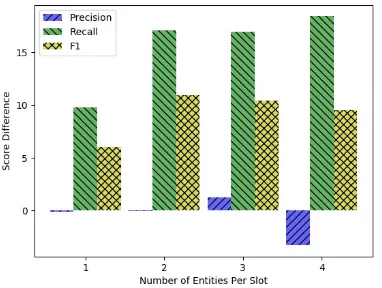
Our model clearly outperforms both the rule-based and the dependency parsing methods. The use of ELMo embeddings gives consistent im-provements in both precision and recall. Although the dependency parsing model achieves satisfac-tory results in precision, its performance in recall is poor. We argue that this is due to the way the dependency trees are constructed in S¸ahin et al.
(2018). Each dependent may be attached to one head, therefore in slots that have multiple true enti-ties (e.g in cases where sender’s name stated mul-tiple times), entities are expected to be attached to each other with a directed dependency relation (called “SAME”) according to their occurrence or-der. Then, the first entity within this order is ex-pected to be attached to its true head. According to our view, this is kind of a unnecessarily strict grammar for the semantic problem in hand. In our investigations over the predicted outputs, we see that the transition based parser struggle to detect correct order forSAME relations, thus degrading its parsing accuracy.
[image:7.595.75.291.64.248.2]Figure 7: Score difference between our model (w/ Fast-Text embeddings) and transition based parser model. Horizontal axis shows number of possible entities for a slot.
learn semantics of pages.
We also counted the number of entity match-ing errors in order to evaluate the quality of pre-dicted and matched transactions. Table5provides these statistics (in the upper block) as well as the numbers of missed and wrong transactions of each model (in the lower block). Unlike in the slot level evaluation, performance of the rule based model is not dramatically worse than the other methods based on the matched transaction counts, but the predicted transactions have lower quality. Rule based model could predict only 14.7% of the trans-actions with no error in any of their slots, while this ratio is much higher in other models. Simi-larly to our slot level evaluations, our models give better performance than the other two methods, while the use of ELMo embeddings provides con-sistent improvements.
5 Conclusion
In this paper, we introduced a method to ex-tract transactions from banking documents. The method uses BiLSTM based deep neural network to predict relations between each entity pairs, and creates a relation graph. From this graph, our de-coding algorithm constructs a series of sub-graphs and applies maximal clique factorization to deter-mine number of transactions and fill their slots. We demonstrated that our method is more accu-rate at predicting transactions and their slots than previously proposed methods. Moreover, It has a higher recall rate on slots with multiple entity can-didates. This allows the use of excess entities in
# Errors Rule Based
Trans. Based
Model w/ Fasttext
Model w/ ELMo
0 74 372 454 490
1 52 43 47 40
2 81 70 52 39
3 62 17 21 13
4 80 4 11 7
5 63 5 9 4
6+ 91 12 4 13
# Matched 503 539 601 606
# Missed 227 191 129 124
[image:8.595.82.273.80.224.2]# Wrong 67 64 27 13
Table 5: Number of entity matching errors in pre-dicted&matched transactions. Number of matched, missed, andwrongtransactions are also given in bot-tom rows.
post-processing steps, which can mitigate the mis-takes of OCR system.
Acknowledgments
This work is supported by The Scientific and Tech-nological Research Council of Turkey with the project no TEYDEB 3180571. We would like to thank our colleagues Mehmet Yasin Akpınar, Cemil Cengiz, Deniz Engin, and Tu˘gba Pamay for their valuable discussions and support.
References
Piotr Bojanowski, Edouard Grave, Armand Joulin, and Tomas Mikolov. 2016. Enriching word vectors with subword information.CoRR, abs/1607.04606.
Hai Leong Chieu and Hwee Tou Ng. 2002. A maximum entropy approach to information extrac-tion from semi-structured and free text. In Eigh-teenth National Conference on Artificial Intelli-gence, pages 786–791, Menlo Park, CA, USA. American Association for Artificial Intelligence.
Nancy A. Chinchor. 1998. Overview of MUC-7. In Seventh Message Understanding Conference (MUC-7): Proceedings of a Conference Held in Fairfax, Virginia, April 29 - May 1, 1998.
Robin Jia, Cliff Wong, and Hoifung Poon. 2019.
Document-level n-ary relation extraction with multiscale representation learning. CoRR, abs/1904.02347.
Guillaume Lample, Miguel Ballesteros, Sandeep Sub-ramanian, Kazuya Kawakami, and Chris Dyer. 2016.
Neural architectures for named entity recognition. InProceedings of the 2016 Conference of the North American Chapter of the Association for Computa-tional Linguistics: Human Language Technologies, pages 260–270, San Diego, California. Association for Computational Linguistics.
David McClosky, Mihai Surdeanu, and Christopher D. Manning. 2011. Event extraction as dependency parsing. InProceedings of the 49th Annual Meet-ing of the Association for Computational LMeet-inguis- Linguis-tics: Human Language Technologies - Volume 1, HLT ’11, pages 1626–1635, Stroudsburg, PA, USA. Association for Computational Linguistics.
Ryan McDonald, Fernando Pereira, Seth Kulick, Scott Winters, Yang Jin, and Pete White. 2005. Simple algorithms for complex relation extraction with ap-plications to biomedical IE. InProceedings of the 43rd Annual Meeting of the Association for Com-putational Linguistics (ACL’05), pages 491–498, Ann Arbor, Michigan. Association for Computa-tional Linguistics.
Joakim Nivre, Marco Kuhlmann, and Johan Hall. 2009.
An improved oracle for dependency parsing with online reordering. In Proceedings of the 11th International Conference on Parsing Technologies (IWPT’09), pages 73–76, Paris, France. Association for Computational Linguistics.
Nanyun Peng, Hoifung Poon, Chris Quirk, Kristina Toutanova, and Wen-tau Yih. 2017. Cross-sentence n-ary relation extraction with graph lstms. Transac-tions of the Association for Computational Linguis-tics, 5:101–115.
Matthew E. Peters, Mark Neumann, Mohit Iyyer, Matt Gardner, Christopher Clark, Kenton Lee, and Luke Zettlemoyer. 2018. Deep contextualized word rep-resentations.CoRR, abs/1802.05365.
R. Sprugnoli and S. Tonelli. 2017. One, no one and one hundred thousand events: Defining and processing events in an inter-disciplinary perspective. Natural Language Engineering, 23(4):485–506.
Shaolei Wang, Yue Zhang, Wanxiang Che, and Ting Liu. 2018. Joint extraction of entities and rela-tions based on a novel graph scheme. In Proceed-ings of the 27th International Joint Conference on Artificial Intelligence, IJCAI’18, pages 4461–4467. AAAI Press.
Michael Wick, Aron Culotta, and Andrew McCal-lum. 2006. Learning field compatibilities to extract database records from unstructured text. In Pro-ceedings of the 2006 Conference on Empirical Meth-ods in Natural Language Processing, pages 603– 611, Sydney, Australia. Association for Computa-tional Linguistics.